SURGICAL INFECTIONS
&
ANTIBIOTICS
SURGICAL INFECTIONS
&
ANTIBIOTICS






Definition
Pathogenesis
Clinical features & investigations (general)
Common pathogens
Common infections
Antibiotics use
Therapeutic
Prophylactic
INFECTION
Invasion of the body by pathogenic
microorganisms and reaction of the
host to organisms and their toxins
SURGICAL INFECTIONS
 A surgical infection is an infection
which requires surgical treatment and
has developed befor, or as a
complication of surgical treatment.
Surgical Infection
 A major challenge
 Accounts for 1/3 of surgical patients
 Increased cost to healthcare
Factors contributing to infections
 Adequate dose of microorganisms
 Virulence of microorganisms
 Suitable environment ( closed space )
 Susceptible host
Pathogenicity of bacteria
Exotoxins: specific, soluble proteins, remote cytotoxic effect
Cl.Tetani, Strep. pyogenes
Endotoxins: part of gram-negative bacterial wall,
lipopolysaccharides e.g., E coli
Resist phagocytosis: Protective capsule
Klebsiela and Strep. pneumoniae
Host Resistance
 Intact skin / mucous membrane.
(surgery/ trauma-break it )
 Immunity:
Cellular (phagocytes )
Antibodies
Prevention of surgical infection
 Patient in best general condition.
(host defense)
 Minimize introduction of pathogens during
surgery.
 Good surgical technique.
 Peri-operative care (support defense)
Clinical features
 Local- pain, heat, redness, swelling, loss of function
(apparent in superficial infections)
 Systemic- fever, tachycardia, chills
 Investigations:
Leukocytosis
Exudates- Gram stain, culture
Blood culture ( chills & fever )
Special investigations ( radiology, biopsy )
Principles of surgical treatment
 Debridement- necrotic, injured tissue
 Drainage- abscess, infected fluid
 Removal- infection source, foreign body
 Supportive measures:
•
•
• immobilization
elevation
antibiotics
STREPTOCOCCI






Gram positive
Flora of the mouth and pharynx, ( bowel )
Streptococcus pyogenes –( β hemolytic) 90% of
infections e.g.,lymphangitis, cellulitis, rheumatic fever
Strep. viridens- endocarditis, urinary infection
Strep. fecalis – urinary infection, pyogenic infection
Strep. pneumonae – pneumonia, meningitis
STREPTOCOCCAL INFECTIONS
Erysipelas






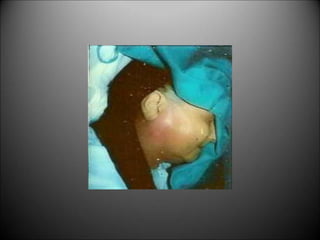
Superficial spreading cellulitis & lymphangitis
Area of redness, sharply defined irregular border
Follows minor skin injuries
Strep pyogenes
Common site: around nose extending to both cheeks
Penicillin, Erythromycin
SREPTOCOCCAL INFECTION
Cellulitis






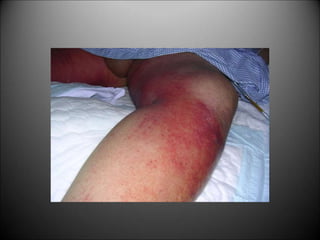
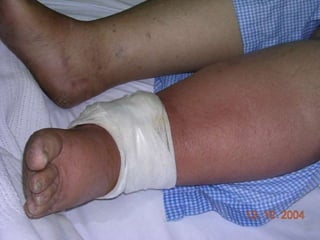
Inflammation of skin & subcutaneous tissue
Non-suppurative
Strep. Pyogenes
Common sites- limbs
Affected area is red, hot & indurated
Treatment : Rest, elevation of affected limb
Penicillin, Erythromycin
Fluocloxacillin ( staph. suspected )
NECROTIZING FASCIITIS


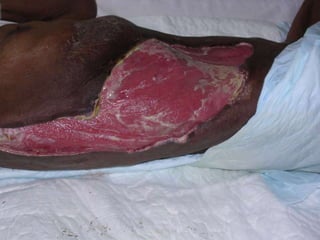
Necrosis of superficial fascia, overlying skin
Polymicrobial
strep, staph, enterococci, bacteroides, enterobacteriaceae
 Sites- abd.wall (Meleny’s),
perineum (Fournier’s),
limbs,
 Usually follows abdominal surgery or trauma
NECROTIZING FASCIITIS
 More in diabetic patient
 Starts as cellulitis, edema, systemic toxicity
 Appears less extensive than actual necrosis
 Treatment:
Debridement , repeated dressings, skin grafting
Broad spectrum antibiotics
ampicillin, clindamycin, aminoglycosides
STAPHYLOCOCCI


Inhabitants of skin, Gram positive
Infection characterized by suppuration
 Staph.aureus- SSI, nosocomial ,superficial infections



Staph. epidermidis- opportunistic ( wound, endocarditis )
Antibiotics: Penicillin, Cephalosporin, Vancomycin
MRSA: Vancomycin
STAPHYLCOCCAL INFECTIONS
 Abscess- localized pus collection
Treatment- drainage, antibiotics
 Furuncle- infection of hair follicle / sweat glands
 Carbuncle- extension of furuncle into subcut. tissue
common in diabetics
common sites- back, back of neck
Treatment: drainage, antibiotics, control diabetes
Surgical site infection (SSI)
 38% of all surgical infections
 Infection within 30 days of operation
 Classification:
Superficial: Superficial SSI–infection in subcutaneous plane (47%)
Deep: Subfascial SSI- muscle plane (23%)
Organ/ space SSI- intra-abdominal, other spaces (30%)


Staph. aureus- most common organism
E coli, Entercoccus ,other Entetobacteriaceae- deep infections
B fragilis – intrabd. abscess
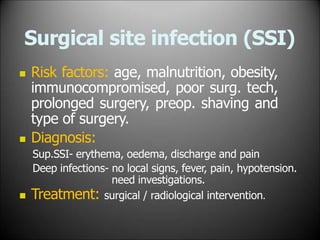
Surgical site infection (SSI)
 Risk factors: age, malnutrition, obesity,
immunocompromised, poor surg. tech,
prolonged surgery, preop. shaving and
type of surgery.
 Diagnosis:
Sup.SSI- erythema, oedema, discharge and pain
Deep infections- no local signs, fever, pain, hypotension.
need investigations.
 Treatment: surgical / radiological intervention.
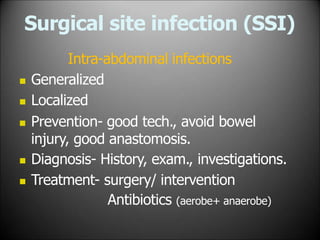
Surgical site infection (SSI)
Intra-abdominal infections
 Generalized
 Localized
 Prevention- good tech., avoid bowel
injury, good anastomosis.
 Diagnosis- History, exam., investigations.
 Treatment- surgery/ intervention
Antibiotics (aerobe+ anaerobe)
GRAM NEGATIVE ORGANISMS
( Enterobactericiae )
Escherichia coli
Facultative anaerobe, Intestinal flora
Produce exotoxin & endotoxin
Endotoxin produce Gram-negative shock
Wound infection, abdominal abscess,
UTI, meningitis, endocarditis
Treatment- ampicillin, cephalosporin, aminoglycoside
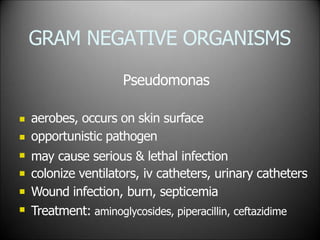
GRAM NEGATIVE ORGANISMS
Pseudomonas






aerobes, occurs on skin surface
opportunistic pathogen
may cause serious & lethal infection
colonize ventilators, iv catheters, urinary catheters
Wound infection, burn, septicemia
Treatment: aminoglycosides, piperacillin, ceftazidime
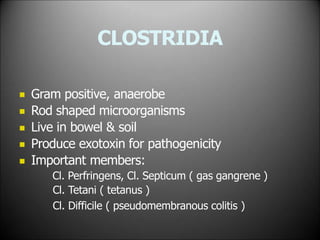
CLOSTRIDIA





Gram positive, anaerobe
Rod shaped microorganisms
Live in bowel & soil
Produce exotoxin for pathogenicity
Important members:
Cl. Perfringens, Cl. Septicum ( gas gangrene )
Cl. Tetani ( tetanus )
Cl. Difficile ( pseudomembranous colitis )
GAS GANGRENE










Cl. Perfringens, Cl. Septicum
Exotoxins: lecithinase, collagenase, hyaluridase
Large wounds of muscle ( contaminated by soil, foreign body )
Rapid myonecrosis, crepitus in subcutaneous tissue
Seropurulent discharge, foul smell, swollen
Toxemia, tachycardia, ill looking
X-ray: gas in muscle and under skin
Penicillin, clindamycin, metronidazole
Wound exposure, debridement , drainage, amputation
Hyperbaric oxygen
TETANUS









Cl. Tetani, produce neurotoxin
Penetrating wound ( rusty nail, thorn )
Usually wound healed when symptoms appear
Incubation period: 7-10 days
Trismus- first symptom, stiffness in neck & back
Anxious look with mouth drawn up ( risus sardonicus)
Respiration & swallowing progressively difficult
Reflex convulsions along with tonic spasm
Death by exhaustion, aspiration or asphyxiation
TETANUS
 Treatment:
wound debridement, penicillin
Muscle relaxants, ventilatory support
Nutritional support
 Prophylaxis:
wound care, antibiotics
Human TIG in high risk ( un-immunized )
Commence active immunization ( T toxoid)
Previously immunized-
booster >10 years needs a booster dose
booster <10 years- no treatment in low risk wounds
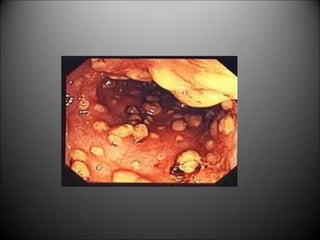
PSEUDOMEMBRANOUS COLITIS






Cl. Difficile
Overtakes normal flora in patients on antibiotics
Watery diarrhea, abdominal pain, fever
Sigmoidoscopy: membrane of exudates (pseudomembranes)
Stool- culture and toxin assay
Treatment :
stop offending antibiotic
oral vancomycin/ metronidazole
rehydration, isolate patient
GRAM NEGATVE ANAEROBES
Bacteroides fragilis







Normal flora in oral cavity, colon
Intra-abdominal & gynecologic infections ( 90% )
Foul smelling pus, gas in surrounding tissue, necrosis
Spiking fever, jaundice, Leukocytosis
No growth on standard culture
Needs anaerobe culture media
Treatment:
Surgical drainage
Antibiotics- clindamycin, metronidazole
ANTIBIOTICS
Chemotherapeutic agents that act on organisms
 Bacteriocidal: Penicillin, Cephalosporin, Vancomycin
Aminoglycosides
 Bacteriostatic: Erythromycin, Clindamycin,
Tetracycline
ANTIBIOTICS




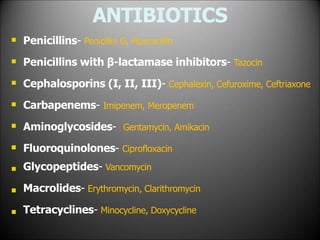
Penicillins- Penicillin G, Piperacillin
Penicillins with β-lactamase inhibitors- Tazocin
Cephalosporins (I, II, III)- Cephalexin, Cefuroxime, Ceftriaxone
Carbapenems- Imipenem, Meropenem
 Aminoglycosides- Gentamycin, Amikacin




Fluoroquinolones- Ciprofloxacin
Glycopeptides- Vancomycin
Macrolides- Erythromycin, Clarithromycin
Tetracyclines- Minocycline, Doxycycline
ROLE OF ANTIBIOTICS
 Therapeutic:
To treat existing infection
 Prophylactic:
To reduce the risk of wound
infection
ANTIBIOTIC THERAPY
( Guideline for surgical infections )
 Pseudomembranous colitis- oral vancomycin/ metronidazole
 Biliary-tract infection- cephalosporin or gentamycin
 Peritonitis- cephalosporin/ gentamycin + metronidazole/ clindamycin



Septicemia- aminoglycoside + ceftazidime, Tazocin or imipenem,
( may add metronidazole )
Septicemia due to vascular catheter- Flucloxacillin/ vancomycin
or Cefuroxime
Cellulitis- penicillin, erythromycin
( flucloxacillin if Staphylococcus infection. Suspected )
ANTIBIOTIC PROPHYLAXIS

Prophylaxis in clean-contaminated/
high risk clean wounds
 Antibiotic is given just before patient
sent for surgery
 Duration of antibiotic is controversial
( one dose- 24 hour regimen )
ANTIBIOTIC PROPHYLAXIS
BASED ON SURGICAL WOUND CLASSIFICATION


A. Clean : CLASS I e.g. surgeries on thyroid gland,
breast, hernia,
• No need for prophylaxis in clean surgeries, except for :
oImmunucompromised patients, e.g. diabetics, patients
using corticosteroids.
oIf the surgery include inserting foreign materials such as
artificial valves.
o High risk patients like those with infective endocarditis.
The risk of postoperative wound infection is around
2%.
ANTIBIOTIC PROPHYLAXIS
 B. Clean/Contaminated (minimal
contamination) : CLASS II
e.g., biliary,urinary, GI tract surgery
 Prophylaxis is advisable, and the risk of
infection is about 5-10%.
ANTIBIOTIC PROPHYLAXIS
 C. Contaminated (gross contamination) :
CLASS III e.g. during bowel surgery
 Prophylaxis is advisable and the risk of infection
is up to 20%.
ANTIBIOTIC PROPHYLAXIS
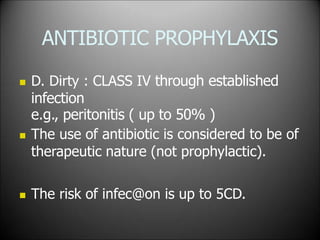
 D. Dirty : CLASS IV through established
infection
e.g., peritonitis ( up to 50% )
 The use of antibiotic is considered to be of
therapeutic nature (not prophylactic).
 The risk of infec@on is up to 5CD.
GHaJ4XcF5llaaR8p826.pptx

GHaJ4XcF5llaaR8p826.pptx

  • 1.
  • 2.
    SURGICAL INFECTIONS & ANTIBIOTICS       Definition Pathogenesis Clinical features& investigations (general) Common pathogens Common infections Antibiotics use Therapeutic Prophylactic
  • 3.
    INFECTION Invasion of thebody by pathogenic microorganisms and reaction of the host to organisms and their toxins
  • 4.
    SURGICAL INFECTIONS  Asurgical infection is an infection which requires surgical treatment and has developed befor, or as a complication of surgical treatment.
  • 5.
    Surgical Infection  Amajor challenge  Accounts for 1/3 of surgical patients  Increased cost to healthcare
  • 6.
    Factors contributing toinfections  Adequate dose of microorganisms  Virulence of microorganisms  Suitable environment ( closed space )  Susceptible host
  • 7.
    Pathogenicity of bacteria Exotoxins:specific, soluble proteins, remote cytotoxic effect Cl.Tetani, Strep. pyogenes Endotoxins: part of gram-negative bacterial wall, lipopolysaccharides e.g., E coli Resist phagocytosis: Protective capsule Klebsiela and Strep. pneumoniae
  • 8.
    Host Resistance  Intactskin / mucous membrane. (surgery/ trauma-break it )  Immunity: Cellular (phagocytes ) Antibodies
  • 9.
    Prevention of surgicalinfection  Patient in best general condition. (host defense)  Minimize introduction of pathogens during surgery.  Good surgical technique.  Peri-operative care (support defense)
  • 10.
    Clinical features  Local-pain, heat, redness, swelling, loss of function (apparent in superficial infections)  Systemic- fever, tachycardia, chills  Investigations: Leukocytosis Exudates- Gram stain, culture Blood culture ( chills & fever ) Special investigations ( radiology, biopsy )
  • 11.
    Principles of surgicaltreatment  Debridement- necrotic, injured tissue  Drainage- abscess, infected fluid  Removal- infection source, foreign body  Supportive measures: • • • immobilization elevation antibiotics
  • 12.
    STREPTOCOCCI       Gram positive Flora ofthe mouth and pharynx, ( bowel ) Streptococcus pyogenes –( β hemolytic) 90% of infections e.g.,lymphangitis, cellulitis, rheumatic fever Strep. viridens- endocarditis, urinary infection Strep. fecalis – urinary infection, pyogenic infection Strep. pneumonae – pneumonia, meningitis
  • 13.
    STREPTOCOCCAL INFECTIONS Erysipelas       Superficial spreadingcellulitis & lymphangitis Area of redness, sharply defined irregular border Follows minor skin injuries Strep pyogenes Common site: around nose extending to both cheeks Penicillin, Erythromycin
  • 15.
    SREPTOCOCCAL INFECTION Cellulitis       Inflammation ofskin & subcutaneous tissue Non-suppurative Strep. Pyogenes Common sites- limbs Affected area is red, hot & indurated Treatment : Rest, elevation of affected limb Penicillin, Erythromycin Fluocloxacillin ( staph. suspected )
  • 17.
    NECROTIZING FASCIITIS   Necrosis ofsuperficial fascia, overlying skin Polymicrobial strep, staph, enterococci, bacteroides, enterobacteriaceae  Sites- abd.wall (Meleny’s), perineum (Fournier’s), limbs,  Usually follows abdominal surgery or trauma
  • 18.
    NECROTIZING FASCIITIS  Morein diabetic patient  Starts as cellulitis, edema, systemic toxicity  Appears less extensive than actual necrosis  Treatment: Debridement , repeated dressings, skin grafting Broad spectrum antibiotics ampicillin, clindamycin, aminoglycosides
  • 20.
    STAPHYLOCOCCI   Inhabitants of skin,Gram positive Infection characterized by suppuration  Staph.aureus- SSI, nosocomial ,superficial infections    Staph. epidermidis- opportunistic ( wound, endocarditis ) Antibiotics: Penicillin, Cephalosporin, Vancomycin MRSA: Vancomycin
  • 21.
    STAPHYLCOCCAL INFECTIONS  Abscess-localized pus collection Treatment- drainage, antibiotics  Furuncle- infection of hair follicle / sweat glands  Carbuncle- extension of furuncle into subcut. tissue common in diabetics common sites- back, back of neck Treatment: drainage, antibiotics, control diabetes
  • 23.
    Surgical site infection(SSI)  38% of all surgical infections  Infection within 30 days of operation  Classification: Superficial: Superficial SSI–infection in subcutaneous plane (47%) Deep: Subfascial SSI- muscle plane (23%) Organ/ space SSI- intra-abdominal, other spaces (30%)   Staph. aureus- most common organism E coli, Entercoccus ,other Entetobacteriaceae- deep infections B fragilis – intrabd. abscess
  • 24.
    Surgical site infection(SSI)  Risk factors: age, malnutrition, obesity, immunocompromised, poor surg. tech, prolonged surgery, preop. shaving and type of surgery.  Diagnosis: Sup.SSI- erythema, oedema, discharge and pain Deep infections- no local signs, fever, pain, hypotension. need investigations.  Treatment: surgical / radiological intervention.
  • 26.
    Surgical site infection(SSI) Intra-abdominal infections  Generalized  Localized  Prevention- good tech., avoid bowel injury, good anastomosis.  Diagnosis- History, exam., investigations.  Treatment- surgery/ intervention Antibiotics (aerobe+ anaerobe)
  • 27.
    GRAM NEGATIVE ORGANISMS (Enterobactericiae ) Escherichia coli Facultative anaerobe, Intestinal flora Produce exotoxin & endotoxin Endotoxin produce Gram-negative shock Wound infection, abdominal abscess, UTI, meningitis, endocarditis Treatment- ampicillin, cephalosporin, aminoglycoside
  • 28.
    GRAM NEGATIVE ORGANISMS Pseudomonas       aerobes,occurs on skin surface opportunistic pathogen may cause serious & lethal infection colonize ventilators, iv catheters, urinary catheters Wound infection, burn, septicemia Treatment: aminoglycosides, piperacillin, ceftazidime
  • 29.
    CLOSTRIDIA      Gram positive, anaerobe Rodshaped microorganisms Live in bowel & soil Produce exotoxin for pathogenicity Important members: Cl. Perfringens, Cl. Septicum ( gas gangrene ) Cl. Tetani ( tetanus ) Cl. Difficile ( pseudomembranous colitis )
  • 30.
    GAS GANGRENE           Cl. Perfringens,Cl. Septicum Exotoxins: lecithinase, collagenase, hyaluridase Large wounds of muscle ( contaminated by soil, foreign body ) Rapid myonecrosis, crepitus in subcutaneous tissue Seropurulent discharge, foul smell, swollen Toxemia, tachycardia, ill looking X-ray: gas in muscle and under skin Penicillin, clindamycin, metronidazole Wound exposure, debridement , drainage, amputation Hyperbaric oxygen
  • 31.
    TETANUS          Cl. Tetani, produceneurotoxin Penetrating wound ( rusty nail, thorn ) Usually wound healed when symptoms appear Incubation period: 7-10 days Trismus- first symptom, stiffness in neck & back Anxious look with mouth drawn up ( risus sardonicus) Respiration & swallowing progressively difficult Reflex convulsions along with tonic spasm Death by exhaustion, aspiration or asphyxiation
  • 32.
    TETANUS  Treatment: wound debridement,penicillin Muscle relaxants, ventilatory support Nutritional support  Prophylaxis: wound care, antibiotics Human TIG in high risk ( un-immunized ) Commence active immunization ( T toxoid) Previously immunized- booster >10 years needs a booster dose booster <10 years- no treatment in low risk wounds
  • 33.
    PSEUDOMEMBRANOUS COLITIS       Cl. Difficile Overtakesnormal flora in patients on antibiotics Watery diarrhea, abdominal pain, fever Sigmoidoscopy: membrane of exudates (pseudomembranes) Stool- culture and toxin assay Treatment : stop offending antibiotic oral vancomycin/ metronidazole rehydration, isolate patient
  • 35.
    GRAM NEGATVE ANAEROBES Bacteroidesfragilis        Normal flora in oral cavity, colon Intra-abdominal & gynecologic infections ( 90% ) Foul smelling pus, gas in surrounding tissue, necrosis Spiking fever, jaundice, Leukocytosis No growth on standard culture Needs anaerobe culture media Treatment: Surgical drainage Antibiotics- clindamycin, metronidazole
  • 36.
    ANTIBIOTICS Chemotherapeutic agents thatact on organisms  Bacteriocidal: Penicillin, Cephalosporin, Vancomycin Aminoglycosides  Bacteriostatic: Erythromycin, Clindamycin, Tetracycline
  • 37.
    ANTIBIOTICS     Penicillins- Penicillin G,Piperacillin Penicillins with β-lactamase inhibitors- Tazocin Cephalosporins (I, II, III)- Cephalexin, Cefuroxime, Ceftriaxone Carbapenems- Imipenem, Meropenem  Aminoglycosides- Gentamycin, Amikacin     Fluoroquinolones- Ciprofloxacin Glycopeptides- Vancomycin Macrolides- Erythromycin, Clarithromycin Tetracyclines- Minocycline, Doxycycline
  • 38.
    ROLE OF ANTIBIOTICS Therapeutic: To treat existing infection  Prophylactic: To reduce the risk of wound infection
  • 39.
    ANTIBIOTIC THERAPY ( Guidelinefor surgical infections )  Pseudomembranous colitis- oral vancomycin/ metronidazole  Biliary-tract infection- cephalosporin or gentamycin  Peritonitis- cephalosporin/ gentamycin + metronidazole/ clindamycin    Septicemia- aminoglycoside + ceftazidime, Tazocin or imipenem, ( may add metronidazole ) Septicemia due to vascular catheter- Flucloxacillin/ vancomycin or Cefuroxime Cellulitis- penicillin, erythromycin ( flucloxacillin if Staphylococcus infection. Suspected )
  • 40.
    ANTIBIOTIC PROPHYLAXIS  Prophylaxis inclean-contaminated/ high risk clean wounds  Antibiotic is given just before patient sent for surgery  Duration of antibiotic is controversial ( one dose- 24 hour regimen )
  • 41.
    ANTIBIOTIC PROPHYLAXIS BASED ONSURGICAL WOUND CLASSIFICATION   A. Clean : CLASS I e.g. surgeries on thyroid gland, breast, hernia, • No need for prophylaxis in clean surgeries, except for : oImmunucompromised patients, e.g. diabetics, patients using corticosteroids. oIf the surgery include inserting foreign materials such as artificial valves. o High risk patients like those with infective endocarditis. The risk of postoperative wound infection is around 2%.
  • 42.
    ANTIBIOTIC PROPHYLAXIS  B.Clean/Contaminated (minimal contamination) : CLASS II e.g., biliary,urinary, GI tract surgery  Prophylaxis is advisable, and the risk of infection is about 5-10%.
  • 43.
    ANTIBIOTIC PROPHYLAXIS  C.Contaminated (gross contamination) : CLASS III e.g. during bowel surgery  Prophylaxis is advisable and the risk of infection is up to 20%.
  • 44.
    ANTIBIOTIC PROPHYLAXIS  D.Dirty : CLASS IV through established infection e.g., peritonitis ( up to 50% )  The use of antibiotic is considered to be of therapeutic nature (not prophylactic).  The risk of infec@on is up to 5CD.