1914-1919 WWI & Russian Revolution
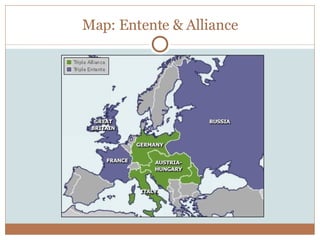
I. Build Up to War National Rivalry and Nationalism Intense rivalries over colonies and trade Triple Alliance and Triple Entente divided Europe into two camps Germany felt that the Entente was an Anti-German coalition Entente formed for fear of increasing German military/industry Growth of nationalism by Slavs in the Balkans and Austria-Hungary Austria felt Serbian nationalism was a threat
I. Build Up to War Russia supported the Serbians Socialist labor movement strikes increased tension Some thought external trouble would help stop internal trouble Increased Militarism Increase in military size and armaments Led to the feeling in other countries to arm faster and more to protect themselves
Map: Entente & Alliance
II. Mobilization to War June 28, 1914- Archduke Francis Ferdinand was assassinated by Gavrilo Princip, a Serbian terrorist in an organization, the Black Hand Germany encouraged Austrian action against Serbia July 23, 1914- Austria delivers an ultimatum to Serbia, which Serbia did not accept July 28, 1914- Austria declares war on Serbia July 30, 1914- Russia orders full mobilization to support Serbia against Austria and Germany
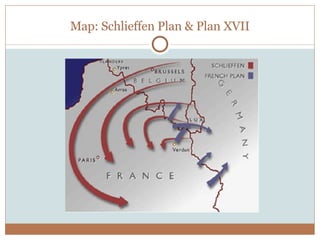
II. Mobilization to War August 1, 1914- Germany declares war on Russia because Russia would not demobilize August 3, 1914- Germany declares war on France General Alfred von Schlieffen devised Schlieffen Plan to deploy most of the troops to France, knock them out before Russia fully mobilized and then redeploy to Russia and take them out
Map: Schlieffen Plan & Plan XVII
II. Mobilization to War Belgium refused Germany entrance to march through to France and Germany invaded, violating Belgian neutrality August 4, 1914- Britain enters the war
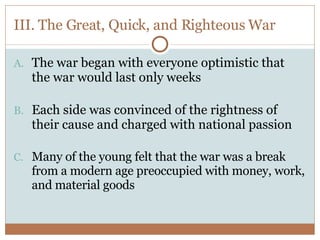
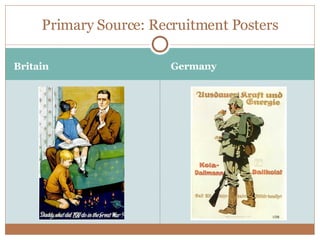
III. The Great, Quick, and Righteous War The war began with everyone optimistic that the war would last only weeks Each side was convinced of the rightness of their cause and charged with national passion Many of the young felt that the war was a break from a modern age preoccupied with money, work, and material goods
Britain Germany Primary Source: Recruitment Posters
The beginning… The reality of war… “ The entire campaign a resounding march of victory- “We’ll be home at Christmas,” the recruits shouted laughingly to their mothers in August of 1914 . . .” - Stefan Zweig,  The World of Yesterday “ The wall of the trench is plastered with smoking splinters, lumps of flesh, and bits of uniform. . . The first recruit seems actually to have gone insane. ” - Erich Remarque,  All Quiet on the Western Front Primary Source: Views of the War
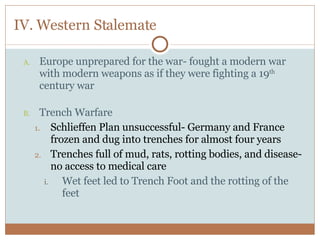
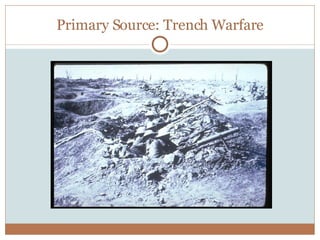
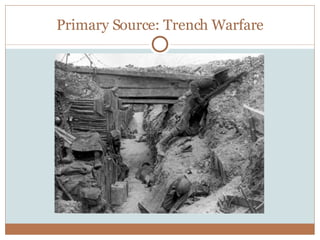
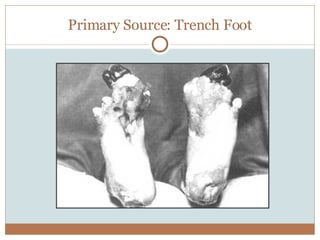
IV. Western Stalemate Europe unprepared for the war- fought a modern war with modern weapons as if they were fighting a 19 th  century war Trench Warfare Schlieffen Plan unsuccessful- Germany and France frozen and dug into trenches for almost four years Trenches full of mud, rats, rotting bodies, and disease- no access to medical care Wet feet led to Trench Foot and the rotting of the feet
Primary Source: Trench Warfare
Primary Source: Trench Foot
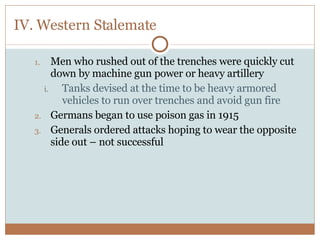
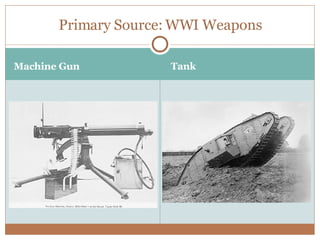
IV. Western Stalemate Men who rushed out of the trenches were quickly cut down by machine gun power or heavy artillery Tanks devised at the time to be heavy armored vehicles to run over trenches and avoid gun fire Germans began to use poison gas in 1915 Generals ordered attacks hoping to wear the opposite side out – not successful
Machine Gun Tank Primary Source: WWI Weapons
IV. Western Stalemate Russia quickly defeated by the Germans Italy betrayed the Triple Alliance by attacking Austria in May, 1915 – promised Austrian land Battle of Verdun, February, 1915- Germany attacked Verdun (France) hoping to devastate France out of the war – causalities were more than a million with 300,000 dead – Britain turned to the offense and pulled Germany out 1917- Russia pulls out of the war due to revolution
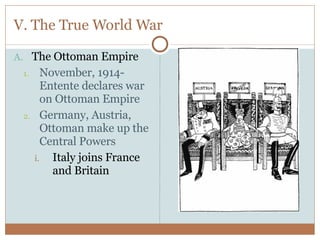
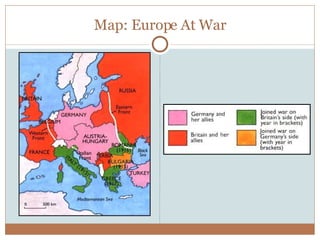
V. The True World War The Ottoman Empire November, 1914- Entente declares war on Ottoman Empire Germany, Austria, Ottoman make up the Central Powers Italy joins France and Britain
Map: Europe At War
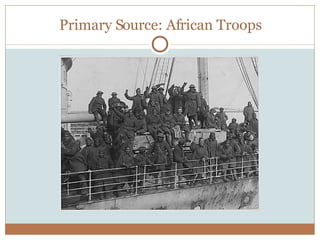
V. The True World War Africa Allied and Central Powers fought in Africa, taking colonies from each other Lawrence of Arabia fought against Ottoman in Middle East in 1917; destroyed the Ottomans by 1918 African troops used on the fields of North Africa and Western Europe; also laborers
Primary Source: African Troops
V. The True World War East Asia Japan joined the Allies in 1914 because they wanted German territory in Asia The U.S. U.S. attempted neutrality 1915- Naval war between Britain and Germany led to Germany sinking the passenger ship Lusitania, on which Americans were boarded – agitated U.S. and Germany stopped submarine warfare
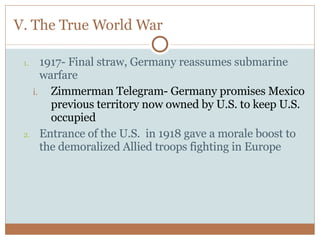
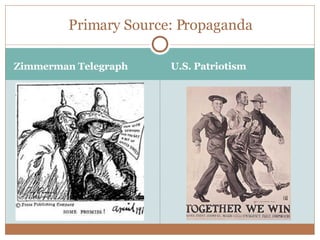
V. The True World War 1917- Final straw, Germany reassumes submarine warfare Zimmerman Telegram- Germany promises Mexico previous territory now owned by U.S. to keep U.S. occupied Entrance of the U.S.  in 1918 gave a morale boost to the demoralized Allied troops fighting in Europe
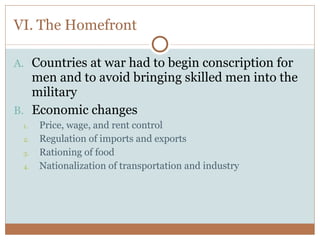
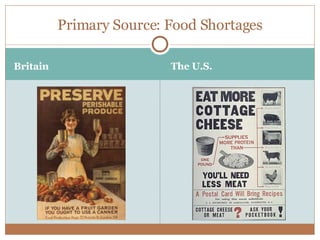
VI. The Homefront Countries at war had to begin conscription for men and to avoid bringing skilled men into the military Economic changes Price, wage, and rent control Regulation of imports and exports Rationing of food Nationalization of transportation and industry
Britain The U.S. Primary Source: Food Shortages
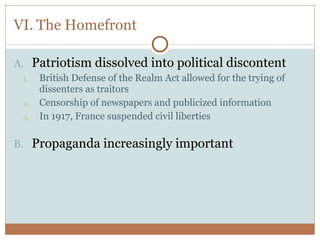
VI. The Homefront Patriotism dissolved into political discontent British Defense of the Realm Act allowed for the trying of dissenters as traitors Censorship of newspapers and publicized information In 1917, France suspended civil liberties Propaganda increasingly important
Zimmerman Telegraph U.S. Patriotism Primary Source: Propaganda
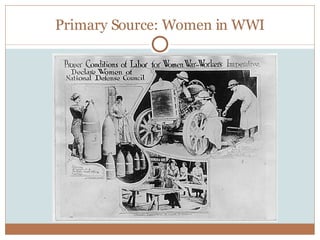
VI. The Homefront As men went away to war, there were more jobs available and unemployment declined Women also entered the workforce in large numbers, working formerly male dominated jobs like truck driving and heavy industry – women demanded equal wages (France made strides to equalize pay) Women’s roles in the workforce seen as temporary – would give up jobs when men returned Led to a new awareness of women in their own independence and livelihood apart from men – led to women in Germany and Austria gaining the right to vote
Primary Source: Women in WWI
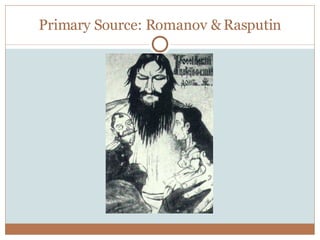
VII. The Russian Revolution Russia was ill-equipped to fight the war and suffered great losses – between 1914-1916 over 6 million casualties - Russia also suffering inflation and hunger Tsarist regime led by Nicholas II pulled away from affairs – a supposed Holy Man named Rasputin became influential to the Tsar, which upset many in Russia – Tsar tried to hold onto autocratic rule
Primary Source: Romanov & Rasputin
VII. The Russian Revolution March, 1917, “Peace and Bread” protests in Petrograd Soldiers meant to disperse crowd joined in Duma assumed responsibility and Tsar abdicated New provisional government decided to carry on war to preserve Russian pride Opposed by soviets who wanted to end the war – soviets largely workers and soldiers
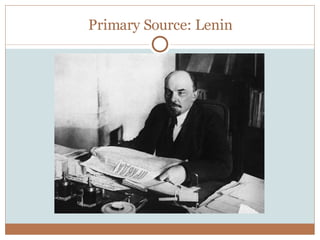
VII. The Russian Revolution The Bolsheviks Marxist Social Democrats led by Vladimir Lenin – dedicated to violent revolution – Lenin was in hiding until the provisional government came to power, then he was secretly shipped back to begin revolution and to seize power Promised: end to war, redistribution of land, transfer of industries to worker councils, and government power to the soviets – gained popularity among the soviet groups
VII. The Russian Revolution Took control of the government on November 6, 1917 with the help of the Petrograd soviets led by Leon Trotsky Lenin the head of the new Council of People’s Commissars - communist
Primary Source: Lenin
VII. The Russian Revolution Civil War in Russia Not everyone was happy with the new communist government and Allies wanted Russia back in the war The Bolshevik Red Army fought anti-Bolshevik forced known as the White Army – White Army defeated Red Army a disciplined unit while White Army was disorganized and not unified – wanted different ends Red secret police, the Red Terror known as the Cheka, stopped any opposition
VII. The Russian Revolution “ War communism” – nationalized banks and industries, grain from peasants, and state centralization Against the foreign invaders of the Japanese, French, British, and American who were stationed in Russia – appealed to Russian patriotism Tsar and his family murdered and burnt down in a mine shaft
VIII. The War Weakens Germany had renewed hope of winning when Russia left the war Second Battle of Marne, July 18, 1918, Germans were defeated and Allies advanced towards Germany September 29, 1918- German leaders begin to call for an armistice and liberal reforms – also wanted to shift blame from military/Kaiser to civilian leadership
VIII. The War Weakens In November, mutinies by the navy and workers and discontent of hungry Germans led to the abdication of Kaiser William II New Socialist republic under Friedrich Ebert November 11, 1918- Germany calls for an armistice – the war is over
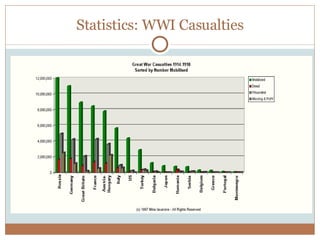
Statistics: WWI Casualties
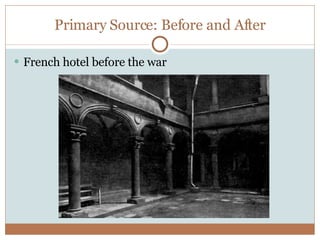
Primary Source: Before and After French hotel before the war
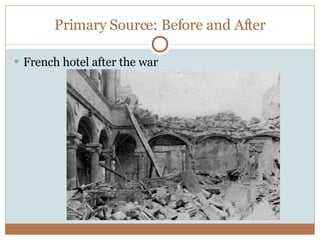
Primary Source: Before and After French hotel after the war
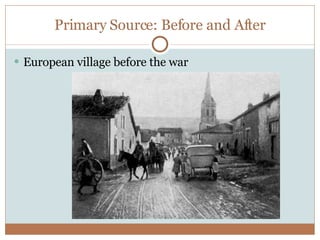
Primary Source: Before and After European village before the war
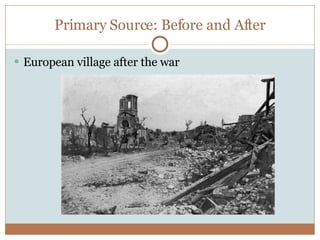
Primary Source: Before and After European village after the war
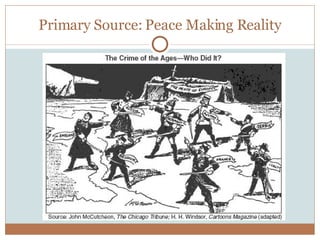
IX. Peace Making and Peace Settlement Paris Peace Conference – January, 1919 Three important men: Woodrow Wilson (U.S.), David Lloyd George (Britain), and Georges Clemenceau (France) [Vittorio Orlando of Italy less important] - no mutual responsibility Wilson wanted the peace settlement to: Open discussion, not secret diplomacy Democracy Freedom of nations and people, eradication of colonies Reduction in arms France (and Britain less so) wanted to punish Germany for the war and make them pay – wanted a demilitarized Germany and German reparations
Primary Source: Peace Making Reality
IX. Peace Making and Peace Settlement League of Nations Purpose Disarmament Collective security Disputes solved by negotiation and diplomacy Weaknesses No military – lacked enforcement power
IX. Peace Making and Peace Settlement Depended on mutual agreement, which was hard to secure from nations all with differing interests Weak and small France felt secure under promise of ‘collective security” but larger countries like Britain did not like the idea of having to protect Europe Enforcement by economic sanction only U.S. did not join - isolationism League became more of an advisory council
IX. Peace Making and Peace Settlement A continuation of “secret diplomacy” Russia and France made agreements behind Britain’s back, feeling Britain had succeeded in the war by using them Austria made secret negotiations with France, no longer willing to depend on Germany – a strain on their relationship
IX. Peace Making and Peace Settlement The Treaty of Versailles, June 28, 1919 Article 231- War Guilt Clause – Germany (and Austria) to blame for the war Germany had to pay reparations Reparation amount never set, leading to disputes over how much Germany should pay – Germany defaulted – Dawes Plan called for U.S. loans and investments
IX. Peace Making and Peace Settlement Germany had to decrease its military size and had demilitarized zones to ‘protect’ neighboring countries Loss territory of Alsace Lorraine back to France and parts of Prussia to Poland
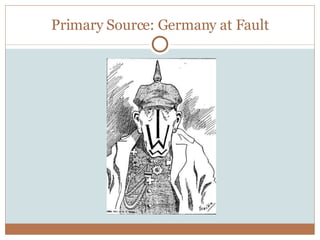
Primary Source: Germany at Fault
IX. Peace Making and Peace Settlement End of Old Empires Austria-Hungary Broken up into states loosely based on ethnicity Germany and Russia lost territory New states such as Finland, Latvia, Yugoslavia, Czechoslovakia Ottoman Empire Promise kept to Arab supporters by breaking up Ottoman Empire Europeans took “mandate” control over old Ottoman lands – suspiciously like colonies

World War I and the Russian Revolution

  • 1.
    1914-1919 WWI &Russian Revolution
  • 2.
    I. Build Upto War National Rivalry and Nationalism Intense rivalries over colonies and trade Triple Alliance and Triple Entente divided Europe into two camps Germany felt that the Entente was an Anti-German coalition Entente formed for fear of increasing German military/industry Growth of nationalism by Slavs in the Balkans and Austria-Hungary Austria felt Serbian nationalism was a threat
  • 3.
    I. Build Upto War Russia supported the Serbians Socialist labor movement strikes increased tension Some thought external trouble would help stop internal trouble Increased Militarism Increase in military size and armaments Led to the feeling in other countries to arm faster and more to protect themselves
  • 4.
  • 5.
    II. Mobilization toWar June 28, 1914- Archduke Francis Ferdinand was assassinated by Gavrilo Princip, a Serbian terrorist in an organization, the Black Hand Germany encouraged Austrian action against Serbia July 23, 1914- Austria delivers an ultimatum to Serbia, which Serbia did not accept July 28, 1914- Austria declares war on Serbia July 30, 1914- Russia orders full mobilization to support Serbia against Austria and Germany
  • 6.
    II. Mobilization toWar August 1, 1914- Germany declares war on Russia because Russia would not demobilize August 3, 1914- Germany declares war on France General Alfred von Schlieffen devised Schlieffen Plan to deploy most of the troops to France, knock them out before Russia fully mobilized and then redeploy to Russia and take them out
  • 7.
  • 8.
    II. Mobilization toWar Belgium refused Germany entrance to march through to France and Germany invaded, violating Belgian neutrality August 4, 1914- Britain enters the war
  • 9.
    III. The Great,Quick, and Righteous War The war began with everyone optimistic that the war would last only weeks Each side was convinced of the rightness of their cause and charged with national passion Many of the young felt that the war was a break from a modern age preoccupied with money, work, and material goods
  • 10.
    Britain Germany PrimarySource: Recruitment Posters
  • 11.
    The beginning… Thereality of war… “ The entire campaign a resounding march of victory- “We’ll be home at Christmas,” the recruits shouted laughingly to their mothers in August of 1914 . . .” - Stefan Zweig, The World of Yesterday “ The wall of the trench is plastered with smoking splinters, lumps of flesh, and bits of uniform. . . The first recruit seems actually to have gone insane. ” - Erich Remarque, All Quiet on the Western Front Primary Source: Views of the War
  • 12.
    IV. Western StalemateEurope unprepared for the war- fought a modern war with modern weapons as if they were fighting a 19 th century war Trench Warfare Schlieffen Plan unsuccessful- Germany and France frozen and dug into trenches for almost four years Trenches full of mud, rats, rotting bodies, and disease- no access to medical care Wet feet led to Trench Foot and the rotting of the feet
  • 13.
  • 14.
  • 15.
  • 16.
    IV. Western StalemateMen who rushed out of the trenches were quickly cut down by machine gun power or heavy artillery Tanks devised at the time to be heavy armored vehicles to run over trenches and avoid gun fire Germans began to use poison gas in 1915 Generals ordered attacks hoping to wear the opposite side out – not successful
  • 17.
    Machine Gun TankPrimary Source: WWI Weapons
  • 18.
    IV. Western StalemateRussia quickly defeated by the Germans Italy betrayed the Triple Alliance by attacking Austria in May, 1915 – promised Austrian land Battle of Verdun, February, 1915- Germany attacked Verdun (France) hoping to devastate France out of the war – causalities were more than a million with 300,000 dead – Britain turned to the offense and pulled Germany out 1917- Russia pulls out of the war due to revolution
  • 19.
    V. The TrueWorld War The Ottoman Empire November, 1914- Entente declares war on Ottoman Empire Germany, Austria, Ottoman make up the Central Powers Italy joins France and Britain
  • 20.
  • 21.
    V. The TrueWorld War Africa Allied and Central Powers fought in Africa, taking colonies from each other Lawrence of Arabia fought against Ottoman in Middle East in 1917; destroyed the Ottomans by 1918 African troops used on the fields of North Africa and Western Europe; also laborers
  • 22.
  • 23.
    V. The TrueWorld War East Asia Japan joined the Allies in 1914 because they wanted German territory in Asia The U.S. U.S. attempted neutrality 1915- Naval war between Britain and Germany led to Germany sinking the passenger ship Lusitania, on which Americans were boarded – agitated U.S. and Germany stopped submarine warfare
  • 24.
    V. The TrueWorld War 1917- Final straw, Germany reassumes submarine warfare Zimmerman Telegram- Germany promises Mexico previous territory now owned by U.S. to keep U.S. occupied Entrance of the U.S. in 1918 gave a morale boost to the demoralized Allied troops fighting in Europe
  • 25.
    VI. The HomefrontCountries at war had to begin conscription for men and to avoid bringing skilled men into the military Economic changes Price, wage, and rent control Regulation of imports and exports Rationing of food Nationalization of transportation and industry
  • 26.
    Britain The U.S.Primary Source: Food Shortages
  • 27.
    VI. The HomefrontPatriotism dissolved into political discontent British Defense of the Realm Act allowed for the trying of dissenters as traitors Censorship of newspapers and publicized information In 1917, France suspended civil liberties Propaganda increasingly important
  • 28.
    Zimmerman Telegraph U.S.Patriotism Primary Source: Propaganda
  • 29.
    VI. The HomefrontAs men went away to war, there were more jobs available and unemployment declined Women also entered the workforce in large numbers, working formerly male dominated jobs like truck driving and heavy industry – women demanded equal wages (France made strides to equalize pay) Women’s roles in the workforce seen as temporary – would give up jobs when men returned Led to a new awareness of women in their own independence and livelihood apart from men – led to women in Germany and Austria gaining the right to vote
  • 30.
  • 31.
    VII. The RussianRevolution Russia was ill-equipped to fight the war and suffered great losses – between 1914-1916 over 6 million casualties - Russia also suffering inflation and hunger Tsarist regime led by Nicholas II pulled away from affairs – a supposed Holy Man named Rasputin became influential to the Tsar, which upset many in Russia – Tsar tried to hold onto autocratic rule
  • 32.
  • 33.
    VII. The RussianRevolution March, 1917, “Peace and Bread” protests in Petrograd Soldiers meant to disperse crowd joined in Duma assumed responsibility and Tsar abdicated New provisional government decided to carry on war to preserve Russian pride Opposed by soviets who wanted to end the war – soviets largely workers and soldiers
  • 34.
    VII. The RussianRevolution The Bolsheviks Marxist Social Democrats led by Vladimir Lenin – dedicated to violent revolution – Lenin was in hiding until the provisional government came to power, then he was secretly shipped back to begin revolution and to seize power Promised: end to war, redistribution of land, transfer of industries to worker councils, and government power to the soviets – gained popularity among the soviet groups
  • 35.
    VII. The RussianRevolution Took control of the government on November 6, 1917 with the help of the Petrograd soviets led by Leon Trotsky Lenin the head of the new Council of People’s Commissars - communist
  • 36.
  • 37.
    VII. The RussianRevolution Civil War in Russia Not everyone was happy with the new communist government and Allies wanted Russia back in the war The Bolshevik Red Army fought anti-Bolshevik forced known as the White Army – White Army defeated Red Army a disciplined unit while White Army was disorganized and not unified – wanted different ends Red secret police, the Red Terror known as the Cheka, stopped any opposition
  • 38.
    VII. The RussianRevolution “ War communism” – nationalized banks and industries, grain from peasants, and state centralization Against the foreign invaders of the Japanese, French, British, and American who were stationed in Russia – appealed to Russian patriotism Tsar and his family murdered and burnt down in a mine shaft
  • 39.
    VIII. The WarWeakens Germany had renewed hope of winning when Russia left the war Second Battle of Marne, July 18, 1918, Germans were defeated and Allies advanced towards Germany September 29, 1918- German leaders begin to call for an armistice and liberal reforms – also wanted to shift blame from military/Kaiser to civilian leadership
  • 40.
    VIII. The WarWeakens In November, mutinies by the navy and workers and discontent of hungry Germans led to the abdication of Kaiser William II New Socialist republic under Friedrich Ebert November 11, 1918- Germany calls for an armistice – the war is over
  • 41.
  • 42.
    Primary Source: Beforeand After French hotel before the war
  • 43.
    Primary Source: Beforeand After French hotel after the war
  • 44.
    Primary Source: Beforeand After European village before the war
  • 45.
    Primary Source: Beforeand After European village after the war
  • 46.
    IX. Peace Makingand Peace Settlement Paris Peace Conference – January, 1919 Three important men: Woodrow Wilson (U.S.), David Lloyd George (Britain), and Georges Clemenceau (France) [Vittorio Orlando of Italy less important] - no mutual responsibility Wilson wanted the peace settlement to: Open discussion, not secret diplomacy Democracy Freedom of nations and people, eradication of colonies Reduction in arms France (and Britain less so) wanted to punish Germany for the war and make them pay – wanted a demilitarized Germany and German reparations
  • 47.
    Primary Source: PeaceMaking Reality
  • 48.
    IX. Peace Makingand Peace Settlement League of Nations Purpose Disarmament Collective security Disputes solved by negotiation and diplomacy Weaknesses No military – lacked enforcement power
  • 49.
    IX. Peace Makingand Peace Settlement Depended on mutual agreement, which was hard to secure from nations all with differing interests Weak and small France felt secure under promise of ‘collective security” but larger countries like Britain did not like the idea of having to protect Europe Enforcement by economic sanction only U.S. did not join - isolationism League became more of an advisory council
  • 50.
    IX. Peace Makingand Peace Settlement A continuation of “secret diplomacy” Russia and France made agreements behind Britain’s back, feeling Britain had succeeded in the war by using them Austria made secret negotiations with France, no longer willing to depend on Germany – a strain on their relationship
  • 51.
    IX. Peace Makingand Peace Settlement The Treaty of Versailles, June 28, 1919 Article 231- War Guilt Clause – Germany (and Austria) to blame for the war Germany had to pay reparations Reparation amount never set, leading to disputes over how much Germany should pay – Germany defaulted – Dawes Plan called for U.S. loans and investments
  • 52.
    IX. Peace Makingand Peace Settlement Germany had to decrease its military size and had demilitarized zones to ‘protect’ neighboring countries Loss territory of Alsace Lorraine back to France and parts of Prussia to Poland
  • 53.
  • 54.
    IX. Peace Makingand Peace Settlement End of Old Empires Austria-Hungary Broken up into states loosely based on ethnicity Germany and Russia lost territory New states such as Finland, Latvia, Yugoslavia, Czechoslovakia Ottoman Empire Promise kept to Arab supporters by breaking up Ottoman Empire Europeans took “mandate” control over old Ottoman lands – suspiciously like colonies