FDR & the New Deal
MAST HS
US HIS – Period 4
Ms. Richardson
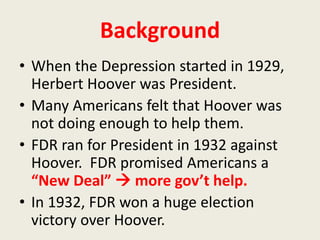
Background
• When the Depression started in 1929,
Herbert Hoover was President.
• Many Americans felt that Hoover was
not doing enough to help them.
• FDR ran for President in 1932 against
Hoover. FDR promised Americans a
“New Deal”  more gov’t help.
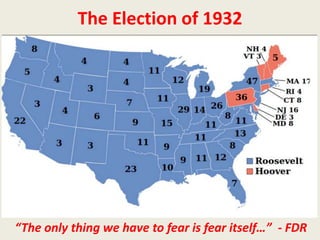
• In 1932, FDR won a huge election
victory over Hoover.
The Election of 1932
“The only thing we have to fear is fear itself…” - FDR
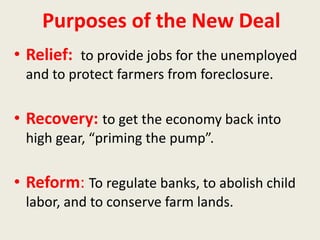
Purposes of the New Deal
• Relief: to provide jobs for the unemployed
and to protect farmers from foreclosure.
• Recovery: to get the economy back into
high gear, “priming the pump”.
• Reform: To regulate banks, to abolish child
labor, and to conserve farm lands.
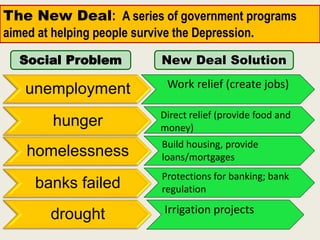
The New Deal: A series of government programs
aimed at helping people survive the Depression.
Social Problem
unemployment
hunger
homelessness
banks failed
New Deal Solution
drought
Work relief (create jobs)
Direct relief (provide food and
money)
Build housing, provide
loans/mortgages
Protections for banking; bank
regulation
Irrigation projects
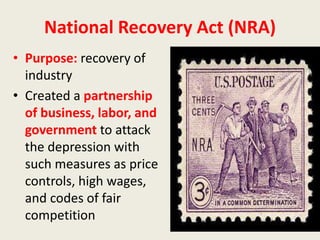
National Recovery Act (NRA)
• Purpose: recovery of
industry
• Created a partnership
of business, labor, and
government to attack
the depression with
such measures as price
controls, high wages,
and codes of fair
competition
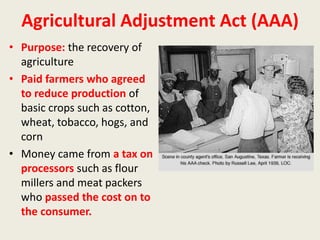
Agricultural Adjustment Act (AAA)
• Purpose: the recovery of
agriculture
• Paid farmers who agreed
to reduce production of
basic crops such as cotton,
wheat, tobacco, hogs, and
corn
• Money came from a tax on
processors such as flour
millers and meat packers
who passed the cost on to
the consumer.
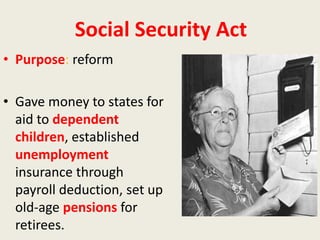
Social Security Act
• Purpose: reform
• Gave money to states for
aid to dependent
children, established
unemployment
insurance through
payroll deduction, set up
old-age pensions for
retirees.
Banking Act / Glass-Steagall Act
• Purpose: reform &
recovery
• Insure bank deposits
against loss in event of a
bank failure.
– Federal Deposit Insurance
Corporation (FDIC)
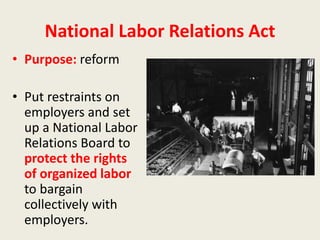
National Labor Relations Act
• Purpose: reform
• Put restraints on
employers and set
up a National Labor
Relations Board to
protect the rights
of organized labor
to bargain
collectively with
employers.
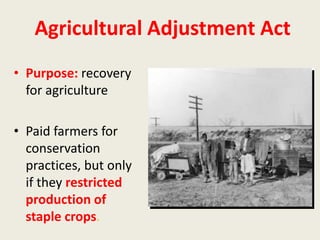
Agricultural Adjustment Act
• Purpose: recovery
for agriculture
• Paid farmers for
conservation
practices, but only
if they restricted
production of
staple crops.
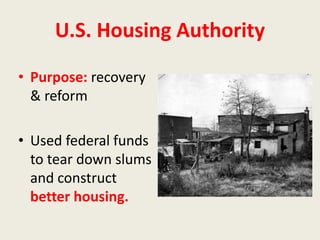
U.S. Housing Authority
• Purpose: recovery
& reform
• Used federal funds
to tear down slums
and construct
better housing.
Criticisms of Radical Opponents
• Radical opponents said the New
Deal did not go far enough.
• They were demagogues (rabble-
rousers) and had popular followings,
so FDR was concerned.
Criticisms of Conservative Opponents
• Conservative opponents said the New Deal went
too far:
– It was socialism (killed individualism)
– It added to the national debt ($35 billion)
– It wasted money on relief and encouraged
idleness
– It violated the constitution & states rights
– It increased the power of the
Presidency (FDR was reaching toward
dictatorship, Congress a rubber stamp,
independence of judiciary threatened, separation
of powers shattered).
Protection of New Deal
Accomplishments
Steps FDR took to protect New Deal
accomplishments (both failed):
– Court-Packing Plan (proposed increasing
Supreme Court from 9 to 15 members, caused
a revolt in Dem. Party).
– Purge of the Democratic Party in the Election
of 1938 (came out strongly in favor of liberal
Dem. candidates. Republicans gained strength
in both houses of Congress).
The Significance of the New Deal
• Physical Rehabilitation of Country
– attacked soil erosion
– built dams and planted trees
• Human Rehabilitation
– social security
– public health
– housing
• Revitalization of Politics
– strengthened executive branch
– increased size and scope of government

The New Deal

  • 1.
    FDR & theNew Deal MAST HS US HIS – Period 4 Ms. Richardson
  • 2.
    Background • When theDepression started in 1929, Herbert Hoover was President. • Many Americans felt that Hoover was not doing enough to help them. • FDR ran for President in 1932 against Hoover. FDR promised Americans a “New Deal”  more gov’t help. • In 1932, FDR won a huge election victory over Hoover.
  • 3.
    The Election of1932 “The only thing we have to fear is fear itself…” - FDR
  • 4.
    Purposes of theNew Deal • Relief: to provide jobs for the unemployed and to protect farmers from foreclosure. • Recovery: to get the economy back into high gear, “priming the pump”. • Reform: To regulate banks, to abolish child labor, and to conserve farm lands.
  • 5.
    The New Deal:A series of government programs aimed at helping people survive the Depression. Social Problem unemployment hunger homelessness banks failed New Deal Solution drought Work relief (create jobs) Direct relief (provide food and money) Build housing, provide loans/mortgages Protections for banking; bank regulation Irrigation projects
  • 6.
    National Recovery Act(NRA) • Purpose: recovery of industry • Created a partnership of business, labor, and government to attack the depression with such measures as price controls, high wages, and codes of fair competition
  • 7.
    Agricultural Adjustment Act(AAA) • Purpose: the recovery of agriculture • Paid farmers who agreed to reduce production of basic crops such as cotton, wheat, tobacco, hogs, and corn • Money came from a tax on processors such as flour millers and meat packers who passed the cost on to the consumer.
  • 8.
    Social Security Act •Purpose: reform • Gave money to states for aid to dependent children, established unemployment insurance through payroll deduction, set up old-age pensions for retirees.
  • 9.
    Banking Act /Glass-Steagall Act • Purpose: reform & recovery • Insure bank deposits against loss in event of a bank failure. – Federal Deposit Insurance Corporation (FDIC)
  • 10.
    National Labor RelationsAct • Purpose: reform • Put restraints on employers and set up a National Labor Relations Board to protect the rights of organized labor to bargain collectively with employers.
  • 11.
    Agricultural Adjustment Act •Purpose: recovery for agriculture • Paid farmers for conservation practices, but only if they restricted production of staple crops.
  • 12.
    U.S. Housing Authority •Purpose: recovery & reform • Used federal funds to tear down slums and construct better housing.
  • 13.
    Criticisms of RadicalOpponents • Radical opponents said the New Deal did not go far enough. • They were demagogues (rabble- rousers) and had popular followings, so FDR was concerned.
  • 14.
    Criticisms of ConservativeOpponents • Conservative opponents said the New Deal went too far: – It was socialism (killed individualism) – It added to the national debt ($35 billion) – It wasted money on relief and encouraged idleness – It violated the constitution & states rights – It increased the power of the Presidency (FDR was reaching toward dictatorship, Congress a rubber stamp, independence of judiciary threatened, separation of powers shattered).
  • 15.
    Protection of NewDeal Accomplishments Steps FDR took to protect New Deal accomplishments (both failed): – Court-Packing Plan (proposed increasing Supreme Court from 9 to 15 members, caused a revolt in Dem. Party). – Purge of the Democratic Party in the Election of 1938 (came out strongly in favor of liberal Dem. candidates. Republicans gained strength in both houses of Congress).
  • 16.
    The Significance ofthe New Deal • Physical Rehabilitation of Country – attacked soil erosion – built dams and planted trees • Human Rehabilitation – social security – public health – housing • Revitalization of Politics – strengthened executive branch – increased size and scope of government

Editor's Notes

  • #3 Hoover thought business should be self-regulating. He was viewed as a “do-nothing president.” “The only thing we have to fear is fear itself….