WWI
GREAT WAR
World War I 1914-1918
Causes of the war
Technology of the war
Military techniques / Battles
War at U.S. “Total War”
US / Russia and the end of the
war
Traditional European
Rules of War
1. A country must declare war before
attacking another country.
2. Each side must wear uniforms or
identify themselves to each other
before attacking. Soldiers wearing an
enemy uniform will be shot as a spy.
Traditional European
Rules of War
3. Commanding officers should not
be targeted
4. Civilians, Surrendering Soldiers
and Medical Personnel will not be
attacked.
Traditional European
Rules of War
5. Hand to Hand combat is
honorable, shooting from a distance
is cowardly
6. Soldiers must be given the
opportunity to surrender honorably.
Long Term Causes
Nationalism-
Deep Devotion to One’s Nation
Competition and Rivalry
developed between European
nations for territory and markets
(Example France and
Germany- Alsace-Lorraine)
Long Term Causes
Militarism-
Glorifying Military Power
Keeping a large standing
army prepared for war
Arms race for military
technology
Long Term Causes
Imperialism-
European competition for
colonies
Quest for colonies often
almost led to war
Imperialism led to rivalry and
mistrust amongst European
nations
Long Term Causes
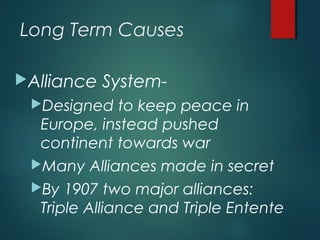
Alliance System-
Designed to keep peace in
Europe, instead pushed
continent towards war
Many Alliances made in secret
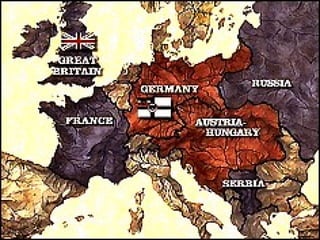
By 1907 two major alliances:
Triple Alliance and Triple Entente
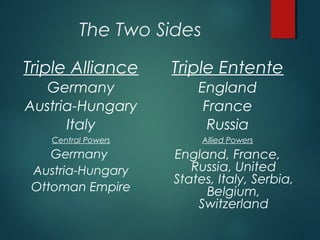
The Two Sides
Triple Alliance
Germany
Austria-Hungary
Italy
Central Powers
Germany
Austria-Hungary
Ottoman Empire
Triple Entente
England
France
Russia
Allied Powers
England, France,
Russia, United
States, Italy, Serbia,
Belgium,
Switzerland
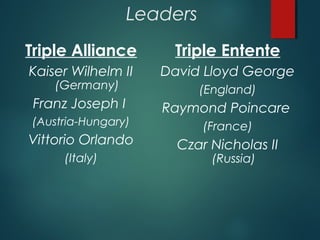
Leaders
Triple Alliance
Kaiser Wilhelm II
(Germany)
Franz Joseph I
(Austria-Hungary)
Vittorio Orlando
(Italy)
Triple Entente
David Lloyd George
(England)
Raymond Poincare
(France)
Czar Nicholas II
(Russia)
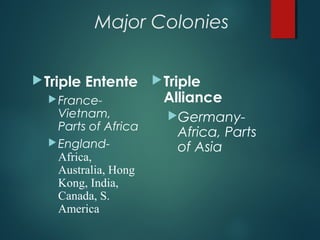
Major Colonies
Triple Entente
France-
Vietnam,
Parts of Africa
England-
Africa,
Australia, Hong
Kong, India,
Canada, S.
America
Triple
Alliance
Germany-
Africa, Parts
of Asia
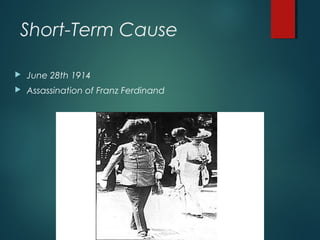
Short-Term Cause
 June 28th 1914
 Assassination of Franz Ferdinand
 July 23rd
Austria Hungary Presents Serbia with an ultimatum
 July 28th
Austria-Hungary declares war on Serbia
 July 29th
Russia Mobilizes its troops
 August 1, 1914 Germany mobilizes troops.
Summer of 1914
Triple Entente/Triple Alliance Actions
 August 2nd
Germany declares war on Russia Germany invades Poland and
Luxemburg, invasion of France starts
 August 3: Germany declares war on France
 August 4: Germany declares war on Belgium and invades it,
 August 4:England declares war on Germany
 August 5: Austria declares war on Russia and Great Britain
Summer of 1914
Triple Entente/Triple Alliance Actions
Who Declared War on
Who?
 Austria-Hungary Declares War on Serbia
 Russia Declares War on Austria Hungary
 Germany Declares War on Russia
 Germany Declares War on France
 England Declares War on Germany and
Austria Hungary
By the end of 1914, not only
Europe was at war, but also
all of Europe’s colonies in
Asia, Africa and South
America.
New Technology
Guns
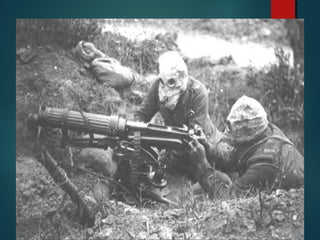
The Machine Gun
It was used by both sides,
hundreds of rounds a minute
could be shot by one person.
The German plan against
France was to rush into the
country as fast as possible:
The Schlieffen Plan
The Machine Gun stopped
this plan
Trench Warfare
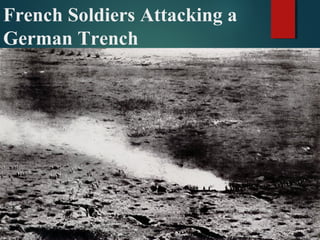
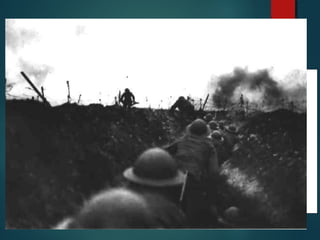
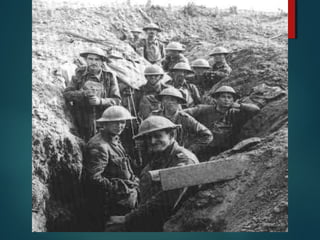
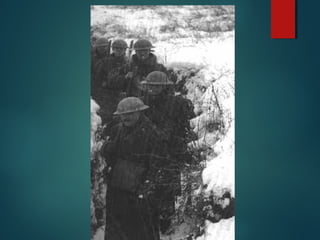
 Both sides dug long trenches that faced each other. The trenches ran for
miles.
 From time to time, one side would attempt to cross the “No-Man’s Land”
the area in between the trenches.
 Trench warfare made WWI extend from a few months of fighting to four
years of fighting
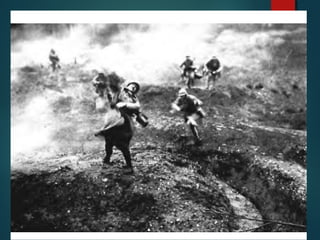
French Soldiers Attacking a
German Trench
Technology:
Chemical Weapons
WWI was the first major war to use
chemical weapons
Mustard Gas and Chlorine Gas were
the two most popular weapons: They
caused suffocation, blindness, and
death
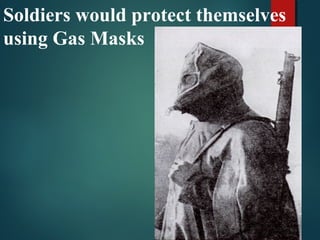
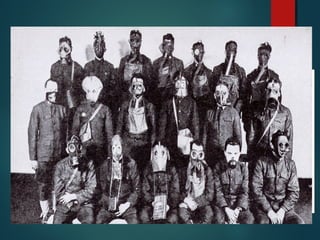
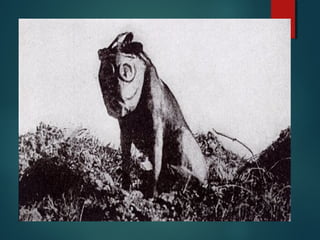
Soldiers would protect themselves
using Gas Masks
Technology:
The U-boat (Submarine)
Germany’s secret weapon during the
war
Sank dozens of British ships,
controlled the oceans.
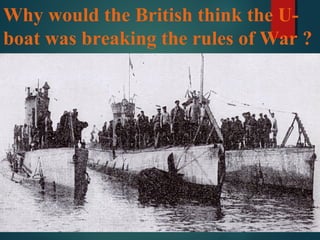
Why would the British think the U-
boat was breaking the rules of War ?
Technology:
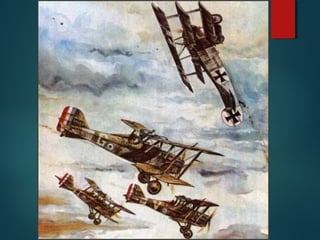
Airpower
 Both sides used aircraft for observation, limited bombing,
and air battles
 Airplanes were slow, clumsy, and unreliable,
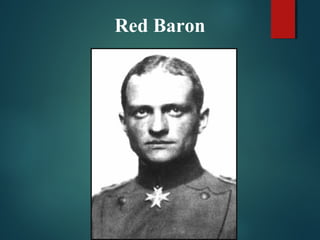
 The most famous German pilot was Baron von Richthofen
(The Red Baron)
Red Baron
Technology:
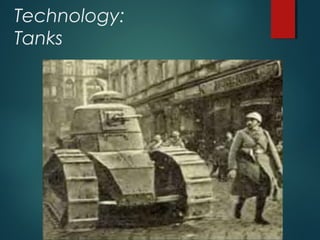
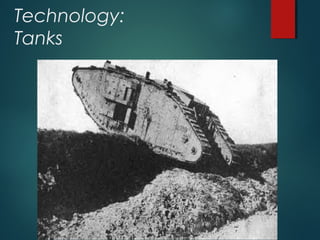
Tanks
Technology:
Tanks
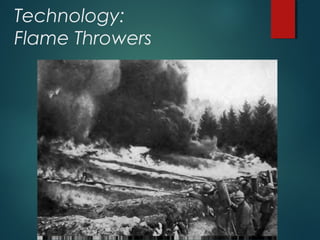
Technology:
Flame Throwers
The Great War
Western Front
 Germans, Austria-Hungarians vs. French, British and later
Americans
 Germany develops the Schlieffen Plan
 Battle of the Marne (1914- German Defeat)
 Trench Warfare on the Western Front
Western Front: Battles
 Battle of Verdun
 Ten months long
 French and German armies.
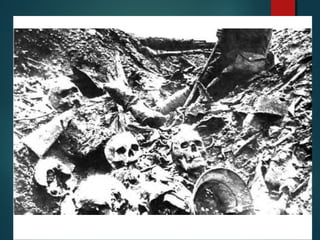
 Estimated 540,000 French and 430,000 German casualties
 No strategic advantages were gained for either side.
 Battle of Somme
 English and French vs Germany
 Six months of fighting
 Five miles of advancement for Allies
 1 million men killed
Eastern Front
 Russians and Serbs vs. Germans and Austria-Hungarians
 War more mobile but still a stalemate
 Russia’s disadvantages
 Not Industrialized
 Short on Supplies
 Russia’s advantage
 People
Eastern Front: Battles
 Battle of Tannenberg:
 August 1914- First major eastern battle.
 Russia was badly defeated and pushed back.
 Russia lost millions of men against Germany, undersupplied,
under gunned
Other Fronts
 Japan, Australia, India join Allies
 Ottoman Turks, Bulgaria join Central Powers
 Gallipoli Campaign in the Ottoman Empire
 Battles occur in Africa and Asia for Colonial Possessions
Russia Exits the War
 In March 1917, Nicholas II abdicates his throne,
 the Russian Duma continues to fight.
 In October 1917: Lenin and the Bolsheviks take command: The Soviet
Union is created.
 March 1918: Soviets and Germans sign the Treaty of Brest-Litovsk,
ending the war in the East.
US claims Neutrality
I didn’t raise my boy to be a soldier
I brought him up to be my pride and joy
Who dares to place a musket on his shoulder,
To shoot some other mother’s darling boy?
US Road to War
 British Blockade
did not allow products to leave or
enter Germany
 German U-Boat Response
counter to blockade, destroy all
boats headed for British shores
US Road to War
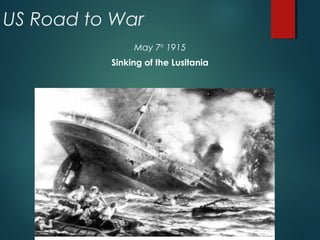
May 7th
1915
Sinking of the Lusitania
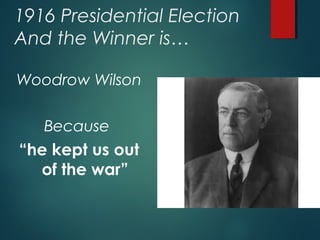
1916 Presidential Election
And the Winner is…
Woodrow Wilson
Because
“he kept us out
of the war”
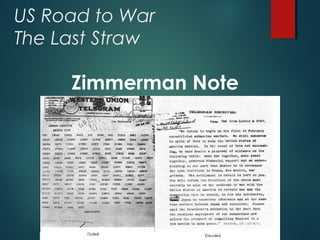
US Road to War
The Last Straw
Zimmerman Note
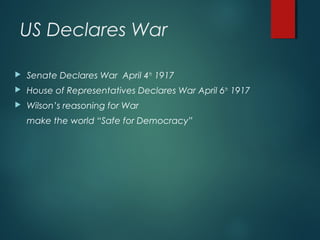
US Declares War
 Senate Declares War April 4th
1917
 House of Representatives Declares War April 6th
1917
 Wilson’s reasoning for War
make the world “Safe for Democracy”
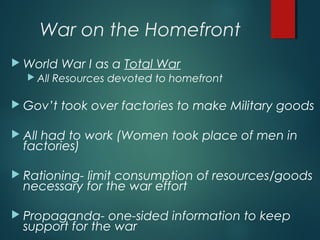
War on the Homefront
 World War I as a Total War
 All Resources devoted to homefront
 Gov’t took over factories to make Military goods
 All had to work (Women took place of men in
factories)
 Rationing- limit consumption of resources/goods
necessary for the war effort
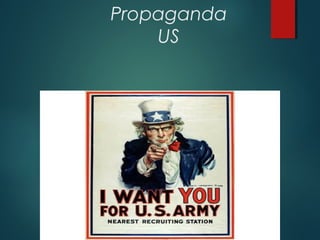
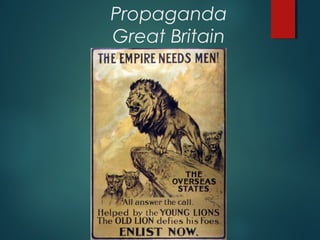
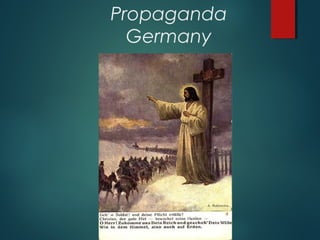
 Propaganda- one-sided information to keep
support for the war
Propaganda
US
Propaganda
Great Britain
Propaganda
Germany
Ending the War 1917-1918
 US Enters the War in April of 1917
 March 1918 Russia and Germany sign the Treaty
of Brest-Litovsk
 Germans now use all resources on Western Front
 March of 1918 Germany begins a massive attack
on France
Ending the War (1918)
The Tide Turns
 German troops fatigued
 US had 140,000 “fresh” troops
 2nd
Battle of the Marne (June 1918)
 Central Powers Crumble
 Revolutions in Austria Hungary
 Ottoman Empire surrenders
 German soldiers mutiny, public turns against Kaiser Wilhelm II
Ending the War (1918)
 Kaiser Wilhelm abdicates on November 9th
1918
 11th
hour of the 11th
day of the 11th
month in 1918
Germany agrees to a cease-fire
 8.5 million soldiers dead
 21 million soldiers wounded
 Cost of 338 billion dollars
Ending the War
The Paris Peace Conference
 Meeting of the “Big Four” at the Paris Peace Conference
 Wilson Proposes his “14 points”
 “Big Four” create Treaty of Versailles
 War Guilt Clause
 Break up of German, Austrian, Russian and Ottoman Empire
 Reparations
 Legacy of bitterness and betrayal
Effects of World War I
 Before World War I feeling of optimism and progress of Human Kind
 After the War feelings of pessimism
 New forms of Art, Literature, Philosophy and Science
 (ex. Surrealism, “Lost” Generation, Psychoanalysis, Existentialism)

World War 1

  • 1.
  • 2.
    World War I1914-1918 Causes of the war Technology of the war Military techniques / Battles War at U.S. “Total War” US / Russia and the end of the war
  • 3.
    Traditional European Rules ofWar 1. A country must declare war before attacking another country. 2. Each side must wear uniforms or identify themselves to each other before attacking. Soldiers wearing an enemy uniform will be shot as a spy.
  • 4.
    Traditional European Rules ofWar 3. Commanding officers should not be targeted 4. Civilians, Surrendering Soldiers and Medical Personnel will not be attacked.
  • 5.
    Traditional European Rules ofWar 5. Hand to Hand combat is honorable, shooting from a distance is cowardly 6. Soldiers must be given the opportunity to surrender honorably.
  • 6.
    Long Term Causes Nationalism- DeepDevotion to One’s Nation Competition and Rivalry developed between European nations for territory and markets (Example France and Germany- Alsace-Lorraine)
  • 7.
    Long Term Causes Militarism- GlorifyingMilitary Power Keeping a large standing army prepared for war Arms race for military technology
  • 8.
    Long Term Causes Imperialism- Europeancompetition for colonies Quest for colonies often almost led to war Imperialism led to rivalry and mistrust amongst European nations
  • 9.
    Long Term Causes AllianceSystem- Designed to keep peace in Europe, instead pushed continent towards war Many Alliances made in secret By 1907 two major alliances: Triple Alliance and Triple Entente
  • 10.
    The Two Sides TripleAlliance Germany Austria-Hungary Italy Central Powers Germany Austria-Hungary Ottoman Empire Triple Entente England France Russia Allied Powers England, France, Russia, United States, Italy, Serbia, Belgium, Switzerland
  • 11.
    Leaders Triple Alliance Kaiser WilhelmII (Germany) Franz Joseph I (Austria-Hungary) Vittorio Orlando (Italy) Triple Entente David Lloyd George (England) Raymond Poincare (France) Czar Nicholas II (Russia)
  • 12.
    Major Colonies Triple Entente France- Vietnam, Partsof Africa England- Africa, Australia, Hong Kong, India, Canada, S. America Triple Alliance Germany- Africa, Parts of Asia
  • 13.
    Short-Term Cause  June28th 1914  Assassination of Franz Ferdinand
  • 14.
     July 23rd AustriaHungary Presents Serbia with an ultimatum  July 28th Austria-Hungary declares war on Serbia  July 29th Russia Mobilizes its troops  August 1, 1914 Germany mobilizes troops. Summer of 1914 Triple Entente/Triple Alliance Actions
  • 15.
     August 2nd Germanydeclares war on Russia Germany invades Poland and Luxemburg, invasion of France starts  August 3: Germany declares war on France  August 4: Germany declares war on Belgium and invades it,  August 4:England declares war on Germany  August 5: Austria declares war on Russia and Great Britain Summer of 1914 Triple Entente/Triple Alliance Actions
  • 16.
    Who Declared Waron Who?  Austria-Hungary Declares War on Serbia  Russia Declares War on Austria Hungary  Germany Declares War on Russia  Germany Declares War on France  England Declares War on Germany and Austria Hungary
  • 18.
    By the endof 1914, not only Europe was at war, but also all of Europe’s colonies in Asia, Africa and South America.
  • 19.
    New Technology Guns The MachineGun It was used by both sides, hundreds of rounds a minute could be shot by one person.
  • 20.
    The German planagainst France was to rush into the country as fast as possible: The Schlieffen Plan The Machine Gun stopped this plan
  • 22.
    Trench Warfare  Bothsides dug long trenches that faced each other. The trenches ran for miles.  From time to time, one side would attempt to cross the “No-Man’s Land” the area in between the trenches.  Trench warfare made WWI extend from a few months of fighting to four years of fighting
  • 23.
  • 29.
    Technology: Chemical Weapons WWI wasthe first major war to use chemical weapons Mustard Gas and Chlorine Gas were the two most popular weapons: They caused suffocation, blindness, and death
  • 30.
    Soldiers would protectthemselves using Gas Masks
  • 33.
    Technology: The U-boat (Submarine) Germany’ssecret weapon during the war Sank dozens of British ships, controlled the oceans.
  • 34.
    Why would theBritish think the U- boat was breaking the rules of War ?
  • 35.
    Technology: Airpower  Both sidesused aircraft for observation, limited bombing, and air battles  Airplanes were slow, clumsy, and unreliable,  The most famous German pilot was Baron von Richthofen (The Red Baron)
  • 36.
  • 38.
  • 39.
  • 40.
  • 41.
    The Great War WesternFront  Germans, Austria-Hungarians vs. French, British and later Americans  Germany develops the Schlieffen Plan  Battle of the Marne (1914- German Defeat)  Trench Warfare on the Western Front
  • 42.
    Western Front: Battles Battle of Verdun  Ten months long  French and German armies.  Estimated 540,000 French and 430,000 German casualties  No strategic advantages were gained for either side.  Battle of Somme  English and French vs Germany  Six months of fighting  Five miles of advancement for Allies  1 million men killed
  • 43.
    Eastern Front  Russiansand Serbs vs. Germans and Austria-Hungarians  War more mobile but still a stalemate  Russia’s disadvantages  Not Industrialized  Short on Supplies  Russia’s advantage  People
  • 44.
    Eastern Front: Battles Battle of Tannenberg:  August 1914- First major eastern battle.  Russia was badly defeated and pushed back.  Russia lost millions of men against Germany, undersupplied, under gunned
  • 45.
    Other Fronts  Japan,Australia, India join Allies  Ottoman Turks, Bulgaria join Central Powers  Gallipoli Campaign in the Ottoman Empire  Battles occur in Africa and Asia for Colonial Possessions
  • 46.
    Russia Exits theWar  In March 1917, Nicholas II abdicates his throne,  the Russian Duma continues to fight.  In October 1917: Lenin and the Bolsheviks take command: The Soviet Union is created.  March 1918: Soviets and Germans sign the Treaty of Brest-Litovsk, ending the war in the East.
  • 47.
    US claims Neutrality Ididn’t raise my boy to be a soldier I brought him up to be my pride and joy Who dares to place a musket on his shoulder, To shoot some other mother’s darling boy?
  • 48.
    US Road toWar  British Blockade did not allow products to leave or enter Germany  German U-Boat Response counter to blockade, destroy all boats headed for British shores
  • 49.
    US Road toWar May 7th 1915 Sinking of the Lusitania
  • 50.
    1916 Presidential Election Andthe Winner is… Woodrow Wilson Because “he kept us out of the war”
  • 51.
    US Road toWar The Last Straw Zimmerman Note
  • 52.
    US Declares War Senate Declares War April 4th 1917  House of Representatives Declares War April 6th 1917  Wilson’s reasoning for War make the world “Safe for Democracy”
  • 53.
    War on theHomefront  World War I as a Total War  All Resources devoted to homefront  Gov’t took over factories to make Military goods  All had to work (Women took place of men in factories)  Rationing- limit consumption of resources/goods necessary for the war effort  Propaganda- one-sided information to keep support for the war
  • 54.
  • 55.
  • 56.
  • 57.
    Ending the War1917-1918  US Enters the War in April of 1917  March 1918 Russia and Germany sign the Treaty of Brest-Litovsk  Germans now use all resources on Western Front  March of 1918 Germany begins a massive attack on France
  • 58.
    Ending the War(1918) The Tide Turns  German troops fatigued  US had 140,000 “fresh” troops  2nd Battle of the Marne (June 1918)  Central Powers Crumble  Revolutions in Austria Hungary  Ottoman Empire surrenders  German soldiers mutiny, public turns against Kaiser Wilhelm II
  • 59.
    Ending the War(1918)  Kaiser Wilhelm abdicates on November 9th 1918  11th hour of the 11th day of the 11th month in 1918 Germany agrees to a cease-fire  8.5 million soldiers dead  21 million soldiers wounded  Cost of 338 billion dollars
  • 60.
    Ending the War TheParis Peace Conference  Meeting of the “Big Four” at the Paris Peace Conference  Wilson Proposes his “14 points”  “Big Four” create Treaty of Versailles  War Guilt Clause  Break up of German, Austrian, Russian and Ottoman Empire  Reparations  Legacy of bitterness and betrayal
  • 61.
    Effects of WorldWar I  Before World War I feeling of optimism and progress of Human Kind  After the War feelings of pessimism  New forms of Art, Literature, Philosophy and Science  (ex. Surrealism, “Lost” Generation, Psychoanalysis, Existentialism)