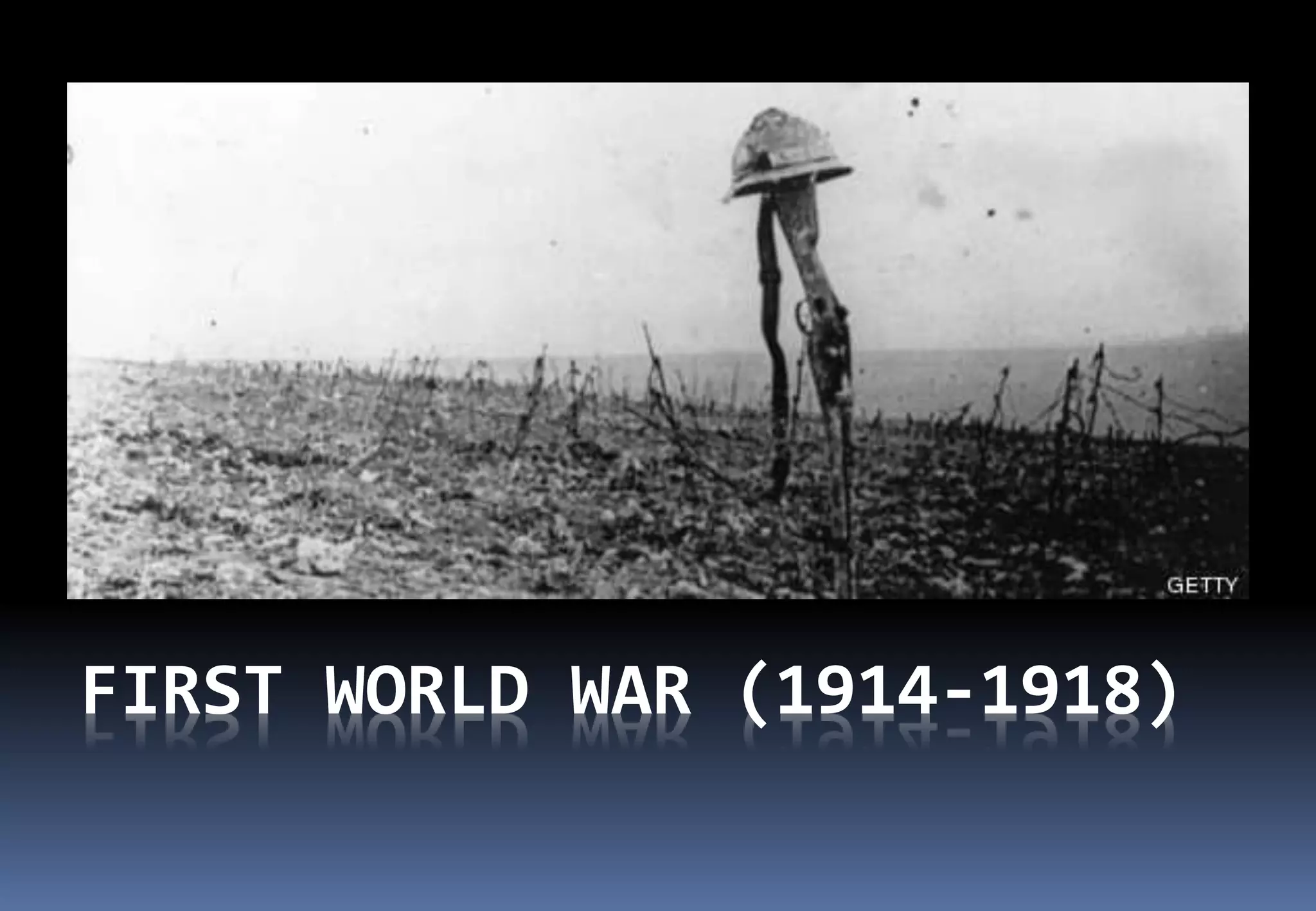
FIRST WORLD WAR (1914-1918)
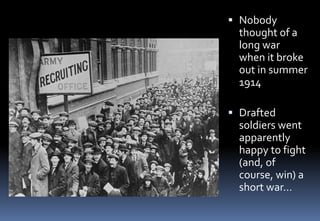
 Nobody
thought of a
long war
when it broke
out in summer
1914
 Drafted
soldiers went
apparently
happy to fight
(and, of
course, win) a
short war…
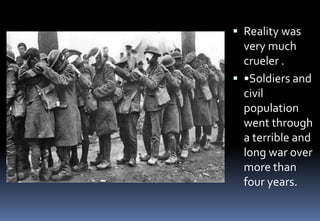
 Reality was
very much
crueler .
 •Soldiers and
civil
population
went through
a terrible and
long war over
more than
four years.
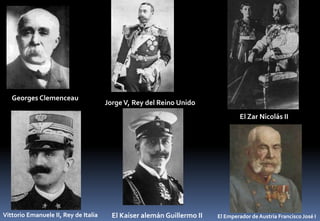
Georges Clemenceau
JorgeV, Rey del Reino Unido
El Zar Nicolás II
Vittorio Emanuele II, Rey de Italia El Emperador de Austria Francisco José IEl Kaiser alemán Guillermo II
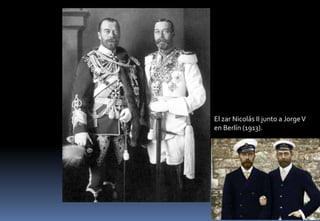
El zar Nicolás II junto a JorgeV
en Berlín (1913).
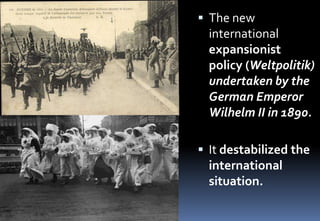
 The new
international
expansionist
policy (Weltpolitik)
undertaken by the
German Emperor
Wilhelm II in 1890.
 It destabilized the
international
situation.
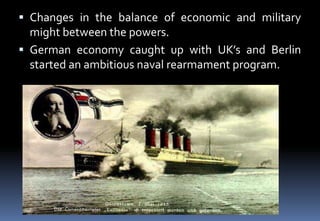
 Changes in the balance of economic and military
might between the powers.
 German economy caught up with UK’s and Berlin
started an ambitious naval rearmament program.
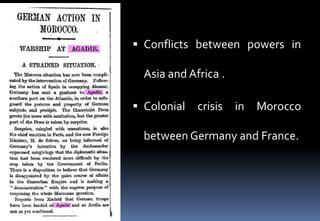
 Conflicts between powers in
Asia and Africa .
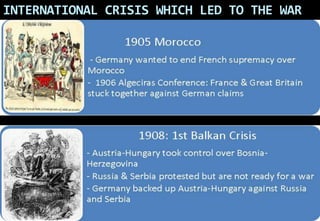
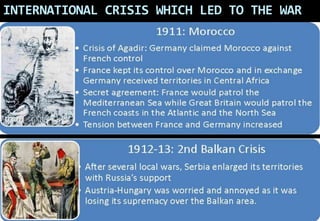
 Colonial crisis in Morocco
between Germany and France.
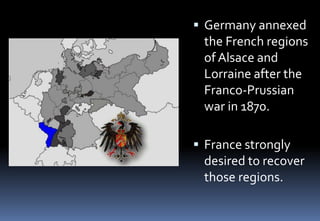
 Germany annexed
the French regions
of Alsace and
Lorraine after the
Franco-Prussian
war in 1870.
 France strongly
desired to recover
those regions.
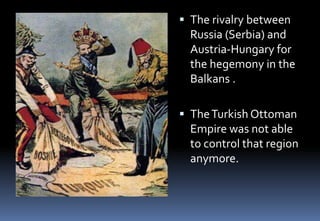
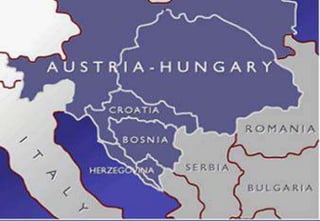
 The rivalry between
Russia (Serbia) and
Austria-Hungary for
the hegemony in the
Balkans .
 TheTurkish Ottoman
Empire was not able
to control that region
anymore.
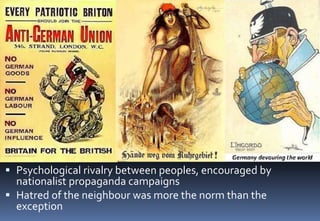
 Psychological rivalry between peoples, encouraged by
nationalist propaganda campaigns
 Hatred of the neighbour was more the norm than the
exception
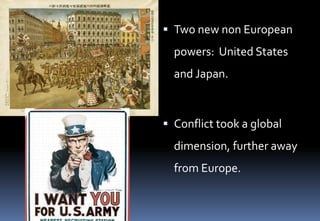
 Two new non European
powers: United States
and Japan.
 Conflict took a global
dimension, further away
from Europe.
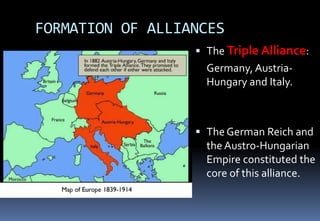
FORMATION OF ALLIANCES
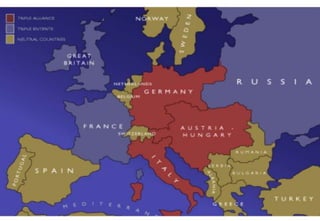
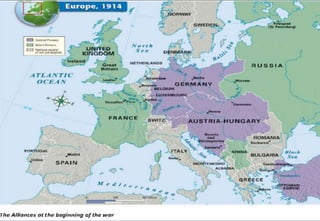
 The Triple Alliance:
Germany, Austria-
Hungary and Italy.
 The German Reich and
the Austro-Hungarian
Empire constituted the
core of this alliance.
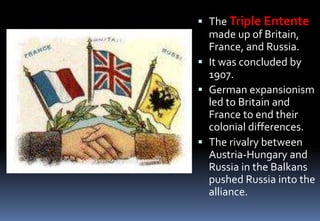
 The Triple Entente
made up of Britain,
France, and Russia.
 It was concluded by
1907.
 German expansionism
led to Britain and
France to end their
colonial differences.
 The rivalry between
Austria-Hungary and
Russia in the Balkans
pushed Russia into the
alliance.
INTERNATIONAL CRISIS WHICH LED TO THE WAR
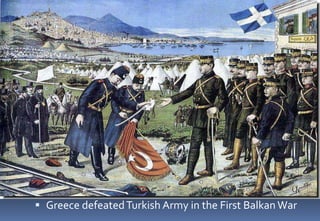
 Greece defeatedTurkish Army in the First Balkan War
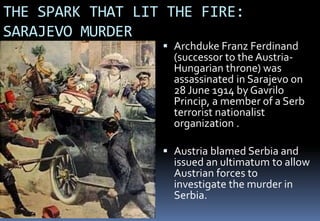
THE SPARK THAT LIT THE FIRE:
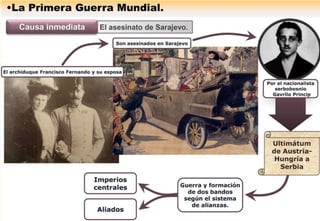
SARAJEVO MURDER
 Archduke Franz Ferdinand
(successor to the Austria-
Hungarian throne) was
assassinated in Sarajevo on
28 June 1914 by Gavrilo
Princip, a member of a Serb
terrorist nationalist
organization .
 Austria blamed Serbia and
issued an ultimatum to allow
Austrian forces to
investigate the murder in
Serbia.
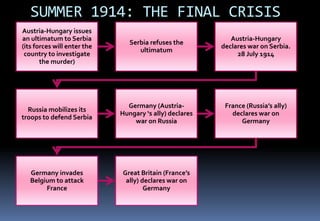
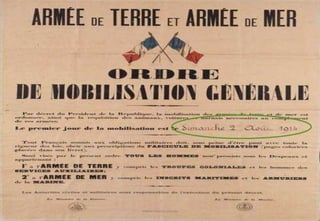
SUMMER 1914: THE FINAL CRISIS
Austria-Hungary issues
an ultimatum to Serbia
(its forces will enter the
country to investigate
the murder)
Serbia refuses the
ultimatum
Austria-Hungary
declares war on Serbia.
28 July 1914
Russia mobilizes its
troops to defend Serbia
Germany (Austria-
Hungary ‘s ally) declares
war on Russia
France (Russia’s ally)
declares war on
Germany
Germany invades
Belgium to attack
France
Great Britain (France’s
ally) declares war on
Germany
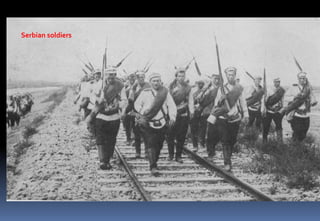
Serbian soldiers
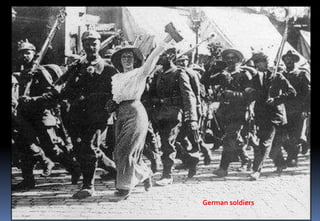
German soldiers
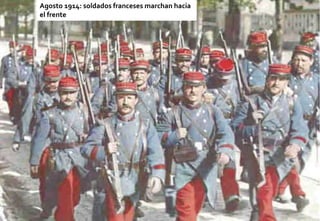
Agosto 1914: soldados franceses marchan hacia
el frente
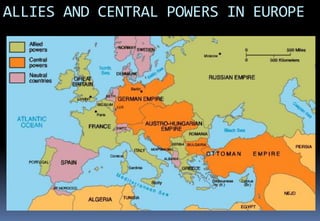
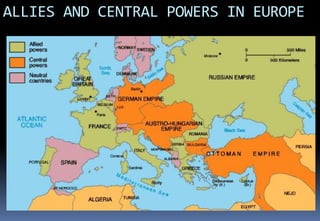
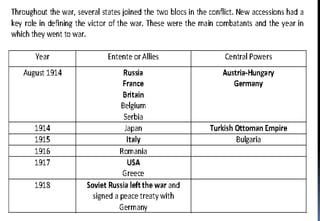
ALLIES AND CENTRAL POWERS IN EUROPE
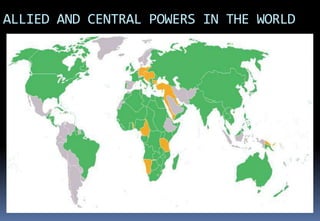
ITS EXTENT
 The high number of combatant countries, the vast
geographical extent justify the name "Great War" or
"WorldWar".
 Although it started in Europe, with the involvement
of Austro-Hungary and Serbia, the game of military
alliances dragged into the war to a growing number
of powers.
 Some countries at war (UK, France, etc.) were
holders of vast colonial empires put their respective
domains at war, which in practice the five continents
were involved in hostilities.
ALLIED AND CENTRAL POWERS IN THE WORLD
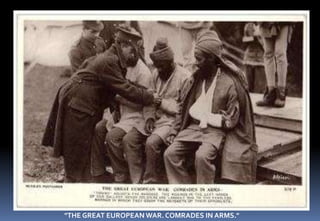
"THE GREAT EUROPEAN WAR. COMRADES IN ARMS."
ITS LENGTH
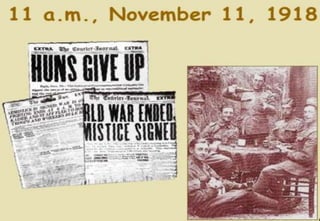
 Since Austria-Hungary declares war on Serbia on July
28, 1914 until Germany signed the armistice on 11
November 1918.
 A war that surpassed in duration to those who had
taken place during the 18th and 19th centuries.
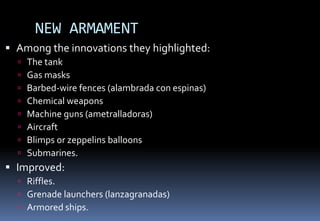
NEW ARMAMENT
 Among the innovations they highlighted:
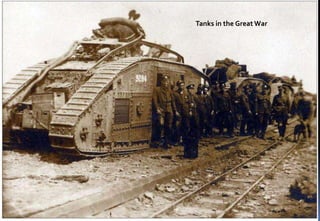
 The tank
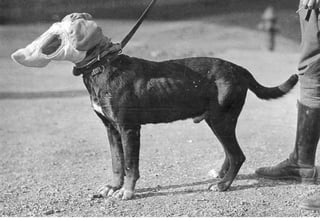
 Gas masks
 Barbed-wire fences (alambrada con espinas)
 Chemical weapons
 Machine guns (ametralladoras)
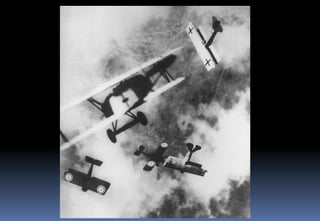
 Aircraft
 Blimps or zeppelins balloons
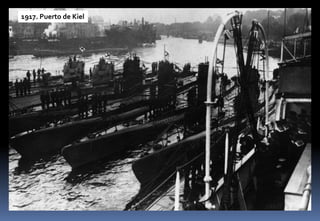
 Submarines.
 Improved:
 Riffles.
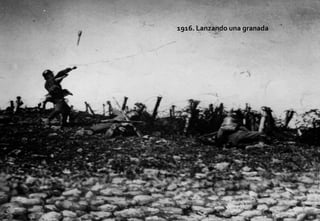
 Grenade launchers (lanzagranadas)
 Armored ships.
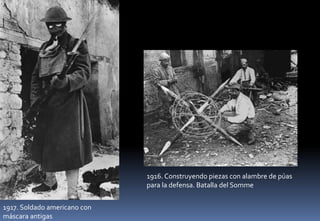
1917. Soldado americano con
máscara antigas
1916. Construyendo piezas con alambre de púas
para la defensa. Batalla del Somme
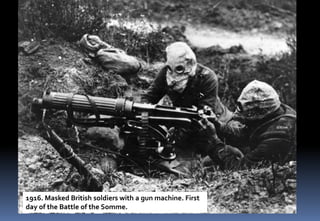
1916. Masked British soldiers with a gun machine. First
day of the Battle of the Somme.
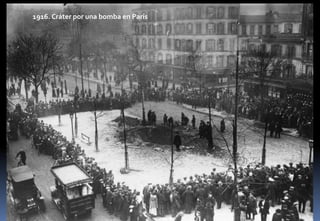
1916. Cráter por una bomba en París
1917. Puerto de Kiel
1916. Lanzando una granada
Tanks in the Great War
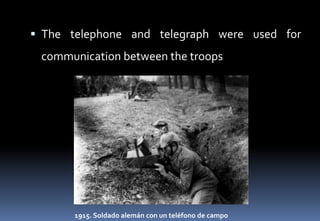
 The telephone and telegraph were used for
communication between the troops
1915. Soldado alemán con un teléfono de campo
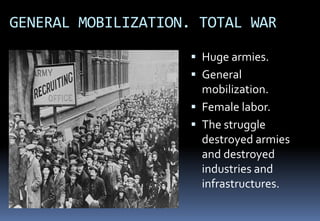
GENERAL MOBILIZATION. TOTAL WAR
 Huge armies.
 General
mobilization.
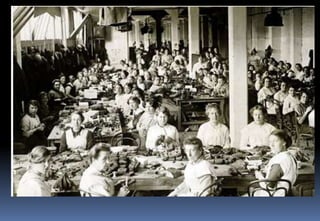
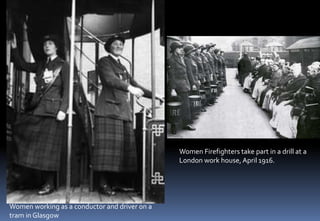
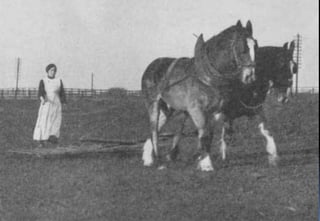
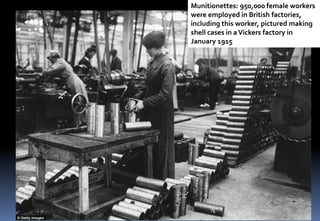
 Female labor.
 The struggle
destroyed armies
and destroyed
industries and
infrastructures.
Women working as a conductor and driver on a
tram in Glasgow
Women Firefighters take part in a drill at a
London work house, April 1916.
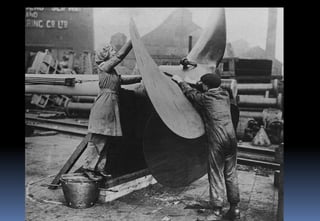
Munitionettes: 950,000 female workers
were employed in British factories,
including this worker, pictured making
shell cases in aVickers factory in
January 1915
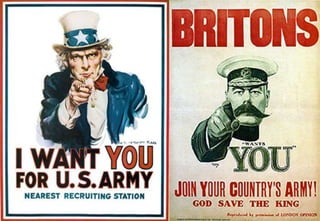
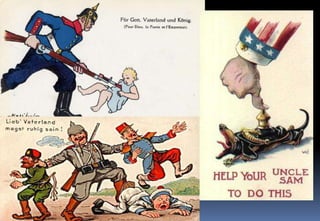
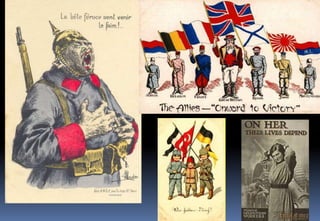
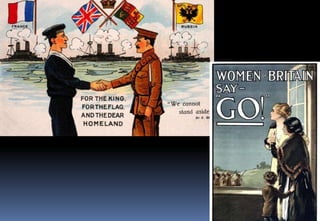
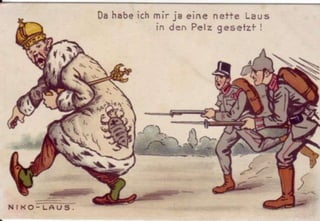
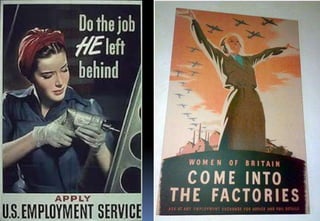
PROPAGANDA
 The outbreak of war was favored by an environment
of international rivalry.
 Use of propaganda by both sides.
 The duration, extent and harshness of the conflict
weakened the morale of both the combatants and
the rear, so campaigns in journals, radio and posters
were used.
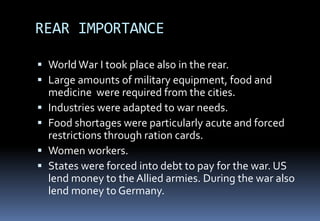
REAR IMPORTANCE
 World War I took place also in the rear.
 Large amounts of military equipment, food and
medicine were required from the cities.
 Industries were adapted to war needs.
 Food shortages were particularly acute and forced
restrictions through ration cards.
 Women workers.
 States were forced into debt to pay for the war. US
lend money to the Allied armies. During the war also
lend money to Germany.
ALLIES AND CENTRAL POWERS IN EUROPE
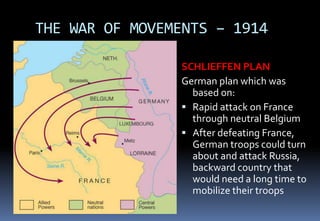
THE WAR OF MOVEMENTS – 1914
SCHLIEFFEN PLAN
German plan which was
based on:
 Rapid attack on France
through neutral Belgium
 After defeating France,
German troops could turn
about and attack Russia,
backward country that
would need a long time to
mobilize their troops
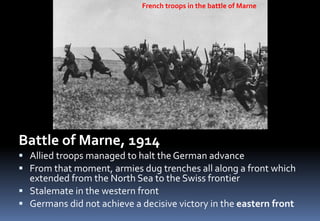
Battle of Marne, 1914
 Allied troops managed to halt the German advance
 From that moment, armies dug trenches all along a front which
extended from the North Sea to the Swiss frontier
 Stalemate in the western front
 Germans did not achieve a decisive victory in the eastern front
French troops in the battle of Marne
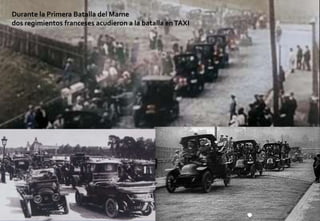
Durante la Primera Batalla del Marne
dos regimientos franceses acudieron a la batalla enTAXI
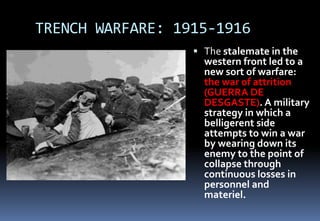
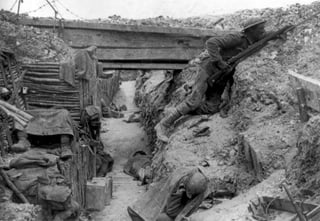
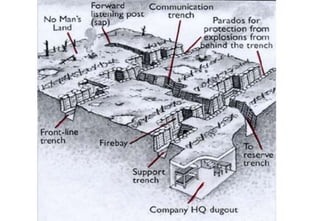
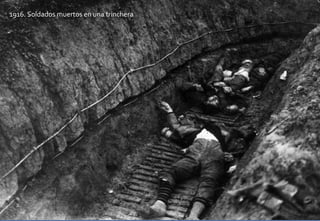
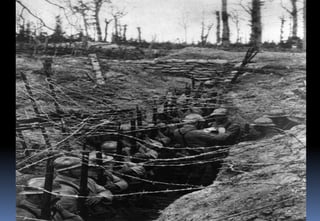
TRENCH WARFARE: 1915-1916
 The stalemate in the
western front led to a
new sort of warfare:
the war of attrition
(GUERRA DE
DESGASTE). A military
strategy in which a
belligerent side
attempts to win a war
by wearing down its
enemy to the point of
collapse through
continuous losses in
personnel and
materiel.
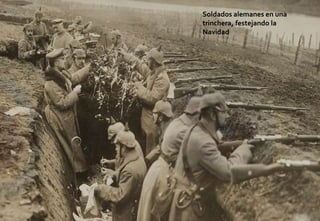
Soldados alemanes en una
trinchera, festejando la
Navidad
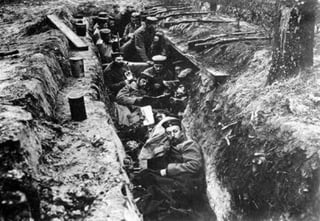
1916. Soldados leyendo un periódico en
una trinchera
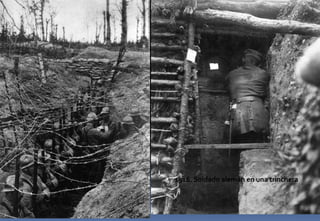
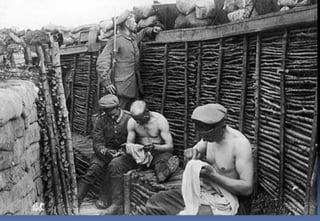
1916. Soldado alemán en una trinchera
1916. Soldados muertos en una trinchera
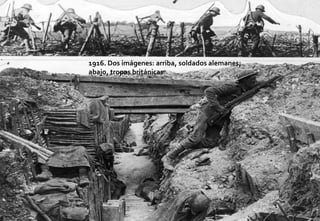
1916. Dos imágenes: arriba, soldados alemanes;
abajo, tropas británicas
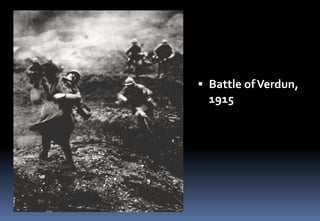
 Battle ofVerdun,
1915
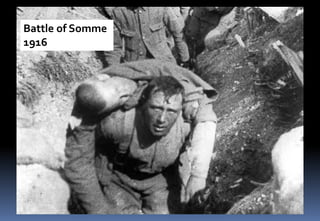
Battle of Somme
1916
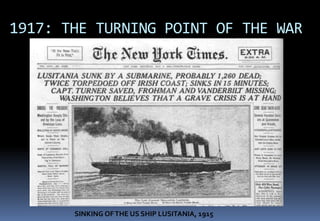
1917: THE TURNING POINT OF THE WAR
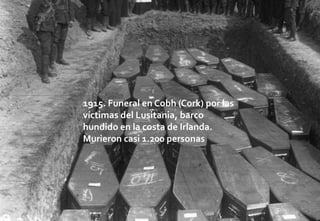
SINKING OFTHE US SHIP LUSITANIA, 1915
1915. Funeral en Cobh (Cork) por las
víctimas del Lusitania, barco
hundido en la costa de Irlanda.
Murieron casi 1.200 personas
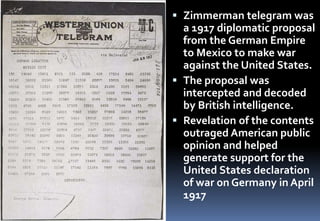
 Zimmerman telegram was
a 1917 diplomatic proposal
from the German Empire
to Mexico to make war
against the United States.
 The proposal was
intercepted and decoded
by British intelligence.
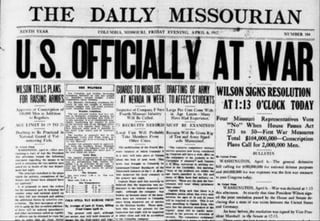
 Revelation of the contents
outraged American public
opinion and helped
generate support for the
United States declaration
of war on Germany in April
1917
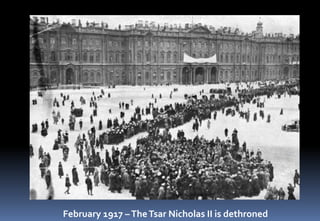
February 1917 –TheTsar Nicholas II is dethroned
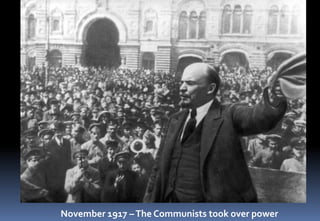
November 1917 –The Communists took over power
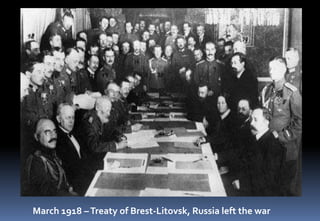
March 1918 –Treaty of Brest-Litovsk, Russia left the war
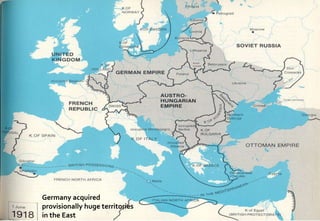
Germany acquired
provisionally huge territories
in the East
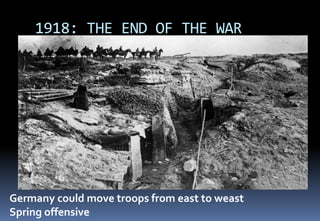
1918: THE END OF THE WAR
Germany could move troops from east to weast
Spring offensive
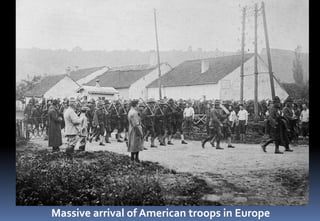
Massive arrival of American troops in Europe
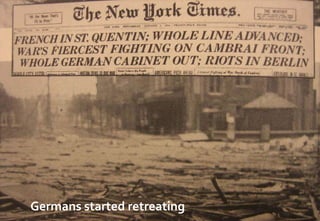
Germans started retreating
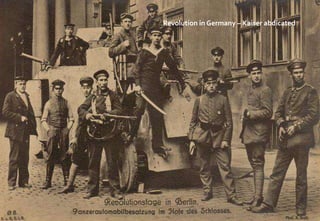
Revolution in Germany – Kaiser abdicated
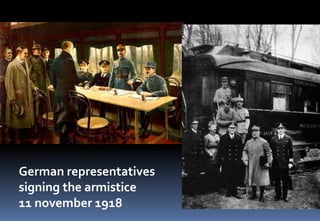
German representatives
signing the armistice
11 november 1918
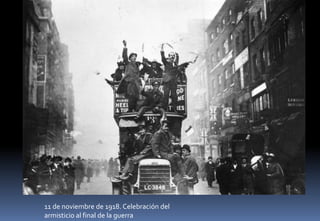
11 de noviembre de 1918. Celebración del
armisticio al final de la guerra
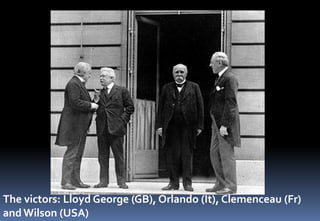
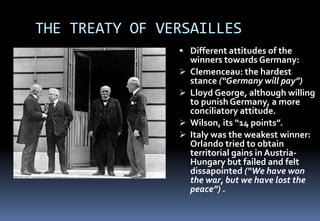
The victors: Lloyd George (GB), Orlando (It), Clemenceau (Fr)
and Wilson (USA)
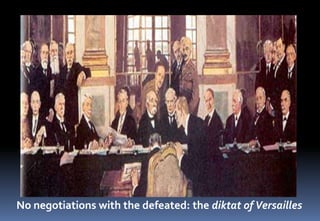
No negotiations with the defeated: the diktat ofVersailles
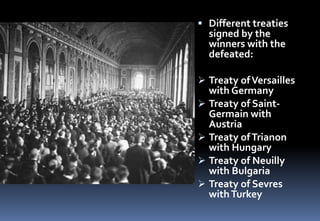
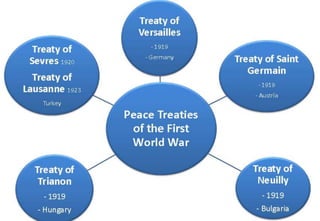
 Different treaties
signed by the
winners with the
defeated:
 Treaty ofVersailles
with Germany
 Treaty of Saint-
Germain with
Austria
 Treaty ofTrianon
with Hungary
 Treaty of Neuilly
with Bulgaria
 Treaty of Sevres
withTurkey
THE TREATY OF VERSAILLES
 Different attitudes of the
winners towards Germany:
 Clemenceau: the hardest
stance (“Germany will pay”)
 Lloyd George, although willing
to punish Germany, a more
conciliatory attitude.
 Wilson, its “14 points”.
 Italy was the weakest winner:
Orlando tried to obtain
territorial gains in Austria-
Hungary but failed and felt
dissapointed (“We have won
the war, but we have lost the
peace”) .
 War guilt:
 Germany had to accept the blame of starting the war .
 Germans considered this clause as extremely unfair .
 As a consequence….
 War reparations
 Germany has to pay for the damage caused to the
Allies .
 A huge amount of money was fixed without any
consultation to Germany (140.000 million gold marks).
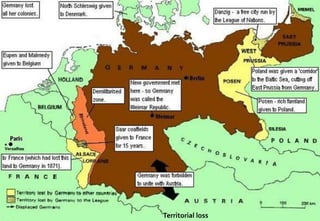
Territorial loss
 Military Clauses:
 Drastic limitation of the German navy.
 Dramatic reduction of the Army (only 100,000
troops, prohibition of having tanks, aircraft and
heavy artillery).
 Demilitarization of the Rhineland region
(Renania).
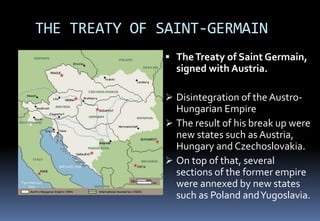
THE TREATY OF SAINT-GERMAIN
 TheTreaty of Saint Germain,
signed with Austria.
 Disintegration of the Austro-
Hungarian Empire
 The result of his break up were
new states such as Austria,
Hungary and Czechoslovakia.
 On top of that, several
sections of the former empire
were annexed by new states
such as Poland andYugoslavia.
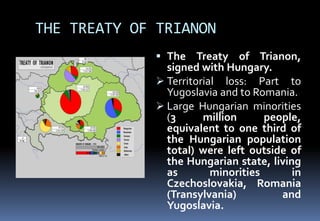
THE TREATY OF TRIANON
 The Treaty of Trianon,
signed with Hungary.
 Territorial loss: Part to
Yugoslavia and to Romania.
 Large Hungarian minorities
(3 million people,
equivalent to one third of
the Hungarian population
total) were left outside of
the Hungarian state, living
as minorities in
Czechoslovakia, Romania
(Transylvania) and
Yugoslavia.
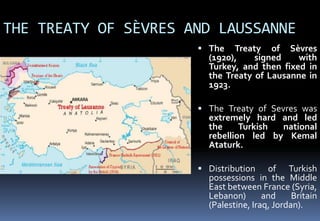
THE TREATY OF SÈVRES AND LAUSSANNE
 The Treaty of Sèvres
(1920), signed with
Turkey, and then fixed in
the Treaty of Lausanne in
1923.
 The Treaty of Sevres was
extremely hard and led
the Turkish national
rebellion led by Kemal
Ataturk.
 Distribution of Turkish
possessions in the Middle
East between France (Syria,
Lebanon) and Britain
(Palestine, Iraq, Jordan).
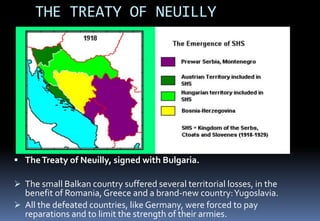
THE TREATY OF NEUILLY
 TheTreaty of Neuilly, signed with Bulgaria.
 The small Balkan country suffered several territorial losses, in the
benefit of Romania, Greece and a brand-new country:Yugoslavia.
 All the defeated countries, like Germany, were forced to pay
reparations and to limit the strength of their armies.
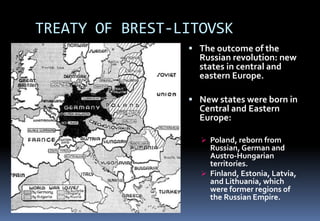
TREATY OF BREST-LITOVSK
 The outcome of the
Russian revolution: new
states in central and
eastern Europe.
 New states were born in
Central and Eastern
Europe:
 Poland, reborn from
Russian, German and
Austro-Hungarian
territories.
 Finland, Estonia, Latvia,
and Lithuania, which
were former regions of
the Russian Empire.
FAILED TREATIES
 These treaties rather than solve the problems
that had led to the GreatWar, increased tensions
in Europe.
 The most important was the German problem.
Many Germans began to bide their time to get
his revenge against the “diktat”, the
“humiliation” ofVersailles. (Treaty ofVersailles)
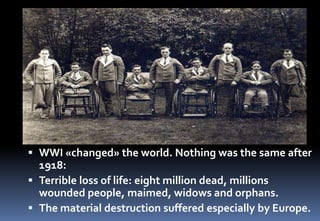
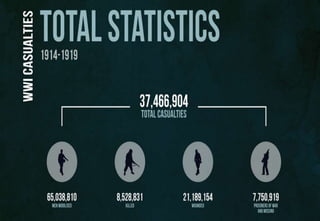
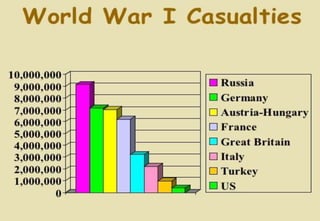
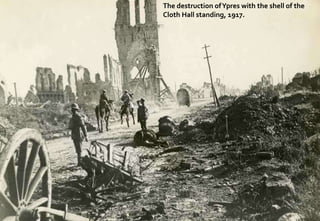
 WWI «changed» the world. Nothing was the same after
1918:
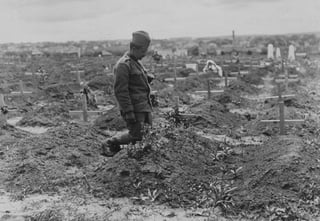
 Terrible loss of life: eight million dead, millions
wounded people, maimed, widows and orphans.
 The material destruction suffered especially by Europe.
The destruction ofYpres with the shell of the
Cloth Hall standing, 1917.
 WWI «changed» the world. Nothing was the same
after 1918:
 USA became the first world power. Europe started a long
decadence
 The mass mobilization of men led to the incorporation of
women into work.
 Soviet revolution and the spread of a prerevolutionary
climate in Europe.
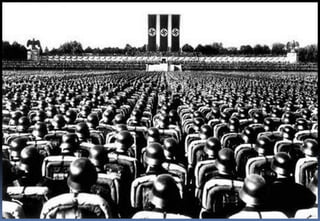
 The exacerbated nationalism + fear of a communist
revolution  fascist movements
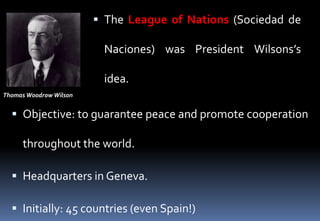
 The League of Nations (Sociedad de
Naciones) was President Wilsons’s
idea.
 Objective: to guarantee peace and promote cooperation
throughout the world.
 Headquarters in Geneva.
 Initially: 45 countries (even Spain!)
Thomas Woodrow Wilson
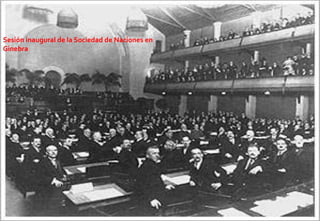
Sesión inaugural de la Sociedad de Naciones en
Ginebra
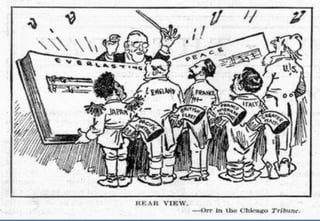
 USA didn’t want to join.
 USSR, Germany were excluded from the LN
 Two organisations:
 An Assembly (all members states).
 A Council (the victorious nations – England, France,
Italy and Japan).
 The League of Nations failed:
 Some of the most important countries didn’t join the
League of Nations:
USA, Germany (later, in 1926 Germany joined the LN, to
get out again when Hitler reached the power in 1933).
USSR wasn’t admitted.
Japan left in 1933 and Italy in 1936.
 The League of Nations had a lack of economic or
military means to impose its decisions.
 http://www.bbc.co.uk/schools/0/ww1/
 http://www.bbc.co.uk/guides/z8sssbk (Life in
trenches)
 http://www.bbc.co.uk/history/worldwars/wwon
e/soldiers_stories_gallery_03.shtml (Trench
life)

WWI PRESENTATION

  • 1.
    FIRST WORLD WAR(1914-1918)
  • 2.
     Nobody thought ofa long war when it broke out in summer 1914  Drafted soldiers went apparently happy to fight (and, of course, win) a short war…
  • 3.
     Reality was verymuch crueler .  •Soldiers and civil population went through a terrible and long war over more than four years.
  • 6.
    Georges Clemenceau JorgeV, Reydel Reino Unido El Zar Nicolás II Vittorio Emanuele II, Rey de Italia El Emperador de Austria Francisco José IEl Kaiser alemán Guillermo II
  • 7.
    El zar NicolásII junto a JorgeV en Berlín (1913).
  • 9.
     The new international expansionist policy(Weltpolitik) undertaken by the German Emperor Wilhelm II in 1890.  It destabilized the international situation.
  • 10.
     Changes inthe balance of economic and military might between the powers.  German economy caught up with UK’s and Berlin started an ambitious naval rearmament program.
  • 11.
     Conflicts betweenpowers in Asia and Africa .  Colonial crisis in Morocco between Germany and France.
  • 12.
     Germany annexed theFrench regions of Alsace and Lorraine after the Franco-Prussian war in 1870.  France strongly desired to recover those regions.
  • 13.
     The rivalrybetween Russia (Serbia) and Austria-Hungary for the hegemony in the Balkans .  TheTurkish Ottoman Empire was not able to control that region anymore.
  • 14.
     Psychological rivalrybetween peoples, encouraged by nationalist propaganda campaigns  Hatred of the neighbour was more the norm than the exception
  • 15.
     Two newnon European powers: United States and Japan.  Conflict took a global dimension, further away from Europe.
  • 16.
    FORMATION OF ALLIANCES The Triple Alliance: Germany, Austria- Hungary and Italy.  The German Reich and the Austro-Hungarian Empire constituted the core of this alliance.
  • 17.
     The TripleEntente made up of Britain, France, and Russia.  It was concluded by 1907.  German expansionism led to Britain and France to end their colonial differences.  The rivalry between Austria-Hungary and Russia in the Balkans pushed Russia into the alliance.
  • 19.
  • 21.
  • 22.
     Greece defeatedTurkishArmy in the First Balkan War
  • 24.
    THE SPARK THATLIT THE FIRE: SARAJEVO MURDER  Archduke Franz Ferdinand (successor to the Austria- Hungarian throne) was assassinated in Sarajevo on 28 June 1914 by Gavrilo Princip, a member of a Serb terrorist nationalist organization .  Austria blamed Serbia and issued an ultimatum to allow Austrian forces to investigate the murder in Serbia.
  • 26.
    SUMMER 1914: THEFINAL CRISIS Austria-Hungary issues an ultimatum to Serbia (its forces will enter the country to investigate the murder) Serbia refuses the ultimatum Austria-Hungary declares war on Serbia. 28 July 1914 Russia mobilizes its troops to defend Serbia Germany (Austria- Hungary ‘s ally) declares war on Russia France (Russia’s ally) declares war on Germany Germany invades Belgium to attack France Great Britain (France’s ally) declares war on Germany
  • 27.
  • 28.
  • 30.
    Agosto 1914: soldadosfranceses marchan hacia el frente
  • 31.
    ALLIES AND CENTRALPOWERS IN EUROPE
  • 33.
    ITS EXTENT  Thehigh number of combatant countries, the vast geographical extent justify the name "Great War" or "WorldWar".  Although it started in Europe, with the involvement of Austro-Hungary and Serbia, the game of military alliances dragged into the war to a growing number of powers.  Some countries at war (UK, France, etc.) were holders of vast colonial empires put their respective domains at war, which in practice the five continents were involved in hostilities.
  • 34.
    ALLIED AND CENTRALPOWERS IN THE WORLD
  • 35.
    "THE GREAT EUROPEANWAR. COMRADES IN ARMS."
  • 36.
    ITS LENGTH  SinceAustria-Hungary declares war on Serbia on July 28, 1914 until Germany signed the armistice on 11 November 1918.  A war that surpassed in duration to those who had taken place during the 18th and 19th centuries.
  • 37.
    NEW ARMAMENT  Amongthe innovations they highlighted:  The tank  Gas masks  Barbed-wire fences (alambrada con espinas)  Chemical weapons  Machine guns (ametralladoras)  Aircraft  Blimps or zeppelins balloons  Submarines.  Improved:  Riffles.  Grenade launchers (lanzagranadas)  Armored ships.
  • 38.
    1917. Soldado americanocon máscara antigas 1916. Construyendo piezas con alambre de púas para la defensa. Batalla del Somme
  • 39.
    1916. Masked Britishsoldiers with a gun machine. First day of the Battle of the Somme.
  • 41.
    1916. Cráter poruna bomba en París
  • 42.
  • 43.
  • 44.
    Tanks in theGreat War
  • 46.
     The telephoneand telegraph were used for communication between the troops 1915. Soldado alemán con un teléfono de campo
  • 47.
    GENERAL MOBILIZATION. TOTALWAR  Huge armies.  General mobilization.  Female labor.  The struggle destroyed armies and destroyed industries and infrastructures.
  • 50.
    Women working asa conductor and driver on a tram in Glasgow Women Firefighters take part in a drill at a London work house, April 1916.
  • 52.
    Munitionettes: 950,000 femaleworkers were employed in British factories, including this worker, pictured making shell cases in aVickers factory in January 1915
  • 54.
    PROPAGANDA  The outbreakof war was favored by an environment of international rivalry.  Use of propaganda by both sides.  The duration, extent and harshness of the conflict weakened the morale of both the combatants and the rear, so campaigns in journals, radio and posters were used.
  • 61.
    REAR IMPORTANCE  WorldWar I took place also in the rear.  Large amounts of military equipment, food and medicine were required from the cities.  Industries were adapted to war needs.  Food shortages were particularly acute and forced restrictions through ration cards.  Women workers.  States were forced into debt to pay for the war. US lend money to the Allied armies. During the war also lend money to Germany.
  • 62.
    ALLIES AND CENTRALPOWERS IN EUROPE
  • 65.
    THE WAR OFMOVEMENTS – 1914 SCHLIEFFEN PLAN German plan which was based on:  Rapid attack on France through neutral Belgium  After defeating France, German troops could turn about and attack Russia, backward country that would need a long time to mobilize their troops
  • 66.
    Battle of Marne,1914  Allied troops managed to halt the German advance  From that moment, armies dug trenches all along a front which extended from the North Sea to the Swiss frontier  Stalemate in the western front  Germans did not achieve a decisive victory in the eastern front French troops in the battle of Marne
  • 67.
    Durante la PrimeraBatalla del Marne dos regimientos franceses acudieron a la batalla enTAXI
  • 68.
    TRENCH WARFARE: 1915-1916 The stalemate in the western front led to a new sort of warfare: the war of attrition (GUERRA DE DESGASTE). A military strategy in which a belligerent side attempts to win a war by wearing down its enemy to the point of collapse through continuous losses in personnel and materiel.
  • 69.
    Soldados alemanes enuna trinchera, festejando la Navidad
  • 70.
    1916. Soldados leyendoun periódico en una trinchera 1916. Soldado alemán en una trinchera
  • 73.
    1916. Soldados muertosen una trinchera
  • 74.
    1916. Dos imágenes:arriba, soldados alemanes; abajo, tropas británicas
  • 78.
  • 79.
  • 80.
    1917: THE TURNINGPOINT OF THE WAR SINKING OFTHE US SHIP LUSITANIA, 1915
  • 82.
    1915. Funeral enCobh (Cork) por las víctimas del Lusitania, barco hundido en la costa de Irlanda. Murieron casi 1.200 personas
  • 83.
     Zimmerman telegramwas a 1917 diplomatic proposal from the German Empire to Mexico to make war against the United States.  The proposal was intercepted and decoded by British intelligence.  Revelation of the contents outraged American public opinion and helped generate support for the United States declaration of war on Germany in April 1917
  • 85.
    February 1917 –TheTsarNicholas II is dethroned
  • 86.
    November 1917 –TheCommunists took over power
  • 87.
    March 1918 –Treatyof Brest-Litovsk, Russia left the war
  • 88.
    Germany acquired provisionally hugeterritories in the East
  • 89.
    1918: THE ENDOF THE WAR Germany could move troops from east to weast Spring offensive
  • 90.
    Massive arrival ofAmerican troops in Europe
  • 91.
  • 92.
    Revolution in Germany– Kaiser abdicated
  • 93.
    German representatives signing thearmistice 11 november 1918
  • 95.
    11 de noviembrede 1918. Celebración del armisticio al final de la guerra
  • 97.
    The victors: LloydGeorge (GB), Orlando (It), Clemenceau (Fr) and Wilson (USA)
  • 98.
    No negotiations withthe defeated: the diktat ofVersailles
  • 99.
     Different treaties signedby the winners with the defeated:  Treaty ofVersailles with Germany  Treaty of Saint- Germain with Austria  Treaty ofTrianon with Hungary  Treaty of Neuilly with Bulgaria  Treaty of Sevres withTurkey
  • 101.
    THE TREATY OFVERSAILLES  Different attitudes of the winners towards Germany:  Clemenceau: the hardest stance (“Germany will pay”)  Lloyd George, although willing to punish Germany, a more conciliatory attitude.  Wilson, its “14 points”.  Italy was the weakest winner: Orlando tried to obtain territorial gains in Austria- Hungary but failed and felt dissapointed (“We have won the war, but we have lost the peace”) .
  • 102.
     War guilt: Germany had to accept the blame of starting the war .  Germans considered this clause as extremely unfair .  As a consequence….  War reparations  Germany has to pay for the damage caused to the Allies .  A huge amount of money was fixed without any consultation to Germany (140.000 million gold marks).
  • 103.
  • 104.
     Military Clauses: Drastic limitation of the German navy.  Dramatic reduction of the Army (only 100,000 troops, prohibition of having tanks, aircraft and heavy artillery).  Demilitarization of the Rhineland region (Renania).
  • 105.
    THE TREATY OFSAINT-GERMAIN  TheTreaty of Saint Germain, signed with Austria.  Disintegration of the Austro- Hungarian Empire  The result of his break up were new states such as Austria, Hungary and Czechoslovakia.  On top of that, several sections of the former empire were annexed by new states such as Poland andYugoslavia.
  • 106.
    THE TREATY OFTRIANON  The Treaty of Trianon, signed with Hungary.  Territorial loss: Part to Yugoslavia and to Romania.  Large Hungarian minorities (3 million people, equivalent to one third of the Hungarian population total) were left outside of the Hungarian state, living as minorities in Czechoslovakia, Romania (Transylvania) and Yugoslavia.
  • 107.
    THE TREATY OFSÈVRES AND LAUSSANNE  The Treaty of Sèvres (1920), signed with Turkey, and then fixed in the Treaty of Lausanne in 1923.  The Treaty of Sevres was extremely hard and led the Turkish national rebellion led by Kemal Ataturk.  Distribution of Turkish possessions in the Middle East between France (Syria, Lebanon) and Britain (Palestine, Iraq, Jordan).
  • 108.
    THE TREATY OFNEUILLY  TheTreaty of Neuilly, signed with Bulgaria.  The small Balkan country suffered several territorial losses, in the benefit of Romania, Greece and a brand-new country:Yugoslavia.  All the defeated countries, like Germany, were forced to pay reparations and to limit the strength of their armies.
  • 109.
    TREATY OF BREST-LITOVSK The outcome of the Russian revolution: new states in central and eastern Europe.  New states were born in Central and Eastern Europe:  Poland, reborn from Russian, German and Austro-Hungarian territories.  Finland, Estonia, Latvia, and Lithuania, which were former regions of the Russian Empire.
  • 110.
    FAILED TREATIES  Thesetreaties rather than solve the problems that had led to the GreatWar, increased tensions in Europe.  The most important was the German problem. Many Germans began to bide their time to get his revenge against the “diktat”, the “humiliation” ofVersailles. (Treaty ofVersailles)
  • 112.
     WWI «changed»the world. Nothing was the same after 1918:  Terrible loss of life: eight million dead, millions wounded people, maimed, widows and orphans.  The material destruction suffered especially by Europe.
  • 118.
    The destruction ofYpreswith the shell of the Cloth Hall standing, 1917.
  • 119.
     WWI «changed»the world. Nothing was the same after 1918:  USA became the first world power. Europe started a long decadence  The mass mobilization of men led to the incorporation of women into work.  Soviet revolution and the spread of a prerevolutionary climate in Europe.  The exacerbated nationalism + fear of a communist revolution  fascist movements
  • 122.
     The Leagueof Nations (Sociedad de Naciones) was President Wilsons’s idea.  Objective: to guarantee peace and promote cooperation throughout the world.  Headquarters in Geneva.  Initially: 45 countries (even Spain!) Thomas Woodrow Wilson
  • 123.
    Sesión inaugural dela Sociedad de Naciones en Ginebra
  • 125.
     USA didn’twant to join.  USSR, Germany were excluded from the LN  Two organisations:  An Assembly (all members states).  A Council (the victorious nations – England, France, Italy and Japan).
  • 127.
     The Leagueof Nations failed:  Some of the most important countries didn’t join the League of Nations: USA, Germany (later, in 1926 Germany joined the LN, to get out again when Hitler reached the power in 1933). USSR wasn’t admitted. Japan left in 1933 and Italy in 1936.  The League of Nations had a lack of economic or military means to impose its decisions.
  • 128.
     http://www.bbc.co.uk/schools/0/ww1/  http://www.bbc.co.uk/guides/z8sssbk(Life in trenches)  http://www.bbc.co.uk/history/worldwars/wwon e/soldiers_stories_gallery_03.shtml (Trench life)