World War I The “Great War” Dr. Robbins World History
MAIN Causes of WWI M ilitarism A lliances I mperialism N ationalism
Cause: Militarism All major nations wanted a large army in response to nationalism, imperialism and the perceived threats from other armies
Cause: Alliances Caused many countries to join fighting once war had begun Before the war: Triple Alliance and Triple Entente Later: Central Powers and Allied Powers
Cause: Imperialism Desire for increased territory and wealth led to competition over colonies
Cause: Nationalism Desire to prove national greatness led to rivalries between great powers Highly nationalistic ethnic groups were calling for independence (e.g., Serbians, part of Slavic ethnic group)
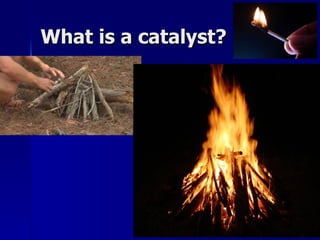
What is a catalyst?
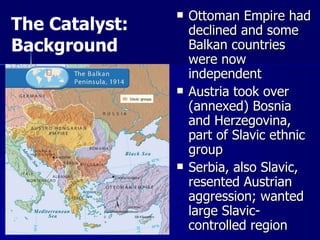
Ottoman Empire had declined and some Balkan countries were now independent Austria took over (annexed) Bosnia and Herzegovina, part of Slavic ethnic group Serbia, also Slavic, resented Austrian aggression; wanted large Slavic-controlled region The Catalyst: Background
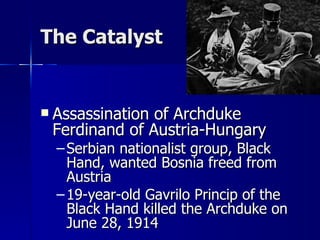
The Catalyst Assassination of Archduke Ferdinand of Austria-Hungary Serbian nationalist group, Black Hand, wanted Bosnia freed from Austria 19-year-old Gavrilo Princip of the Black Hand killed the Archduke on June 28, 1914
The Catalyst Leads to War Austria wanted to punish Serbia and set demands; most agreed to, but not enough Austria declares war against Serbia on July 28, 1914
War Spreads July 28—Russia (also Slavic) mobilized troops to the Austrian border Aug 1—Austria’s ally Germany saw this as a threat and declared war on Russia
War Continues to Spread Aug 3—Germany declared war on France, Russia’s ally Aug 4—after Germany attacked neutral Belgium, to get to France, Britain declared war on Germany
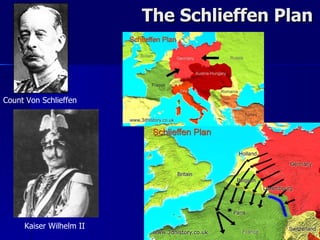
The Schlieffen Plan First—attack France to the west Second—attack Russia to the east Worked well to start: in Paris by Sept 3 Intended to keep Germany from having to fight on two fronts at the same time
The Schlieffen Plan Count Von Schlieffen Kaiser Wilhelm II
Alliances Before the War Triple Alliance:  Germany, Austria-Hungary, Italy Triple Entente: France, Russia, Britain
Alliances Shift After War Starts Central Powers Germany, Austria-Hungary later, Bulgaria and Ottoman Empire (wanting to regain lost territories)
Allied Powers (the Allies) Great Britain, France, Russia soon Japan, and later Italy also Serbia, Greece, Romania, etc. much later, the U.S. (1917)
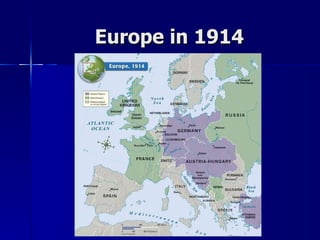
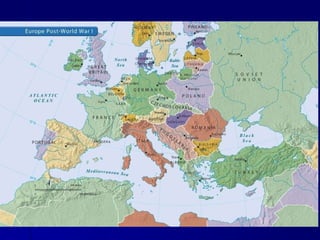
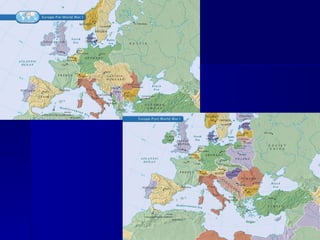
Europe in 1914
“ Short” war goes long German plan worked well to start: in Paris by Sept 3 Battle of the Marne— began on Sept 5, after 8 days of battle, German offensive was stopped Russians soon attacking Germany in the east the Schlieffen Plan has failed
Stuck in the trenches Example of trench warfare Battle of Verdun in Feb 1916—each side lost more than 300,000 men
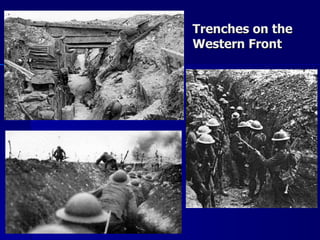
Trenches on the Western Front
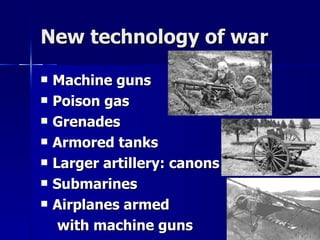
New technology of war Machine guns Poison gas Grenades Armored tanks Larger artillery: canons Submarines Airplanes armed  with machine guns
Western Front Mostly in  France , near German border 500 miles of trenches  dug in France Trench warfare No Man’s Land—the uninhabited land between the rows of trenches STALEMATE—”stuck”, nobody makes any real progress
Eastern Front Along Russia’s borders with Germany and Austria-Hungary Fewer trenches, more mobile and more brutal than western front Russians always short of supplies
Russia’s Role Russia’s huge population provided plenty of soldiers to send to the front Russia kept Germany from winning the war by occupying them in the east, dividing forces
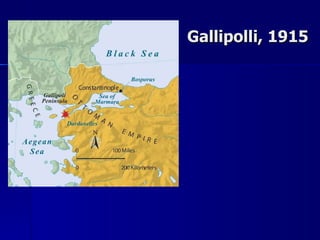
Gallipolli, 1915
“ Global” war Every continent throughout the  GLOBE Fighting over colonies Also colonial subjects served their European masters
Who’s Fighting? Middle East (Arab nationalists helped Britain) Asia (Japan took German colonies; India fought for Britain) Africa (English & French wanted German land) Americas: Brazil, Canada and later, U.S. Australia (fighting for British)
“ Total” War Every country involved devoted its  TOTAL  resources to the war effort Governments took over factories, etc.
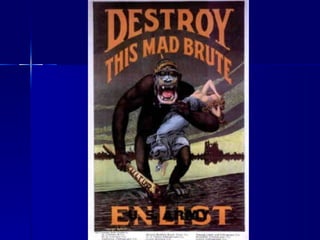
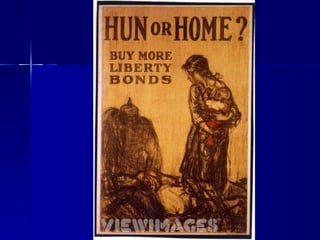
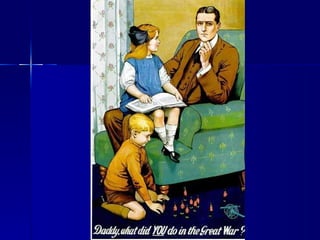
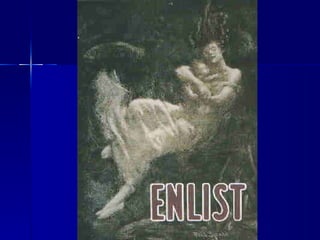
Life on the Home Front Rationing in Europe Limiting the amount of daily supplies that people could buy (gasoline, sugar, etc.) On a volunteer basis in U.S. Propaganda  Persuading the population to support the war


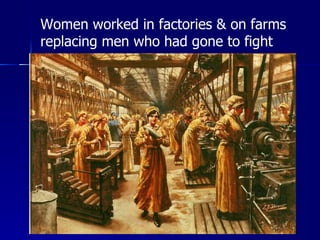
Women worked in factories & on farms replacing men who had gone to fight
U.S. Enters the War U.S. policy of isolationism had kept it out of the war, though they helped Allies Unrestricted submarine warfare by Germans sank British and U.S. ships, including passenger ships (Lusitania)
U.S. Enters the War  cont. Zimmerman Note—US learned of German telegram offering Mexico US territory if it joined Germany US entered war on April 2, 1917 Took a year to get 2 million US soldiers over
Russia’s Problems WWI had contributed to problems in Russia and helped cause revolution Russian Revolution of March, 1917 led to fall of Czar Nicholas II New provisionary government does not leave war, this led to resentment and…
Russia Leaves the War Bolshevik Revolution of Nov, 1917 led to Communist takeover of Russia Bolshevik leader Lenin signed peace treaty with Germany in November, 1917 Treaty of Brest-Litovsk
The Final Act With Russia out, Germany could focus on Western Front BUT…arrival of US troops  and exhaustion of German army and supplies led to defeat of Germany
Fighting Ends Central Powers signed the Armistice (end to fighting)—Nov 11, 1918
Treaty of Versailles Allied Powers met to create a post-war treaty at the Palace of Versailles Started on Jan 18, 1919 & signed on June 28, 1919 (5 years after assassination) Big 4: US, France, Britain, Italy (Japan virtually shut out)
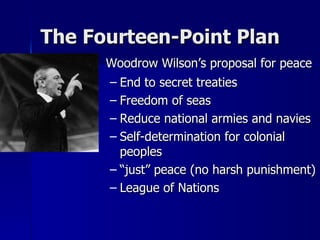
The Fourteen-Point Plan Woodrow Wilson’s proposal for peace End to secret treaties Freedom of seas Reduce national armies and navies Self-determination for colonial peoples “ just” peace (no harsh punishment) League of Nations
In the End… Britain & France agreed to League of Nations but not the rest of Wilson’s plan
Germany was punished: “ War guilt” clause, Germany to pay $33 billion over 30 years to Allies  ($407 billion in 2008 money) Lost lots of territory Restrictions on German military
The Result 4 Empires Ended: Russian, German, Ottoman, Austrian-Hungarian Ex-colonies administered by League; colonies angry at treatment by Europe
More Results Japan and Italy angry—gained little Germany left virtually destroyed, broke, in debt, embittered…ready for Hitler 20 years later
Total Costs 8.5 million soldiers died 21 million soldiers wounded 1918 flu epidemic killed as many as 50 million Made worse by wartime conditions
Total Costs  cont. A generation “lost” Farmland, homes, & villages destroyed Total cost in 1918 dollars: $338 billion (about $4 trillion in today’s money)


World War 1

  • 1.
    World War IThe “Great War” Dr. Robbins World History
  • 2.
    MAIN Causes ofWWI M ilitarism A lliances I mperialism N ationalism
  • 3.
    Cause: Militarism Allmajor nations wanted a large army in response to nationalism, imperialism and the perceived threats from other armies
  • 4.
    Cause: Alliances Causedmany countries to join fighting once war had begun Before the war: Triple Alliance and Triple Entente Later: Central Powers and Allied Powers
  • 5.
    Cause: Imperialism Desirefor increased territory and wealth led to competition over colonies
  • 6.
    Cause: Nationalism Desireto prove national greatness led to rivalries between great powers Highly nationalistic ethnic groups were calling for independence (e.g., Serbians, part of Slavic ethnic group)
  • 7.
    What is acatalyst?
  • 8.
    Ottoman Empire haddeclined and some Balkan countries were now independent Austria took over (annexed) Bosnia and Herzegovina, part of Slavic ethnic group Serbia, also Slavic, resented Austrian aggression; wanted large Slavic-controlled region The Catalyst: Background
  • 9.
    The Catalyst Assassinationof Archduke Ferdinand of Austria-Hungary Serbian nationalist group, Black Hand, wanted Bosnia freed from Austria 19-year-old Gavrilo Princip of the Black Hand killed the Archduke on June 28, 1914
  • 10.
    The Catalyst Leadsto War Austria wanted to punish Serbia and set demands; most agreed to, but not enough Austria declares war against Serbia on July 28, 1914
  • 11.
    War Spreads July28—Russia (also Slavic) mobilized troops to the Austrian border Aug 1—Austria’s ally Germany saw this as a threat and declared war on Russia
  • 12.
    War Continues toSpread Aug 3—Germany declared war on France, Russia’s ally Aug 4—after Germany attacked neutral Belgium, to get to France, Britain declared war on Germany
  • 13.
    The Schlieffen PlanFirst—attack France to the west Second—attack Russia to the east Worked well to start: in Paris by Sept 3 Intended to keep Germany from having to fight on two fronts at the same time
  • 14.
    The Schlieffen PlanCount Von Schlieffen Kaiser Wilhelm II
  • 15.
    Alliances Before theWar Triple Alliance: Germany, Austria-Hungary, Italy Triple Entente: France, Russia, Britain
  • 16.
    Alliances Shift AfterWar Starts Central Powers Germany, Austria-Hungary later, Bulgaria and Ottoman Empire (wanting to regain lost territories)
  • 17.
    Allied Powers (theAllies) Great Britain, France, Russia soon Japan, and later Italy also Serbia, Greece, Romania, etc. much later, the U.S. (1917)
  • 18.
  • 19.
    “ Short” wargoes long German plan worked well to start: in Paris by Sept 3 Battle of the Marne— began on Sept 5, after 8 days of battle, German offensive was stopped Russians soon attacking Germany in the east the Schlieffen Plan has failed
  • 20.
    Stuck in thetrenches Example of trench warfare Battle of Verdun in Feb 1916—each side lost more than 300,000 men
  • 21.
    Trenches on theWestern Front
  • 22.
    New technology ofwar Machine guns Poison gas Grenades Armored tanks Larger artillery: canons Submarines Airplanes armed with machine guns
  • 23.
    Western Front Mostlyin France , near German border 500 miles of trenches dug in France Trench warfare No Man’s Land—the uninhabited land between the rows of trenches STALEMATE—”stuck”, nobody makes any real progress
  • 24.
    Eastern Front AlongRussia’s borders with Germany and Austria-Hungary Fewer trenches, more mobile and more brutal than western front Russians always short of supplies
  • 25.
    Russia’s Role Russia’shuge population provided plenty of soldiers to send to the front Russia kept Germany from winning the war by occupying them in the east, dividing forces
  • 26.
  • 27.
    “ Global” warEvery continent throughout the GLOBE Fighting over colonies Also colonial subjects served their European masters
  • 28.
    Who’s Fighting? MiddleEast (Arab nationalists helped Britain) Asia (Japan took German colonies; India fought for Britain) Africa (English & French wanted German land) Americas: Brazil, Canada and later, U.S. Australia (fighting for British)
  • 29.
    “ Total” WarEvery country involved devoted its TOTAL resources to the war effort Governments took over factories, etc.
  • 30.
    Life on theHome Front Rationing in Europe Limiting the amount of daily supplies that people could buy (gasoline, sugar, etc.) On a volunteer basis in U.S. Propaganda Persuading the population to support the war
  • 31.
  • 32.
  • 33.
  • 34.
  • 35.
    Women worked infactories & on farms replacing men who had gone to fight
  • 36.
    U.S. Enters theWar U.S. policy of isolationism had kept it out of the war, though they helped Allies Unrestricted submarine warfare by Germans sank British and U.S. ships, including passenger ships (Lusitania)
  • 37.
    U.S. Enters theWar cont. Zimmerman Note—US learned of German telegram offering Mexico US territory if it joined Germany US entered war on April 2, 1917 Took a year to get 2 million US soldiers over
  • 38.
    Russia’s Problems WWIhad contributed to problems in Russia and helped cause revolution Russian Revolution of March, 1917 led to fall of Czar Nicholas II New provisionary government does not leave war, this led to resentment and…
  • 39.
    Russia Leaves theWar Bolshevik Revolution of Nov, 1917 led to Communist takeover of Russia Bolshevik leader Lenin signed peace treaty with Germany in November, 1917 Treaty of Brest-Litovsk
  • 40.
    The Final ActWith Russia out, Germany could focus on Western Front BUT…arrival of US troops and exhaustion of German army and supplies led to defeat of Germany
  • 41.
    Fighting Ends CentralPowers signed the Armistice (end to fighting)—Nov 11, 1918
  • 42.
    Treaty of VersaillesAllied Powers met to create a post-war treaty at the Palace of Versailles Started on Jan 18, 1919 & signed on June 28, 1919 (5 years after assassination) Big 4: US, France, Britain, Italy (Japan virtually shut out)
  • 43.
    The Fourteen-Point PlanWoodrow Wilson’s proposal for peace End to secret treaties Freedom of seas Reduce national armies and navies Self-determination for colonial peoples “ just” peace (no harsh punishment) League of Nations
  • 44.
    In the End…Britain & France agreed to League of Nations but not the rest of Wilson’s plan
  • 45.
    Germany was punished:“ War guilt” clause, Germany to pay $33 billion over 30 years to Allies ($407 billion in 2008 money) Lost lots of territory Restrictions on German military
  • 46.
    The Result 4Empires Ended: Russian, German, Ottoman, Austrian-Hungarian Ex-colonies administered by League; colonies angry at treatment by Europe
  • 47.
    More Results Japanand Italy angry—gained little Germany left virtually destroyed, broke, in debt, embittered…ready for Hitler 20 years later
  • 48.
    Total Costs 8.5million soldiers died 21 million soldiers wounded 1918 flu epidemic killed as many as 50 million Made worse by wartime conditions
  • 49.
    Total Costs cont. A generation “lost” Farmland, homes, & villages destroyed Total cost in 1918 dollars: $338 billion (about $4 trillion in today’s money)
  • 50.
  • 51.