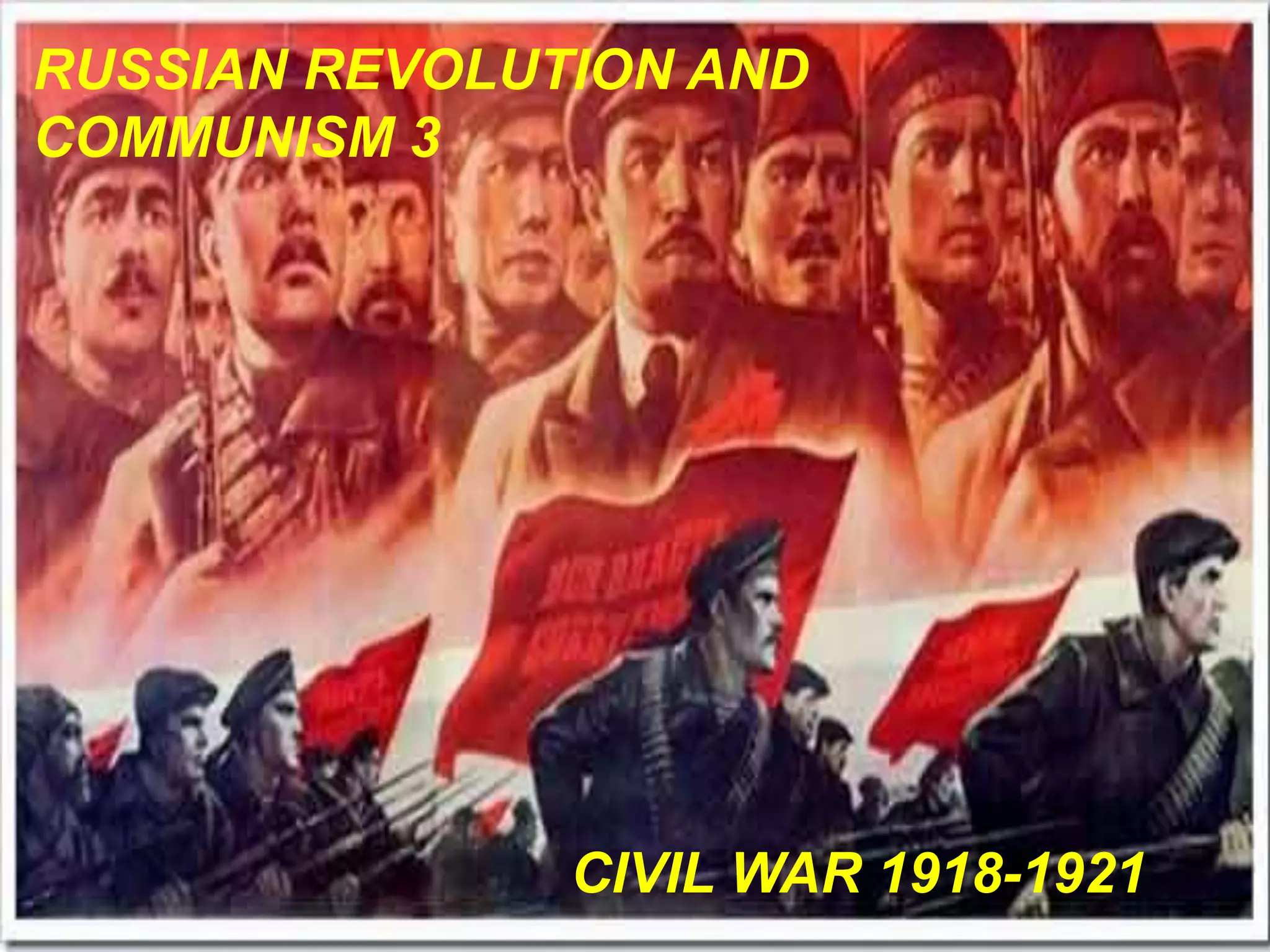
CIVIL WAR 1918-1921
RUSSIAN REVOLUTION AND
COMMUNISM 3
THE BOLSHEVIC REVOLUTION IN OTHER COUNTRIES
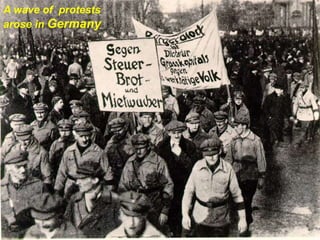
A wave of protests
arose in Germany
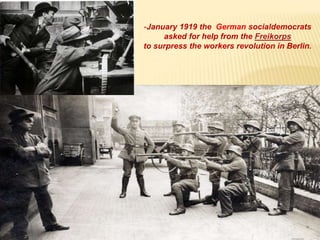
-January 1919 the German socialdemocrats
asked for help from the Freikorps
to surpress the workers revolution in Berlin.
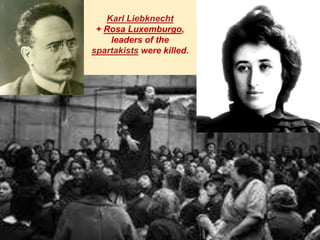
Karl Liebknecht
+ Rosa Luxemburgo,
leaders of the
spartakists were killed.
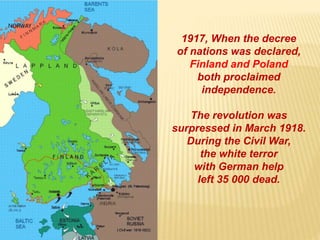
1917, When the decree
of nations was declared,
Finland and Poland
both proclaimed
independence.
The revolution was
surpressed in March 1918.
During the Civil War,
the white terror
with German help
left 35 000 dead.
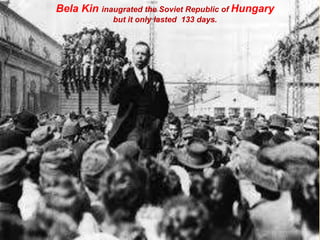
Revolución en Hungría
Bela Kin inaugrated the Soviet Republic of Hungary
but it only lasted 133 days.
There were riots
and insurrections
in Italy between
1919 and 1920.
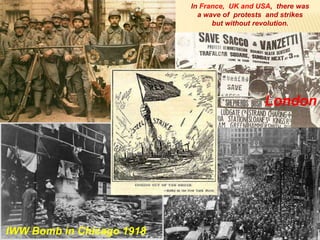
In France, UK and USA, there was
a wave of protests and strikes
but without revolution.
IWW Bomb in Chicago 1918
London
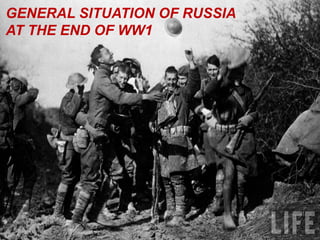
GENERAL SITUATION OF RUSSIA
AT THE END OF WW1
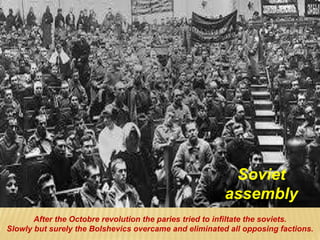
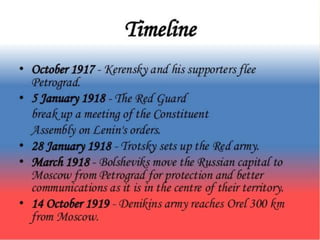
After the Octobre revolution the paries tried to infiltate the soviets.
Slowly but surely the Bolshevics overcame and eliminated all opposing factions.
Soviet
assembly
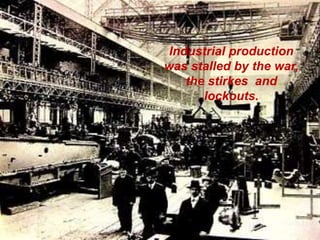
Industrial production
was stalled by the war,
the stirkes and
lockouts.
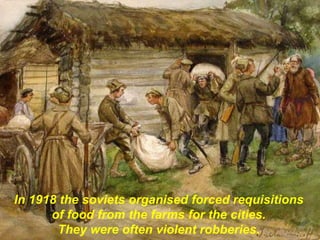
In 1918 the soviets organised forced requisitions
of food from the farms for the cities.
They were often violent robberies.
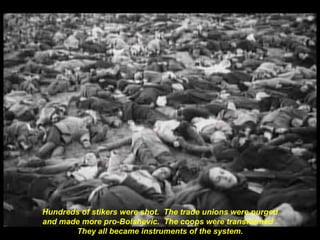
Hundreds of stikers were shot. The trade unions were purged
and made more pro-Bolshevic. The coops were transformed .
They all became instruments of the system.
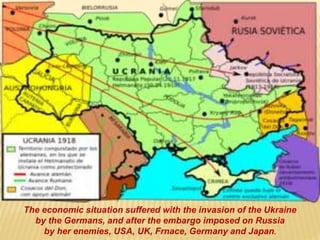
The economic situation suffered with the invasion of the Ukraine
by the Germans, and after the embargo imposed on Russia
by her enemies, USA, UK, Frnace, Germany and Japan.
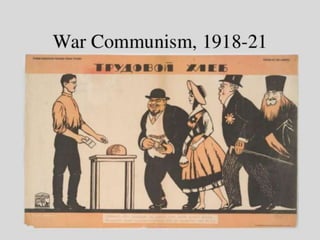
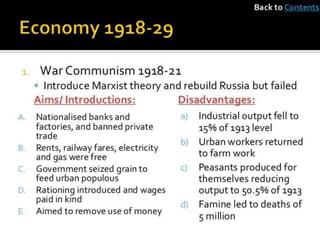
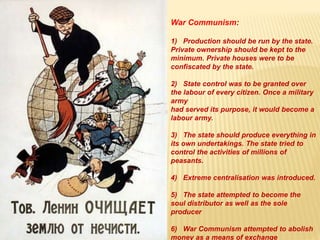
War Communism:
1) Production should be run by the state.
Private ownership should be kept to the
minimum. Private houses were to be
confiscated by the state.
2) State control was to be granted over
the labour of every citizen. Once a military
army
had served its purpose, it would become a
labour army.
3) The state should produce everything in
its own undertakings. The state tried to
control the activities of millions of
peasants.
4) Extreme centralisation was introduced.
5) The state attempted to become the
soul distributor as well as the sole
producer
6) War Communism attempted to abolish
money as a means of exchange
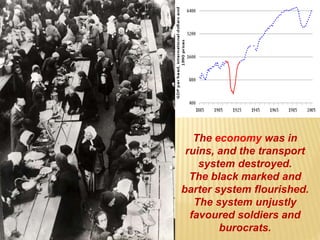
The economy was in
ruins, and the transport
system destroyed.
The black marked and
barter system flourished.
The system unjustly
favoured soldiers and
burocrats.
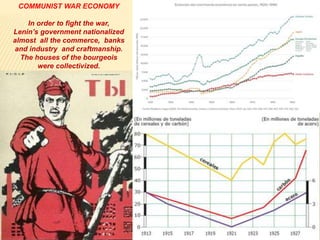
COMMUNIST WAR ECONOMY
In order to fight the war,
Lenin’s government nationalized
almost all the commerce, banks
and industry and craftmanship.
The houses of the bourgeois
were collectivized.
The begining of
the civil war
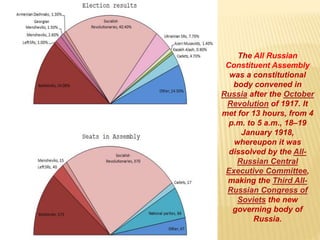
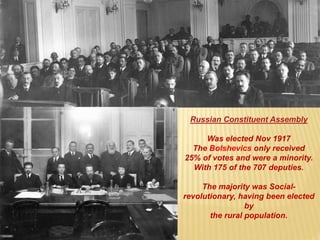
The All Russian
Constituent Assembly
was a constitutional
body convened in
Russia after the October
Revolution of 1917. It
met for 13 hours, from 4
p.m. to 5 a.m., 18–19
January 1918,
whereupon it was
dissolved by the All-
Russian Central
Executive Committee,
making the Third All-
Russian Congress of
Soviets the new
governing body of
Russia.
Russian Constituent Assembly
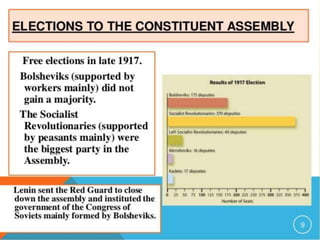
Was elected Nov 1917
The Bolshevics only received
25% of votes and were a minority.
With 175 of the 707 deputies.
The majority was Social-
revolutionary, having been elected
by
the rural population.
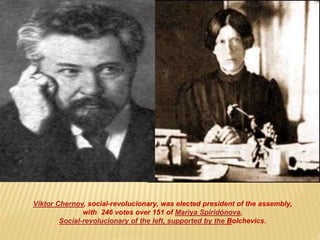
Víktor Chernov, social-revolucionary, was elected president of the assembly,
with 246 votes over 151 of Mariya Spiridónova,
Social-revolucionary of the left, supported by the Bolchevics.
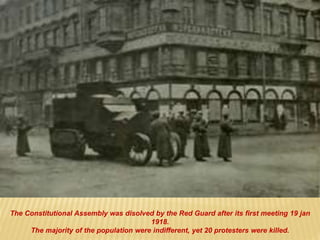
The Constitutional Assembly was disolved by the Red Guard after its first meeting 19 jan
1918.
The majority of the population were indifferent, yet 20 protesters were killed.
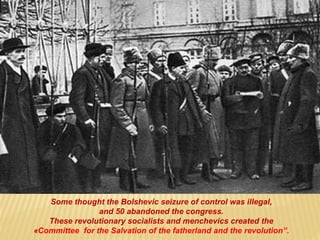
Some thought the Bolshevic seizure of control was illegal,
and 50 abandoned the congress.
These revolutionary socialists and menchevics created the
«Committee for the Salvation of the fatherland and the revolution”.
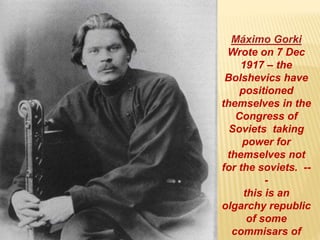
Máximo Gorki
Wrote on 7 Dec
1917 – the
Bolshevics have
positioned
themselves in the
Congress of
Soviets taking
power for
themselves not
for the soviets. --
-
this is an
olgarchy republic
of some
commisars of
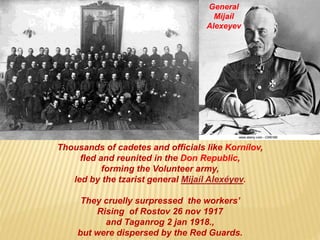
Thousands of cadetes and officials like Kornílov,
fled and reunited in the Don Republic,
forming the Volunteer army,
led by the tzarist general Mijaíl Alexéyev.
They cruelly surpressed the workers’
Rising of Rostov 26 nov 1917
and Taganrog 2 jan 1918.,
but were dispersed by the Red Guards.
General
Mijaíl
Alexeyev
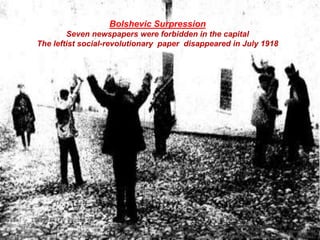
Bolshevic Surpression
Seven newspapers were forbidden in the capital
The leftist social-revolutionary paper disappeared in July 1918
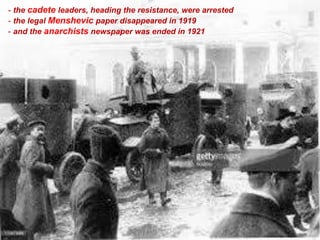
- the cadete leaders, heading the resistance, were arrested
- the legal Menshevic paper disappeared in 1919
- and the anarchists newspaper was ended in 1921
.
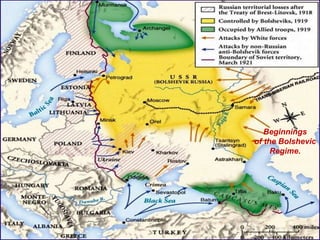
Beginnings
of the Bolshevic
Regime.
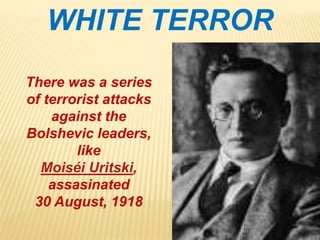
There was a series
of terrorist attacks
against the
Bolshevic leaders,
like
Moiséi Uritski,
assasinated
30 August, 1918
WHITE TERROR
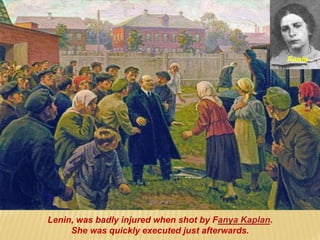
Lenin, was badly injured when shot by Fanya Kaplan.
She was quickly executed just afterwards.
Fania
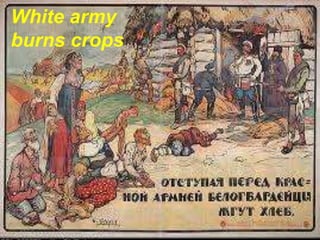
White army
burns crops
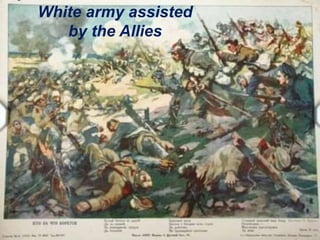
White army assisted
by the Allies
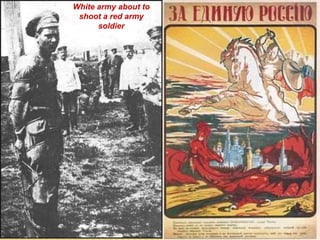
White army about to
shoot a red army
soldier
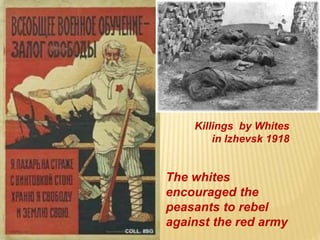
Killings by Whites
in Izhevsk 1918
The whites
encouraged the
peasants to rebel
against the red army
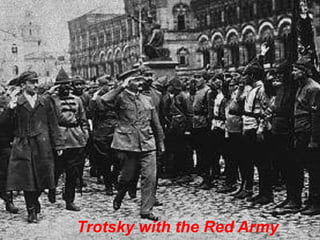
Trotsky with the Red Army
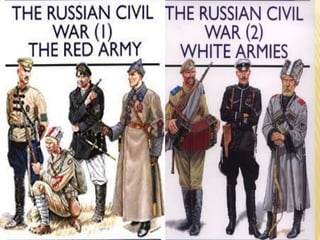
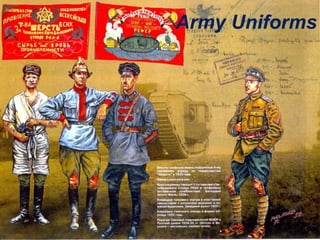
Army Uniforms
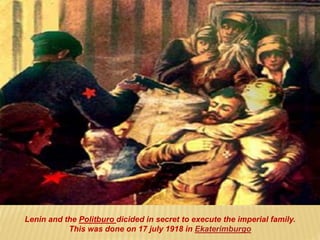
Lenin and the Politburo dicided in secret to execute the imperial family.
This was done on 17 july 1918 in Ekaterimburgo
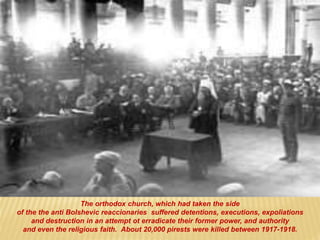
The orthodox church, which had taken the side
of the the anti Bolshevic reaccionaries suffered detentions, executions, expoliations
and destruction in an attempt ot erradicate their former power, and authority
and even the religious faith. About 20,000 pirests were killed between 1917-1918.
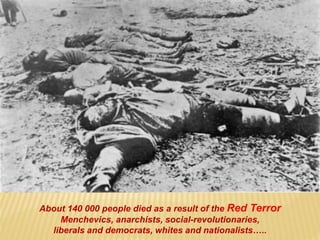
About 140 000 people died as a result of the Red Terror
Menchevics, anarchists, social-revolutionaries,
liberals and democrats, whites and nationalists…..
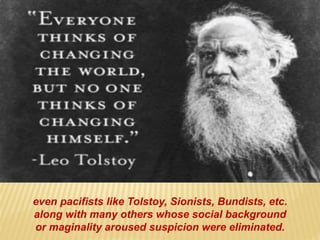
even pacifists like Tolstoy, Sionists, Bundists, etc.
along with many others whose social background
or maginality aroused suspicion were eliminated.
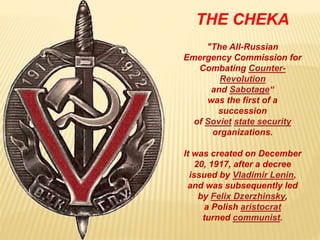
THE CHEKA
"The All-Russian
Emergency Commission for
Combating Counter-
Revolution
and Sabotage“
was the first of a
succession
of Soviet state security
organizations.
It was created on December
20, 1917, after a decree
issued by Vladimir Lenin,
and was subsequently led
by Felix Dzerzhinsky,
a Polish aristocrat
turned communist.
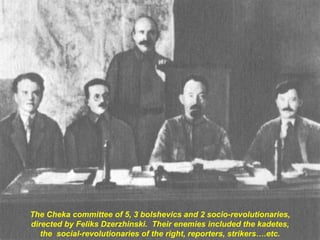
The Cheka committee of 5, 3 bolshevics and 2 socio-revolutionaries,
directed by Feliks Dzerzhinski. Their enemies included the kadetes,
the social-revolutionaries of the right, reporters, strikers….etc.
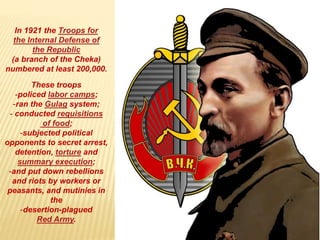
In 1921 the Troops for
the Internal Defense of
the Republic
(a branch of the Cheka)
numbered at least 200,000.
These troops
-policed labor camps;
-ran the Gulag system;
- conducted requisitions
of food;
-subjected political
opponents to secret arrest,
detention, torture and
summary execution;
-and put down rebellions
and riots by workers or
peasants, and mutinies in
the
-desertion-plagued
Red Army.
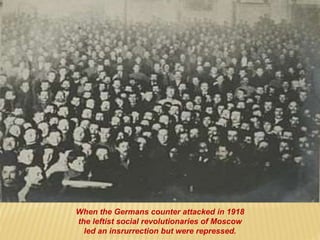
When the Germans counter attacked in 1918
the leftist social revolutionaries of Moscow
led an insrurrection but were repressed.
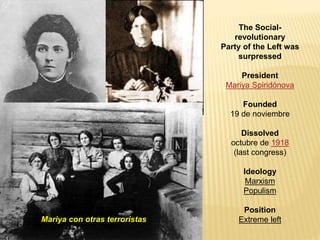
The Social-
revolutionary
Party of the Left was
surpressed
President
Mariya Spiridónova
Founded
19 de noviembre
Dissolved
octubre de 1918
(last congress)
Ideology
Marxism
Populism
Position
Extreme leftMariya con otras terroristas
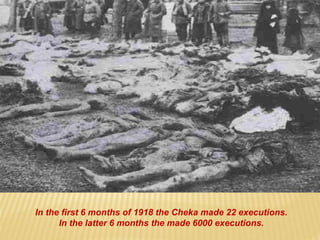
In the first 6 months of 1918 the Cheka made 22 executions.
In the latter 6 months the made 6000 executions.
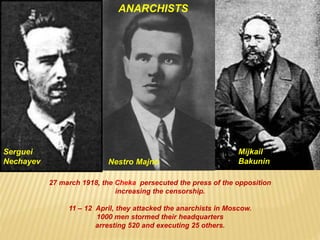
27 march 1918, the Cheka persecuted the press of the opposition
increasing the censorship.
11 – 12 April, they attacked the anarchists in Moscow.
1000 men stormed their headquarters
arresting 520 and executing 25 others.
Nestro Majnó
Serguei
Nechayev
Mijkail
Bakunin
ANARCHISTS
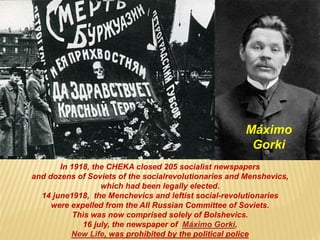
In 1918, the CHEKA closed 205 socialist newspapers
and dozens of Soviets of the socialrevolutionaries and Menshevics,
which had been legally elected.
14 june1918, the Menchevics and leftist social-revolutionaries
were expelled from the All Russian Committee of Soviets.
This was now comprised solely of Bolshevics.
16 july, the newspaper of Máximo Gorki,
New Life, was prohibited by the political police
Máximo
Gorki
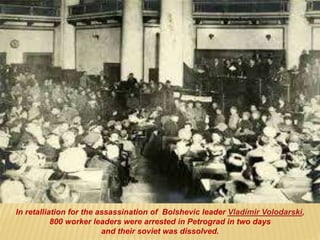
In retalliation for the assassination of Bolshevic leader Vladímir Volodarski,
800 worker leaders were arrested in Petrograd in two days
and their soviet was dissolved.
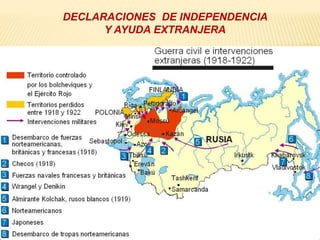
DECLARACIONES DE INDEPENDENCIA
Y AYUDA EXTRANJERA
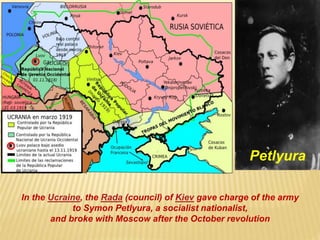
In the Ucraine, the Rada (council) of Kiev gave charge of the army
to Symon Petlyura, a socialist nationalist,
and broke with Moscow after the October revolution
Petlyura
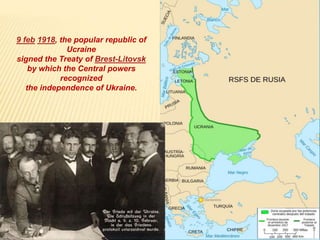
9 feb 1918, the popular republic of
Ucraine
signed the Treaty of Brest-Litovsk
by which the Central powers
recognized
the independence of Ukraine.
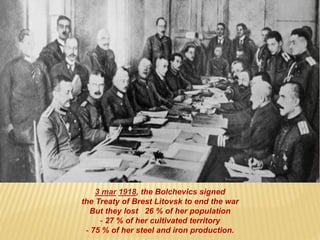
3 mar 1918, the Bolchevics signed
the Treaty of Brest Litovsk to end the war
But they lost 26 % of her population
- 27 % of her cultivated territory
- 75 % of her steel and iron production.
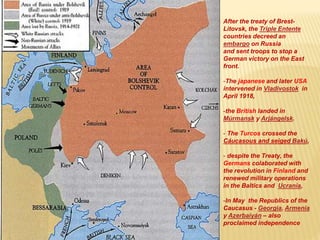
After the treaty of Brest-
Litovsk, the Triple Entente
countries decreed an
embargo on Russia
and sent troops to stop a
German victory on the East
front.
-The japanese and later USA
intervened in Vladivostok in
April 1918,
-the British landed in
Múrmansk y Arjángelsk.
- The Turcos crossed the
Cáucasous and seiged Bakú,
- despite the Treaty, the
Germans colaborated with
the revolution in Finland and
renewed military operations
in the Baltics and Ucrania,
-In May the Republics of the
Caucasus - Georgia, Armenia
y Azerbaiyán – also
proclaimed independence
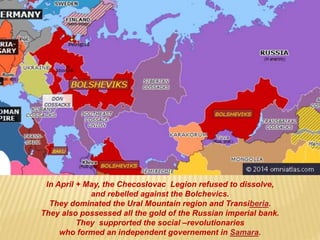
In April + May, the Checoslovac Legion refused to dissolve,
and rebelled against the Bolchevics.
They dominated the Ural Mountain region and Transiberia.
They also possessed all the gold of the Russian imperial bank.
They supprorted the social –revolutionaries
who formed an independent governement in Samara.
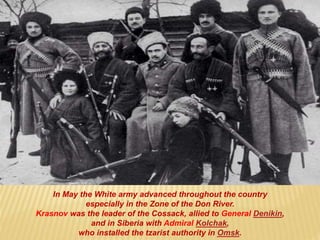
In May the White army advanced throughout the country
especially in the Zone of the Don River.
Krasnov was the leader of the Cossack, allied to General Denikin,
and in Siberia with Admiral Kolchak,
who installed the tzarist authority in Omsk.
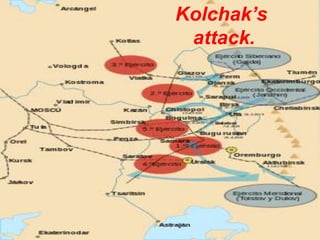
Kolchak’s
attack.
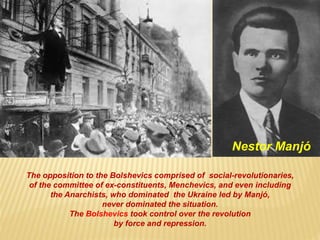
The opposition to the Bolshevics comprised of social-revolutionaries,
of the committee of ex-constituents, Menchevics, and even including
the Anarchists, who dominated the Ukraine led by Manjó,
never dominated the situation.
The Bolshevics took control over the revolution
by force and repression.
Nestor Manjó
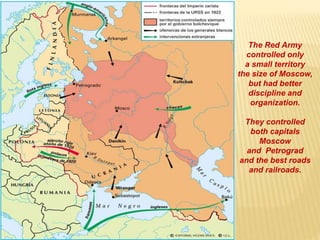
The Red Army
controlled only
a small territory
the size of Moscow,
but had better
discipline and
organization.
They controlled
both capitals
Moscow
and Petrograd
and the best roads
and railroads.
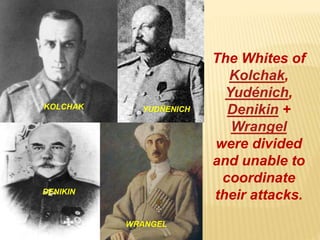
The Whites of
Kolchak,
Yudénich,
Denikin +
Wrangel
were divided
and unable to
coordinate
their attacks.
KOLCHAK YUDÑENICH
DENIKIN
WRANGEL
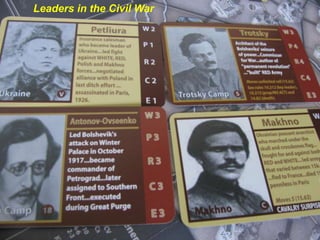
Leaders in the Civil War
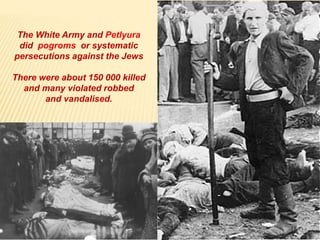
The White Army and Petlyura
did pogroms or systematic
persecutions against the Jews
There were about 150 000 killed
and many violated robbed
and vandalised.
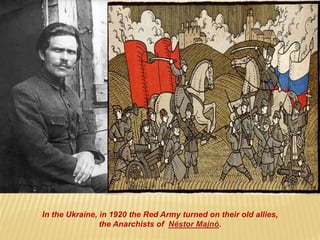
In the Ukraine, in 1920 the Red Army turned on their old allies,
the Anarchists of Néstor Majnó.
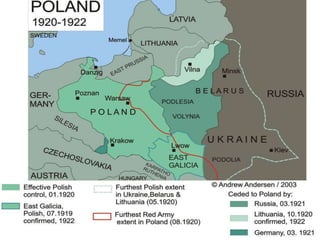
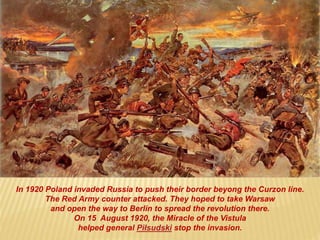
In 1920 Poland invaded Russia to push their border beyong the Curzon line.
The Red Army counter attacked. They hoped to take Warsaw
and open the way to Berlin to spread the revolution there.
On 15 August 1920, the Miracle of the Vistula
helped general Piłsudski stop the invasion.
The Menchevics
won the election
in Georgia,
proclaimed
independence
and formed a
government with
international
recognition
Between 1920 + 1922,
The Red Army invaded
Central Asia
Armenia, Georgia
and Mongolia,
After the defeat of the Whites, there was a wave of Peasant
uprisings.
Many farm workers were killed and tortured.
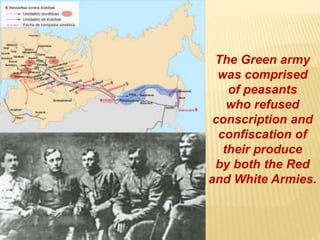
The Green army
was comprised
of peasants
who refused
conscription and
confiscation of
their produce
by both the Red
and White Armies.
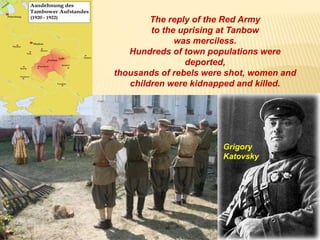
The reply of the Red Army
to the uprising at Tanbow
was merciless.
Hundreds of town populations were
deported,
thousands of rebels were shot, women and
children were kidnapped and killed.
Grigory
Katovsky
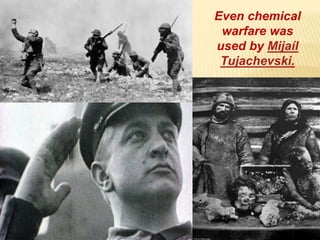
Even chemical
warfare was
used by Mijaíl
Tujachevski.
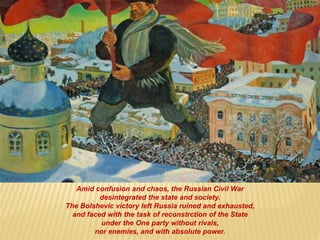
Amid confusion and chaos, the Russian Civil War
desintegrated the state and society.
The Bolshevic victory left Russia ruined and exhausted,
and faced with the task of reconstrction of the State
under the One party without rivals,
nor enemies, and with absolute power.
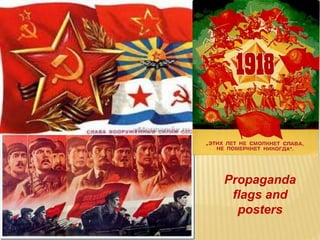
Propaganda
flags and
posters

Russian revolution and communism 3

  • 1.
    CIVIL WAR 1918-1921 RUSSIANREVOLUTION AND COMMUNISM 3
  • 2.
    THE BOLSHEVIC REVOLUTIONIN OTHER COUNTRIES
  • 3.
    A wave ofprotests arose in Germany
  • 4.
    -January 1919 theGerman socialdemocrats asked for help from the Freikorps to surpress the workers revolution in Berlin.
  • 5.
    Karl Liebknecht + RosaLuxemburgo, leaders of the spartakists were killed.
  • 6.
    1917, When thedecree of nations was declared, Finland and Poland both proclaimed independence. The revolution was surpressed in March 1918. During the Civil War, the white terror with German help left 35 000 dead.
  • 8.
    Revolución en Hungría BelaKin inaugrated the Soviet Republic of Hungary but it only lasted 133 days.
  • 9.
    There were riots andinsurrections in Italy between 1919 and 1920.
  • 10.
    In France, UKand USA, there was a wave of protests and strikes but without revolution. IWW Bomb in Chicago 1918 London
  • 11.
    GENERAL SITUATION OFRUSSIA AT THE END OF WW1
  • 12.
    After the Octobrerevolution the paries tried to infiltate the soviets. Slowly but surely the Bolshevics overcame and eliminated all opposing factions. Soviet assembly
  • 13.
    Industrial production was stalledby the war, the stirkes and lockouts.
  • 14.
    In 1918 thesoviets organised forced requisitions of food from the farms for the cities. They were often violent robberies.
  • 15.
    Hundreds of stikerswere shot. The trade unions were purged and made more pro-Bolshevic. The coops were transformed . They all became instruments of the system.
  • 16.
    The economic situationsuffered with the invasion of the Ukraine by the Germans, and after the embargo imposed on Russia by her enemies, USA, UK, Frnace, Germany and Japan.
  • 19.
    War Communism: 1) Productionshould be run by the state. Private ownership should be kept to the minimum. Private houses were to be confiscated by the state. 2) State control was to be granted over the labour of every citizen. Once a military army had served its purpose, it would become a labour army. 3) The state should produce everything in its own undertakings. The state tried to control the activities of millions of peasants. 4) Extreme centralisation was introduced. 5) The state attempted to become the soul distributor as well as the sole producer 6) War Communism attempted to abolish money as a means of exchange
  • 20.
    The economy wasin ruins, and the transport system destroyed. The black marked and barter system flourished. The system unjustly favoured soldiers and burocrats.
  • 21.
    COMMUNIST WAR ECONOMY Inorder to fight the war, Lenin’s government nationalized almost all the commerce, banks and industry and craftmanship. The houses of the bourgeois were collectivized.
  • 22.
  • 24.
    The All Russian ConstituentAssembly was a constitutional body convened in Russia after the October Revolution of 1917. It met for 13 hours, from 4 p.m. to 5 a.m., 18–19 January 1918, whereupon it was dissolved by the All- Russian Central Executive Committee, making the Third All- Russian Congress of Soviets the new governing body of Russia.
  • 26.
    Russian Constituent Assembly Waselected Nov 1917 The Bolshevics only received 25% of votes and were a minority. With 175 of the 707 deputies. The majority was Social- revolutionary, having been elected by the rural population.
  • 27.
    Víktor Chernov, social-revolucionary,was elected president of the assembly, with 246 votes over 151 of Mariya Spiridónova, Social-revolucionary of the left, supported by the Bolchevics.
  • 28.
    The Constitutional Assemblywas disolved by the Red Guard after its first meeting 19 jan 1918. The majority of the population were indifferent, yet 20 protesters were killed.
  • 29.
    Some thought theBolshevic seizure of control was illegal, and 50 abandoned the congress. These revolutionary socialists and menchevics created the «Committee for the Salvation of the fatherland and the revolution”.
  • 30.
    Máximo Gorki Wrote on7 Dec 1917 – the Bolshevics have positioned themselves in the Congress of Soviets taking power for themselves not for the soviets. -- - this is an olgarchy republic of some commisars of
  • 31.
    Thousands of cadetesand officials like Kornílov, fled and reunited in the Don Republic, forming the Volunteer army, led by the tzarist general Mijaíl Alexéyev. They cruelly surpressed the workers’ Rising of Rostov 26 nov 1917 and Taganrog 2 jan 1918., but were dispersed by the Red Guards. General Mijaíl Alexeyev
  • 33.
    Bolshevic Surpression Seven newspaperswere forbidden in the capital The leftist social-revolutionary paper disappeared in July 1918
  • 34.
    - the cadeteleaders, heading the resistance, were arrested - the legal Menshevic paper disappeared in 1919 - and the anarchists newspaper was ended in 1921
  • 35.
  • 36.
    There was aseries of terrorist attacks against the Bolshevic leaders, like Moiséi Uritski, assasinated 30 August, 1918 WHITE TERROR
  • 37.
    Lenin, was badlyinjured when shot by Fanya Kaplan. She was quickly executed just afterwards. Fania
  • 38.
  • 39.
  • 40.
    White army aboutto shoot a red army soldier
  • 41.
    Killings by Whites inIzhevsk 1918 The whites encouraged the peasants to rebel against the red army
  • 43.
  • 44.
  • 45.
    Lenin and thePolitburo dicided in secret to execute the imperial family. This was done on 17 july 1918 in Ekaterimburgo
  • 46.
    The orthodox church,which had taken the side of the the anti Bolshevic reaccionaries suffered detentions, executions, expoliations and destruction in an attempt ot erradicate their former power, and authority and even the religious faith. About 20,000 pirests were killed between 1917-1918.
  • 47.
    About 140 000people died as a result of the Red Terror Menchevics, anarchists, social-revolutionaries, liberals and democrats, whites and nationalists…..
  • 48.
    even pacifists likeTolstoy, Sionists, Bundists, etc. along with many others whose social background or maginality aroused suspicion were eliminated.
  • 50.
    THE CHEKA "The All-Russian EmergencyCommission for Combating Counter- Revolution and Sabotage“ was the first of a succession of Soviet state security organizations. It was created on December 20, 1917, after a decree issued by Vladimir Lenin, and was subsequently led by Felix Dzerzhinsky, a Polish aristocrat turned communist.
  • 51.
    The Cheka committeeof 5, 3 bolshevics and 2 socio-revolutionaries, directed by Feliks Dzerzhinski. Their enemies included the kadetes, the social-revolutionaries of the right, reporters, strikers….etc.
  • 52.
    In 1921 theTroops for the Internal Defense of the Republic (a branch of the Cheka) numbered at least 200,000. These troops -policed labor camps; -ran the Gulag system; - conducted requisitions of food; -subjected political opponents to secret arrest, detention, torture and summary execution; -and put down rebellions and riots by workers or peasants, and mutinies in the -desertion-plagued Red Army.
  • 53.
    When the Germanscounter attacked in 1918 the leftist social revolutionaries of Moscow led an insrurrection but were repressed.
  • 54.
    The Social- revolutionary Party ofthe Left was surpressed President Mariya Spiridónova Founded 19 de noviembre Dissolved octubre de 1918 (last congress) Ideology Marxism Populism Position Extreme leftMariya con otras terroristas
  • 55.
    In the first6 months of 1918 the Cheka made 22 executions. In the latter 6 months the made 6000 executions.
  • 56.
    27 march 1918,the Cheka persecuted the press of the opposition increasing the censorship. 11 – 12 April, they attacked the anarchists in Moscow. 1000 men stormed their headquarters arresting 520 and executing 25 others. Nestro Majnó Serguei Nechayev Mijkail Bakunin ANARCHISTS
  • 57.
    In 1918, theCHEKA closed 205 socialist newspapers and dozens of Soviets of the socialrevolutionaries and Menshevics, which had been legally elected. 14 june1918, the Menchevics and leftist social-revolutionaries were expelled from the All Russian Committee of Soviets. This was now comprised solely of Bolshevics. 16 july, the newspaper of Máximo Gorki, New Life, was prohibited by the political police Máximo Gorki
  • 58.
    In retalliation forthe assassination of Bolshevic leader Vladímir Volodarski, 800 worker leaders were arrested in Petrograd in two days and their soviet was dissolved.
  • 59.
  • 60.
    In the Ucraine,the Rada (council) of Kiev gave charge of the army to Symon Petlyura, a socialist nationalist, and broke with Moscow after the October revolution Petlyura
  • 61.
    9 feb 1918,the popular republic of Ucraine signed the Treaty of Brest-Litovsk by which the Central powers recognized the independence of Ukraine.
  • 62.
    3 mar 1918,the Bolchevics signed the Treaty of Brest Litovsk to end the war But they lost 26 % of her population - 27 % of her cultivated territory - 75 % of her steel and iron production.
  • 63.
    After the treatyof Brest- Litovsk, the Triple Entente countries decreed an embargo on Russia and sent troops to stop a German victory on the East front. -The japanese and later USA intervened in Vladivostok in April 1918, -the British landed in Múrmansk y Arjángelsk. - The Turcos crossed the Cáucasous and seiged Bakú, - despite the Treaty, the Germans colaborated with the revolution in Finland and renewed military operations in the Baltics and Ucrania, -In May the Republics of the Caucasus - Georgia, Armenia y Azerbaiyán – also proclaimed independence
  • 64.
    In April +May, the Checoslovac Legion refused to dissolve, and rebelled against the Bolchevics. They dominated the Ural Mountain region and Transiberia. They also possessed all the gold of the Russian imperial bank. They supprorted the social –revolutionaries who formed an independent governement in Samara.
  • 65.
    In May theWhite army advanced throughout the country especially in the Zone of the Don River. Krasnov was the leader of the Cossack, allied to General Denikin, and in Siberia with Admiral Kolchak, who installed the tzarist authority in Omsk.
  • 66.
  • 67.
    The opposition tothe Bolshevics comprised of social-revolutionaries, of the committee of ex-constituents, Menchevics, and even including the Anarchists, who dominated the Ukraine led by Manjó, never dominated the situation. The Bolshevics took control over the revolution by force and repression. Nestor Manjó
  • 68.
    The Red Army controlledonly a small territory the size of Moscow, but had better discipline and organization. They controlled both capitals Moscow and Petrograd and the best roads and railroads.
  • 69.
    The Whites of Kolchak, Yudénich, Denikin+ Wrangel were divided and unable to coordinate their attacks. KOLCHAK YUDÑENICH DENIKIN WRANGEL
  • 70.
    Leaders in theCivil War
  • 71.
    The White Armyand Petlyura did pogroms or systematic persecutions against the Jews There were about 150 000 killed and many violated robbed and vandalised.
  • 72.
    In the Ukraine,in 1920 the Red Army turned on their old allies, the Anarchists of Néstor Majnó.
  • 73.
    In 1920 Polandinvaded Russia to push their border beyong the Curzon line. The Red Army counter attacked. They hoped to take Warsaw and open the way to Berlin to spread the revolution there. On 15 August 1920, the Miracle of the Vistula helped general Piłsudski stop the invasion.
  • 74.
    The Menchevics won theelection in Georgia, proclaimed independence and formed a government with international recognition
  • 75.
    Between 1920 +1922, The Red Army invaded Central Asia Armenia, Georgia and Mongolia,
  • 77.
    After the defeatof the Whites, there was a wave of Peasant uprisings. Many farm workers were killed and tortured.
  • 78.
    The Green army wascomprised of peasants who refused conscription and confiscation of their produce by both the Red and White Armies.
  • 79.
    The reply ofthe Red Army to the uprising at Tanbow was merciless. Hundreds of town populations were deported, thousands of rebels were shot, women and children were kidnapped and killed. Grigory Katovsky
  • 80.
    Even chemical warfare was usedby Mijaíl Tujachevski.
  • 81.
    Amid confusion andchaos, the Russian Civil War desintegrated the state and society. The Bolshevic victory left Russia ruined and exhausted, and faced with the task of reconstrction of the State under the One party without rivals, nor enemies, and with absolute power.
  • 82.