Russian Revolution:  Study Guide Part I B. Bergey, 2007
Before the Revolution
Question 1:  Fill in the Blank 1a.  The Russian Empire in 1861 stretched _______________ miles from east to west. 1b.  The Russian Empire had a population of _______________. 1c.  More than ______________ languages were spoken.
Question 1:  Fill in the Blank 1a.  The Russian Empire in 1861 stretched  7,000  miles from east to west. 1b.  The Russian Empire had a population of  74 million . 1c.  More than  100  languages were spoken.
How was Russia governed? Tsar; Romanov family since 1613 Nobles and Clergy:  Landowning class Serfs:  90%, lived in 750,000 small villages No political parties No legislator No constitution
What were the political groups struggling for? Largely supportive of the Tsar Generations of repression and suffering left intellectual groups seeking change Non-Russian minorities (Poles, Jews, Finns, Ukrainians) wanted to free themselves from tsar Groups roughly divided into two categories: Liberal Reformers Socialists
Q2:  List the general goals of the: Liberal Reformers: Implement Enlightenment ideas Emphasize individual freedom Protect individual right Rule of law through constitutional practices
Q2:  List the general goals of the: Socialists: End exploitation of peasants and workers By giving “means of production” to workers Dismantle capitalism Create a classless society
Marx’s Ideas German philosopher Communist Manifesto , 1848;  Capital , 1867 History is struggle between class struggle Fundamental crisis between property owners and those who labor on that property Stages of economic development; industrial capitalism is last stage In each stage, oppressed class rises up against owners, Eventually, private property abolished and collectively owned
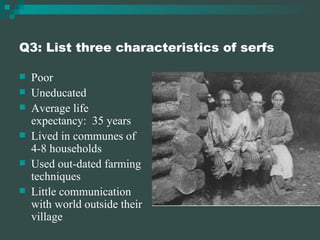
Q3: List three characteristics of serfs Poor Uneducated Average life expectancy:  35 years Lived in communes of 4-8 households Used out-dated farming techniques Little communication with world outside their village
Volga Barge Haulers
Q4: List four reforms of Alexander II Land transference  (starting 1861) Jury trials Relaxed censorship laws Elected assembles ( zemstvos ) for local issues (e.g., roads, primary education, taxation) State-support industries (e.g., rail construction) Encouraged foreign & domestic  entrepreneurs
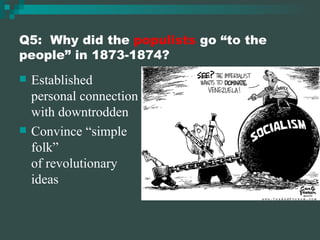
Q5:  Why did the  populists  go “to the people” in 1873-1874? Established personal connection with downtrodden Convince “simple folk”  of revolutionary ideas
Q6:  List two consequences of the famine of 1891 Small-scale revolts Land seizures Banned newspaper reports of famine “ Crystallized political and social awakening of the educated class ”
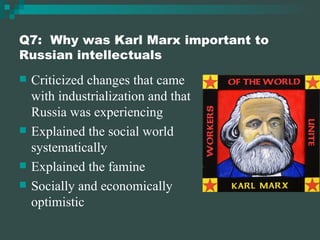
Q7:  Why was Karl Marx important to Russian intellectuals Criticized changes that came with industrialization and that Russia was experiencing Explained the social world systematically Explained the famine Socially and economically optimistic
Problems in the cities Peasants flocked to cities to work industrial jobs Urban pop. From 7 to 21 million Overcrowded cities Unsanitary housing Low pay Unsafe work conditions Hostility of workers grows Workers banded together Increasingly large-scale strikes
Discontent Groups Middle-class liberals Repressed minorities Landless peasants Industrial workers
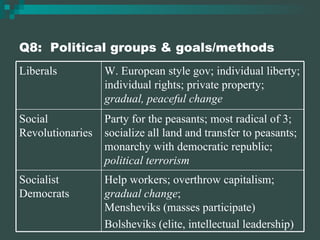
Q8:  Political groups & goals/methods Help workers; overthrow capitalism;  gradual change ;  Mensheviks (masses participate) Bolsheviks (elite, intellectual leadership) Socialist Democrats Party for the peasants; most radical of 3; socialize all land and transfer to peasants; monarchy with democratic republic;  political terrorism Social Revolutionaries W. European style gov; individual liberty; individual rights; private property;  gradual, peaceful change Liberals
Growth of Russia
Permafrost in Russia
Peasant Unrest
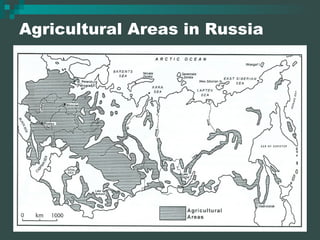
Agricultural Areas in Russia
1905 Revolution
1905 Revolution Sunday Jan. 9, 1905  Bloody Sunday 150,000 workers, women and children Peaceful march on Tsar’s Winter Palace, St. Petersburg Forty killed, hundreds wounded Clashes elsewhere in city, 200 dead
Q9:  How did Bloody Sunday change people’s attitudes toward the Tsar? No longer protective “Little Father” Violent reaction to peaceful protest Unable to meet needs of the people
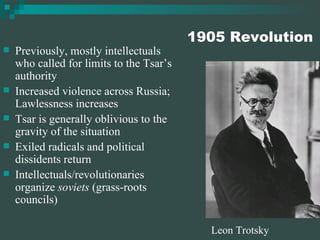
1905 Revolution Previously, mostly intellectuals who called for limits to the Tsar’s authority Increased violence across Russia; Lawlessness increases Tsar is generally oblivious to the gravity of the situation Exiled radicals and political dissidents return Intellectuals/revolutionaries organize  soviets  (grass-roots councils) Leon Trotsky
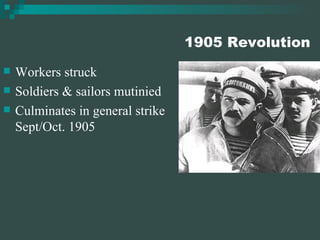
1905 Revolution Workers struck Soldiers & sailors mutinied Culminates in general strike Sept/Oct. 1905
October Manifesto Expansion of civil liberties Limited Monarchy Legislator elected by universal suffrage, called Duma Legalization of trade unions and political parties In response to the October general strike
Failure of the October Manifesto By May 1906, Nicholas had reclaimed almost all autocratic powers Was able to appoint half of the Duma Shut down 4 Dumas from 1906-1916 Could make laws by decree when Duma not in session Complete control over army, foreign police and secret police
October Manifesto Splits Liberals Octobrists :  View manifesto as a good starting point for cooperation with Tsar; favored limited suffrage and gradual change Kadets : questioned Tsars’ willingness to deliver; worked for further concessions Socialist:  rejected manifesto, called for radical political and social change Conservatives:  Pro-Tsar groups (Union of the Russian People, Black Hundreds) beat ethnic minorities and those having democratic sympathies
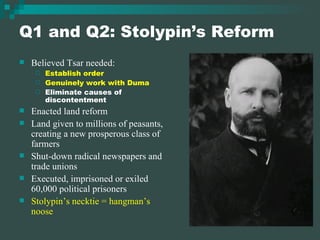
Q1 and Q2: Stolypin’s Reform Believed Tsar needed: Establish order Genuinely work with Duma Eliminate causes of discontentment Enacted land reform Land given to millions of peasants, creating a new prosperous class of farmers Shut-down radical newspapers and trade unions Executed, imprisoned or exiled 60,000 political prisoners Stolypin’s necktie = hangman’s noose
Q3: Fill in the Blank “ Stolypin wanted to drive the  poorer  and  inefficient  peasants off the land allowing them to sell to the more  productive  and  wealthier  peasants”
Q3: Fill in the Blank “ Stolypin wanted to drive the  poorer  and  inefficient  peasants off the  land  allowing them to sell to the more  productive  and wealthier peasants”
Q4: Pos/Neg Economic Indicators Renewed growth of Russian and foreign industry Iron/coal production   Imports/exports   World’s leading grain exporter Capitalists made record profits 17,000 peasant disturbances 3 million workers participate in 9,000 strikes Prices triple while wages double 6 million war refugees and new hires in cities
Russia in WWI After initial success, Russia suffers badly in WWI Poor transportation left the front lacking guns, ammunition, and materials By 1915, supply of riffles exhausted; fought with clubs Peasants  drafted Nicholas, though inexperienced, takes control Increasing numbers of troops desert the front
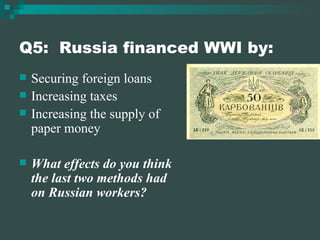
Q5:  Russia financed WWI by: Securing foreign loans Increasing taxes Increasing the supply of paper money What effects do you think the last two methods had on Russian workers?
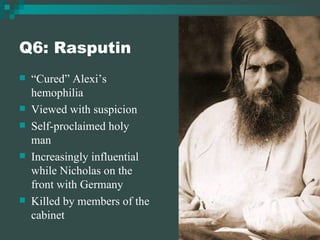
Q6: Rasputin “ Cured” Alexi’s hemophilia  Viewed with suspicion Self-proclaimed holy man Increasingly influential while Nicholas on the front with Germany Killed by members of the cabinet
 
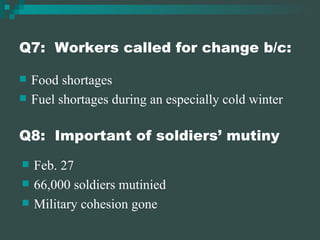
Q7:  Workers called for change b/c: Food shortages Fuel shortages during an especially cold winter Q8:  Important of soldiers’ mutiny Feb. 27 66,000 soldiers mutinied Military cohesion gone
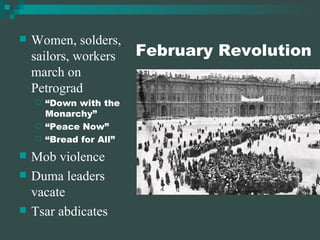
February Revolution Women, solders, sailors, workers march on Petrograd “Down with the Monarchy” “Peace Now” “Bread for All” Mob violence Duma leaders vacate Tsar abdicates
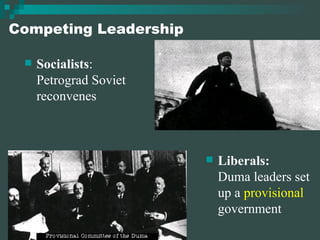
Competing Leadership Socialists : Petrograd Soviet reconvenes  Liberals: Duma leaders set up a  provisional  government
Q9: Soviet’s gained loyalty by: “Order Number One” which gave Soviets the ability to overrule the military, thereby absolving the soldiers who had mutinied
Q10: Political Reforms by Provisional Government Freedom of assembly, speech, press Universal suffrage Repealed legal restrictions on religion, class, and race Outlawed capital punishment Brought police under local government
Alexander Kerensky Socialist Leader in both provisional government and Petrograd soviet Believed Russia should stay in the WWI
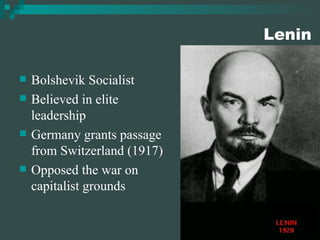
Lenin Bolshevik Socialist Believed in elite leadership Germany grants passage from Switzerland (1917) Opposed the war on capitalist grounds
Red Guard  Take Over General Kornilov attempts to take Petrograd, seeking military dictatorship Provisional gov’t sought help from Red Guard, the Bolshevik militia Red Guard easily defeats military troops, gains weapons, respect and experience Three weeks later, Red Guard overtake the provisional gov’t Little resistance
Civil War Only Bolsheviks were selected to lead Anti-Bolshevik forces formed in provinces, called Whites
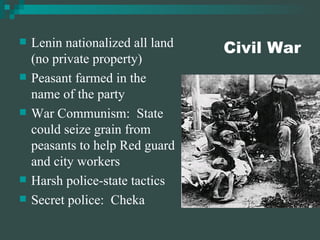
Civil War Lenin nationalized all land (no private property) Peasant farmed in the name of the party War Communism:  State could seize grain from peasants to help Red guard and city workers Harsh police-state tactics Secret police:  Cheka
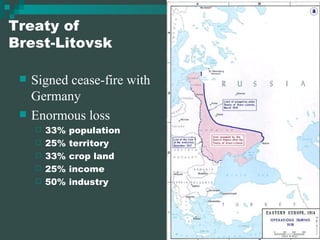
Treaty of  Brest-Litovsk Signed cease-fire with Germany Enormous loss 33% population 25% territory 33% crop land 25% income 50% industry
After the Civil War: Chaos in Russia Civil War ends 1921 Millions of casualties from WWI Billions of dollars lost in WWI Wages at 1/10 of pre-war levels Inflation = 1000% De-urbanization 50% in Moscow 60% in Petrograd
New Economic Policy (NEP) Reintroduced limited capitalism “ One step backwards to take two steps forward” Peasants could sell food on open markets Retail shops allowed Entrepreneurs encouraged to sell consumer goods Gov’t controlled major industries (mining, steel, transportation) Huge success
Communist Society With an improved economy, Lenin started to construct the society he envisioned Equality between men and women Universal suffrage Disallowed titles of mobility and rank Church stripped of land, money and influence in education and gov’t
Communist Society Desired to be industrially self-sufficient Needed to educate peasants (literacy campaign) Hospitals and clinics Trained doctors (including women)
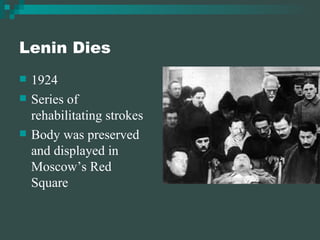
Lenin Dies 1924 Series of rehabilitating strokes Body was preserved and displayed in Moscow’s Red Square
Building the Communist Soviet Union 1922 Constitution both Democratic and Socialist Elected Legislature All rights to all people Universal suffrage In reality: Communist Party ruled, not people Army and secret police maintained order Russia—the largest republic of the Union—ruled the others
Stalin takes power Stalin = “Man of Steel” Stalin politically outmaneuvers Trotsky as Lenin’s successor Trotsky criticizes Stalin and goes into exile Killed by Stalin supporter in Mexico, 1940
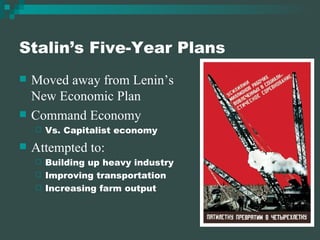
Stalin’s Five-Year Plans Moved away from Lenin’s New Economic Plan Command Economy Vs. Capitalist economy Attempted to: Building up heavy industry Improving transportation Increasing farm output
5 year plans successful? Yes Incentives to those who met high expectations; punishment for those who failed Larger factories Hydorelectric power stations Oil, coal, steel production grew Mining expanded More railroads built No Peasants’ and workers’ lives improved little Wages low Consumer goods scarce Central planning inefficient Shortages & surpluses Low quality goods
Revolution in Agriculture Reclaimed small farming units from Lenin’s NEP Collectivization Created large collectives Peasants reacted by killing animals, destroying tools, burning crops Resistance was met with brutality
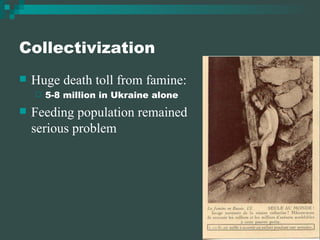
Collectivization Huge death toll from famine: 5-8 million in Ukraine alone Feeding population remained serious problem
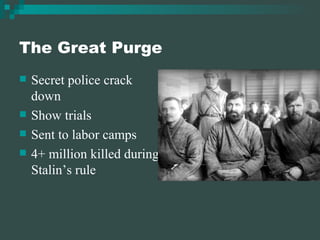
The Great Purge Secret police crack down Show trials Sent to labor camps 4+ million killed during Stalin’s rule
Totalitarian Control Marx said the state would wither away under communism Under Stalin, it became the ultimate power Totalitarianism: State controls all aspects of society Through terror Through propaganda
YouTube:  “Propaganda Stalin”
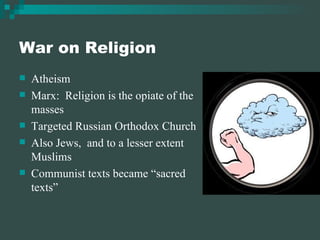
War on Religion Atheism Marx:  Religion is the opiate of the masses Targeted Russian Orthodox Church Also Jews,  and to a lesser extent Muslims Communist texts became “sacred texts”
Changes in Society
New Elite Noble class destroyed Communist Party official become new elite Industrial managers Military leaders Scientists Special homes Special stores for consumer goods
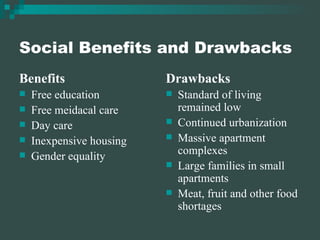
Social Benefits and Drawbacks Benefits Free education Free meidacal care Day care Inexpensive housing Gender equality Drawbacks Standard of living remained low Continued urbanization Massive apartment complexes Large families in small apartments Meat, fruit and other food shortages

Russian Revolution

  • 1.
    Russian Revolution: Study Guide Part I B. Bergey, 2007
  • 2.
  • 3.
    Question 1: Fill in the Blank 1a. The Russian Empire in 1861 stretched _______________ miles from east to west. 1b. The Russian Empire had a population of _______________. 1c. More than ______________ languages were spoken.
  • 4.
    Question 1: Fill in the Blank 1a. The Russian Empire in 1861 stretched 7,000 miles from east to west. 1b. The Russian Empire had a population of 74 million . 1c. More than 100 languages were spoken.
  • 5.
    How was Russiagoverned? Tsar; Romanov family since 1613 Nobles and Clergy: Landowning class Serfs: 90%, lived in 750,000 small villages No political parties No legislator No constitution
  • 6.
    What were thepolitical groups struggling for? Largely supportive of the Tsar Generations of repression and suffering left intellectual groups seeking change Non-Russian minorities (Poles, Jews, Finns, Ukrainians) wanted to free themselves from tsar Groups roughly divided into two categories: Liberal Reformers Socialists
  • 7.
    Q2: Listthe general goals of the: Liberal Reformers: Implement Enlightenment ideas Emphasize individual freedom Protect individual right Rule of law through constitutional practices
  • 8.
    Q2: Listthe general goals of the: Socialists: End exploitation of peasants and workers By giving “means of production” to workers Dismantle capitalism Create a classless society
  • 9.
    Marx’s Ideas Germanphilosopher Communist Manifesto , 1848; Capital , 1867 History is struggle between class struggle Fundamental crisis between property owners and those who labor on that property Stages of economic development; industrial capitalism is last stage In each stage, oppressed class rises up against owners, Eventually, private property abolished and collectively owned
  • 10.
    Q3: List threecharacteristics of serfs Poor Uneducated Average life expectancy: 35 years Lived in communes of 4-8 households Used out-dated farming techniques Little communication with world outside their village
  • 11.
  • 12.
    Q4: List fourreforms of Alexander II Land transference (starting 1861) Jury trials Relaxed censorship laws Elected assembles ( zemstvos ) for local issues (e.g., roads, primary education, taxation) State-support industries (e.g., rail construction) Encouraged foreign & domestic entrepreneurs
  • 13.
    Q5: Whydid the populists go “to the people” in 1873-1874? Established personal connection with downtrodden Convince “simple folk” of revolutionary ideas
  • 14.
    Q6: Listtwo consequences of the famine of 1891 Small-scale revolts Land seizures Banned newspaper reports of famine “ Crystallized political and social awakening of the educated class ”
  • 15.
    Q7: Whywas Karl Marx important to Russian intellectuals Criticized changes that came with industrialization and that Russia was experiencing Explained the social world systematically Explained the famine Socially and economically optimistic
  • 16.
    Problems in thecities Peasants flocked to cities to work industrial jobs Urban pop. From 7 to 21 million Overcrowded cities Unsanitary housing Low pay Unsafe work conditions Hostility of workers grows Workers banded together Increasingly large-scale strikes
  • 17.
    Discontent Groups Middle-classliberals Repressed minorities Landless peasants Industrial workers
  • 18.
    Q8: Politicalgroups & goals/methods Help workers; overthrow capitalism; gradual change ; Mensheviks (masses participate) Bolsheviks (elite, intellectual leadership) Socialist Democrats Party for the peasants; most radical of 3; socialize all land and transfer to peasants; monarchy with democratic republic; political terrorism Social Revolutionaries W. European style gov; individual liberty; individual rights; private property; gradual, peaceful change Liberals
  • 19.
  • 20.
  • 21.
  • 22.
  • 23.
  • 24.
    1905 Revolution SundayJan. 9, 1905 Bloody Sunday 150,000 workers, women and children Peaceful march on Tsar’s Winter Palace, St. Petersburg Forty killed, hundreds wounded Clashes elsewhere in city, 200 dead
  • 25.
    Q9: Howdid Bloody Sunday change people’s attitudes toward the Tsar? No longer protective “Little Father” Violent reaction to peaceful protest Unable to meet needs of the people
  • 26.
    1905 Revolution Previously,mostly intellectuals who called for limits to the Tsar’s authority Increased violence across Russia; Lawlessness increases Tsar is generally oblivious to the gravity of the situation Exiled radicals and political dissidents return Intellectuals/revolutionaries organize soviets (grass-roots councils) Leon Trotsky
  • 27.
    1905 Revolution Workersstruck Soldiers & sailors mutinied Culminates in general strike Sept/Oct. 1905
  • 28.
    October Manifesto Expansionof civil liberties Limited Monarchy Legislator elected by universal suffrage, called Duma Legalization of trade unions and political parties In response to the October general strike
  • 29.
    Failure of theOctober Manifesto By May 1906, Nicholas had reclaimed almost all autocratic powers Was able to appoint half of the Duma Shut down 4 Dumas from 1906-1916 Could make laws by decree when Duma not in session Complete control over army, foreign police and secret police
  • 30.
    October Manifesto SplitsLiberals Octobrists : View manifesto as a good starting point for cooperation with Tsar; favored limited suffrage and gradual change Kadets : questioned Tsars’ willingness to deliver; worked for further concessions Socialist: rejected manifesto, called for radical political and social change Conservatives: Pro-Tsar groups (Union of the Russian People, Black Hundreds) beat ethnic minorities and those having democratic sympathies
  • 31.
    Q1 and Q2:Stolypin’s Reform Believed Tsar needed: Establish order Genuinely work with Duma Eliminate causes of discontentment Enacted land reform Land given to millions of peasants, creating a new prosperous class of farmers Shut-down radical newspapers and trade unions Executed, imprisoned or exiled 60,000 political prisoners Stolypin’s necktie = hangman’s noose
  • 32.
    Q3: Fill inthe Blank “ Stolypin wanted to drive the poorer and inefficient peasants off the land allowing them to sell to the more productive and wealthier peasants”
  • 33.
    Q3: Fill inthe Blank “ Stolypin wanted to drive the poorer and inefficient peasants off the land allowing them to sell to the more productive and wealthier peasants”
  • 34.
    Q4: Pos/Neg EconomicIndicators Renewed growth of Russian and foreign industry Iron/coal production  Imports/exports  World’s leading grain exporter Capitalists made record profits 17,000 peasant disturbances 3 million workers participate in 9,000 strikes Prices triple while wages double 6 million war refugees and new hires in cities
  • 35.
    Russia in WWIAfter initial success, Russia suffers badly in WWI Poor transportation left the front lacking guns, ammunition, and materials By 1915, supply of riffles exhausted; fought with clubs Peasants drafted Nicholas, though inexperienced, takes control Increasing numbers of troops desert the front
  • 36.
    Q5: Russiafinanced WWI by: Securing foreign loans Increasing taxes Increasing the supply of paper money What effects do you think the last two methods had on Russian workers?
  • 37.
    Q6: Rasputin “Cured” Alexi’s hemophilia Viewed with suspicion Self-proclaimed holy man Increasingly influential while Nicholas on the front with Germany Killed by members of the cabinet
  • 38.
  • 39.
    Q7: Workerscalled for change b/c: Food shortages Fuel shortages during an especially cold winter Q8: Important of soldiers’ mutiny Feb. 27 66,000 soldiers mutinied Military cohesion gone
  • 40.
    February Revolution Women,solders, sailors, workers march on Petrograd “Down with the Monarchy” “Peace Now” “Bread for All” Mob violence Duma leaders vacate Tsar abdicates
  • 41.
    Competing Leadership Socialists: Petrograd Soviet reconvenes Liberals: Duma leaders set up a provisional government
  • 42.
    Q9: Soviet’s gainedloyalty by: “Order Number One” which gave Soviets the ability to overrule the military, thereby absolving the soldiers who had mutinied
  • 43.
    Q10: Political Reformsby Provisional Government Freedom of assembly, speech, press Universal suffrage Repealed legal restrictions on religion, class, and race Outlawed capital punishment Brought police under local government
  • 44.
    Alexander Kerensky SocialistLeader in both provisional government and Petrograd soviet Believed Russia should stay in the WWI
  • 45.
    Lenin Bolshevik SocialistBelieved in elite leadership Germany grants passage from Switzerland (1917) Opposed the war on capitalist grounds
  • 46.
    Red Guard Take Over General Kornilov attempts to take Petrograd, seeking military dictatorship Provisional gov’t sought help from Red Guard, the Bolshevik militia Red Guard easily defeats military troops, gains weapons, respect and experience Three weeks later, Red Guard overtake the provisional gov’t Little resistance
  • 47.
    Civil War OnlyBolsheviks were selected to lead Anti-Bolshevik forces formed in provinces, called Whites
  • 48.
    Civil War Leninnationalized all land (no private property) Peasant farmed in the name of the party War Communism: State could seize grain from peasants to help Red guard and city workers Harsh police-state tactics Secret police: Cheka
  • 49.
    Treaty of Brest-Litovsk Signed cease-fire with Germany Enormous loss 33% population 25% territory 33% crop land 25% income 50% industry
  • 50.
    After the CivilWar: Chaos in Russia Civil War ends 1921 Millions of casualties from WWI Billions of dollars lost in WWI Wages at 1/10 of pre-war levels Inflation = 1000% De-urbanization 50% in Moscow 60% in Petrograd
  • 51.
    New Economic Policy(NEP) Reintroduced limited capitalism “ One step backwards to take two steps forward” Peasants could sell food on open markets Retail shops allowed Entrepreneurs encouraged to sell consumer goods Gov’t controlled major industries (mining, steel, transportation) Huge success
  • 52.
    Communist Society Withan improved economy, Lenin started to construct the society he envisioned Equality between men and women Universal suffrage Disallowed titles of mobility and rank Church stripped of land, money and influence in education and gov’t
  • 53.
    Communist Society Desiredto be industrially self-sufficient Needed to educate peasants (literacy campaign) Hospitals and clinics Trained doctors (including women)
  • 54.
    Lenin Dies 1924Series of rehabilitating strokes Body was preserved and displayed in Moscow’s Red Square
  • 55.
    Building the CommunistSoviet Union 1922 Constitution both Democratic and Socialist Elected Legislature All rights to all people Universal suffrage In reality: Communist Party ruled, not people Army and secret police maintained order Russia—the largest republic of the Union—ruled the others
  • 56.
    Stalin takes powerStalin = “Man of Steel” Stalin politically outmaneuvers Trotsky as Lenin’s successor Trotsky criticizes Stalin and goes into exile Killed by Stalin supporter in Mexico, 1940
  • 57.
    Stalin’s Five-Year PlansMoved away from Lenin’s New Economic Plan Command Economy Vs. Capitalist economy Attempted to: Building up heavy industry Improving transportation Increasing farm output
  • 58.
    5 year planssuccessful? Yes Incentives to those who met high expectations; punishment for those who failed Larger factories Hydorelectric power stations Oil, coal, steel production grew Mining expanded More railroads built No Peasants’ and workers’ lives improved little Wages low Consumer goods scarce Central planning inefficient Shortages & surpluses Low quality goods
  • 59.
    Revolution in AgricultureReclaimed small farming units from Lenin’s NEP Collectivization Created large collectives Peasants reacted by killing animals, destroying tools, burning crops Resistance was met with brutality
  • 60.
    Collectivization Huge deathtoll from famine: 5-8 million in Ukraine alone Feeding population remained serious problem
  • 61.
    The Great PurgeSecret police crack down Show trials Sent to labor camps 4+ million killed during Stalin’s rule
  • 62.
    Totalitarian Control Marxsaid the state would wither away under communism Under Stalin, it became the ultimate power Totalitarianism: State controls all aspects of society Through terror Through propaganda
  • 63.
  • 64.
    War on ReligionAtheism Marx: Religion is the opiate of the masses Targeted Russian Orthodox Church Also Jews, and to a lesser extent Muslims Communist texts became “sacred texts”
  • 65.
  • 66.
    New Elite Nobleclass destroyed Communist Party official become new elite Industrial managers Military leaders Scientists Special homes Special stores for consumer goods
  • 67.
    Social Benefits andDrawbacks Benefits Free education Free meidacal care Day care Inexpensive housing Gender equality Drawbacks Standard of living remained low Continued urbanization Massive apartment complexes Large families in small apartments Meat, fruit and other food shortages