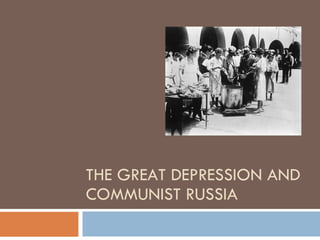
THE GREAT DEPRESSION AND COMMUNIST RUSSIA
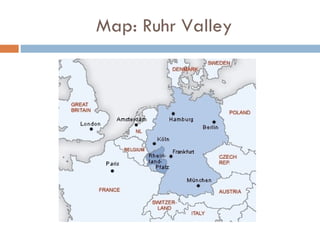
I. Legacy of WWI & Peace By 1922, Germany unable to pay reparations France occupied the heavily industrialized Ruhr valley, using mine and factories to collect money in place of reparations Germany responded by printing more money, lowering the value and increasing inflation Germany plagued with political unrest by those unhappy that Germany agreed to the Versailles Treaty
Map: Ruhr Valley
I. Legacy of WWI & Peace 1924, the U.S. Dawes Plan reduced German reparation payments and based payments on the ability of Germany to pay Included a loan of $200 million Heavy U.S. investment in Europe 1925, Treaty of Locarno Allowed Germany into the League of Nations
I. Legacy of WWI & Peace Alsace-Lorraine returned to France Rhineland a neutral zone Disarmament weak – League said to disarm “to the lowest point consistent with national safety” – nations not quick to disarm due to mutual lingering mistrust
II. The Great Depression Domestic economies weak and increasingly controlled by governments Countries plagued by war debts and reparation payments Prices for agricultural goods declining due to over production To protect economies, central and eastern Europeans countries closed borders off to trade and imposed tariffs
II. The Great Depression Economies were international U.S. invested heavily in German bonds and industries, which brought prosperity to all of Europe between 1924-1929 American economy booming, so investors pulled out of Germany to invest at home Buying on margin (only paying 10% of cost at the time) led to a lot of buying and selling for profit – stock prices rose – when people lost confidence in the market, they sold in mass numbers
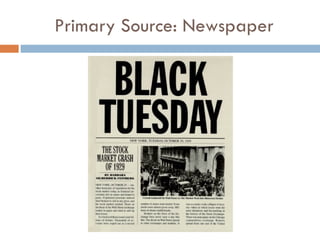
II. The Great Depression October, 1929, crash of the stock market led to panicked withdrawal of money from German and European markets Withdrawal of money weakened Germany and other European states
Primary Source: Newspaper
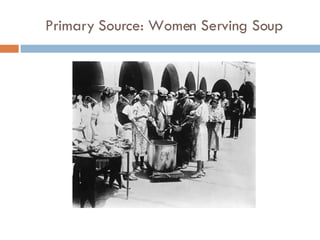
II. The Great Depression Women’s roles and the family Women able to secure low paying jobs in housekeeping or servants while men were unemployed – men resentful of this Young men with nothing to do joined gangs Government inability to fix bad conditions led some countries to be taken easily by Marxist doctrine and dictatorial solutions
Primary Source: Women Serving Soup
III. The World in Depression Britain Suffering after WWI from a decline in the steel, coal, and textile industry – led to unemployment Labour Party replaced by Conservatives who provided low interest loans, devalued the pound, balanced the budget, and used protective tariffs
III. The World in Depression Cambridge economist, John Maynard Keynes said that unemployment could be brought to an end by putting people back to work even if the government went into debt so that demand would go back up Britain alleviated when it began its armament industries again
III. The World in Depression France Not hit hard until 1932 due to its balanced economy Depression led to political chaos – leftist communist, socialist, and radicals formed Popular Front party Instituted collective bargaining, 40-hour work week, two week paid vacations, and minimal wages Did not solve conditions of depression
III. The World in Depression Germany Weimar Republic established in 1918 Economic troubles led the German people to dislike the Weimar government, which gave rise to extremist parties
III. The World in Depression U.S. Franklin D. Roosevelt brought in the New Deal, a program of government intervention in the economy Public works projects put people back to work Beginning of the welfare state and Social Security U.S. alleviated by the growth of the armaments industry
IV. Socialism in Russia Problems in Russia: food hording so that it wouldn’t be taken, drought, and reduced industrial production March 1921- New Economic Plan (NEP) Allowed peasants to sell their food Allowed small private businesses though heavy industry, transportation and banking remained in the governments hands By 1922, the market was revived and there was a good harvest
IV. Socialism in Russia Women’s Rights Led by Alexandra Kollontai Health care for women and children, marriage as a civil act, legal divorce, and legal abortions Often faced violence from men who felt threatened by the possible rights of their wives Undone by later Communist leaders
IV. Socialism in Russia Leadership after the death of Lenin Lenin died in 1924 Two political groups battled for power Left- led by Leon Trotsky: end NEP, industrialize, and spread Communism abroad Right- concentrate on making a socialist state and continue the NEP
IV. Socialism in Russia Joseph Stalin was party secretary and used his skills of organization to become leader of the Communist Party
V. Culture and Intellectual Trends WWI supported beliefs that humans were violent animals incapable of rationality Women- shorter skirts, more makeup, short hair, and more exposed body – sexual issues more out in the open Popularity of nihilism- being does not have purpose, value, or truth – morality or higher power does not exist
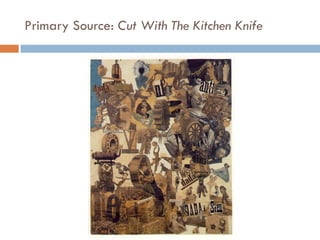
V. Culture and Intellectual Trends Dadaism “ Everything happens in a completely idiotic way. . . . Like everything in life, Dada is useless.” Anti-art to reflect the insanity of life Hannah Hoch-  Cut With The Kitchen Knife  criticized the German Weimar Republic – popular for feminist themes
Primary Source:  Cut With The Kitchen Knife
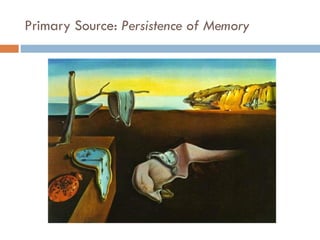
V. Culture and Intellectual Trends Surrealism Reality outside of the material – dreamlike – the unconscious – nightmares and fantasies Salvador Dali-  The Persistence of Memory  – objects outside of their rightful context and place stress irrationality
Primary Source:  Persistence of Memory
V. Culture and Intellectual Trends Functionalism in architecture spread by German Bauhaus school Arnold Schonberg created atonal music without recognizable harmony “ Stream of Consciousness” writing popular – stressed internal dialogue such as James Joyce’s  Ulysses ; other writers like Hermann Hesse wrote about the spiritual loneliness of modern life
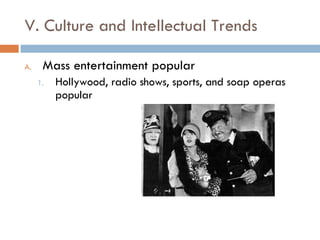
V. Culture and Intellectual Trends Mass entertainment popular Hollywood, radio shows, sports, and soap operas popular

Great Depression & Communist Russia

  • 1.
    THE GREAT DEPRESSIONAND COMMUNIST RUSSIA
  • 2.
    I. Legacy ofWWI & Peace By 1922, Germany unable to pay reparations France occupied the heavily industrialized Ruhr valley, using mine and factories to collect money in place of reparations Germany responded by printing more money, lowering the value and increasing inflation Germany plagued with political unrest by those unhappy that Germany agreed to the Versailles Treaty
  • 3.
  • 4.
    I. Legacy ofWWI & Peace 1924, the U.S. Dawes Plan reduced German reparation payments and based payments on the ability of Germany to pay Included a loan of $200 million Heavy U.S. investment in Europe 1925, Treaty of Locarno Allowed Germany into the League of Nations
  • 5.
    I. Legacy ofWWI & Peace Alsace-Lorraine returned to France Rhineland a neutral zone Disarmament weak – League said to disarm “to the lowest point consistent with national safety” – nations not quick to disarm due to mutual lingering mistrust
  • 6.
    II. The GreatDepression Domestic economies weak and increasingly controlled by governments Countries plagued by war debts and reparation payments Prices for agricultural goods declining due to over production To protect economies, central and eastern Europeans countries closed borders off to trade and imposed tariffs
  • 7.
    II. The GreatDepression Economies were international U.S. invested heavily in German bonds and industries, which brought prosperity to all of Europe between 1924-1929 American economy booming, so investors pulled out of Germany to invest at home Buying on margin (only paying 10% of cost at the time) led to a lot of buying and selling for profit – stock prices rose – when people lost confidence in the market, they sold in mass numbers
  • 8.
    II. The GreatDepression October, 1929, crash of the stock market led to panicked withdrawal of money from German and European markets Withdrawal of money weakened Germany and other European states
  • 9.
  • 10.
    II. The GreatDepression Women’s roles and the family Women able to secure low paying jobs in housekeeping or servants while men were unemployed – men resentful of this Young men with nothing to do joined gangs Government inability to fix bad conditions led some countries to be taken easily by Marxist doctrine and dictatorial solutions
  • 11.
  • 12.
    III. The Worldin Depression Britain Suffering after WWI from a decline in the steel, coal, and textile industry – led to unemployment Labour Party replaced by Conservatives who provided low interest loans, devalued the pound, balanced the budget, and used protective tariffs
  • 13.
    III. The Worldin Depression Cambridge economist, John Maynard Keynes said that unemployment could be brought to an end by putting people back to work even if the government went into debt so that demand would go back up Britain alleviated when it began its armament industries again
  • 14.
    III. The Worldin Depression France Not hit hard until 1932 due to its balanced economy Depression led to political chaos – leftist communist, socialist, and radicals formed Popular Front party Instituted collective bargaining, 40-hour work week, two week paid vacations, and minimal wages Did not solve conditions of depression
  • 15.
    III. The Worldin Depression Germany Weimar Republic established in 1918 Economic troubles led the German people to dislike the Weimar government, which gave rise to extremist parties
  • 16.
    III. The Worldin Depression U.S. Franklin D. Roosevelt brought in the New Deal, a program of government intervention in the economy Public works projects put people back to work Beginning of the welfare state and Social Security U.S. alleviated by the growth of the armaments industry
  • 17.
    IV. Socialism inRussia Problems in Russia: food hording so that it wouldn’t be taken, drought, and reduced industrial production March 1921- New Economic Plan (NEP) Allowed peasants to sell their food Allowed small private businesses though heavy industry, transportation and banking remained in the governments hands By 1922, the market was revived and there was a good harvest
  • 18.
    IV. Socialism inRussia Women’s Rights Led by Alexandra Kollontai Health care for women and children, marriage as a civil act, legal divorce, and legal abortions Often faced violence from men who felt threatened by the possible rights of their wives Undone by later Communist leaders
  • 19.
    IV. Socialism inRussia Leadership after the death of Lenin Lenin died in 1924 Two political groups battled for power Left- led by Leon Trotsky: end NEP, industrialize, and spread Communism abroad Right- concentrate on making a socialist state and continue the NEP
  • 20.
    IV. Socialism inRussia Joseph Stalin was party secretary and used his skills of organization to become leader of the Communist Party
  • 21.
    V. Culture andIntellectual Trends WWI supported beliefs that humans were violent animals incapable of rationality Women- shorter skirts, more makeup, short hair, and more exposed body – sexual issues more out in the open Popularity of nihilism- being does not have purpose, value, or truth – morality or higher power does not exist
  • 22.
    V. Culture andIntellectual Trends Dadaism “ Everything happens in a completely idiotic way. . . . Like everything in life, Dada is useless.” Anti-art to reflect the insanity of life Hannah Hoch- Cut With The Kitchen Knife criticized the German Weimar Republic – popular for feminist themes
  • 23.
    Primary Source: Cut With The Kitchen Knife
  • 24.
    V. Culture andIntellectual Trends Surrealism Reality outside of the material – dreamlike – the unconscious – nightmares and fantasies Salvador Dali- The Persistence of Memory – objects outside of their rightful context and place stress irrationality
  • 25.
    Primary Source: Persistence of Memory
  • 26.
    V. Culture andIntellectual Trends Functionalism in architecture spread by German Bauhaus school Arnold Schonberg created atonal music without recognizable harmony “ Stream of Consciousness” writing popular – stressed internal dialogue such as James Joyce’s Ulysses ; other writers like Hermann Hesse wrote about the spiritual loneliness of modern life
  • 27.
    V. Culture andIntellectual Trends Mass entertainment popular Hollywood, radio shows, sports, and soap operas popular