Jenny Harrow, Cass Business School & John
Higgs, The Joseph Rank Trust
Workshop 1: “Turning Strategy into
Great Performance”
The narrative of the ‘great performance’
is invariably retrospective
when do great performances become
‘classic’, ‘ vintage’ , outdated
or ‘evergreen’?
The ‘strategy to performance’ gap in for-profits
“ companies typically realise only about 60%
of their strategies’ potential value because
of defects and breakdowns in planning and
execution”
Mankins and Steele (2005): “Turning Great Strategy
into Great Performance”, HBR, 2005
What counts as ‘performance’ for charities,
third sector organisations, nonprofits ?
Stone et al (1999, 415)
” ……performance as the ability to acquire
resources necessary for organizational
survival.
…...a proxy measure, indicating perceived
organizational effectiveness and legitimacy by
resource suppliers.”
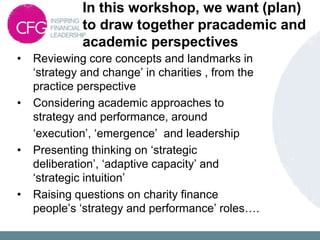
In this workshop, we want (plan)
to draw together pracademic and
academic perspectives
• Reviewing core concepts and landmarks in
‘strategy and change’ in charities , from the
practice perspective
• Considering academic approaches to
strategy and performance, around
‘execution’, ‘emergence’ and leadership
• Presenting thinking on ‘strategic
deliberation’, ‘adaptive capacity’ and
‘strategic intuition’
• Raising questions on charity finance
people’s ‘strategy and performance’ roles….
Strategy and change
• Develop
• Review
• Implement
• Engaging hearts & Minds
hearts and minds………….
• Strategy
• Mission
• Effectiveness
• Trust in the
Brand
• British Army
Malaya
Emergency
1952
• General Sir
Gerald Templer
Definition of strategy for non
profits….
Non-profit strategy is a coherent set of
general ideas which explain how the
organization is going to pursue its vision
and carry out its mission during the years
ahead.
Sheehan, R. M., Jr. (1996). Mission Accomplishment
as Philanthropic Organization Effectiveness. Nonprofit
and Voluntary Sector Quarterly, vol. 25, no. 1, 110-
123.
Recognising strategy in
your organisation
• the pattern of decisions that determines
and reveals its purposes and goals,
which produces the principal policies
and plans for achieving those goals
• levels of input
Development of strategy
non profits focus on their “mission gap”
when creating strategy. They create a
“vision” for what they want to organization
to be like and create a strategy to
achieve the vision, and subsequently
close the mission gap.
Strategy & Mission
Commitment to accomplish the mission
is the driving force for attaining high
performance (Senge, 1990).
Non-profits have missions which are to
make a difference in the world. Their aim
is to accomplish their missions. Their
“mission gap” is a key motivator in
strategy development.
Mission effectiveness
• Defined as the degree to which
employees perceive their organisation
fulfilling its mission or stated charitable
objects.
• Effectiveness is a result of interaction
among the organisation’s trustees, staff,
beneficiaries and other stakeholders.
Measuring effectiveness
The most important benefit of an
appraisal of an organisation’s
effectiveness, is to be able to determine
the extent to which the organisations
mission is being achieved.
Mission trade-offs
Charities must analyse both the direct
and indirect mission impacts of any
initiatives, which may results in a series
of trade-offs between mission-responsive
and financially rewarding activities.
Mission Gap
The term “mission gap” refers to the
difference between the current state of
the condition of the “persons, places,
and/or things” for whom/which the
organization wants to make a difference
and their/its condition in an ideal world
Trust in the brand?
• CFG Chair April
2014:
“charities are
becoming
extraordinarily
disconnected from
supporters who do
not understand the
work they do”
Better
communication
with the public
about the
realities of how
charities work
Brand identity – a good thing?
“ I guess the danger for the charity is
becoming a brand. The brand ought to
be supportive and descriptive of what the
charity really is and does. It is very easy
in this day and age to create a brand,
which bears little resemblance to what
lies underneath”.
Some underlying academic
perspectives:
(i) the deployment or execution
of the ‘strategic plan’ is what
matters
e.g. Kaplan and Norton (2008) The Execution
Premium: linking strategy to operations for
competitive advantage
“ In October 2007, Tony Hayward, new CEO of BP
said “our problem is not about the strategy itself
but our execution of it”
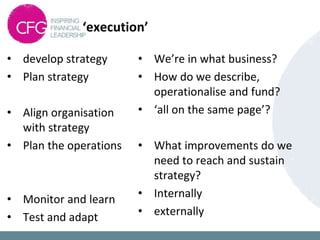
‘execution’
• develop strategy
• Plan strategy
• Align organisation
with strategy
• Plan the operations
• Monitor and learn
• Test and adapt
• We’re in what business?
• How do we describe,
operationalise and fund?
• ‘all on the same page’?
• What improvements do we
need to reach and sustain
strategy?
• Internally
• externally
rational, linear,
prescriptive, reductionist ;
judgmental?
e.g. “Evolution or extinction: A strategy for
nonprofits in the marketplace” (2000)
“From beggar to partner: nonprofit-business
collaboration as a strategic choice for the
nonprofits” (2013)
(Are CFOs the natural executors’?)
(ii) strategy is better
understood as being “crafted”
Mintzberg (1978) strategy as “
a pattern in a stream of
decisions”
deliberate strategy
– patterns intended
before being
realised
emergent strategy
- patterns realised
in spite of or in
the absence of
intentions……
Emergent strategy – does not lend
itself to template –building-
Are CFOs likely emergent strategisers?
With what impacts on performance?
• Can we identify
its components
• Can we express
emergent strategy
visually?
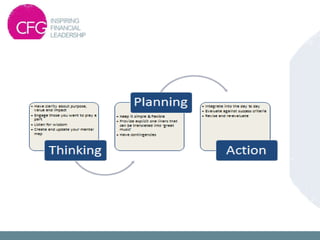
(iii) strategy and leadership are
critically inter-linked
Caroline Copeman at Cass CCE uses
Adair’s leadership model, to derive a
“futures” view of ‘what strategy is about’:
“Strategy, a combination of thinking, planning and
action, can be seen as a means of mobilising an
organisation to get to its future - delivering superior
value and making a difference for beneficiaries”
(iv) Thinking of strategy in terms of
‘strategic conversations’ or
‘deliberations’ (Bryson 2011)
Chadwick-Coule’s (2011) case study research in TSOs
Unitary approach – strategy dominated by CEO and elite
group of board members
Pluralist approach - where a commitment to ‘democratic
discourse’ a on major decisions on resources and mission,
with ‘space for debate beyond those who sit at the apex of the
organisation’
Who are the conversationalists in your
organisation’s strategic conversations?
whose voices are muffled?
Where does and where should the CFO and
finance staff sit – at the apex?
How are ‘all’ best engaged?
Bryson: “no where in the deliberative tradition implies
that there is one best answer to major challenges”
What to deliberate on ? Copeman:
• What do you want the future to hold?
• Which other organisations could you work with?
• Where will you focus your attention?
• How do you take staff and trustees with you?
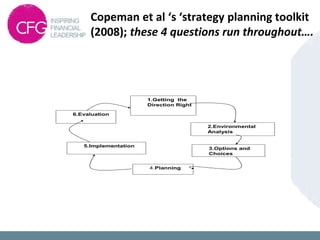
Copeman et al ‘s ‘strategy planning toolkit
(2008); these 4 questions run throughout….
1.Getting the
Direction Right
3.Options and
Choices
4.Planning
5.Implementation
6.Evaluation
2.Environmental
Analysis
But still possible for strategy to be widely
understood in organisations as
“‘ top management’s plans to attain outcomes
consistent with the organisation’s mission
and goals”
(Wright et al, 1992)
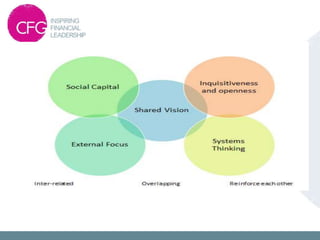
(v) ‘adaptive capacity is critical for
strategy making - where rational and
crafting approaches meet?
Strichman and Marshood ( 2010 )
Haifa-Boston learning exchange, adaptive
capacity in new and early stage nonprofit
organisations as critical:
( where there may be strong consensus on
organisational vision; less on providing
sufficient clarity regarding specific
organisational goals……)
(vi) that divergent thinking has
a critical role, e.g. that of
‘strategic intuition, (Duggan,
2007, 2013)
distinct from ‘ordinary’ intuition (emotion,
feeling)
‘strategic intuition’ –stems from’ thinking’; i.e.
• different from
‘snap judgments’
(which Duggan sees
as ‘expert intuition’)
• Your expert intuition
might see something
familiar and make a
snap judgment too
soon.
• “(This discipline)
requires you to see
when a situation is
new and turn off your
expert intuition”
“strategic intuition is always slow,
it works best for new situations
which is when you need your new
ideas”
“reverse
brainstorming”
“sleep on it”
An especial challenge for
professional staff?
Do we equate CFOs with
strategic intuition?
Who knows if you had a ‘great
performance’ – or a
controversial one?
Some final thoughts -
• Strategic
communications
e.g.
- creating ‘bright
spots’
- focusing on the
impact which data
and data-based
insights can have
Should we still be looking for
‘breakthrough strategies’?
e.g. Sheehan, ‘Breakthrough Strategies for
Nonprofits’, Wiley 2013
For truly significant performance, nonprofit managers
must break through traditional ideas and approaches
and craft aspirational visions, identify relevant
mission accomplishment measures, and execute
strategy focused on achieving outcome-based, stretch
goals.”
Differentiation the key – back to ‘brand’?
CFOs and colleagues….
The challenges of
strategic
differentiation
in third sector
organisations?
How far can we
stretch this ?
Finance functions
and roles –
Are they , should
they be a critical
differentiator?
Bryson, J. M.(2011) Strategic Planning for Public and Nonprofit Organisations :A
guide to strengthening and sustaining organizational achievement, John Wiley. fourth
edition
Chadwick-Coule, T. (2011). Social Dynamics and the Strategy Process: Bridging or
Creating a Divide Between Trustees and Staff?. Nonprofit and Voluntary Sector
Quarterly, 40(1), 33-56.
Copeman, C, Bruce, I, Forrest, A, Lesirge, R, Palmer, P and Patel, A (2008) ‘Tools for
Tomorrow’ ,NCVO: London
Crittenden, W. F. (2013). Book Review: Mission Impact: Breakthrough Strategies for
Nonprofits, by Robert M. Sheehan Jr. Nonprofit and Voluntary Sector Quarterly,
42(6), 1288-1290.
Duggan,W.(2007, 2013) Strategic Intuition: the creative spark in human achievement,
Columbia University Press.
Kaplan, R. and Norton, D.S. (2008) The Execution Premium –;linking strategy to
operations for competitive advantage, Harvard Business School Publishing, Boston
Mankins, M. C., & Steele, R. (2005). Turning great strategy into great performance.
Harvard Business Review, July
Mintzberg, H. (1979). An emerging strategy of" direct" research.
Administrative Science Quarterly, 24,4, 582-589.
Senge, P. M. (1990). The Fifth Discipline. New York: Doubleday/Currency.
Sheehan, R. M., Jr. (1996). Mission Accomplishment as Philanthropic
Organization Effectiveness. Nonprofit and Voluntary Sector Quarterly, vol. 25,
no. 1, 110-123.
Sheehan, R.M. Jr, (2010) Mission Impact: Breakthrough Strategies for
Nonprofits, Wiley
Skloot, E. (2000). Evolution or extinction: A strategy for nonprofits in the
marketplace. Nonprofit and Voluntary Sector Quarterly, 29(2), 315-324.
Stone, M. M., Bigelow, B., & Crittenden, W. (1999). Research on Strategic
Management in Nonprofit Organizations Synthesis, Analysis, and Future
Directions. Administration & Society, 31(3), 378-423.
Strichman, N., & Marshood, F. (2010). Adaptive Capacity and Social Change.
Introduction: A Conceptual Framework. Organizational Learning and Long-term
Stability. New England Journal of Public Policy, 23(1), 19.
Wheelwright, S. C. (1984). Manufacturing strategy: defining the missing link. Strategic
Management Journal, 5(1), 77-91.
Wright, ,P. Pirngle, C. and Kroll, M. (1992) Strategic Management, texts and cases, Allyn
and Bacon, Boston.

WORKSHOP 1 – TURNING STRATEGY INTO GREAT PERFORMANCE

  • 1.
    Jenny Harrow, CassBusiness School & John Higgs, The Joseph Rank Trust Workshop 1: “Turning Strategy into Great Performance”
  • 2.
    The narrative ofthe ‘great performance’ is invariably retrospective when do great performances become ‘classic’, ‘ vintage’ , outdated or ‘evergreen’?
  • 3.
    The ‘strategy toperformance’ gap in for-profits “ companies typically realise only about 60% of their strategies’ potential value because of defects and breakdowns in planning and execution” Mankins and Steele (2005): “Turning Great Strategy into Great Performance”, HBR, 2005
  • 4.
    What counts as‘performance’ for charities, third sector organisations, nonprofits ? Stone et al (1999, 415) ” ……performance as the ability to acquire resources necessary for organizational survival. …...a proxy measure, indicating perceived organizational effectiveness and legitimacy by resource suppliers.”
  • 5.
    In this workshop,we want (plan) to draw together pracademic and academic perspectives • Reviewing core concepts and landmarks in ‘strategy and change’ in charities , from the practice perspective • Considering academic approaches to strategy and performance, around ‘execution’, ‘emergence’ and leadership • Presenting thinking on ‘strategic deliberation’, ‘adaptive capacity’ and ‘strategic intuition’ • Raising questions on charity finance people’s ‘strategy and performance’ roles….
  • 6.
    Strategy and change •Develop • Review • Implement • Engaging hearts & Minds
  • 7.
    hearts and minds…………. •Strategy • Mission • Effectiveness • Trust in the Brand • British Army Malaya Emergency 1952 • General Sir Gerald Templer
  • 8.
    Definition of strategyfor non profits…. Non-profit strategy is a coherent set of general ideas which explain how the organization is going to pursue its vision and carry out its mission during the years ahead. Sheehan, R. M., Jr. (1996). Mission Accomplishment as Philanthropic Organization Effectiveness. Nonprofit and Voluntary Sector Quarterly, vol. 25, no. 1, 110- 123.
  • 9.
    Recognising strategy in yourorganisation • the pattern of decisions that determines and reveals its purposes and goals, which produces the principal policies and plans for achieving those goals • levels of input
  • 10.
    Development of strategy nonprofits focus on their “mission gap” when creating strategy. They create a “vision” for what they want to organization to be like and create a strategy to achieve the vision, and subsequently close the mission gap.
  • 11.
    Strategy & Mission Commitmentto accomplish the mission is the driving force for attaining high performance (Senge, 1990). Non-profits have missions which are to make a difference in the world. Their aim is to accomplish their missions. Their “mission gap” is a key motivator in strategy development.
  • 12.
    Mission effectiveness • Definedas the degree to which employees perceive their organisation fulfilling its mission or stated charitable objects. • Effectiveness is a result of interaction among the organisation’s trustees, staff, beneficiaries and other stakeholders.
  • 13.
    Measuring effectiveness The mostimportant benefit of an appraisal of an organisation’s effectiveness, is to be able to determine the extent to which the organisations mission is being achieved.
  • 14.
    Mission trade-offs Charities mustanalyse both the direct and indirect mission impacts of any initiatives, which may results in a series of trade-offs between mission-responsive and financially rewarding activities.
  • 15.
    Mission Gap The term“mission gap” refers to the difference between the current state of the condition of the “persons, places, and/or things” for whom/which the organization wants to make a difference and their/its condition in an ideal world
  • 16.
    Trust in thebrand? • CFG Chair April 2014: “charities are becoming extraordinarily disconnected from supporters who do not understand the work they do” Better communication with the public about the realities of how charities work
  • 17.
    Brand identity –a good thing? “ I guess the danger for the charity is becoming a brand. The brand ought to be supportive and descriptive of what the charity really is and does. It is very easy in this day and age to create a brand, which bears little resemblance to what lies underneath”.
  • 18.
    Some underlying academic perspectives: (i)the deployment or execution of the ‘strategic plan’ is what matters e.g. Kaplan and Norton (2008) The Execution Premium: linking strategy to operations for competitive advantage “ In October 2007, Tony Hayward, new CEO of BP said “our problem is not about the strategy itself but our execution of it”
  • 19.
    ‘execution’ • develop strategy •Plan strategy • Align organisation with strategy • Plan the operations • Monitor and learn • Test and adapt • We’re in what business? • How do we describe, operationalise and fund? • ‘all on the same page’? • What improvements do we need to reach and sustain strategy? • Internally • externally
  • 20.
    rational, linear, prescriptive, reductionist; judgmental? e.g. “Evolution or extinction: A strategy for nonprofits in the marketplace” (2000) “From beggar to partner: nonprofit-business collaboration as a strategic choice for the nonprofits” (2013) (Are CFOs the natural executors’?)
  • 21.
    (ii) strategy isbetter understood as being “crafted” Mintzberg (1978) strategy as “ a pattern in a stream of decisions” deliberate strategy – patterns intended before being realised emergent strategy - patterns realised in spite of or in the absence of intentions……
  • 22.
    Emergent strategy –does not lend itself to template –building- Are CFOs likely emergent strategisers? With what impacts on performance? • Can we identify its components • Can we express emergent strategy visually?
  • 23.
    (iii) strategy andleadership are critically inter-linked Caroline Copeman at Cass CCE uses Adair’s leadership model, to derive a “futures” view of ‘what strategy is about’: “Strategy, a combination of thinking, planning and action, can be seen as a means of mobilising an organisation to get to its future - delivering superior value and making a difference for beneficiaries”
  • 25.
    (iv) Thinking ofstrategy in terms of ‘strategic conversations’ or ‘deliberations’ (Bryson 2011) Chadwick-Coule’s (2011) case study research in TSOs Unitary approach – strategy dominated by CEO and elite group of board members Pluralist approach - where a commitment to ‘democratic discourse’ a on major decisions on resources and mission, with ‘space for debate beyond those who sit at the apex of the organisation’
  • 26.
    Who are theconversationalists in your organisation’s strategic conversations? whose voices are muffled? Where does and where should the CFO and finance staff sit – at the apex? How are ‘all’ best engaged?
  • 27.
    Bryson: “no wherein the deliberative tradition implies that there is one best answer to major challenges” What to deliberate on ? Copeman: • What do you want the future to hold? • Which other organisations could you work with? • Where will you focus your attention? • How do you take staff and trustees with you?
  • 28.
    Copeman et al‘s ‘strategy planning toolkit (2008); these 4 questions run throughout…. 1.Getting the Direction Right 3.Options and Choices 4.Planning 5.Implementation 6.Evaluation 2.Environmental Analysis
  • 29.
    But still possiblefor strategy to be widely understood in organisations as “‘ top management’s plans to attain outcomes consistent with the organisation’s mission and goals” (Wright et al, 1992)
  • 30.
    (v) ‘adaptive capacityis critical for strategy making - where rational and crafting approaches meet? Strichman and Marshood ( 2010 ) Haifa-Boston learning exchange, adaptive capacity in new and early stage nonprofit organisations as critical: ( where there may be strong consensus on organisational vision; less on providing sufficient clarity regarding specific organisational goals……)
  • 32.
    (vi) that divergentthinking has a critical role, e.g. that of ‘strategic intuition, (Duggan, 2007, 2013) distinct from ‘ordinary’ intuition (emotion, feeling) ‘strategic intuition’ –stems from’ thinking’; i.e.
  • 33.
    • different from ‘snapjudgments’ (which Duggan sees as ‘expert intuition’) • Your expert intuition might see something familiar and make a snap judgment too soon. • “(This discipline) requires you to see when a situation is new and turn off your expert intuition”
  • 34.
    “strategic intuition isalways slow, it works best for new situations which is when you need your new ideas” “reverse brainstorming” “sleep on it” An especial challenge for professional staff? Do we equate CFOs with strategic intuition?
  • 35.
    Who knows ifyou had a ‘great performance’ – or a controversial one? Some final thoughts - • Strategic communications e.g. - creating ‘bright spots’ - focusing on the impact which data and data-based insights can have
  • 36.
    Should we stillbe looking for ‘breakthrough strategies’? e.g. Sheehan, ‘Breakthrough Strategies for Nonprofits’, Wiley 2013 For truly significant performance, nonprofit managers must break through traditional ideas and approaches and craft aspirational visions, identify relevant mission accomplishment measures, and execute strategy focused on achieving outcome-based, stretch goals.” Differentiation the key – back to ‘brand’?
  • 37.
    CFOs and colleagues…. Thechallenges of strategic differentiation in third sector organisations? How far can we stretch this ? Finance functions and roles – Are they , should they be a critical differentiator?
  • 38.
    Bryson, J. M.(2011)Strategic Planning for Public and Nonprofit Organisations :A guide to strengthening and sustaining organizational achievement, John Wiley. fourth edition Chadwick-Coule, T. (2011). Social Dynamics and the Strategy Process: Bridging or Creating a Divide Between Trustees and Staff?. Nonprofit and Voluntary Sector Quarterly, 40(1), 33-56. Copeman, C, Bruce, I, Forrest, A, Lesirge, R, Palmer, P and Patel, A (2008) ‘Tools for Tomorrow’ ,NCVO: London Crittenden, W. F. (2013). Book Review: Mission Impact: Breakthrough Strategies for Nonprofits, by Robert M. Sheehan Jr. Nonprofit and Voluntary Sector Quarterly, 42(6), 1288-1290. Duggan,W.(2007, 2013) Strategic Intuition: the creative spark in human achievement, Columbia University Press. Kaplan, R. and Norton, D.S. (2008) The Execution Premium –;linking strategy to operations for competitive advantage, Harvard Business School Publishing, Boston Mankins, M. C., & Steele, R. (2005). Turning great strategy into great performance. Harvard Business Review, July
  • 39.
    Mintzberg, H. (1979).An emerging strategy of" direct" research. Administrative Science Quarterly, 24,4, 582-589. Senge, P. M. (1990). The Fifth Discipline. New York: Doubleday/Currency. Sheehan, R. M., Jr. (1996). Mission Accomplishment as Philanthropic Organization Effectiveness. Nonprofit and Voluntary Sector Quarterly, vol. 25, no. 1, 110-123. Sheehan, R.M. Jr, (2010) Mission Impact: Breakthrough Strategies for Nonprofits, Wiley Skloot, E. (2000). Evolution or extinction: A strategy for nonprofits in the marketplace. Nonprofit and Voluntary Sector Quarterly, 29(2), 315-324. Stone, M. M., Bigelow, B., & Crittenden, W. (1999). Research on Strategic Management in Nonprofit Organizations Synthesis, Analysis, and Future Directions. Administration & Society, 31(3), 378-423.
  • 40.
    Strichman, N., &Marshood, F. (2010). Adaptive Capacity and Social Change. Introduction: A Conceptual Framework. Organizational Learning and Long-term Stability. New England Journal of Public Policy, 23(1), 19. Wheelwright, S. C. (1984). Manufacturing strategy: defining the missing link. Strategic Management Journal, 5(1), 77-91. Wright, ,P. Pirngle, C. and Kroll, M. (1992) Strategic Management, texts and cases, Allyn and Bacon, Boston.