Thinking Strategically About
            Strategy
Prepared By :- Nitish Raj
IIPM; New Delhi
 Mentor: Kamlesh Kumar, Ph.D.
Professor Of Business Strategy
College Of Business
University Of Michigan-Dearborn (USA)


11/21/2011                              1
What is strategy?


                    2
Strategy as a plan:
An intended course of action developed
  consciously and purposefully


                                         3
But defining strategy as a plan is NOT
sufficient!


                                         4
For a strategy to be truly deliberate- that is, for
  a plan to have been intended exactly as
  realized would seem to be a tall order.


                                                      5
Just watch for yourself what Reed
  Hastings, the CEO of Netflix has to say
  about this:
http://money.cnn.com/video/fortune/2009/11/2
  0/f banetflixceohastings.cnnmoney/


                                               6
Let us then examine the concept of strategy
  from a different approach:
Strategy as a pattern in stream of
  actions over time.


                                              7
The strategies followed my most successful
  organizations contain elements:
      that were originally intended,

                 as well as

unintended elements that emerged over time.

                                              8
Here is an what an expert who has extensively
  researched this issue has to say:
http://money.cnn.com/video/technology/2009
  /10/12/ttkomisarcostcopaypal.fortune/


                                            9
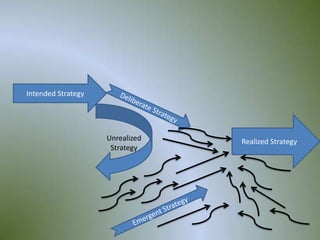
Intended Strategy


                    Unrealized   Realized Strategy
                     Strategy


                                                 10
It is, therefore, important to understand that
  organizational success does not depend on
  blind devotion to implementing intended
  strategies.


                                                 11
Rather, it requires skillfully adjusting
 intentions, plans and policies as events
 continue to unfold.


                                            12
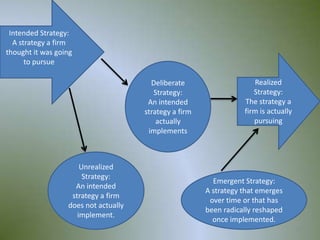
Intended Strategy:
  A strategy a firm
thought it was going
      to pursue

                                        Deliberate                    Realized
                                         Strategy:                    Strategy:
                                       An intended                 The strategy a
                                      strategy a firm              firm is actually
                                          actually                    pursuing
                                       implements


                      Unrealized
                       Strategy:
                                                          Emergent Strategy:
                    An intended
                                                        A strategy that emerges
                   strategy a firm
                                                         over time or that has
                  does not actually
                                                        been radically reshaped
                     implement.
                                                          once implemented.
                                                                                      13
Intended Strategies are based on strategic
  intentions – outcomes of formal planning
  and goal setting.


                                             14
When an organization can formulate
 intentions and move to their realization, this
 is deliberate strategy.


                                              15
A convergent series of actions taken by the
  organization towards achieving the strategic
  intentions is a realized strategy.


                                             16
Those strategic intentions that the
 organization is not able to act upon are the
 unrealized strategy.


                                                17
When the organization takes consistent
 actions that were not part of its formal
 intentions, those are emergent strategies.


                                              18
Thus, the finalized strategy of successful
 organizations is often a combination of
 deliberate and emergent strategies.


                                             19
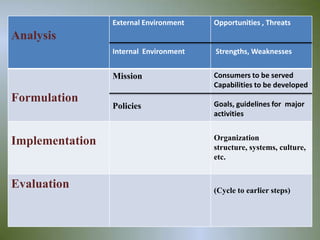
Next, let us take a look at the conventional
 model of managing strategically.

The conventional view of managing an
 organization strategically involves
 analysis, which is followed by optimal
 decisions, and their subsequent meticulous
 implementation.

                                               20
External Environment   Opportunities , Threats
Analysis
                 Internal Environment   Strengths, Weaknesses


                 Mission                Consumers to be served
                                        Capabilities to be developed
Formulation                             Goals, guidelines for major
                 Policies
                                        activities


                                        Organization
Implementation                          structure, systems, culture,
                                        etc.


Evaluation                              (Cycle to earlier steps)


                                                                   21
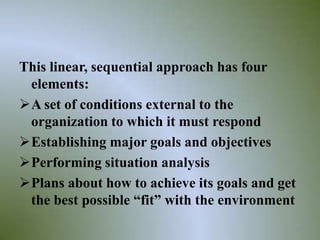
This linear, sequential approach has four
 elements:
A set of conditions external to the
 organization to which it must respond
Establishing major goals and objectives
Performing situation analysis
Plans about how to achieve its goals and get
 the best possible “fit” with the environment
                                            22
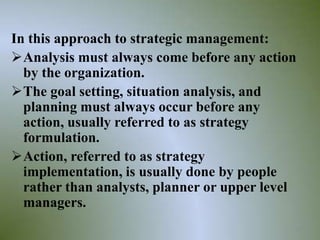
In this approach to strategic management:
Analysis must always come before any action
  by the organization.
The goal setting, situation analysis, and
  planning must always occur before any
  action, usually referred to as strategy
  formulation.
Action, referred to as strategy
  implementation, is usually done by people
  rather than analysts, planner or upper level
  managers.
                                             23
But such an approach neither describes the
 strategic management process, as it is
 followed by organizations, in
 reality, accurately; nor does it prescribe the
 ideal practice.


                                                  24
For one, the business environment is far
 from predictable( for most
 organizations), thus limiting the ability for
 analysis.
Further, decisions are seldom based on
 optimal rationality alone, given the political
 processes that occur in organizations.
In addition, in reality, formulation and
 implementation are intertwined as complex
 interactive processes.
                                              25
Organizational Learning: A Different
 Approach To Managing Strategically


                                  26
This approach to managing an organization
 strategically requires an ongoing process of
 continually rethinking and adjusting the
 plans and activities.


                                                27
It assumes that:
In practice, most formal plans offer only
  general guidelines
Strategic management cannot be viewed
  simplistically as just the formal process of
  coming up with the plan and then seeking that
  it is implemented
Leaders can make incremental adjustments to
  the formal plans with the hope of moving the
  organization towards its goals, by way of
  numerous small steps of progress rather than a
  few major strides.
                                              28
In following this approach most successful
  leaders are willing to concede that they lack
  the ability to foresee the future and the
  power to enforce adherence to the plans.
But that does not mean that they are willing to
  allow their organizations to drift aimlessly.


                                              29
Leaders manage incrementally, but
  they also manage with a purpose.


                                     30
Leaders of such organization have a vision of
 what they want the organization to be in
 years to come, but they try to move towards
 this position in an evolutionary way.


                                            31
Often times this is done by building a strong
 but flexible core business and then
 continually experimenting with “side bet
 ventures” to see what else works.


                                                32
Just see for yourself how one of the most
  successful organizations of recent times-
  Google is following a similar approach:
http://money.cnn.com/video/technology/2010/0
  7/26/tmgooglenogrowth.fortune/


                                           33
The unknowable aspects of the future, as such
 do not stop leaders from trying to
 understand what will and will not work in
 moving them toward what a vision of what
 the organization should become.


                                            34
When new trends are observed, they carry out
 small-scale experiments(side bet ventures)
 to see how the organization as a whole
 might adapt to them.


                                           35
But they also realize that they cannot hope to
 spot all important emerging trends and try
 all new ideas, and therefore, encourage
 similar experimentation throughout the
 organization.


                                                 36
The role of leadership becomes building an
 organization in which all members
 continuously search out ideas for improving
 the status quo, conduct experiments to see
 which of these ideas are more fruitful, and
 then spread what has been learned from
 these experiments throughout the
 organization.

                                           37
The conclusion from the discussion is that:

While the formal strategic planning approach
 has given rise to a broad range of planning
 techniques and methods, it is naïve to rely
 solely on it, because of the complexity and
 unpredictability facing most organizations,
 and the resultant difficulty in enforcing a
 strict adherence to a plan.

                                              38
Thus Strategic Planning, by definition, is a
  future-oriented activity, but the efforts
  should not be on foreseeing the future and
  building perfect plans accordingly,
                    rather
the efforts should be on trying to understand
  what will move the organization toward a
  vision of what the organization should
  become.


                                                39
40

Thinking strategically about strategy

  • 1.
    Thinking Strategically About Strategy Prepared By :- Nitish Raj IIPM; New Delhi Mentor: Kamlesh Kumar, Ph.D. Professor Of Business Strategy College Of Business University Of Michigan-Dearborn (USA) 11/21/2011 1
  • 2.
  • 3.
    Strategy as aplan: An intended course of action developed consciously and purposefully 3
  • 4.
    But defining strategyas a plan is NOT sufficient! 4
  • 5.
    For a strategyto be truly deliberate- that is, for a plan to have been intended exactly as realized would seem to be a tall order. 5
  • 6.
    Just watch foryourself what Reed Hastings, the CEO of Netflix has to say about this: http://money.cnn.com/video/fortune/2009/11/2 0/f banetflixceohastings.cnnmoney/ 6
  • 7.
    Let us thenexamine the concept of strategy from a different approach: Strategy as a pattern in stream of actions over time. 7
  • 8.
    The strategies followedmy most successful organizations contain elements: that were originally intended, as well as unintended elements that emerged over time. 8
  • 9.
    Here is anwhat an expert who has extensively researched this issue has to say: http://money.cnn.com/video/technology/2009 /10/12/ttkomisarcostcopaypal.fortune/ 9
  • 10.
    Intended Strategy Unrealized Realized Strategy Strategy 10
  • 11.
    It is, therefore,important to understand that organizational success does not depend on blind devotion to implementing intended strategies. 11
  • 12.
    Rather, it requiresskillfully adjusting intentions, plans and policies as events continue to unfold. 12
  • 13.
    Intended Strategy: A strategy a firm thought it was going to pursue Deliberate Realized Strategy: Strategy: An intended The strategy a strategy a firm firm is actually actually pursuing implements Unrealized Strategy: Emergent Strategy: An intended A strategy that emerges strategy a firm over time or that has does not actually been radically reshaped implement. once implemented. 13
  • 14.
    Intended Strategies arebased on strategic intentions – outcomes of formal planning and goal setting. 14
  • 15.
    When an organizationcan formulate intentions and move to their realization, this is deliberate strategy. 15
  • 16.
    A convergent seriesof actions taken by the organization towards achieving the strategic intentions is a realized strategy. 16
  • 17.
    Those strategic intentionsthat the organization is not able to act upon are the unrealized strategy. 17
  • 18.
    When the organizationtakes consistent actions that were not part of its formal intentions, those are emergent strategies. 18
  • 19.
    Thus, the finalizedstrategy of successful organizations is often a combination of deliberate and emergent strategies. 19
  • 20.
    Next, let ustake a look at the conventional model of managing strategically. The conventional view of managing an organization strategically involves analysis, which is followed by optimal decisions, and their subsequent meticulous implementation. 20
  • 21.
    External Environment Opportunities , Threats Analysis Internal Environment Strengths, Weaknesses Mission Consumers to be served Capabilities to be developed Formulation Goals, guidelines for major Policies activities Organization Implementation structure, systems, culture, etc. Evaluation (Cycle to earlier steps) 21
  • 22.
    This linear, sequentialapproach has four elements: A set of conditions external to the organization to which it must respond Establishing major goals and objectives Performing situation analysis Plans about how to achieve its goals and get the best possible “fit” with the environment 22
  • 23.
    In this approachto strategic management: Analysis must always come before any action by the organization. The goal setting, situation analysis, and planning must always occur before any action, usually referred to as strategy formulation. Action, referred to as strategy implementation, is usually done by people rather than analysts, planner or upper level managers. 23
  • 24.
    But such anapproach neither describes the strategic management process, as it is followed by organizations, in reality, accurately; nor does it prescribe the ideal practice. 24
  • 25.
    For one, thebusiness environment is far from predictable( for most organizations), thus limiting the ability for analysis. Further, decisions are seldom based on optimal rationality alone, given the political processes that occur in organizations. In addition, in reality, formulation and implementation are intertwined as complex interactive processes. 25
  • 26.
    Organizational Learning: ADifferent Approach To Managing Strategically 26
  • 27.
    This approach tomanaging an organization strategically requires an ongoing process of continually rethinking and adjusting the plans and activities. 27
  • 28.
    It assumes that: Inpractice, most formal plans offer only general guidelines Strategic management cannot be viewed simplistically as just the formal process of coming up with the plan and then seeking that it is implemented Leaders can make incremental adjustments to the formal plans with the hope of moving the organization towards its goals, by way of numerous small steps of progress rather than a few major strides. 28
  • 29.
    In following thisapproach most successful leaders are willing to concede that they lack the ability to foresee the future and the power to enforce adherence to the plans. But that does not mean that they are willing to allow their organizations to drift aimlessly. 29
  • 30.
    Leaders manage incrementally,but they also manage with a purpose. 30
  • 31.
    Leaders of suchorganization have a vision of what they want the organization to be in years to come, but they try to move towards this position in an evolutionary way. 31
  • 32.
    Often times thisis done by building a strong but flexible core business and then continually experimenting with “side bet ventures” to see what else works. 32
  • 33.
    Just see foryourself how one of the most successful organizations of recent times- Google is following a similar approach: http://money.cnn.com/video/technology/2010/0 7/26/tmgooglenogrowth.fortune/ 33
  • 34.
    The unknowable aspectsof the future, as such do not stop leaders from trying to understand what will and will not work in moving them toward what a vision of what the organization should become. 34
  • 35.
    When new trendsare observed, they carry out small-scale experiments(side bet ventures) to see how the organization as a whole might adapt to them. 35
  • 36.
    But they alsorealize that they cannot hope to spot all important emerging trends and try all new ideas, and therefore, encourage similar experimentation throughout the organization. 36
  • 37.
    The role ofleadership becomes building an organization in which all members continuously search out ideas for improving the status quo, conduct experiments to see which of these ideas are more fruitful, and then spread what has been learned from these experiments throughout the organization. 37
  • 38.
    The conclusion fromthe discussion is that: While the formal strategic planning approach has given rise to a broad range of planning techniques and methods, it is naïve to rely solely on it, because of the complexity and unpredictability facing most organizations, and the resultant difficulty in enforcing a strict adherence to a plan. 38
  • 39.
    Thus Strategic Planning,by definition, is a future-oriented activity, but the efforts should not be on foreseeing the future and building perfect plans accordingly, rather the efforts should be on trying to understand what will move the organization toward a vision of what the organization should become. 39
  • 40.

Editor's Notes

  • #11 Fig. 1 Deliberate and Emergent Strategies