Strategic Planning
Overview
Strategic planning is one of the most important responsibilities of the senior

management of an organization. It is the vehicle that senior management should use to
set the organizational vision, determine the strategies required to achieve that vision,
make the resource deployment decisions to achieve the selected strategies, and build
alignment to the vision and strategic direction throughout all levels of the organization.
Unfortunately, strategic planning is also one of the most misunderstood and poorly used
tools in many organizations. Strategic plans are often large documents with detailed
plans created arduously over months at great effort...only to gather dust and languish
after they have been duly acknowledged and then filed away.
Overview
There are several reasons why strategic plans are not developed
properly, or not implemented properly. Among the most common are:
• Senior management does not follow a defined process to
accomplish this task. As a consequence, months of effort are wasted
in creating reams of paper that do not have strategic import.
• The process is delegated to a planning group, or assigned to the
various functional leaders to complete for their respective areas. If
completed in individual functional areas, the plan may work for
individual departments, but is likely to sub-optimize the whole
organization. If assigned to a planning group, the result is often not
truly embraced and endorsed by senior leadership.
• Senior management does not set aside the time to develop the
strategic plan as a collective team work product.
Overview
There are several reasons why strategic plans are not developed
properly, or not implemented properly. Among the most common are:
• The organization does not understand what a strategic plan is
actually designed to provide. Therefore, the strategic plan is a
tactical business plan with multiple year extrapolations. There is
very little about it that addresses actual strategic direction.
• Senior management does to follow a defined process or
methodology that will result in a strategic plan in a timely and
efficient yet comprehensive manner.
• The plan is developed but there is no process to communicate it
throughout the organization and build organization-wide alignment
to its implementation.
• The plan is developed with no implementation guidelines at all. At
best, it is implemented in pieces. At worst, it is unfunded and
ignored.
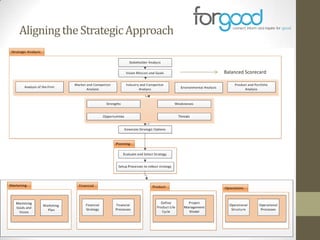
Aligning the Strategic Approach

Balanced Scorecard
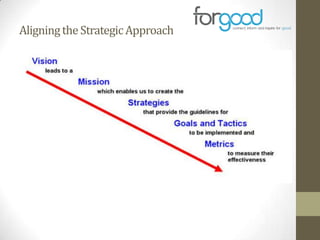
Aligning the Strategic Approach
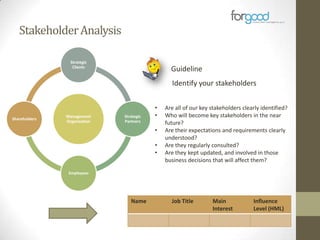
Stakeholder Analysis
Strategic
Clients

Guideline
Identify your stakeholders

Shareholders

Management
Organisation

Strategic
Partners

•
•
•
•
•

Are all of our key stakeholders clearly identified?
Who will become key stakeholders in the near
future?
Are their expectations and requirements clearly
understood?
Are they regularly consulted?
Are they kept updated, and involved in those
business decisions that will affect them?

Employees

Name

Job Title

Main
Interest

Influence
Level (HML)
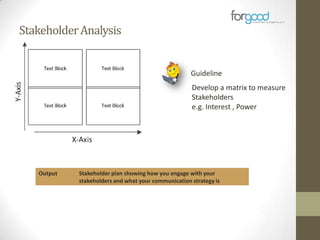
Stakeholder Analysis

Guideline

Develop a matrix to measure
Stakeholders
e.g. Interest , Power

Output

Stakeholder plan showing how you engage with your
stakeholders and what your communication strategy is
Vision Mission and Objectives
“Strategic planning is worthless—
unless there is first a strategic vision.”
— John Naisbitt, Author of “Megatrends”

A clear vision and mission statement, objectives, and business
description are important points of departure. The vision is what guides
your social enterprise and energizes your stakeholders; it is the “big
picture” illustrating what you expect to achieve.
Vision and Mission
The mission statement is the heart of your social enterprise.
It describes its central purpose and the basic principles that guide the actions of employees, partners, and
management. As well, it articulates the strategy you will use to accomplish your goals and objectives. A mission
statement also defines your target population and embodies the organizational values of your social enterprise.
The mission statement also provides direction to your social enterprise. If the business plan can be considered
the road map of your social enterprise and the vision is the direction in which you are going, then the mission
statement consists of the street signs to get there. Your business plan must be consistent with your mission
statement, so use it as an anchoring guide in each step of the planning process.

Guideline

Mission Statement

Use Smart Language
• Specific
• Measurable
• Achievable
• Realistic
• Timeous

To be number 1 catalyst in developing countries for
improving the quantity and quality on social action by
creating a social network that works seamlessly aligning it
to the real needs as identified by the end of 2013
Business Objectives
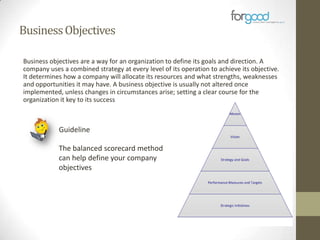
Business objectives are a way for an organization to define its goals and direction. A
company uses a combined strategy at every level of its operation to achieve its objective.
It determines how a company will allocate its resources and what strengths, weaknesses
and opportunities it may have. A business objective is usually not altered once
implemented, unless changes in circumstances arise; setting a clear course for the
organization it key to its success

Guideline
The balanced scorecard method
can help define your company
objectives
The Balanced Scorecard – Key Benefits
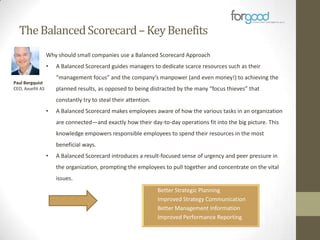
Why should small companies use a Balanced Scorecard Approach
•

A Balanced Scorecard guides managers to dedicate scarce resources such as their
“management focus” and the company’s manpower (and even money!) to achieving the

Paul Bergquist
CEO, Axsellit AS

planned results, as opposed to being distracted by the many “focus thieves” that
constantly try to steal their attention.
•

A Balanced Scorecard makes employees aware of how the various tasks in an organization
are connected—and exactly how their day-to-day operations fit into the big picture. This
knowledge empowers responsible employees to spend their resources in the most
beneficial ways.

•

A Balanced Scorecard introduces a result-focused sense of urgency and peer pressure in
the organization, prompting the employees to pull together and concentrate on the vital
issues.
•
•
•
•

Better Strategic Planning
Improved Strategy Communication
Better Management Information
Improved Performance Reporting
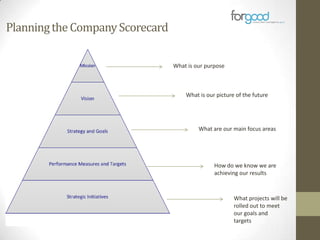
Planning the Company Scorecard
What is our purpose

What is our picture of the future

What are our main focus areas

How do we know we are
achieving our results

What projects will be
rolled out to meet
our goals and
targets
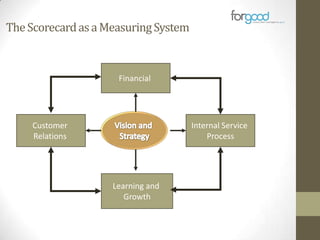
The Scorecard as a Measuring System

Financial

Customer
Relations

Internal Service
Process

Learning and
Growth
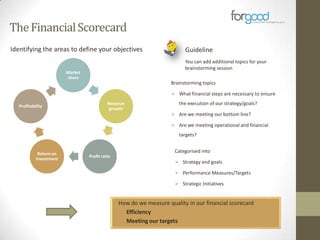
The Financial Scorecard
Identifying the areas to define your objectives

Guideline
You can add additional topics for your
brainstorming session

Market
share

Brainstorming topics
 What financial steps are necessary to ensure
Profitability

Revenue
growth

the execution of our strategy/goals?
 Are we meeting our bottom line?
 Are we meeting operational and financial
targets?

Return on
investment

Categorised into
Profit ratio

 Strategy and goals
 Performance Measures/Targets
 Strategic Initiatives

How do we measure quality in our financial scorecard
• Efficiency
• Meeting our targets
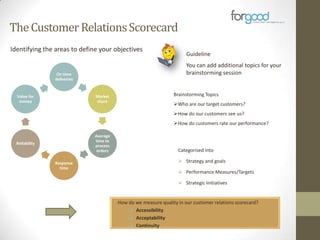
The Customer Relations Scorecard
Identifying the areas to define your objectives

You can add additional topics for your
brainstorming session

On time
deliveries

Value for
money

Guideline

Market
share

Brainstorming Topics
Who are our target customers?
How do our customers see us?
How do customers rate our performance?

Average
time to
process
orders

Reliability

Response
time

Categorised into
 Strategy and goals
 Performance Measures/Targets
 Strategic Initiatives

How do we measure quality in our customer relations scorecard?
 Accessibility
 Acceptability
 Continuity
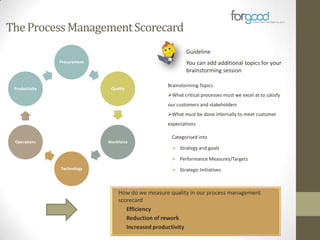
The Process Management Scorecard
Guideline
Procurement

Productivity

You can add additional topics for your
brainstorming session
Quality

Brainstorming Topics
What critical processes must we excel at to satisfy
our customers and stakeholders
What must be done internally to meet customer
expectations

Operations

Workforce

Categorised into
 Strategy and goals
 Performance Measures/Targets

Technology

 Strategic Initiatives

How do we measure quality in our process management
scorecard
• Efficiency
• Reduction of rework
• Increased productivity
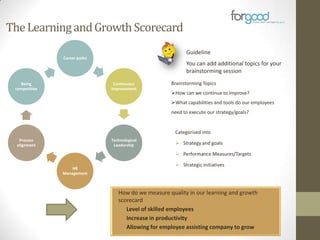
The Learning and Growth Scorecard
Guideline
Career paths

You can add additional topics for your
brainstorming session
Being
competitive

Continuous
Improvement

Brainstorming Topics

How can we continue to improve?
What capabilities and tools do our employees
need to execute our strategy/goals?

Categorised into
Process
alignment

Technological
Leadership

 Strategy and goals
 Performance Measures/Targets

HR
Management

 Strategic Initiatives

How do we measure quality in our learning and growth
scorecard
• Level of skilled employees
• Increase in productivity
• Allowing for employee assisting company to grow
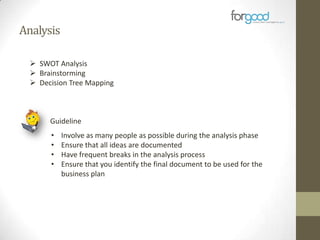
Analysis
 SWOT Analysis
 Brainstorming
 Decision Tree Mapping

Guideline

•
•
•
•

Involve as many people as possible during the analysis phase
Ensure that all ideas are documented
Have frequent breaks in the analysis process
Ensure that you identify the final document to be used for the
business plan
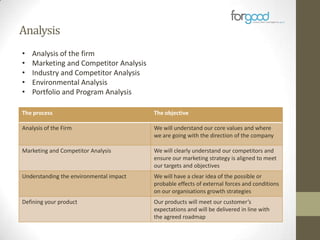
Analysis
•
•
•
•
•

Analysis of the firm
Marketing and Competitor Analysis
Industry and Competitor Analysis
Environmental Analysis
Portfolio and Program Analysis

The process

The objective

Analysis of the Firm

We will understand our core values and where
we are going with the direction of the company

Marketing and Competitor Analysis

We will clearly understand our competitors and
ensure our marketing strategy is aligned to meet
our targets and objectives

Understanding the environmental impact

We will have a clear idea of the possible or
probable effects of external forces and conditions
on our organisations growth strategies

Defining your product

Our products will meet our customer’s
expectations and will be delivered in line with
the agreed roadmap
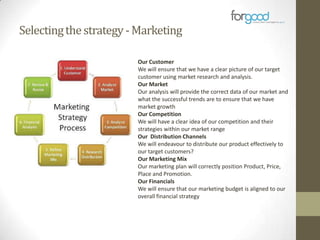
Selecting the strategy - Marketing
Our Customer
We will ensure that we have a clear picture of our target
customer using market research and analysis.
Our Market
Our analysis will provide the correct data of our market and
what the successful trends are to ensure that we have
market growth
Our Competition
We will have a clear idea of our competition and their
strategies within our market range
Our Distribution Channels
We will endeavour to distribute our product effectively to
our target customers?
Our Marketing Mix
Our marketing plan will correctly position Product, Price,
Place and Promotion.
Our Financials
We will ensure that our marketing budget is aligned to our
overall financial strategy
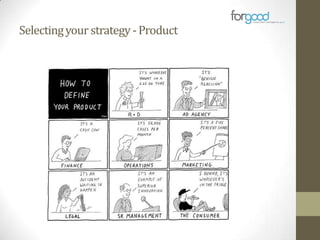
Selecting your strategy - Product
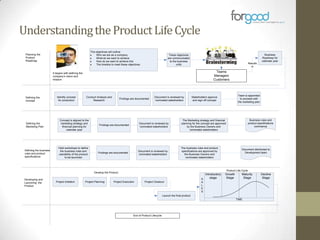
Understanding the Product Life Cycle
The objectives will outline
Who we are as a company
What do we want to achieve
How do we want to achieve this
The timeline to meet these objectives

Planning the
Product
Roadmap

These objectives
are communicated
to the business
units

Results
in

Teams
Managers
Customers

It begins with defining the
company’s vision and
mission

Defining the
concept

Defining the
Marketing Plan

Defining the business
rules and product
specifications

Identify concept
for production

Conduct Analysis and
Research

Concept is aligned to the
marketing strategy and
financial planning for
calendar year

Hold workshops to define
the business rules and
userability of the product
to be launched

Findings are documented

Document is reviewed by
nominated stakeholders

Document is reviewed by
nominated stakeholders

Findings are documented

Document is reviewed by
nominated stakeholders

Findings are documented

Project Initiation

Project Planning

Team is appointed
to proceed with
the marketing plan

Stakeholders approve
and sign off concept

Business rules and
product specifications
commence

The Marketing strategy and financial
planning for the concept are approved
by the Business Owners and
nominated stakeholders

The business rules and product
specifications are approved by
the Business Owners and
nominated stakeholders

Document distributed to
Development team

Product Life Cycle

Develop the Product
Developing and
Launching the
Product

Business
Roadmap for
calendar year

Introductory
stage
S

Project Execution

Project Closeout

Growth
Stage

Maturity
Stage

A
L
E
S

Launch the final product
TIME

End of Product Lifecycle

Decline
Stage
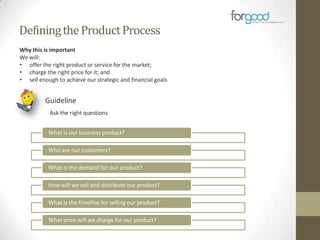
Defining the Product Process
Why this is important
We will:
• offer the right product or service for the market;
• charge the right price for it; and
• sell enough to achieve our strategic and financial goals

Guideline
Ask the right questions
What is our business product?
Who are our customers?
What is the demand for our product?
How will we sell and distribute our product?
What is the timeline for selling our product?
What price will we charge for our product?
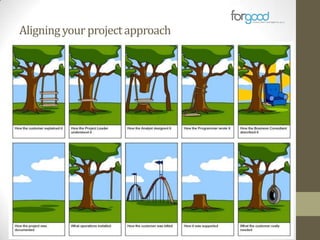
Aligning your project approach
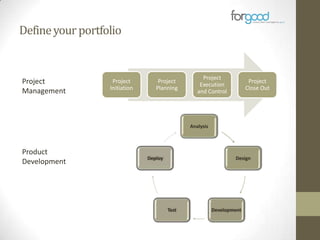
Define your portfolio

Project
Management

Project
Initiation

Project
Planning

Project
Execution
and Control

Project
Close Out

Analysis

Product
Development

Deploy

Design

Test

Development
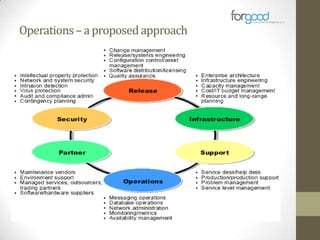
Operations – a proposed approach
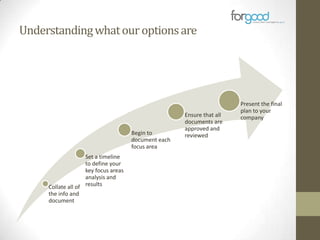
Understanding what our options are

Begin to
document each
focus area

Set a timeline
to define your
key focus areas
analysis and
Collate all of results
the info and
document

Ensure that all
documents are
approved and
reviewed

Present the final
plan to your
company
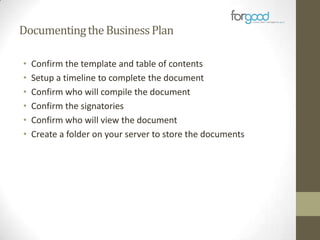
Documenting the Business Plan
•
•
•
•
•
•

Confirm the template and table of contents
Setup a timeline to complete the document
Confirm who will compile the document
Confirm the signatories
Confirm who will view the document
Create a folder on your server to store the documents
Conclusions
• It is important to keep in mind that this presentation is a
generic and high level approach to develop and document
your business plan. You will go through various versions until
you have reach the correct amount of detail and content that
works for your company
• You can add or subtract where required from this presentation
to align to your own individual approach for presenting to
your audience
• The ultimate and key goal for this presentation is to have a
business plan that will allow your business to grow and
advance
• You should use the business process in this presentation as a
roadmap to ensure that you cover all your business areas,
goals and vision for your company

Strategy planning for small digital companies

  • 1.
  • 2.
    Overview Strategic planning isone of the most important responsibilities of the senior management of an organization. It is the vehicle that senior management should use to set the organizational vision, determine the strategies required to achieve that vision, make the resource deployment decisions to achieve the selected strategies, and build alignment to the vision and strategic direction throughout all levels of the organization. Unfortunately, strategic planning is also one of the most misunderstood and poorly used tools in many organizations. Strategic plans are often large documents with detailed plans created arduously over months at great effort...only to gather dust and languish after they have been duly acknowledged and then filed away.
  • 3.
    Overview There are severalreasons why strategic plans are not developed properly, or not implemented properly. Among the most common are: • Senior management does not follow a defined process to accomplish this task. As a consequence, months of effort are wasted in creating reams of paper that do not have strategic import. • The process is delegated to a planning group, or assigned to the various functional leaders to complete for their respective areas. If completed in individual functional areas, the plan may work for individual departments, but is likely to sub-optimize the whole organization. If assigned to a planning group, the result is often not truly embraced and endorsed by senior leadership. • Senior management does not set aside the time to develop the strategic plan as a collective team work product.
  • 4.
    Overview There are severalreasons why strategic plans are not developed properly, or not implemented properly. Among the most common are: • The organization does not understand what a strategic plan is actually designed to provide. Therefore, the strategic plan is a tactical business plan with multiple year extrapolations. There is very little about it that addresses actual strategic direction. • Senior management does to follow a defined process or methodology that will result in a strategic plan in a timely and efficient yet comprehensive manner. • The plan is developed but there is no process to communicate it throughout the organization and build organization-wide alignment to its implementation. • The plan is developed with no implementation guidelines at all. At best, it is implemented in pieces. At worst, it is unfunded and ignored.
  • 5.
    Aligning the StrategicApproach Balanced Scorecard
  • 6.
  • 7.
    Stakeholder Analysis Strategic Clients Guideline Identify yourstakeholders Shareholders Management Organisation Strategic Partners • • • • • Are all of our key stakeholders clearly identified? Who will become key stakeholders in the near future? Are their expectations and requirements clearly understood? Are they regularly consulted? Are they kept updated, and involved in those business decisions that will affect them? Employees Name Job Title Main Interest Influence Level (HML)
  • 8.
    Stakeholder Analysis Guideline Develop amatrix to measure Stakeholders e.g. Interest , Power Output Stakeholder plan showing how you engage with your stakeholders and what your communication strategy is
  • 9.
    Vision Mission andObjectives “Strategic planning is worthless— unless there is first a strategic vision.” — John Naisbitt, Author of “Megatrends” A clear vision and mission statement, objectives, and business description are important points of departure. The vision is what guides your social enterprise and energizes your stakeholders; it is the “big picture” illustrating what you expect to achieve.
  • 10.
    Vision and Mission Themission statement is the heart of your social enterprise. It describes its central purpose and the basic principles that guide the actions of employees, partners, and management. As well, it articulates the strategy you will use to accomplish your goals and objectives. A mission statement also defines your target population and embodies the organizational values of your social enterprise. The mission statement also provides direction to your social enterprise. If the business plan can be considered the road map of your social enterprise and the vision is the direction in which you are going, then the mission statement consists of the street signs to get there. Your business plan must be consistent with your mission statement, so use it as an anchoring guide in each step of the planning process. Guideline Mission Statement Use Smart Language • Specific • Measurable • Achievable • Realistic • Timeous To be number 1 catalyst in developing countries for improving the quantity and quality on social action by creating a social network that works seamlessly aligning it to the real needs as identified by the end of 2013
  • 11.
    Business Objectives Business objectivesare a way for an organization to define its goals and direction. A company uses a combined strategy at every level of its operation to achieve its objective. It determines how a company will allocate its resources and what strengths, weaknesses and opportunities it may have. A business objective is usually not altered once implemented, unless changes in circumstances arise; setting a clear course for the organization it key to its success Guideline The balanced scorecard method can help define your company objectives
  • 12.
    The Balanced Scorecard– Key Benefits Why should small companies use a Balanced Scorecard Approach • A Balanced Scorecard guides managers to dedicate scarce resources such as their “management focus” and the company’s manpower (and even money!) to achieving the Paul Bergquist CEO, Axsellit AS planned results, as opposed to being distracted by the many “focus thieves” that constantly try to steal their attention. • A Balanced Scorecard makes employees aware of how the various tasks in an organization are connected—and exactly how their day-to-day operations fit into the big picture. This knowledge empowers responsible employees to spend their resources in the most beneficial ways. • A Balanced Scorecard introduces a result-focused sense of urgency and peer pressure in the organization, prompting the employees to pull together and concentrate on the vital issues. • • • • Better Strategic Planning Improved Strategy Communication Better Management Information Improved Performance Reporting
  • 13.
    Planning the CompanyScorecard What is our purpose What is our picture of the future What are our main focus areas How do we know we are achieving our results What projects will be rolled out to meet our goals and targets
  • 14.
    The Scorecard asa Measuring System Financial Customer Relations Internal Service Process Learning and Growth
  • 15.
    The Financial Scorecard Identifyingthe areas to define your objectives Guideline You can add additional topics for your brainstorming session Market share Brainstorming topics  What financial steps are necessary to ensure Profitability Revenue growth the execution of our strategy/goals?  Are we meeting our bottom line?  Are we meeting operational and financial targets? Return on investment Categorised into Profit ratio  Strategy and goals  Performance Measures/Targets  Strategic Initiatives How do we measure quality in our financial scorecard • Efficiency • Meeting our targets
  • 16.
    The Customer RelationsScorecard Identifying the areas to define your objectives You can add additional topics for your brainstorming session On time deliveries Value for money Guideline Market share Brainstorming Topics Who are our target customers? How do our customers see us? How do customers rate our performance? Average time to process orders Reliability Response time Categorised into  Strategy and goals  Performance Measures/Targets  Strategic Initiatives How do we measure quality in our customer relations scorecard?  Accessibility  Acceptability  Continuity
  • 17.
    The Process ManagementScorecard Guideline Procurement Productivity You can add additional topics for your brainstorming session Quality Brainstorming Topics What critical processes must we excel at to satisfy our customers and stakeholders What must be done internally to meet customer expectations Operations Workforce Categorised into  Strategy and goals  Performance Measures/Targets Technology  Strategic Initiatives How do we measure quality in our process management scorecard • Efficiency • Reduction of rework • Increased productivity
  • 18.
    The Learning andGrowth Scorecard Guideline Career paths You can add additional topics for your brainstorming session Being competitive Continuous Improvement Brainstorming Topics How can we continue to improve? What capabilities and tools do our employees need to execute our strategy/goals? Categorised into Process alignment Technological Leadership  Strategy and goals  Performance Measures/Targets HR Management  Strategic Initiatives How do we measure quality in our learning and growth scorecard • Level of skilled employees • Increase in productivity • Allowing for employee assisting company to grow
  • 19.
    Analysis  SWOT Analysis Brainstorming  Decision Tree Mapping Guideline • • • • Involve as many people as possible during the analysis phase Ensure that all ideas are documented Have frequent breaks in the analysis process Ensure that you identify the final document to be used for the business plan
  • 20.
    Analysis • • • • • Analysis of thefirm Marketing and Competitor Analysis Industry and Competitor Analysis Environmental Analysis Portfolio and Program Analysis The process The objective Analysis of the Firm We will understand our core values and where we are going with the direction of the company Marketing and Competitor Analysis We will clearly understand our competitors and ensure our marketing strategy is aligned to meet our targets and objectives Understanding the environmental impact We will have a clear idea of the possible or probable effects of external forces and conditions on our organisations growth strategies Defining your product Our products will meet our customer’s expectations and will be delivered in line with the agreed roadmap
  • 21.
    Selecting the strategy- Marketing Our Customer We will ensure that we have a clear picture of our target customer using market research and analysis. Our Market Our analysis will provide the correct data of our market and what the successful trends are to ensure that we have market growth Our Competition We will have a clear idea of our competition and their strategies within our market range Our Distribution Channels We will endeavour to distribute our product effectively to our target customers? Our Marketing Mix Our marketing plan will correctly position Product, Price, Place and Promotion. Our Financials We will ensure that our marketing budget is aligned to our overall financial strategy
  • 22.
  • 23.
    Understanding the ProductLife Cycle The objectives will outline Who we are as a company What do we want to achieve How do we want to achieve this The timeline to meet these objectives Planning the Product Roadmap These objectives are communicated to the business units Results in Teams Managers Customers It begins with defining the company’s vision and mission Defining the concept Defining the Marketing Plan Defining the business rules and product specifications Identify concept for production Conduct Analysis and Research Concept is aligned to the marketing strategy and financial planning for calendar year Hold workshops to define the business rules and userability of the product to be launched Findings are documented Document is reviewed by nominated stakeholders Document is reviewed by nominated stakeholders Findings are documented Document is reviewed by nominated stakeholders Findings are documented Project Initiation Project Planning Team is appointed to proceed with the marketing plan Stakeholders approve and sign off concept Business rules and product specifications commence The Marketing strategy and financial planning for the concept are approved by the Business Owners and nominated stakeholders The business rules and product specifications are approved by the Business Owners and nominated stakeholders Document distributed to Development team Product Life Cycle Develop the Product Developing and Launching the Product Business Roadmap for calendar year Introductory stage S Project Execution Project Closeout Growth Stage Maturity Stage A L E S Launch the final product TIME End of Product Lifecycle Decline Stage
  • 24.
    Defining the ProductProcess Why this is important We will: • offer the right product or service for the market; • charge the right price for it; and • sell enough to achieve our strategic and financial goals Guideline Ask the right questions What is our business product? Who are our customers? What is the demand for our product? How will we sell and distribute our product? What is the timeline for selling our product? What price will we charge for our product?
  • 25.
  • 26.
    Define your portfolio Project Management Project Initiation Project Planning Project Execution andControl Project Close Out Analysis Product Development Deploy Design Test Development
  • 27.
    Operations – aproposed approach
  • 28.
    Understanding what ouroptions are Begin to document each focus area Set a timeline to define your key focus areas analysis and Collate all of results the info and document Ensure that all documents are approved and reviewed Present the final plan to your company
  • 29.
    Documenting the BusinessPlan • • • • • • Confirm the template and table of contents Setup a timeline to complete the document Confirm who will compile the document Confirm the signatories Confirm who will view the document Create a folder on your server to store the documents
  • 30.
    Conclusions • It isimportant to keep in mind that this presentation is a generic and high level approach to develop and document your business plan. You will go through various versions until you have reach the correct amount of detail and content that works for your company • You can add or subtract where required from this presentation to align to your own individual approach for presenting to your audience • The ultimate and key goal for this presentation is to have a business plan that will allow your business to grow and advance • You should use the business process in this presentation as a roadmap to ensure that you cover all your business areas, goals and vision for your company

Editor's Notes

  • #6 006 The Business Planning Process MapSuccessfully launching a new business or initiative requires careful planning and the results of a business planning process are usually captured in a business plan. Any investor or those in an existing business responsible for approving new initiatives will invariably want to see a business plan before making any financial commitment. The business plan, besides being a prerequisite for gaining access to finance, also provides the blueprint for successfully creating and running a new venture. Even in fast-moving markets where the plan itself may quickly become outdated the insight gained from the planning process that created it remains invaluable. A business plan describes the business’s vision and objectives as well as the strategy and tactics that will be employed to achieve them. A plan may also provide the basis for operational budgets, targets, procedures and management controls. No two businesses are identical and no two business plans are ever exactly the same. There are different reasons for preparing a business plan and different audiences. The task of writing a business plan is a lot easier if you have a template that can be tailored to the specific needs of your business. The book “Guide to Business Planning” by Graham Friend and Stefan Zehle provides such template. It also explains how to design and present a business plan to maximise the likelihood of its gaining approval or funding.Although the presentation of the final business plan is important, ultimately the substance of the plan is most crucial. The strategies and tactics described in the plan should be the outputs from a logical and appropriately comprehensive business planning process. The book provides apractical step-by-step business planning process and a reference for the tools and techniques necessary to complete it. The stages of the business planning process are shown on the chart. The process should begin by evaluating the environment in which the business operates before analysing the specific industry and the suppliers, competitors and customers within it. The insight from this analysis and an understanding of the strengths and weaknesses of the business or new venture, combined with a set of expectations about the future, can becoupled with creative and innovative thinking to develop a range of strategic options for evaluation. The evaluation stage includes developing forecasts (notably for market demand), financial projections and, in some cases, a range of valuations, as well as calculating various measures of performance with which to validate and benchmark the forecasts. The business planning process should test alternative ideas and assumptions, as one of the main reasons for planning is to help the business prepare for an uncertain future.