Risk Assessment and Management
Faisal Al Hadad
Consultant of Family Medicine
& Occupational Health
PSMMC
Hazard vs. Risk
Hazard is any source of potential damage, harm or
adverse health effects on something or someone under
certain conditions at work.
Risk is the chance or probability that a person will be
harmed or experience an adverse healtheffect if exposed
to a hazard.
Classification of aerosols
Dusts solid particles made airborne by mechanical disintegration of bulk
solid material e.g. cutting, grinding, abrasion, crushing, handling,
transportation
Inhalable dust is fraction of total airborne particles that are inhaled through
the nose and or mouth e.g. wood dust, cement dust, flour dust
Respirable dust is fraction of total airborne particles that penetrate the
unciliated airways of the lung (alveolar region) where gas exchange occurs
e.g. silica, coal dust
Fibres: respirable fibre is defined as a fibre >5 µm in length, with a length
to width ratio of at least 3:1 and a diameter <3 µm e.g. asbestos, machine
Made mineral fibre
Classification of aerosols
Fumes formed when material from a volatilized solid condenses in cool air
e.g. rubber fume, diesel fumes, welding fume
Mists are suspended liquid droplets generated by condensation of liquids from
the vapour back to the liquid state or by breaking up a liquid into dispersed
state e.g. paint spraying mist, oil mist
Gases are formless fluids which expand to occupy the space or enclosure in
which they are confined e.g. CO
Vapours are volatile forms of substances that are normally in the solid or
liquid state at room temperature and pressure e.g. toluene
Risk Assessment
Definition:
RA is a structured and systematic procedure, which is
dependent upon the correct identification of hazards and
an appropriate assessment of risks arising from them for
purposes of their control and avoidance
(HSE, 1995)
Risk Assessment
Purpose of risk assessment: to enable a valid decision to be
made about measures necessary to control exposure to
substances hazardous to health arising in any workplace
Process of risk assessment
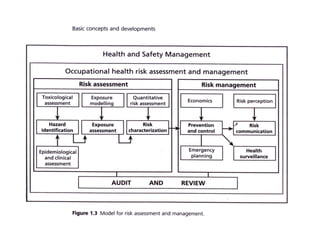
1. Hazard identification
2. Exposure assessment
3. Risk characterization
Hazard identification
Definition: hazard identification is determining the presence and
characteristics of contaminants that affect human health
Methods:
 Accident and ill health statistics
 Investigation of accidents, ill health effects and complaints
 Audits
 Workplace inspections (walk-through survey)
 List of the chemicals purchased and used (MSDS)
 Understanding the process in order to determine the intermediate and final
products
 Brain-storming of those who work in specific areas
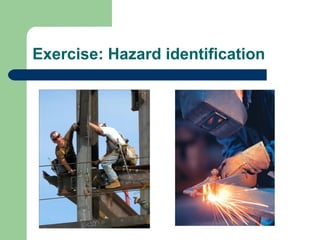
Exercise: Hazard identification
Exposure assessment

Definition: exposure assessment is determining the
conditions of exposure and the doses received by those
exposed
Methods:
 Workplace inspections
 Industrial hygiene surveys (e.g. sampling, noise survey)


Biological monitoring
Risk characterization

Definition: risk characterization estimating the likelihood
of an adverse health outcome in exposed populations
and the uncertainties associated with the estimate
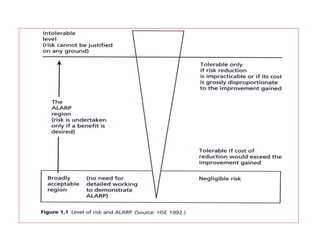
Level of risk
 intolerable
 tolerable
 negligible
Risk Management
Definition: risk management is the eradication or minimization of the
adverse effects of the pure risks to which an organization is exposed
(Bamber, 1990)
Purpose : to prevent injuries and ill health from hazards
Process:
 Prevention and control
 Risk communication
 Health surveillance
Prevention and control


Organizational solutions



Engineering solutions



Use of personal protective equipments
Organizational solutions


Complete elimination of the process that leads to the exposure



Complete elimination of the substance (s) causing the risk



Substitution by a less toxic substance



Substitution by the same substance, but in a form that reduces the risk of
exposure



Designing or redesigning the process so that exposure is minimized



Suppressing the substance
Engineering solutions



Total enclosures under negative pressure



Partial enclosures with extract ventilation



Extracted canopies



Hood or slots



General or dilution ventilation
Use of personal protective equipments



Respiratory protective equipment (e.g. respirator, breathing apparatus)



Hearing protectors (earmuffs/earplugs)



Gloves/sleeves



Protective clothing (e.g. jacket, trousers, aprons, overalls, coveralls,
body suits)



Eye and face protectors (e.g. safety spectacles, goggles, face shields
or visors)
Risk communication




Risk communication is communicating information
on risks to the stakeholders
Communication on risk should aim to bridge the gap
between perceived risks and real risks
Health surveillance
Definition:
The periodic medicophysiological examination of exposed workers
with the objective of protecting and preventing occupationally
related diseases (Notten et al, 1986)

Rationale:
to detect adverse health effects from occupational exposures at as
early a stage as possible
Indications of health surveillance
Where the RA indicates that it is required or it meets the following criteria:


An identifiable disease or adverse effect is associated with the work activity



Appropriate methods are available to identify such ill effects



It is reasonably likely that the adverse effect will occur giving the prevailing
work conditions



HS will offer additional protection to the workforce's health
Methods of health surveillance


Symptom review



Clinical assessment



Medical examination



Special investigations (lung function tests, audiometry, chest x-rays,
bladder cytology, periodic eye tests)



Determination of immune status (anti-HBS, tuberculin testing)



Biological monitoring (blood, urine, expired air samples)

Workplace risk management

  • 1.
    Risk Assessment andManagement Faisal Al Hadad Consultant of Family Medicine & Occupational Health PSMMC
  • 2.
    Hazard vs. Risk Hazardis any source of potential damage, harm or adverse health effects on something or someone under certain conditions at work. Risk is the chance or probability that a person will be harmed or experience an adverse healtheffect if exposed to a hazard.
  • 4.
    Classification of aerosols Dustssolid particles made airborne by mechanical disintegration of bulk solid material e.g. cutting, grinding, abrasion, crushing, handling, transportation Inhalable dust is fraction of total airborne particles that are inhaled through the nose and or mouth e.g. wood dust, cement dust, flour dust Respirable dust is fraction of total airborne particles that penetrate the unciliated airways of the lung (alveolar region) where gas exchange occurs e.g. silica, coal dust Fibres: respirable fibre is defined as a fibre >5 µm in length, with a length to width ratio of at least 3:1 and a diameter <3 µm e.g. asbestos, machine Made mineral fibre
  • 5.
    Classification of aerosols Fumesformed when material from a volatilized solid condenses in cool air e.g. rubber fume, diesel fumes, welding fume Mists are suspended liquid droplets generated by condensation of liquids from the vapour back to the liquid state or by breaking up a liquid into dispersed state e.g. paint spraying mist, oil mist Gases are formless fluids which expand to occupy the space or enclosure in which they are confined e.g. CO Vapours are volatile forms of substances that are normally in the solid or liquid state at room temperature and pressure e.g. toluene
  • 7.
    Risk Assessment Definition: RA isa structured and systematic procedure, which is dependent upon the correct identification of hazards and an appropriate assessment of risks arising from them for purposes of their control and avoidance (HSE, 1995)
  • 8.
    Risk Assessment Purpose ofrisk assessment: to enable a valid decision to be made about measures necessary to control exposure to substances hazardous to health arising in any workplace Process of risk assessment 1. Hazard identification 2. Exposure assessment 3. Risk characterization
  • 9.
    Hazard identification Definition: hazardidentification is determining the presence and characteristics of contaminants that affect human health Methods:  Accident and ill health statistics  Investigation of accidents, ill health effects and complaints  Audits  Workplace inspections (walk-through survey)  List of the chemicals purchased and used (MSDS)  Understanding the process in order to determine the intermediate and final products  Brain-storming of those who work in specific areas
  • 10.
  • 11.
    Exposure assessment Definition: exposureassessment is determining the conditions of exposure and the doses received by those exposed Methods:  Workplace inspections  Industrial hygiene surveys (e.g. sampling, noise survey)  Biological monitoring
  • 12.
    Risk characterization Definition: riskcharacterization estimating the likelihood of an adverse health outcome in exposed populations and the uncertainties associated with the estimate Level of risk  intolerable  tolerable  negligible
  • 14.
    Risk Management Definition: riskmanagement is the eradication or minimization of the adverse effects of the pure risks to which an organization is exposed (Bamber, 1990) Purpose : to prevent injuries and ill health from hazards Process:  Prevention and control  Risk communication  Health surveillance
  • 15.
    Prevention and control  Organizationalsolutions  Engineering solutions  Use of personal protective equipments
  • 16.
    Organizational solutions  Complete eliminationof the process that leads to the exposure  Complete elimination of the substance (s) causing the risk  Substitution by a less toxic substance  Substitution by the same substance, but in a form that reduces the risk of exposure  Designing or redesigning the process so that exposure is minimized  Suppressing the substance
  • 17.
    Engineering solutions  Total enclosuresunder negative pressure  Partial enclosures with extract ventilation  Extracted canopies  Hood or slots  General or dilution ventilation
  • 18.
    Use of personalprotective equipments  Respiratory protective equipment (e.g. respirator, breathing apparatus)  Hearing protectors (earmuffs/earplugs)  Gloves/sleeves  Protective clothing (e.g. jacket, trousers, aprons, overalls, coveralls, body suits)  Eye and face protectors (e.g. safety spectacles, goggles, face shields or visors)
  • 19.
    Risk communication   Risk communicationis communicating information on risks to the stakeholders Communication on risk should aim to bridge the gap between perceived risks and real risks
  • 20.
    Health surveillance Definition: The periodicmedicophysiological examination of exposed workers with the objective of protecting and preventing occupationally related diseases (Notten et al, 1986) Rationale: to detect adverse health effects from occupational exposures at as early a stage as possible
  • 21.
    Indications of healthsurveillance Where the RA indicates that it is required or it meets the following criteria:  An identifiable disease or adverse effect is associated with the work activity  Appropriate methods are available to identify such ill effects  It is reasonably likely that the adverse effect will occur giving the prevailing work conditions  HS will offer additional protection to the workforce's health
  • 22.
    Methods of healthsurveillance  Symptom review  Clinical assessment  Medical examination  Special investigations (lung function tests, audiometry, chest x-rays, bladder cytology, periodic eye tests)  Determination of immune status (anti-HBS, tuberculin testing)  Biological monitoring (blood, urine, expired air samples)