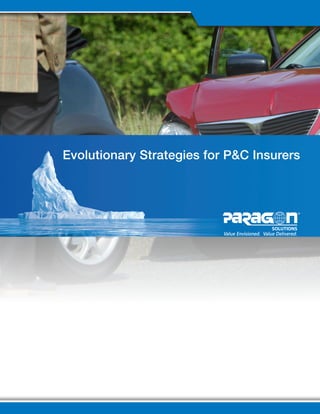
Evolutionary Strategies for P&C Insurers
Executive Summary
The insurance industry has undergone a gradual,
technology-driven transformation over the last
four decades. From the 1970s through the 1990s,
mainframe and client server applications changed
the efficiency equation. At the end of the 20th
century, the Internet signaled the beginning
of a new era of complex interaction between
insureds, agents, and carriers. Today, entirely
new technologies such as telematics, mobile
technologies, advanced underwriting models, and
the shift to a customer-centric paradigm are further
altering the industry.
Signs indicate this “third wave” of transformation
may be more significant and far-reaching than
those preceding it, surfacing significant issues and
exposing inefficiencies. The recent soft market,
combined with broader economic challenges such
as the sudden decrease in investment income that
accompanied the most recent recession, have
exposed carriers with less efficient operations or
poor underwriting disciplines. Carriers that thought
they could wait-out the cycle as they have in years
past now face a new reality.
The transformation currently underway is causing
operational, organizational, and IT pain points.
Carriers that fail to address process inefficiencies
and evolve business processes to address current
challenges risk being left behind. The insurance
industry has traditionally been slow to evolve. In
today’s business environment a slow evolution is
no longer an option
Value Envisioned. Value Delivered.
1.800.462.5582  ■ www.consultparagon.com
Evolving P&C Insurers
Carriers have historically
been backwards-focused
and have tended to maintain
established processes
without question. They
also have the propensity
to be risk-averse. These
characteristics need to
change. Carriers must be
willing to try new things
without betting the ranch or
subjecting the company to
undue risk.
1
Insurers need to embrace
commoditization, at least partially,
and develop boxed products
demanding better predictive
analytics, automated underwriting,
analysis of abundant social data,
and distributor-friendly sales
support systems.
Introduction
In the past, the insurance industry operated in a
world that required little transparency. Insurance
companies could hide behind walls. The relatively
long cycle times accepted in the market allowed
carriers to mask underwriting, servicing, and
claims inefficiencies. Waiting days or weeks for a
quote was acceptable to the average buyer. But
consumer expectations have changed. Today’s
consumers demand instant service, transparency,
and convenience. New expectations are forcing
the insurance business to evolve from a product-
centric model to a customer-centric model. To keep
and grow business, carriers need to redesign and
refocus their entire business process around the
individual buyer.
Implementing a customer-centric model places
significant pressure on carriers to invest in
technology and operations that use personnel
more efficiently. As the industry becomes more
competitive, carriers that are not extremely efficient
or specialized will no longer compete effectively.
Already, less efficient, middle-tier carriers are
getting squeezed by large, national players or
outmaneuvered by affinity companies at the local
level. Mid-sized companies that are not hyper-
specialized or extremely good at serving specific
needs are at risk. Mitigating this risk requires
adapting in three major areas:
Embrace Commoditization
Ten to 12 years ago, before the widespread use
of online insurance quoting and servicing, carriers
relied on agents to sell insurance for products such
as personal lines auto and home coverage. Today,
because of the availability of Internet research,
ratings, and reviews, the ability to run real-time
quotes, and the overall explosion of information,
these products have become more commoditized.
There is no longer a “special sauce” for general
products. Perceived and actual differences in
products and service continue to be eroded.
Rating models are more sophisticated. Pricing
parity is matched with service parity, and the bar is
constantly rising. While such innovations take time
to percolate in a highly regulated and conservative
environment, carriers need to foster innovation in
measured steps.
2
Operational efficiency and IT effectiveness are
now table stakes, as opposed to being good
to have in years past (heading in the direction
of personal banking, where interactions and
transactions are becoming increasingly efficient
and less mysterious). Insurers need to embrace
commoditization, at least partially, and develop
boxed products demanding better predictive
analytics, automated underwriting, analysis of
abundant social data, and distributor-friendly sales
support systems.
While certain niche markets and very large
commercial accounts may be somewhat insulated
from the forces of change, most small and mid-
market products are already heading in this
direction. Business managers and corporate risk
managers are applying the same lessons they
learned in managing their personal policies and
asking for the same or better from their commercial
carriers. This trend may be lagging personal lines by
a few years, but it is evident none-the-less.
Respond to Customer Demands
for Transparency
Today, not all consumers are interested in buying
insurance in the way most insurers sell it. Demands
for better and faster service from insurance
carriers continue to rise. Today’s customers expect
transparency and convenience. People on the road
shop their business from anywhere at any time.
They expect up-to-the-second information,
multi-channel access, and immediate responses,
as well as the ability to purchase multiple products
across lines of business, regardless of the
back-end environment.
Demand for multi-channel strategies will explode
as focus shifts from selling to buying preferences.
While some will continue to be comfortable with
local agent models, others, particularly those of
Generations X, Y and Z, will choose to buy through
retail, banking, or online channels.
Despite all this, there remains a need for the trusted
advisor role an agent or broker provides. A J.D.
Power and Associates study of U.S. insurance
shopping found that, despite the growing popularity
of online shopping, insurance agents still have
the upper hand when it comes down to an actual
purchase. Over 50 percent of quotes initiated
online were eventually closed by an agent or call
center representative.
Invest in Flexible Technology
In the 1980s and 1990s, most insurance carriers
built proprietary policy administration systems that
allowed for little flexibility. Technology was oriented
toward developers and long testing lifecycles. Carriers
offered a limited number of packages, which were
rated and underwritten as a package. Each package
might take a year to put together, and changes
required significant business process changes, new
underwriting, new forms, etc. Today, most carriers
offer configurable products, allowing consumers to
Value Envisioned. Value Delivered.
3
1.800.462.5582  ■ www.consultparagon.com
A J.D. Power and Associates
study of U.S. insurance
shopping found that, despite
the growing popularity of
online shopping, insurance
agents still have the upper
hand when it comes down
to an actual purchase. Over
50 percent of quotes initiated
online were eventually
closed by an agent or call
center representative.
1
J.D. Power and Associates 2011 U.S. Insurance Shopping Study, June 2, 2011.
select indefinite combinations of coverages. And the
entire process has sped up dramatically.
Competition is increasing the focus on niche
markets. When a niche market is identified, a carrier
needs to put a product together, package it, sell it,
and be ready to process claims in a month rather
than in a year. Yet carriers today often operate
utilizing a hodge-podge of technology systems
that limit their ability to respond to market changes
quickly. Additionally, the cost of supporting and
maintaining or propping up such systems can be
significant, with some carriers spending two to three
percent of gross written premium on IT simply to
maintain the status quo.
The technologies carriers invest in today must
allow them to turn on a dime. Toward this end,
some carriers have abandoned their homegrown
systems over the last five to six years in favor of
third party systems. Newer technologies such as
cloud computing offer opportunities to migrate off
legacy core systems, improve operational efficiency,
and challenge existing business norms. Predictive
modeling and advanced analytics can also be
instrumental in a carrier’s quest to differentiate
themselves through more efficient underwriting,
enhanced customer experience, and fraud control.
Meanwhile, the mobile space is becoming a key
battleground. Mobile features and functions offered
by the leading carriers are becoming increasingly
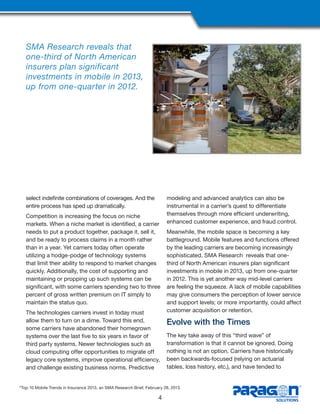
sophisticated. SMA Research reveals that one-
third of North American insurers plan significant
investments in mobile in 2013, up from one-quarter
in 2012. This is yet another way mid-level carriers
are feeling the squeeze. A lack of mobile capabilities
may give consumers the perception of lower service
and support levels; or more importantly, could affect
customer acquisition or retention.
Evolve with the Times
The key take away of this “third wave” of
transformation is that it cannot be ignored. Doing
nothing is not an option. Carriers have historically
been backwards-focused (relying on actuarial
tables, loss history, etc.), and have tended to
4
SMA Research reveals that
one-third of North American
insurers plan significant
investments in mobile in 2013,
up from one-quarter in 2012.
2
Top 10 Mobile Trends in Insurance 2013, an SMA Research Brief, February 28, 2013.
Value Envisioned. Value Delivered.
maintain established processes without question.
They also have the propensity to be risk-averse.
These characteristics need to change. Carriers must
be willing to try new things without betting the ranch
or subjecting the company to undue risk.
P&C insurance carriers need to focus on integrating
internal and external innovations to create
end-to-end customer experiences that achieve the
level of customer-centricity necessary to improve
loyalty, reduce churn, and grow revenue. They
need to build change-capable organizations and
focus on becoming operationally excellent using
lean processes.
To achieve these goals, carriers need a measured
approach and a long-term strategy. A few
strategic drivers should be selected and floated
to operational and technology initiatives that are
well funded, supported by a change-capable
organization, and driven with a sense of urgency.
Many P&C insurers pride themselves on their ability
to respond rapidly to emergencies and/or natural
disasters. Those urgent response mechanisms and
the all hands on deck mentality should be used to
address today’s business issues, ensuring a carrier
is prepared to survive both hard and soft markets,
the changes happening now as part of the “third
wave,” and changes yet to come in the future.
About Paragon Solutions:
Paragon Solutions is an advisory consulting
and systems integration firm that specializes in
enterprise information management to help clients
leverage information assets for better business
results. The company does this through its industry
practices, solution accelerators and specialized
technology competencies that help clients achieve
operational efficiency, business scalability, and
regulatory compliance.
Paragon works with businesses that are focused
in a few key industries − communications, financial
services, healthcare, insurance, and life sciences.
The industry-focused practices work with Paragon’s
competency groups to address today’s client
concerns in Process Optimization, Information
Management, and Information Insight.
For more information, please visit the Paragon
website at www.consultparagon.com, or call
1.800.462.5582.
5
Corporate Headquarters – Cranford, NJ
Chicago • Boston • New York • Philadelphia •
London • Bangalore, India
Copyright ©2013 Paragon Solutions is a registered
trademark of Paragon Solutions, Inc.
https://www.facebook.com/paragonsolutions
https://twitter.com/consultparagon
http://www.linkedin.com/company/paragon

Evolutionary strategies for p&c insurers

  • 1.
  • 2.
    Executive Summary The insuranceindustry has undergone a gradual, technology-driven transformation over the last four decades. From the 1970s through the 1990s, mainframe and client server applications changed the efficiency equation. At the end of the 20th century, the Internet signaled the beginning of a new era of complex interaction between insureds, agents, and carriers. Today, entirely new technologies such as telematics, mobile technologies, advanced underwriting models, and the shift to a customer-centric paradigm are further altering the industry. Signs indicate this “third wave” of transformation may be more significant and far-reaching than those preceding it, surfacing significant issues and exposing inefficiencies. The recent soft market, combined with broader economic challenges such as the sudden decrease in investment income that accompanied the most recent recession, have exposed carriers with less efficient operations or poor underwriting disciplines. Carriers that thought they could wait-out the cycle as they have in years past now face a new reality. The transformation currently underway is causing operational, organizational, and IT pain points. Carriers that fail to address process inefficiencies and evolve business processes to address current challenges risk being left behind. The insurance industry has traditionally been slow to evolve. In today’s business environment a slow evolution is no longer an option Value Envisioned. Value Delivered. 1.800.462.5582  ■ www.consultparagon.com Evolving P&C Insurers Carriers have historically been backwards-focused and have tended to maintain established processes without question. They also have the propensity to be risk-averse. These characteristics need to change. Carriers must be willing to try new things without betting the ranch or subjecting the company to undue risk. 1
  • 3.
    Insurers need toembrace commoditization, at least partially, and develop boxed products demanding better predictive analytics, automated underwriting, analysis of abundant social data, and distributor-friendly sales support systems. Introduction In the past, the insurance industry operated in a world that required little transparency. Insurance companies could hide behind walls. The relatively long cycle times accepted in the market allowed carriers to mask underwriting, servicing, and claims inefficiencies. Waiting days or weeks for a quote was acceptable to the average buyer. But consumer expectations have changed. Today’s consumers demand instant service, transparency, and convenience. New expectations are forcing the insurance business to evolve from a product- centric model to a customer-centric model. To keep and grow business, carriers need to redesign and refocus their entire business process around the individual buyer. Implementing a customer-centric model places significant pressure on carriers to invest in technology and operations that use personnel more efficiently. As the industry becomes more competitive, carriers that are not extremely efficient or specialized will no longer compete effectively. Already, less efficient, middle-tier carriers are getting squeezed by large, national players or outmaneuvered by affinity companies at the local level. Mid-sized companies that are not hyper- specialized or extremely good at serving specific needs are at risk. Mitigating this risk requires adapting in three major areas: Embrace Commoditization Ten to 12 years ago, before the widespread use of online insurance quoting and servicing, carriers relied on agents to sell insurance for products such as personal lines auto and home coverage. Today, because of the availability of Internet research, ratings, and reviews, the ability to run real-time quotes, and the overall explosion of information, these products have become more commoditized. There is no longer a “special sauce” for general products. Perceived and actual differences in products and service continue to be eroded. Rating models are more sophisticated. Pricing parity is matched with service parity, and the bar is constantly rising. While such innovations take time to percolate in a highly regulated and conservative environment, carriers need to foster innovation in measured steps. 2
  • 4.
    Operational efficiency andIT effectiveness are now table stakes, as opposed to being good to have in years past (heading in the direction of personal banking, where interactions and transactions are becoming increasingly efficient and less mysterious). Insurers need to embrace commoditization, at least partially, and develop boxed products demanding better predictive analytics, automated underwriting, analysis of abundant social data, and distributor-friendly sales support systems. While certain niche markets and very large commercial accounts may be somewhat insulated from the forces of change, most small and mid- market products are already heading in this direction. Business managers and corporate risk managers are applying the same lessons they learned in managing their personal policies and asking for the same or better from their commercial carriers. This trend may be lagging personal lines by a few years, but it is evident none-the-less. Respond to Customer Demands for Transparency Today, not all consumers are interested in buying insurance in the way most insurers sell it. Demands for better and faster service from insurance carriers continue to rise. Today’s customers expect transparency and convenience. People on the road shop their business from anywhere at any time. They expect up-to-the-second information, multi-channel access, and immediate responses, as well as the ability to purchase multiple products across lines of business, regardless of the back-end environment. Demand for multi-channel strategies will explode as focus shifts from selling to buying preferences. While some will continue to be comfortable with local agent models, others, particularly those of Generations X, Y and Z, will choose to buy through retail, banking, or online channels. Despite all this, there remains a need for the trusted advisor role an agent or broker provides. A J.D. Power and Associates study of U.S. insurance shopping found that, despite the growing popularity of online shopping, insurance agents still have the upper hand when it comes down to an actual purchase. Over 50 percent of quotes initiated online were eventually closed by an agent or call center representative. Invest in Flexible Technology In the 1980s and 1990s, most insurance carriers built proprietary policy administration systems that allowed for little flexibility. Technology was oriented toward developers and long testing lifecycles. Carriers offered a limited number of packages, which were rated and underwritten as a package. Each package might take a year to put together, and changes required significant business process changes, new underwriting, new forms, etc. Today, most carriers offer configurable products, allowing consumers to Value Envisioned. Value Delivered. 3 1.800.462.5582  ■ www.consultparagon.com A J.D. Power and Associates study of U.S. insurance shopping found that, despite the growing popularity of online shopping, insurance agents still have the upper hand when it comes down to an actual purchase. Over 50 percent of quotes initiated online were eventually closed by an agent or call center representative. 1 J.D. Power and Associates 2011 U.S. Insurance Shopping Study, June 2, 2011.
  • 5.
    select indefinite combinationsof coverages. And the entire process has sped up dramatically. Competition is increasing the focus on niche markets. When a niche market is identified, a carrier needs to put a product together, package it, sell it, and be ready to process claims in a month rather than in a year. Yet carriers today often operate utilizing a hodge-podge of technology systems that limit their ability to respond to market changes quickly. Additionally, the cost of supporting and maintaining or propping up such systems can be significant, with some carriers spending two to three percent of gross written premium on IT simply to maintain the status quo. The technologies carriers invest in today must allow them to turn on a dime. Toward this end, some carriers have abandoned their homegrown systems over the last five to six years in favor of third party systems. Newer technologies such as cloud computing offer opportunities to migrate off legacy core systems, improve operational efficiency, and challenge existing business norms. Predictive modeling and advanced analytics can also be instrumental in a carrier’s quest to differentiate themselves through more efficient underwriting, enhanced customer experience, and fraud control. Meanwhile, the mobile space is becoming a key battleground. Mobile features and functions offered by the leading carriers are becoming increasingly sophisticated. SMA Research reveals that one- third of North American insurers plan significant investments in mobile in 2013, up from one-quarter in 2012. This is yet another way mid-level carriers are feeling the squeeze. A lack of mobile capabilities may give consumers the perception of lower service and support levels; or more importantly, could affect customer acquisition or retention. Evolve with the Times The key take away of this “third wave” of transformation is that it cannot be ignored. Doing nothing is not an option. Carriers have historically been backwards-focused (relying on actuarial tables, loss history, etc.), and have tended to 4 SMA Research reveals that one-third of North American insurers plan significant investments in mobile in 2013, up from one-quarter in 2012. 2 Top 10 Mobile Trends in Insurance 2013, an SMA Research Brief, February 28, 2013.
  • 6.
    Value Envisioned. ValueDelivered. maintain established processes without question. They also have the propensity to be risk-averse. These characteristics need to change. Carriers must be willing to try new things without betting the ranch or subjecting the company to undue risk. P&C insurance carriers need to focus on integrating internal and external innovations to create end-to-end customer experiences that achieve the level of customer-centricity necessary to improve loyalty, reduce churn, and grow revenue. They need to build change-capable organizations and focus on becoming operationally excellent using lean processes. To achieve these goals, carriers need a measured approach and a long-term strategy. A few strategic drivers should be selected and floated to operational and technology initiatives that are well funded, supported by a change-capable organization, and driven with a sense of urgency. Many P&C insurers pride themselves on their ability to respond rapidly to emergencies and/or natural disasters. Those urgent response mechanisms and the all hands on deck mentality should be used to address today’s business issues, ensuring a carrier is prepared to survive both hard and soft markets, the changes happening now as part of the “third wave,” and changes yet to come in the future. About Paragon Solutions: Paragon Solutions is an advisory consulting and systems integration firm that specializes in enterprise information management to help clients leverage information assets for better business results. The company does this through its industry practices, solution accelerators and specialized technology competencies that help clients achieve operational efficiency, business scalability, and regulatory compliance. Paragon works with businesses that are focused in a few key industries − communications, financial services, healthcare, insurance, and life sciences. The industry-focused practices work with Paragon’s competency groups to address today’s client concerns in Process Optimization, Information Management, and Information Insight. For more information, please visit the Paragon website at www.consultparagon.com, or call 1.800.462.5582. 5 Corporate Headquarters – Cranford, NJ Chicago • Boston • New York • Philadelphia • London • Bangalore, India Copyright ©2013 Paragon Solutions is a registered trademark of Paragon Solutions, Inc. https://www.facebook.com/paragonsolutions https://twitter.com/consultparagon http://www.linkedin.com/company/paragon