1
Occupational Health
Overview
Diploma in Safety & Health Course Programme
Tay Kay Chuang
MSc.in OSH (USA)
Topic No. 1
2
Scope
1. Brief History of Occupational Health
2. Definition of Occupational Health
3. Focus of Occupational Health
4. Various disciplines of Occupational Health
5. Safety versus Health
6. Health Hazards
7. Concept of Prevention and Control
3
1. Occupational Health History
A. Ancient times, Middle Ages, and the Renaissance
1. Ancient Times
 Miners of Ancient times (slaves, prisoners or criminals).
 Poor working conditions (almost a complete disregard for workers’
safety and health) in gold, silver and lead mines of Ancient Greece
and Egypt.
2. Middle Ages
 Mining in Central Europe had become a skilled occupation.
 Intensified mining - mines got deeper and conditions worsened
(Premature deaths of workers mainly due to pulmonary diseases –
silicosis + TB).
3. RENAISSANCE
 Mining, metal work & other trades flourished in Italy.
 First systemic study of trade diseases by Bernardino Ramazzini,
1633-1714(Father of Occupational Medicine) was based on visits
to workshops.
4
1.Occupational Health History
continued ..
B. Industrial Revolution in Great Britain
 Latter half of 18th
Century, Mechanization transferred the making
of textiles from peoples’ homes to the new factories.
 Problems : Workers of all grades exposed to pressures of
increasing productions (physical & psychological hazards at
work)
 Effects of industrialisation on Community health
 Family life disrupted as men moved into new industrial
areas leaving families behind
 Situation encouraged alcoholism and prostitution
 Epidemics due to overcrowding in unsanitary conditions.
 Malnutrition (poverty and unemployment)
5
1. Occupational Health History
continued ..
Effects of industrialisation on worker health
• Workers in factories were exposed to hazards of
occupational disease (wide range of chemicals)
• Workers had to work excessively long hours.
• Untrained Workers had to handle new machinery equipped
with poor safety devices – high incidence of injuries
6
First Factory Act– 1819 (UK)
The first Factory Act was passed in 1819. It was applied to textile mills and
laid down hours of work and regulations covering education and hygiene and
child labour. The Act was known thereafter as the Magna Carta of Childhood
and marked the first protection of the children of the poor from toil, starvation
and ignorance.
Examples:
1. Children below 18 :
• Not allowed to work in textile mills after 8.30pm till 5.30am
• Not allowed to work more than 12 hours in a day or 65 hours per
week
2.Meals break – not < 1.5 hours
3.Unlawful to employ children who did not complete their nineth year of
education to work in any factory.
4.Unlawful to let children < 11 years old to work in factory > 9 hrs/day or > 48
hours per week
1. Occupational Health History …
7
1. Occupational Health History
…continued
Influence from developments in Medicine
 Agricola and Paracelcus (15th Century)
 Physicians who made their first observations on miners and their diseases
 Bernardino Ramazzini (1633-1714)
 Father of Occupational Medicine who made first systemic study of trade
diseases based on visits to workshops and described the associated treatment
and preventive measures.
 He recommended that physicians should routinely enquire about a patient’s
occupation.
 Percivall Pot (1713-88)
 Drew attention to soot as a cause of scrotal cancer in chimney sweeps.
 Charles Turner Thackrah (1795-1833)
 Published the first British work on occupational diseases.
8
Class Exercise No.1
1. In the Ancient times, why were prisoners, criminals and slaves
being asked to work in mining metals?
2. Why was Dr. Ramazzini recommended that doctors when seeing
sick workers should ask for their occupation?
3. What were the social impacts of Industrial Revolution in UK in
the later half of 18th
Century , when machines were widely used for
textiles making?
9
2. Definition of Occupational Health
 Promotion and maintenance of the highest degree
of the physical, mental and social well-being of
workers in all occupations;
 Prevention from amongst workers of ill-health
caused by their working conditions;
 Protection of workers in their employment from
risks resulting from factors adverse to health;
 Placing and maintenance of workers in an
occupational environment adapted to their
physiological and psychological ability.
Aim – To adapt work to man and each man to his job.
ILO / WHO committee on Occupational Health
10
3. Focus of Occupational Health
 Promote and maintain workers’ optimal Health.
 Physical fitness to work
 Mentally sound (work-life balance; cordial work relationship)
 Social health (happy family , good nutrition no social ills such as alcohol &
drugs abuse, prostitution)
 Prevention from illnesses or diseases arising from the workplace or
work processes.
 Anticipation, identification, evaluation, control and review of hazards/risks.
 Improve quality of work environment and work processes to suit
workers’ physiological and psychological capabilities .
 Improve work space and means of access for workers to maintain
equipment (preferably at design stage).
11
Focus of Occupational Health
…continued
Concept of Promotion and Prevention
Occupational Health Diseases
Workplace Accidents
Factors relating to work
-Hazards
-Work environment
- Working methods
-Equipment, machinery etc
Healthy Lifestyle
-No Smoking
-No Alcohol and drug
-Hobbies that promote health
Prevention Promotion
12
Class Exercise No. 2
1. Give 3 examples each of adverse factors that may harm
the well-being of workers in terms of
 Physical health
 Mental health and
 Social health
13
4. Occupational Health Disciplines
 Occupational Medicine
 Industrial Hygiene
 Occupational Toxicology
 Ergonomics
 Epidemiology
 Industrial Psychology
14
Occupational Medicine
Medical specialty concerned with the promotion and maintenance of
the physical and mental health of employees in occupational settings.
• assessment of workers’ health
• linking working conditions and processes to workers’ health
• assisting in managing the health, skills and working capacity of
the entire working population and
• managing individual cases in the context of working ability and
production
Industrial hygiene
Preventive science devoted to anticipation, recognition, evaluation
and control of health hazards at the place of work
Toxicology
Study of chemical or physical agents that produce adverse responses
in the biological systems with which they interact.
15
Ergonomics
It is a scientific approach of how to fit the task demands of the
workplace to the employee who perform the task.
Epidemiology
The study of the distribution and determinants of health-related states
in specified populations, and the application of this study to control of
health problems.
Distribution – refers to analysis by time, place, and classes of
person affected.
Determinants – all the physical, biological, social, cultural, and
behavioural factors that influence health.
16
Recent trends in OH
 Last 30 years
 incidence Occupational Diseases (OD) reduced
 methods to detect early OD
 monitoring of workers’ exposure to health risks allows early
detection of OD
 epidemiology establishes exposure & diseases
 Exposure standards develop
 These are largely due to improvement in technology,
safer and healthier work environment, positive work
behaviour of workers and employers, and introduction of
OSH legislation to protect the safety and health of
people at work.
17
5. Relationship between Occupational Safety
and Occupational Health
 Safety
 prevention of accidents (risks from moving machinery,
fire and explosions, lightning, falling objects, sharp
objects, acid burn, etc.)
 Health
 Prevention of diseases (risks from chemical, physical,
biological, ergonomics & psychological agents)
18
Cause and Effect
CAUSE
EFFECT
SAFET
Y
HEALT
H
CAUSE
EFFECT
Heredity
Previous
Exposures
Time
Dose
Lifestyle
19
Causes and Effects
Musculo-Skeletal Disorders (MSD)
Dermatitis
StressMetal Fume fevers
NIHL
Mesothelioma
Leukaemia
Lung cancer
Accidents
Solvent
Effects
Welder’s Flash
Minutes Days Months Years Decades
Cause is
hard to see
Cause is
easy to see
20
Hazard and Risk
HAZARD
Potential of an agent to cause harm to health
RISK
Likelihood that an agent will cause harm to health in the
actual circumstances of exposure
RISK = HAZARD X EXPOSURE
21
Hazard v Risk
Hazard
- The potential of a chemical to cause harm to an
individual
• The Hazard relates to the intrinsic properties of the
chemical (its physicochemical properties and health
effects) to cause harm and will always be the same
Risk
- The likelihood of harm to worker occurring under the
actual circumstances of exposure
• The Risk is totally dependant on the actual exposure
(Intensity or magnitude x duration x frequency) to
the agent.
22
7. Health Hazard types
 2 basic Categories
 Acute and Chronic
Acute
 An acute effect is caused by short period of
exposure (e.g. in seconds or minutes) to high
concentrations of a substance.
 Example: The acute effect of carbon monoxide
(CO) poisoning where a brief exposure to a high
CO concentration causes asphyxiation.
23
Hazards Types
 Chronic Effects
 Chronic or long-term effects are caused by
repeated or prolonged exposure (continuing
day after day or week after week), typically
involving relatively low levels of a substance.
 Example: Silicosis (causing fibrosis of lungs) is due to prolonged
exposure over a number of years to crystalline silica.
24
Classification of Health Hazards
1. Physical
2. Chemical
3. Biological
4. Ergonomic
5. Psychological
There are 5 general groups of Health Hazards
25
1.1. Physical HazardsPhysical Hazards
From NoiseFrom Noise
From LightFrom Light
Examples of the 5 Groups of Health Hazards
26
From Temperature
Coldness
Heat stress
Vibration
Radiation
1.1. Physical Hazards:Physical Hazards:
27
From Welding Fume, Mineral oils, Paints,, Silica sand,
Acids, Alkalis, Solvent (Thinner, Adhesive, Benzene,
Diesel).
28
•Bacteria (e.g. E.Coli, Staphylococci,TB, legionella);
•Virus(e.g. Hepatitis A,B & C, HIV, SARS, Avian Influenza);
•Fungus & Spores
29
Manual lifting, Posture, Repetitive
Movement, Space, Comfort.
30
ERGONOMIC
HAZARDS
Air temperature too hot/cold,
low relative humidity
Poor design, inaccessibility,
insufficient space, awkward postures
Mismatch of work
environment
Workstation
Too bright/dim
Manual lifting
31
Mental stress, Overwork, Work Pressure, Long Shift Hours /
work Schedule-night duty, offshore duty roster, boredom,
Unreasonable deadline ,cultural shock., poor communications,
monotonous work
Increase risk of incident.
32
Routes of Entry of “Poisons” into human
body
 Inhalation- most significant route of entry
(respiratory system)
 Absorption (through skin, eye and mucous
membrane)
 Ingestion (mouth)
 Injection
33
8. Principles of Prevention and
control
 Systematic approach
to control of hazards
 thorough
understanding of
process required
 Control hierarchy
 Closing the loop
Review
Anticipation
Identification/recognition
Assessment/Evaluation
Control
34
8. Principles of Prevention & Control
1. Anticipation
 Predict or expect dangerous situations before they occur and take steps to
prevent them.
2. Identification/Recognition
 Identify hazardous situations (worksite audit, incident investigation report,
literature, exposure monitoring)
 Understanding work process and materials used
3. Assessment/Evaluation
 Assess work process and risks involved
 Can be qualitative or quantitative assessment involving ther services of
experts
4. Controls
 Implemented based on risks identified.
 Preferred methods
 Hierarchy of control principle.
 Principle of ALARP
35
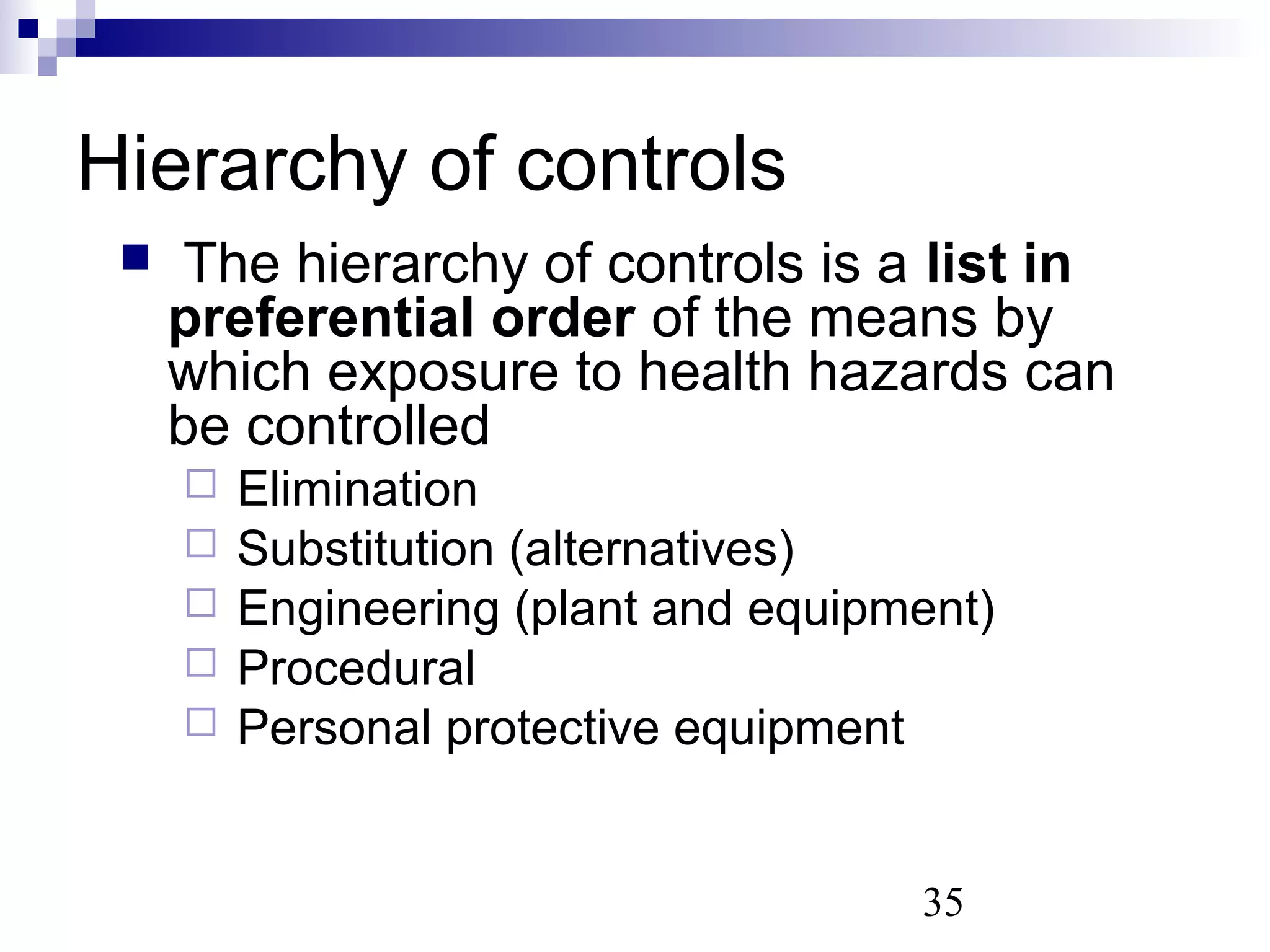
 The hierarchy of controls is a list in
preferential order of the means by
which exposure to health hazards can
be controlled
 Elimination
 Substitution (alternatives)
 Engineering (plant and equipment)
 Procedural
 Personal protective equipment
Hierarchy of controls
Effectiveness of Controls
The types of control vary in their
effectiveness according to the control
hierarchy:
Elimination Most Effective
Substitution
Engineering
Procedural
PPE Least Effective
Types of controls
 Elimination and substitution
 Engineering (plant and
equipment):
 Equipment/processes designed
to prevent or minimize release
of the hazard
 Examples: containment (enclosure),
exhaust ventilation, waste treatment
process
Types of controls
 Procedural:
 Safe systems of work / Permit to work
system
 Record systems
 Staff Instruction, Information & training
 Supervision, Emergency arrangements
 Personal Protective Equipment (PPE):
 Respiratory & Skin Protection as a
secondary line
of defence or as the only option
39
Definitions of ALARP
 ALARP = As Low As Reasonably Practicable.“
This means “ balancing the reduction in risk against :
 State of knowledge about the hazard or risk
 Availability and suitability of ways to remove or mitigate the hazard or
risk;
 cost of removing or mitigating the hazard or risk
 ALARP level represents the point, objectively
assessed based on existing knowledge, at which the time,
difficulty and cost of further reduction measures become
unreasonably disproportional to the additional risk reduction
obtained.
ALARP Definition
40
•
•
•
•
•
•
Risk to
Health
Tolerability level
Cost of
Control
ALARPLegal Liability Wasteful
ALARP
41
Principles of Prevention & Control
5. REVIEW
 Regular review by management for continual
improvement on safe work practice.
 Examples:
 Workplace inspection or OSH Management System audit
 Review on the close-out status of follow-up actions on
inspections, audits or incident investigation reports.
 Review on effectiveness of control measures.
Class Exercise No. 3
Identify 2 Health Hazards and their Harmful Effects at
your Workplace or home
Hazard Source Route Harmful Effect
1. Physical
2. Chemical
3. Ergonomic
4. Biological
5. Psychological

Topic no.1 occupationa health

  • 1.
    1 Occupational Health Overview Diploma inSafety & Health Course Programme Tay Kay Chuang MSc.in OSH (USA) Topic No. 1
  • 2.
    2 Scope 1. Brief Historyof Occupational Health 2. Definition of Occupational Health 3. Focus of Occupational Health 4. Various disciplines of Occupational Health 5. Safety versus Health 6. Health Hazards 7. Concept of Prevention and Control
  • 3.
    3 1. Occupational HealthHistory A. Ancient times, Middle Ages, and the Renaissance 1. Ancient Times  Miners of Ancient times (slaves, prisoners or criminals).  Poor working conditions (almost a complete disregard for workers’ safety and health) in gold, silver and lead mines of Ancient Greece and Egypt. 2. Middle Ages  Mining in Central Europe had become a skilled occupation.  Intensified mining - mines got deeper and conditions worsened (Premature deaths of workers mainly due to pulmonary diseases – silicosis + TB). 3. RENAISSANCE  Mining, metal work & other trades flourished in Italy.  First systemic study of trade diseases by Bernardino Ramazzini, 1633-1714(Father of Occupational Medicine) was based on visits to workshops.
  • 4.
    4 1.Occupational Health History continued.. B. Industrial Revolution in Great Britain  Latter half of 18th Century, Mechanization transferred the making of textiles from peoples’ homes to the new factories.  Problems : Workers of all grades exposed to pressures of increasing productions (physical & psychological hazards at work)  Effects of industrialisation on Community health  Family life disrupted as men moved into new industrial areas leaving families behind  Situation encouraged alcoholism and prostitution  Epidemics due to overcrowding in unsanitary conditions.  Malnutrition (poverty and unemployment)
  • 5.
    5 1. Occupational HealthHistory continued .. Effects of industrialisation on worker health • Workers in factories were exposed to hazards of occupational disease (wide range of chemicals) • Workers had to work excessively long hours. • Untrained Workers had to handle new machinery equipped with poor safety devices – high incidence of injuries
  • 6.
    6 First Factory Act–1819 (UK) The first Factory Act was passed in 1819. It was applied to textile mills and laid down hours of work and regulations covering education and hygiene and child labour. The Act was known thereafter as the Magna Carta of Childhood and marked the first protection of the children of the poor from toil, starvation and ignorance. Examples: 1. Children below 18 : • Not allowed to work in textile mills after 8.30pm till 5.30am • Not allowed to work more than 12 hours in a day or 65 hours per week 2.Meals break – not < 1.5 hours 3.Unlawful to employ children who did not complete their nineth year of education to work in any factory. 4.Unlawful to let children < 11 years old to work in factory > 9 hrs/day or > 48 hours per week 1. Occupational Health History …
  • 7.
    7 1. Occupational HealthHistory …continued Influence from developments in Medicine  Agricola and Paracelcus (15th Century)  Physicians who made their first observations on miners and their diseases  Bernardino Ramazzini (1633-1714)  Father of Occupational Medicine who made first systemic study of trade diseases based on visits to workshops and described the associated treatment and preventive measures.  He recommended that physicians should routinely enquire about a patient’s occupation.  Percivall Pot (1713-88)  Drew attention to soot as a cause of scrotal cancer in chimney sweeps.  Charles Turner Thackrah (1795-1833)  Published the first British work on occupational diseases.
  • 8.
    8 Class Exercise No.1 1.In the Ancient times, why were prisoners, criminals and slaves being asked to work in mining metals? 2. Why was Dr. Ramazzini recommended that doctors when seeing sick workers should ask for their occupation? 3. What were the social impacts of Industrial Revolution in UK in the later half of 18th Century , when machines were widely used for textiles making?
  • 9.
    9 2. Definition ofOccupational Health  Promotion and maintenance of the highest degree of the physical, mental and social well-being of workers in all occupations;  Prevention from amongst workers of ill-health caused by their working conditions;  Protection of workers in their employment from risks resulting from factors adverse to health;  Placing and maintenance of workers in an occupational environment adapted to their physiological and psychological ability. Aim – To adapt work to man and each man to his job. ILO / WHO committee on Occupational Health
  • 10.
    10 3. Focus ofOccupational Health  Promote and maintain workers’ optimal Health.  Physical fitness to work  Mentally sound (work-life balance; cordial work relationship)  Social health (happy family , good nutrition no social ills such as alcohol & drugs abuse, prostitution)  Prevention from illnesses or diseases arising from the workplace or work processes.  Anticipation, identification, evaluation, control and review of hazards/risks.  Improve quality of work environment and work processes to suit workers’ physiological and psychological capabilities .  Improve work space and means of access for workers to maintain equipment (preferably at design stage).
  • 11.
    11 Focus of OccupationalHealth …continued Concept of Promotion and Prevention Occupational Health Diseases Workplace Accidents Factors relating to work -Hazards -Work environment - Working methods -Equipment, machinery etc Healthy Lifestyle -No Smoking -No Alcohol and drug -Hobbies that promote health Prevention Promotion
  • 12.
    12 Class Exercise No.2 1. Give 3 examples each of adverse factors that may harm the well-being of workers in terms of  Physical health  Mental health and  Social health
  • 13.
    13 4. Occupational HealthDisciplines  Occupational Medicine  Industrial Hygiene  Occupational Toxicology  Ergonomics  Epidemiology  Industrial Psychology
  • 14.
    14 Occupational Medicine Medical specialtyconcerned with the promotion and maintenance of the physical and mental health of employees in occupational settings. • assessment of workers’ health • linking working conditions and processes to workers’ health • assisting in managing the health, skills and working capacity of the entire working population and • managing individual cases in the context of working ability and production Industrial hygiene Preventive science devoted to anticipation, recognition, evaluation and control of health hazards at the place of work Toxicology Study of chemical or physical agents that produce adverse responses in the biological systems with which they interact.
  • 15.
    15 Ergonomics It is ascientific approach of how to fit the task demands of the workplace to the employee who perform the task. Epidemiology The study of the distribution and determinants of health-related states in specified populations, and the application of this study to control of health problems. Distribution – refers to analysis by time, place, and classes of person affected. Determinants – all the physical, biological, social, cultural, and behavioural factors that influence health.
  • 16.
    16 Recent trends inOH  Last 30 years  incidence Occupational Diseases (OD) reduced  methods to detect early OD  monitoring of workers’ exposure to health risks allows early detection of OD  epidemiology establishes exposure & diseases  Exposure standards develop  These are largely due to improvement in technology, safer and healthier work environment, positive work behaviour of workers and employers, and introduction of OSH legislation to protect the safety and health of people at work.
  • 17.
    17 5. Relationship betweenOccupational Safety and Occupational Health  Safety  prevention of accidents (risks from moving machinery, fire and explosions, lightning, falling objects, sharp objects, acid burn, etc.)  Health  Prevention of diseases (risks from chemical, physical, biological, ergonomics & psychological agents)
  • 18.
  • 19.
    19 Causes and Effects Musculo-SkeletalDisorders (MSD) Dermatitis StressMetal Fume fevers NIHL Mesothelioma Leukaemia Lung cancer Accidents Solvent Effects Welder’s Flash Minutes Days Months Years Decades Cause is hard to see Cause is easy to see
  • 20.
    20 Hazard and Risk HAZARD Potentialof an agent to cause harm to health RISK Likelihood that an agent will cause harm to health in the actual circumstances of exposure RISK = HAZARD X EXPOSURE
  • 21.
    21 Hazard v Risk Hazard -The potential of a chemical to cause harm to an individual • The Hazard relates to the intrinsic properties of the chemical (its physicochemical properties and health effects) to cause harm and will always be the same Risk - The likelihood of harm to worker occurring under the actual circumstances of exposure • The Risk is totally dependant on the actual exposure (Intensity or magnitude x duration x frequency) to the agent.
  • 22.
    22 7. Health Hazardtypes  2 basic Categories  Acute and Chronic Acute  An acute effect is caused by short period of exposure (e.g. in seconds or minutes) to high concentrations of a substance.  Example: The acute effect of carbon monoxide (CO) poisoning where a brief exposure to a high CO concentration causes asphyxiation.
  • 23.
    23 Hazards Types  ChronicEffects  Chronic or long-term effects are caused by repeated or prolonged exposure (continuing day after day or week after week), typically involving relatively low levels of a substance.  Example: Silicosis (causing fibrosis of lungs) is due to prolonged exposure over a number of years to crystalline silica.
  • 24.
    24 Classification of HealthHazards 1. Physical 2. Chemical 3. Biological 4. Ergonomic 5. Psychological There are 5 general groups of Health Hazards
  • 25.
    25 1.1. Physical HazardsPhysicalHazards From NoiseFrom Noise From LightFrom Light Examples of the 5 Groups of Health Hazards
  • 26.
  • 27.
    27 From Welding Fume,Mineral oils, Paints,, Silica sand, Acids, Alkalis, Solvent (Thinner, Adhesive, Benzene, Diesel).
  • 28.
    28 •Bacteria (e.g. E.Coli,Staphylococci,TB, legionella); •Virus(e.g. Hepatitis A,B & C, HIV, SARS, Avian Influenza); •Fungus & Spores
  • 29.
    29 Manual lifting, Posture,Repetitive Movement, Space, Comfort.
  • 30.
    30 ERGONOMIC HAZARDS Air temperature toohot/cold, low relative humidity Poor design, inaccessibility, insufficient space, awkward postures Mismatch of work environment Workstation Too bright/dim Manual lifting
  • 31.
    31 Mental stress, Overwork,Work Pressure, Long Shift Hours / work Schedule-night duty, offshore duty roster, boredom, Unreasonable deadline ,cultural shock., poor communications, monotonous work Increase risk of incident.
  • 32.
    32 Routes of Entryof “Poisons” into human body  Inhalation- most significant route of entry (respiratory system)  Absorption (through skin, eye and mucous membrane)  Ingestion (mouth)  Injection
  • 33.
    33 8. Principles ofPrevention and control  Systematic approach to control of hazards  thorough understanding of process required  Control hierarchy  Closing the loop Review Anticipation Identification/recognition Assessment/Evaluation Control
  • 34.
    34 8. Principles ofPrevention & Control 1. Anticipation  Predict or expect dangerous situations before they occur and take steps to prevent them. 2. Identification/Recognition  Identify hazardous situations (worksite audit, incident investigation report, literature, exposure monitoring)  Understanding work process and materials used 3. Assessment/Evaluation  Assess work process and risks involved  Can be qualitative or quantitative assessment involving ther services of experts 4. Controls  Implemented based on risks identified.  Preferred methods  Hierarchy of control principle.  Principle of ALARP
  • 35.
    35  The hierarchyof controls is a list in preferential order of the means by which exposure to health hazards can be controlled  Elimination  Substitution (alternatives)  Engineering (plant and equipment)  Procedural  Personal protective equipment Hierarchy of controls
  • 36.
    Effectiveness of Controls Thetypes of control vary in their effectiveness according to the control hierarchy: Elimination Most Effective Substitution Engineering Procedural PPE Least Effective
  • 37.
    Types of controls Elimination and substitution  Engineering (plant and equipment):  Equipment/processes designed to prevent or minimize release of the hazard  Examples: containment (enclosure), exhaust ventilation, waste treatment process
  • 38.
    Types of controls Procedural:  Safe systems of work / Permit to work system  Record systems  Staff Instruction, Information & training  Supervision, Emergency arrangements  Personal Protective Equipment (PPE):  Respiratory & Skin Protection as a secondary line of defence or as the only option
  • 39.
    39 Definitions of ALARP ALARP = As Low As Reasonably Practicable.“ This means “ balancing the reduction in risk against :  State of knowledge about the hazard or risk  Availability and suitability of ways to remove or mitigate the hazard or risk;  cost of removing or mitigating the hazard or risk  ALARP level represents the point, objectively assessed based on existing knowledge, at which the time, difficulty and cost of further reduction measures become unreasonably disproportional to the additional risk reduction obtained. ALARP Definition
  • 40.
    40 • • • • • • Risk to Health Tolerability level Costof Control ALARPLegal Liability Wasteful ALARP
  • 41.
    41 Principles of Prevention& Control 5. REVIEW  Regular review by management for continual improvement on safe work practice.  Examples:  Workplace inspection or OSH Management System audit  Review on the close-out status of follow-up actions on inspections, audits or incident investigation reports.  Review on effectiveness of control measures.
  • 42.
    Class Exercise No.3 Identify 2 Health Hazards and their Harmful Effects at your Workplace or home Hazard Source Route Harmful Effect 1. Physical 2. Chemical 3. Ergonomic 4. Biological 5. Psychological

Editor's Notes

  • #4 TRAINER’S GUIDE Age of antiquity , Middles Ages and renaissance - Mining is one of the oldest industries and has always been a hazardous occupation. Conditions in the gold, silver and lead mines of ancient Greece and Egypt reveal an almost complete disregard for miners’ health and safety. Since the miner of antiquity was a slave, prisoner or criminal, there was no reason to improve working conditions because one of the objectives was punishment and there were ample reserves of manpower to replace those who were killed or maimed. 18th century - mechanization transferred the making of textiles from people’s homes to the new factories - beginning of industrial revolution ( Great technological inventions ) -It exposed workers of all grades to the pressures of increasing production and associated physical and psychological hazards of work. Effects of industrialization on community health - not directly occupational in origin. - family life was disrupted when men moved into new industrial areas leaving their families behind; a situation that encouraged alcoholism and prostitution. - epidemics due to overcrowding and unsanitary condition Effects of industrialization on workers’ health - long hours of work; little attention was paid to safety devices and workers were often simple untrained to handle the new machinery. The first Factory Act was passed in 1819. It is applied to textile mills and laid down hours of work and regulations covering education and hygiene and child labour. The Act was known thereafter as the Magna Carta of Childhood and marked the first protection of the children of the poor from toil, starvation and ignorance.
  • #5 TRAINER’S GUIDE Age of antiquity , Middles Ages and renaissance - Mining is one of the oldest industries and has always been a hazardous occupation. Conditions in the gold, silver and lead mines of ancient Greece and Egypt reveal an almost complete disregard for miners’ health and safety. Since the miner of antiquity was a slave, prisoner or criminal, there was no reason to improve working conditions because one of the objectives was punishment and there were ample reserves of manpower to replace those who were killed or maimed. 18th century - mechanization transferred the making of textiles from people’s homes to the new factories - beginning of industrial revolution ( Great technological inventions ) -It exposed workers of all grades to the pressures of increasing production and associated physical and psychological hazards of work. Effects of industrialization on community health - not directly occupational in origin. - family life was disrupted when men moved into new industrial areas leaving their families behind; a situation that encouraged alcoholism and prostitution. - epidemics due to overcrowding and unsanitary condition Effects of industrialization on workers’ health - long hours of work; little attention was paid to safety devices and workers were often simple untrained to handle the new machinery. The first Factory Act was passed in 1819. It is applied to textile mills and laid down hours of work and regulations covering education and hygiene and child labour. The Act was known thereafter as the Magna Carta of Childhood and marked the first protection of the children of the poor from toil, starvation and ignorance.
  • #8 TRAINER’S GUIDE The first observation on miners and their diseases were made by Agricola (1494-1555) and Paracelsus (1493 - 1451). Paracelcus – published in 1533 Von der Bergsucht und anderen Bergkrankheiten (Miner’s phthisis and other miner’s diseases) Bernardino Ramazzini – in 1700, published De morbis artificum diatriba (an account of the diseases of work), which described over 50 occupational disorders along with an account of working conditions at the time. Ramazzini, known as the father of occupational medicine, wrote of occupational asthma in grain workers and lead and mercury poisoning, and described both a range of treatments and preventive measures. Dr Percivall Pott had drawn attention to soot as a cause of scrotal cancer in chimney sweeps. Charles Turner Thackrah - recognise as one of the great pioneers in occupational medicine. He published the first British work on occupational disease.
  • #10 TRAINER’S GUIDE Occupational health The specialized practice of medicine, public health and ancillary health professions in an occupational setting. Its aim are to promote health as well as to prevent occupationally related diseases, and injuries and the impairments arising there from, and when work related injury or illness occurs, to treat these conditions. This field combines preventive and therapeutic health services. (John M. Last et al. 1995. A Dictionary of Epidemiology. Oxford, New York) Protect worker : Prior to work : Unsuitable worker who may endanger self or others not chosen At work : injury /disease while at work identified and worsening of condition prevented &amp; treated (prevention) After disease / injury : Fit to return Retire : Enter healthy , leave healthy. Optimum health : Fit , efficient worker , minimal medical leave Prevention of disease / injury : Health promotion, specific protection, early diagnosis and treatment , limit impairment , rehabilitation
  • #12 TRAINER’S GUIDE Occupational Medicine Medical specialty dealing with the assessment of workers’ health, linking working conditions and processes to workers’ health, assisting in managing the health, skills and working capacity of the entire working population and managing individual cases in the context of working ability and production Industrial hygiene Preventive science devoted to anticipation, recognition, evaluation and control of health hazards at the place of work Toxicology Study of chemical or physical agents that produce adverse responses in the biological systems with which they interact Ergonomic It is a scientific approach of how to fit the task demands of the workplace to the employee who perform the task Epidemiology The study of the distribution and determinants of health-related states in specified populations, and the application of this study to control of health problems. distribution – refers to analysis by time, place, and classes of person affected determinants – all the physical, biological, social, cultural, and behaviour factors that influence health
  • #14 TRAINER’S GUIDE Occupational Medicine Medical specialty dealing with the assessment of workers’ health, linking working conditions and processes to workers’ health, assisting in managing the health, skills and working capacity of the entire working population and managing individual cases in the context of working ability and production Industrial hygiene Preventive science devoted to anticipation, recognition, evaluation and control of health hazards at the place of work Toxicology Study of chemical or physical agents that produce adverse responses in the biological systems with which they interact Ergonomic It is a scientific approach of how to fit the task demands of the workplace to the employee who perform the task Epidemiology The study of the distribution and determinants of health-related states in specified populations, and the application of this study to control of health problems. distribution – refers to analysis by time, place, and classes of person affected determinants – all the physical, biological, social, cultural, and behaviour factors that influence health
  • #19 &amp;lt;number&amp;gt;
  • #20 &amp;lt;number&amp;gt;
  • #22 &amp;lt;number&amp;gt;
  • #26 &amp;lt;number&amp;gt;
  • #27 &amp;lt;number&amp;gt;
  • #28 &amp;lt;number&amp;gt;
  • #29 &amp;lt;number&amp;gt;
  • #30 &amp;lt;number&amp;gt;
  • #31 &amp;lt;number&amp;gt;
  • #32 &amp;lt;number&amp;gt;
  • #36 &amp;lt;number&amp;gt;
  • #37 &amp;lt;number&amp;gt;
  • #38 &amp;lt;number&amp;gt;
  • #39 &amp;lt;number&amp;gt;
  • #40 &amp;lt;number&amp;gt;
  • #41 &amp;lt;number&amp;gt;
  • #43 &amp;lt;number&amp;gt; Reinforce need to think of source and route when defining agent to harmful effect link