Institut Latihan Kementerian Kesihatan Malaysia (ILKKM)
Prog : Diploma in Medical And Health Science (DMHS)
Sem 4
MHBE 2013
3.3: Hazard
Identification and
Management
(2 Hour)
Learning Objectives;
1. Explain type of hazard
2. Explain assessment and identification of hazard
3. Describe concept of management hazard control
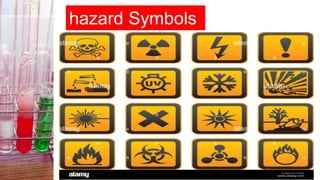
hazard Symbols
Introduction
• Safety management leads to
• Increased productivity
• Avoiding injuries
• Avoiding costly, time consuming, stressful a
nd inconvenient incidents
• HIRAC (Hazard identification, risk assessment
and Risk Control)
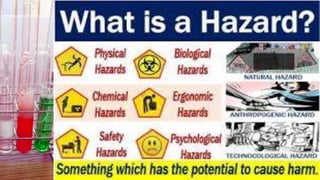
What are hazards?
A hazard is a source or a situation with the
potential for harm in terms of human injury or ill-
health, damage to property, damage to the
environment, or a combination of these.
Hazards at work may include noisy machinery, a
moving forklift, chemicals, electricity, working at
heights, a repetitive job, or inappropriate behaviour
that adversely affects a worker’s safety and health
Hazards
Hazard: condition or set of circumstances that present
a potential for harm
Two categories
1. Health hazards: occupational illnesses
2. Safety hazards: physical harm, injuries
What is risk?
• A risk is the chance of something hap
pening that will have a negative effect
. The level of risk reflects:
i. the likelihood of the unwanted event
ii. the potential consequences of the u
nwanted event.
What are controls?
Controls are the measures put in place to decrease the likelihoo
d or consequences from an unwanted event. They can:
i. prevent the unwanted event or reduce the loss of control of
the hazard (e.g. reduce or contain energy release)
ii. reduce the effects (e.g. provide shield from hazard; event h
as happened but emergency response and medical treatme
nt reduce the severity and duration of consequences).
What are the 5 major types of
hazards
• Biological
• Chemical
• Ergonomic
• Physical
• Psychological
BIOLOGICAL HAZARD
Biologic hazards that may be present at a hazardous waste site in
clude poisonous plants, insects, animals, and indigenous pathoge
ns. Protective clothing and respiratory equipment can help reduce
the chances of exposure. Thorough washing of any exposed bod
y parts and equipment will help protect against infection ( e.g ; Blo
od and other body fluids, Fungi/mold, Bacteria and viruses, Plants
, Insect bites, Animal and bird droppings.
PHYSICAL HAZARD
Are factors within the environment t
hat can harm the body without nece
ssarily touching it e.g;
i. Radiation: including ionising, nonionizing (EMF’s, microwaves, radio
waves, etc.)
ii. High exposure to sunlight/ultraviolet rays
iii. Temperature extremes – hot and cold
iv. Constant loud noise
ERGONOMICS HAZARDS
They are the hardest to spot since you don’t always imme
diately notice the strain on your body or the harm that the
se hazards pose. Short term exposure may result in “sore
muscles” the next day or in the days following exposure, b
ut long-term exposure can result in serious long-term illne
sses.
i. Improperly adjusted workstations and chairs
ii. Frequent lifting
iii. Poor posture
iv. Awkward movements, especially if they are repetitive
v. Repeating the same movements over and over
vi. Vibration
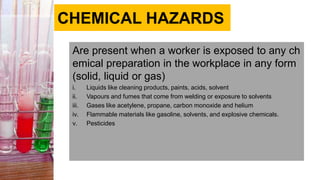
CHEMICAL HAZARDS
Are present when a worker is exposed to any ch
emical preparation in the workplace in any form
(solid, liquid or gas)
i. Liquids like cleaning products, paints, acids, solvent
ii. Vapours and fumes that come from welding or exposure to solvents
iii. Gases like acetylene, propane, carbon monoxide and helium
iv. Flammable materials like gasoline, solvents, and explosive chemicals.
v. Pesticides
Hazard Identification
Hazard identification is part of the process used to ev
aluate if any particular situation, item, thing, etc. may
have the potential to cause harm. The term often use
d to describe the full process is risk
assessment:
i. Identify hazards and risk factors that have the potential to cause har
m
ii. Analyze and evaluate the risk associated with that hazard
iii. Determine appropriate ways to eliminate the hazard, or control the ri
sk when the hazard cannot be eliminated
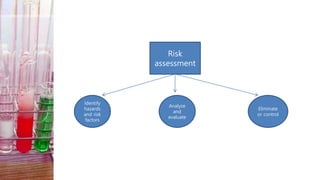
Risk
assessment
Identify
hazards
and risk
factors
Analyze
and
evaluate
Eliminate
or control
What is hazard and risk management?
Risk Management, in the context of occupational
safety and health (OSH), is the process of
identifying OSH hazards, determining the risk
based on likelihood and severity of work injuries, il
l health and property damage, prioritising the
implementation of preventive measures to
mitigate these risks.
Hazard Identification
• Main cause of occupational health and
safety problems
• Eliminating hazards or controlling risks is
the best way to reduce workplace injury
and illness
How to Start
• Check your potential injuries area:
1. Regular hazard assessment surveys of operations,
equipment, substances and tasks
2. A system of recording injuries, near misses and
identified hazards
3. Safe procedures for employees tasks
4. Safety training and supervision for new and young employees
5. Protective clothing and equipment
6. Safety training and practice for each new piece of equipment
7. Safety discussions between employers, contractors and
employees
8. Safety information readily available for hazardous substances
9. Copies of the regulations
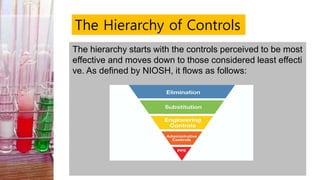
The hierarchy starts with the controls perceived to be most
effective and moves down to those considered least effecti
ve. As defined by NIOSH, it flows as follows:
The Hierarchy of Controls
As defined by NIOSH, it flows as
follows:
i. Elimination – Physically remove the hazard
ii. Substitution – Replace the hazard
iii. Engineering controls – Isolate people from the hazard
iv. Administrative controls – Change the way people work
v. Personal protective equipment– Protect the worker with PPE
How do you identify hazards in
risk management?
i. Speak to your employees - they may be aw
are of hazards that aren't so obvious to you.
ii. Observe the tasks carried out by your emplo
yees.
iii. Check your accident, near miss and ill-healt
h records.
iv. Read instructions for tools and equipment - t
hey will inform you of hazards.
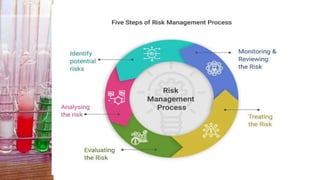
What are the 5 stages of
risk management?
i. Identify the risk.
ii. Analyze the risk.
iii. Prioritize the risk.
iv. Treat the risk.
v. Monitor the risk.
Identify the risk
An organization can identify their risks
through experience and internal history
, consulting with industry professionals,
and external research.
Analyze the risk
• Measure frequency and severity.
• Many organizations use a heat map
to measure their risks on this scale to
identify which risks are frequent and
which are severe.
Prioritize the risk
Organizations usually have the
options to accept, avoid, control,
or transfer a risk.
Treat the risk
• Once all reasonable potential solutions are lis
ted, pick the one that is most likely to achieve
desired outcomes.
• Set up a formal process to implement the sol
ution logically and consistently across the org
anization, and encourage employees every st
ep of the way.
Monitor the risk
Determine whether the initiatives are
effective and whether changes or updates
are required. Sometimes, the team may h
ave to start over with a new process if the
implemented strategy is not effective
Student reading/ priority references :
Book / Journal / Article
No References
1. Deshmukh, L. M. (2005). Industrial Safety Management: Hazard
Identification and Risk Control. McGraw-Hill Education.
2. Bahr, N. J. (2014). System safety engineering and risk assessment:
a practical approach. CRC press.
3. Reese, C. D. (2018). Occupational health and safety management:
a practical approach. CRC press.
Internet/ e book/ online
No References
1. https://www.westernsydney.edu.au/__data/assets/pdf_file/
0020/12917/12917_Hazard_Identification,_Risk_Assessm
ent_and_control_Procedure.pdf
2. https://www.osha.gov/sites/default/files/2018-12/fy11_sh-2
2318-11_Mod_3_ParticipantManual.pdf
3. https://www.westernsydney.edu.au/__data/assets/pdf_file/
0020/12917/12917_Hazard_Identification,_Risk_Assessm
ent_and_control_Procedure.pdf
ILKKM ; DPMH ; MHBE 2013
Basic Epidemiology
Assignment 1 (Group Assigment).
Setiap group diberi lokasi berlainan seperti di asrama, dewan
kuliah, kafateria dan lain. Sila kenal pasti jenis-jenis hazard
dan terangkan langkah-langkah yang perlu dilakukan bagi
mengawal hazard tersebut dengan menggunakan 5 peringkat
dalam pengurusan hazard.
Arahan tugasan
1. Tarikh akhir penghantaran :
2. Penulisan dalam Microsoft words , Font 12 dan double
3. spacing.
4. Wakil subjek MHBE sila compile dan serahkan melalui
google drive.

Hazard Identification and Management.ppt

  • 1.
    Institut Latihan KementerianKesihatan Malaysia (ILKKM) Prog : Diploma in Medical And Health Science (DMHS) Sem 4 MHBE 2013 3.3: Hazard Identification and Management (2 Hour)
  • 2.
    Learning Objectives; 1. Explaintype of hazard 2. Explain assessment and identification of hazard 3. Describe concept of management hazard control
  • 4.
  • 5.
    Introduction • Safety managementleads to • Increased productivity • Avoiding injuries • Avoiding costly, time consuming, stressful a nd inconvenient incidents • HIRAC (Hazard identification, risk assessment and Risk Control)
  • 6.
    What are hazards? Ahazard is a source or a situation with the potential for harm in terms of human injury or ill- health, damage to property, damage to the environment, or a combination of these. Hazards at work may include noisy machinery, a moving forklift, chemicals, electricity, working at heights, a repetitive job, or inappropriate behaviour that adversely affects a worker’s safety and health
  • 7.
    Hazards Hazard: condition orset of circumstances that present a potential for harm Two categories 1. Health hazards: occupational illnesses 2. Safety hazards: physical harm, injuries
  • 8.
    What is risk? •A risk is the chance of something hap pening that will have a negative effect . The level of risk reflects: i. the likelihood of the unwanted event ii. the potential consequences of the u nwanted event.
  • 9.
    What are controls? Controlsare the measures put in place to decrease the likelihoo d or consequences from an unwanted event. They can: i. prevent the unwanted event or reduce the loss of control of the hazard (e.g. reduce or contain energy release) ii. reduce the effects (e.g. provide shield from hazard; event h as happened but emergency response and medical treatme nt reduce the severity and duration of consequences).
  • 10.
    What are the5 major types of hazards • Biological • Chemical • Ergonomic • Physical • Psychological
  • 11.
    BIOLOGICAL HAZARD Biologic hazardsthat may be present at a hazardous waste site in clude poisonous plants, insects, animals, and indigenous pathoge ns. Protective clothing and respiratory equipment can help reduce the chances of exposure. Thorough washing of any exposed bod y parts and equipment will help protect against infection ( e.g ; Blo od and other body fluids, Fungi/mold, Bacteria and viruses, Plants , Insect bites, Animal and bird droppings.
  • 12.
    PHYSICAL HAZARD Are factorswithin the environment t hat can harm the body without nece ssarily touching it e.g; i. Radiation: including ionising, nonionizing (EMF’s, microwaves, radio waves, etc.) ii. High exposure to sunlight/ultraviolet rays iii. Temperature extremes – hot and cold iv. Constant loud noise
  • 13.
    ERGONOMICS HAZARDS They arethe hardest to spot since you don’t always imme diately notice the strain on your body or the harm that the se hazards pose. Short term exposure may result in “sore muscles” the next day or in the days following exposure, b ut long-term exposure can result in serious long-term illne sses. i. Improperly adjusted workstations and chairs ii. Frequent lifting iii. Poor posture iv. Awkward movements, especially if they are repetitive v. Repeating the same movements over and over vi. Vibration
  • 14.
    CHEMICAL HAZARDS Are presentwhen a worker is exposed to any ch emical preparation in the workplace in any form (solid, liquid or gas) i. Liquids like cleaning products, paints, acids, solvent ii. Vapours and fumes that come from welding or exposure to solvents iii. Gases like acetylene, propane, carbon monoxide and helium iv. Flammable materials like gasoline, solvents, and explosive chemicals. v. Pesticides
  • 15.
    Hazard Identification Hazard identificationis part of the process used to ev aluate if any particular situation, item, thing, etc. may have the potential to cause harm. The term often use d to describe the full process is risk assessment: i. Identify hazards and risk factors that have the potential to cause har m ii. Analyze and evaluate the risk associated with that hazard iii. Determine appropriate ways to eliminate the hazard, or control the ri sk when the hazard cannot be eliminated
  • 16.
  • 17.
    What is hazardand risk management? Risk Management, in the context of occupational safety and health (OSH), is the process of identifying OSH hazards, determining the risk based on likelihood and severity of work injuries, il l health and property damage, prioritising the implementation of preventive measures to mitigate these risks.
  • 18.
    Hazard Identification • Maincause of occupational health and safety problems • Eliminating hazards or controlling risks is the best way to reduce workplace injury and illness
  • 19.
    How to Start •Check your potential injuries area: 1. Regular hazard assessment surveys of operations, equipment, substances and tasks 2. A system of recording injuries, near misses and identified hazards 3. Safe procedures for employees tasks
  • 20.
    4. Safety trainingand supervision for new and young employees 5. Protective clothing and equipment 6. Safety training and practice for each new piece of equipment 7. Safety discussions between employers, contractors and employees 8. Safety information readily available for hazardous substances 9. Copies of the regulations
  • 21.
    The hierarchy startswith the controls perceived to be most effective and moves down to those considered least effecti ve. As defined by NIOSH, it flows as follows: The Hierarchy of Controls
  • 22.
    As defined byNIOSH, it flows as follows: i. Elimination – Physically remove the hazard ii. Substitution – Replace the hazard iii. Engineering controls – Isolate people from the hazard iv. Administrative controls – Change the way people work v. Personal protective equipment– Protect the worker with PPE
  • 23.
    How do youidentify hazards in risk management? i. Speak to your employees - they may be aw are of hazards that aren't so obvious to you. ii. Observe the tasks carried out by your emplo yees. iii. Check your accident, near miss and ill-healt h records. iv. Read instructions for tools and equipment - t hey will inform you of hazards.
  • 24.
    What are the5 stages of risk management? i. Identify the risk. ii. Analyze the risk. iii. Prioritize the risk. iv. Treat the risk. v. Monitor the risk.
  • 26.
    Identify the risk Anorganization can identify their risks through experience and internal history , consulting with industry professionals, and external research.
  • 27.
    Analyze the risk •Measure frequency and severity. • Many organizations use a heat map to measure their risks on this scale to identify which risks are frequent and which are severe.
  • 28.
    Prioritize the risk Organizationsusually have the options to accept, avoid, control, or transfer a risk.
  • 29.
    Treat the risk •Once all reasonable potential solutions are lis ted, pick the one that is most likely to achieve desired outcomes. • Set up a formal process to implement the sol ution logically and consistently across the org anization, and encourage employees every st ep of the way.
  • 30.
    Monitor the risk Determinewhether the initiatives are effective and whether changes or updates are required. Sometimes, the team may h ave to start over with a new process if the implemented strategy is not effective
  • 31.
    Student reading/ priorityreferences : Book / Journal / Article No References 1. Deshmukh, L. M. (2005). Industrial Safety Management: Hazard Identification and Risk Control. McGraw-Hill Education. 2. Bahr, N. J. (2014). System safety engineering and risk assessment: a practical approach. CRC press. 3. Reese, C. D. (2018). Occupational health and safety management: a practical approach. CRC press. Internet/ e book/ online No References 1. https://www.westernsydney.edu.au/__data/assets/pdf_file/ 0020/12917/12917_Hazard_Identification,_Risk_Assessm ent_and_control_Procedure.pdf 2. https://www.osha.gov/sites/default/files/2018-12/fy11_sh-2 2318-11_Mod_3_ParticipantManual.pdf 3. https://www.westernsydney.edu.au/__data/assets/pdf_file/ 0020/12917/12917_Hazard_Identification,_Risk_Assessm ent_and_control_Procedure.pdf
  • 32.
    ILKKM ; DPMH; MHBE 2013 Basic Epidemiology
  • 33.
    Assignment 1 (GroupAssigment). Setiap group diberi lokasi berlainan seperti di asrama, dewan kuliah, kafateria dan lain. Sila kenal pasti jenis-jenis hazard dan terangkan langkah-langkah yang perlu dilakukan bagi mengawal hazard tersebut dengan menggunakan 5 peringkat dalam pengurusan hazard. Arahan tugasan 1. Tarikh akhir penghantaran : 2. Penulisan dalam Microsoft words , Font 12 dan double 3. spacing. 4. Wakil subjek MHBE sila compile dan serahkan melalui google drive.