

Dr Faisal Al Haddad
Consultant of Family Medicine & Occupational Health
Head of Public Health Department, KFHH
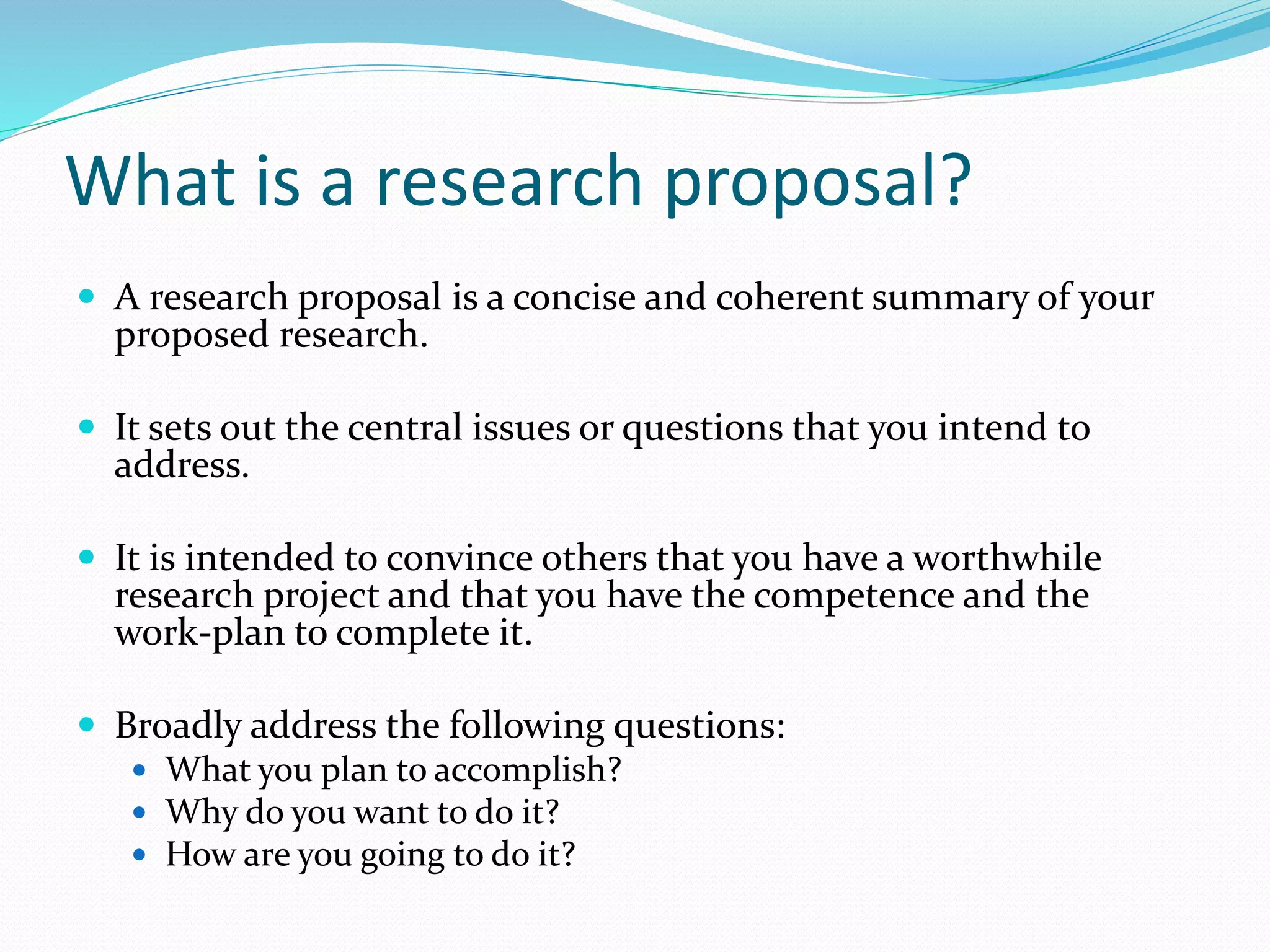
What is a research proposal?
 A research proposal is a concise and coherent summary of your
proposed research.
 It sets out the central issues or questions that you intend to
address.
 It is intended to convince others that you have a worthwhile
research project and that you have the competence and the
work-plan to complete it.
 Broadly address the following questions:
 What you plan to accomplish?
 Why do you want to do it?
 How are you going to do it?
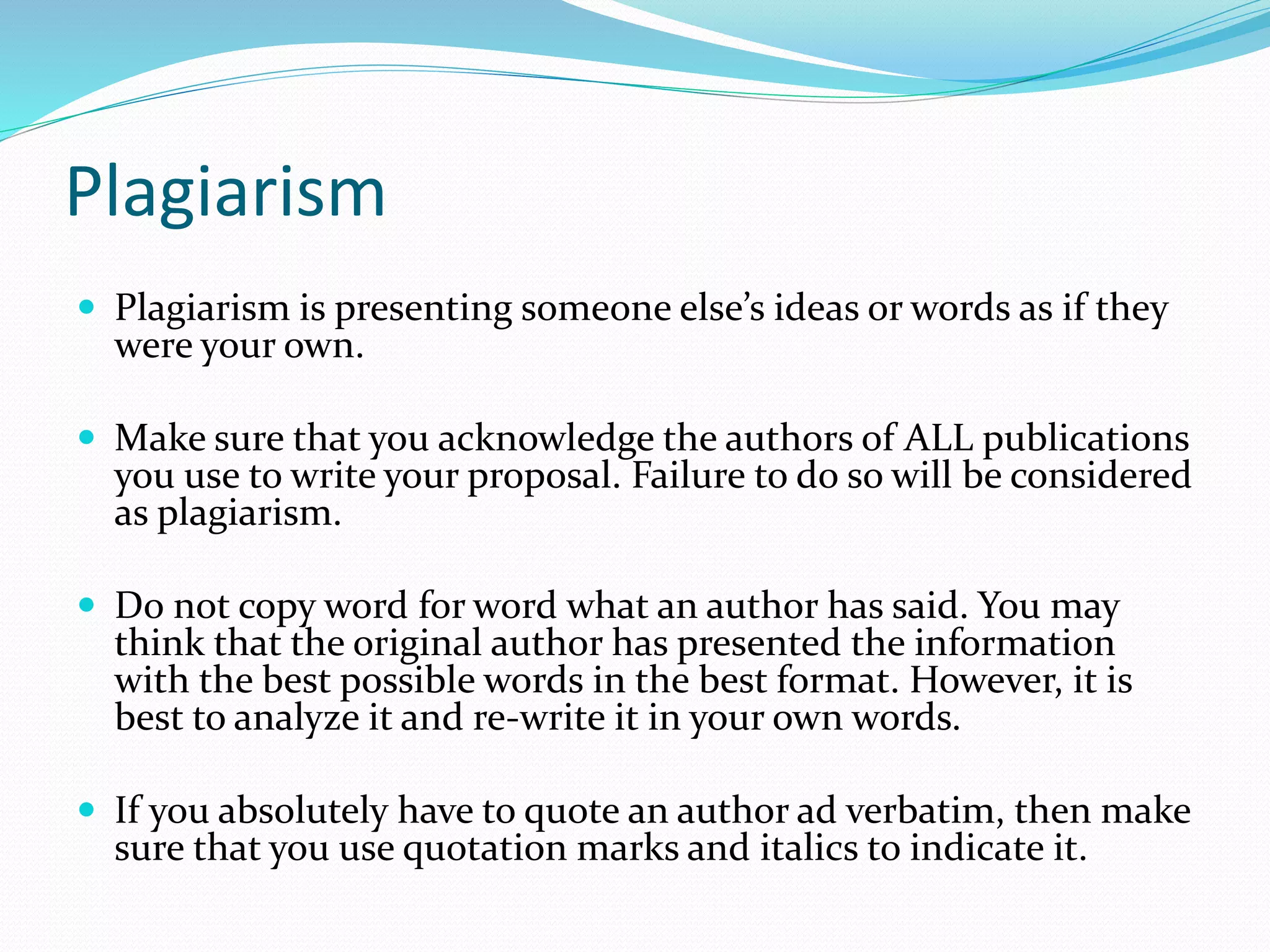
Plagiarism
 Plagiarism is presenting someone else’s ideas or words as if they
were your own.
 Make sure that you acknowledge the authors of ALL publications
you use to write your proposal. Failure to do so will be considered
as plagiarism.
 Do not copy word for word what an author has said. You may
think that the original author has presented the information
with the best possible words in the best format. However, it is
best to analyze it and re-write it in your own words.
 If you absolutely have to quote an author ad verbatim, then make
sure that you use quotation marks and italics to indicate it.
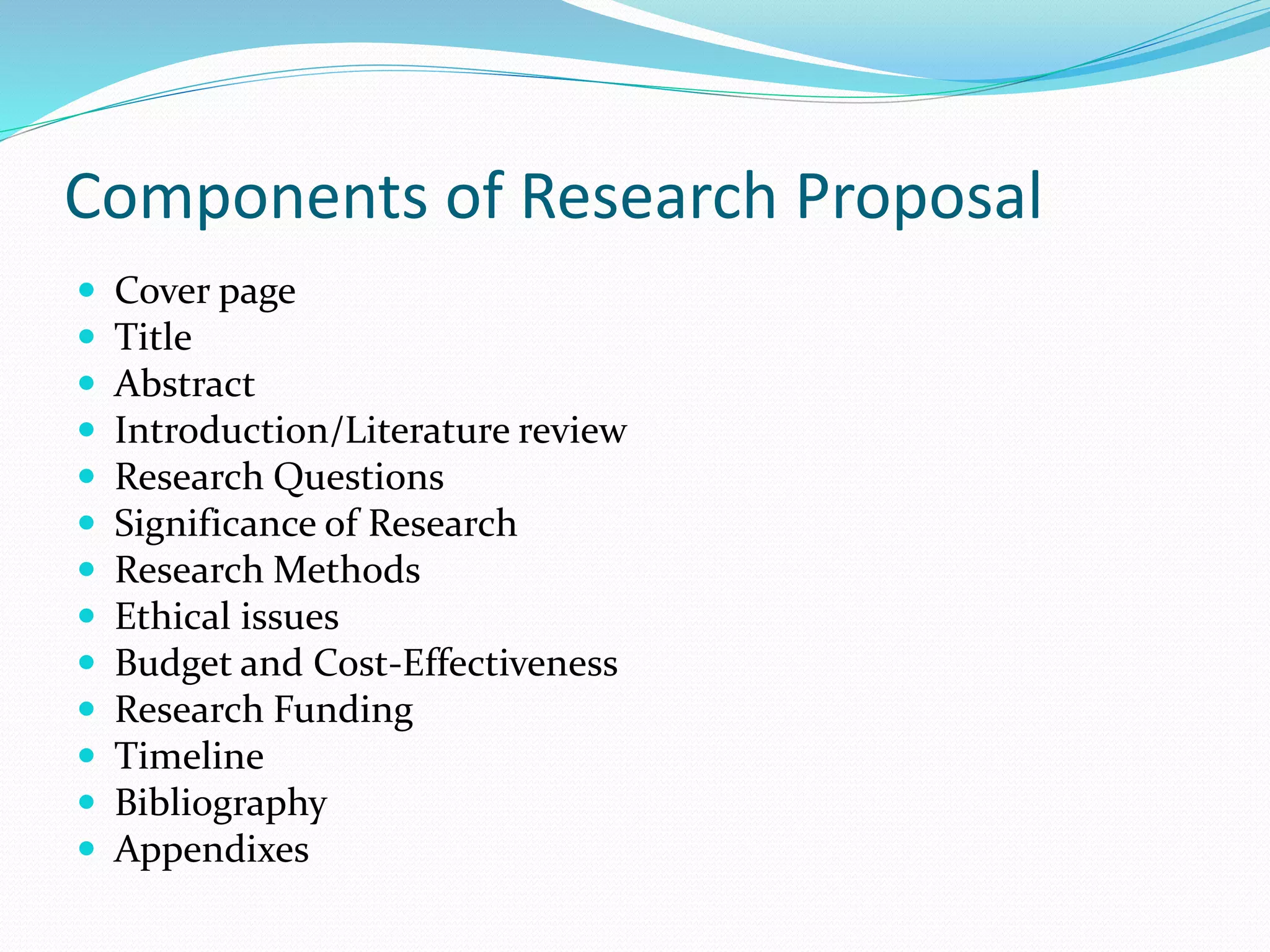
Components of Research Proposal
 Cover page
 Title
 Abstract
 Introduction/Literature review
 Research Questions
 Significance of Research
 Research Methods
 Ethical issues
 Budget and Cost-Effectiveness
 Research Funding
 Timeline
 Bibliography
 Appendixes
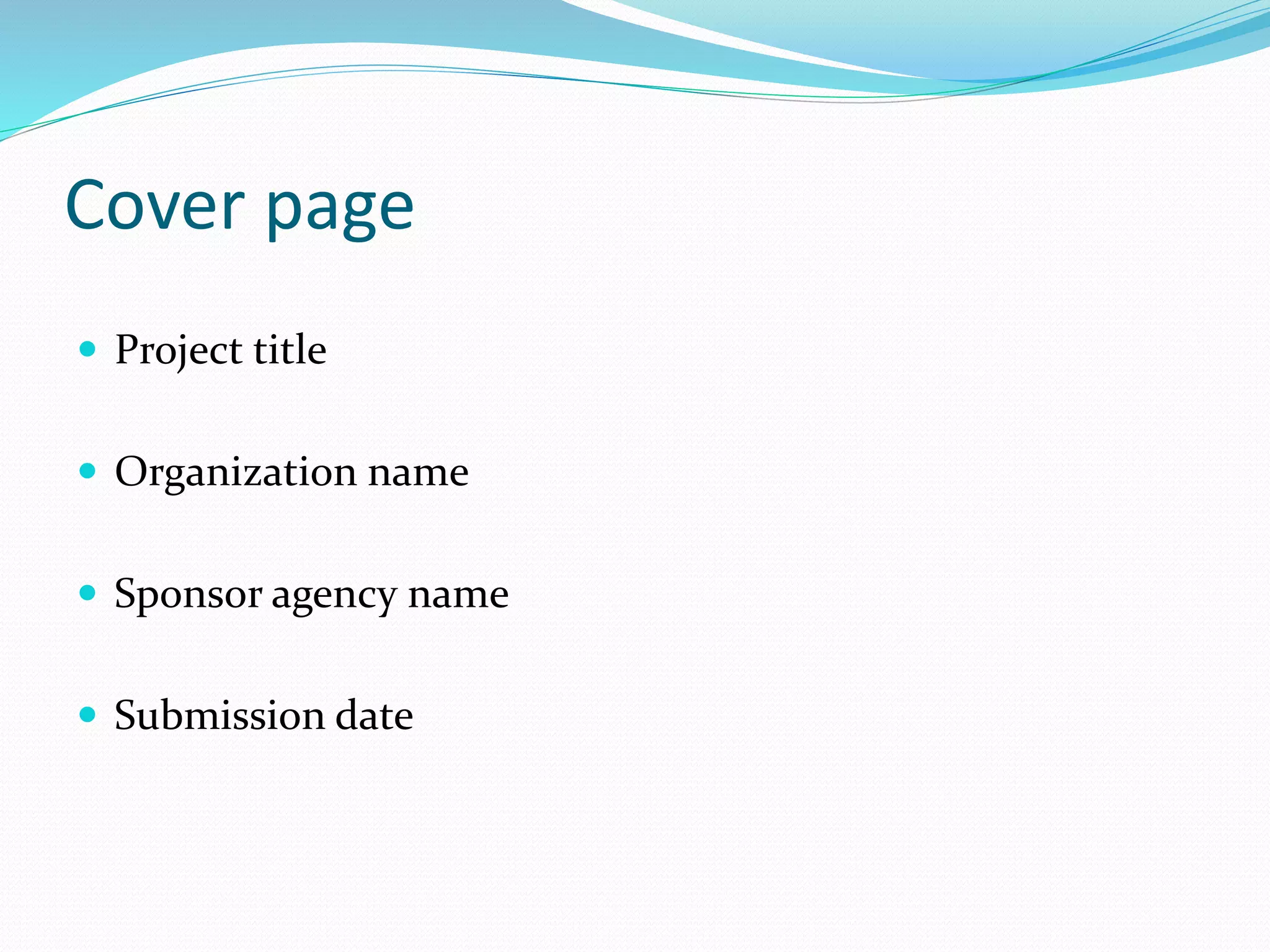
Cover page
 Project title
 Organization name
 Sponsor agency name
 Submission date
Title
 It should be concise, descriptive and catchy.
 An effective title not only pricks the reader interest,
but also predisposes him favorably towards the
proposal.
 This is just a tentative title for your intended research.
You will be able to revise your title during the course of
your research
Abstract
 The proposal should include a concise statement of
your intended research of no more than 100 words.
 This may be a couple of sentences setting out the
problem that you want to examine or the central
question that you wish to address and the method.
Introduction/Literature review
 You should include a brief overview of the general area of study
within which your proposed research falls, summarizing the
current state of knowledge and recent debates on the topic.
 Sources of Literature review:
 Books,
 Journals
 Theses/ Dissertations
 Conference proceedings
 Web sites (URLs)
 Bibliographies
 Statistics
 Government documents
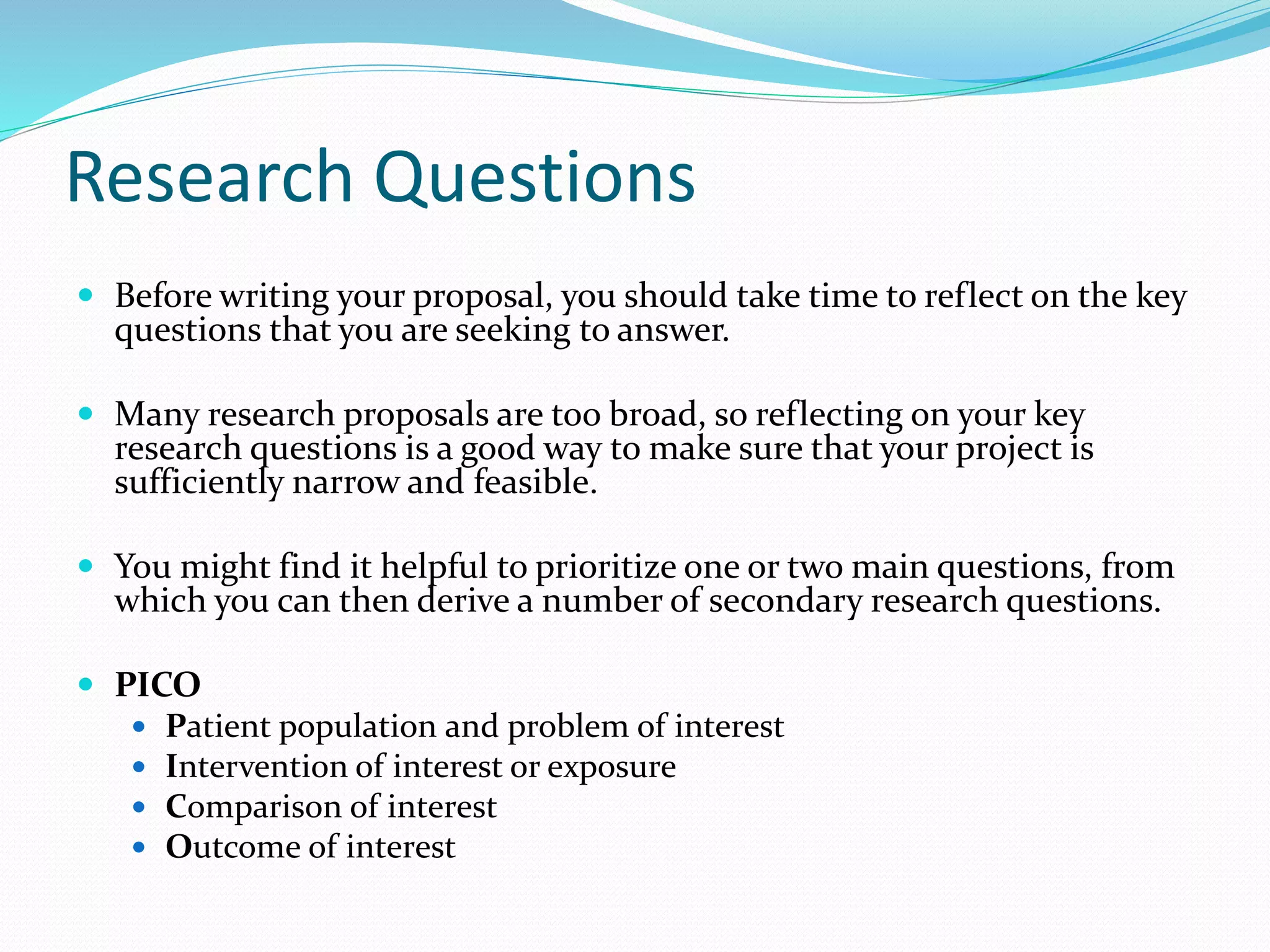
Research Questions
 Before writing your proposal, you should take time to reflect on the key
questions that you are seeking to answer.
 Many research proposals are too broad, so reflecting on your key
research questions is a good way to make sure that your project is
sufficiently narrow and feasible.
 You might find it helpful to prioritize one or two main questions, from
which you can then derive a number of secondary research questions.
 PICO
 Patient population and problem of interest
 Intervention of interest or exposure
 Comparison of interest
 Outcome of interest
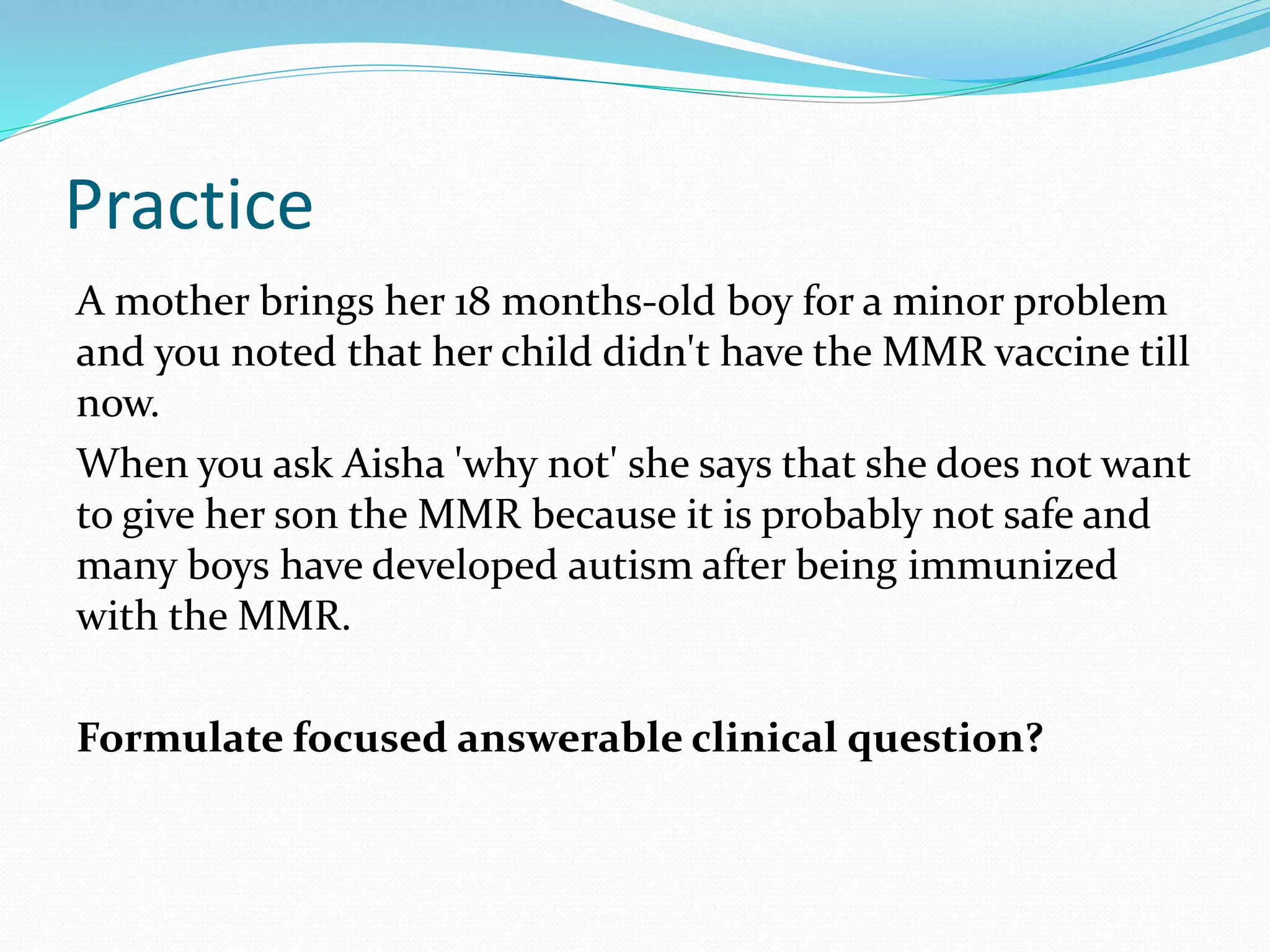
Practice
A mother brings her 18 months-old boy for a minor problem
and you noted that her child didn't have the MMR vaccine till
now.
When you ask Aisha 'why not' she says that she does not want
to give her son the MMR because it is probably not safe and
many boys have developed autism after being immunized
with the MMR.
Formulate focused answerable clinical question?
Significance of Research
 You should explain why your research is important.
 For example by:
 Explaining how your research builds on and adds to the
current state of knowledge in the field or
 Setting out reasons why it is timely to research your
proposed topic.
 Who will benefit from the proposed research project?
Research Methods
The proposal should outline your research methods, explaining how you are going
to conduct your research.
 Research subjects or participants
 Sample size
 Study Design – Type of Design Used and Sequence of Events
 Study instruments
 Data Collection – Description of variables, control, measure
 Data Analysis- Describe how collected data will be analyzed
 Ethical issues
Research subjects or participants:
 What are the criteria for inclusion or selection?
 What are the criteria for exclusion?
 What is the sampling procedure you will use so as to ensure
representativeness and reliability of the sample and to
minimize sampling errors?
 Will there be use of controls in your study?
 What are the criteria for discontinuation?
Sample size
 The proposal should provide information and justification (basis on
which the sample size is calculated) about sample size.
 A larger sample size than needed to test the research hypothesis
increases the cost and duration of the study and will be unethical if it
exposes human subjects to any potential unnecessary risk without
additional benefit.
 A smaller sample size than needed can also be unethical as it exposes
human subjects to risk with no benefit to scientific knowledge.
 Calculation of sample size has been made easy by computer software
programmes, but the principles underlying the estimation should be
well understood.
Study instruments
 Instruments are the tools by which the data are collected.
 For validated questionnaires/interview schedules, reference to
published work should be given and the instrument appended to the
proposal.
 For new a questionnaire which is being designed specifically for your
study the details about preparing, precoding and pretesting of
questionnaire should be furnished and the document appended to the
proposal.
 Descriptions of other methods of observations like medical
examination, laboratory tests and screening procedures is necessary-
for established procedures, reference of published work cited but for
new or modified procedure, an adequate description is necessary with
justification for the same.
Data Collection
 A short description of the protocol of data collection to minimizes the
possibility of confusion, delays and errors. (e.g. study on BP
measurement)
 Variables:
 Dependent (effect, outcome, consequence, result, condition, disease)
 Independent (cause, predisposing factor and risk factor)
 Confounding (may influence the effect of independent variables)
 Background (sex, age, ethnic origin, education, marital status, social
status)
 For instance, in a study of the effect of measles on child mortality
 Measles (independent variable)
 Child mortality (dependent variable)
 Nutritional status (confounding variable)
Data analysis
 The description should include the design of the
analysis form, plans for processing and coding the data
and the choice of the statistical method to be applied
to each data.
 What will be the procedures for accounting for
missing, unused or spurious data?
Ethical issues
 The Informed consent form must be attached to the proposal
 Ethics checklist: The proposal must describe the measures that will
be undertaken to ensure that the proposed research is carried out in
accordance with Declaration of Helsinki:
 Is the research design adequate to provide answers to the research
question?
 Is the method of selection of research subjects justified?
 Are the interventions justified, in terms of risk/benefit ratio?
 For observations made, have measures been taken to ensure
confidentiality?
Budget and Cost-Effectiveness
 Be realistic about your budget.
 Inflating budget may hurt your chances of being funded.
 Budgeting too low may make the project impossible to do
with funds provided
 Demonstrate that project is cost-effective: it will have a
significant impact for a reasonable cost
Research Funding
 There are several types of funding:
 Your own funds
 External funding bodies such as charities;
 National/ governmental agencies;
 Employers and the private sector and;
 University scholarships.
 It takes time to investigate potential funding avenues so
allow plenty of time.
 It is not unreasonable to start investigating approximately
one year before your proposed start date.
Timeline
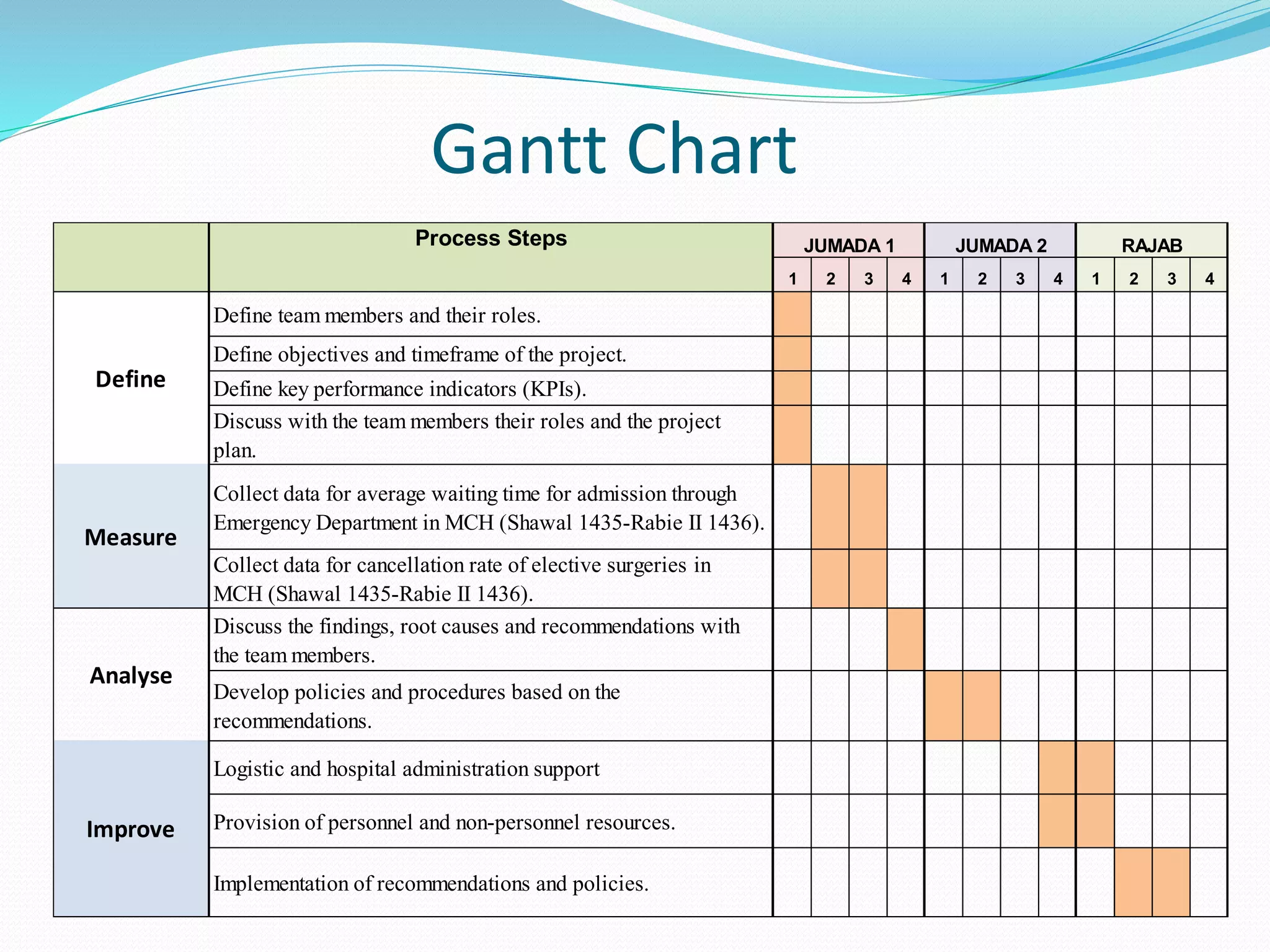
 It is very useful to describe the milestones of your
research projects (e.g. Gantt chart).
 This will demonstrate to the reviewer or prospective
supervisor that you have really thought of how you are
intending on conducting your research.
Gantt Chart
1 2 3 4 1 2 3 4 1 2 3 4
Define team members and their roles.
Define objectives and timeframe of the project.
Define key performance indicators (KPIs).
Discuss with the team members their roles and the project
plan.
Collect data for average waiting time for admission through
Emergency Department in MCH (Shawal 1435-Rabie II 1436).
Collect data for cancellation rate of elective surgeries in
MCH (Shawal 1435-Rabie II 1436).
Discuss the findings, root causes and recommendations with
the team members.
Develop policies and procedures based on the
recommendations.
Logistic and hospital administration support
Provision of personnel and non-personnel resources.
Implementation of recommendations and policies.
Analyse
Improve
JUMADA 2 RAJAB
Define
Measure
Process Steps JUMADA 1
Bibliography
 The proposal should include a short bibliography identifying the most relevant
works
 Harvard (author-date) style
 Uses the author’s name and date of publication in the body of the text, and the
bibliography is given alphabetically by author.
 Annas, G.J. (1997a), ’New drugs for acute respiratory distress syndrome’, New
England Journal of Medicine, vol. 337, no. 6, pp. 435-439.
 Vancouver (author-number) style
 Uses a number series to indicate references. Bibliographies list these in
numerical order as they appear in the text.
 (1) Annas GJ. New drugs for acute respiratory distress syndrome. N Engl J Med.
1997;337:435-9.
 For web based search include the date of access for the cited website, for
example: add the sentence “accessed on June 10, 2008”
Appendixes
 Interview protocols
 Sample of informed consent forms
 Cover letters sent to appropriate stakeholders
 Ethical Approval
 Official letters for permission to conduct research.
 Questionnaire
 Permission from copyright holder or proof of purchase of copyrighted
instrument

How to Write Research Proposal

  • 1.
    Dr Faisal AlHaddad Consultant of Family Medicine & Occupational Health Head of Public Health Department, KFHH
  • 2.
    What is aresearch proposal?  A research proposal is a concise and coherent summary of your proposed research.  It sets out the central issues or questions that you intend to address.  It is intended to convince others that you have a worthwhile research project and that you have the competence and the work-plan to complete it.  Broadly address the following questions:  What you plan to accomplish?  Why do you want to do it?  How are you going to do it?
  • 3.
    Plagiarism  Plagiarism ispresenting someone else’s ideas or words as if they were your own.  Make sure that you acknowledge the authors of ALL publications you use to write your proposal. Failure to do so will be considered as plagiarism.  Do not copy word for word what an author has said. You may think that the original author has presented the information with the best possible words in the best format. However, it is best to analyze it and re-write it in your own words.  If you absolutely have to quote an author ad verbatim, then make sure that you use quotation marks and italics to indicate it.
  • 4.
    Components of ResearchProposal  Cover page  Title  Abstract  Introduction/Literature review  Research Questions  Significance of Research  Research Methods  Ethical issues  Budget and Cost-Effectiveness  Research Funding  Timeline  Bibliography  Appendixes
  • 5.
    Cover page  Projecttitle  Organization name  Sponsor agency name  Submission date
  • 6.
    Title  It shouldbe concise, descriptive and catchy.  An effective title not only pricks the reader interest, but also predisposes him favorably towards the proposal.  This is just a tentative title for your intended research. You will be able to revise your title during the course of your research
  • 7.
    Abstract  The proposalshould include a concise statement of your intended research of no more than 100 words.  This may be a couple of sentences setting out the problem that you want to examine or the central question that you wish to address and the method.
  • 8.
    Introduction/Literature review  Youshould include a brief overview of the general area of study within which your proposed research falls, summarizing the current state of knowledge and recent debates on the topic.  Sources of Literature review:  Books,  Journals  Theses/ Dissertations  Conference proceedings  Web sites (URLs)  Bibliographies  Statistics  Government documents
  • 9.
    Research Questions  Beforewriting your proposal, you should take time to reflect on the key questions that you are seeking to answer.  Many research proposals are too broad, so reflecting on your key research questions is a good way to make sure that your project is sufficiently narrow and feasible.  You might find it helpful to prioritize one or two main questions, from which you can then derive a number of secondary research questions.  PICO  Patient population and problem of interest  Intervention of interest or exposure  Comparison of interest  Outcome of interest
  • 10.
    Practice A mother bringsher 18 months-old boy for a minor problem and you noted that her child didn't have the MMR vaccine till now. When you ask Aisha 'why not' she says that she does not want to give her son the MMR because it is probably not safe and many boys have developed autism after being immunized with the MMR. Formulate focused answerable clinical question?
  • 11.
    Significance of Research You should explain why your research is important.  For example by:  Explaining how your research builds on and adds to the current state of knowledge in the field or  Setting out reasons why it is timely to research your proposed topic.  Who will benefit from the proposed research project?
  • 12.
    Research Methods The proposalshould outline your research methods, explaining how you are going to conduct your research.  Research subjects or participants  Sample size  Study Design – Type of Design Used and Sequence of Events  Study instruments  Data Collection – Description of variables, control, measure  Data Analysis- Describe how collected data will be analyzed  Ethical issues
  • 13.
    Research subjects orparticipants:  What are the criteria for inclusion or selection?  What are the criteria for exclusion?  What is the sampling procedure you will use so as to ensure representativeness and reliability of the sample and to minimize sampling errors?  Will there be use of controls in your study?  What are the criteria for discontinuation?
  • 14.
    Sample size  Theproposal should provide information and justification (basis on which the sample size is calculated) about sample size.  A larger sample size than needed to test the research hypothesis increases the cost and duration of the study and will be unethical if it exposes human subjects to any potential unnecessary risk without additional benefit.  A smaller sample size than needed can also be unethical as it exposes human subjects to risk with no benefit to scientific knowledge.  Calculation of sample size has been made easy by computer software programmes, but the principles underlying the estimation should be well understood.
  • 15.
    Study instruments  Instrumentsare the tools by which the data are collected.  For validated questionnaires/interview schedules, reference to published work should be given and the instrument appended to the proposal.  For new a questionnaire which is being designed specifically for your study the details about preparing, precoding and pretesting of questionnaire should be furnished and the document appended to the proposal.  Descriptions of other methods of observations like medical examination, laboratory tests and screening procedures is necessary- for established procedures, reference of published work cited but for new or modified procedure, an adequate description is necessary with justification for the same.
  • 16.
    Data Collection  Ashort description of the protocol of data collection to minimizes the possibility of confusion, delays and errors. (e.g. study on BP measurement)  Variables:  Dependent (effect, outcome, consequence, result, condition, disease)  Independent (cause, predisposing factor and risk factor)  Confounding (may influence the effect of independent variables)  Background (sex, age, ethnic origin, education, marital status, social status)  For instance, in a study of the effect of measles on child mortality  Measles (independent variable)  Child mortality (dependent variable)  Nutritional status (confounding variable)
  • 17.
    Data analysis  Thedescription should include the design of the analysis form, plans for processing and coding the data and the choice of the statistical method to be applied to each data.  What will be the procedures for accounting for missing, unused or spurious data?
  • 18.
    Ethical issues  TheInformed consent form must be attached to the proposal  Ethics checklist: The proposal must describe the measures that will be undertaken to ensure that the proposed research is carried out in accordance with Declaration of Helsinki:  Is the research design adequate to provide answers to the research question?  Is the method of selection of research subjects justified?  Are the interventions justified, in terms of risk/benefit ratio?  For observations made, have measures been taken to ensure confidentiality?
  • 19.
    Budget and Cost-Effectiveness Be realistic about your budget.  Inflating budget may hurt your chances of being funded.  Budgeting too low may make the project impossible to do with funds provided  Demonstrate that project is cost-effective: it will have a significant impact for a reasonable cost
  • 20.
    Research Funding  Thereare several types of funding:  Your own funds  External funding bodies such as charities;  National/ governmental agencies;  Employers and the private sector and;  University scholarships.  It takes time to investigate potential funding avenues so allow plenty of time.  It is not unreasonable to start investigating approximately one year before your proposed start date.
  • 21.
    Timeline  It isvery useful to describe the milestones of your research projects (e.g. Gantt chart).  This will demonstrate to the reviewer or prospective supervisor that you have really thought of how you are intending on conducting your research.
  • 22.
    Gantt Chart 1 23 4 1 2 3 4 1 2 3 4 Define team members and their roles. Define objectives and timeframe of the project. Define key performance indicators (KPIs). Discuss with the team members their roles and the project plan. Collect data for average waiting time for admission through Emergency Department in MCH (Shawal 1435-Rabie II 1436). Collect data for cancellation rate of elective surgeries in MCH (Shawal 1435-Rabie II 1436). Discuss the findings, root causes and recommendations with the team members. Develop policies and procedures based on the recommendations. Logistic and hospital administration support Provision of personnel and non-personnel resources. Implementation of recommendations and policies. Analyse Improve JUMADA 2 RAJAB Define Measure Process Steps JUMADA 1
  • 23.
    Bibliography  The proposalshould include a short bibliography identifying the most relevant works  Harvard (author-date) style  Uses the author’s name and date of publication in the body of the text, and the bibliography is given alphabetically by author.  Annas, G.J. (1997a), ’New drugs for acute respiratory distress syndrome’, New England Journal of Medicine, vol. 337, no. 6, pp. 435-439.  Vancouver (author-number) style  Uses a number series to indicate references. Bibliographies list these in numerical order as they appear in the text.  (1) Annas GJ. New drugs for acute respiratory distress syndrome. N Engl J Med. 1997;337:435-9.  For web based search include the date of access for the cited website, for example: add the sentence “accessed on June 10, 2008”
  • 24.
    Appendixes  Interview protocols Sample of informed consent forms  Cover letters sent to appropriate stakeholders  Ethical Approval  Official letters for permission to conduct research.  Questionnaire  Permission from copyright holder or proof of purchase of copyrighted instrument