How to ChooseHow to Choose
ResearchTopicResearchTopic
Dr Faisal Al Haddad
Consultant of Family Medicine & Occupational Health
Director of Bed Management Department, KFHH
Trainer-Saudi Board of Family Medicine
PHC CBAHI Surveyor
Step 1: Brainstorm for ideasStep 1: Brainstorm for ideas
 Choose a topic that interests you
 Do you have a strong opinion on a current medical
controversy?
 Did you read a newspaper article, or see a TV
broadcast recently that piqued your curiosity?
 Do you have a personal issue, problem, or interest
you'd like to know more about?
 Is there an aspect of one of your courses you are
interested in learning more about?
Step 2: Read generalStep 2: Read general
background informationbackground information
Read a general information on the topic you are
considering to get an overview of the topic.
 If you can't find an article on your topic, try using
broader terms and ask for help from a librarian. 
Use online databases to scan current articles on
the topic.  
Use web search engines to find web sites on the
topic.
Step 3: Focus in on your topicStep 3: Focus in on your topic
 Keep it manageable. A topic will be very difficult to research if it is
too broad, or too narrow.
◦ Lung cancer
◦ Risk factors of lung cancer in Saudi Arabia
◦ Risk factors of lung cancer in Saudi Arabia among males aged 40 to 60
 One way to narrow a broad topic is to limit  your topic:
◦ by geographic region
◦ by time frame    
◦ by population group  
 If you have any uncertainties about the focus of your topic:
◦ discuss your topic with your instructor
◦ discuss your topic with a librarian
Step 4: Make a list of usefulStep 4: Make a list of useful
keywordskeywords
Look for words that best describe your topic.
Find synonyms, broader and narrower terms
for each keyword you find in order to expand
your search capabilities
Keep a list of these words to use as keywords
later as you search in catalogs and other online
databases
Step 5: Be flexibleStep 5: Be flexible
You may find too much articles and need to
narrow your focus, or too little and need to
broaden your focus.
When researching, you may not wish to
change your topic, but you may decide that
some other aspect of the topic is more
interesting or manageable. 
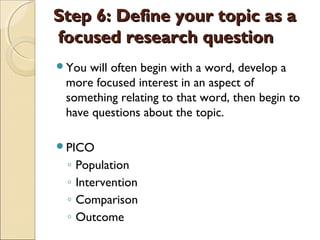
Step 6: Define your topic as aStep 6: Define your topic as a
focused research questionfocused research question
You will often begin with a word, develop a
more focused interest in an aspect of
something relating to that word, then begin to
have questions about the topic. 
PICO
◦ Population
◦ Intervention
◦ Comparison
◦ Outcome
Step 7: Research and readStep 7: Research and read
more about your topicmore about your topic
Use the key words you have gathered to
research in the catalog, article databases and
web search engines
You will need to do some research and reading
before you select your final topic.
Can you find enough information to answer
your research question?
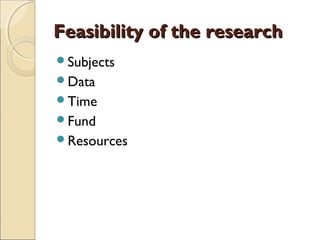
Feasibility of the researchFeasibility of the research
Subjects
Data
Time
Fund
Resources
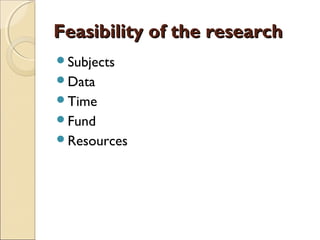
Feasibility of the researchFeasibility of the research
Subjects
Data
Time
Fund
Resources

How to Choose Research Topic

  • 1.
    How to ChooseHowto Choose ResearchTopicResearchTopic Dr Faisal Al Haddad Consultant of Family Medicine & Occupational Health Director of Bed Management Department, KFHH Trainer-Saudi Board of Family Medicine PHC CBAHI Surveyor
  • 2.
    Step 1: Brainstormfor ideasStep 1: Brainstorm for ideas  Choose a topic that interests you  Do you have a strong opinion on a current medical controversy?  Did you read a newspaper article, or see a TV broadcast recently that piqued your curiosity?  Do you have a personal issue, problem, or interest you'd like to know more about?  Is there an aspect of one of your courses you are interested in learning more about?
  • 3.
    Step 2: ReadgeneralStep 2: Read general background informationbackground information Read a general information on the topic you are considering to get an overview of the topic.  If you can't find an article on your topic, try using broader terms and ask for help from a librarian.  Use online databases to scan current articles on the topic.   Use web search engines to find web sites on the topic.
  • 4.
    Step 3: Focusin on your topicStep 3: Focus in on your topic  Keep it manageable. A topic will be very difficult to research if it is too broad, or too narrow. ◦ Lung cancer ◦ Risk factors of lung cancer in Saudi Arabia ◦ Risk factors of lung cancer in Saudi Arabia among males aged 40 to 60  One way to narrow a broad topic is to limit  your topic: ◦ by geographic region ◦ by time frame     ◦ by population group    If you have any uncertainties about the focus of your topic: ◦ discuss your topic with your instructor ◦ discuss your topic with a librarian
  • 5.
    Step 4: Makea list of usefulStep 4: Make a list of useful keywordskeywords Look for words that best describe your topic. Find synonyms, broader and narrower terms for each keyword you find in order to expand your search capabilities Keep a list of these words to use as keywords later as you search in catalogs and other online databases
  • 6.
    Step 5: BeflexibleStep 5: Be flexible You may find too much articles and need to narrow your focus, or too little and need to broaden your focus. When researching, you may not wish to change your topic, but you may decide that some other aspect of the topic is more interesting or manageable. 
  • 7.
    Step 6: Defineyour topic as aStep 6: Define your topic as a focused research questionfocused research question You will often begin with a word, develop a more focused interest in an aspect of something relating to that word, then begin to have questions about the topic.  PICO ◦ Population ◦ Intervention ◦ Comparison ◦ Outcome
  • 8.
    Step 7: Researchand readStep 7: Research and read more about your topicmore about your topic Use the key words you have gathered to research in the catalog, article databases and web search engines You will need to do some research and reading before you select your final topic. Can you find enough information to answer your research question?
  • 9.
    Feasibility of theresearchFeasibility of the research Subjects Data Time Fund Resources
  • 10.
    Feasibility of theresearchFeasibility of the research Subjects Data Time Fund Resources