HAZARD
IDENTIFICATION
BY
MUGUMYA IVAN
(PhD Cand’t
MPH,BEHS,DMLT,CEHS,CUEPH-USA)
Presentation outline
Hazard Identification
Typical workplace hazards
Recognition
Evaluation
Control
IDENTIFICATION OF OCCUPATIONAL
HAZARDS
❖ For centuries the work Environment has contributed
significant risk of adverse health effects due to
physical, chemical, ergonomic, psychological and
biological hazards.
❖ Identifying and controlling workplace hazards
involves both hard data and a comprehensive
understanding of issues such as acceptable risk and
employee comfort and productivity.
Why the need for Occupational Safety
and Health regulations?
❖ To reduce workplace accidents;
❖ To reduce work related deaths;
❖ To reduce the number of workers that get
disabled in workplace;
❖ To reduce new cases of occupational diseases;
❖ To promote good health at the workplace;
❖ To promote a good work environment for
workers;
❖ To promote the construction of environmentally
friendly workplaces.
Typical workplace hazards:
● Chemicals and other hazardous materials that result in employee
exposure and environmental risks
● Excessive odour, noise and vibrations
● Temperature extremes that result in heat and cold stress.
● Biohazards including both natural and man-made (e.g.,
bioterrorism)
● Ionizing and non-ionizing radiation
● Ergonomic hazards resulting in musculoskeletal disorders (e.g.
back injuries)
● Safety-related hazards (e.g. slips, trips and falls) causing personal
injury
Hazard identification
❏ Recognition of the potential of a substance to cause harm
to human health or the environment.
❏ Hazards in the workplace can change from day to day.
Therefore, identification is an ongoing process that is a
critical component of any health and safety program.
❏ It should be done on regular basis
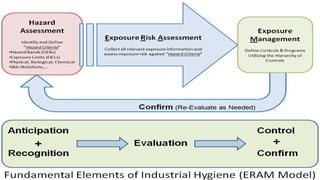
❏ A common approach of this process is to use the principles
of industrial hygiene to recognize, evaluate and control
employee exposures to workplace hazards.
❏ Same as: Identification, Assessment and Control
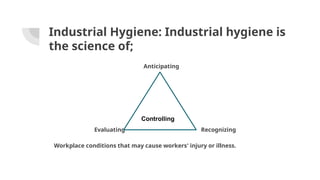
Industrial Hygiene: Industrial hygiene is
the science of;
Anticipating
Evaluating Recognizing
Workplace conditions that may cause workers' injury or illness.
Controlling
Cont’
In simple terms:
Identify - find it
Asses - asses it
Control - fix it
The hazard identification process results in
benefit to both employee health and safety
and environmental protection concerns
The practice of industrial hygiene utilizes the
recognition, evaluation and control-phased
approach to hazard identification.
Recognition
Involves basic characterization and information gathering.
The health and safety professional will find some exposure
hazards obvious, such as high noise levels, while others are
not so obvious, such as determining the cause of employee
health complaints.
In either case, hazard recognition attempts to gather
existing information about the exposure.
Methods, tools and resources for the
hazard recognition
● Industry/factory walk-around surveys
● Employee/staff interviews
● Records review
● Government/non-government
standards review
● Literature review
The walk-around surveys use observational skills
and other senses, such as hearing and smelling, to
gather information about a particular process or
task.
Real-time monitoring equipment, such as a sound
level meter, may be used to qualify the hazard for
further evaluation. Most of the
monitoring/sampling data collection, however, is
reserved for the hazard evaluation phase.
Employee/staff interviews attempt to capture the
hands-on personal aspects that the hazard
Records review may look at the process flow
diagrams, exposure monitoring data,
environmental reports, and job hazard analysis
documents.
Standards review will consider applicable
exposure limits and performance standards.
Literature reviews, such as material safety data
sheets (MSDS) and toxicology profiles/studies,
provide a significant amount of information
concerning a hazard.
2. Evaluation
● The evaluation phase attempts to determine
the degree of severity of the hazard.
● This is accomplished using a three-step
process: An assessment or measurement of
the exposure
● Comparison of the measured exposure to the
benchmark used, such as the permissible
exposure limit (PEL)
● Determination of whether the risk is
acceptable
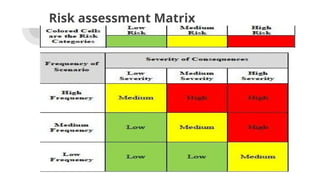
Risk assessment Matrix
Task
With the help of a risk assessment
matrix come up with a detailed
assesment report for an exercise
conducted in a steel rolling mill located
at Namanve industrial park. To be
submited on 2nd May 2024 before class
WHEN DO YOU PERFORM
A RISK ASSESSMENT?
Determination of whether risk is acceptable
most often depends on how generally
accepted the benchmark used is.
Benchmarks may include
TLV- Threshold Level Values
REL- Recommended exposure Level
PEL- Permissible Exposure Limits
3. Control
❏ Implementation of control strategies is the last phase
considered in the hazard identification process.
❏ Control strategies must always consider minimum
compliance requirements.
❏ However, recognizing employee comfort as a vital
element is also important.
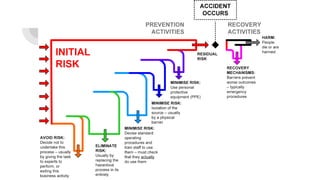
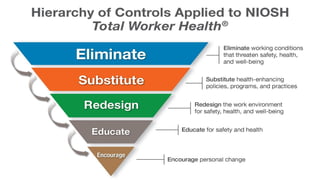
❏ Best practices for controlling exposure hazards
includes a hierarchy of preferred methods including
Control method
Elimination
Substitution
Engineering controls e.g vacuum cleaning instead of
sweeping, process enclosures, isolation or local
exhaust ventilation
Administrative controls including employee training
and good housekeeping, job rotations, shift work,
policies, equipment maintenance, personal hygiene
practices.
Personal Protective Equipment (PPE)
such as respiratory protection, hearing
protection, eye and head protection.
Protection by PPE will reduce but not
eliminate exposure. Use of protective
gloves and clothing or aprons and the
application of barrier creams can greatly
reduce exposure.
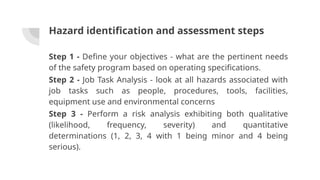
Hazard identification and assessment steps
Step 1 - Define your objectives - what are the pertinent needs
of the safety program based on operating specifications.
Step 2 - Job Task Analysis - look at all hazards associated with
job tasks such as people, procedures, tools, facilities,
equipment use and environmental concerns
Step 3 - Perform a risk analysis exhibiting both qualitative
(likelihood, frequency, severity) and quantitative
determinations (1, 2, 3, 4 with 1 being minor and 4 being
serious).
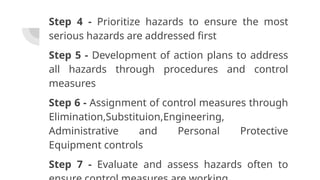
Step 4 - Prioritize hazards to ensure the most
serious hazards are addressed first
Step 5 - Development of action plans to address
all hazards through procedures and control
measures
Step 6 - Assignment of control measures through
Elimination,Substituion,Engineering,
Administrative and Personal Protective
Equipment controls
Step 7 - Evaluate and assess hazards often to
HAZARD IDENTIFICATION.pptx.                df

HAZARD IDENTIFICATION.pptx. df

  • 1.
  • 2.
    Presentation outline Hazard Identification Typicalworkplace hazards Recognition Evaluation Control
  • 3.
    IDENTIFICATION OF OCCUPATIONAL HAZARDS ❖For centuries the work Environment has contributed significant risk of adverse health effects due to physical, chemical, ergonomic, psychological and biological hazards. ❖ Identifying and controlling workplace hazards involves both hard data and a comprehensive understanding of issues such as acceptable risk and employee comfort and productivity.
  • 4.
    Why the needfor Occupational Safety and Health regulations? ❖ To reduce workplace accidents; ❖ To reduce work related deaths; ❖ To reduce the number of workers that get disabled in workplace; ❖ To reduce new cases of occupational diseases; ❖ To promote good health at the workplace; ❖ To promote a good work environment for workers; ❖ To promote the construction of environmentally friendly workplaces.
  • 7.
    Typical workplace hazards: ●Chemicals and other hazardous materials that result in employee exposure and environmental risks ● Excessive odour, noise and vibrations ● Temperature extremes that result in heat and cold stress. ● Biohazards including both natural and man-made (e.g., bioterrorism) ● Ionizing and non-ionizing radiation ● Ergonomic hazards resulting in musculoskeletal disorders (e.g. back injuries) ● Safety-related hazards (e.g. slips, trips and falls) causing personal injury
  • 8.
    Hazard identification ❏ Recognitionof the potential of a substance to cause harm to human health or the environment. ❏ Hazards in the workplace can change from day to day. Therefore, identification is an ongoing process that is a critical component of any health and safety program. ❏ It should be done on regular basis ❏ A common approach of this process is to use the principles of industrial hygiene to recognize, evaluate and control employee exposures to workplace hazards. ❏ Same as: Identification, Assessment and Control
  • 9.
    Industrial Hygiene: Industrialhygiene is the science of; Anticipating Evaluating Recognizing Workplace conditions that may cause workers' injury or illness. Controlling
  • 10.
    Cont’ In simple terms: Identify- find it Asses - asses it Control - fix it The hazard identification process results in benefit to both employee health and safety and environmental protection concerns
  • 12.
    The practice ofindustrial hygiene utilizes the recognition, evaluation and control-phased approach to hazard identification. Recognition Involves basic characterization and information gathering. The health and safety professional will find some exposure hazards obvious, such as high noise levels, while others are not so obvious, such as determining the cause of employee health complaints. In either case, hazard recognition attempts to gather existing information about the exposure.
  • 13.
    Methods, tools andresources for the hazard recognition ● Industry/factory walk-around surveys ● Employee/staff interviews ● Records review ● Government/non-government standards review ● Literature review
  • 14.
    The walk-around surveysuse observational skills and other senses, such as hearing and smelling, to gather information about a particular process or task. Real-time monitoring equipment, such as a sound level meter, may be used to qualify the hazard for further evaluation. Most of the monitoring/sampling data collection, however, is reserved for the hazard evaluation phase. Employee/staff interviews attempt to capture the hands-on personal aspects that the hazard
  • 15.
    Records review maylook at the process flow diagrams, exposure monitoring data, environmental reports, and job hazard analysis documents. Standards review will consider applicable exposure limits and performance standards. Literature reviews, such as material safety data sheets (MSDS) and toxicology profiles/studies, provide a significant amount of information concerning a hazard.
  • 16.
    2. Evaluation ● Theevaluation phase attempts to determine the degree of severity of the hazard. ● This is accomplished using a three-step process: An assessment or measurement of the exposure ● Comparison of the measured exposure to the benchmark used, such as the permissible exposure limit (PEL) ● Determination of whether the risk is acceptable
  • 17.
  • 18.
    Task With the helpof a risk assessment matrix come up with a detailed assesment report for an exercise conducted in a steel rolling mill located at Namanve industrial park. To be submited on 2nd May 2024 before class
  • 19.
    WHEN DO YOUPERFORM A RISK ASSESSMENT?
  • 20.
    Determination of whetherrisk is acceptable most often depends on how generally accepted the benchmark used is. Benchmarks may include TLV- Threshold Level Values REL- Recommended exposure Level PEL- Permissible Exposure Limits
  • 21.
    3. Control ❏ Implementationof control strategies is the last phase considered in the hazard identification process. ❏ Control strategies must always consider minimum compliance requirements. ❏ However, recognizing employee comfort as a vital element is also important. ❏ Best practices for controlling exposure hazards includes a hierarchy of preferred methods including
  • 23.
    Control method Elimination Substitution Engineering controlse.g vacuum cleaning instead of sweeping, process enclosures, isolation or local exhaust ventilation Administrative controls including employee training and good housekeeping, job rotations, shift work, policies, equipment maintenance, personal hygiene practices.
  • 24.
    Personal Protective Equipment(PPE) such as respiratory protection, hearing protection, eye and head protection. Protection by PPE will reduce but not eliminate exposure. Use of protective gloves and clothing or aprons and the application of barrier creams can greatly reduce exposure.
  • 26.
    Hazard identification andassessment steps Step 1 - Define your objectives - what are the pertinent needs of the safety program based on operating specifications. Step 2 - Job Task Analysis - look at all hazards associated with job tasks such as people, procedures, tools, facilities, equipment use and environmental concerns Step 3 - Perform a risk analysis exhibiting both qualitative (likelihood, frequency, severity) and quantitative determinations (1, 2, 3, 4 with 1 being minor and 4 being serious).
  • 27.
    Step 4 -Prioritize hazards to ensure the most serious hazards are addressed first Step 5 - Development of action plans to address all hazards through procedures and control measures Step 6 - Assignment of control measures through Elimination,Substituion,Engineering, Administrative and Personal Protective Equipment controls Step 7 - Evaluate and assess hazards often to