
Philippa Gibson 
OCCUPATIONAL HEALTH RISK ASSESSMENT – 
LEGAL COMPLIANCE AND UNCERTAINTIES 
PREPARED FOR OHSIG September 2014
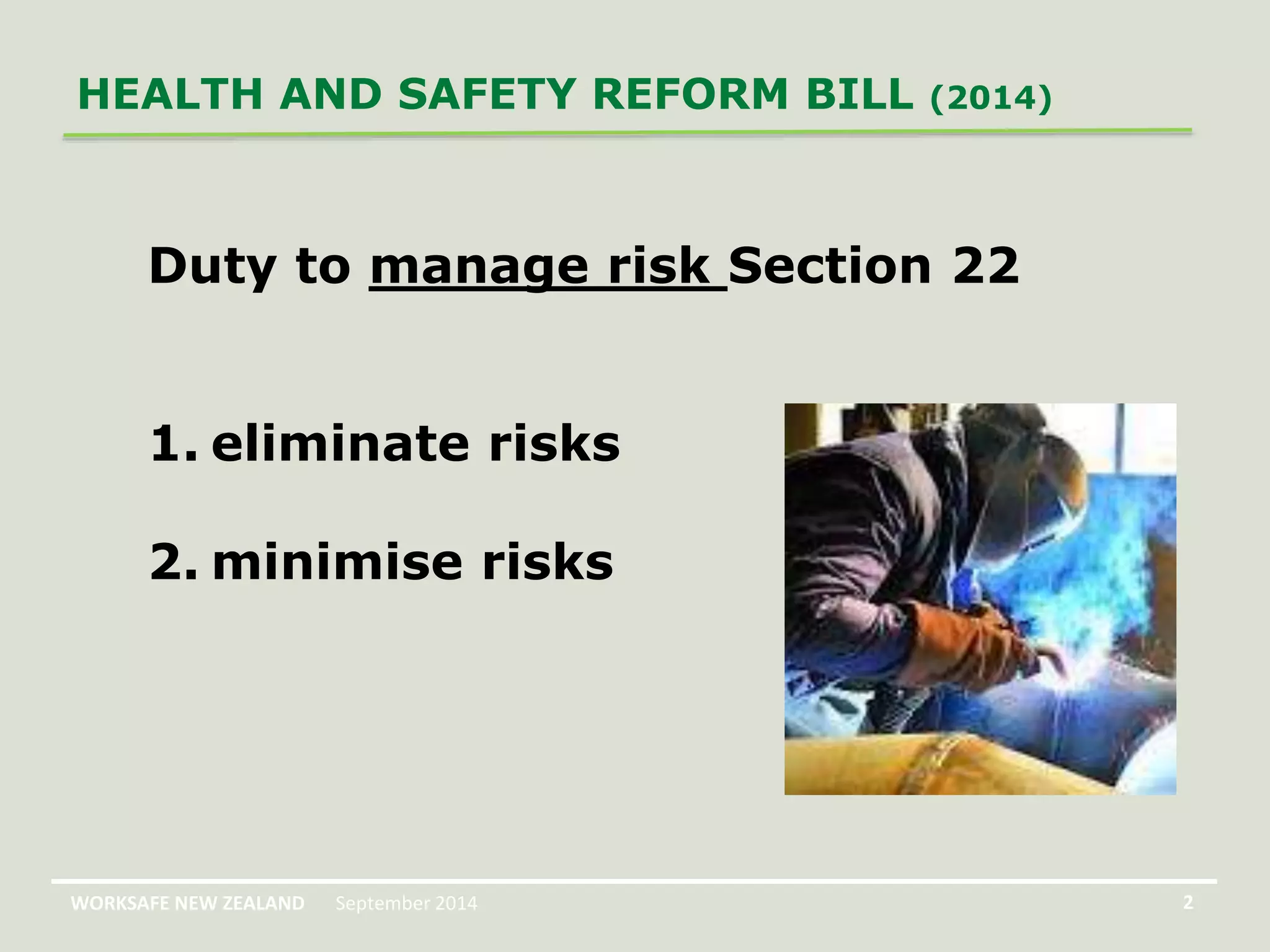
HEALTH AND SAFETY REFORM BILL (2014) 
Duty to manage risk Section 22 
1. eliminate risks 
2. minimise risks 
WORKSAFE NEW ZEALAND September 2014 2
RISK MANAGEMENT – 
AS/NZS/ISO 31000:2009 Principals and guidelines 
Risk 
the effect of uncertainty on objectives 
Risk management 
coordinated activities to direct and control an 
organization with regard to risk 
WORKSAFE NEW ZEALAND September 2014 3
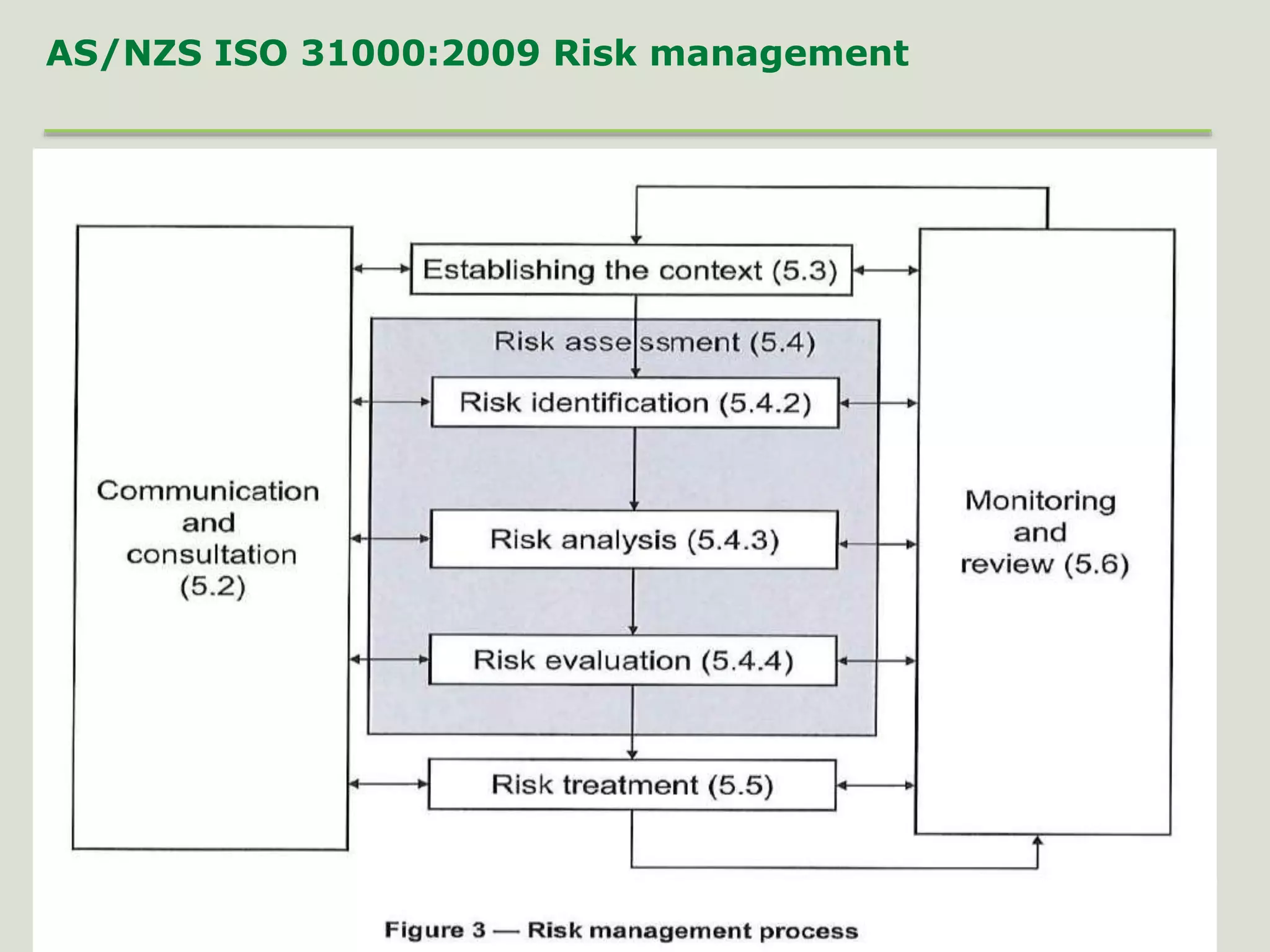
AS/NZS ISO 31000:2009 Risk management 
WORKSAFE NEW ZEALAND MAY 2014
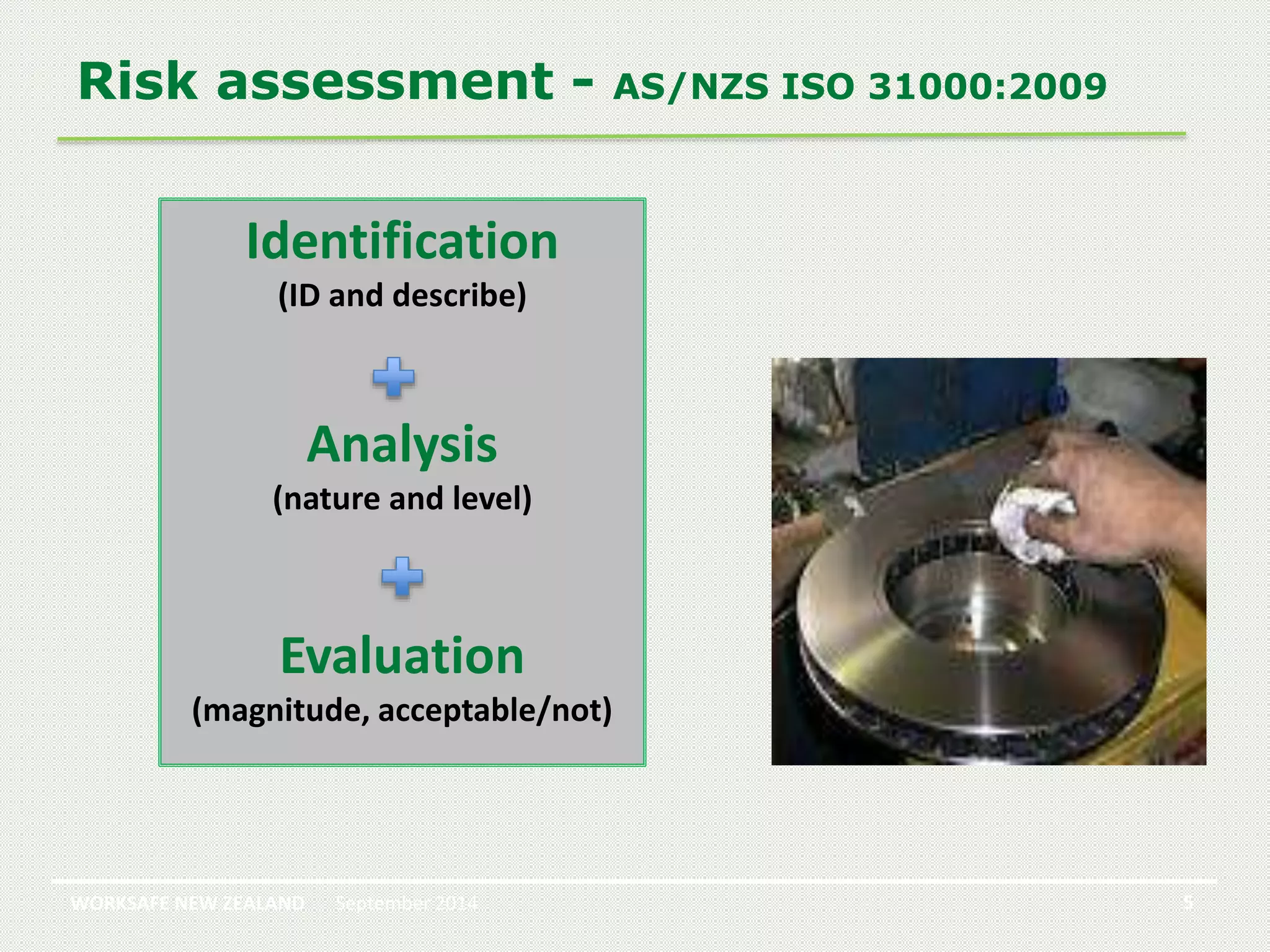
Risk assessment - AS/NZS ISO 31000:2009 
Identification 
(ID and describe) 
Analysis 
(nature and level) 
Evaluation 
(magnitude, acceptable/not) 
WORKSAFE NEW ZEALAND September 2014 5
OCCUPATIONAL HEALTH RISK ASSESSMENT 
• informs (is part of) the risk management process 
• You must consider the strengths, uncertainties and 
assumptions that affect on the overall risk assessment 
Source: Environmental Health risk assessment Guidelines for assessing human 
health risks from environmental hazards (Commonwealth of Australia, 2012) 
WORKSAFE NEW ZEALAND September 2014 6
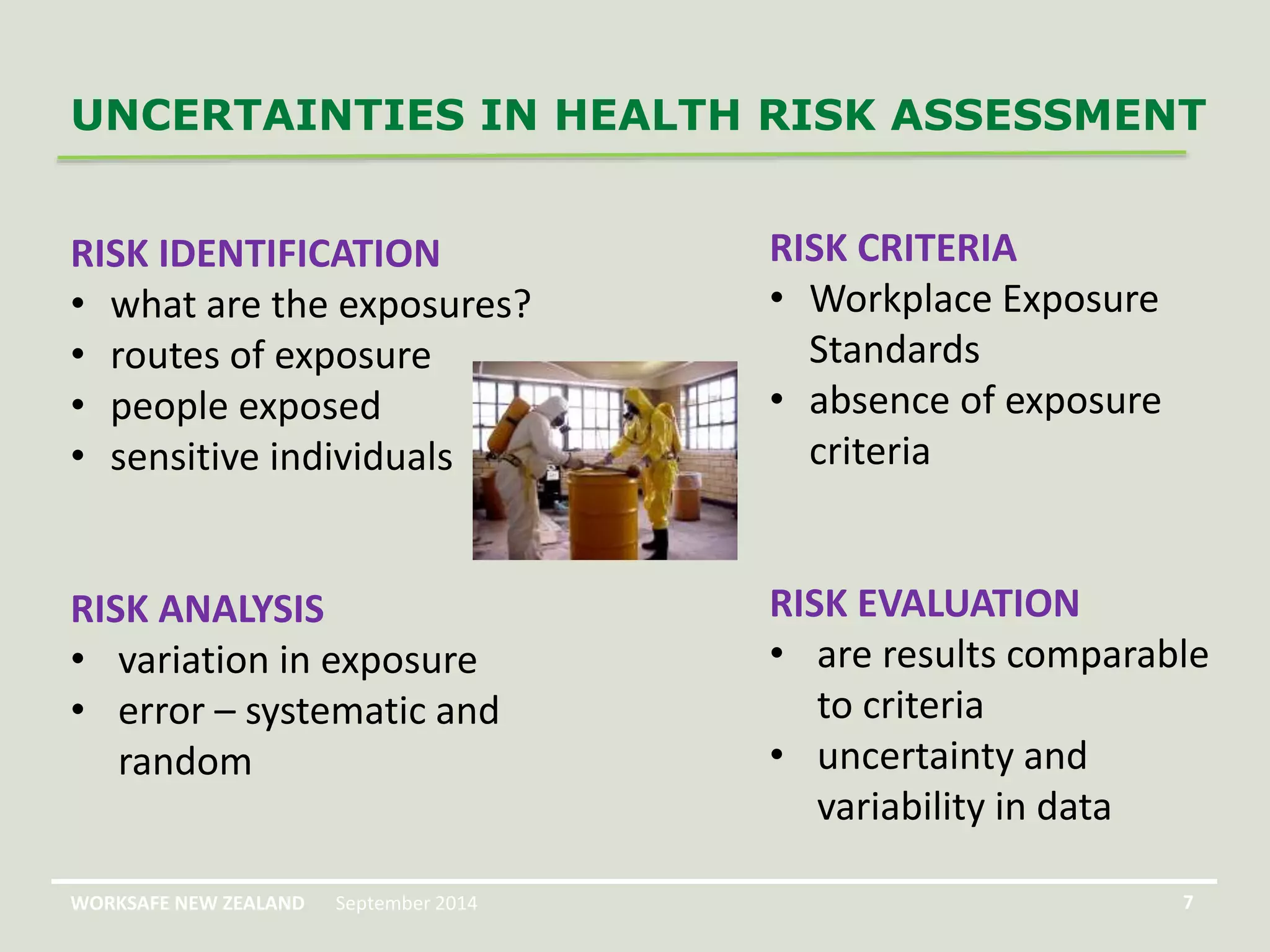
UNCERTAINTIES IN HEALTH RISK ASSESSMENT 
RISK IDENTIFICATION 
• what are the exposures? 
• routes of exposure 
• people exposed 
• sensitive individuals 
RISK ANALYSIS 
• variation in exposure 
• error – systematic and 
random 
RISK CRITERIA 
• Workplace Exposure 
Standards 
• absence of exposure 
criteria 
RISK EVALUATION 
• are results comparable 
to criteria 
• uncertainty and 
variability in data 
WORKSAFE NEW ZEALAND September 2014 7
RISK ANALYSIS UNCERTAINTIES – airborne exposure 
Quantitative exposure assessment 
• varied methods 
• instrument limitations 
• systematic error- sampling and analysis 
• random error - variation in exposure 
Qualitative exposure assessment e.g. 
control banding 
• model limitations 
• modelling assumptions 
WORKSAFE NEW ZEALAND September 2014 8
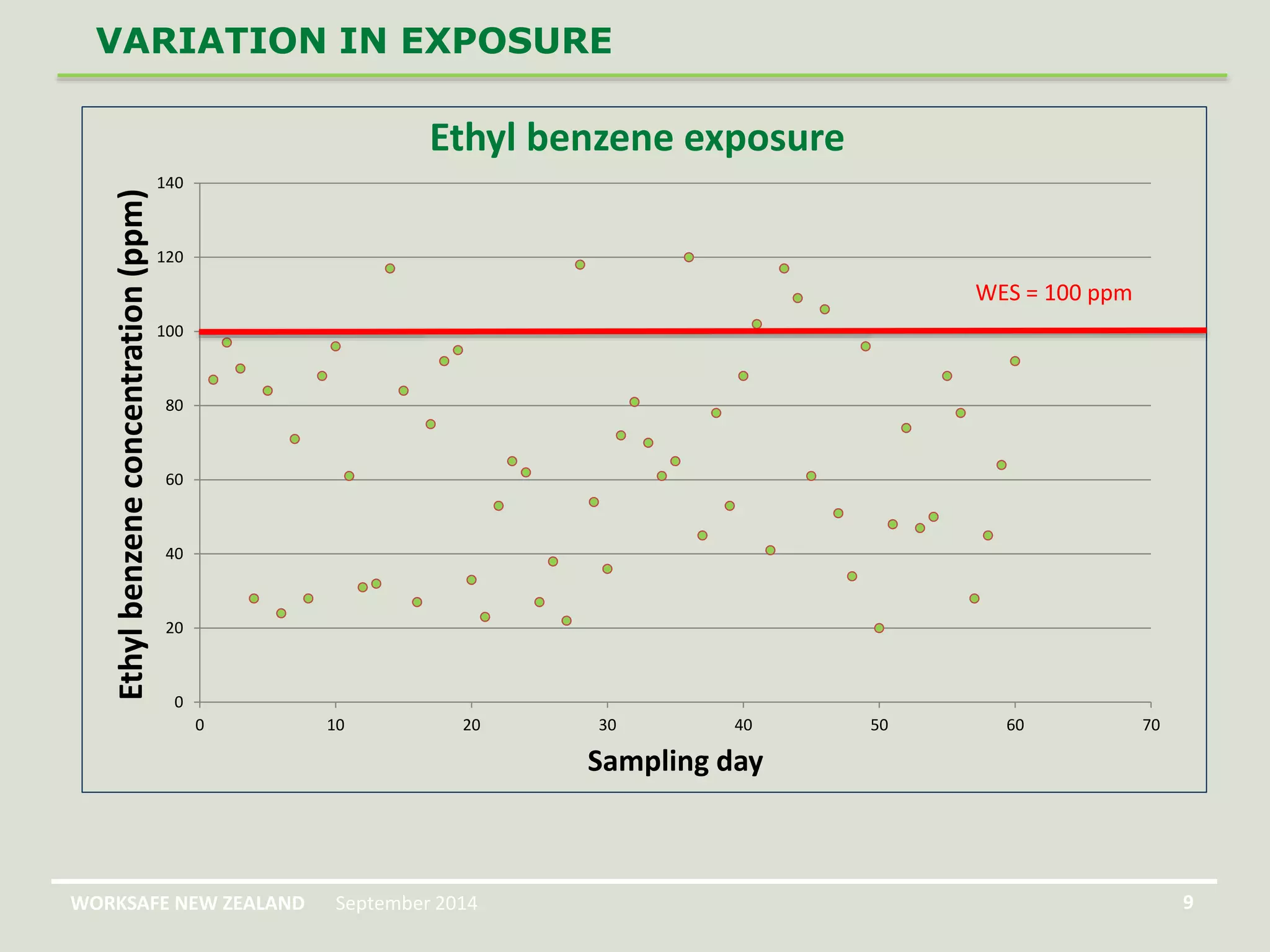
WES = 100 ppm 
VARIATION IN EXPOSURE 
140 
120 
100 
80 
60 
40 
20 
0 
Ethyl benzene exposure 
0 10 20 30 40 50 60 70 
Ethyl benzene concentration (ppm) 
Sampling day 
WORKSAFE NEW ZEALAND September 2014 9
RISK EVALUATION UNCERTAINTIES 
(risk analysis + risk criteria) 
Workplace Exposure Standard as risk criteria 
• Compliance with the designated value does not 
guarantee that all workers are protected from 
discomfort or ill heath – (individual susceptibility) 
• e.g. certain genetic variations increase risk of 
developing occupational asthma from HDI isocyanate 
• e.g. genetic polymorphisms give rise to varying risk of 
developing cancer. e.g. variation in DNA repair genes, 
differences in metabolism, enzyme polymorphisms 
• Basis for the WES often ignored – health end point e.g. 
dichloromethane - acutely toxic, skin and eye irritant, CNS, 
suspected carcinogen, hepatotoxic, nephrotoxic, produces 
carboxyhaemoglobin 
WORKSAFE NEW ZEALAND September 2014 10
UNCERTAINTIES 
“Lack of, or imperfect knowledge concerning the present 
or future state of an organism, system, or 
(sub)population under consideration, which may affect 
its accuracy or relevance. 
Uncertainty can be reduced, at least in principle, 
by improving the quality and/or amount of 
information.” 
(Source: WHO, “Guidance Document on characterizing and 
communicating uncertainty in exposure assessment”, 2008) 
WORKSAFE NEW ZEALAND September 2014 11
HEALTH RISK ASSESSMENT 
• Each step in the risk assessment process 
introduces uncertainty 
• We need to consider the effect of those 
uncertainties on the risk evaluation 
• What do we need to do to manage those 
uncertainties to improve the risk assessment?
worksafe.govt.nz 
0800 030 040

Occupational health risk assessment

  • 1.
    Philippa Gibson OCCUPATIONALHEALTH RISK ASSESSMENT – LEGAL COMPLIANCE AND UNCERTAINTIES PREPARED FOR OHSIG September 2014
  • 2.
    HEALTH AND SAFETYREFORM BILL (2014) Duty to manage risk Section 22 1. eliminate risks 2. minimise risks WORKSAFE NEW ZEALAND September 2014 2
  • 3.
    RISK MANAGEMENT – AS/NZS/ISO 31000:2009 Principals and guidelines Risk the effect of uncertainty on objectives Risk management coordinated activities to direct and control an organization with regard to risk WORKSAFE NEW ZEALAND September 2014 3
  • 4.
    AS/NZS ISO 31000:2009Risk management WORKSAFE NEW ZEALAND MAY 2014
  • 5.
    Risk assessment -AS/NZS ISO 31000:2009 Identification (ID and describe) Analysis (nature and level) Evaluation (magnitude, acceptable/not) WORKSAFE NEW ZEALAND September 2014 5
  • 6.
    OCCUPATIONAL HEALTH RISKASSESSMENT • informs (is part of) the risk management process • You must consider the strengths, uncertainties and assumptions that affect on the overall risk assessment Source: Environmental Health risk assessment Guidelines for assessing human health risks from environmental hazards (Commonwealth of Australia, 2012) WORKSAFE NEW ZEALAND September 2014 6
  • 7.
    UNCERTAINTIES IN HEALTHRISK ASSESSMENT RISK IDENTIFICATION • what are the exposures? • routes of exposure • people exposed • sensitive individuals RISK ANALYSIS • variation in exposure • error – systematic and random RISK CRITERIA • Workplace Exposure Standards • absence of exposure criteria RISK EVALUATION • are results comparable to criteria • uncertainty and variability in data WORKSAFE NEW ZEALAND September 2014 7
  • 8.
    RISK ANALYSIS UNCERTAINTIES– airborne exposure Quantitative exposure assessment • varied methods • instrument limitations • systematic error- sampling and analysis • random error - variation in exposure Qualitative exposure assessment e.g. control banding • model limitations • modelling assumptions WORKSAFE NEW ZEALAND September 2014 8
  • 9.
    WES = 100ppm VARIATION IN EXPOSURE 140 120 100 80 60 40 20 0 Ethyl benzene exposure 0 10 20 30 40 50 60 70 Ethyl benzene concentration (ppm) Sampling day WORKSAFE NEW ZEALAND September 2014 9
  • 10.
    RISK EVALUATION UNCERTAINTIES (risk analysis + risk criteria) Workplace Exposure Standard as risk criteria • Compliance with the designated value does not guarantee that all workers are protected from discomfort or ill heath – (individual susceptibility) • e.g. certain genetic variations increase risk of developing occupational asthma from HDI isocyanate • e.g. genetic polymorphisms give rise to varying risk of developing cancer. e.g. variation in DNA repair genes, differences in metabolism, enzyme polymorphisms • Basis for the WES often ignored – health end point e.g. dichloromethane - acutely toxic, skin and eye irritant, CNS, suspected carcinogen, hepatotoxic, nephrotoxic, produces carboxyhaemoglobin WORKSAFE NEW ZEALAND September 2014 10
  • 11.
    UNCERTAINTIES “Lack of,or imperfect knowledge concerning the present or future state of an organism, system, or (sub)population under consideration, which may affect its accuracy or relevance. Uncertainty can be reduced, at least in principle, by improving the quality and/or amount of information.” (Source: WHO, “Guidance Document on characterizing and communicating uncertainty in exposure assessment”, 2008) WORKSAFE NEW ZEALAND September 2014 11
  • 12.
    HEALTH RISK ASSESSMENT • Each step in the risk assessment process introduces uncertainty • We need to consider the effect of those uncertainties on the risk evaluation • What do we need to do to manage those uncertainties to improve the risk assessment?
  • 13.

Editor's Notes

  • #3 A duty imposed on a person under this Act to ensure health and safety requires the person— (a) to eliminate risks to health and safety, so far as is reasonably practicable; and (b) if it is not reasonably practicable to eliminate risks to health and safety, to minimise those risks so far as is reasonably practicable. No general definition of ‘risk’ in regulations (except specifics e.g. lead risk work – leads to a blood lead level exceeding specific values, High risk work (forklifts, scaffolding) A female of reproductive capacity— 10μg/dL (0.48μmol/L); or (b) in any other case—30μg/dL (1.45μmol/L). NZ = 1.5μmol/L (no specific one for females)
  • #4 GWRM review - The HSE Act focuses on the tangible management of hazards - including a detailed definition of a hazard - and does not refer to ‘risk’. However, requiring duty holders to take all practicable steps to manage hazards means that employers must take into account the likelihood of harm occurring. Risk management is therefore inherent in the process even though it is not explicitly referred to. e.g. objective is zero harm , or compliance with HS law, or ensuring exposure is less than WES. AS/NZS ISO 31000:2009 Risk management – principals and guidelines
  • #5 Context: Parameters to include when managing risk Scope Risk criteria - terms of reference against which the significance of a risk is evaluated.
  • #6 Risk identification = Identifying and describing risk Risk analysis= Nature and level of risk Risk evaluation = Compare risk analysis to risk criteria – determine magnitude and is it acceptable/tolerable
  • #8 Risk identification = Finding and describing risk Risk analysis= Nature and level of risk Risk criteria - terms of reference against which the significance of a risk is evaluated. Risk evaluation = Compare risk analysis to risk criteria – determine magnitude and is it acceptable/tolerable
  • #9 Qual model limitations – e.g. doesn’t cover the range of work activities needed. Qual model assumptions – e.g. simple near field far field dispersion of contaminants, or underlying algorithm for exposure estimation based on flawed exposure data Systematic errors - usually come from the measuring instruments e.g. mistakes in pump calibration, using pump at P/T without calibrating at the P/T, physical or chemical interference, sample degradation with storage, internal lab random variation - season, interday, intraday, change in process, worker activities, temperature (re evaporation rate), seasonal changes causes change in natural ventilation, changes in the pump flow rate, collection efficiency, desorption efficiency
  • #11 DCM HSNO = acutely toxic, skin and eye irritant, CNS, suspected carcinogen and target or system organ toxic hepatotoxic (liver) TLV based on preventing CNS depression and reducing carboxyhaemoglobin. It metabolises to CO. Risk evaluation = Compare risk analysis to risk criteria – determine magnitude and is it acceptable/tolerable
  • #13  American Industrial Hygiene Association (AIHA) compliance = upper tolerance limit less than the WES. UTL = 95% confident that 95% of the exposures fall below this level.