TITLE
Prepared by:
PART 4: IMPLEMENTATION & OPERATION
4.1 Hazard Identification, Risk
Assessment and Risk Control (HIRARC)
Learning Objectives
 To define what is
hazard, risk and
danger.
 To assess the hazard
identification, risk
assessment and risk
control process.
 To describe the
method of identifying
hazard.
 To construct the risk
assessment matrix.
Hazard: A source or a situation with a potential
for harm in terms of human injury or ill
health, damage to property, damage to the
environment or a combination of these.
 Danger: Relative exposure to hazard
Definitions
Risk: A combination of the likelihood of an
occurrence of a hazardous event with specified
period or in specified circumstances and the
severity of injury or damage to the health of
people, property, environment or any combination
of these caused by the event.
Definitions
What is Risk assessment: The process of
evaluating the risks to safety and health arising from
hazards at work.
 Risk assessment results is documented and used for:
1. Risk control in OSH management
2. Future reference and review
Risk Assessment
1. Integrate Risk Management as part of planning
at all levels of business
2. Accept all risks
3. Make risk decisions appropriately (depending on
level of risk)
4. Manage the risk
Basic Principles Of Risk Management
Gives organisations a more effective way of managing
hazards
 Requirement of the law e.g.
 OSHA 1994, CIMAH Regulations 1996  USECHH Regulations
2000
 Requirement of OSH management system
standards:
 MS 1722:2003,
 OHSAS 18001 and
 ISO 14001, etc.
Why Carry Out Risk Assessment?
Routine and non-routine activities including
emergencies;
 Activities of all personnel having access to the workplace
(including subcontractors and visitors);
 Facilities at the workplace, whether provided-by the
organization or others.
Risk Assessment Should Be Carried Out
For:
Before Operation
 During Operation
 After Operation
When To Carry Out Risk Assessment
Types of review:
 initial review, and
 periodic review.
When To Review Risk Assessment
Review whenever there are changes:
 internal
 Before modification, changes or introduction of new
 Materials, machinery or processes, working procedures,
 external
 Amendments of national laws and regulations
 Developments in OSH knowledge and technology
When To Review Risk Assessment
Person or persons trained to identify hazard and
risk assessment
 In some cases legally competent person, example : Chemical
Health Risk Assessor
 Consultation with and involvement of workers
 Safety and health committee OR workers and their
representatives
 Involvement of supervisors
Who Will Carry Out Risk Assessment
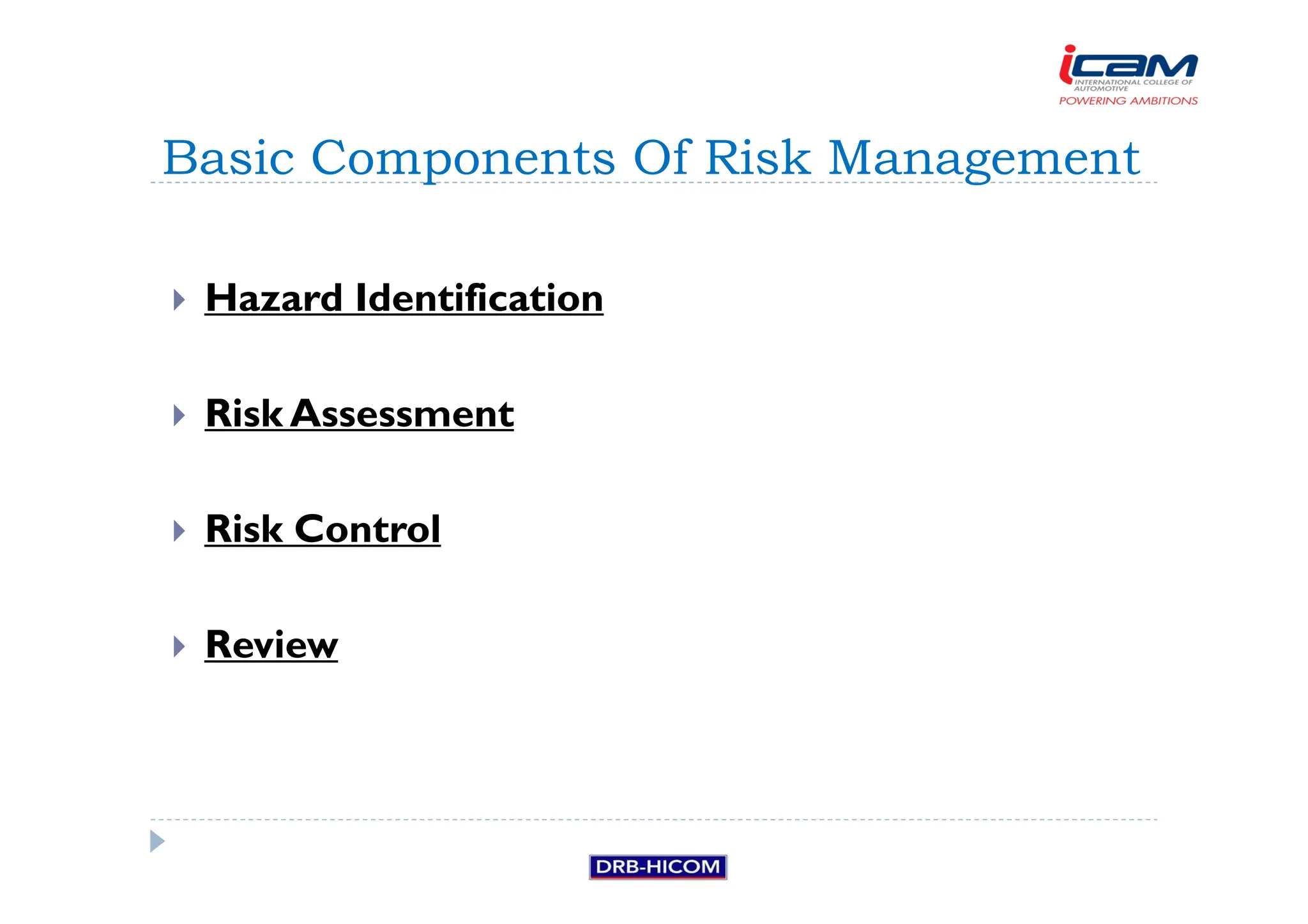
Hazard Identification
 Risk Assessment
 Risk Control
 Review
Basic Components Of Risk Management
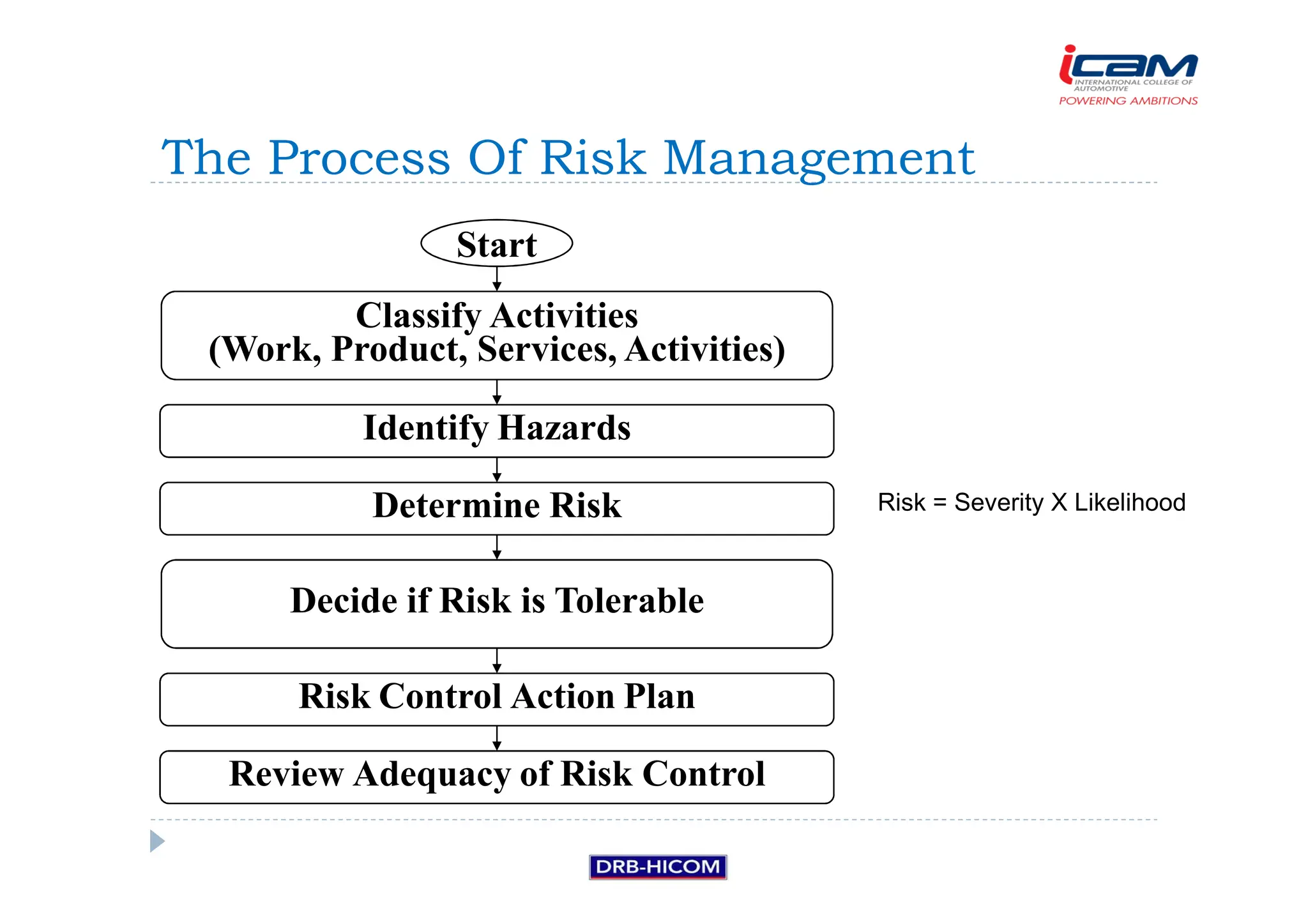
Classify Activities
(Work, Product, Services, Activities)
Determine Risk
Decide if Risk is Tolerable
Risk Control Action Plan
Identify Hazards
Review Adequacy of Risk Control
Start
Risk = Severity X Likelihood
The Process Of Risk Management
Hazard Identification
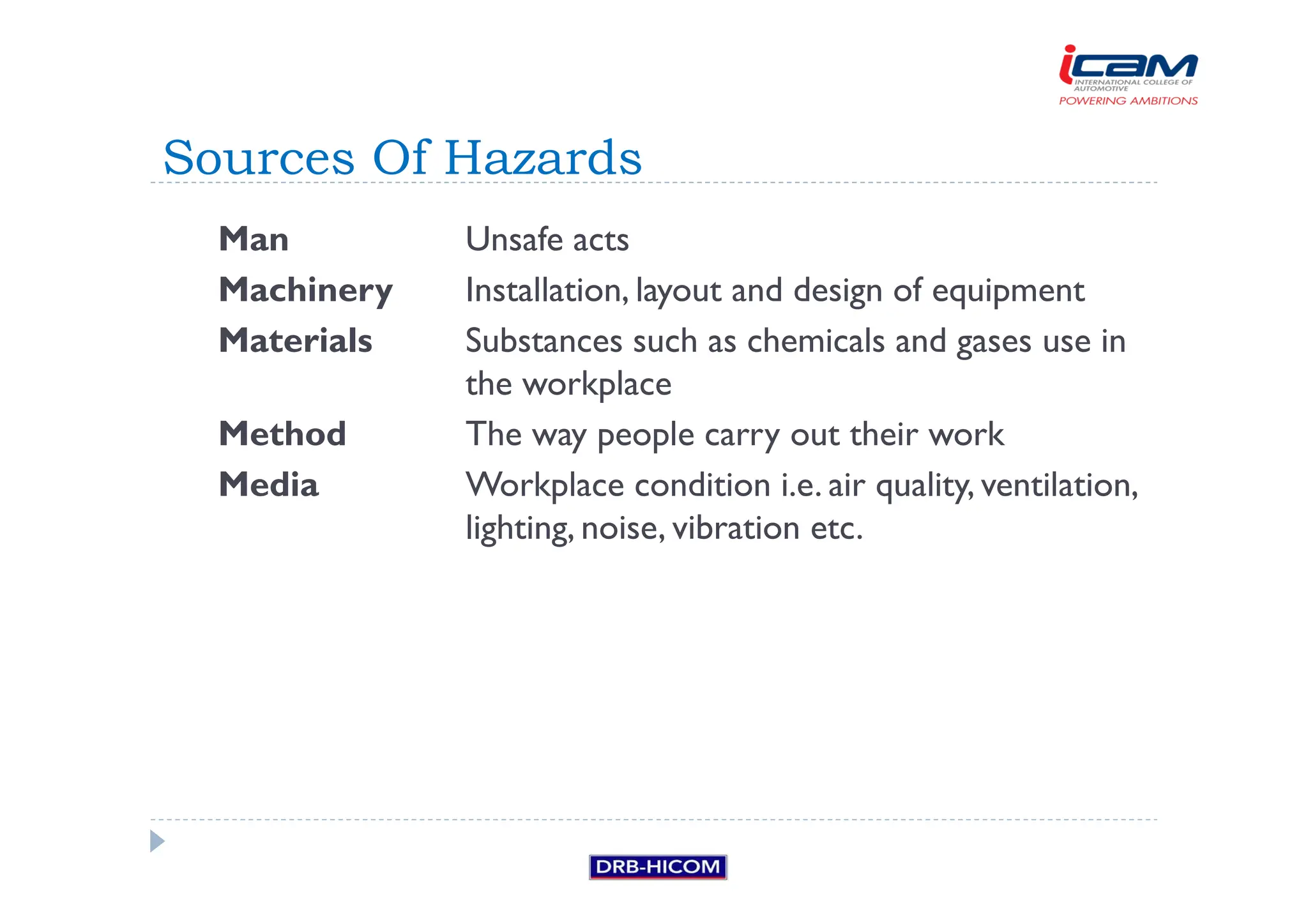
Man Unsafe acts
Machinery Installation, layout and design of equipment
Materials Substances such as chemicals and gases use in
the workplace
Method The way people carry out their work
Media Workplace condition i.e. air quality, ventilation,
lighting, noise, vibration etc.
Sources Of Hazards
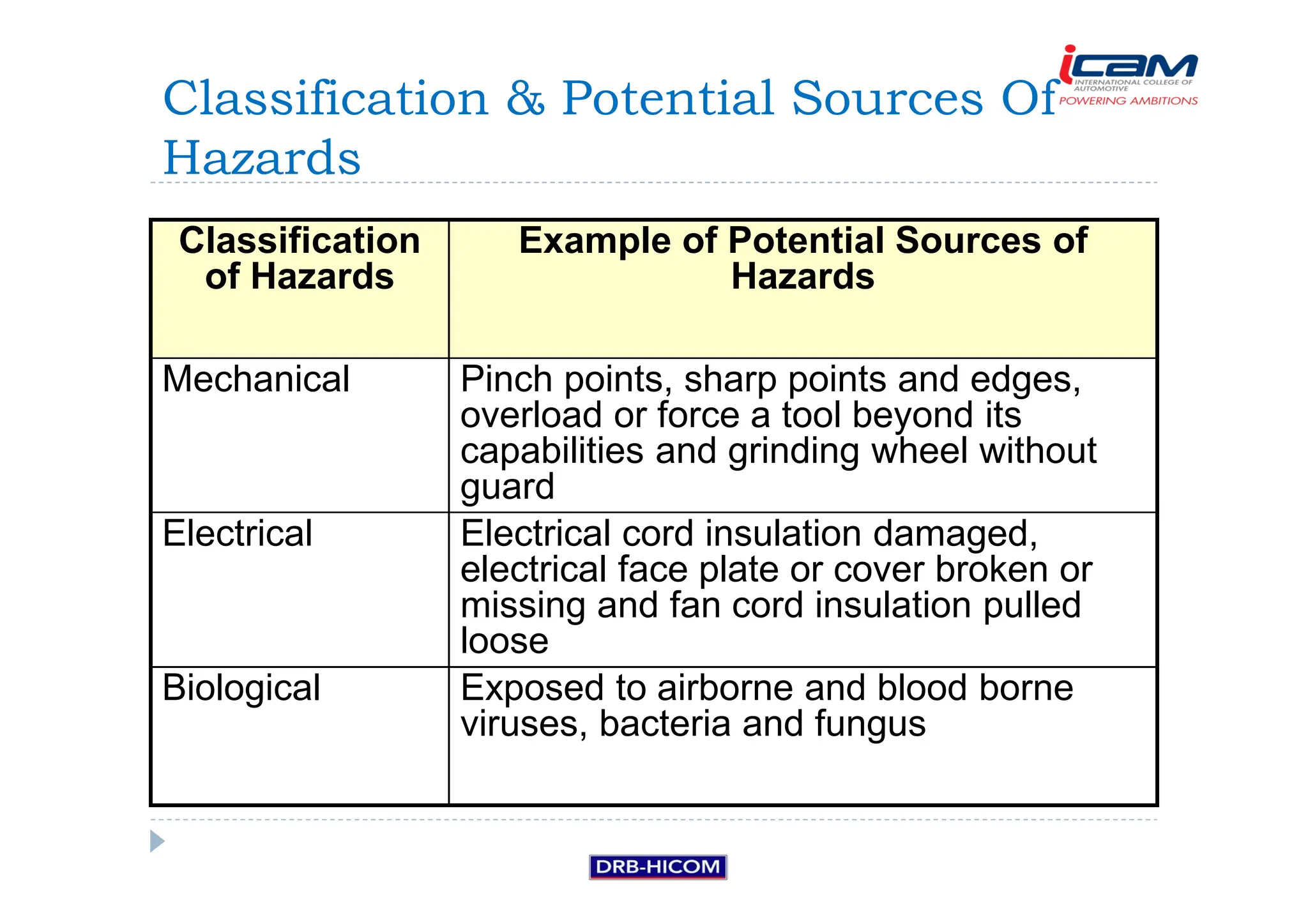
Classification
of Hazards
Example of Potential Sources of
Hazards
Mechanical Pinch points, sharp points and edges,
overload or force a tool beyond its
capabilities and grinding wheel without
guard
Electrical Electrical cord insulation damaged,
electrical face plate or cover broken or
missing and fan cord insulation pulled
loose
Biological Exposed to airborne and blood borne
viruses, bacteria and fungus
Classification  Potential Sources Of
Hazards
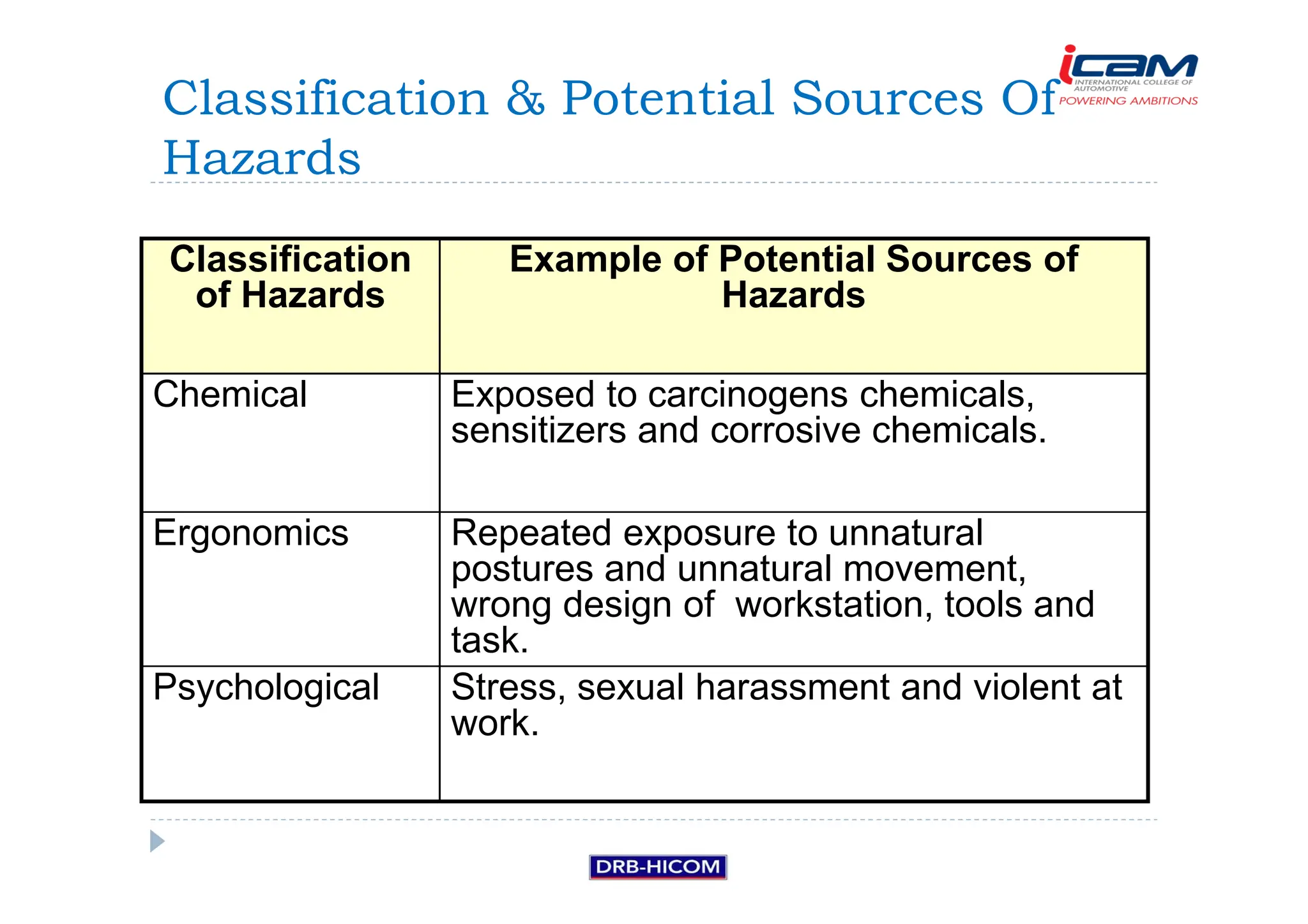
Classification
of Hazards
Example of Potential Sources of
Hazards
Chemical Exposed to carcinogens chemicals,
sensitizers and corrosive chemicals.
Ergonomics Repeated exposure to unnatural
postures and unnatural movement,
wrong design of workstation, tools and
task.
Psychological Stress, sexual harassment and violent at
work.
Classification  Potential Sources Of
Hazards
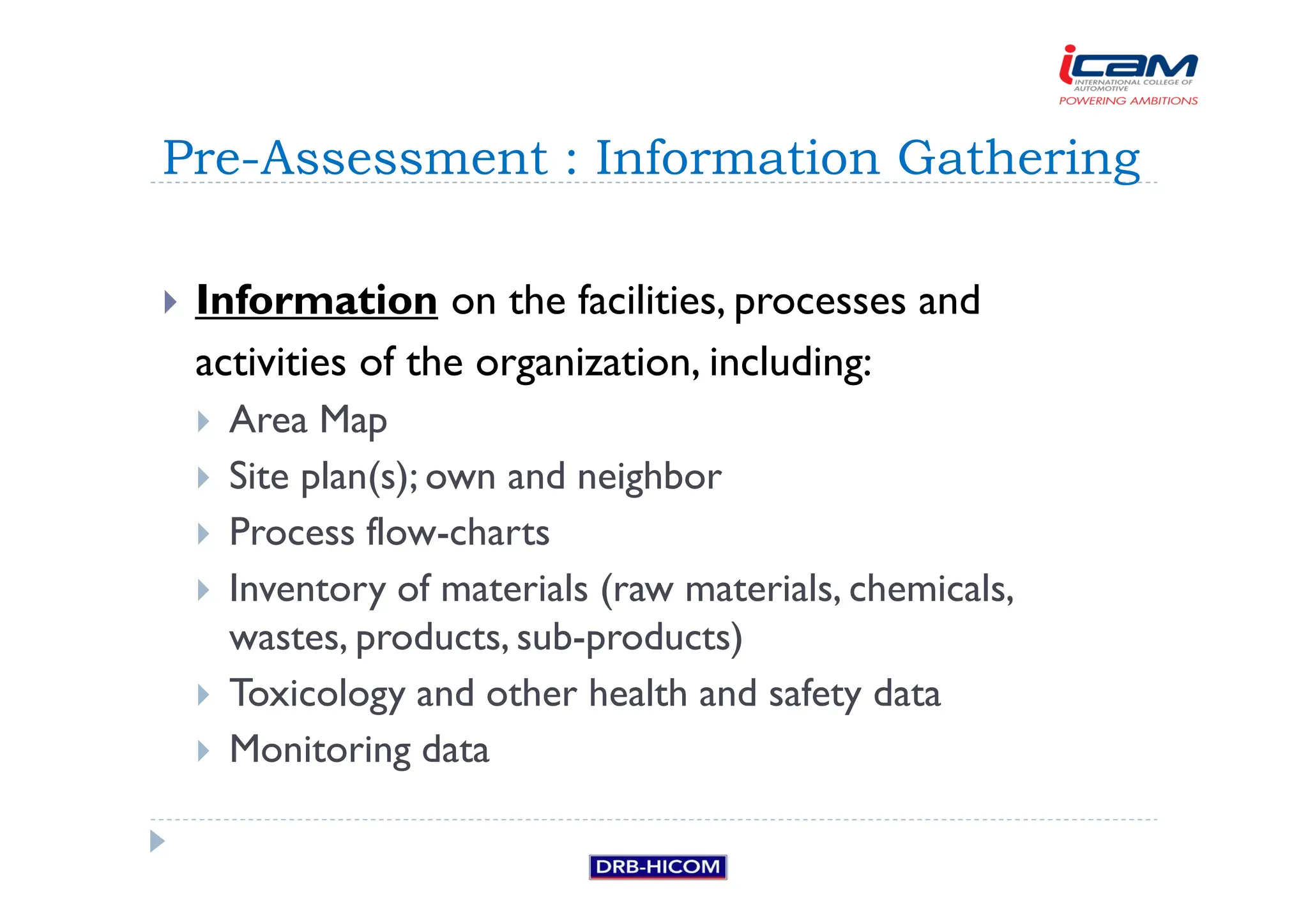
Information on the facilities, processes and
activities of the organization, including:
 Area Map
 Site plan(s); own and neighbor
 Process flow-charts
 Inventory of materials (raw materials, chemicals,
wastes, products, sub-products)
 Toxicology and other health and safety data
 Monitoring data
Pre-Assessment : Information Gathering
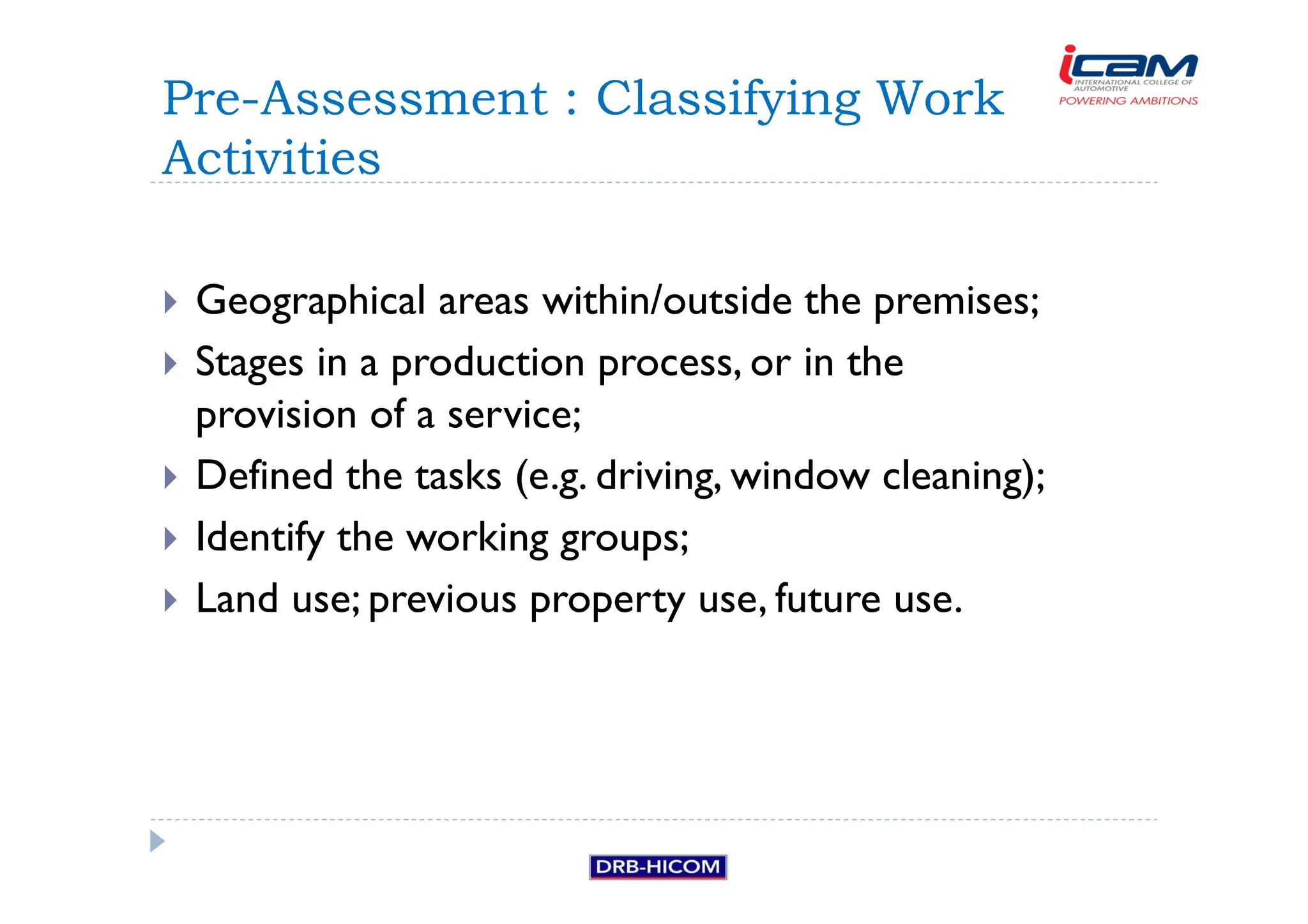
Geographical areas within/outside the premises;
 Stages in a production process, or in the
provision of a service;
 Defined the tasks (e.g. driving, window cleaning);
 Identify the working groups;
 Land use; previous property use, future use.
Pre-Assessment : Classifying Work
Activities
Review of documents and publications
 Inspection and observation at the workplace
 Measurement of the atmosphere, monitoring
the environment or medical surveillance of
workers
 Hazard Analysis
Methods Of Identifying Hazards
Reports of accidents, accident investigation and
audits
 Information from publications
 Acts, Regulations and Codes of Practice
 Statistics
 Handbooks
 Chemical Safety Data Sheet (CSDS)
Document Review
Types of inspections: statutory inspection, periodic
inspection, formal and informal inspection
 Documentation - Checklist and inspection worksheet
(standard approach and record)
Inspection  Observation
Activities - to involve supervisors, managers and
employees
 Inspection outcome - to include actions and
timeframes
 Ensure follow up on action - to ensure effectiveness
Inspection  Observation
Types of monitoring: area and personal monitoring.
 Monitoring of:
 Noise
 Heat
 Radiation
 Air contaminants
 Chemicals etc.
Exposure Monitoring
Biological monitoring is a regular measuring activity
where selected validated indicators of the uptake of
toxic substances in the human body are determined
in order to prevent health impairment.
 This form of monitoring could entail examination of, for
example, blood, urine, saliva and expired air.
Biological Monitoring
Biological monitoring commonly features in the
health or medical surveillance of persons exposed
to hazardous environments especially complying to
legal requirement i.e. USECHH Regulations 2000 etc.
Biological Monitoring
Health Surveillance isWarranted if:
 Substance is used in workplace
 Substance is hazardous
 Evidence or reason to suspect injury
 Atmospheric monitoring insufficient
Medical Surveillance
Method use: (example)
 Job Safety Analysis (JSA)
 Hazards and Operability Studies (HAZOP)
 FaultTree Analysis etc.
Hazards Analysis
Job described in less than 10 steps
 Action verb used to describe job
 List things that can go wrong
Job Safety Analysis (JSA)
Note:
 The term JSA includes the formulation of
safe work procedures using written
instructions for workers
 May still require other risk controls
 Supervisor and workers assist
 Ideally all jobs should have a JSA
Job Safety Analysis (JSA)
To identify and evaluate safety hazard in the
process plant
 To identify operability problems
 New design or process
 Multidisciplinary brainstorming
 “What If” questionnaire method
 Focus on fire, explosion, toxic release etc.
Hazards  Operability Studies (HAZOP)
To analyse how and why incident could occur.
 Graphic technique - traces branches of events.
 To calculate probability of end event.
 Example:Water pumping system
Fault Tree Analysis
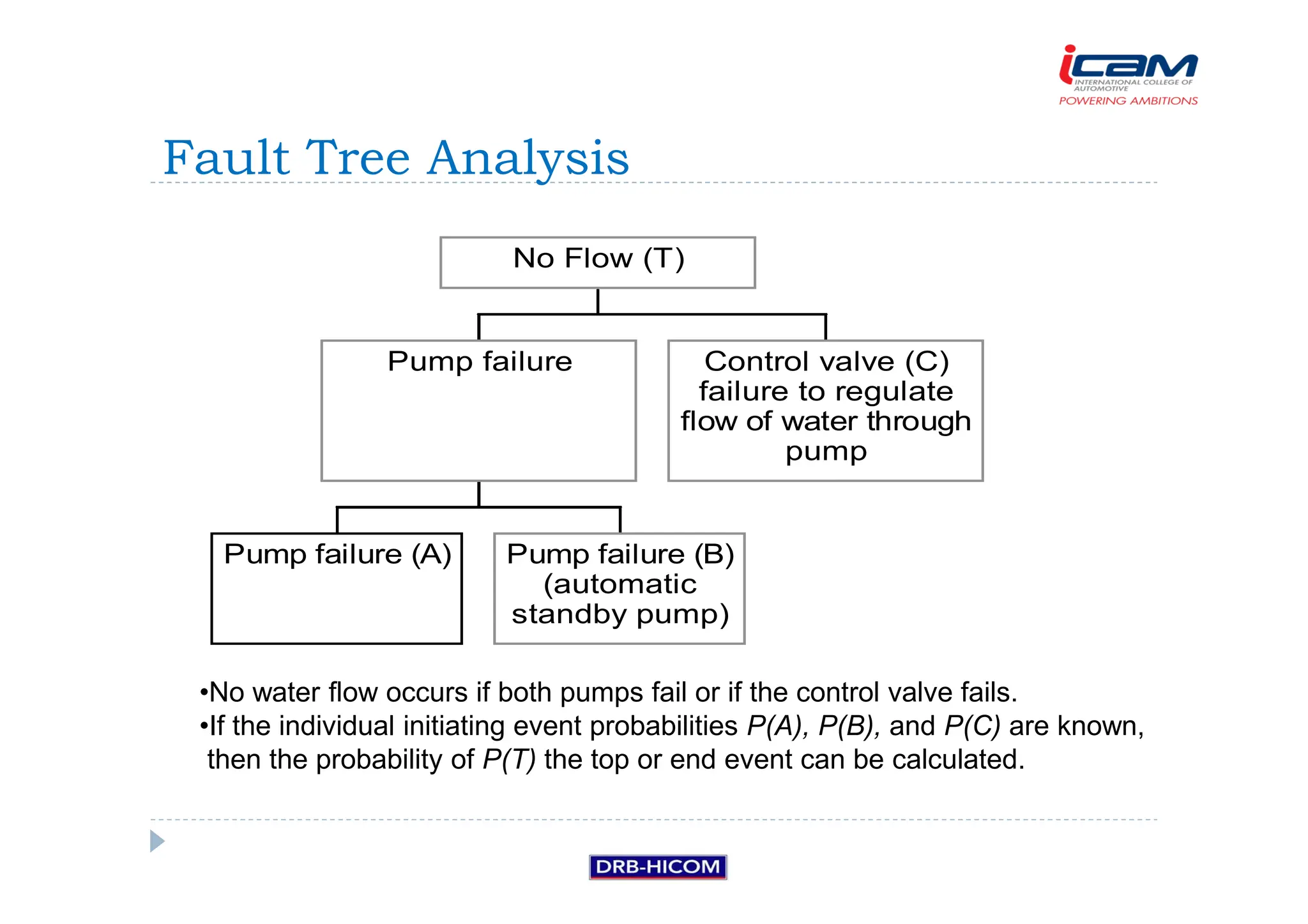
Pump failure (A) Pump failure (B)
(automatic
standby pump)
Pump failure Control valve (C)
failure to regulate
flow of water through
pump
No Flow (T)
•No water flow occurs if both pumps fail or if the control valve fails.
•If the individual initiating event probabilities P(A), P(B), and P(C) are known,
then the probability of P(T) the top or end event can be calculated.
Fault Tree Analysis
Risk Assessment
Approach:
 Qualitative Risk Assessment
 Semi-Quantitative Risk Assessment
 Quantitative Risk Assessment
Types of Risk Assessment
Severity in terms of:
 Harm to health
 Damage to property
 Damage to environment
 Or the combination of the above
Determining Severity
Determine severity categories i.e.:
 Fatality
 Major injuries (normally irreversible injury or
damage to health)
 Minor injuries (normally reversible injury or
damage to health requiring days off work)
 Negligible injuries (first aid)
Severity
Based on statistic  data, professional judgement.
 Determine likelihood categories i.e.:
 highly likely,
 likely,
 highly unlikely.
Determining Likelihood of Occurrences
of Hazard
Very likely - could happen frequently
 Likely - could happen occasionally
 Unlikely - could happen, but only rarely
 Highly unlikely - could happen, but probably
never will
Likelihood
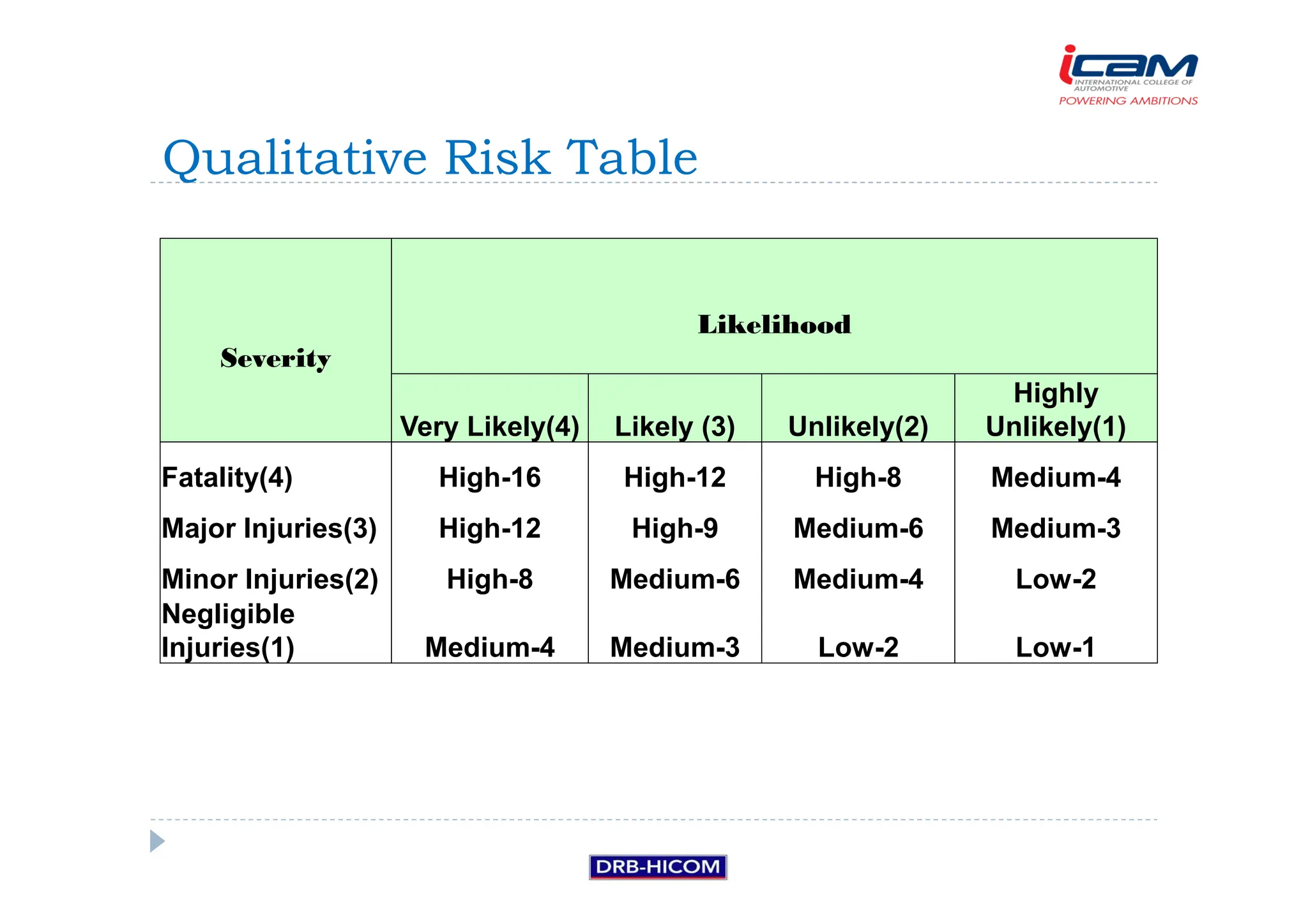
Severity
Likelihood
Very Likely(4) Likely (3) Unlikely(2)
Highly
Unlikely(1)
Fatality(4) High-16 High-12 High-8 Medium-4
Major Injuries(3) High-12 High-9 Medium-6 Medium-3
Minor Injuries(2) High-8 Medium-6 Medium-4 Low-2
Negligible
Injuries(1) Medium-4 Medium-3 Low-2 Low-1
Qualitative Risk Table
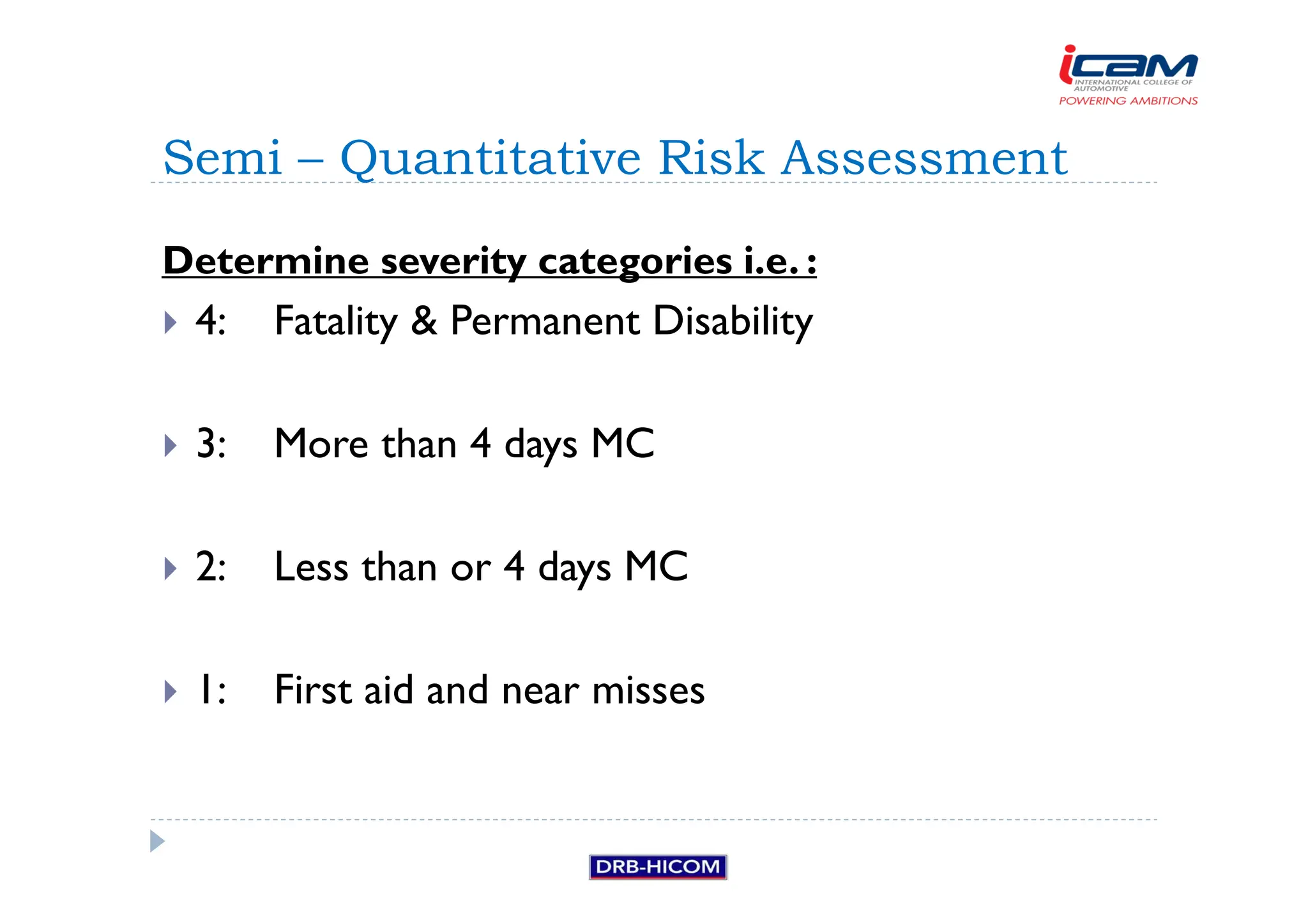
Determine severity categories i.e. :
 4: Fatality  Permanent Disability
 3: More than 4 days MC
 2: Less than or 4 days MC
 1: First aid and near misses
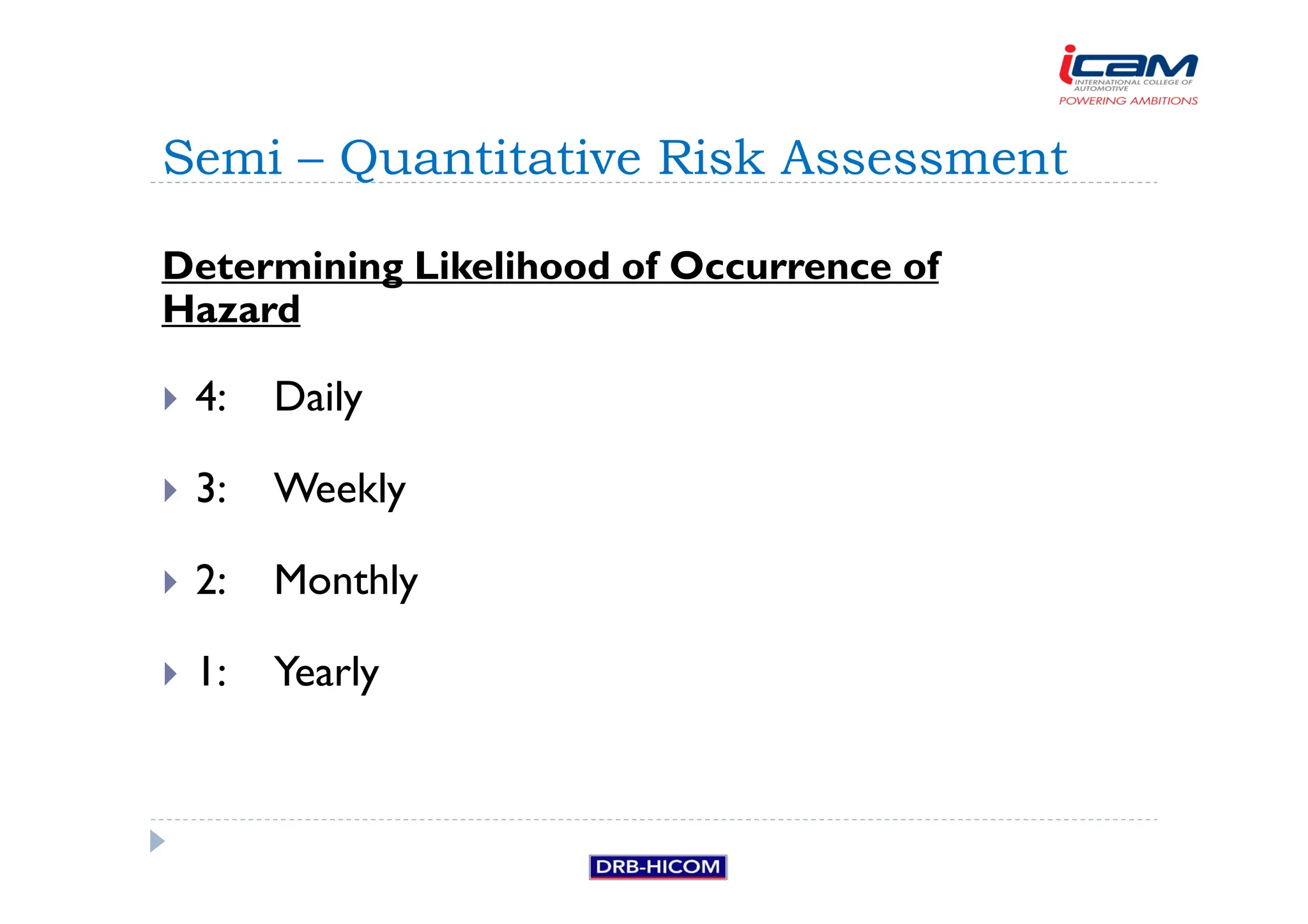
Semi – Quantitative Risk Assessment
Determining Likelihood of Occurrence of
Hazard
 4: Daily
 3: Weekly
 2: Monthly
 1: Yearly
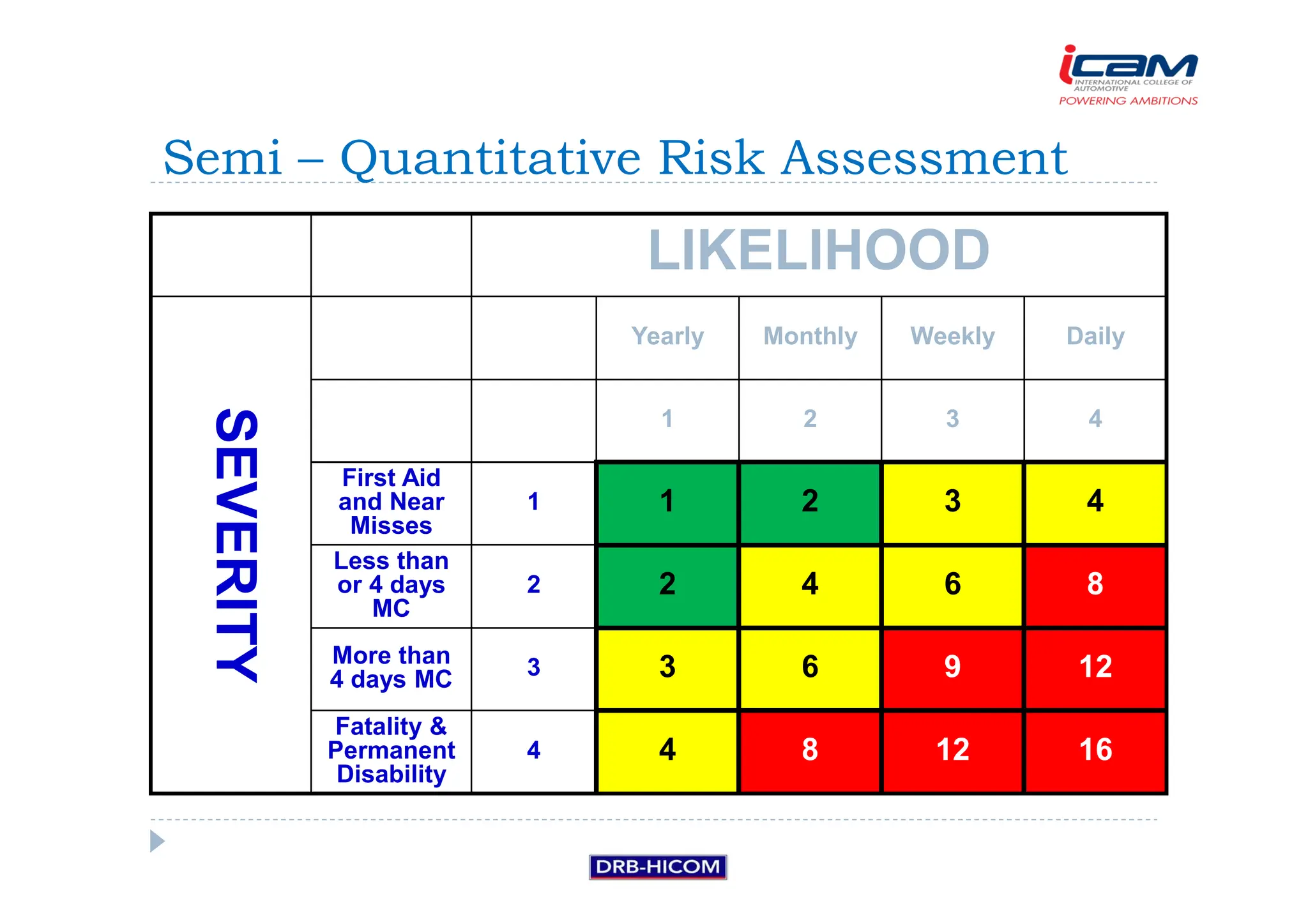
Semi – Quantitative Risk Assessment
LIKELIHOOD
SEVERITY
Yearly Monthly Weekly Daily
1 2 3 4
First Aid
and Near
Misses
1 1 2 3 4
Less than
or 4 days
MC
2 2 4 6 8
More than
4 days MC 3 3 6 9 12
Fatality 
Permanent
Disability
4 4 8 12 16
Semi – Quantitative Risk Assessment
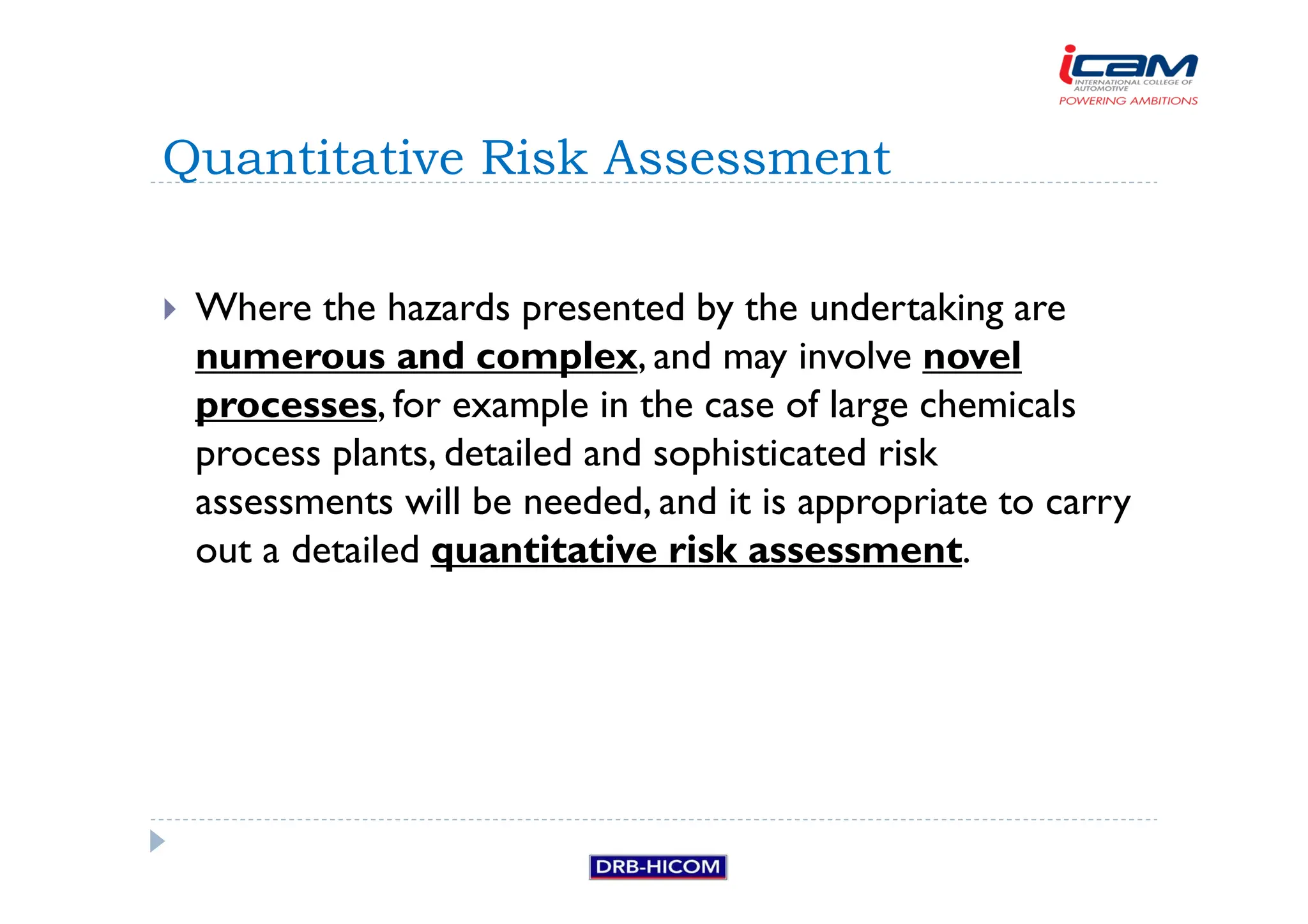
Where the hazards presented by the undertaking are
numerous and complex, and may involve novel
processes, for example in the case of large chemicals
process plants, detailed and sophisticated risk
assessments will be needed, and it is appropriate to carry
out a detailed quantitative risk assessment.
Quantitative Risk Assessment
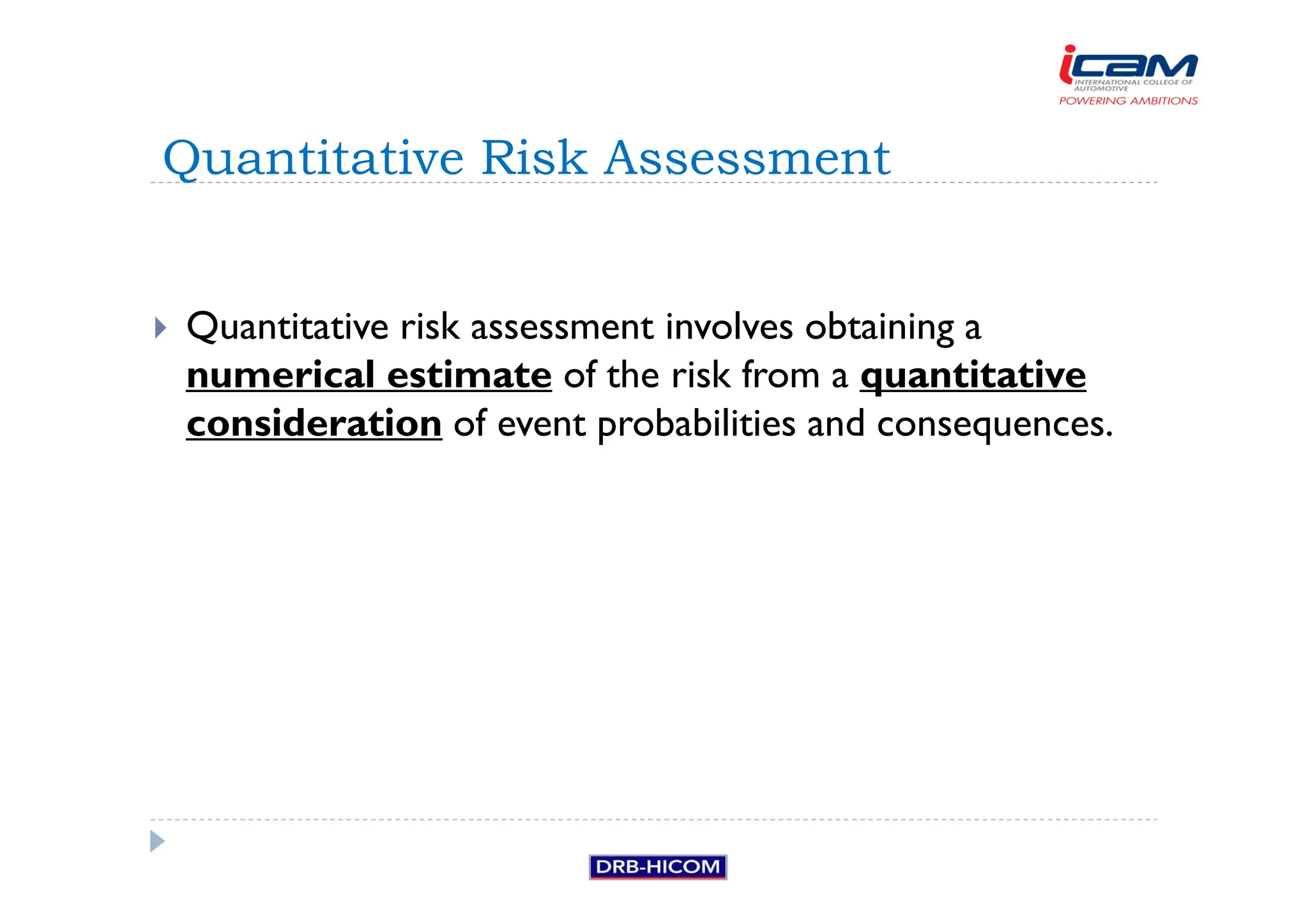
Quantitative risk assessment involves obtaining a
numerical estimate of the risk from a quantitative
consideration of event probabilities and consequences.
Quantitative Risk Assessment
In carrying out quantitative risk assessments, special
quantitative tools and techniques will be used for
hazard identification, and to estimate the severity of the
consequences and the likelihood of realisation of the
hazards.
Quantitative Risk Assessment
Where such methods and techniques are used it is
important that they are carried out by suitably qualified
and experience assessors.
Quantitative Risk Assessment
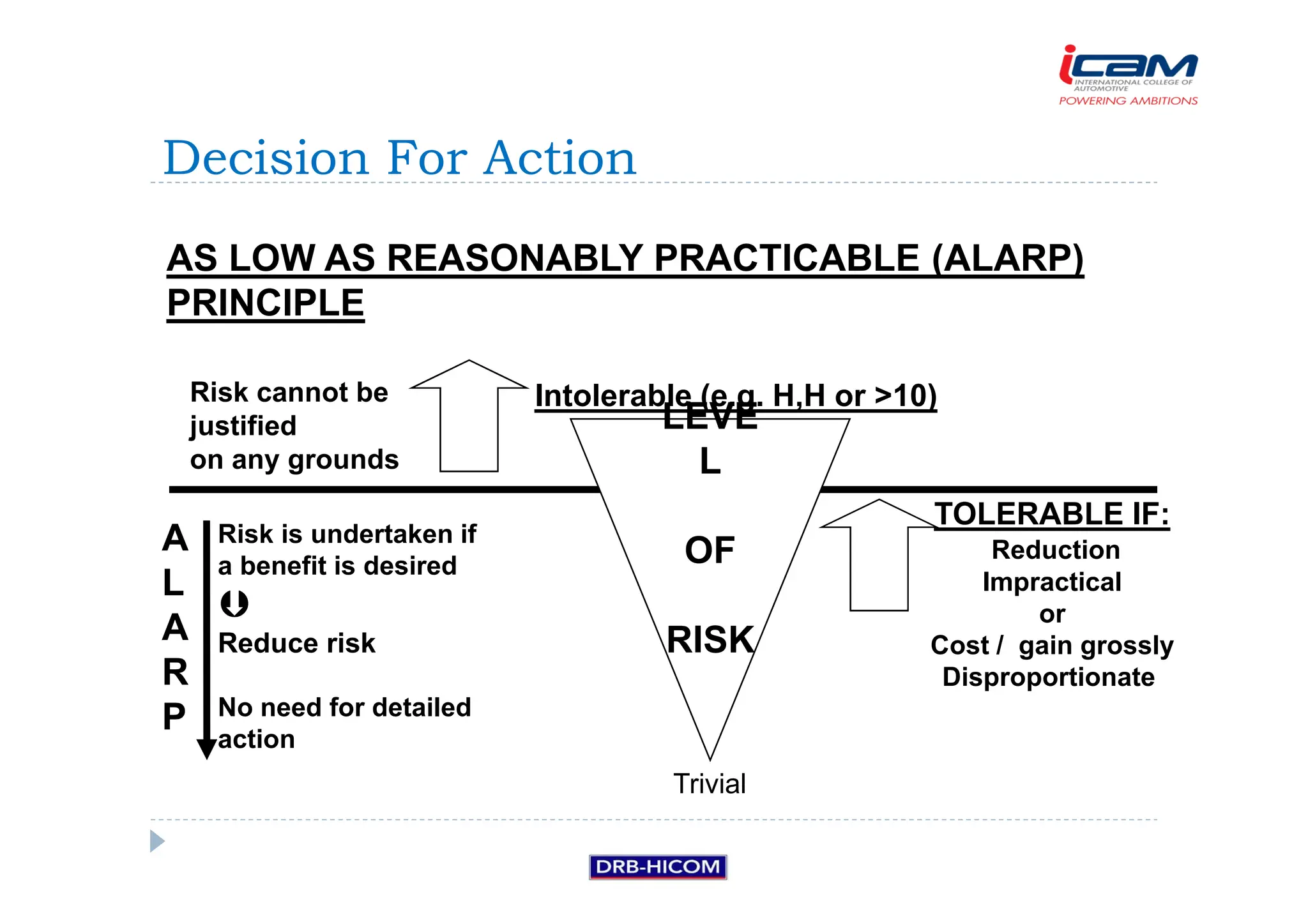
LEVE
L
OF
RISK
AS LOW AS REASONABLY PRACTICABLE (ALARP)
PRINCIPLE
Risk cannot be
justified
on any grounds
A
L
A
R
P
Risk is undertaken if
a benefit is desired


Reduce risk
No need for detailed
action
TOLERABLE IF:
Reduction
Impractical
or
Cost / gain grossly
Disproportionate
Intolerable (e.g. H,H or 10)
Trivial
Decision For Action
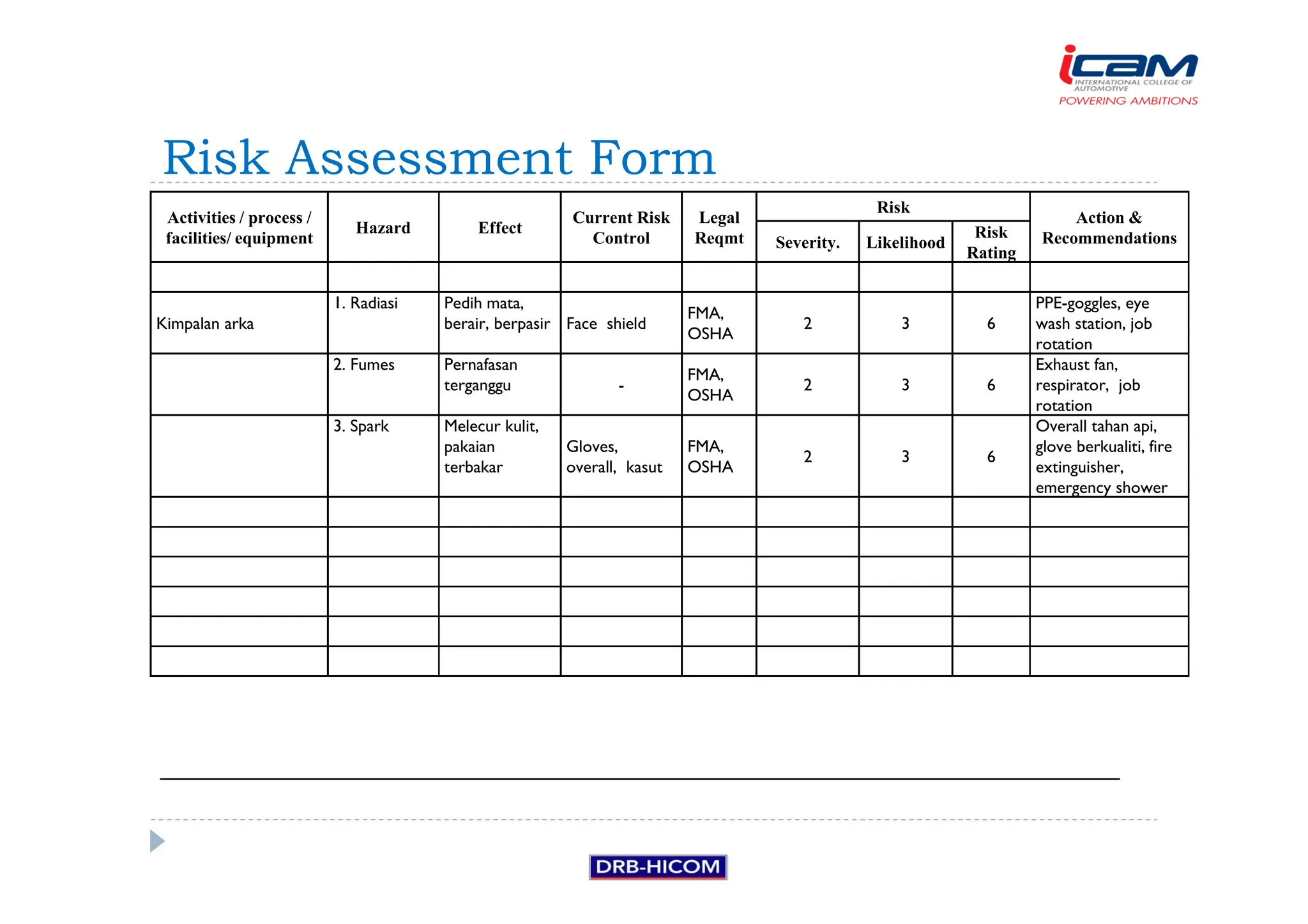
Activities / process /
facilities/ equipment
Hazard Effect
Current Risk
Control
Legal
Reqmt
Risk
Action 
Recommendations
Severity. Likelihood
Risk
Rating
Kimpalan arka
1. Radiasi Pedih mata,
berair, berpasir Face shield
FMA,
OSHA
2 3 6
PPE-goggles, eye
wash station, job
rotation
2. Fumes Pernafasan
terganggu -
FMA,
OSHA
2 3 6
Exhaust fan,
respirator, job
rotation
3. Spark Melecur kulit,
pakaian
terbakar
Gloves,
overall, kasut
FMA,
OSHA
2 3 6
Overall tahan api,
glove berkualiti, fire
extinguisher,
emergency shower
Risk Assessment Form
Risk Control
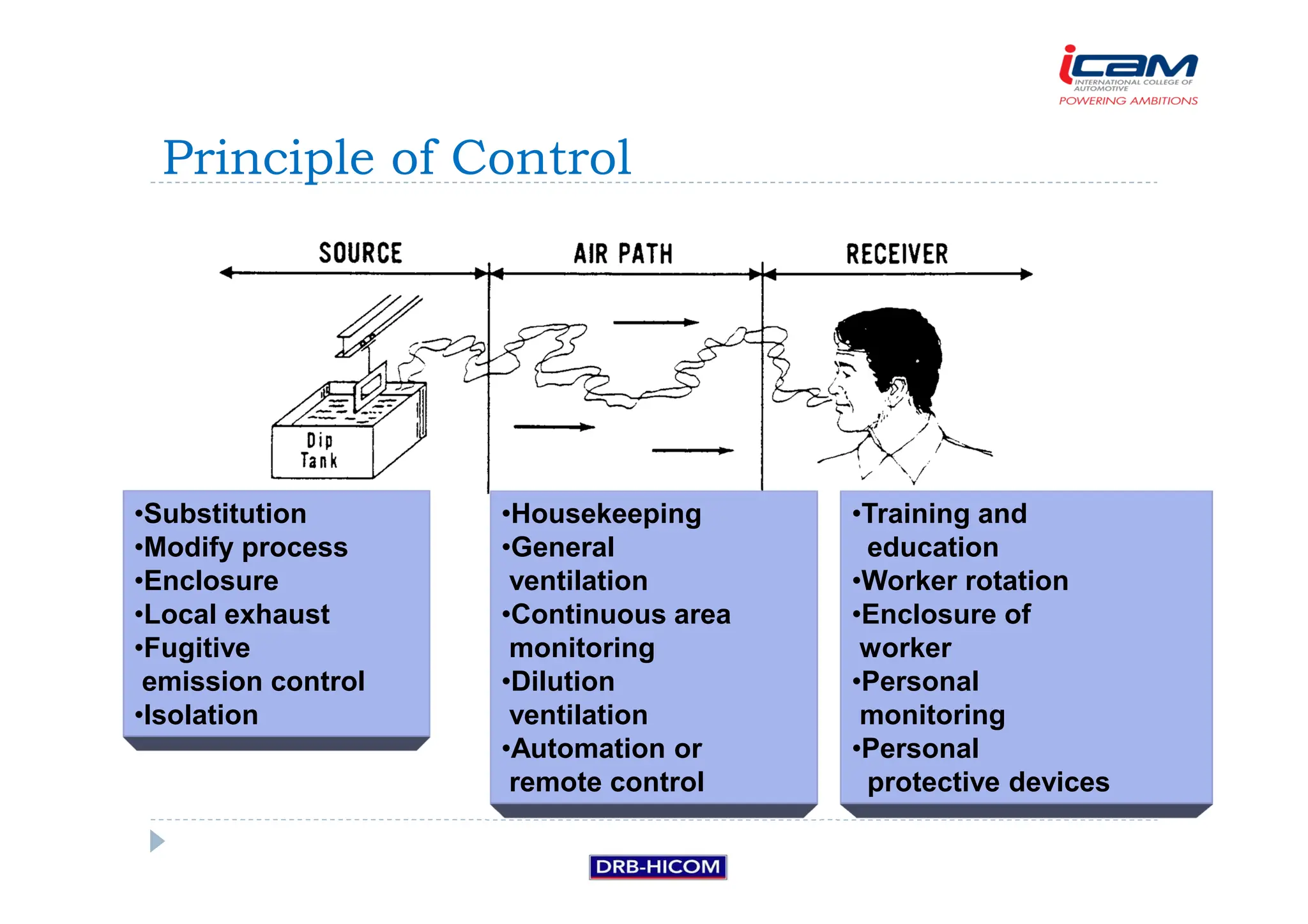
•Substitution
•Modify process
•Enclosure
•Local exhaust
•Fugitive
emission control
•Isolation
•Housekeeping
•General
ventilation
•Continuous area
monitoring
•Dilution
ventilation
•Automation or
remote control
•Training and
education
•Worker rotation
•Enclosure of
worker
•Personal
monitoring
•Personal
protective devices
Principle of Control
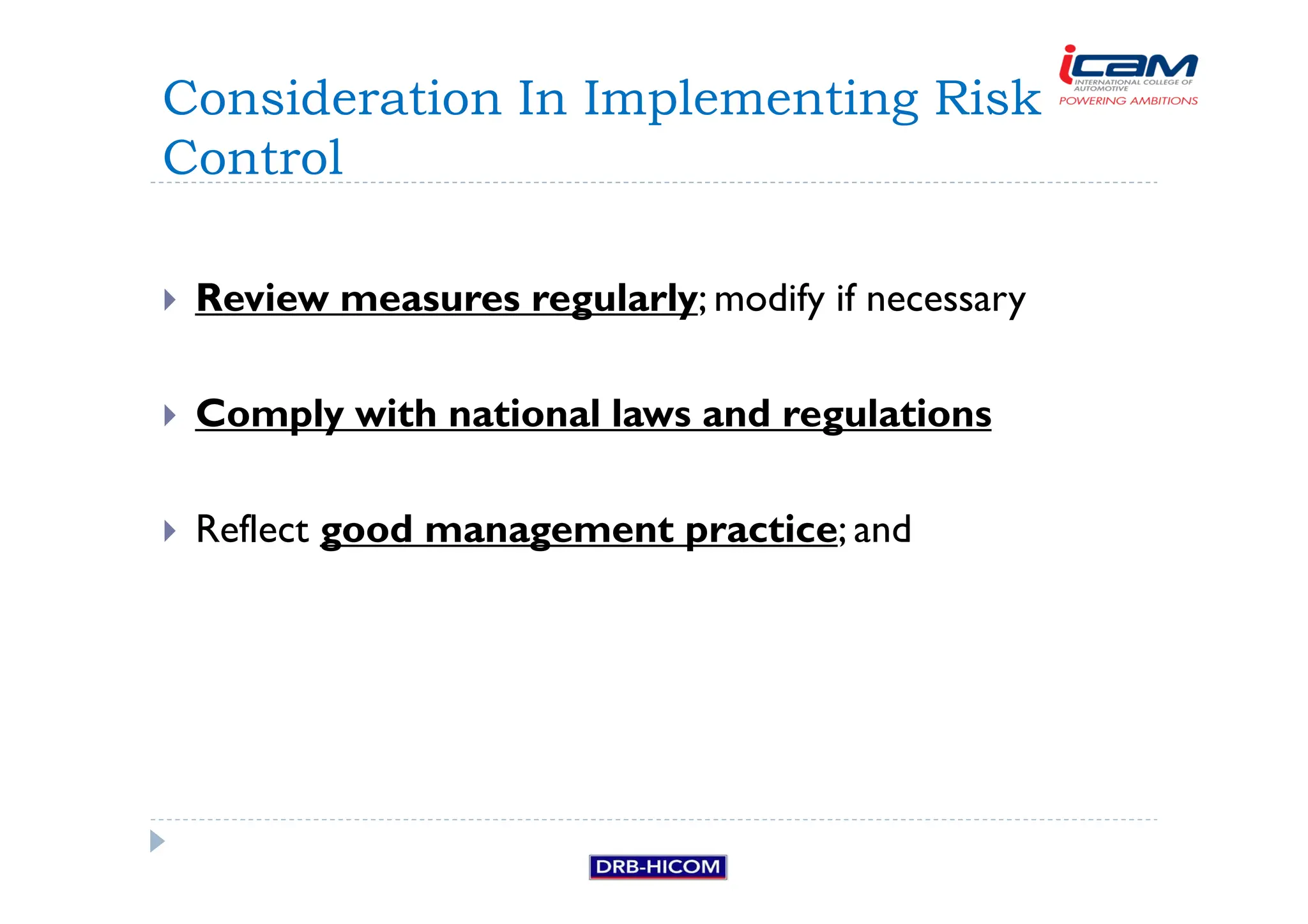
Review measures regularly; modify if necessary
 Comply with national laws and regulations
 Reflect good management practice; and
Consideration In Implementing Risk
Control
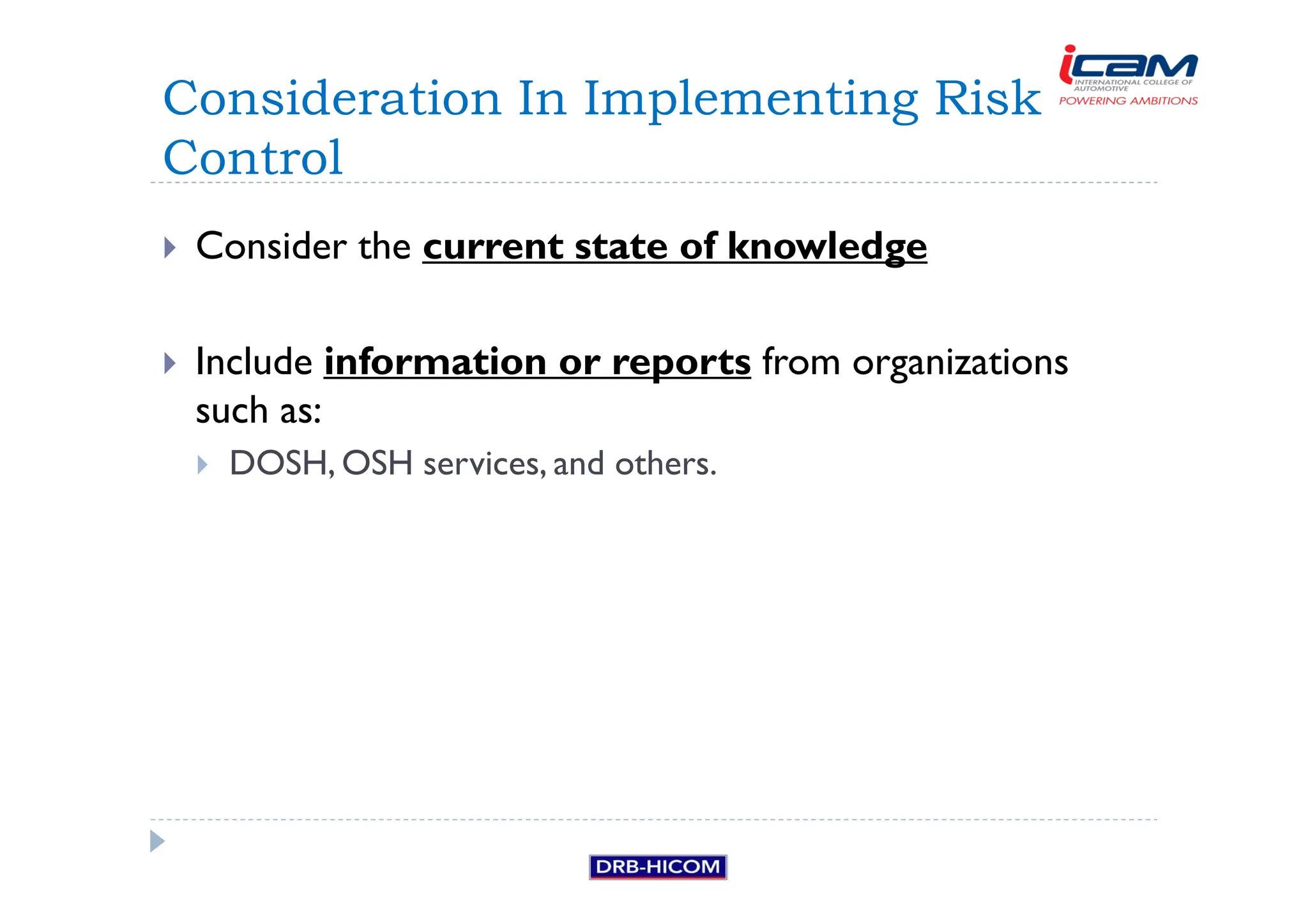
Consider the current state of knowledge
 Include information or reports from organizations
such as:
 DOSH, OSH services, and others.
Consideration In Implementing Risk
Control
Hierarchy Of Control
MOST EFFECTIVE
Elimination - remove the hazard.
FAIRLY EFFECTIVE
Substitution - use less hazardous one.
Isolation – isolate the work area i.e. X-ray machine in restricted
room
Engineering Control – design, isolation at source, barricade,
guarding,
LEAST EFFECTIVE
Administrative Control – safe work procedure, isolation i.e. reduce
exposure time and limit, training, signage etc
PPE - last resort.
The basis of OSH management is the identification of
hazard, risk assessment and control
 Ways of identifying hazards varies from inspection of
the workplace to reviewing legislation
 Risk assessment allows an organisation to build a
sound basis for managing hazard
 Hierarchy of hazard control starts by elimination; use
PPE as protection is the last resort
Summary

hazard identification and risk analysis system

  • 1.
    TITLE Prepared by: PART 4:IMPLEMENTATION & OPERATION 4.1 Hazard Identification, Risk Assessment and Risk Control (HIRARC)
  • 2.
    Learning Objectives Todefine what is hazard, risk and danger. To assess the hazard identification, risk assessment and risk control process. To describe the method of identifying hazard. To construct the risk assessment matrix.
  • 3.
    Hazard: A sourceor a situation with a potential for harm in terms of human injury or ill health, damage to property, damage to the environment or a combination of these. Danger: Relative exposure to hazard Definitions
  • 4.
    Risk: A combinationof the likelihood of an occurrence of a hazardous event with specified period or in specified circumstances and the severity of injury or damage to the health of people, property, environment or any combination of these caused by the event. Definitions
  • 5.
    What is Riskassessment: The process of evaluating the risks to safety and health arising from hazards at work. Risk assessment results is documented and used for: 1. Risk control in OSH management 2. Future reference and review Risk Assessment
  • 6.
    1. Integrate RiskManagement as part of planning at all levels of business 2. Accept all risks 3. Make risk decisions appropriately (depending on level of risk) 4. Manage the risk Basic Principles Of Risk Management
  • 7.
    Gives organisations amore effective way of managing hazards Requirement of the law e.g. OSHA 1994, CIMAH Regulations 1996 USECHH Regulations 2000 Requirement of OSH management system standards: MS 1722:2003, OHSAS 18001 and ISO 14001, etc. Why Carry Out Risk Assessment?
  • 8.
    Routine and non-routineactivities including emergencies; Activities of all personnel having access to the workplace (including subcontractors and visitors); Facilities at the workplace, whether provided-by the organization or others. Risk Assessment Should Be Carried Out For:
  • 9.
    Before Operation DuringOperation After Operation When To Carry Out Risk Assessment
  • 10.
    Types of review: initial review, and periodic review. When To Review Risk Assessment
  • 11.
    Review whenever thereare changes: internal Before modification, changes or introduction of new Materials, machinery or processes, working procedures, external Amendments of national laws and regulations Developments in OSH knowledge and technology When To Review Risk Assessment
  • 12.
    Person or personstrained to identify hazard and risk assessment In some cases legally competent person, example : Chemical Health Risk Assessor Consultation with and involvement of workers Safety and health committee OR workers and their representatives Involvement of supervisors Who Will Carry Out Risk Assessment
  • 13.
    Hazard Identification RiskAssessment Risk Control Review Basic Components Of Risk Management
  • 14.
    Classify Activities (Work, Product,Services, Activities) Determine Risk Decide if Risk is Tolerable Risk Control Action Plan Identify Hazards Review Adequacy of Risk Control Start Risk = Severity X Likelihood The Process Of Risk Management
  • 15.
  • 16.
    Man Unsafe acts MachineryInstallation, layout and design of equipment Materials Substances such as chemicals and gases use in the workplace Method The way people carry out their work Media Workplace condition i.e. air quality, ventilation, lighting, noise, vibration etc. Sources Of Hazards
  • 17.
    Classification of Hazards Example ofPotential Sources of Hazards Mechanical Pinch points, sharp points and edges, overload or force a tool beyond its capabilities and grinding wheel without guard Electrical Electrical cord insulation damaged, electrical face plate or cover broken or missing and fan cord insulation pulled loose Biological Exposed to airborne and blood borne viruses, bacteria and fungus Classification Potential Sources Of Hazards
  • 18.
    Classification of Hazards Example ofPotential Sources of Hazards Chemical Exposed to carcinogens chemicals, sensitizers and corrosive chemicals. Ergonomics Repeated exposure to unnatural postures and unnatural movement, wrong design of workstation, tools and task. Psychological Stress, sexual harassment and violent at work. Classification Potential Sources Of Hazards
  • 19.
    Information on thefacilities, processes and activities of the organization, including: Area Map Site plan(s); own and neighbor Process flow-charts Inventory of materials (raw materials, chemicals, wastes, products, sub-products) Toxicology and other health and safety data Monitoring data Pre-Assessment : Information Gathering
  • 20.
    Geographical areas within/outsidethe premises; Stages in a production process, or in the provision of a service; Defined the tasks (e.g. driving, window cleaning); Identify the working groups; Land use; previous property use, future use. Pre-Assessment : Classifying Work Activities
  • 21.
    Review of documentsand publications Inspection and observation at the workplace Measurement of the atmosphere, monitoring the environment or medical surveillance of workers Hazard Analysis Methods Of Identifying Hazards
  • 22.
    Reports of accidents,accident investigation and audits Information from publications Acts, Regulations and Codes of Practice Statistics Handbooks Chemical Safety Data Sheet (CSDS) Document Review
  • 23.
    Types of inspections:statutory inspection, periodic inspection, formal and informal inspection Documentation - Checklist and inspection worksheet (standard approach and record) Inspection Observation
  • 24.
    Activities - toinvolve supervisors, managers and employees Inspection outcome - to include actions and timeframes Ensure follow up on action - to ensure effectiveness Inspection Observation
  • 25.
    Types of monitoring:area and personal monitoring. Monitoring of: Noise Heat Radiation Air contaminants Chemicals etc. Exposure Monitoring
  • 26.
    Biological monitoring isa regular measuring activity where selected validated indicators of the uptake of toxic substances in the human body are determined in order to prevent health impairment. This form of monitoring could entail examination of, for example, blood, urine, saliva and expired air. Biological Monitoring
  • 27.
    Biological monitoring commonlyfeatures in the health or medical surveillance of persons exposed to hazardous environments especially complying to legal requirement i.e. USECHH Regulations 2000 etc. Biological Monitoring
  • 28.
    Health Surveillance isWarrantedif: Substance is used in workplace Substance is hazardous Evidence or reason to suspect injury Atmospheric monitoring insufficient Medical Surveillance
  • 29.
    Method use: (example) Job Safety Analysis (JSA) Hazards and Operability Studies (HAZOP) FaultTree Analysis etc. Hazards Analysis
  • 30.
    Job described inless than 10 steps Action verb used to describe job List things that can go wrong Job Safety Analysis (JSA)
  • 31.
    Note: The termJSA includes the formulation of safe work procedures using written instructions for workers May still require other risk controls Supervisor and workers assist Ideally all jobs should have a JSA Job Safety Analysis (JSA)
  • 32.
    To identify andevaluate safety hazard in the process plant To identify operability problems New design or process Multidisciplinary brainstorming “What If” questionnaire method Focus on fire, explosion, toxic release etc. Hazards Operability Studies (HAZOP)
  • 33.
    To analyse howand why incident could occur. Graphic technique - traces branches of events. To calculate probability of end event. Example:Water pumping system Fault Tree Analysis
  • 34.
    Pump failure (A)Pump failure (B) (automatic standby pump) Pump failure Control valve (C) failure to regulate flow of water through pump No Flow (T) •No water flow occurs if both pumps fail or if the control valve fails. •If the individual initiating event probabilities P(A), P(B), and P(C) are known, then the probability of P(T) the top or end event can be calculated. Fault Tree Analysis
  • 35.
  • 36.
    Approach: Qualitative RiskAssessment Semi-Quantitative Risk Assessment Quantitative Risk Assessment Types of Risk Assessment
  • 37.
    Severity in termsof: Harm to health Damage to property Damage to environment Or the combination of the above Determining Severity
  • 38.
    Determine severity categoriesi.e.: Fatality Major injuries (normally irreversible injury or damage to health) Minor injuries (normally reversible injury or damage to health requiring days off work) Negligible injuries (first aid) Severity
  • 39.
    Based on statistic data, professional judgement. Determine likelihood categories i.e.: highly likely, likely, highly unlikely. Determining Likelihood of Occurrences of Hazard
  • 40.
    Very likely -could happen frequently Likely - could happen occasionally Unlikely - could happen, but only rarely Highly unlikely - could happen, but probably never will Likelihood
  • 41.
    Severity Likelihood Very Likely(4) Likely(3) Unlikely(2) Highly Unlikely(1) Fatality(4) High-16 High-12 High-8 Medium-4 Major Injuries(3) High-12 High-9 Medium-6 Medium-3 Minor Injuries(2) High-8 Medium-6 Medium-4 Low-2 Negligible Injuries(1) Medium-4 Medium-3 Low-2 Low-1 Qualitative Risk Table
  • 42.
    Determine severity categoriesi.e. : 4: Fatality Permanent Disability 3: More than 4 days MC 2: Less than or 4 days MC 1: First aid and near misses Semi – Quantitative Risk Assessment
  • 43.
    Determining Likelihood ofOccurrence of Hazard 4: Daily 3: Weekly 2: Monthly 1: Yearly Semi – Quantitative Risk Assessment
  • 44.
    LIKELIHOOD SEVERITY Yearly Monthly WeeklyDaily 1 2 3 4 First Aid and Near Misses 1 1 2 3 4 Less than or 4 days MC 2 2 4 6 8 More than 4 days MC 3 3 6 9 12 Fatality Permanent Disability 4 4 8 12 16 Semi – Quantitative Risk Assessment
  • 45.
    Where the hazardspresented by the undertaking are numerous and complex, and may involve novel processes, for example in the case of large chemicals process plants, detailed and sophisticated risk assessments will be needed, and it is appropriate to carry out a detailed quantitative risk assessment. Quantitative Risk Assessment
  • 46.
    Quantitative risk assessmentinvolves obtaining a numerical estimate of the risk from a quantitative consideration of event probabilities and consequences. Quantitative Risk Assessment
  • 47.
    In carrying outquantitative risk assessments, special quantitative tools and techniques will be used for hazard identification, and to estimate the severity of the consequences and the likelihood of realisation of the hazards. Quantitative Risk Assessment
  • 48.
    Where such methodsand techniques are used it is important that they are carried out by suitably qualified and experience assessors. Quantitative Risk Assessment
  • 49.
    LEVE L OF RISK AS LOW ASREASONABLY PRACTICABLE (ALARP) PRINCIPLE Risk cannot be justified on any grounds A L A R P Risk is undertaken if a benefit is desired Reduce risk No need for detailed action TOLERABLE IF: Reduction Impractical or Cost / gain grossly Disproportionate Intolerable (e.g. H,H or 10) Trivial Decision For Action
  • 50.
    Activities / process/ facilities/ equipment Hazard Effect Current Risk Control Legal Reqmt Risk Action Recommendations Severity. Likelihood Risk Rating Kimpalan arka 1. Radiasi Pedih mata, berair, berpasir Face shield FMA, OSHA 2 3 6 PPE-goggles, eye wash station, job rotation 2. Fumes Pernafasan terganggu - FMA, OSHA 2 3 6 Exhaust fan, respirator, job rotation 3. Spark Melecur kulit, pakaian terbakar Gloves, overall, kasut FMA, OSHA 2 3 6 Overall tahan api, glove berkualiti, fire extinguisher, emergency shower Risk Assessment Form
  • 51.
  • 52.
    •Substitution •Modify process •Enclosure •Local exhaust •Fugitive emissioncontrol •Isolation •Housekeeping •General ventilation •Continuous area monitoring •Dilution ventilation •Automation or remote control •Training and education •Worker rotation •Enclosure of worker •Personal monitoring •Personal protective devices Principle of Control
  • 53.
    Review measures regularly;modify if necessary Comply with national laws and regulations Reflect good management practice; and Consideration In Implementing Risk Control
  • 54.
    Consider the currentstate of knowledge Include information or reports from organizations such as: DOSH, OSH services, and others. Consideration In Implementing Risk Control
  • 55.
    Hierarchy Of Control MOSTEFFECTIVE Elimination - remove the hazard. FAIRLY EFFECTIVE Substitution - use less hazardous one. Isolation – isolate the work area i.e. X-ray machine in restricted room Engineering Control – design, isolation at source, barricade, guarding, LEAST EFFECTIVE Administrative Control – safe work procedure, isolation i.e. reduce exposure time and limit, training, signage etc PPE - last resort.
  • 56.
    The basis ofOSH management is the identification of hazard, risk assessment and control Ways of identifying hazards varies from inspection of the workplace to reviewing legislation Risk assessment allows an organisation to build a sound basis for managing hazard Hierarchy of hazard control starts by elimination; use PPE as protection is the last resort Summary