10/28/2025 1
Applying InfectionPrevention Techniques
and Workplace Occupational Health Safety
(OHS)
Applying Infection Prevention Techniques and
Workplace Occupational Health Safety (OHS)
2.
10/28/2025 Applying InfectionPrevention Techniques and
Workplace Occupational Health Safety (OHS)
2
Unit 4:
Assess and Control Risk and Hazard
3.
3
Develop organizational proceduresfor
hazard identification and control of risks
1. Identify Infection risks
• A risk is the chance, high or low, that a hazard will
cause harm, injury or ill health, or the likelihood, or
possibility, which harm (injury, illness, death, damage
etc)
• A hazard is a situation or item that could cause harm.
4.
4
• Risk Assessment:Is defined as the process of
assessing the risks associated with each of the hazards
identified so the nature of the risk can be understood.
• Risk Control: Taking actions to eliminate health and
safety risks so far as is reasonably practicable.
5.
5
• Monitoring andReview: This involves ongoing
monitoring of the hazards identified, risks assessed and
risk control processes and reviewing them to make sure
they are working effectively.
Who Is at Risk of Infections?
•Health care personnel, including support staff (e.g.,
housekeeping, laundry staff, and maintenance), who work
in health care settings are at risk of exposure to serious,
potentially life-threatening infections such as HIV, hepatitis
B virus (HBV), and hepatitis C virus (HCV).
6.
6
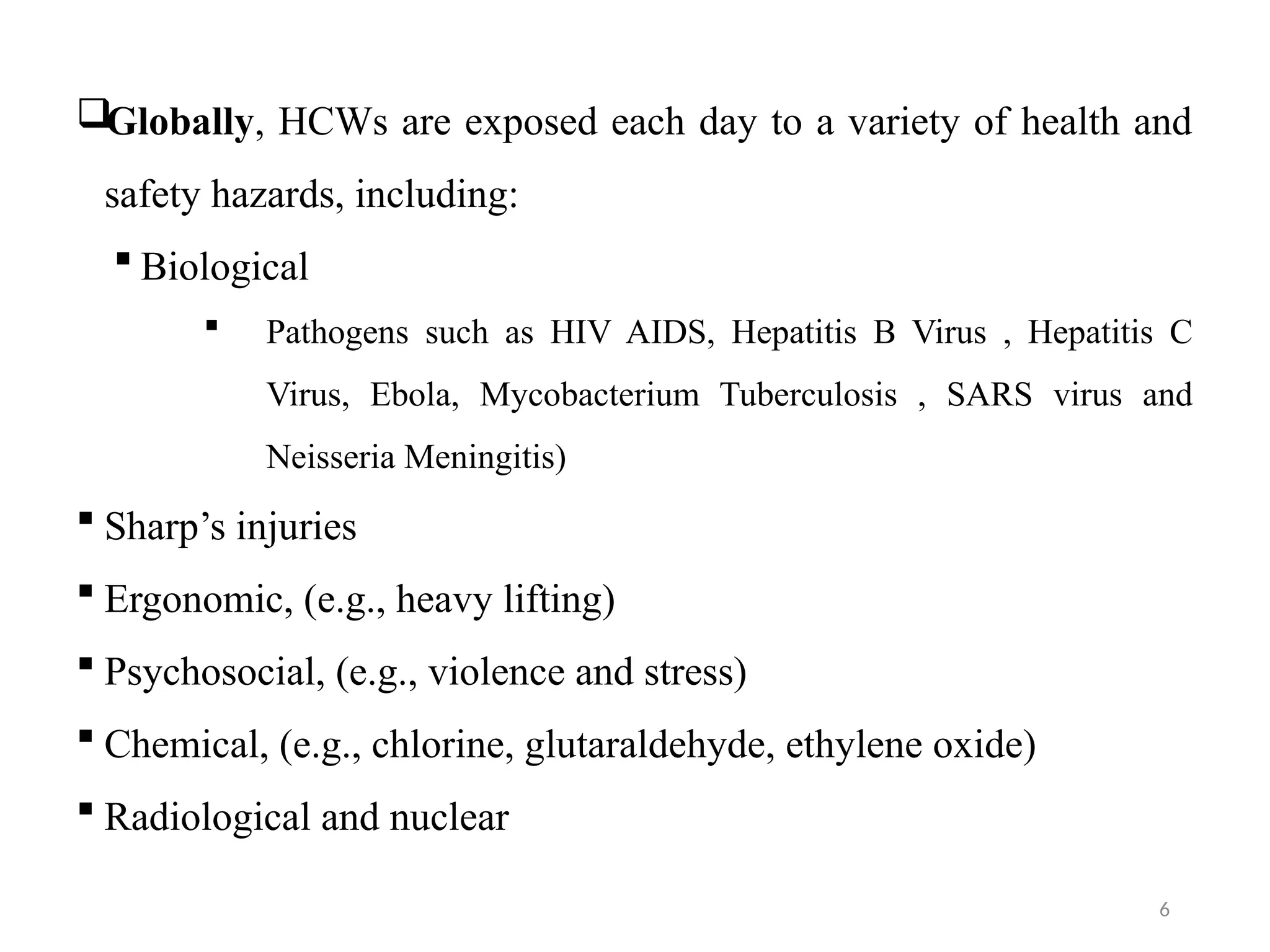
Globally, HCWs areexposed each day to a variety of health and
safety hazards, including:
Biological
Pathogens such as HIV AIDS, Hepatitis B Virus , Hepatitis C
Virus, Ebola, Mycobacterium Tuberculosis , SARS virus and
Neisseria Meningitis)
Sharp’s injuries
Ergonomic, (e.g., heavy lifting)
Psychosocial, (e.g., violence and stress)
Chemical, (e.g., chlorine, glutaraldehyde, ethylene oxide)
Radiological and nuclear
7.
7
The risk tostaff arises from
From sharps and hollow needles
Splashing of conjunctivae and mucous membranes
with contaminated blood
Heavy contamination of broken skin, e g. cuts,
dermatitis etc.
Handling of large quantities of blood and body fluids
without protective clothing.
8.
8
The risk topatients arises from:
use of recycled hollow needles and
syringes
contaminated blood transfusion
heavy soiling of the environment
poor ward facilities and cleaning
9.
9
Applying Response toinfection risks
• Risk management is the process of making health
care safer for the patient, staff and visitors by
identifying hazards in the workplace and taking action
to minimize their harm wherever possible.
10.
10
There are anumber of steps in the risk
management process:
Identifying the hazard
Assessing the risks
Using control measures
Identifying a hazard
11.
11
• A hazardis anything with the potential to
cause harm to you, the patients, your co-
workers or visitors to the work area.
• Assessing the risks: It is important to assess
the risks associated with each hazard to
determine how it can be eliminated.
12.
12
Preparing Procedures forrisk control
Strategies for identifying risks vary.
Risk identification can be proactive or reactive.
The following contains information about
proactive and reactive strategies that can help
management and workers identify hazards that
present risks to health and safety.
13.
10/28/2025 Applying InfectionPrevention Techniques and
Workplace Occupational Health Safety (OHS)
13
• By integrating both proactive and reactive
strategies, organizations can work towards
creating safer work environments and
preventing future incidents.
14.
14
Proactive strategies
Aproactive strategy is one carried out to prevent an
accident or incident; for example, implementing
processes to identify hazards and risks.
Two examples are a job safety analysis (JSA) and an
audit.
A JSA contains information about how a job should
be carried out, types of risks and control measures.
15.
10/28/2025 Applying InfectionPrevention Techniques and
Workplace Occupational Health Safety (OHS)
15
Proactive strategies
• Providers should carry out regular internal audits
to check that the control measures for infection and
other risks are being implemented.
• External bodies such as state and territory (Work
Health and Safety ) WHS authorities can also carry
out audits to check that safety controls are
appropriate.
16.
10/28/2025 Applying InfectionPrevention Techniques and
Workplace Occupational Health Safety (OHS)
16
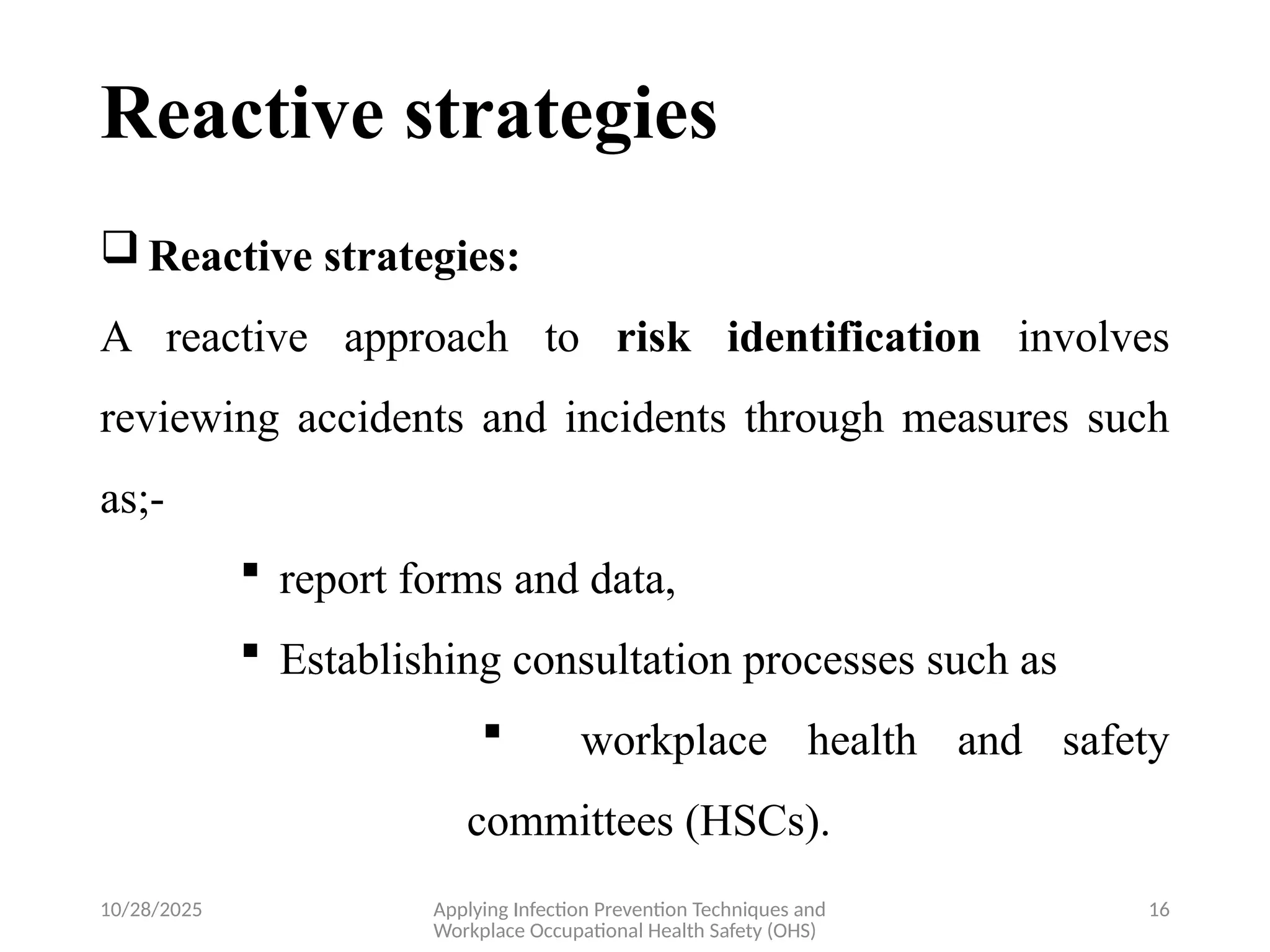
Reactive strategies
Reactive strategies:
A reactive approach to risk identification involves
reviewing accidents and incidents through measures such
as;-
report forms and data,
Establishing consultation processes such as
workplace health and safety
committees (HSCs).
17.
10/28/2025 Applying InfectionPrevention Techniques and
Workplace Occupational Health Safety (OHS)
17
Reactive strategies..
Incident and accident report forms are filled out after any
incident or accident
Data from these forms is used by HSCs, WHS officers
and managers to identify hazards
Committees, team meetings and other forums give staff
the chance to discuss infection control risks and provide
suggestions for policy and procedure improvements.
18.
10/28/2025 Applying InfectionPrevention Techniques and
Workplace Occupational Health Safety (OHS)
18
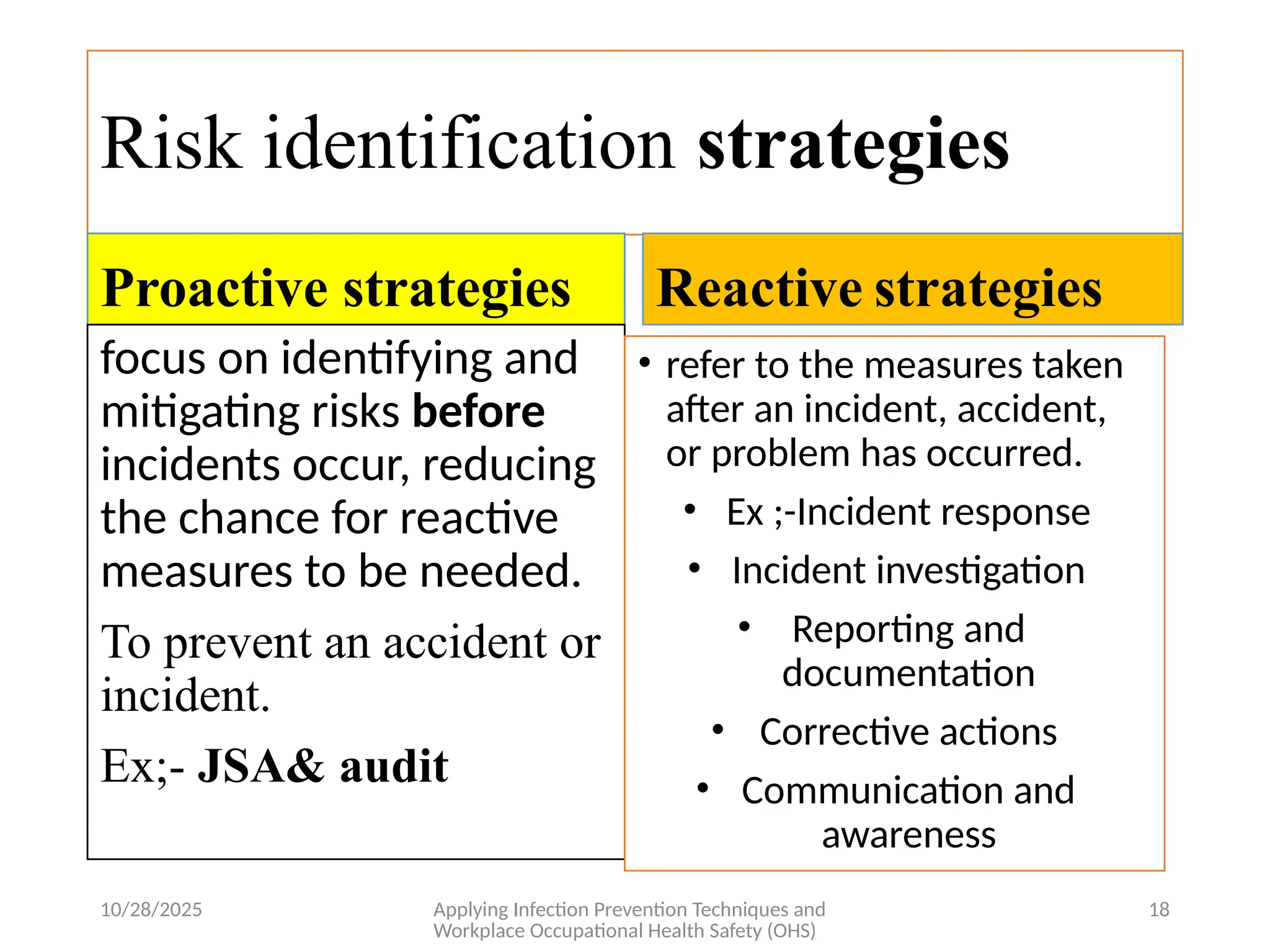
Risk identification strategies
Proactive strategies
focus on identifying and
mitigating risks before
incidents occur, reducing
the chance for reactive
measures to be needed.
To prevent an accident or
incident.
Ex;- JSA& audit
Reactive strategies
• refer to the measures taken
after an incident, accident,
or problem has occurred.
• Ex ;-Incident response
• Incident investigation
• Reporting and
documentation
• Corrective actions
• Communication and
awareness
19.
19
The five stepsin carrying out a risk assessment are shown here
1.Evaluate the likelihood of an injury or illness occurring and the
likely severity of any injury or illness
2.Review health and safety information relevant to the hazard such as
incident reports, SDSs, results of workplace monitoring and
inspections and supplier information
3.Identify factors that contribute to the risk such as the physical
layout of the workplace, the knowledge, skills and experience of
workers, and existing work practices
4.Identify actions necessary to eliminate or control the risk
5.Complete any relevant records.
20.
10/28/2025 Applying InfectionPrevention Techniques and
Workplace Occupational Health Safety (OHS)
20
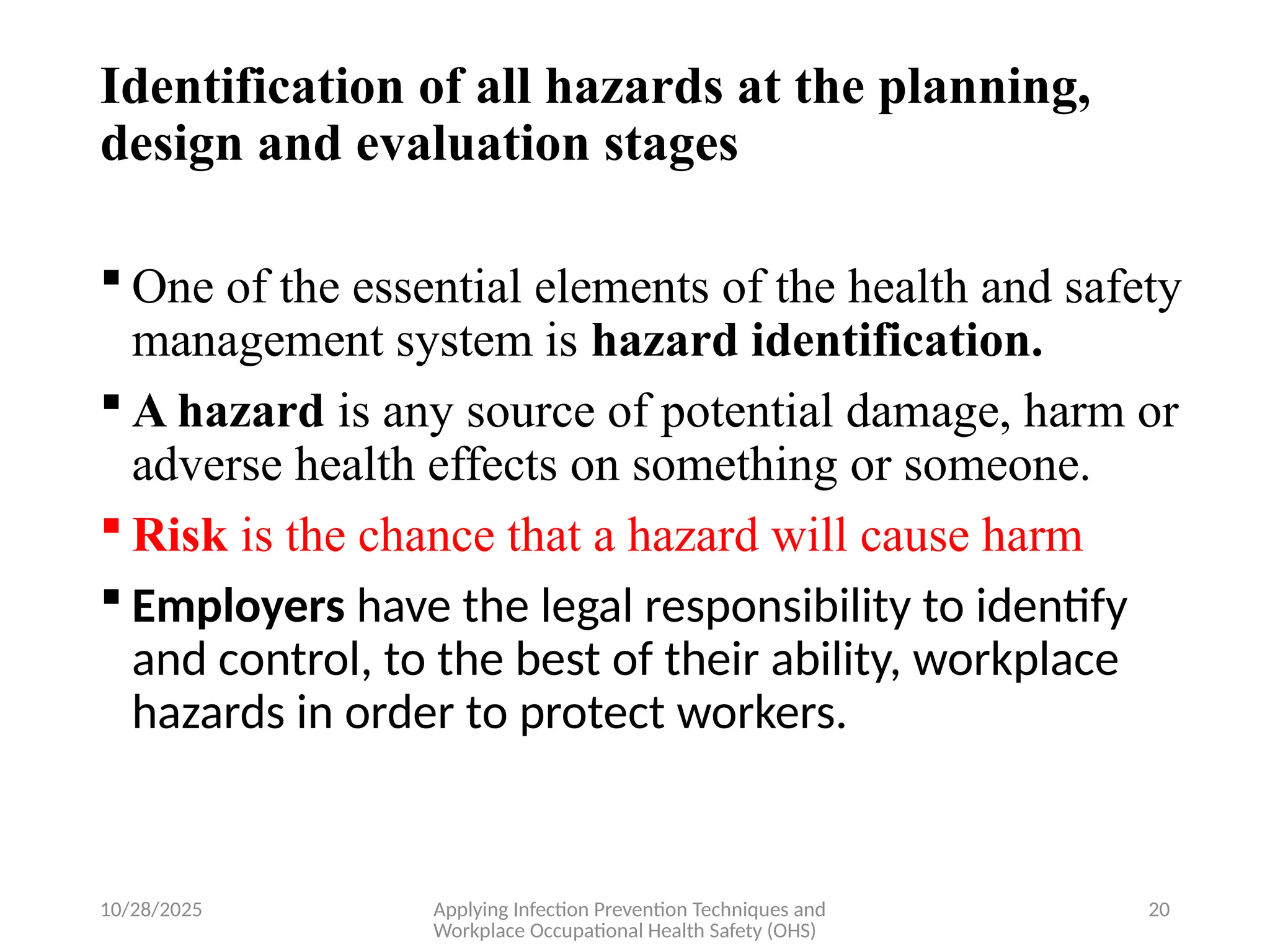
Identification of all hazards at the planning,
design and evaluation stages
One of the essential elements of the health and safety
management system is hazard identification.
A hazard is any source of potential damage, harm or
adverse health effects on something or someone.
Risk is the chance that a hazard will cause harm
Employers have the legal responsibility to identify
and control, to the best of their ability, workplace
hazards in order to protect workers.
21.
10/28/2025 Applying InfectionPrevention Techniques and
Workplace Occupational Health Safety (OHS)
21
Identification of all hazards at the planning,
design and evaluation stages..
• It is the responsibility of all workers to
understand
What a hazard is,
What the risk is,
How the hazards can affect people,
property, and the environment, and
How to prevent injury or illness from
that hazard.
22.
22
When to identifyhazards?
• Formal hazard assessments involving all workers
before start work.
• Informal hazard assessments that are ongoing and
often undocumented, which consists of continuously
scanning surroundings to be aware of condition
changes.
• Identification of hazard It is an on-going process.
23.
23
You can identifyhazards:
During design and implementation
Designing new process
Purchasing and installing new machinery
Before tasks are done
Using new equipment or processes
Each shift in hazardous environments
During work
Be aware of changes, abnormal conditions, or
sudden emissions
After incidents
Near misses or minor events
Injuries
24.
24
Employer responsibilities
An employerhas many responsibilities for hazard control under the
legislation.
These responsibilities include the following:
Identify, assess, and properly control workplace hazards.
Prepare a current list of known hazards in the workplace,
including chemical and biological substances, physical agents,
work design hazards, and any other risks.
Maintain hazard identification and control lists as part of the
health and safety management system.
25.
10/28/2025 Applying InfectionPrevention Techniques and
Workplace Occupational Health Safety (OHS)
25
Employer responsibilities..
Develop written safe work practices and procedures.
Inform workers about the hazards in the workplace.
Train workers with regard to hazard assessment and
required control measures to keep them safe at work.
Ensure that an emergency response plan is developed
for hazardous tasks.
26.
26
STEPS OF HAZARDIDENTIFICATION
Identify hazards
Assess the risk of the identified hazards using a risk
assessment methodology
Determine the appropriate controls
Implement controls to address identified hazards,
27.
10/28/2025 Applying InfectionPrevention Techniques and
Workplace Occupational Health Safety (OHS)
27
Activities that are considered to be
High Hazard Work include
Building construction
Drilling for gas, oil and
minerals
Service for gas and oil wells
and power tong service
Logging
Sawmilling
Iron and steel processing
and fabrication
Road construction,
earthwork, tunneling and
trenching
Local and provincial
hauling and trucking
Mining and smelting
Exploration drilling, shaft
sinking, quarrying and
crushing of rocks
Manufacturing of concrete
block, brick, artificial stone
and other clay and cement
products
Power line construction and
maintenance.
28.
28
Developing and maintaining
hazardrisk control measures
What Are Hazard Control Measures?
• Control measures include actions that reduce risk from
hazard exposure by removing the hazard or reducing
exposure to it.
• Control measures also include substituting less
hazardous materials, introducing physical barriers to
the hazard, changing work processes to limit hazard
exposure, and providing your workers with appropriate
personal protective equipment (PPE).
29.
29
Steps of HazardControl
The best way to prevent injuries or illness in your
workplace is to find the hazards that could cause injury or
illness, and fix them.
Do this by following four simple steps:
1. Spot the Hazard
2. Assess the Risk
3. Fix the Problem
4. Evaluate Results
30.
30
1.Spot the hazard
Ahazard is anything that has the potential to cause injury,
illness or damage to your health.
Hazards at work may include:
manual tasks
Untidy (Disorderly ) workplaces
Bullying (mistreatment) and violence
working at heights
faulty or unguarded machinery
chemicals
noise
poor work design (repetitive movements)
Inadequate management systems
31.
10/28/2025 Applying InfectionPrevention Techniques and
Workplace Occupational Health Safety (OHS)
31
2. Assess the Risk
It involves identifying potential hazards and
assessing the risks they pose to workers in
the workplace.
Risk assessment is a systematic process that
helps employers to identify, evaluate, and
prioritize risks to the health, safety, and
well-being of employees.
32.
32
3. Fix theproblem (Risk Control)
Some problems may be fixed easily and straight away,
while others will need more effort and planning.
Concentrate on the most urgent hazards without
neglecting the simpler ones that could be easily and
immediately fixed.
Some solutions are more effective than others
Make sure your solution does not introduce new
hazards.
33.
33
4. Evaluate theresults
Look at your incident records to see if numbers are going
down.
Make sure your solution does not introduce new hazards.
Choose a time frame appropriate to the task and the risk
involved
During each of these four steps, employers, managers,
contractors and workers need to communicate with
each other and work together.
Hazard management is not a one-off event — it’s an
ongoing process.
34.
34
Hierarchy of controls
•Usethe hierarchy of controls to remove or reduce risk
in your workplace
• It starts with the most effective control method
(removing the hazard from your workplace completely)
and finishes with the least effective (wearing personal
protective equipment/PPE)
35.
35
A.Eliminate the hazard
Remove it completely from your workplace.
For example: repair damaged equipment; outsource
processes involving hazardous chemicals or
equipment to a company set up to manage them
safely.
If this is not practical, then use the next one
36.
36
B. Substitute thehazard
Replace it with a safer alternative.
For example: use a less toxic chemical; lift smaller
packages.
If this is not practical, then use the next one
C. Isolate the hazard
Keep it away from workers as much as possible.
For example: relocate photocopiers to separate,
ventilated rooms; install barriers to restrict access to
37.
37
D. Use engineeringcontrols
Adapt tools or equipment to reduce the risk.
For example: place guards on dangerous parts of machinery;
use a trolley for moving heavy loads.
If this is not practical, then use the next
E. Use administrative controls
Change work practices and organization.
For example, rotate jobs to reduce the time spent on any
single work task; train staff in safe work procedures; carry out
routine maintenance of equipment.
If this is not practical, then use the next.
38.
10/28/2025 Applying InfectionPrevention Techniques and
Workplace Occupational Health Safety (OHS)
38
Hazard Hierarchy of controls
Implement controls to address identified hazards, focusing on hazards with the greatest risk first, and
considering: elimination/substitution, engineering, administrative (including safe work practices/procedures
and training),
39.
39
F. Use personalprotective equipment (PPE)
•For example: use hearing/eye protection equipment,
hard hats, gloves and masks; train staff to use PPE
correctly.
•Referee this video for control measure https://
youtu.be/oM-TjIvcgOU?t=12 ( show Video file)
Safety Management System_ Hazard Control Measures.
mp4
40.
40
Identifying inadequacies inexisting risk control
measures
Once your controls are implemented and employees
have been trained to the required level, evaluation
Are effective
Safe to follow
Are introduced safely
Are reviewed to ensure that all hazards are
identified
41.
10/28/2025 Applying InfectionPrevention Techniques and
Workplace Occupational Health Safety (OHS)
41
Identifying inadequacies in
existing risk control measures..
Have not been superseded with new work methods,
equipment or chemicals to make the process safe
have been clearly communicate and taught to the
workplace in terms of training and instruction
have been accurately understood so that workers are
identifying and minimizing risk Other than the control
measures that you put in place;
42.
42
Protocols for carefollowing exposure to
blood or other body fluids
• Definition: Blood borne Pathogen Exposure - a
percutaneous injury (e.g., a needle stick or cut with
a sharp object) or contact of mucous membrane or
non-intact skin (e.g., exposed skin that is chapped,
abraded, or afflicted with dermatitis) with blood,
tissue, or other body fluids that are potentially
infectious
• Health care workers (HCW) are at risk of acquiring
infection through occupational exposure.
43.
43
Types of Occupationalinjuries
Occupational injury may be divided into Three:
1. Percutaneous exposure (from needles, instruments, bone
fragments, human bite which penetrates the skin layer, etc.)
2. Exposure via broken skin (exposed skin that is chapped,
abraded, or afflicted with dermatitis etc.) with blood, tissue,
or other body fluids that are potentially infectious; and
3. Exposure via mucous membranes including the eye.
44.
44
Types of exposure
1.Percutaneous Injury
Puncture or laceration of the skin that penetrates into or
below the dermis.
For the purposes of this protocol, a percutaneous exposure to
blood/body fluids which has one or more of the following
factors present will be defined as a more severe exposure
Deep percutaneous injury.
45.
10/28/2025 Applying InfectionPrevention Techniques and
Workplace Occupational Health Safety (OHS)
45
Percutaneous Injury ..
Visible blood present on the device associated
with the exposure
Exposure from a procedure which involved a
needle placed directly into the Source’s vein or
artery
Large-bore hollow needle
46.
46
2. Mucous Membraneand Non-intact Skin
Exposures
Mucous Membrane Exposure: When blood/body
fluids come into contact with mucous membranes
(e.g., eyes, oral cavity)
Non-intact Skin Exposure: When blood/body fluids
come into contact with an open wound or exposed
skin that is chapped, abraded or non-intact because of
dermatitis
47.
47
•A larger volumeof blood/body fluid is associated with
increased transmission risk for mucous membrane and non-
intact skin exposures. (Open skin )
•For the purposes of this protocol, a mucous membrane or non-
intact skin exposure involving a major splash of blood/body
fluids will be defined as a large volume exposure.
•Exposures involving lesser amounts (e.g., only a few drops of
fluid) will be defined as a small volume exposure.
Mucous Membrane and Non-intact Skin
Exposures …
48.
48
3. Human Bites
•Humanbites may occur in both occupational and
non-occupational settings.
•The person bitten has a potential percutaneous
exposure and the person who was the biter has a
potential mucous membrane exposure.
•Therefore, an individual who bites may be both the
Source and Exposed in bite incidents.
49.
49
4. Consensual Sex(Sero-discordant Partners)
A sero-discordant Partners is a romantic or sexual
relationship where one person is living with HIV and the other
is not.
HBV and/or HIV PEP should be considered for the following
unprotected (e.g., condom breakage) sexual exposures where
the Source is known to be positive for the respective viruses.
The risk of a health care worker acquiring HIV after a needle
stick or other “sharps” injury is less than 0.5%.
50.
50
Risk reduction mustbe undertaken for all blood borne
pathogens, including:
Adherence to standard precautions using personal protective
equipment
Appropriate use of safety devices and a needle disposal system
to limit sharps exposure.
Training for health care workers in safe sharps practice should
be ongoing.
Information on preventive measures must be provided to all
staff with potential exposure to blood and blood products.
51.
51
Policies which arein keeping with the local
and national guidelines must include
screening of patients
disposal of sharps and wastes
protective clothing
managing inoculation accidents
sterilization and disinfection.
52.
52
•Post exposure prophylaxisshould be started as per local or
national guidelines.
• In case of hepatitis B, immunization is the best way of
preventing transmission to health care staff.
All HCWs at risk must be vaccinated.
Staff infected with blood-borne pathogens may transmit
these infections to patients and require careful evaluation
with respect to their duties.
This status should not be used as cause for discrimination
53.
53
Exposures for whichPEP is indicated
• Break in the skin by a sharp object (including hollow-
bore, solid-bore, and cutting needles or broken glassware)
that is contaminated with blood, visibly bloody fluid, or
other potentially infectious material, or sharp objects had
been in the source patient's blood vessel
Bite from a patient with visible bleeding (in the mouth)
and which causes bleeding in the exposed worker.
Splash of blood, visibly bloody fluid, or other potentially
infectious material to a mucosal surface (mouth, nose, or
eyes).
54.
10/28/2025 Applying InfectionPrevention Techniques and
Workplace Occupational Health Safety (OHS)
54
Exposures for which PEP is indicated
Remember!!
Health care workers should have immediate
access to post exposure prophylaxis (PEP) ,
24 hours a day,
7 days a week to be freely dispensed
by any hospital (private or public),
regardless of the location or type of work
they do.
55.
55
General procedures
First Aid
when an exposure incident occurs, implement first aid
Following any exposure, the wound should be washed
immediately and thoroughly with soap and water, flush the eyes
with running water immediately following a bodily fluid splash.
Alcohol, hydrogen peroxide, Betadine or other chemical
cleansers are best avoided. Wound should not be squeezed or
sucked.
56.
10/28/2025 Applying InfectionPrevention Techniques and
Workplace Occupational Health Safety (OHS)
56
General procedures…
For mucosal contact e.g. spillage into the conjunctivae,
the exposed area should be immediately flushed with
plenty of clean running water.
The exposed HCW is responsible for reporting the
exposure incident to his/her supervisor and should then
seek immediate medical advice for proper wound care
and post-exposure management.
57.
57
The following informationshould be recorded
in the exposed worker's confidential medical
record:
details about the source patient (e.g. name,
National Registration Identity Card (NRIC)
No, diagnosis and any relevant
information)
date, time and place of the exposure
details of the procedure being performed
use of protective equipment at the time of
the exposure
the type, severity, and amount of fluid to
which the worker was exposed.
58.
58
General procedures…
Reporting
All institutionsshould have a mechanism in place for reporting
and managing of sharp injuries and mucosal exposure in the
occupational setting.
HCWs must know the reporting process to facilitate quick and
smooth flow so as to allow the attending physician to evaluate
the risk of exposure and provide prompt appropriate post
exposure treatment.
59.
59
General procedures…
Counseling:
•Until the risk of infection is ruled out, advice
should be given to the exposed staff to refrain from
donating blood, plasma, organs, tissue or semen.
The use of condom during sexual intercourse should
also be advised.
60.
10/28/2025 Applying InfectionPrevention Techniques and
Workplace Occupational Health Safety (OHS)
60
Establish and maintain participative
arrangements
Unit 5
61.
10/28/2025 Applying InfectionPrevention Techniques and
Workplace Occupational Health Safety (OHS)
61
Occupational Health
and
Safety Regulations
62.
10/28/2025 Applying InfectionPrevention Techniques and
Workplace Occupational Health Safety (OHS)
62
Introduction
Occupational health and safety (OHS) refers to a
multidisciplinary field focused on promoting and
ensuring the well-being, health, and safety of workers
in various workplace settings.
It involves identifying and addressing potential
hazards, risks, and dangers that may arise during
work processes, with the goal of preventing
accidents, injuries, and occupational illnesses.
63.
10/28/2025 Applying InfectionPrevention Techniques and
Workplace Occupational Health Safety (OHS)
63
The primary objectives of occupational
health and safety include;
Occupational health and safety include;
• Risk Identification and Assessment:
• Hazard Control:
• Employee Education and Training:
• Accident and Incident Investigation.
• Compliance with Regulations:
• Health Promotion and Wellness:
• Risk Assessment
• Emergency Preparedness
• Ergonomics:
• Psychological Health and Safety:
64.
10/28/2025 Applying InfectionPrevention Techniques and
Workplace Occupational Health Safety (OHS)
64
OHS legislation
• OHS legislation refers to the set of laws,
regulations, and standards that govern occupational
health and safety practices in a particular authority.
• These laws are established by government
authorities and are designed to protect
workers from hazards, promote safe work
practices, and ensure a healthy and secure
working environment.
65.
10/28/2025 Applying InfectionPrevention Techniques and
Workplace Occupational Health Safety (OHS)
65
Occupational health and safety..
• Effective management of occupational health
and safety (OHS) in an organization involves a
systematic approach to identifying and addressing
workplace hazards, promoting a safety culture, and
ensuring compliance with relevant regulations.
66.
10/28/2025 Applying InfectionPrevention Techniques and
Workplace Occupational Health Safety (OHS)
66
Occupational health and safety..
• OHS regulations, is a set of rules and guidelines
established by regulatory bodies to ensure the
health, safety, and welfare of employees in the
workplace.
• These regulations aim to prevent work-related
injuries, illnesses, and accidents by setting
standards, promoting safe work practices, and
enforcing compliance.
67.
10/28/2025 Applying InfectionPrevention Techniques and
Workplace Occupational Health Safety (OHS)
67
Occupational health and safety..
• Here are some key factors for effective OHS
management:
•Leadership Commitment
•Safety Policies and Procedures
•Risk Assessment:
•Employee Engagement and Training
•Safety Inspections and Audits.
•Incident Reporting and Investigation
68.
10/28/2025 Applying InfectionPrevention Techniques and
Workplace Occupational Health Safety (OHS)
68
Participative arrangement
• The identification and assessment of hazards and risks
• Decisions regarding the control of risks
• Decisions regarding employees’ facilities
• Any changes proposed by the employer that may impact on
OHS
• Decisions regarding the policies and procedures for the
resolution of OHS issues, consultation processes for
monitoring activities for OHS purposes and for providing
information and training for OHS.
• Decisions regarding the membership of any OHS
committee.
69.
10/28/2025 Applying InfectionPrevention Techniques and
Workplace Occupational Health Safety (OHS)
69
Occupational health and safety..
• In the context of OHS legislation, employers need
to consult with employees via a process that
includes the following critical steps
•Information needs to be shared with
employees
•Employees must be given reasonable
time and opportunity to provide feedback
•Employers must take any feedback into
consideration
70.
10/28/2025 Applying InfectionPrevention Techniques and
Workplace Occupational Health Safety (OHS)
70
Occupational health and safety..
• OHS information can be provided by via regular
meetings, OHS committees, team briefings, and
other such employee forums.
• These may be supported by the production of OHS
communication packages and the availability of
information on an organization’s intranet.
71.
10/28/2025 Applying InfectionPrevention Techniques and
Workplace Occupational Health Safety (OHS)
71
Dealing with Issues of participation and
consultation
Generally, there are 7 main steps involved in issue
resolution:
1. Identify the issue and the problem or impact that is being
caused by the issue.
2. Agree on what is expected to happen to resolve the issue
3. Research and analyses the issue to determine its cause
4. Look for solutions to the issue and generate alternative
possible solutions
72.
10/28/2025 Applying InfectionPrevention Techniques and
Workplace Occupational Health Safety (OHS)
72
Dealing with Issues of
participation and consultation…
5. Evaluate the alternatives and determine the best
solution that will resolve the issue
6. Take action to implement the resolution
7. Monitor the outcome and results of the resolution
evaluate if the resolution has been effective and
successful.
73.
10/28/2025 Applying InfectionPrevention Techniques and
Workplace Occupational Health Safety (OHS)
73
Occupational health and safety..
• Processes of consultation form an integral part of
any organization’s approach to OHS.
• Consultation must enable a two-way process
• between the employer and the employees,
• and must acknowledge the diversity of employees
within the workplace (must consider any special
needs, language issues, disabilities, cultural
requirements, etc.).
74.
10/28/2025 Applying InfectionPrevention Techniques and
Workplace Occupational Health Safety (OHS)
74
Occupational health and safety..
• Employee Engagement
Participative arrangements and consultation are the
mechanisms that provide critical support for the
organization’s OHS system.
Encourage them to be more creative.
People may be inspired and feel empowered
to contribute ideas.
Enhance the effectiveness of the overall OHS
system.
75.
10/28/2025 Applying InfectionPrevention Techniques and
Workplace Occupational Health Safety (OHS)
75
Occupational health and safety..
• The participative arrangements and
consultation within the organization for OHS
need to be
• Recorded and documented via
• the production of meeting agendas
and minutes.
76.
10/28/2025 Applying InfectionPrevention Techniques and
Workplace Occupational Health Safety (OHS)
76
Occupational health and safety..
• Agendas for meetings need to detail the following
information:
Date, time and venue of the meeting
Expected attendees
Agenda items to be addressed and the time
of each topic
Nominee who will lead or present each
agenda item
Any preparation that attendees need to
complete prior to the meeting.
77.
10/28/2025 Applying InfectionPrevention Techniques and
Workplace Occupational Health Safety (OHS)
77
Occupational health and safety..
• The minutes of meetings need to detail the following
information:
Date, time and venue of the meeting
Chairperson details
Agenda items that were addressed
Details and outcomes of any discussions at the
meeting
Actions and timeframes associated with the
agenda items
Any attachments such as reports that were used
as reference in the meeting.
78.
10/28/2025 Applying InfectionPrevention Techniques and
Workplace Occupational Health Safety (OHS)
78
Occupational health and safety..
• The most appropriate and effective means of
communicating with their employees about OHS
Policies and procedures manuals
Organizational intranet information updates
Newsletters
Training sessions
Information flyers
Booklets
Regular team or department meetings.
79.
10/28/2025 Applying InfectionPrevention Techniques and
Workplace Occupational Health Safety (OHS)
79
Occupational health and safety..
OHS information can be provided by via
Regular meetings
OHS committees
Team briefings and other such employee forum
80.
10/28/2025 Applying InfectionPrevention Techniques and
Workplace Occupational Health Safety (OHS)
80
Establish and monitoring Systems for keeping
OHS records
Monitoring in the work place General principles:
Employers should monitor and record the exposure of
workers to hazardous chemicals to ensure their safety and
health.
Airborne concentrations of hazardous chemicals should be
measured ensure the safety and health of workers against
inhalation risks.
Estimate of the risk of exposure and to assess the existing
control measures.
The chemical safety data sheets; estimation of exposure
based on the method of work and work pattern.
81.
10/28/2025 Applying InfectionPrevention Techniques and
Workplace Occupational Health Safety (OHS)
81
Occupational health and safety..
• Measuring methods
• OHS Exposure sampling Methods
Personal Exposure measurement
Statics Environmental Exposure measurement
Example Air quality measurement
Range of concentrations above and below the
exposure limits or other exposure criteria in
accordance with published national or international
standards
82.
10/28/2025 Applying InfectionPrevention Techniques and
Workplace Occupational Health Safety (OHS)
82
Occupational health and safety..
• Personal monitoring
Personal monitoring should be used to evaluate
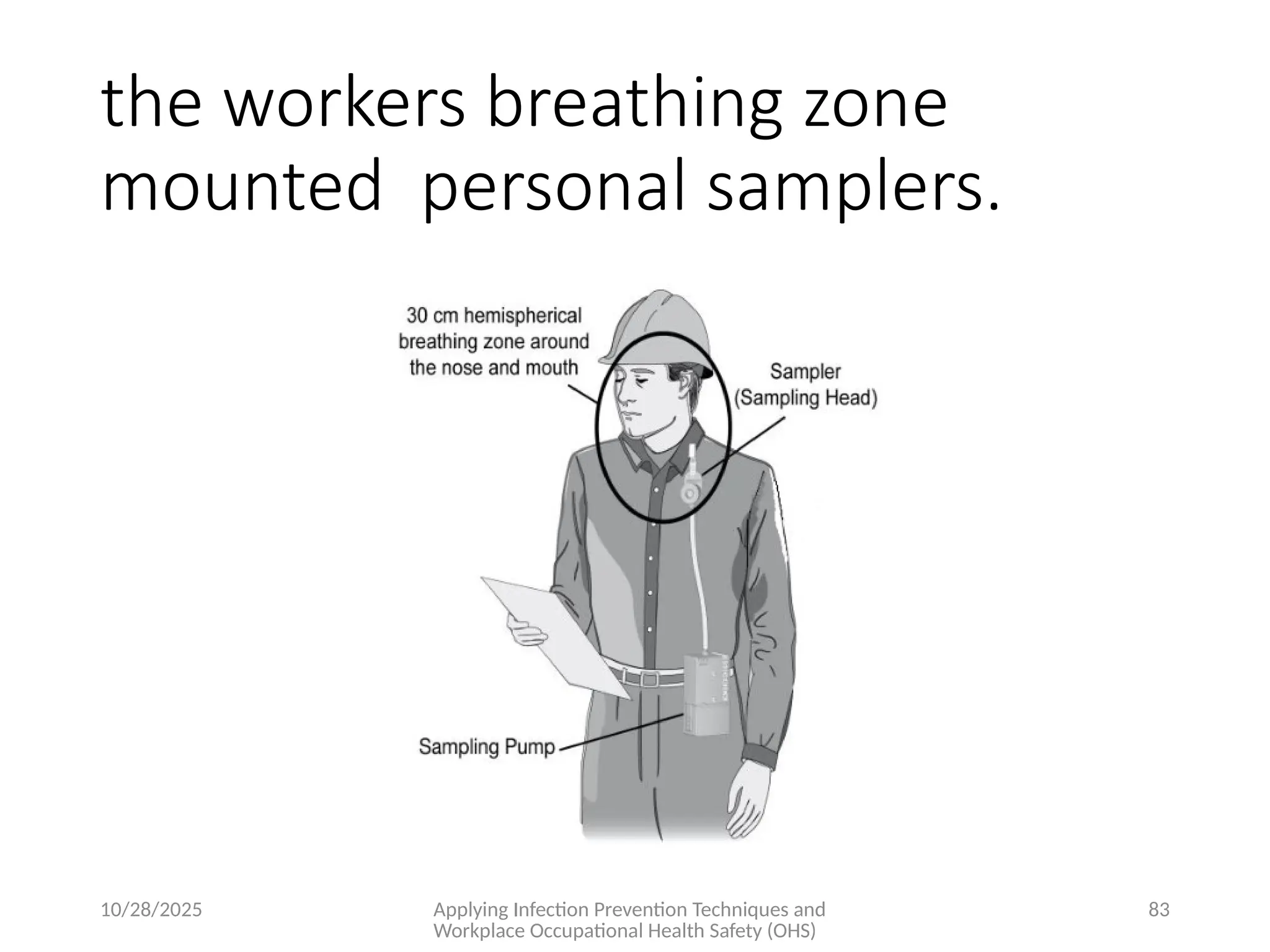
Air samples should be collected in the workers
breathing zone by means of personal samplers.
Sampling should be carried out while the work
activity is in operating.
Personal sampling should measure exposure, or
allow assessment of exposure throughout the
work shift.
83.
10/28/2025 Applying InfectionPrevention Techniques and
Workplace Occupational Health Safety (OHS)
83
the workers breathing zone
mounted personal samplers.
84.
10/28/2025 Applying InfectionPrevention Techniques and
Workplace Occupational Health Safety (OHS)
84
Occupational health and safety..
• The concentrations vary from one work operation
to another.
• The Exposure time
• The working hours.
• Type of work
85.
10/28/2025 Applying InfectionPrevention Techniques and
Workplace Occupational Health Safety (OHS)
85
Monitoring strategy
• The monitoring of airborne concentrations of
chemicals or Particulate matter done by
• by skilled personnel with adequate equipment and
technical training.
• regular inspection, maintenance and calibration of
the measuring equipment.
86.
10/28/2025 Applying InfectionPrevention Techniques and
Workplace Occupational Health Safety (OHS)
86
Record keeping
• Records should be kept by employers on measurements
of airborne hazardous chemicals.
• Personal sampling measurements, including the
exposures calculated, should be recorded.
• Numerical results of measurements, the monitoring data
will be recorded.
• Records should be kept for a period of time determined
by the competent authority.
• at least 30 years where the record is representative of the
personal exposures of identifiable employees
• At least five years in all other cases.
87.
10/28/2025 Applying InfectionPrevention Techniques and
Workplace Occupational Health Safety (OHS)
87
Thank You
THE END
Editor's Notes
#11 last alternative is to use some form of personal protection when exposed to the hazard.
#22 Documentation from this should be reviewed as conditions change
#42 visible blood- semen, vaginal secretions, cerebrospinal fluid, synovial fluid, pleural fluid, peritoneal fluid, pericardial fluid, and amniotic fluid are also considered potentially infectious
Urine or gastric contents without visible blood are not considered potentially infectious
#47 Non-intact skin: Areas of the skin that have been opened by cuts, abrasions, dermatitis, chapped skin, etc.
#49 It is important for healthcare providers to be aware of serodiscordant couples and to provide appropriate counseling and treatment options to prevent HIV transmission.
#53 Remember, Health care workers should have immediate access to post exposure prophylaxis (PEP) , 24 hours a day, 7 days a week to be freely dispensed by any hospital (private or public), regardless of the location or type of work they do.