HAZARD IDENTIFICATION AND RISK ASSESSMENT
2
CONTENTS
• Introduction
• Objective
• Scope
• Methodology
• Results and Discussions (include pictures if possible)
• References
3
INTRODUCTION
What is a HIRA?
A HIRA is a risk assessment tool that can be used to assess which
hazards pose the greatest risk in terms of how likely they are to
occur and how great their potential impact may be. It is not
intended to be used as a prediction tool to determine which hazard
will cause the next emergency.
4
OBJECTIVE
• Help you to prepare for the worst and/or most likely hazards.
• Save time by isolating any hazards which can not affect your
community.
• Allows for the creation of emergency plans, exercises and
training based on the most likely and/or highest risk scenarios.
• Helps your program to become proactive rather than just
reactive.
5
SCOPE
• HIRA leads to help in
• Increased productivity
• Avoiding injuries
• Avoiding costly, time consuming, stressful and inconvenient
incidents
6
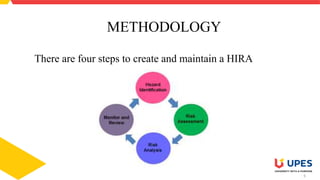
METHODOLOGY
There are four steps to create and maintain a HIRA
7
1. Hazard identification: Hazard has to be identified in
workplace using different assessment methods like
FMEA,FTA,ETA etc
Hazard are of two types
• Health hazard
• Safety hazard
2. Risk assessment: It is an integral part of risk management
consists of
• Identification
• Analysis- says about frequency, consequence,Risk matrix
• Evaluation- control selection;control effectiveness
8
3. Determining the control measure: Hirerachy of control measure
to reduce the impact of the hazard
• Elimination
• Substitution
• Isolation
• Segregation
• Engineering controls and administrative controls
• PPE
9
4. IMPLEMENTATION OF CONTROL MEASURE:
Implement the control measure that has determined.
5. MONITOR AND REVIEW:
It is important to remember that a HIRA is an ongoing process and
hazards and their associated risks must be monitored and reviewed
at least once per year.
10
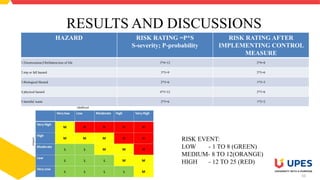
RESULTS AND DISCUSSIONS
HAZARD RISK RATING =P*S
S-severity; P-probability
RISK RATING AFTER
IMPLEMENTING CONTROL
MEASURE
1.Eloctrocution,Fibrillation,loss of life 3*4=12 2*4=8
2.trip or fall hazard 3*3=9 2*3=6
3.Biological Hazard 2*3=6 1*3=3
4.physical hazard 4*3=12 2*3=6
5.harmful waste 2*3=6 1*2=2
RISK EVENT:
LOW - 1 TO 8 (GREEN)
MEDIUM- 8 TO 12(ORANGE)
HIGH - 12 TO 25 (RED)
11
REFERENCES
• Emergency management Ontario,2012
• Occupational health safety association.
HIRA

HIRA

  • 1.
  • 2.
    2 CONTENTS • Introduction • Objective •Scope • Methodology • Results and Discussions (include pictures if possible) • References
  • 3.
    3 INTRODUCTION What is aHIRA? A HIRA is a risk assessment tool that can be used to assess which hazards pose the greatest risk in terms of how likely they are to occur and how great their potential impact may be. It is not intended to be used as a prediction tool to determine which hazard will cause the next emergency.
  • 4.
    4 OBJECTIVE • Help youto prepare for the worst and/or most likely hazards. • Save time by isolating any hazards which can not affect your community. • Allows for the creation of emergency plans, exercises and training based on the most likely and/or highest risk scenarios. • Helps your program to become proactive rather than just reactive.
  • 5.
    5 SCOPE • HIRA leadsto help in • Increased productivity • Avoiding injuries • Avoiding costly, time consuming, stressful and inconvenient incidents
  • 6.
    6 METHODOLOGY There are foursteps to create and maintain a HIRA
  • 7.
    7 1. Hazard identification:Hazard has to be identified in workplace using different assessment methods like FMEA,FTA,ETA etc Hazard are of two types • Health hazard • Safety hazard 2. Risk assessment: It is an integral part of risk management consists of • Identification • Analysis- says about frequency, consequence,Risk matrix • Evaluation- control selection;control effectiveness
  • 8.
    8 3. Determining thecontrol measure: Hirerachy of control measure to reduce the impact of the hazard • Elimination • Substitution • Isolation • Segregation • Engineering controls and administrative controls • PPE
  • 9.
    9 4. IMPLEMENTATION OFCONTROL MEASURE: Implement the control measure that has determined. 5. MONITOR AND REVIEW: It is important to remember that a HIRA is an ongoing process and hazards and their associated risks must be monitored and reviewed at least once per year.
  • 10.
    10 RESULTS AND DISCUSSIONS HAZARDRISK RATING =P*S S-severity; P-probability RISK RATING AFTER IMPLEMENTING CONTROL MEASURE 1.Eloctrocution,Fibrillation,loss of life 3*4=12 2*4=8 2.trip or fall hazard 3*3=9 2*3=6 3.Biological Hazard 2*3=6 1*3=3 4.physical hazard 4*3=12 2*3=6 5.harmful waste 2*3=6 1*2=2 RISK EVENT: LOW - 1 TO 8 (GREEN) MEDIUM- 8 TO 12(ORANGE) HIGH - 12 TO 25 (RED)
  • 11.
    11 REFERENCES • Emergency managementOntario,2012 • Occupational health safety association.