Industrial Hygiene
Compiled By : Vasant Oak
DGM – EHSS
What’s Up - 9987592242
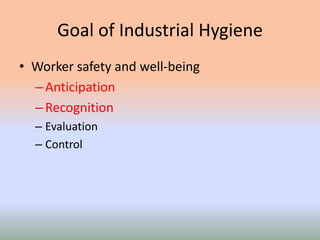
Goal of Industrial Hygiene
• Worker safety and well-being
–Anticipation
–Recognition
– Evaluation
– Control
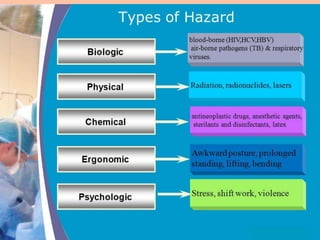
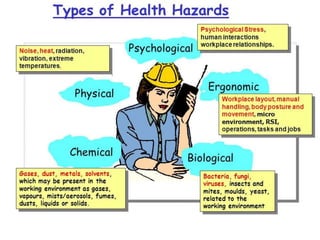
Workplace Hazards
• Chemical
• Physical
• Ergonomic
• Biological
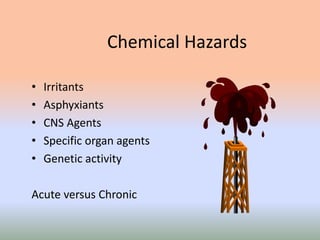
Chemical Hazards
• Irritants
• Asphyxiants
• CNS Agents
• Specific organ agents
• Genetic activity
Acute versus Chronic
Irritants
• Respiratory
• Skin
• Eye
Irritants
• Primary/Secondary
– Primary – at source of contact
– Secondary – travels through blood to another area
• Reversible/Irreversible
• Sensitization
– Irritant that has a delayed reaction on subsequent
exposure
Asphyxiants
• Simple Asphyxiants
– N2
– CO2
– He
– CH4
• Dilute air so oxygen
content is low
• Chemical Asphyxiants
– CO
– HCN
– H2S
• Interact at cellular level
to inhibit oxygen
uptake.
Central Nervous System Depressants
• Narcotics
• Anesthetics
• Depressants
CNS Depressants
• Aliphatic Hydrocarbons
– Increased chain length enhances effect
– Addition of an alcohol group (i.e. ethanol)
– Addition of a halide group enhances the effect
Specific Organ Attack
• May be reversible or irreversible
– Blood - Hemotoxic
– Liver – Hepatotoxic
– Lungs – Pulmonotoxic
– Kidneys – Nephrotoxic
– Skin – Dermatotoxic
– Nerves & Brain - Neurotoxic
Genetic Activity
• Typically is irreversible
– Causes cancer – Carcinogen
– Causes chromosome damage – Mutagen
– Causes birth defects – Teratogen
– Causes damage to reproductive system -
Reproductive Hazard
Anticipation of Chemical Hazards
• Consider the following:
– Raw materials
– Intermediates formed
– Final products
– Disposal of used products
– Maintenance materials
• “Cradle to Grave” thought process
Anticipation of Chemical Hazards
• Occupational Safety and Health Administration
(OSHA) has established Permissible Exposure limits
– They are defined in time weighted average, TWA, for most
working conditions. Short Term Exposure Limits, STEL, for
15 minute exposure. Ceiling, C, for maximum allowable
concentration.
• American Council of Government Industrial
Hygienists (ACGIH) has established Threshold Limit
Values, TLV.
Anticipation of Chemical Hazards
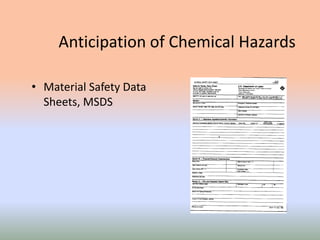
• Material Safety Data
Sheets, MSDS
Recognition of Chemical Hazards
• Odors
– Not all agents have detectable odor
• Frequent headaches
• Dermatitis
• Drowsiness
• Personality changes
• Clusters of problems
Workplace Hazards
• Chemical
• Physical
• Ergonomic
• Biological
Physical Hazards
• Dusts and Fibers
• Noise
• Corrosives
• Temperature Extremes
• Ionizing Radiation
• Non-Ionizing Radiation
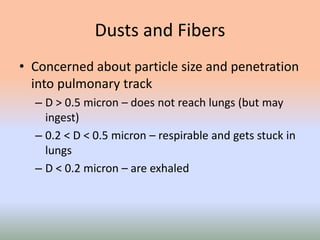
Dusts and Fibers
• Concerned about particle size and penetration
into pulmonary track
– D > 0.5 micron – does not reach lungs (but may
ingest)
– 0.2 < D < 0.5 micron – respirable and gets stuck in
lungs
– D < 0.2 micron – are exhaled
Noise Hazard Recognition
• Need to shout
• Ringing sensation
• Degraded hearing after work
• Auditory testing
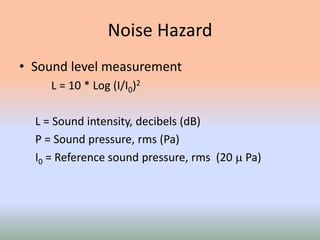
Noise Hazard
• Sound level measurement
L = 10 * Log (I/I0)2
L = Sound intensity, decibels (dB)
P = Sound pressure, rms (Pa)
I0 = Reference sound pressure, rms (20  Pa)
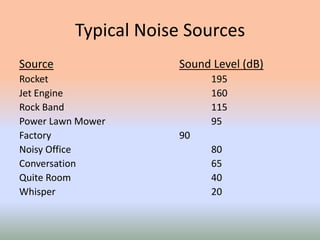
Typical Noise Sources
Source Sound Level (dB)
Rocket 195
Jet Engine 160
Rock Band 115
Power Lawn Mower 95
Factory 90
Noisy Office 80
Conversation 65
Quite Room 40
Whisper 20
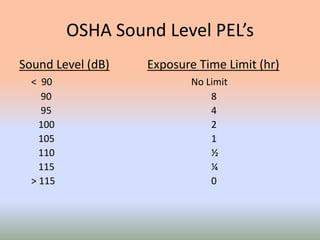
OSHA Sound Level PEL’s
Sound Level (dB) Exposure Time Limit (hr)
< 90 No Limit
90 8
95 4
100 2
105 1
110 ½
115 ¼
> 115 0
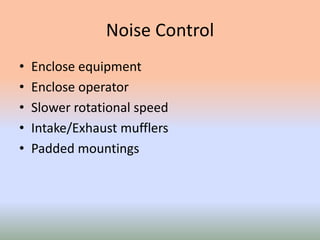
Noise Control
• Enclose equipment
• Enclose operator
• Slower rotational speed
• Intake/Exhaust mufflers
• Padded mountings
Corrosive Hazards
• Usually concerned with the affect of
corrosives on process equipment
• Concern for contact of workers with corrosives
– Usually involves necrosis, the death of local
tissue due to contact of agent
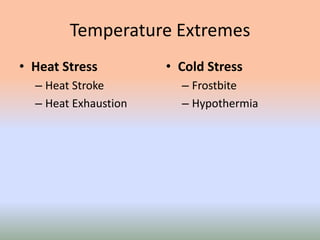
Temperature Extremes
• Heat Stress
– Heat Stroke
– Heat Exhaustion
• Cold Stress
– Frostbite
– Hypothermia
Heat Stress
• Body’s Energy Balance
– Metabolic rate
– Radiation
– Convection
– Sweating
• External Conditions
– Temperature
– Humidity
– Air movement
– Radiation
In a typical healthy individual the internal core body
temperature may rise as much as 3°C during heat stress
Cold Stress
• Less Common in Industrial Situations
– Cold climates
– Refrigerated space
– Wind chill
• Responses to Cold Stress
– Body core temperature is typically 37°C
– Shivering when body Tc < 36°C
– Lose Consciousness at Tc < 34°C
Temperature Stress Control
• Hot Stress
– Air movement
– Periodic rest
– Remove to cooler
location
• Cold Stress
– Limit exposure time
– Protective clothing
Ionizing Radiation
• Physical damage to cells
• Possible genetic damage
• Types of Radiation
– Alpha – emitted from nuclei of radioactive particles
– Beta – similar to  but with more penetrating (~ 1 cm)
– X-ray – produced from high speed electrons striking
material
– Gamma – originates from nucleus, produces burns
– Neutrons – emitted from disintegration of isotopes, very
penetrating
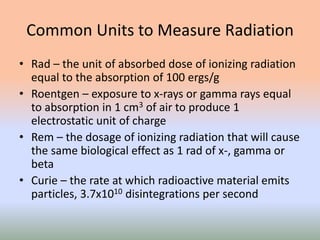
Common Units to Measure Radiation
• Rad – the unit of absorbed dose of ionizing radiation
equal to the absorption of 100 ergs/g
• Roentgen – exposure to x-rays or gamma rays equal
to absorption in 1 cm3 of air to produce 1
electrostatic unit of charge
• Rem – the dosage of ionizing radiation that will cause
the same biological effect as 1 rad of x-, gamma or
beta
• Curie – the rate at which radioactive material emits
particles, 3.7x10¹⁰ disintegrations per second
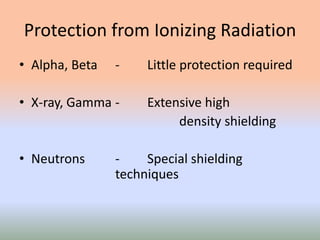
Protection from Ionizing Radiation
• Alpha, Beta - Little protection required
• X-ray, Gamma - Extensive high
density shielding
• Neutrons - Special shielding
techniques
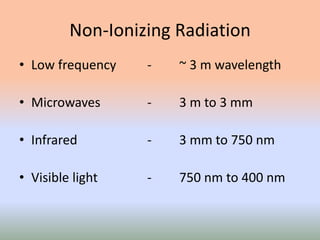
Non-Ionizing Radiation
• Low frequency - ~ 3 m wavelength
• Microwaves - 3 m to 3 mm
• Infrared - 3 mm to 750 nm
• Visible light - 750 nm to 400 nm
Non-Ionizing Radiation
• Ultraviolet Radiation
– UV-A 400 to 320 nm
• Harmful only to eyes, causes sun tan
– UV-B 320 to 280 nm
• Causes skin damage (sun burn), source arc welding
– UV-C 280 to 220 nm
• Severe damage, source germicidal lamps
Laser Light
• Especially dangerous for eyes
• Retinal burns
• Corneal burns
Workplace Hazards
• Chemical
• Physical
• Ergonomic
• Biological
Ergonomic Hazards
• Physiological Hazards
– Awkward movements
– Muscle strain
• Psychological Hazards
– Boredom
– Concentrated attention
– Simulated inputs
Ergonomic Hazards
• Increasing emphasis due to repetitive nature
of some industrial manufacturing jobs.
• Also with more operators working at
computers or workstations there are
ergonomic concerns.
Workplace Hazards
• Chemical
• Physical
• Ergonomic
• Biological
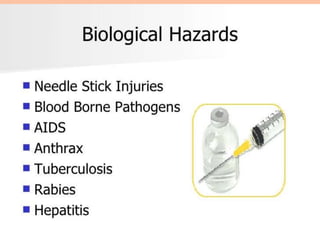
Biological Hazards
• Pathogenic organisms
– Five levels of classification
• 1 least dangerous
• 5 most dangerous
– Pathogenic organisms are typically not found in a chemical
processing facility
– Possible biological hazards in an industrial setting
• AIDS
• Hepatitis B
Biological Hazards
• Industries with possible biological hazards
– Pharmaceutical Manufacturing
– Food processing or agricultural products
• Typically hazards are well contained
Occupier’s Responsibility
• Be aware of industrial hazards and possible
effects.
• Design inherently safer systems that minimize
worker exposure to hazards.
• As a manager encourage proper safety
procedures and good housekeeping to
minimize employees exposure to hazardous
situations.
Let’s Do It… Together
Compiled By : Vasant Oak
DGM – EHSS
What’s Up - 9987592242

Industrial Hygiene

  • 1.
    Industrial Hygiene Compiled By: Vasant Oak DGM – EHSS What’s Up - 9987592242
  • 2.
    Goal of IndustrialHygiene • Worker safety and well-being –Anticipation –Recognition – Evaluation – Control
  • 4.
    Workplace Hazards • Chemical •Physical • Ergonomic • Biological
  • 6.
    Chemical Hazards • Irritants •Asphyxiants • CNS Agents • Specific organ agents • Genetic activity Acute versus Chronic
  • 7.
  • 8.
    Irritants • Primary/Secondary – Primary– at source of contact – Secondary – travels through blood to another area • Reversible/Irreversible • Sensitization – Irritant that has a delayed reaction on subsequent exposure
  • 9.
    Asphyxiants • Simple Asphyxiants –N2 – CO2 – He – CH4 • Dilute air so oxygen content is low • Chemical Asphyxiants – CO – HCN – H2S • Interact at cellular level to inhibit oxygen uptake.
  • 10.
    Central Nervous SystemDepressants • Narcotics • Anesthetics • Depressants
  • 11.
    CNS Depressants • AliphaticHydrocarbons – Increased chain length enhances effect – Addition of an alcohol group (i.e. ethanol) – Addition of a halide group enhances the effect
  • 12.
    Specific Organ Attack •May be reversible or irreversible – Blood - Hemotoxic – Liver – Hepatotoxic – Lungs – Pulmonotoxic – Kidneys – Nephrotoxic – Skin – Dermatotoxic – Nerves & Brain - Neurotoxic
  • 13.
    Genetic Activity • Typicallyis irreversible – Causes cancer – Carcinogen – Causes chromosome damage – Mutagen – Causes birth defects – Teratogen – Causes damage to reproductive system - Reproductive Hazard
  • 14.
    Anticipation of ChemicalHazards • Consider the following: – Raw materials – Intermediates formed – Final products – Disposal of used products – Maintenance materials • “Cradle to Grave” thought process
  • 15.
    Anticipation of ChemicalHazards • Occupational Safety and Health Administration (OSHA) has established Permissible Exposure limits – They are defined in time weighted average, TWA, for most working conditions. Short Term Exposure Limits, STEL, for 15 minute exposure. Ceiling, C, for maximum allowable concentration. • American Council of Government Industrial Hygienists (ACGIH) has established Threshold Limit Values, TLV.
  • 16.
    Anticipation of ChemicalHazards • Material Safety Data Sheets, MSDS
  • 17.
    Recognition of ChemicalHazards • Odors – Not all agents have detectable odor • Frequent headaches • Dermatitis • Drowsiness • Personality changes • Clusters of problems
  • 19.
    Workplace Hazards • Chemical •Physical • Ergonomic • Biological
  • 20.
    Physical Hazards • Dustsand Fibers • Noise • Corrosives • Temperature Extremes • Ionizing Radiation • Non-Ionizing Radiation
  • 21.
    Dusts and Fibers •Concerned about particle size and penetration into pulmonary track – D > 0.5 micron – does not reach lungs (but may ingest) – 0.2 < D < 0.5 micron – respirable and gets stuck in lungs – D < 0.2 micron – are exhaled
  • 22.
    Noise Hazard Recognition •Need to shout • Ringing sensation • Degraded hearing after work • Auditory testing
  • 23.
    Noise Hazard • Soundlevel measurement L = 10 * Log (I/I0)2 L = Sound intensity, decibels (dB) P = Sound pressure, rms (Pa) I0 = Reference sound pressure, rms (20  Pa)
  • 24.
    Typical Noise Sources SourceSound Level (dB) Rocket 195 Jet Engine 160 Rock Band 115 Power Lawn Mower 95 Factory 90 Noisy Office 80 Conversation 65 Quite Room 40 Whisper 20
  • 25.
    OSHA Sound LevelPEL’s Sound Level (dB) Exposure Time Limit (hr) < 90 No Limit 90 8 95 4 100 2 105 1 110 ½ 115 ¼ > 115 0
  • 26.
    Noise Control • Encloseequipment • Enclose operator • Slower rotational speed • Intake/Exhaust mufflers • Padded mountings
  • 27.
    Corrosive Hazards • Usuallyconcerned with the affect of corrosives on process equipment • Concern for contact of workers with corrosives – Usually involves necrosis, the death of local tissue due to contact of agent
  • 28.
    Temperature Extremes • HeatStress – Heat Stroke – Heat Exhaustion • Cold Stress – Frostbite – Hypothermia
  • 29.
    Heat Stress • Body’sEnergy Balance – Metabolic rate – Radiation – Convection – Sweating • External Conditions – Temperature – Humidity – Air movement – Radiation In a typical healthy individual the internal core body temperature may rise as much as 3°C during heat stress
  • 30.
    Cold Stress • LessCommon in Industrial Situations – Cold climates – Refrigerated space – Wind chill • Responses to Cold Stress – Body core temperature is typically 37°C – Shivering when body Tc < 36°C – Lose Consciousness at Tc < 34°C
  • 31.
    Temperature Stress Control •Hot Stress – Air movement – Periodic rest – Remove to cooler location • Cold Stress – Limit exposure time – Protective clothing
  • 32.
    Ionizing Radiation • Physicaldamage to cells • Possible genetic damage • Types of Radiation – Alpha – emitted from nuclei of radioactive particles – Beta – similar to  but with more penetrating (~ 1 cm) – X-ray – produced from high speed electrons striking material – Gamma – originates from nucleus, produces burns – Neutrons – emitted from disintegration of isotopes, very penetrating
  • 33.
    Common Units toMeasure Radiation • Rad – the unit of absorbed dose of ionizing radiation equal to the absorption of 100 ergs/g • Roentgen – exposure to x-rays or gamma rays equal to absorption in 1 cm3 of air to produce 1 electrostatic unit of charge • Rem – the dosage of ionizing radiation that will cause the same biological effect as 1 rad of x-, gamma or beta • Curie – the rate at which radioactive material emits particles, 3.7x10¹⁰ disintegrations per second
  • 34.
    Protection from IonizingRadiation • Alpha, Beta - Little protection required • X-ray, Gamma - Extensive high density shielding • Neutrons - Special shielding techniques
  • 35.
    Non-Ionizing Radiation • Lowfrequency - ~ 3 m wavelength • Microwaves - 3 m to 3 mm • Infrared - 3 mm to 750 nm • Visible light - 750 nm to 400 nm
  • 36.
    Non-Ionizing Radiation • UltravioletRadiation – UV-A 400 to 320 nm • Harmful only to eyes, causes sun tan – UV-B 320 to 280 nm • Causes skin damage (sun burn), source arc welding – UV-C 280 to 220 nm • Severe damage, source germicidal lamps
  • 37.
    Laser Light • Especiallydangerous for eyes • Retinal burns • Corneal burns
  • 38.
    Workplace Hazards • Chemical •Physical • Ergonomic • Biological
  • 39.
    Ergonomic Hazards • PhysiologicalHazards – Awkward movements – Muscle strain • Psychological Hazards – Boredom – Concentrated attention – Simulated inputs
  • 40.
    Ergonomic Hazards • Increasingemphasis due to repetitive nature of some industrial manufacturing jobs. • Also with more operators working at computers or workstations there are ergonomic concerns.
  • 41.
    Workplace Hazards • Chemical •Physical • Ergonomic • Biological
  • 42.
    Biological Hazards • Pathogenicorganisms – Five levels of classification • 1 least dangerous • 5 most dangerous – Pathogenic organisms are typically not found in a chemical processing facility – Possible biological hazards in an industrial setting • AIDS • Hepatitis B
  • 43.
    Biological Hazards • Industrieswith possible biological hazards – Pharmaceutical Manufacturing – Food processing or agricultural products • Typically hazards are well contained
  • 46.
    Occupier’s Responsibility • Beaware of industrial hazards and possible effects. • Design inherently safer systems that minimize worker exposure to hazards. • As a manager encourage proper safety procedures and good housekeeping to minimize employees exposure to hazardous situations.
  • 47.
    Let’s Do It…Together Compiled By : Vasant Oak DGM – EHSS What’s Up - 9987592242