Chapter 6 Work and Energy
Units of Chapter 6 Work Done by a Constant Force Kinetic Energy, and the Work-Energy Principle Potential Energy Conservative and Nonconservative Forces Mechanical Energy and Its Conservation Problem Solving Using Conservation of Mechanical Energy
Units of Chapter 6 Other Forms of Energy; Energy Transformations and the Law of Conservation of Energy Energy Conservation with Dissipative Forces: Solving Problems Power
So far :  Motion analysis with  forces . NOW :  An alternative analysis using the concepts of  Work & Energy .  Work :  Precisely defined in physics. Describes  what is accomplished  by a force in moving an object through a distance.
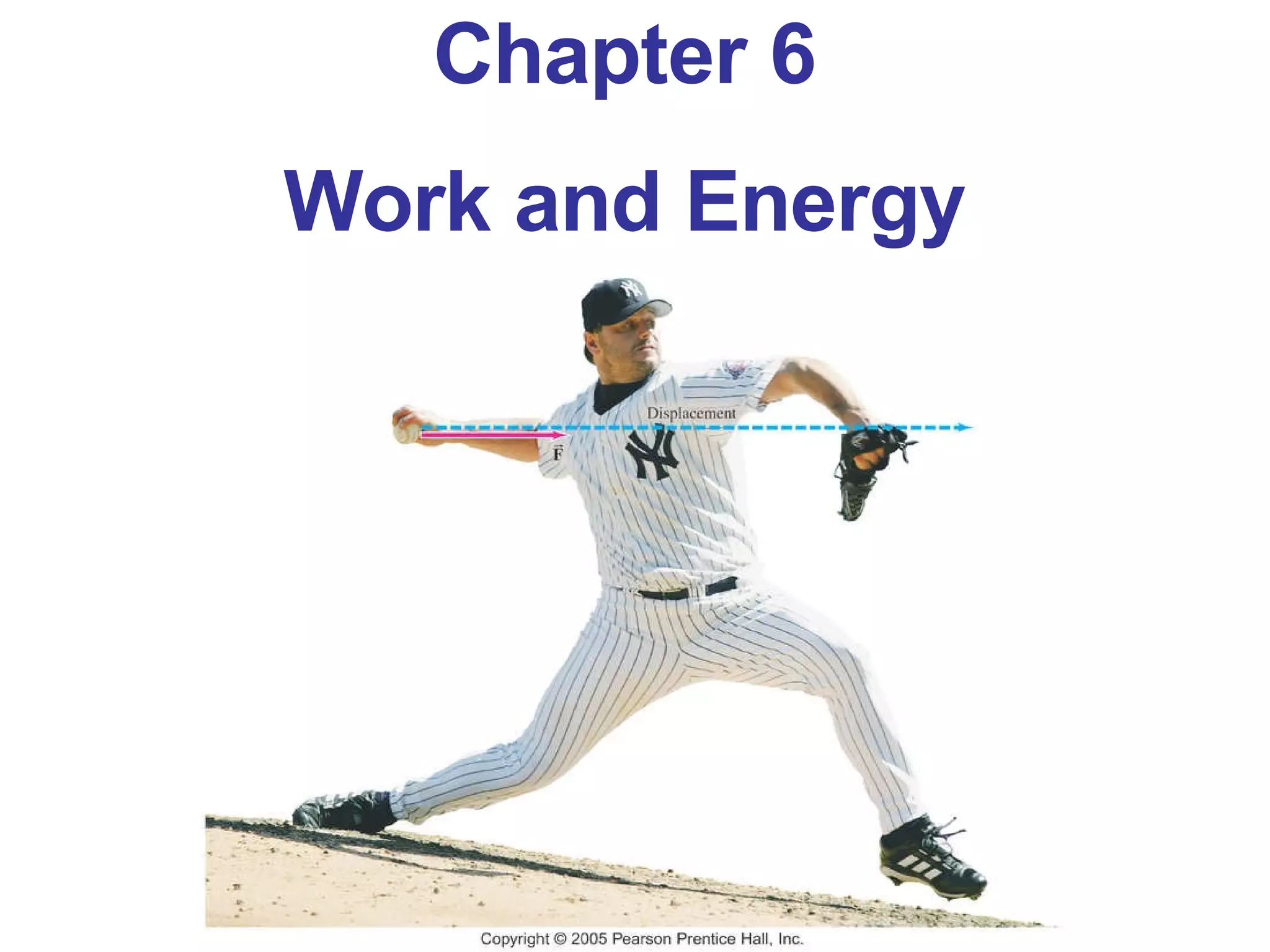
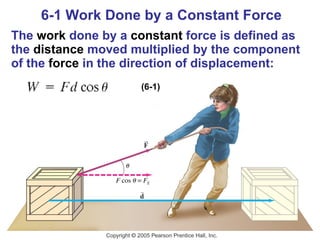
6-1 Work Done by a Constant Force The  work  done by a  constant  force is defined as the  distance  moved multiplied by the component of the  force  in the direction of displacement: (6-1)
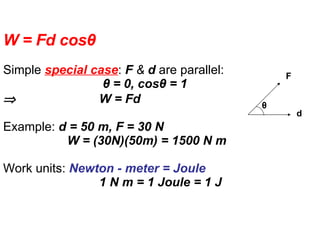
W = Fd cos θ Simple  special case :  F  &  d  are parallel:    θ  = 0, cos θ  = 1    W = Fd Example:  d = 50 m, F = 30 N W = (30N)(50m) = 1500 N m Work units:  Newton - meter = Joule   1 N m = 1 Joule = 1 J   θ F d
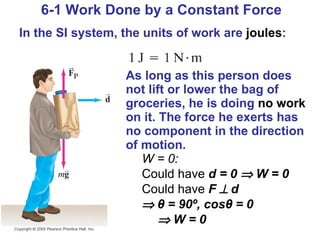
6-1 Work Done by a Constant Force In the SI system, the units of work are  joules : As long as this person does not lift or lower the bag of groceries, he is doing  no work  on it. The force he exerts has no component in the direction of motion. W = 0: Could have  d = 0    W = 0 Could have  F    d      θ  = 90º, cos θ  = 0     W = 0
6-1 Work Done by a Constant Force Solving work problems: Draw  a free-body diagram. Choose a  coordinate  system. Apply  Newton’s laws  to determine any unknown forces. Find the  work  done by a specific force. To find the  net work , either find  the  net force  and then find the work it  does, or find  the work done by each force and  add .
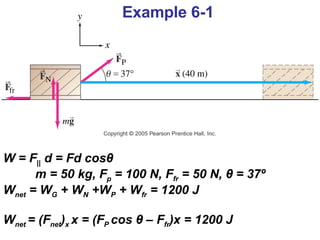
W = F ||  d = Fd cos θ m = 50 kg, F p  = 100 N, F fr  = 50 N,  θ  = 37º W net  = W G  + W N  +W P  + W fr  = 1200 J W net  = (F net ) x  x = (F P  cos  θ  – F fr )x = 1200 J Example 6-1
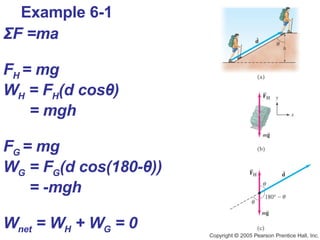
Example 6-1 Σ F =ma F H  = mg W H  = F H (d cos θ )   = mgh F G  = mg W G  = F G (d cos(180- θ ))   = -mgh W net  = W H  + W G  = 0
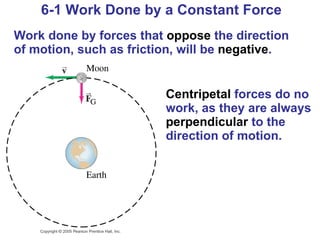
6-1 Work Done by a Constant Force Work done by forces that  oppose  the direction of motion, such as friction, will be  negative . Centripetal  forces do no work, as they are always  perpendicular  to the direction of motion.
6-3 Kinetic Energy, and the Work-Energy Principle Energy  was traditionally defined as the  ability to do work . We now know that not all forces are able to do work; however, we are dealing in these chapters with  mechanical  energy, which does follow this definition. Energy     The ability to do work Kinetic Energy      The energy of motion “ Kinetic”      Greek word for motion An object in motion has the ability to do work
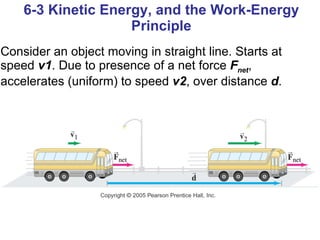
Consider an object moving in straight line. Starts at speed  v1 . Due to presence of a net force  F net , accelerates (uniform) to speed  v2 , over distance  d . 6-3 Kinetic Energy, and the Work-Energy Principle
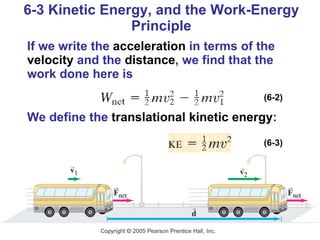
Newton’s 2nd Law:  F net = ma   (1) 1d motion, constant  a      (v 2 ) 2  = (v 1 ) 2  + 2ad   a = [(v 2 ) 2  - (v 1 ) 2 ]/(2d)     (2)   Work done:  W net  = F net d   (3) Combine (1), (2), (3):    W net  = mad = md [(v 2 ) 2  - (v 1 ) 2 ]/(2d)   OR  W net  =  (½)m(v 2 ) 2   –  (½)m(v 1 ) 2 6-3 Kinetic Energy, and the Work-Energy Principle
6-3 Kinetic Energy, and the Work-Energy Principle If we write the  acceleration  in terms of the  velocity  and the  distance , we find that the work done here is We define the  translational kinetic energy : (6-2) (6-3)
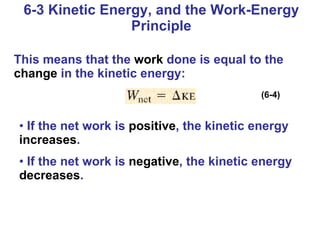
6-3 Kinetic Energy, and the Work-Energy Principle This means that the  work  done is equal to the  change  in the kinetic energy: If the net work is  positive , the kinetic energy  increases . If the net work is  negative , the kinetic energy  decreases . (6-4)
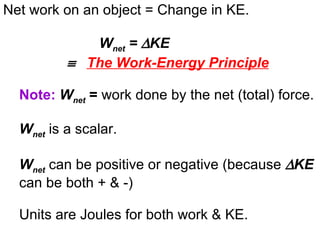
Net work on an object = Change in KE. W net  =   KE      The Work-Energy Principle Note:   W net  =  work done by the net (total) force. W net   is a scalar.  W net   can be positive or negative (because   KE   can be both + & -) Units are Joules for both work & KE.
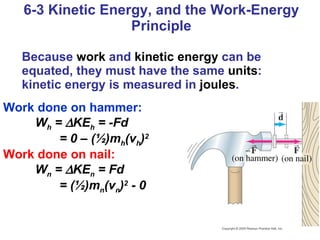
6-3 Kinetic Energy, and the Work-Energy Principle Because  work  and  kinetic energy  can be equated, they must have the same  units : kinetic energy is measured in  joules . Work done on hammer: W h  =   KE h  = -Fd   = 0 – (½)m h (v h ) 2   Work done on nail: W n  =   KE n  = Fd   = (½)m n (v n ) 2  - 0
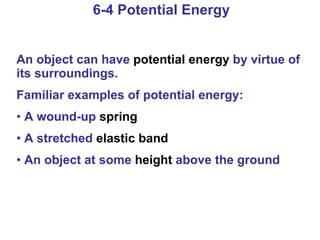
6-4 Potential Energy An object can have  potential energy  by virtue of its surroundings. Familiar examples of potential energy: A wound-up  spring A stretched  elastic band An object at some  height  above the ground
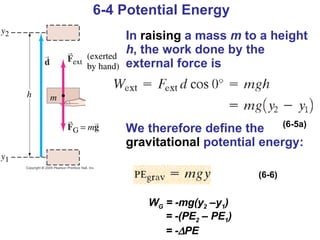
6-4 Potential Energy In  raising  a mass  m  to a height  h , the work done by the external force is We therefore define the  gravitational  potential energy: (6-5a) (6-6) W G  = -mg(y 2  –y 1 ) = -(PE 2  – PE 1 ) = -  PE
W ext  =   PE   The Work done by an external force to move the object of mass m from point 1 to point 2 (without acceleration) is equal to the change in potential energy between positions 1 and 2 W G  = -  PE 6-4 Potential Energy
6-4 Potential Energy This  potential  energy can become  kinetic  energy if the object is dropped. Potential energy is a property of a  system  as a whole, not just of the object (because it depends on external forces). If  , where do we  measure   y  from? It turns out not to matter, as long as we are  consistent  about where we choose  y  = 0. Only  changes  in potential energy can be measured.
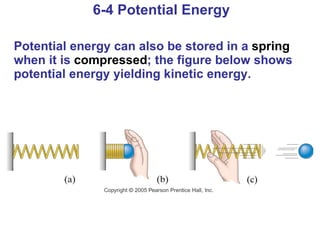
6-4 Potential Energy Potential energy can also be stored in a  spring  when it is  compressed ; the figure below shows potential energy yielding kinetic energy.
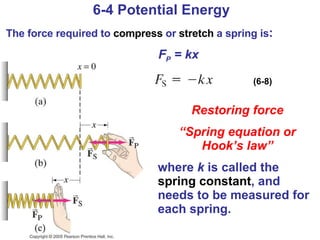
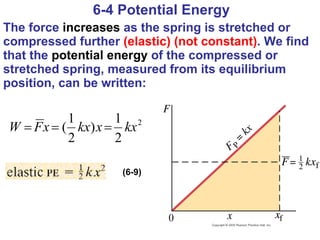
6-4 Potential Energy Restoring force “ Spring equation or Hook’s law” where  k  is called the  spring constant , and needs to be measured for each spring. (6-8) The force required to  compress  or  stretch  a spring is :   F P  = kx
6-4 Potential Energy The force  increases  as the spring is stretched or compressed further  (elastic) (not constant) . We find that the  potential energy  of the compressed or stretched spring, measured from its equilibrium position, can be written: (6-9)
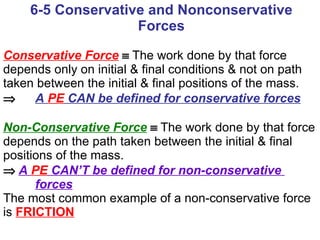
Conservative Force      The work done by that force depends only on initial & final conditions & not on path taken between the initial & final positions of the mass.    A  PE  CAN be defined for conservative forces Non-Conservative Force      The work done by that force depends on the path taken between the initial & final positions of the mass.    A  PE  CAN’T be defined for non-conservative  forces The most common example of a non-conservative force is  FRICTION 6-5 Conservative and Nonconservative Forces
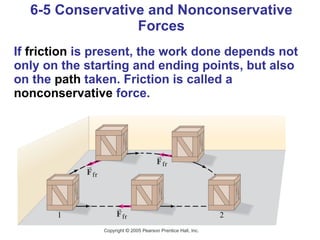
6-5 Conservative and Nonconservative Forces If  friction  is present, the work done depends not only on the starting and ending points, but also on the  path  taken. Friction is called a  nonconservative  force.
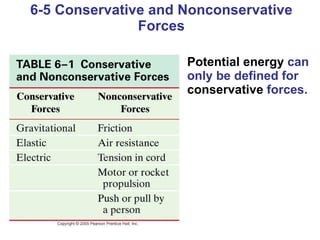
6-5 Conservative and Nonconservative Forces Potential energy  can only be defined for  conservative  forces.
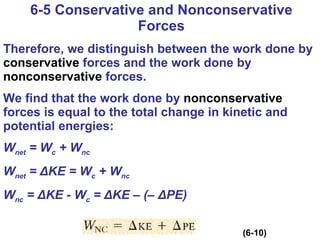
6-5 Conservative and Nonconservative Forces Therefore, we distinguish between the work done by  conservative  forces and the work done by  nonconservative  forces. We find that the work done by  nonconservative  forces is equal to the total change in kinetic and potential energies: W net  = W c  + W nc W net  =  Δ KE = W c  + W nc W nc  =  Δ KE - W c  =  Δ KE – (–  Δ PE)   (6-10)
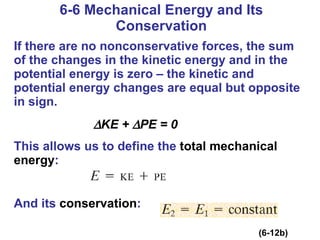
6-6 Mechanical Energy and Its Conservation If there are no nonconservative forces, the sum of the changes in the kinetic energy and in the potential energy is zero – the kinetic and potential energy changes are equal but opposite in sign.  KE +   PE = 0 This allows us to define the  total mechanical energy :   And its  conservation : (6-12b)
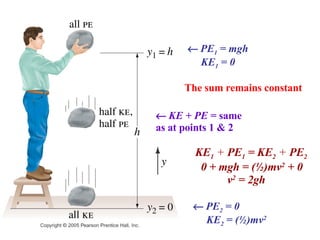
   PE 2  = 0 KE 2  = (½)mv 2   KE 1  +  PE 1  = KE 2  +  PE 2 0 + mgh = (½)mv 2   + 0 v 2  = 2gh    KE   + PE  = same  as at points 1 & 2 The sum remains constant    PE 1  = mgh KE 1  = 0
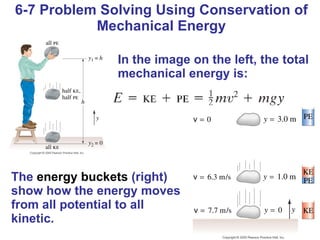
6-7 Problem Solving Using Conservation of Mechanical Energy In the image on the left, the total mechanical energy is:  The  energy buckets  (right) show how the energy moves from all potential to all kinetic.
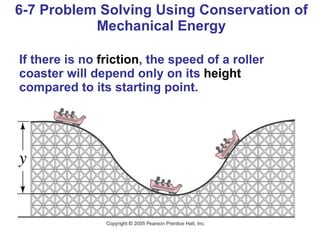
6-7 Problem Solving Using Conservation of Mechanical Energy If there is no  friction , the speed of a roller coaster will depend only on its  height  compared to its starting point.
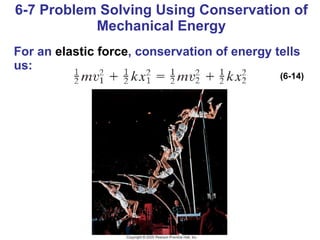
6-7 Problem Solving Using Conservation of Mechanical Energy For an  elastic force , conservation of energy tells us: (6-14)
6-8 Other Forms of Energy; Energy Transformations and the Conservation of Energy Some other forms of energy: Electric  energy,  nuclear  energy,  thermal  energy,  chemical  energy. Work  is done when energy is  transferred  from one object to another. Accounting for all forms of energy, we find that the total energy neither increases nor decreases.  Energy  as a whole is  conserved .
6-9 Energy Conservation with Dissipative Processes; Solving Problems If there is a  nonconservative  force such as friction, where do the kinetic and potential energies go? They become  heat ; the actual temperature rise of the materials involved can be calculated.
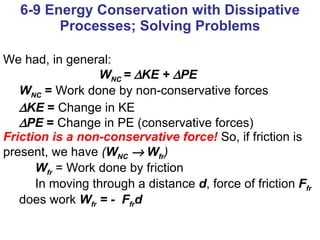
We had, in general: W NC  =   KE +   PE W NC  =  Work done by non-conservative forces  KE  =  Change in KE  PE  =  Change in PE (conservative forces) Friction is a non-conservative force!  So, if friction is present, we have  ( W NC     W fr )   W fr   = Work done by friction In moving through a distance  d , force of friction  F fr   does work  W fr  = -  F fr d   6-9 Energy Conservation with Dissipative Processes; Solving Problems
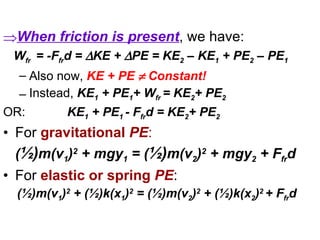
When friction is present , we have: W fr   = -F fr d =   KE +   PE = KE 2  – KE 1  + PE 2  – PE 1 Also now,  KE + PE    Constant! Instead,  KE 1  + PE 1 + W fr  = KE 2 + PE 2   OR:  KE 1  + PE 1  - F fr d = KE 2 + PE 2   For  gravitational  PE : ( ½) m(v 1 ) 2  + mgy 1  = ( ½) m(v 2 ) 2  + mgy 2  + F fr d   For  elastic or spring  PE :  (½)m(v 1 ) 2  + (½)k(x 1 ) 2  = (½)m(v 2 ) 2  + (½)k(x 2 ) 2  + F fr d
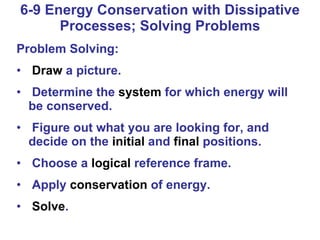
6-9 Energy Conservation with Dissipative Processes; Solving Problems Problem Solving: Draw  a picture. Determine the  system  for which energy will be conserved. Figure out what you are looking for, and decide on the  initial  and  final  positions. Choose a  logical  reference frame. Apply  conservation  of energy. Solve .
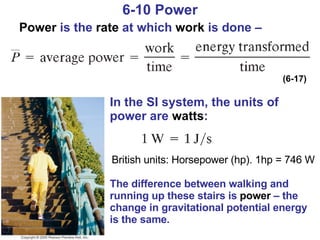
6-10 Power Power  is the  rate  at which  work  is done –  The difference between walking and running up these stairs is  power  – the change in gravitational potential energy is the same. (6-17) In the SI system, the units of power are  watts : British units: Horsepower (hp). 1hp = 746 W
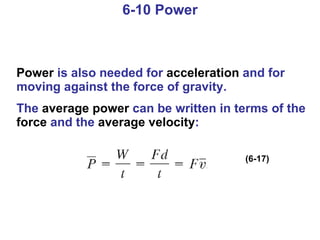
6-10 Power Power  is also needed for  acceleration  and for moving against the force of gravity. The  average power  can be written in terms of the  force  and the  average velocity : (6-17)
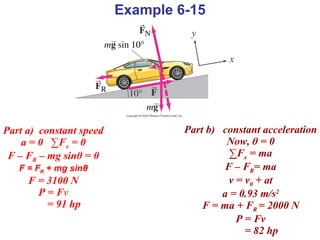
Part a)  constant speed a = 0  ∑F x  = 0 F – F R  – mg sin θ  = 0 F = F R  + mg sin θ F = 3100 N P = F v = 91 hp Part b)  constant acceleration Now,  θ  = 0 ∑ F x  = ma F – F R = ma v = v 0  + at a = 0.93 m/s 2 F = ma + F R  = 2000 N P = Fv = 82 hp Example 6-15
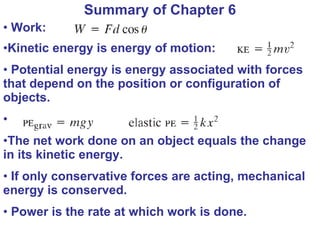
Summary of Chapter 6 Work:  Kinetic energy is energy of motion:  Potential energy is energy associated with forces that depend on the position or configuration of objects.  The net work done on an object equals the change in its kinetic energy. If only conservative forces are acting, mechanical energy is conserved. Power is the rate at which work is done.

Lecture Ch 06

  • 1.
    Chapter 6 Workand Energy
  • 2.
    Units of Chapter6 Work Done by a Constant Force Kinetic Energy, and the Work-Energy Principle Potential Energy Conservative and Nonconservative Forces Mechanical Energy and Its Conservation Problem Solving Using Conservation of Mechanical Energy
  • 3.
    Units of Chapter6 Other Forms of Energy; Energy Transformations and the Law of Conservation of Energy Energy Conservation with Dissipative Forces: Solving Problems Power
  • 4.
    So far : Motion analysis with forces . NOW : An alternative analysis using the concepts of Work & Energy . Work : Precisely defined in physics. Describes what is accomplished by a force in moving an object through a distance.
  • 5.
    6-1 Work Doneby a Constant Force The work done by a constant force is defined as the distance moved multiplied by the component of the force in the direction of displacement: (6-1)
  • 6.
    W = Fdcos θ Simple special case : F & d are parallel: θ = 0, cos θ = 1  W = Fd Example: d = 50 m, F = 30 N W = (30N)(50m) = 1500 N m Work units: Newton - meter = Joule 1 N m = 1 Joule = 1 J θ F d
  • 7.
    6-1 Work Doneby a Constant Force In the SI system, the units of work are joules : As long as this person does not lift or lower the bag of groceries, he is doing no work on it. The force he exerts has no component in the direction of motion. W = 0: Could have d = 0  W = 0 Could have F  d  θ = 90º, cos θ = 0  W = 0
  • 8.
    6-1 Work Doneby a Constant Force Solving work problems: Draw a free-body diagram. Choose a coordinate system. Apply Newton’s laws to determine any unknown forces. Find the work done by a specific force. To find the net work , either find the net force and then find the work it does, or find the work done by each force and add .
  • 9.
    W = F|| d = Fd cos θ m = 50 kg, F p = 100 N, F fr = 50 N, θ = 37º W net = W G + W N +W P + W fr = 1200 J W net = (F net ) x x = (F P cos θ – F fr )x = 1200 J Example 6-1
  • 10.
    Example 6-1 ΣF =ma F H = mg W H = F H (d cos θ ) = mgh F G = mg W G = F G (d cos(180- θ )) = -mgh W net = W H + W G = 0
  • 11.
    6-1 Work Doneby a Constant Force Work done by forces that oppose the direction of motion, such as friction, will be negative . Centripetal forces do no work, as they are always perpendicular to the direction of motion.
  • 12.
    6-3 Kinetic Energy,and the Work-Energy Principle Energy was traditionally defined as the ability to do work . We now know that not all forces are able to do work; however, we are dealing in these chapters with mechanical energy, which does follow this definition. Energy  The ability to do work Kinetic Energy  The energy of motion “ Kinetic”  Greek word for motion An object in motion has the ability to do work
  • 13.
    Consider an objectmoving in straight line. Starts at speed v1 . Due to presence of a net force F net , accelerates (uniform) to speed v2 , over distance d . 6-3 Kinetic Energy, and the Work-Energy Principle
  • 14.
    Newton’s 2nd Law: F net = ma (1) 1d motion, constant a  (v 2 ) 2 = (v 1 ) 2 + 2ad  a = [(v 2 ) 2 - (v 1 ) 2 ]/(2d) (2) Work done: W net = F net d (3) Combine (1), (2), (3):  W net = mad = md [(v 2 ) 2 - (v 1 ) 2 ]/(2d) OR W net = (½)m(v 2 ) 2 – (½)m(v 1 ) 2 6-3 Kinetic Energy, and the Work-Energy Principle
  • 15.
    6-3 Kinetic Energy,and the Work-Energy Principle If we write the acceleration in terms of the velocity and the distance , we find that the work done here is We define the translational kinetic energy : (6-2) (6-3)
  • 16.
    6-3 Kinetic Energy,and the Work-Energy Principle This means that the work done is equal to the change in the kinetic energy: If the net work is positive , the kinetic energy increases . If the net work is negative , the kinetic energy decreases . (6-4)
  • 17.
    Net work onan object = Change in KE. W net =  KE  The Work-Energy Principle Note: W net = work done by the net (total) force. W net is a scalar. W net can be positive or negative (because  KE can be both + & -) Units are Joules for both work & KE.
  • 18.
    6-3 Kinetic Energy,and the Work-Energy Principle Because work and kinetic energy can be equated, they must have the same units : kinetic energy is measured in joules . Work done on hammer: W h =  KE h = -Fd = 0 – (½)m h (v h ) 2 Work done on nail: W n =  KE n = Fd = (½)m n (v n ) 2 - 0
  • 19.
    6-4 Potential EnergyAn object can have potential energy by virtue of its surroundings. Familiar examples of potential energy: A wound-up spring A stretched elastic band An object at some height above the ground
  • 20.
    6-4 Potential EnergyIn raising a mass m to a height h , the work done by the external force is We therefore define the gravitational potential energy: (6-5a) (6-6) W G = -mg(y 2 –y 1 ) = -(PE 2 – PE 1 ) = -  PE
  • 21.
    W ext =  PE The Work done by an external force to move the object of mass m from point 1 to point 2 (without acceleration) is equal to the change in potential energy between positions 1 and 2 W G = -  PE 6-4 Potential Energy
  • 22.
    6-4 Potential EnergyThis potential energy can become kinetic energy if the object is dropped. Potential energy is a property of a system as a whole, not just of the object (because it depends on external forces). If , where do we measure y from? It turns out not to matter, as long as we are consistent about where we choose y = 0. Only changes in potential energy can be measured.
  • 23.
    6-4 Potential EnergyPotential energy can also be stored in a spring when it is compressed ; the figure below shows potential energy yielding kinetic energy.
  • 24.
    6-4 Potential EnergyRestoring force “ Spring equation or Hook’s law” where k is called the spring constant , and needs to be measured for each spring. (6-8) The force required to compress or stretch a spring is : F P = kx
  • 25.
    6-4 Potential EnergyThe force increases as the spring is stretched or compressed further (elastic) (not constant) . We find that the potential energy of the compressed or stretched spring, measured from its equilibrium position, can be written: (6-9)
  • 26.
    Conservative Force  The work done by that force depends only on initial & final conditions & not on path taken between the initial & final positions of the mass.  A PE CAN be defined for conservative forces Non-Conservative Force  The work done by that force depends on the path taken between the initial & final positions of the mass.  A PE CAN’T be defined for non-conservative forces The most common example of a non-conservative force is FRICTION 6-5 Conservative and Nonconservative Forces
  • 27.
    6-5 Conservative andNonconservative Forces If friction is present, the work done depends not only on the starting and ending points, but also on the path taken. Friction is called a nonconservative force.
  • 28.
    6-5 Conservative andNonconservative Forces Potential energy can only be defined for conservative forces.
  • 29.
    6-5 Conservative andNonconservative Forces Therefore, we distinguish between the work done by conservative forces and the work done by nonconservative forces. We find that the work done by nonconservative forces is equal to the total change in kinetic and potential energies: W net = W c + W nc W net = Δ KE = W c + W nc W nc = Δ KE - W c = Δ KE – (– Δ PE) (6-10)
  • 30.
    6-6 Mechanical Energyand Its Conservation If there are no nonconservative forces, the sum of the changes in the kinetic energy and in the potential energy is zero – the kinetic and potential energy changes are equal but opposite in sign.  KE +  PE = 0 This allows us to define the total mechanical energy : And its conservation : (6-12b)
  • 31.
    PE 2 = 0 KE 2 = (½)mv 2 KE 1 + PE 1 = KE 2 + PE 2 0 + mgh = (½)mv 2 + 0 v 2 = 2gh  KE + PE = same as at points 1 & 2 The sum remains constant  PE 1 = mgh KE 1 = 0
  • 32.
    6-7 Problem SolvingUsing Conservation of Mechanical Energy In the image on the left, the total mechanical energy is: The energy buckets (right) show how the energy moves from all potential to all kinetic.
  • 33.
    6-7 Problem SolvingUsing Conservation of Mechanical Energy If there is no friction , the speed of a roller coaster will depend only on its height compared to its starting point.
  • 34.
    6-7 Problem SolvingUsing Conservation of Mechanical Energy For an elastic force , conservation of energy tells us: (6-14)
  • 35.
    6-8 Other Formsof Energy; Energy Transformations and the Conservation of Energy Some other forms of energy: Electric energy, nuclear energy, thermal energy, chemical energy. Work is done when energy is transferred from one object to another. Accounting for all forms of energy, we find that the total energy neither increases nor decreases. Energy as a whole is conserved .
  • 36.
    6-9 Energy Conservationwith Dissipative Processes; Solving Problems If there is a nonconservative force such as friction, where do the kinetic and potential energies go? They become heat ; the actual temperature rise of the materials involved can be calculated.
  • 37.
    We had, ingeneral: W NC =  KE +  PE W NC = Work done by non-conservative forces  KE = Change in KE  PE = Change in PE (conservative forces) Friction is a non-conservative force! So, if friction is present, we have ( W NC  W fr ) W fr = Work done by friction In moving through a distance d , force of friction F fr does work W fr = - F fr d 6-9 Energy Conservation with Dissipative Processes; Solving Problems
  • 38.
    When friction ispresent , we have: W fr = -F fr d =  KE +  PE = KE 2 – KE 1 + PE 2 – PE 1 Also now, KE + PE  Constant! Instead, KE 1 + PE 1 + W fr = KE 2 + PE 2 OR: KE 1 + PE 1 - F fr d = KE 2 + PE 2 For gravitational PE : ( ½) m(v 1 ) 2 + mgy 1 = ( ½) m(v 2 ) 2 + mgy 2 + F fr d For elastic or spring PE : (½)m(v 1 ) 2 + (½)k(x 1 ) 2 = (½)m(v 2 ) 2 + (½)k(x 2 ) 2 + F fr d
  • 39.
    6-9 Energy Conservationwith Dissipative Processes; Solving Problems Problem Solving: Draw a picture. Determine the system for which energy will be conserved. Figure out what you are looking for, and decide on the initial and final positions. Choose a logical reference frame. Apply conservation of energy. Solve .
  • 40.
    6-10 Power Power is the rate at which work is done – The difference between walking and running up these stairs is power – the change in gravitational potential energy is the same. (6-17) In the SI system, the units of power are watts : British units: Horsepower (hp). 1hp = 746 W
  • 41.
    6-10 Power Power is also needed for acceleration and for moving against the force of gravity. The average power can be written in terms of the force and the average velocity : (6-17)
  • 42.
    Part a) constant speed a = 0 ∑F x = 0 F – F R – mg sin θ = 0 F = F R + mg sin θ F = 3100 N P = F v = 91 hp Part b) constant acceleration Now, θ = 0 ∑ F x = ma F – F R = ma v = v 0 + at a = 0.93 m/s 2 F = ma + F R = 2000 N P = Fv = 82 hp Example 6-15
  • 43.
    Summary of Chapter6 Work: Kinetic energy is energy of motion: Potential energy is energy associated with forces that depend on the position or configuration of objects. The net work done on an object equals the change in its kinetic energy. If only conservative forces are acting, mechanical energy is conserved. Power is the rate at which work is done.