Harmonic Motion


   AP Physics C
Springs are like Waves and Circles
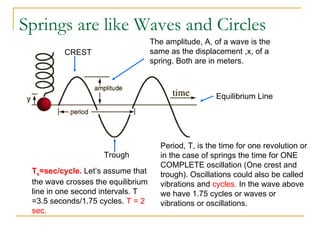
                                    The amplitude, A, of a wave is the
          CREST                     same as the displacement ,x, of a
                                    spring. Both are in meters.


                                                      Equilibrium Line


                                      Period, T, is the time for one revolution or
                    Trough            in the case of springs the time for ONE
                                      COMPLETE oscillation (One crest and
 Ts=sec/cycle. Let’s assume that      trough). Oscillations could also be called
 the wave crosses the equilibrium     vibrations and cycles. In the wave above
 line in one second intervals. T      we have 1.75 cycles or waves or
 =3.5 seconds/1.75 cycles. T = 2      vibrations or oscillations.
 sec.
Frequency
The FREQUENCY of a wave is the inverse of the
  PERIOD. That means that the frequency is the
  #cycles per sec. The commonly used unit is
  HERTZ(HZ).
                seconds    3.5s
  Period = T =           =       = 2s
                 cycles 1.75cyc
                     cycles 1.75cyc
  Frequency = f =          =         = 0.5 c = 0.5 Hz
                    seconds 3.5 sec         s
      1        1
  T=      f =
      f       T
Recall: Hooke’s Law
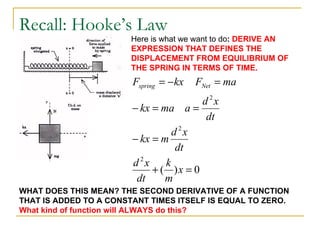
                        Here is what we want to do: DERIVE AN
                        EXPRESSION THAT DEFINES THE
                        DISPLACEMENT FROM EQUILIBRIUM OF
                        THE SPRING IN TERMS OF TIME.
                        Fspring = −kx   FNet = ma
                                        d 2x
                        − kx = ma a =
                                         dt
                                  d 2x
                        − kx = m
                                   dt
                        d 2x    k
                             + ( )x = 0
                         dt     m
WHAT DOES THIS MEAN? THE SECOND DERIVATIVE OF A FUNCTION
THAT IS ADDED TO A CONSTANT TIMES ITSELF IS EQUAL TO ZERO.
What kind of function will ALWAYS do this?
A SINE FUNCTION!
Putting it all together: The bottom line


                Since all springs exhibit properties of circle
                motion we can use these expressions to
                derive the formula for the period of a
                spring.
The simple pendulum
                               Fr sin θ = τ = Iα
                               − mg sin θ ( L) = (mL2 )α
                               − g sin θ = Lα       ifθ <<<, sin θ = θ
                                    g
                               α + ( )θ = 0                If the angle is small,
                                    L
                     mgcosθ
                                                           the “radian” value for
                 θ                   g      2π             theta and the sine of
                               ω=      , ω=
                                     L      T              the theta in degrees
           mg                                              will be equal.
                                                l
                      mgsinθ   Tpendulum = 2π
                                                g
A simple pendulum is one where a
mass is located at the end of string.
                                           Once again, using our sine function
The string’s length represents the
                                           model we can derive using circular
radius of a circle and has negligible
                                           motion equations the formula for the
mass.
                                           period of a pendulum.
The Physical Pendulum
                       A physical pendulum is an oscillating body that
                       rotates according to the location of its center of
                       mass rather than a simple pendulum where all the
                       mass is located at the end of a light string.
                                       Fr sin θ = τ = Iα
                                       − mg sin θd = Iα , d = L
                                                                     2
                                       − mgd = Iα        ifθ <<<, sin θ = θ
                                          mgd
                                       α +(    )θ = 0
                                           I
It is important to understand
that “d” is the lever arm                  mgd        2π
                                       ω=       , ω=
distance or the distance from                I        T
the COM position to the point of                                  I
rotation. It is also the same “d” in   Tphysical pendulum = 2π
                                                                 mgd
the Parallel Axes theorem.
Example
A spring is hanging from the ceiling. You know that if you
  elongate the spring by 3.0 meters, it will take 330 N of force
  to hold it at that position: The spring is then hung and a
  5.0-kg mass is attached. The system is allowed to reach
  equilibrium; then displaced an additional 1.5 meters and
  released. Calculate the:

  Spring Constant      Fs = kx 330 = (k )(3)
                      k=     110 N/m


                          k    k   110
  Angular frequency
                      ω =
                        2
                            ω=   =     =               4.7 rad/s
                          m    m    5
Example
A spring is hanging from the ceiling. You know that if you
  elongate the spring by 3.0 meters, it will take 330 N of
  force to hold it at that position: The spring is then hung
  and a 5.0-kg mass is attached. The system is allowed to
  reach equilibrium; then displaced an additional 1.5
  meters and released. Calculate the:

 Amplitude    Stated in the question as 1.5 m

                                      2π
                            ω = 2πf =
                                      T
 Frequency and Period            ω 4.7
                            f =     =    =      0.75 Hz
                                2π 2π
                                2π 2π
                            T=     =     =      1.34 s
                                ω 4.7
Example
A spring is hanging from the ceiling. You know that if you
  elongate the spring by 3.0 meters, it will take 330 N of
  force to hold it at that position: The spring is then hung
  and a 5.0-kg mass is attached. The system is allowed to
  reach equilibrium; then displaced an additional 1.5
  meters and released. Calculate the:
                      U s = 1 kx 2 = 1 kA2
   Total Energy              2        2
                      U = 1 (110)(1.5) 2 = 123.75 J
                            2
   Maximum velocity   v = Aω = (1.5)(4.7) =      7.05 m/s
Example
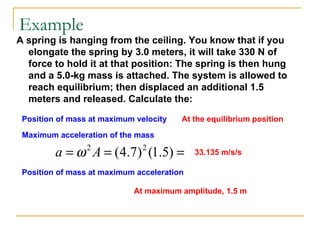
A spring is hanging from the ceiling. You know that if you
  elongate the spring by 3.0 meters, it will take 330 N of
  force to hold it at that position: The spring is then hung
  and a 5.0-kg mass is attached. The system is allowed to
  reach equilibrium; then displaced an additional 1.5
  meters and released. Calculate the:

 Position of mass at maximum velocity   At the equilibrium position

 Maximum acceleration of the mass

         a = ω 2 A = (4.7) 2 (1.5) =        33.135 m/s/s

 Position of mass at maximum acceleration

                            At maximum amplitude, 1.5 m

Simple Harmonic Motion

  • 1.
    Harmonic Motion AP Physics C
  • 2.
    Springs are likeWaves and Circles The amplitude, A, of a wave is the CREST same as the displacement ,x, of a spring. Both are in meters. Equilibrium Line Period, T, is the time for one revolution or Trough in the case of springs the time for ONE COMPLETE oscillation (One crest and Ts=sec/cycle. Let’s assume that trough). Oscillations could also be called the wave crosses the equilibrium vibrations and cycles. In the wave above line in one second intervals. T we have 1.75 cycles or waves or =3.5 seconds/1.75 cycles. T = 2 vibrations or oscillations. sec.
  • 3.
    Frequency The FREQUENCY ofa wave is the inverse of the PERIOD. That means that the frequency is the #cycles per sec. The commonly used unit is HERTZ(HZ). seconds 3.5s Period = T = = = 2s cycles 1.75cyc cycles 1.75cyc Frequency = f = = = 0.5 c = 0.5 Hz seconds 3.5 sec s 1 1 T= f = f T
  • 4.
    Recall: Hooke’s Law Here is what we want to do: DERIVE AN EXPRESSION THAT DEFINES THE DISPLACEMENT FROM EQUILIBRIUM OF THE SPRING IN TERMS OF TIME. Fspring = −kx FNet = ma d 2x − kx = ma a = dt d 2x − kx = m dt d 2x k + ( )x = 0 dt m WHAT DOES THIS MEAN? THE SECOND DERIVATIVE OF A FUNCTION THAT IS ADDED TO A CONSTANT TIMES ITSELF IS EQUAL TO ZERO. What kind of function will ALWAYS do this?
  • 5.
  • 6.
    Putting it alltogether: The bottom line Since all springs exhibit properties of circle motion we can use these expressions to derive the formula for the period of a spring.
  • 7.
    The simple pendulum Fr sin θ = τ = Iα − mg sin θ ( L) = (mL2 )α − g sin θ = Lα ifθ <<<, sin θ = θ g α + ( )θ = 0 If the angle is small, L mgcosθ the “radian” value for θ g 2π theta and the sine of ω= , ω= L T the theta in degrees mg will be equal. l mgsinθ Tpendulum = 2π g A simple pendulum is one where a mass is located at the end of string. Once again, using our sine function The string’s length represents the model we can derive using circular radius of a circle and has negligible motion equations the formula for the mass. period of a pendulum.
  • 8.
    The Physical Pendulum A physical pendulum is an oscillating body that rotates according to the location of its center of mass rather than a simple pendulum where all the mass is located at the end of a light string. Fr sin θ = τ = Iα − mg sin θd = Iα , d = L 2 − mgd = Iα ifθ <<<, sin θ = θ mgd α +( )θ = 0 I It is important to understand that “d” is the lever arm mgd 2π ω= , ω= distance or the distance from I T the COM position to the point of I rotation. It is also the same “d” in Tphysical pendulum = 2π mgd the Parallel Axes theorem.
  • 9.
    Example A spring ishanging from the ceiling. You know that if you elongate the spring by 3.0 meters, it will take 330 N of force to hold it at that position: The spring is then hung and a 5.0-kg mass is attached. The system is allowed to reach equilibrium; then displaced an additional 1.5 meters and released. Calculate the: Spring Constant Fs = kx 330 = (k )(3) k= 110 N/m k k 110 Angular frequency ω = 2 ω= = = 4.7 rad/s m m 5
  • 10.
    Example A spring ishanging from the ceiling. You know that if you elongate the spring by 3.0 meters, it will take 330 N of force to hold it at that position: The spring is then hung and a 5.0-kg mass is attached. The system is allowed to reach equilibrium; then displaced an additional 1.5 meters and released. Calculate the: Amplitude Stated in the question as 1.5 m 2π ω = 2πf = T Frequency and Period ω 4.7 f = = = 0.75 Hz 2π 2π 2π 2π T= = = 1.34 s ω 4.7
  • 11.
    Example A spring ishanging from the ceiling. You know that if you elongate the spring by 3.0 meters, it will take 330 N of force to hold it at that position: The spring is then hung and a 5.0-kg mass is attached. The system is allowed to reach equilibrium; then displaced an additional 1.5 meters and released. Calculate the: U s = 1 kx 2 = 1 kA2 Total Energy 2 2 U = 1 (110)(1.5) 2 = 123.75 J 2 Maximum velocity v = Aω = (1.5)(4.7) = 7.05 m/s
  • 12.
    Example A spring ishanging from the ceiling. You know that if you elongate the spring by 3.0 meters, it will take 330 N of force to hold it at that position: The spring is then hung and a 5.0-kg mass is attached. The system is allowed to reach equilibrium; then displaced an additional 1.5 meters and released. Calculate the: Position of mass at maximum velocity At the equilibrium position Maximum acceleration of the mass a = ω 2 A = (4.7) 2 (1.5) = 33.135 m/s/s Position of mass at maximum acceleration At maximum amplitude, 1.5 m