Work and
Energy
CHAPTER 6
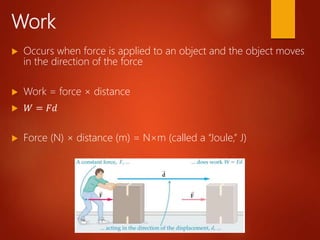
Work
 Occurs when force is applied to an object and the object moves
in the direction of the force
 Work = force × distance
 𝑊 = 𝐹𝑑
 Force (N) × distance (m) = N×m (called a “Joule,” J)
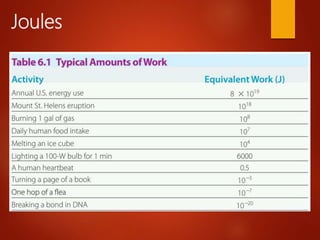
Joules
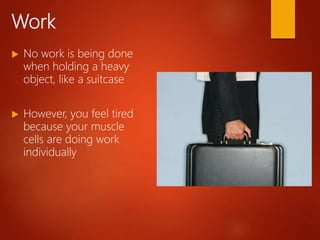
Work
 No work is being done
when holding a heavy
object, like a suitcase
 However, you feel tired
because your muscle
cells are doing work
individually
Work at an Angle
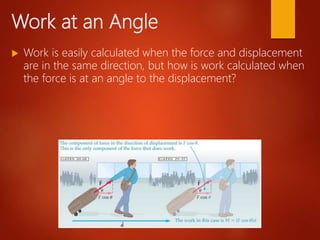
 Work is easily calculated when the force and displacement
are in the same direction, but how is work calculated when
the force is at an angle to the displacement?
Work at an Angle
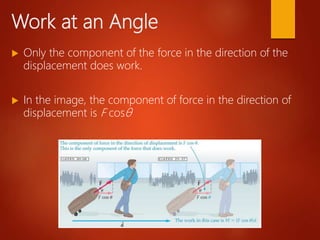
 Only the component of the force in the direction of the
displacement does work.
 In the image, the component of force in the direction of
displacement is F cosθ
Work
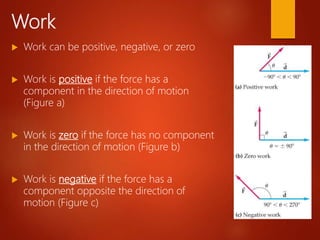
 Work can be positive, negative, or zero
 Work is positive if the force has a
component in the direction of motion
(Figure a)
 Work is zero if the force has no component
in the direction of motion (Figure b)
 Work is negative if the force has a
component opposite the direction of
motion (Figure c)
Work
 When more than
one force acts on
an object, the
total work is the
sum of the work
done by each
force separately
 Wtotal = W1 + W2
+ W3 + …
Work and Energy
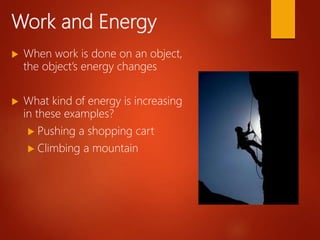
 When work is done on an object,
the object’s energy changes
 What kind of energy is increasing
in these examples?
 Pushing a shopping cart
 Climbing a mountain
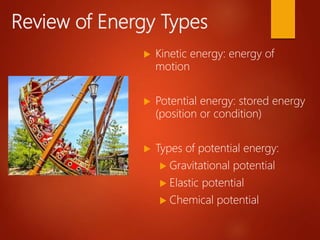
Review of Energy Types
 Kinetic energy: energy of
motion
 Potential energy: stored energy
(position or condition)
 Types of potential energy:
 Gravitational potential
 Elastic potential
 Chemical potential
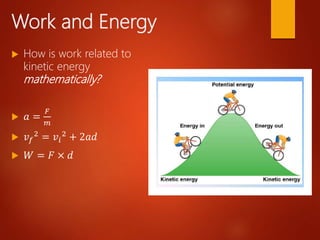
Work and Energy
 How is work related to
kinetic energy
mathematically?
 𝑎 =
𝐹
𝑚
 𝑣𝑓
2 = 𝑣𝑖
2 + 2𝑎𝑑
 𝑊 = 𝐹 × 𝑑
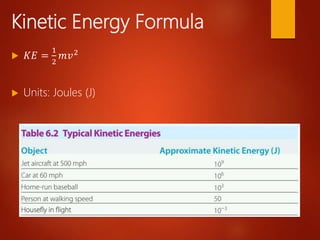
Kinetic Energy Formula
 𝐾𝐸 =
1
2
𝑚𝑣2
 Units: Joules (J)
Practice Problem
 Calculate the kinetic energy of a truck traveling at 6.0 m/s.
The truck has a mass of 3900 kg.
 What would happen to the amount of kinetic energy if the
truck doubled its speed to 12 m/s?
Work and Energy
 The total work done on an object equals the change in
that object’s kinetic energy.
 𝑊𝑡𝑜𝑡𝑎𝑙 = ∆𝐾𝐸
 𝑊𝑡𝑜𝑡𝑎𝑙 =
1
2
𝑚𝑣 𝑓
2 −
1
2
𝑚𝑣𝑖
2
 Example Problem: How much work is required for a
74-kg sprinter to accelerate from rest to a speed of 2.2
m/s?
 Is this work positive or negative?
Work and Energy
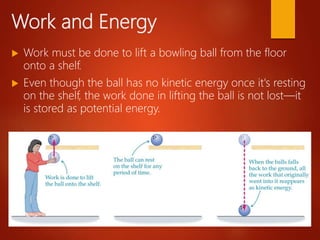
 Work must be done to lift a bowling ball from the floor
onto a shelf.
 Even though the ball has no kinetic energy once it's resting
on the shelf, the work done in lifting the ball is not lost—it
is stored as potential energy.
Work and Potential Energy
 Potential energy (PE) is stored for later
 Gravitational potential energy is stored in an object that is
at some height above the ground and has the potential to
fall
 Lifting a mass (m) from the ground to a height (h) requires
a force (ma or mg). Thus, the work done and potential
energy acquired equals FORCE x DISTANCE, or…
 𝑊 = 𝑚𝑔ℎ
Practice Problem
 Find the gravitational potential energy of a 65-kg person
standing on a diving board that is 3.0 meters high.
Conservation of Energy
 Law of Conservation of Energy states that energy can be
transformed from one form to another but never lost or
gained
 This concept is essential for solving many physics problems
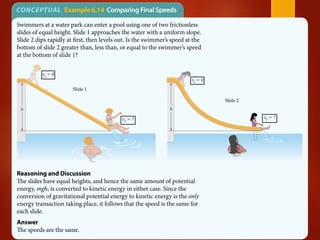
 NOTE: objects moving downward through the same
vertical distance but following different paths will have the
same final speed
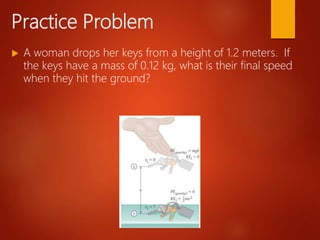
Practice Problem
 A woman drops her keys from a height of 1.2 meters. If
the keys have a mass of 0.12 kg, what is their final speed
when they hit the ground?
Power
 Doing the same amount of work in a shorter amount of
time takes more effort. Scientists refer to this effort as
POWER.
 𝑃 =
𝑊
𝑡
 Units:
𝐽
𝑠
or watts (W)
Power
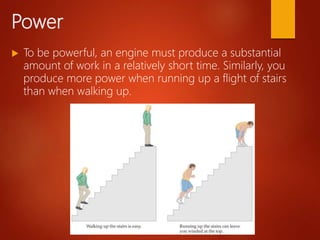
 To be powerful, an engine must produce a substantial
amount of work in a relatively short time. Similarly, you
produce more power when running up a flight of stairs
than when walking up.
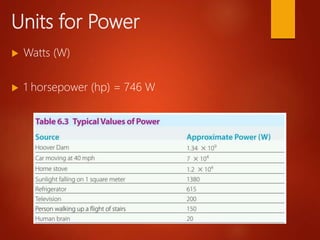
Units for Power
 Watts (W)
 1 horsepower (hp) = 746 W

Work and Energy

  • 1.
  • 2.
    Work  Occurs whenforce is applied to an object and the object moves in the direction of the force  Work = force × distance  𝑊 = 𝐹𝑑  Force (N) × distance (m) = N×m (called a “Joule,” J)
  • 3.
  • 4.
    Work  No workis being done when holding a heavy object, like a suitcase  However, you feel tired because your muscle cells are doing work individually
  • 5.
    Work at anAngle  Work is easily calculated when the force and displacement are in the same direction, but how is work calculated when the force is at an angle to the displacement?
  • 6.
    Work at anAngle  Only the component of the force in the direction of the displacement does work.  In the image, the component of force in the direction of displacement is F cosθ
  • 7.
    Work  Work canbe positive, negative, or zero  Work is positive if the force has a component in the direction of motion (Figure a)  Work is zero if the force has no component in the direction of motion (Figure b)  Work is negative if the force has a component opposite the direction of motion (Figure c)
  • 8.
    Work  When morethan one force acts on an object, the total work is the sum of the work done by each force separately  Wtotal = W1 + W2 + W3 + …
  • 9.
    Work and Energy When work is done on an object, the object’s energy changes  What kind of energy is increasing in these examples?  Pushing a shopping cart  Climbing a mountain
  • 10.
    Review of EnergyTypes  Kinetic energy: energy of motion  Potential energy: stored energy (position or condition)  Types of potential energy:  Gravitational potential  Elastic potential  Chemical potential
  • 11.
    Work and Energy How is work related to kinetic energy mathematically?  𝑎 = 𝐹 𝑚  𝑣𝑓 2 = 𝑣𝑖 2 + 2𝑎𝑑  𝑊 = 𝐹 × 𝑑
  • 12.
    Kinetic Energy Formula 𝐾𝐸 = 1 2 𝑚𝑣2  Units: Joules (J)
  • 13.
    Practice Problem  Calculatethe kinetic energy of a truck traveling at 6.0 m/s. The truck has a mass of 3900 kg.  What would happen to the amount of kinetic energy if the truck doubled its speed to 12 m/s?
  • 14.
    Work and Energy The total work done on an object equals the change in that object’s kinetic energy.  𝑊𝑡𝑜𝑡𝑎𝑙 = ∆𝐾𝐸  𝑊𝑡𝑜𝑡𝑎𝑙 = 1 2 𝑚𝑣 𝑓 2 − 1 2 𝑚𝑣𝑖 2  Example Problem: How much work is required for a 74-kg sprinter to accelerate from rest to a speed of 2.2 m/s?  Is this work positive or negative?
  • 15.
    Work and Energy Work must be done to lift a bowling ball from the floor onto a shelf.  Even though the ball has no kinetic energy once it's resting on the shelf, the work done in lifting the ball is not lost—it is stored as potential energy.
  • 16.
    Work and PotentialEnergy  Potential energy (PE) is stored for later  Gravitational potential energy is stored in an object that is at some height above the ground and has the potential to fall  Lifting a mass (m) from the ground to a height (h) requires a force (ma or mg). Thus, the work done and potential energy acquired equals FORCE x DISTANCE, or…  𝑊 = 𝑚𝑔ℎ
  • 17.
    Practice Problem  Findthe gravitational potential energy of a 65-kg person standing on a diving board that is 3.0 meters high.
  • 18.
    Conservation of Energy Law of Conservation of Energy states that energy can be transformed from one form to another but never lost or gained  This concept is essential for solving many physics problems  NOTE: objects moving downward through the same vertical distance but following different paths will have the same final speed
  • 19.
    Practice Problem  Awoman drops her keys from a height of 1.2 meters. If the keys have a mass of 0.12 kg, what is their final speed when they hit the ground?
  • 21.
    Power  Doing thesame amount of work in a shorter amount of time takes more effort. Scientists refer to this effort as POWER.  𝑃 = 𝑊 𝑡  Units: 𝐽 𝑠 or watts (W)
  • 22.
    Power  To bepowerful, an engine must produce a substantial amount of work in a relatively short time. Similarly, you produce more power when running up a flight of stairs than when walking up.
  • 23.
    Units for Power Watts (W)  1 horsepower (hp) = 746 W