Work better. Play together?!
     On Enterprise Gamification


       loveyourwork!           COLLABORATe!
                       FLOW!
Outline: on Enterprise Gamification

 Enterprise gamification is a hot new idea. !
 !
 Great potential for benefit (and misuse) !
 !
 Misconceptions create the risk of getting it wrong !
 !
 We share our lessons learned for making it work.
Games are having their moment in the limelight
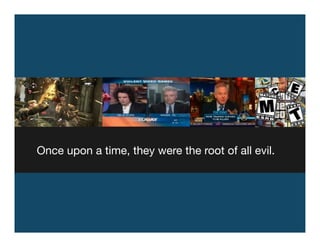
Once upon a time, they were the root of all evil.
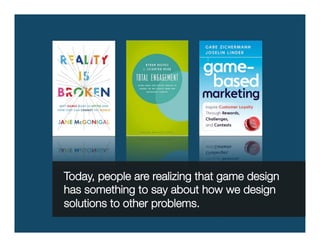
Today, people are realizing that game design
has something to say about how we design
solutions to other problems.
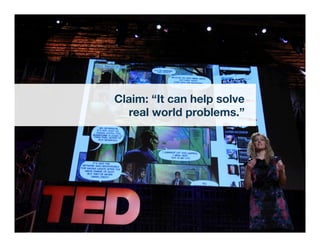
Claim: “It can help solve 
  real world problems.”
Claim: “It can drive employee motivation & performance”
Just add points & rewards (cash, tchotchke’s, whatever)…
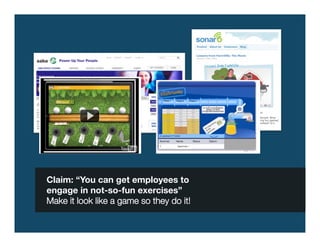
Claim: “You can get employees to 
engage in not-so-fun exercises”
Make it look like a game so they do it!
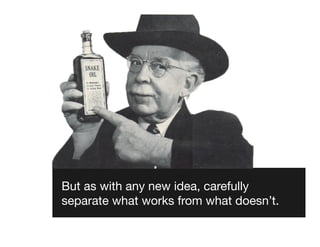
But as with any new idea, carefully
separate what works from what doesn’t.
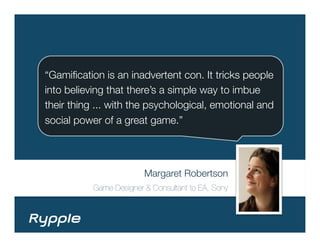
“Gamification is an inadvertent con. It tricks people
into believing that there’s a simple way to imbue
their thing ... with the psychological, emotional and
social power of a great game.”


                         Margaret Robertson 
           Game Designer & Consultant to EA, Sony
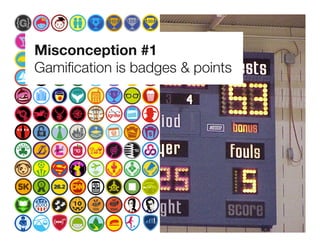
Misconception #1
Gamification is badges & points
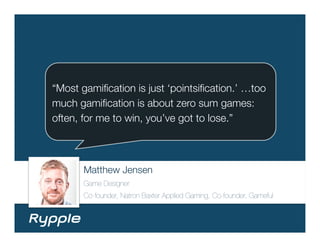
“Most gamification is just ‘pointsification.’ …too
much gamification is about zero sum games:
often, for me to win, you’ve got to lose.”


       Matthew Jensen
       Game Designer
       Co-founder, Natron Baxter Applied Gaming, Co-founder, Gameful
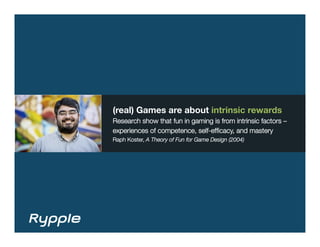
(real) Games are about intrinsic rewards
Research show that fun in gaming is from intrinsic factors – 
experiences of competence, self-efficacy, and mastery
Raph Koster, A Theory of Fun for Game Design (2004)
Misconception #2
Games have to be fun
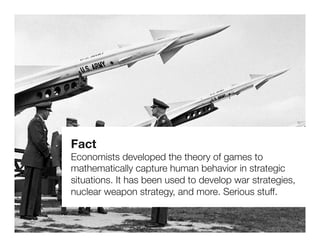
Fact
Economists developed the theory of games to
mathematically capture human behavior in strategic
situations. It has been used to develop war strategies,
nuclear weapon strategy, and more. Serious stuff.
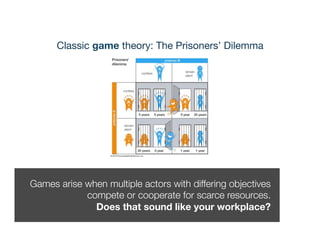
Classic game theory: The Prisoners’ Dilemma


Games arise when multiple actors with differing objectives
            compete or cooperate for scarce resources.
              Does that sound like your workplace?
Misconception #3
Games are not appropriate at work
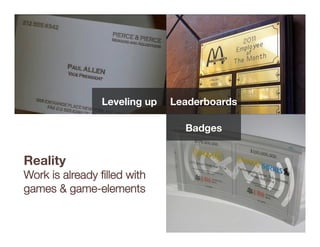
Leveling up
   Leaderboards

                                 Badges


Reality"
Work is already filled with
games & game-elements
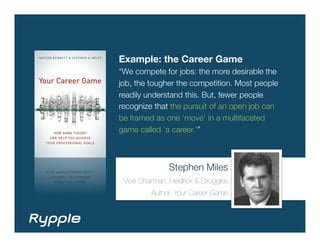
Example: the Career Game
“We compete for jobs: the more desirable the
job, the tougher the competition. Most people
readily understand this. But, fewer people
recognize that the pursuit of an open job can
be framed as one ‘move’ in a multifaceted
game called ‘a career.’”


                Stephen Miles
 Vice Chairman, Heidrick & Struggles
          Author, Your Career Game
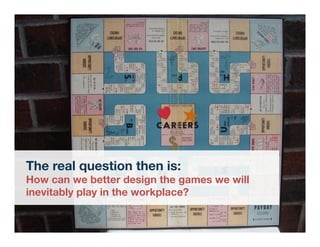
The real question then is:
How can we better design the games we will
inevitably play in the workplace?
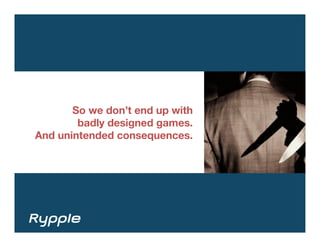
So we don’t end up with 
        badly designed games.
And unintended consequences.
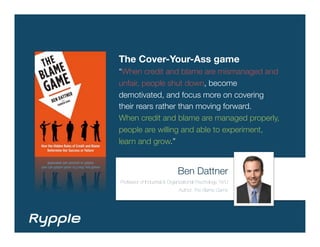
The Cover-Your-Ass game
“When credit and blame are mismanaged and
unfair, people shut down, become
demotivated, and focus more on covering
their rears rather than moving forward.
When credit and blame are managed properly,
people are willing and able to experiment,
learn and grow.”


                              Ben Dattner
Professor of Industrial & Organizational Psychology, NYU
                              Author, The Blame Game
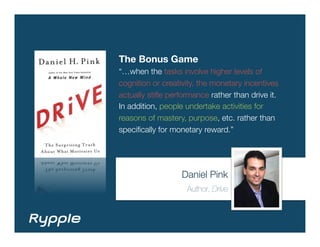
The Bonus Game
“…when the tasks involve higher levels of
cognition or creativity, the monetary incentives
actually stifle performance rather than drive it.
In addition, people undertake activities for
reasons of mastery, purpose, etc. rather than
specifically for monetary reward.”


                  Daniel Pink
                    Author, Drive
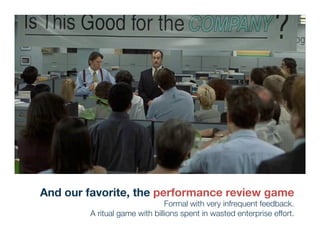
And our favorite, the performance review game
                               Formal with very infrequent feedback. 
        A ritual game with billions spent in wasted enterprise effort.
Initial lessons learnt in designing "
good games at work*


                              *So far. This is a WIP
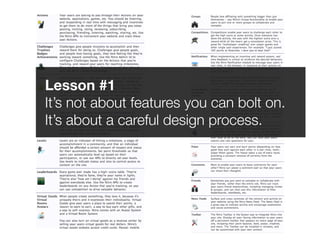
Lesson #1
It’s not about features you can bolt on.
It’s about a careful design process.
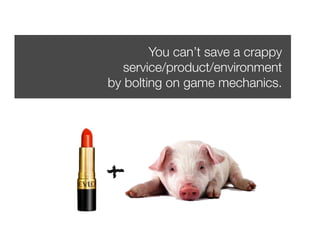
You can’t save a crappy "
   service/product/environment"
by bolting on game mechanics.


+
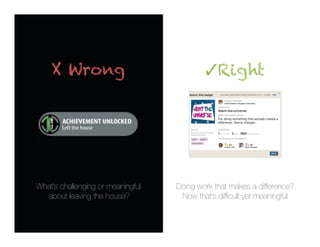
X Wrong                                 ✓ Right


What’s challenging or meaningful
   Doing work that makes a difference?
  about leaving the house?
          Now that’s difficult yet meaningful
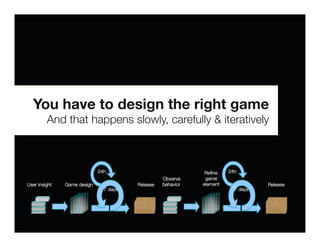
You have to design the right game
         And that happens slowly, carefully & iteratively


                               24h
                                Refine 
   24h
                                                      Observe 
    game
User insight
   Game design
               Release
   behavior
   element
               Release
                                 7 days
                                       7 days
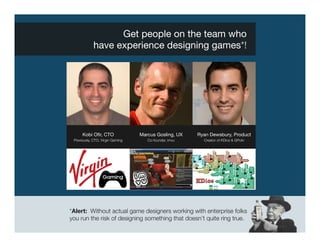
Get people on the team who "
             have experience designing games*!


      Kobi Ofir, CTO
               Marcus Gosling, UX
    Ryan Dewsbury, Product
 Previously, CTO, Virgin Gaming
      Co-founder, imvu
     Creator of KDice & GPokr


*Alert: Without actual game designers working with enterprise folks
you run the risk of designing something that doesn’t quite ring true.
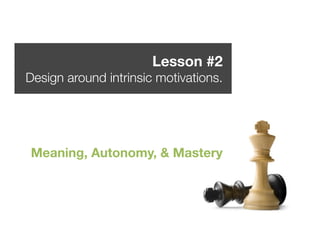
Lesson #2
Design around intrinsic motivations.


Meaning, Autonomy, & Mastery
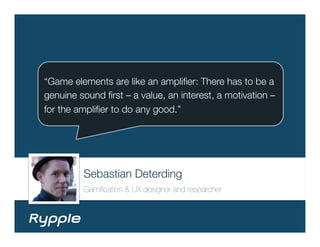
“Game elements are like an amplifier: There has to be a
genuine sound first – a value, an interest, a motivation –
for the amplifier to do any good.”


         Sebastian Deterding
         Gamification & UX designer and researcher
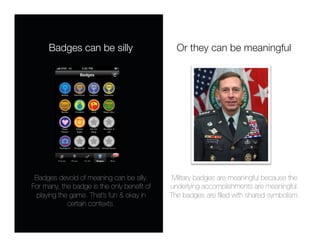
Badges can be silly
                     Or they can be meaningful


 Badges devoid of meaning can be silly.
     Military badges are meaningful because the
For many, the badge is the only benefit of   underlying accomplishments are meaningful. 
 playing the game. That’s fun & okay in     The badges are filled with shared symbolism.
            certain contexts.
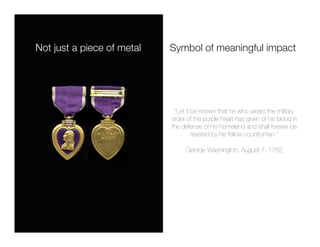
Not just a piece of metal
   Symbol of meaningful impact


                              "Let it be known that he who wears the military
                             order of the purple heart has given of his blood in
                             the defense of his homeland and shall forever be
                                      revered by his fellow countrymen." 
                                                       
                                   George Washington, August 7, 1782
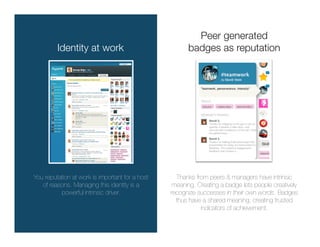
Peer generated
         Identity at work
                             badges as reputation


You reputation at work is important for a host     Thanks from peers & managers have intrinsic
   of reasons. Managing this identity is a        meaning. Creating a badge lets people creatively
          powerful intrinsic driver. 
           recognize successes in their own words. Badges
                                                   thus have a shared meaning, creating trusted
                                                            indicators of achievement.
Lesson #3
Amplify positive behaviors that already exist.
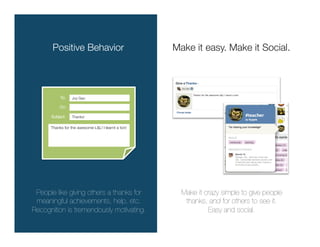
Positive Behavior
                            Make it easy. Make it Social.


           To:
   Joy Gao 


           Cc:

      Subject:
   Thanks!

      Thanks for the awesome L&L! I learnt a ton!


 People like giving others a thanks for                Make it crazy simple to give people
 meaningful achievements, help, etc. 
                  thanks, and for others to see it. 
Recognition is tremendously motivating.
                        Easy and social.
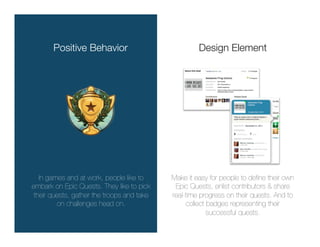
Positive Behavior
                            Design Element


   In games and at work, people like to     Make it easy for people to define their own
embark on Epic Quests. They like to pick     Epic Quests, enlist contributors & share
 their quests, gather the troops and take   real-time progress on their quests. And to
         on challenges head on. 
                collect badges representing their
                                                         successful quests.
Lesson #4
         Do it slowly and very carefully
            Games elements have real 
& sometimes unintended consequences
Game element
                 Unintended consequence


Scoreboards are a common               “Depending on [work context],
game element. Harmless in       leaderboards can feel like yet another form
 the virtual world of games.
      of control and pressure, or as merely
                                        informational and supportive” 
                                     *Sebastian Deterding, Meaningful Gamification
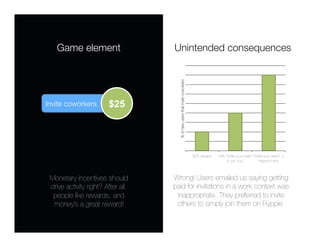
Game element
                   Unintended consequences


                                      % of new users that invite coworkers
Invite coworkers
        $25


                                                                              $25 reward
   with "invite your team "invite your team" +
                                                                                                  to join you"
        reasons why


 Monetary incentives should         Wrong! Users emailed us saying getting
 drive activity right? After all,   paid for invitations in a work context was
  people like rewards, and           inappropriate. They preferred to invite
  money’s a great reward!
           others to simply join them on Rypple.
Lesson #5
Simplicity counts
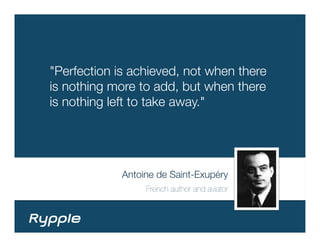
"Perfection is achieved, not when there
is nothing more to add, but when there
is nothing left to take away." 


             Antoine de Saint-Exupéry
                  French author and aviator
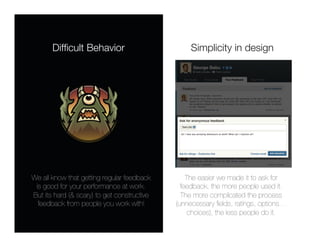
Difficult Behavior
                         Simplicity in design


We all know that getting regular feedback        The easier we made it to ask for
 is good for your performance at work.
        feedback, the more people used it. 
But its hard (& scary) to get constructive     The more complicated the process
  feedback from people you work with!
       (unnecessary fields, ratings, options…
                                                  choices), the less people do it.
In summary
Helpful lessons on Enterprise Gamification
 Work is already filled with games. They’re mostly poorly designed.!
 !
 Get people on the team with experience in building games.!
 !
 Design, build, learn, design, ... repeat.!
 !
 Leverage intrinsic motivators at work. Amplify positive behaviors.!
 !
 Watch for unintended consequences of game elements in the
 social context of work.!
 !
 Simplicity counts.
Want to learn more?
Daniel Debow
@ddebow
ddebow@rypple.com
1.888.4RYPPLE

Gamification in Enterprise Technology

  • 1.
    Work better. Playtogether?! On Enterprise Gamification loveyourwork! COLLABORATe! FLOW!
  • 2.
    Outline: on EnterpriseGamification Enterprise gamification is a hot new idea. ! ! Great potential for benefit (and misuse) ! ! Misconceptions create the risk of getting it wrong ! ! We share our lessons learned for making it work.
  • 3.
    Games are havingtheir moment in the limelight
  • 4.
    Once upon atime, they were the root of all evil.
  • 5.
    Today, people arerealizing that game design has something to say about how we design solutions to other problems.
  • 6.
    Claim: “It canhelp solve real world problems.”
  • 7.
    Claim: “It candrive employee motivation & performance” Just add points & rewards (cash, tchotchke’s, whatever)…
  • 8.
    Claim: “You canget employees to engage in not-so-fun exercises” Make it look like a game so they do it!
  • 9.
    But as withany new idea, carefully separate what works from what doesn’t.
  • 10.
    “Gamification is aninadvertent con. It tricks people into believing that there’s a simple way to imbue their thing ... with the psychological, emotional and social power of a great game.” Margaret Robertson Game Designer & Consultant to EA, Sony
  • 11.
  • 12.
    “Most gamification isjust ‘pointsification.’ …too much gamification is about zero sum games: often, for me to win, you’ve got to lose.” Matthew Jensen Game Designer Co-founder, Natron Baxter Applied Gaming, Co-founder, Gameful
  • 13.
    (real) Games areabout intrinsic rewards Research show that fun in gaming is from intrinsic factors – experiences of competence, self-efficacy, and mastery Raph Koster, A Theory of Fun for Game Design (2004)
  • 14.
  • 15.
    Fact Economists developed thetheory of games to mathematically capture human behavior in strategic situations. It has been used to develop war strategies, nuclear weapon strategy, and more. Serious stuff.
  • 16.
    Classic game theory:The Prisoners’ Dilemma Games arise when multiple actors with differing objectives compete or cooperate for scarce resources. Does that sound like your workplace?
  • 17.
    Misconception #3 Games arenot appropriate at work
  • 18.
    Leveling up Leaderboards Badges Reality" Work is already filled with games & game-elements
  • 19.
    Example: the CareerGame “We compete for jobs: the more desirable the job, the tougher the competition. Most people readily understand this. But, fewer people recognize that the pursuit of an open job can be framed as one ‘move’ in a multifaceted game called ‘a career.’” Stephen Miles Vice Chairman, Heidrick & Struggles Author, Your Career Game
  • 20.
    The real questionthen is: How can we better design the games we will inevitably play in the workplace?
  • 21.
    So we don’tend up with badly designed games. And unintended consequences.
  • 22.
    The Cover-Your-Ass game “Whencredit and blame are mismanaged and unfair, people shut down, become demotivated, and focus more on covering their rears rather than moving forward. When credit and blame are managed properly, people are willing and able to experiment, learn and grow.” Ben Dattner Professor of Industrial & Organizational Psychology, NYU Author, The Blame Game
  • 23.
    The Bonus Game “…whenthe tasks involve higher levels of cognition or creativity, the monetary incentives actually stifle performance rather than drive it. In addition, people undertake activities for reasons of mastery, purpose, etc. rather than specifically for monetary reward.” Daniel Pink Author, Drive
  • 24.
    And our favorite,the performance review game Formal with very infrequent feedback. A ritual game with billions spent in wasted enterprise effort.
  • 25.
    Initial lessons learntin designing " good games at work* *So far. This is a WIP
  • 26.
    Lesson #1 It’s notabout features you can bolt on. It’s about a careful design process.
  • 27.
    You can’t savea crappy " service/product/environment" by bolting on game mechanics. +
  • 28.
    X Wrong ✓ Right What’s challenging or meaningful Doing work that makes a difference? about leaving the house? Now that’s difficult yet meaningful
  • 29.
    You have todesign the right game And that happens slowly, carefully & iteratively 24h Refine 24h Observe game User insight Game design Release behavior element Release 7 days 7 days
  • 30.
    Get people onthe team who " have experience designing games*! Kobi Ofir, CTO Marcus Gosling, UX Ryan Dewsbury, Product Previously, CTO, Virgin Gaming Co-founder, imvu Creator of KDice & GPokr *Alert: Without actual game designers working with enterprise folks you run the risk of designing something that doesn’t quite ring true.
  • 31.
    Lesson #2 Design aroundintrinsic motivations. Meaning, Autonomy, & Mastery
  • 32.
    “Game elements arelike an amplifier: There has to be a genuine sound first – a value, an interest, a motivation – for the amplifier to do any good.” Sebastian Deterding Gamification & UX designer and researcher
  • 33.
    Badges can besilly Or they can be meaningful Badges devoid of meaning can be silly. Military badges are meaningful because the For many, the badge is the only benefit of underlying accomplishments are meaningful. playing the game. That’s fun & okay in The badges are filled with shared symbolism. certain contexts.
  • 34.
    Not just apiece of metal Symbol of meaningful impact "Let it be known that he who wears the military order of the purple heart has given of his blood in the defense of his homeland and shall forever be revered by his fellow countrymen." George Washington, August 7, 1782
  • 35.
    Peer generated Identity at work badges as reputation You reputation at work is important for a host Thanks from peers & managers have intrinsic of reasons. Managing this identity is a meaning. Creating a badge lets people creatively powerful intrinsic driver. recognize successes in their own words. Badges thus have a shared meaning, creating trusted indicators of achievement.
  • 36.
    Lesson #3 Amplify positivebehaviors that already exist.
  • 37.
    Positive Behavior Make it easy. Make it Social. To: Joy Gao Cc: Subject: Thanks! Thanks for the awesome L&L! I learnt a ton! People like giving others a thanks for Make it crazy simple to give people meaningful achievements, help, etc. thanks, and for others to see it. Recognition is tremendously motivating. Easy and social.
  • 38.
    Positive Behavior Design Element In games and at work, people like to Make it easy for people to define their own embark on Epic Quests. They like to pick Epic Quests, enlist contributors & share their quests, gather the troops and take real-time progress on their quests. And to on challenges head on. collect badges representing their successful quests.
  • 39.
    Lesson #4 Do it slowly and very carefully Games elements have real & sometimes unintended consequences
  • 40.
    Game element Unintended consequence Scoreboards are a common “Depending on [work context], game element. Harmless in leaderboards can feel like yet another form the virtual world of games. of control and pressure, or as merely informational and supportive” *Sebastian Deterding, Meaningful Gamification
  • 41.
    Game element Unintended consequences % of new users that invite coworkers Invite coworkers $25 $25 reward with "invite your team "invite your team" + to join you" reasons why Monetary incentives should Wrong! Users emailed us saying getting drive activity right? After all, paid for invitations in a work context was people like rewards, and inappropriate. They preferred to invite money’s a great reward! others to simply join them on Rypple.
  • 42.
  • 43.
    "Perfection is achieved,not when there is nothing more to add, but when there is nothing left to take away." Antoine de Saint-Exupéry French author and aviator
  • 44.
    Difficult Behavior Simplicity in design We all know that getting regular feedback The easier we made it to ask for is good for your performance at work. feedback, the more people used it. But its hard (& scary) to get constructive The more complicated the process feedback from people you work with! (unnecessary fields, ratings, options… choices), the less people do it.
  • 45.
  • 46.
    Helpful lessons onEnterprise Gamification Work is already filled with games. They’re mostly poorly designed.! ! Get people on the team with experience in building games.! ! Design, build, learn, design, ... repeat.! ! Leverage intrinsic motivators at work. Amplify positive behaviors.! ! Watch for unintended consequences of game elements in the social context of work.! ! Simplicity counts.
  • 47.
    Want to learnmore? Daniel Debow @ddebow ddebow@rypple.com 1.888.4RYPPLE

Editor's Notes

  • #4 Need better gaming image
  • #22 [group goals, epic quests, helping people elevate their own games]