Coaching with Compassion (Part 2)
       Teleos Leadership Institute


            Powered by:
Rypple Leadership Series
         Your Host                           Our Guests


       Nick Stein             Suzanne Rotondo& Gretchen Schmelzer
Director of Content & Media    Executive Director & Senior Consultant
           Rypple                   Teleos Leadershi p Institute
        @stein_nick
Coaching with Rypple
Rypple Leadership Series
         Your Host                           Our Guests


       Nick Stein             Suzanne Rotondo& Gretchen Schmelzer
Director of Content & Media    Executive Director & Senior Consultant
           Rypple                   Teleos Leadershi p Institute
        @stein_nick
Polling

Where in the world are you?
US East
US West
US Other
Canada
Europe
Asia
Africa
Australia/New Zealand
To get the most out of today’s
                  webinar..
•   Be here.
•   Be open.
•   Have a notebook and a pen to write.
•   Be willing to commit to action.
About Teleos Leadership Institute
•Founded in 2001 by scholar/practitioners in
leadership. We emphasize mindfulness, hope and
compassion as key to success.

•We are executive coaches and also train and
supervise other executive coaches, both one on
one and inside large organizations that want to
have a coaching culture.

•Based on research in neuropsychology, group
dynamics, emotional intelligence, organizational
development, and more.
                                                              Teleos is the team behind
                                                    New York Times bestselling business
•Based in Philadelphia, USA. Teleos works in many
                                                       books and numerous articles on
fields: UNDP, Unisys, Google, US Steel,                 leadership in Harvard Business
UniCreditBanc, Prudential UK, Nature Conservancy                                Review.
Coaching with Compassion Timeline

Webinar 1   • Mindset and preparation for meeting
            • Establish trust, set the emotional climate
            • Start the conversation: What are my aspirations?
 October    • Assignment


Webinar 2   • Review Reflections
            • Leaders Set Climate; Why Climate Matters
            • Reality check: Getting feedback
November    • Assignment


Webinar 3   • Set Goals: Find intersection of aspirations and what organization needs.
            • What’s the path forward? Co-design pathway & experiments
 January    • Track learning; tweak along the way; reinforce positive change
What we’ll cover today
• Mindset of a coaching manager (review)
• Explore how leaders set the climate in
  organizations
• See how climate drives results

• We’ll get specific with Part 2 of the 3-part
  coaching with compassion developmental
  process.
Mindset of a Coaching Manager
Invests their energy in
another person to help
them reach their desired
potential—both
personally and
professionally.
Mindset of Coaching Manager
Beyond tracking
performance and
results, finds the highest
and best points of
intersection between the
aspirations/goals of direct
report(s) and what the
organization needs.
What Does a Coaching Manager Do?
– Creates conditions for a person to maximize her/his
  performance and potential

– Helps a person move from her/his current situation to where
  s/he wants to be

– Behaves in ways that engender trust and trustworthiness:
  respectful, curious, timely, consistent, present, caring

– Sets climate for the team, department or organization
Climate
On a department or
organizational level, a
coaching manager (and
all leaders) sets the
climate.
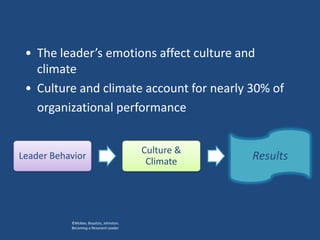
• The leader’s emotions affect culture and
   climate
 • Culture and climate account for nearly 30% of
   organizational performance


                                         Culture &
Leader Behavior
                                          Climate    Results


           ©McKee, Boyatzis, Johnston.
           Becoming a Resonant Leader
What Is Organizational Climate?
Recurring patterns of
behavior, attitudes
and feelings that
characterize life in
the organization and
are a major force in
influencing employee
behavior.
What Motivates Us
There is a gulf
between what
employees need do
to “get by” and what
they can do if they
perform at their full
potential.
What Motivates us
A positive climate
encourages
discretionary effort
and commitment, it
spurs creativity and
innovative thinking.
This is where coaching
managers fit in.
What Makes a Climate?
In one department of the
same organization, people
might be floundering,
confused by conflicting
priorities and starved for
performance feedback, while
people in another department
understand their priorities,
have the authority to get the
job done and have a strong
sense of commitment to their
own developmental goals.


            So it’s not about resources, mission or pressures.
Six factors that influence climate

1) Clarity
2) Standards
3) Responsibility
4) Flexibility
5) Rewards and
   Recognition
6) Team Commitment
1) Clarity:Everyone in
the organization
knows what is
expected of them.


Coaching Manager:
This requires empathy and
transparency. Without it,
people often rely on
smoke and mirrors.
2)
Standards:Challenging
, but attainable, goals
are set and employees
are supported to meet
those goals.

Coaching Manager: Powerful
developmental goals meet the
organization's needs AND the
desires of the employee. Your
role in supporting those goals is
critical to climate.
3) Responsibility:
Employees are given
authority to
accomplish their set
of responsibilities—
they have a defined
span of control and
can run within that.

Coaching Manager:
They know you trust
them and have their
back.
4) Flexibility: There are no
unnecessary rules, policies
and procedures.

Coaching Manager: Limit
bureaucracy. That is
empathic and it opens the
door for flexible thinking,
creativity and innovation.
5) Rewards: Employees are
recognized and rewarded
for good
performance, receive
honest feedback.
Coaching Manager: Model
and recognize behaviors
that support the vision,
purpose and strategy of
your department or
organization. Support
development and hopes
of employees.
6) Team Commitment:
People are proud to belong
to the organization, feel a
sense of trust and pride in
colleagues and connected to
a worthy common goal

Coaching Manager:
Support relationships to
influence even more
powerful team outcomes.
Department Vision
Reflect and write:
 What is my high level vision for my team or
  department over the next 2-3 years?
 What kinds of activities am I hoping to see from my
  team or department?
 What kind of climate will I need to foster to make
  that happen?
Stop and Ask Yourself
 What messages am I communicating daily? Weekly?
  Are they consistent? Are they supportive?
 Am I noticing and acknowledging good work around
  me? How?
 How is morale? How am I contributing to a positive
  outlook among my employees? Am I lowering
  anxiety and reducing unnecessary hassles?
Poll
Have you started the developmental process from last webinar with any of
your direct reports?
Yes
No, but plan to
No, but have meetings set up
No, too hard to find time

If yes, how is it going so far?
Excellent
Better than Expected
Good
Not Sure
Not so good
Meeting 1 & 2 Recap
       Meeting One                 Meeting Two
• You set the stage for a   • You had a conversation
  developmental               with your direct report
  framework                   about the
• You assigned 3              exercises, identifying
  reflection exercises        themes and areas of
  about aspirations           importance for
  (Noble Purpose, 27          development
  Things, At My Best)       • You assigned “Strengths
                              I see in myself”
Meeting Three
        Before Meeting:                     During Meeting:
Reflect on what you heard         •   Re-establish trust, set the
from your direct report about         emotional tone
her/his hopes for the future in   •   Start the conversation:
previous meetings. When               What have you been
she/he is at her/his best?            thinking about since we last
What are the conditions?              met?
What stands out to you?           •   Will you share your sense of
                                      your own strengths (from
                                      last assignment)
                                  •   Assignment: career lifeline,
                                      leadership self study
THE CONVERSATION
“I really enjoyed our last conversation about where
you want to go in your life, times when you feel you
were at your best—even your noble purpose. Is
there anything else you’d like to add to the
conversation we had? *“Here’s what stood out to
me, as your manager…”+

Last time we spoke, I asked you to reflect on your
strengths—what you believe they are, including any
that may not be fully utilized in your current role.
What did you come up with?”

After the direct report shares reflections, deepen
the conversation with open-ended questions; share
your sense of her/his strengths.
Assign your direct report 2 exercises

–Career Lifeline
–Leadership Self-Study
Career Lifeline
• Draw a line across a
  page. At the right, list
  your most recent job,
  along with dates and
  highlights/lowlights.

• Work to the left, in
  descending order of
  past jobs.
Leadership Self Study
• Find 2-4 people who will
  be honest and supportive;
  go for a walk and talk
  with them for 30 minutes

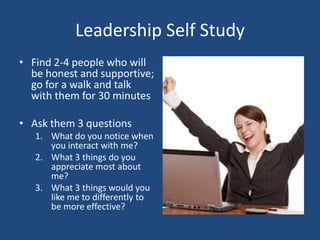
• Ask them 3 questions
   1. What do you notice when
      you interact with me?
   2. What 3 things do you
      appreciate most about
      me?
   3. What 3 things would you
      like me to differently to
      be more effective?
Meeting Four: Follow–up Conversation
Meeting Four: Use Scaffolding
• Listening          “So, here’s what it sounds
                     like your work history has
• Paraphrasing       been about for you?
• Checking for
                     Did I get that right? What
  understanding
                     did I miss?
• Inquiry
                     What really stands out to
                     you from your Walk &
• Assign “Personal   Talks? What are you
                     taking away from them?
  Balance Sheet”
THE CONVERSATION:CLOSING

 “I really appreciated this time with you, it was
 interesting to learn about your career history and
 what it was like for you along the way. I also enjoyed
 hearing about your conversations with people about
 what they appreciate and also would like to see you
 do differently. There’s a lot to think about and
 consider in there. A lot to feel good about.

 For our next meeting, your task is to reflect on your
 Personal Balance Sheet– a step toward determining
 what you may want to focus on as we identify your
 developmental goals next time we meet.”
Assignment: Personal Balance Sheet
Assets                                     Liabilities

Distinctive Strengths                      My Weaknesses


Potential Strengths                        Weaknesses I Want to Change


My Enduring Dispositions that Support Me   My Enduring Dispositions that Get in My Way
Coaching with Compassion Timeline

            • Mindset and preparation for meeting

Webinar 1   • Establish trust, set the emotional climate
            • Start the conversation: What are my aspirations
            • Assignment


            • Review Reflections

Webinar 2   • Deepen the Conversation
            • Reality check: Getting feedback
            • Assignment


Webinar 3   • Set Goals: find intersection of aspirations and what organization needs.
            • What’s the path forward? Co-design pathway & experiments
            • Track learning; tweak along the way; reinforce positive change
Q&A
Upcoming Rypple Webinars
                               Coaching with Compassion
Coachable Moments                       Part 3


Tuesday,December 13, 2011

    Scott Eblin                Suzanne Rotondo
  President, The Eblin Group     Teleos Leadership Institute
Contact Us
www.teleosleaders.com

srotondo@teleosleaders.com

gschmelzer@teleosleaders.com

Teleos Leadership Institute
7837 Old York Road
Elkins Park, PA 19027
267.620.9999
References
Boyatzis, R. & McKee, A. (2005). Resonant Leadership: Renewing Yourself and Connecting With Others
Through Mindfulness, Hope, and Compassion. Boston: Harvard Business School Press.

Boyatsis, R., Mckee, A., & Johnston, F. (2008). Becoming a Resonant Leader. Boston: Harvard Business School
Press.

Boyatzis, R. E., Jack, A., Cesaro, R., Passarelli, A. &Khawaja, M. (2010). Coaching with Compassion: An fMRI
Study of Coaching to the Positive or Negative Emotional Attractor. Presented at the Annual Meeting of the
Academy of Management, Montreal.

Boyatzis, R.E., Passarelli, A.P., Koenig, K., Lowe, M., Mathew, B., Stoller, J. & Phillips, M. (under review).
Examination of the Neural Substrates Activated in Experiences with Resonant & Dissonant Leaders.
Leadership Quarterly.

Boyatzis, R.E., Smith, M. and Blaize, N. (2006) “Developing sustainable leaders through coaching and
compassion, Academy of Management Journal on Learning and Education. 5(1): 8-24.

Cattaneo, L. &Rizzolatti, G. (2009). The mirror neuron system. Neurobiological Review, 66(5), p. 557-560
References
Decety, J. &Michalska, K.J. (2010). Neurodevelopmental change in circuits underlying empathy and
sympathy from childhood to adulthood. Developmental Science. 13: 6, 886-899.

Doidge, Norman: The Brain That Changes Itself. New York: Penguin, 2008.

Goleman, D., Boyatzis, R., & McKee, A. (2002). Primal Leadership: Realizing the Power of Emotional
Intelligence. Boston: Harvard Business School Press.

Isen, Alice M. (2002). "A Role for Neuropsychology in Understanding the Facilitating Influence of Positive
Affect on Social Behavior and Cognitive Processes."Handbook of Positive Psychology. C. R. Snyder and S.
J. Lopez. Oxford (Eds), England and New York, NY, Oxford University Press: Chapter 38: (pp 528-540).

LeDoux, J. (2002). Synaptic self: How our brains become who we are. NY: Viking.

Kegan, Robert . (1994). In Over Our Heads: The Mental Demands of Modern Life, Cambridge, MA:
Harvard University Press.

Sapolsky, R. M. (2004). Why zebra’s don’t get ulcers (third edition).NY: Harper Collins.

How to Coach Employees with Compassion (Part 2)

  • 1.
    Coaching with Compassion(Part 2) Teleos Leadership Institute Powered by:
  • 2.
    Rypple Leadership Series Your Host Our Guests Nick Stein Suzanne Rotondo& Gretchen Schmelzer Director of Content & Media Executive Director & Senior Consultant Rypple Teleos Leadershi p Institute @stein_nick
  • 3.
  • 4.
    Rypple Leadership Series Your Host Our Guests Nick Stein Suzanne Rotondo& Gretchen Schmelzer Director of Content & Media Executive Director & Senior Consultant Rypple Teleos Leadershi p Institute @stein_nick
  • 5.
    Polling Where in theworld are you? US East US West US Other Canada Europe Asia Africa Australia/New Zealand
  • 6.
    To get themost out of today’s webinar.. • Be here. • Be open. • Have a notebook and a pen to write. • Be willing to commit to action.
  • 7.
    About Teleos LeadershipInstitute •Founded in 2001 by scholar/practitioners in leadership. We emphasize mindfulness, hope and compassion as key to success. •We are executive coaches and also train and supervise other executive coaches, both one on one and inside large organizations that want to have a coaching culture. •Based on research in neuropsychology, group dynamics, emotional intelligence, organizational development, and more. Teleos is the team behind New York Times bestselling business •Based in Philadelphia, USA. Teleos works in many books and numerous articles on fields: UNDP, Unisys, Google, US Steel, leadership in Harvard Business UniCreditBanc, Prudential UK, Nature Conservancy Review.
  • 8.
    Coaching with CompassionTimeline Webinar 1 • Mindset and preparation for meeting • Establish trust, set the emotional climate • Start the conversation: What are my aspirations? October • Assignment Webinar 2 • Review Reflections • Leaders Set Climate; Why Climate Matters • Reality check: Getting feedback November • Assignment Webinar 3 • Set Goals: Find intersection of aspirations and what organization needs. • What’s the path forward? Co-design pathway & experiments January • Track learning; tweak along the way; reinforce positive change
  • 9.
    What we’ll covertoday • Mindset of a coaching manager (review) • Explore how leaders set the climate in organizations • See how climate drives results • We’ll get specific with Part 2 of the 3-part coaching with compassion developmental process.
  • 10.
    Mindset of aCoaching Manager Invests their energy in another person to help them reach their desired potential—both personally and professionally.
  • 11.
    Mindset of CoachingManager Beyond tracking performance and results, finds the highest and best points of intersection between the aspirations/goals of direct report(s) and what the organization needs.
  • 12.
    What Does aCoaching Manager Do? – Creates conditions for a person to maximize her/his performance and potential – Helps a person move from her/his current situation to where s/he wants to be – Behaves in ways that engender trust and trustworthiness: respectful, curious, timely, consistent, present, caring – Sets climate for the team, department or organization
  • 13.
    Climate On a departmentor organizational level, a coaching manager (and all leaders) sets the climate.
  • 14.
    • The leader’semotions affect culture and climate • Culture and climate account for nearly 30% of organizational performance Culture & Leader Behavior Climate Results ©McKee, Boyatzis, Johnston. Becoming a Resonant Leader
  • 15.
    What Is OrganizationalClimate? Recurring patterns of behavior, attitudes and feelings that characterize life in the organization and are a major force in influencing employee behavior.
  • 16.
    What Motivates Us Thereis a gulf between what employees need do to “get by” and what they can do if they perform at their full potential.
  • 17.
    What Motivates us Apositive climate encourages discretionary effort and commitment, it spurs creativity and innovative thinking. This is where coaching managers fit in.
  • 18.
    What Makes aClimate? In one department of the same organization, people might be floundering, confused by conflicting priorities and starved for performance feedback, while people in another department understand their priorities, have the authority to get the job done and have a strong sense of commitment to their own developmental goals. So it’s not about resources, mission or pressures.
  • 19.
    Six factors thatinfluence climate 1) Clarity 2) Standards 3) Responsibility 4) Flexibility 5) Rewards and Recognition 6) Team Commitment
  • 20.
    1) Clarity:Everyone in theorganization knows what is expected of them. Coaching Manager: This requires empathy and transparency. Without it, people often rely on smoke and mirrors.
  • 21.
    2) Standards:Challenging , but attainable,goals are set and employees are supported to meet those goals. Coaching Manager: Powerful developmental goals meet the organization's needs AND the desires of the employee. Your role in supporting those goals is critical to climate.
  • 22.
    3) Responsibility: Employees aregiven authority to accomplish their set of responsibilities— they have a defined span of control and can run within that. Coaching Manager: They know you trust them and have their back.
  • 23.
    4) Flexibility: Thereare no unnecessary rules, policies and procedures. Coaching Manager: Limit bureaucracy. That is empathic and it opens the door for flexible thinking, creativity and innovation.
  • 24.
    5) Rewards: Employeesare recognized and rewarded for good performance, receive honest feedback. Coaching Manager: Model and recognize behaviors that support the vision, purpose and strategy of your department or organization. Support development and hopes of employees.
  • 25.
    6) Team Commitment: Peopleare proud to belong to the organization, feel a sense of trust and pride in colleagues and connected to a worthy common goal Coaching Manager: Support relationships to influence even more powerful team outcomes.
  • 26.
    Department Vision Reflect andwrite:  What is my high level vision for my team or department over the next 2-3 years?  What kinds of activities am I hoping to see from my team or department?  What kind of climate will I need to foster to make that happen?
  • 27.
    Stop and AskYourself  What messages am I communicating daily? Weekly? Are they consistent? Are they supportive?  Am I noticing and acknowledging good work around me? How?  How is morale? How am I contributing to a positive outlook among my employees? Am I lowering anxiety and reducing unnecessary hassles?
  • 28.
    Poll Have you startedthe developmental process from last webinar with any of your direct reports? Yes No, but plan to No, but have meetings set up No, too hard to find time If yes, how is it going so far? Excellent Better than Expected Good Not Sure Not so good
  • 29.
    Meeting 1 &2 Recap Meeting One Meeting Two • You set the stage for a • You had a conversation developmental with your direct report framework about the • You assigned 3 exercises, identifying reflection exercises themes and areas of about aspirations importance for (Noble Purpose, 27 development Things, At My Best) • You assigned “Strengths I see in myself”
  • 30.
    Meeting Three Before Meeting: During Meeting: Reflect on what you heard • Re-establish trust, set the from your direct report about emotional tone her/his hopes for the future in • Start the conversation: previous meetings. When What have you been she/he is at her/his best? thinking about since we last What are the conditions? met? What stands out to you? • Will you share your sense of your own strengths (from last assignment) • Assignment: career lifeline, leadership self study
  • 31.
    THE CONVERSATION “I reallyenjoyed our last conversation about where you want to go in your life, times when you feel you were at your best—even your noble purpose. Is there anything else you’d like to add to the conversation we had? *“Here’s what stood out to me, as your manager…”+ Last time we spoke, I asked you to reflect on your strengths—what you believe they are, including any that may not be fully utilized in your current role. What did you come up with?” After the direct report shares reflections, deepen the conversation with open-ended questions; share your sense of her/his strengths.
  • 32.
    Assign your directreport 2 exercises –Career Lifeline –Leadership Self-Study
  • 33.
    Career Lifeline • Drawa line across a page. At the right, list your most recent job, along with dates and highlights/lowlights. • Work to the left, in descending order of past jobs.
  • 34.
    Leadership Self Study •Find 2-4 people who will be honest and supportive; go for a walk and talk with them for 30 minutes • Ask them 3 questions 1. What do you notice when you interact with me? 2. What 3 things do you appreciate most about me? 3. What 3 things would you like me to differently to be more effective?
  • 35.
  • 36.
    Meeting Four: UseScaffolding • Listening “So, here’s what it sounds like your work history has • Paraphrasing been about for you? • Checking for Did I get that right? What understanding did I miss? • Inquiry What really stands out to you from your Walk & • Assign “Personal Talks? What are you taking away from them? Balance Sheet”
  • 37.
    THE CONVERSATION:CLOSING “Ireally appreciated this time with you, it was interesting to learn about your career history and what it was like for you along the way. I also enjoyed hearing about your conversations with people about what they appreciate and also would like to see you do differently. There’s a lot to think about and consider in there. A lot to feel good about. For our next meeting, your task is to reflect on your Personal Balance Sheet– a step toward determining what you may want to focus on as we identify your developmental goals next time we meet.”
  • 38.
    Assignment: Personal BalanceSheet Assets Liabilities Distinctive Strengths My Weaknesses Potential Strengths Weaknesses I Want to Change My Enduring Dispositions that Support Me My Enduring Dispositions that Get in My Way
  • 39.
    Coaching with CompassionTimeline • Mindset and preparation for meeting Webinar 1 • Establish trust, set the emotional climate • Start the conversation: What are my aspirations • Assignment • Review Reflections Webinar 2 • Deepen the Conversation • Reality check: Getting feedback • Assignment Webinar 3 • Set Goals: find intersection of aspirations and what organization needs. • What’s the path forward? Co-design pathway & experiments • Track learning; tweak along the way; reinforce positive change
  • 40.
  • 41.
    Upcoming Rypple Webinars Coaching with Compassion Coachable Moments Part 3 Tuesday,December 13, 2011 Scott Eblin Suzanne Rotondo President, The Eblin Group Teleos Leadership Institute
  • 42.
  • 43.
    References Boyatzis, R. &McKee, A. (2005). Resonant Leadership: Renewing Yourself and Connecting With Others Through Mindfulness, Hope, and Compassion. Boston: Harvard Business School Press. Boyatsis, R., Mckee, A., & Johnston, F. (2008). Becoming a Resonant Leader. Boston: Harvard Business School Press. Boyatzis, R. E., Jack, A., Cesaro, R., Passarelli, A. &Khawaja, M. (2010). Coaching with Compassion: An fMRI Study of Coaching to the Positive or Negative Emotional Attractor. Presented at the Annual Meeting of the Academy of Management, Montreal. Boyatzis, R.E., Passarelli, A.P., Koenig, K., Lowe, M., Mathew, B., Stoller, J. & Phillips, M. (under review). Examination of the Neural Substrates Activated in Experiences with Resonant & Dissonant Leaders. Leadership Quarterly. Boyatzis, R.E., Smith, M. and Blaize, N. (2006) “Developing sustainable leaders through coaching and compassion, Academy of Management Journal on Learning and Education. 5(1): 8-24. Cattaneo, L. &Rizzolatti, G. (2009). The mirror neuron system. Neurobiological Review, 66(5), p. 557-560
  • 44.
    References Decety, J. &Michalska,K.J. (2010). Neurodevelopmental change in circuits underlying empathy and sympathy from childhood to adulthood. Developmental Science. 13: 6, 886-899. Doidge, Norman: The Brain That Changes Itself. New York: Penguin, 2008. Goleman, D., Boyatzis, R., & McKee, A. (2002). Primal Leadership: Realizing the Power of Emotional Intelligence. Boston: Harvard Business School Press. Isen, Alice M. (2002). "A Role for Neuropsychology in Understanding the Facilitating Influence of Positive Affect on Social Behavior and Cognitive Processes."Handbook of Positive Psychology. C. R. Snyder and S. J. Lopez. Oxford (Eds), England and New York, NY, Oxford University Press: Chapter 38: (pp 528-540). LeDoux, J. (2002). Synaptic self: How our brains become who we are. NY: Viking. Kegan, Robert . (1994). In Over Our Heads: The Mental Demands of Modern Life, Cambridge, MA: Harvard University Press. Sapolsky, R. M. (2004). Why zebra’s don’t get ulcers (third edition).NY: Harper Collins.