NON-PERFORMING ASSETS
What is NPA …… Non performing advances  or  non-performing Assets  (or non-performing loans) are loans  that are not being repaid or serviced through Interest payments on time. def : when interest or other dues to a bank remain unpaid for more than 90 days the entire bank loan automatically turns a “ Non-Performing Asset ”
Indian Economy and NPA’s The Indian Economy has been much affected due to lack of infrastructure facilities, sticky legal system, cutting of exposures to emerging markets by FII’s,etc. Under such a situation it goes without saying that banks are no exception and are bound to face the heat of a global downturn. Banks and FII’s in India hold NPA’s worth around  Rs 1,10,000 crores.
Global Developments and NPA’s The core banking business is of mobilizing the deposits and utilizing it for lending to industry. Lending business is encouraged which helps in productive purposes which results in economic growth. However lending also carries credit risk, which arises from the borrower’s inability to repay it .
How much risk can a bank  afford to take? Recent happenings in the business world-Enron, Worldcom, Xerox, global crossing do not give much confidence to banks. The history of FII’s also reveals the fact that the biggest banking failures were due to credit risk. Due to this, banks are restricting their lending operations to secured avenues only with adequate collateral on which to fall back upon in a situation of default.
Why NPA’s have become an issue for banks and FII’s in India? The origin of the problem of burgeoning NPA’s lies in the quality of managing credit risk by the banks concerned. What is needed is having adequate preventive measures in place namely, fixing pre-sanctioned appraisal responsibility & having an effective post-disbursement supervision. Banks concerned should continuously monitor loans to identify accounts that have potential to become non-performing.
Resolution of NPA’s At present, local banks are saddled with the management of NPA’s for which they do not have management time for proper resolution. As a result, they are reluctant to make new loan to industrial or commercial enterprises as NPA’s have strained their resources.  The unavailability of new loans has therefore hindered economic growth and development.
Contd……  ADB intends to assist local banks resolve their problems with NPA’s by facilitating the financing of SPV’s and other mechanisms designed to acquire and service such assets. This will enable the local banking system to focus on its core operations and provide financing to productive sectors of economy. In addition ADB will assist distressed companies in their restructuring & rehabilitation efforts.
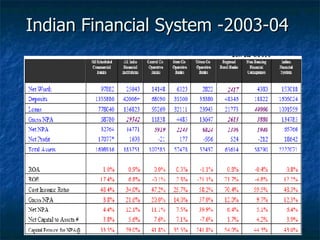
Indian Banking systems – some hard facts Gross NPA’s of the financial system is placed at Rs 1,35,000 crore, of which, over Rs 98,000 crore pertains to Scheduled Commercial Banks (SCB’s) and FII’s. Gross NPA’s showed increasing trend over the yrs and accretion to gross NPA’s by SCB’s during last two fiscals were Rs 24,824  crore(2001-02) & Rs 21,862 crore(2002-03).
Contd……. This accretion is not considering the cases restructured through CDR mechanism during 2002-03 and thereafter (Rs 46,000 crore). On account of low “Loan to GDP Ratio” (around 60%) in India, the enormity of NPA’s in India in GDP term appears to be low in comparison with china, korea, etc. 43% of the capital base of the financial system stands eroded on account of net NPA’s.
RBI Guidelines on classification of bank advances According to RBI guidelines, bank advances are mainly classified into: Standard assets:  such an asset is not a Non-Performing Asset. Sub-standard assets : it is classified as NPA for a period not exceeding 18 months. Doubtful assets:  Asset that has remained sub standard for a period of 12 months (w.e.f. March 31, 2005). Loss Assets:  here loss is identified by the banks concerned or by internal auditors or by RBI inspectors.
Financial statements in assessing the risk of default for lenders For banks and Financial Institutions, both the balance sheet and income statement have a key role to play by providing valuable information on a borrowers ability The key accounting ratios generally used for the purpose of ascertaining the creditworthiness of a business entity are that of debt-equity ratio & interest coverage ratio.
Measures to reduce NPA’s Provision of bad debts from net profit. Implementation of Securitisation Act 2002. Increasing the share of Retail business i.e., personal loans, vehicle loans, home loans, credit cards, etc. Increasing the deposits. Increase lending share to priority sector.
High cost of funds due to NPA Quite often genuine borrowers face difficulties in raising funds from banks due to mounting NPA’s. With the enactment of the Securitiastion and Reconstruction of Financial Assets and enforcement of Security Interest Act, 2002, banks can issue notices to pay up the dues  And the borrowers will have to clear the dues within 60 days. If the defaulters don’t pay the dues, then the banks can takeover the possession of assets & also takeover the management of the company.
Credit Risk And NPA NPAs are a result of past action whose effects are realized in the  present  Credit risk is a much more forward-looking approach and is mainly concerned with managing the quality of credit portfolio before default takes place
Credit Rating Credit rating has been explained as forming an opinion of the future ability, legal obligation and willingness of a bond issuer or obligor to make full and timely payments on principal and interest due to the investors  Definition by Moody
Tangled By Huge NPAs……..WHY Indian banks so far were encircled by the chains of regulation and aegis of protection  No formal policies, procedures, systems, tools and techniques of credit risk assessment
At The Mercy Of Balance Sheet Operating margin Current ratio  cash flow Fund flow
Perception and reality may differ 180* Accounting policies has loopholes Chartered Accountants make their balance sheet look as they want it to look like  Past performance is no indicator of the future performance ideally
Darling Of Bourses Takes A Hit Hasty commitments to expand rapidly by rediff have brought it to red  Its share price is ruling well below its issue price  So relying completely on the past ratios meant no monitoring of the management decisions and no control over their decisions
Collateral-A Defensive Approach Collateral was another way to judge the credit quality  A client is good if she had attractive assets to put as collateral and bad otherwise.  Poor decision making-accepted clients of poor quality and rejected the clients of good quality  Collateral is hardly a security
Credit Risk Techniques Quantitative Ratio analysis Fund flows Mathematical models Qualitative Policies Procedures Concentration
Playing with Precision Altman's Z Score predicts whether or not a company is likely to enter into bankruptcy within one or two years  the algorithm has been consistently reported to have a 95 % accuracy of prediction of bankruptcy  Consideration-current assets, total assets, net sales, interest, total liability, current liabilities, market value of equity, earnings before taxes and retained earnings
Play or Leave 3.0 or more : Most likely safe 2.8 to 3.0 : Just safe 1.8 to 2.7 : likely to bankrupt in two years Below 1.8 : Recovery least expected
Getting The Combination Right Credit metrics works on the statistical concepts like probability, means, and standard deviation, correlation, and concentrations
Credit Metrics-Application Reduce the portfolio risk : reevaluate obligors having the largest absolute size arguing that a single default among these would have the greatest impact  reevaluate obligors having the highest percentage level of risk arguing that these are the most likely to contribute to portfolio losses
Balancing Act Identifying the correlations across the portfolio so that the potential concentration may be reduced and the portfolio is adequately diversified across the uncorrelated constituents  Concentration may lead to an undue accumulation of risk at one point.
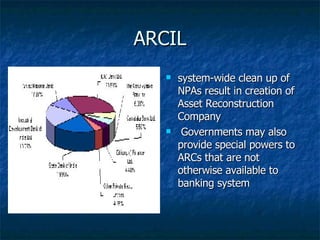
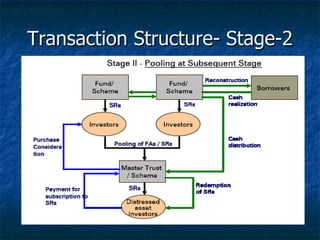
ARCIL system-wide clean up of NPAs result in creation of Asset Reconstruction Company Governments may also provide special powers to ARCs that are not otherwise available to banking system
ARCIL Objectives Convert NPA into performing assets Act as nodal agency for NPA resolution Create a vibrant market for NPA\restructured debt Re-energize the financial sector.
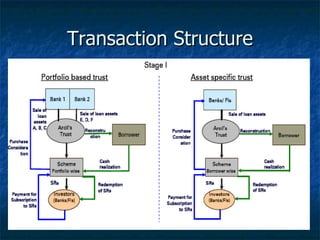
Transaction Structure
Transaction Structure- Stage-2
ARCIL- International Examples In 1980s, U.S. used government sponsored ARC - Resolution Trust Corporation (RTC) to overcome thrift crisis. RTC acted as a “bad bank” and functioned as an effective sales mechanism for disposal of assets  In early 1990s Mexico and Sweden demonstrated successful use of ARC mechanism (Fobaproa and Securum respectively) as a “bad bank” and to clean and reprivatise/ recapitalise the banks  Korea used KAMCO as the nodal agency for acquiring and disposing NPAs. KAMCO has used securitisation and joint venture route for investor participation in the assets
Indian Financial System -2003-04
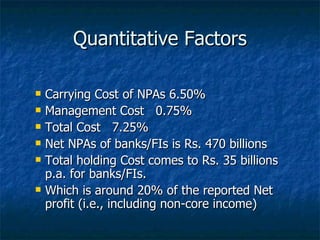
Quantitative Factors Carrying Cost of NPAs 6.50%  Management Cost  0.75%  Total Cost  7.25%  Net NPAs of banks/FIs is Rs. 470 billions  Total holding Cost comes to Rs. 35 billions p.a. for banks/FIs. Which is around 20% of the reported Net profit (i.e., including non-core income)
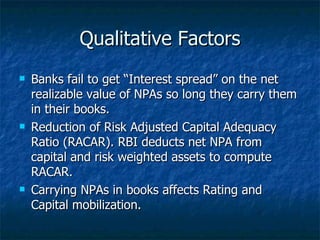
Qualitative Factors Banks fail to get “Interest spread” on the net realizable value of NPAs so long they carry them in their books. Reduction of Risk Adjusted Capital Adequacy Ratio (RACAR). RBI deducts net NPA from capital and risk weighted assets to compute RACAR. Carrying NPAs in books affects Rating and Capital mobilization.
MANAGING NPA   There are two issues, which, if tackled properly, would efficiently solve the problem of NPAs viz. (i) ‘STOCK’ ( accumulation of NPAs) problem and (ii) ‘FLOW’  ( accretion ) problem. Several measures like Lok Adalat, DRTs( Debt Recovery Tribunals),Strengthening of credit appraisal and monitoring system have been initiated by the regulators to tackle the ‘flow’ problem.  Towards resolution of the ‘stock’ problem of NPAs GOI took proactive steps and enacted the Securitasation & Reconstruction Act 2002 in December 2002.

MANAGING NPA- Models Globally there have been two models: (i) A central disposition agency which takes  bad loans from all financial institutions or (ii) An entity specific to a particular bank or a group of banks e.g. Arcil.
MANAGING NPA- Resolution Strategy There are primarily two strategies  (I) Loan Management Strategy - Restructuring of loan on sustainable debt considerations -  Maximise overall recovery value - Fair treatment to all  stakeholders - One Time Settlement
MANAGING NPA- Resolution Strategy (II) Asset Management Strategy - Disposition by strip sale - Change in management -  Takeover of  assets - Legal route / Foreclosure
MANAGING NPA-Indian Approach The Indian system envisages multiple ARCs(Asset Reconstruction Company) as non government entities with equity support of promoters. The ARCs in India are not supported by through Govt. funding and are not structured like a Central disposition agency.
MANAGING NPA-Through ARCs ARCs are governed by  the provisions of  Securitisation Act 2002 and operates within the perview of RBI guidelines. The salient features of the Securitisation Act in respect of ARCs are as follows: -  Unfettered right to the lenders acting in majority (> 75% by value) to enforce security rights without judicial intervention
Salient Features …. -  Establishment & empowerment of ARCs  No single investor / sponsor to have majority  control over ARCs - Paves way for debt aggregation in ARCs by enabling acquisition of assets -  Accords ARCs the rights of the lenders  - Additional rights to ARCs – not available with lenders  Sale or lease of businesses by superceding  board powers -Enables foreign investor participation
MANAGING NPA MEASURES FOR RECONSTRUCTION ( SECTION 9) - Change in or takeover of management of business of the borrower - Sale or lease of part or whole business of the borrower (Above two powers not available as of now, because RBI guidelines have not been issued for the same)
MANAGING NPA - Rescheduling of payment of debt - Enforcement of security interest in accordance with the Act - Settlement of dues payable by the borrower - Taking possession of secured assets in accordance with the Act
Key Isuues before ARCs Valuation of NPA Debt Aggregation Legal & Regulatory
Suggestions and Conclusion Siphoning off money or diversion of loans from banks should be erased from criminal offence. Government funding/guarantee in some form should be available for transfer of assets to ARCs. Banks should restrain itself from lending to just about anything that is in fashion.

Npa

  • 1.
  • 2.
    What is NPA…… Non performing advances or non-performing Assets (or non-performing loans) are loans that are not being repaid or serviced through Interest payments on time. def : when interest or other dues to a bank remain unpaid for more than 90 days the entire bank loan automatically turns a “ Non-Performing Asset ”
  • 3.
    Indian Economy andNPA’s The Indian Economy has been much affected due to lack of infrastructure facilities, sticky legal system, cutting of exposures to emerging markets by FII’s,etc. Under such a situation it goes without saying that banks are no exception and are bound to face the heat of a global downturn. Banks and FII’s in India hold NPA’s worth around Rs 1,10,000 crores.
  • 4.
    Global Developments andNPA’s The core banking business is of mobilizing the deposits and utilizing it for lending to industry. Lending business is encouraged which helps in productive purposes which results in economic growth. However lending also carries credit risk, which arises from the borrower’s inability to repay it .
  • 5.
    How much riskcan a bank afford to take? Recent happenings in the business world-Enron, Worldcom, Xerox, global crossing do not give much confidence to banks. The history of FII’s also reveals the fact that the biggest banking failures were due to credit risk. Due to this, banks are restricting their lending operations to secured avenues only with adequate collateral on which to fall back upon in a situation of default.
  • 6.
    Why NPA’s havebecome an issue for banks and FII’s in India? The origin of the problem of burgeoning NPA’s lies in the quality of managing credit risk by the banks concerned. What is needed is having adequate preventive measures in place namely, fixing pre-sanctioned appraisal responsibility & having an effective post-disbursement supervision. Banks concerned should continuously monitor loans to identify accounts that have potential to become non-performing.
  • 7.
    Resolution of NPA’sAt present, local banks are saddled with the management of NPA’s for which they do not have management time for proper resolution. As a result, they are reluctant to make new loan to industrial or commercial enterprises as NPA’s have strained their resources. The unavailability of new loans has therefore hindered economic growth and development.
  • 8.
    Contd…… ADBintends to assist local banks resolve their problems with NPA’s by facilitating the financing of SPV’s and other mechanisms designed to acquire and service such assets. This will enable the local banking system to focus on its core operations and provide financing to productive sectors of economy. In addition ADB will assist distressed companies in their restructuring & rehabilitation efforts.
  • 9.
    Indian Banking systems– some hard facts Gross NPA’s of the financial system is placed at Rs 1,35,000 crore, of which, over Rs 98,000 crore pertains to Scheduled Commercial Banks (SCB’s) and FII’s. Gross NPA’s showed increasing trend over the yrs and accretion to gross NPA’s by SCB’s during last two fiscals were Rs 24,824 crore(2001-02) & Rs 21,862 crore(2002-03).
  • 10.
    Contd……. This accretionis not considering the cases restructured through CDR mechanism during 2002-03 and thereafter (Rs 46,000 crore). On account of low “Loan to GDP Ratio” (around 60%) in India, the enormity of NPA’s in India in GDP term appears to be low in comparison with china, korea, etc. 43% of the capital base of the financial system stands eroded on account of net NPA’s.
  • 11.
    RBI Guidelines onclassification of bank advances According to RBI guidelines, bank advances are mainly classified into: Standard assets: such an asset is not a Non-Performing Asset. Sub-standard assets : it is classified as NPA for a period not exceeding 18 months. Doubtful assets: Asset that has remained sub standard for a period of 12 months (w.e.f. March 31, 2005). Loss Assets: here loss is identified by the banks concerned or by internal auditors or by RBI inspectors.
  • 12.
    Financial statements inassessing the risk of default for lenders For banks and Financial Institutions, both the balance sheet and income statement have a key role to play by providing valuable information on a borrowers ability The key accounting ratios generally used for the purpose of ascertaining the creditworthiness of a business entity are that of debt-equity ratio & interest coverage ratio.
  • 13.
    Measures to reduceNPA’s Provision of bad debts from net profit. Implementation of Securitisation Act 2002. Increasing the share of Retail business i.e., personal loans, vehicle loans, home loans, credit cards, etc. Increasing the deposits. Increase lending share to priority sector.
  • 14.
    High cost offunds due to NPA Quite often genuine borrowers face difficulties in raising funds from banks due to mounting NPA’s. With the enactment of the Securitiastion and Reconstruction of Financial Assets and enforcement of Security Interest Act, 2002, banks can issue notices to pay up the dues And the borrowers will have to clear the dues within 60 days. If the defaulters don’t pay the dues, then the banks can takeover the possession of assets & also takeover the management of the company.
  • 15.
    Credit Risk AndNPA NPAs are a result of past action whose effects are realized in the present Credit risk is a much more forward-looking approach and is mainly concerned with managing the quality of credit portfolio before default takes place
  • 16.
    Credit Rating Creditrating has been explained as forming an opinion of the future ability, legal obligation and willingness of a bond issuer or obligor to make full and timely payments on principal and interest due to the investors Definition by Moody
  • 17.
    Tangled By HugeNPAs……..WHY Indian banks so far were encircled by the chains of regulation and aegis of protection No formal policies, procedures, systems, tools and techniques of credit risk assessment
  • 18.
    At The MercyOf Balance Sheet Operating margin Current ratio cash flow Fund flow
  • 19.
    Perception and realitymay differ 180* Accounting policies has loopholes Chartered Accountants make their balance sheet look as they want it to look like Past performance is no indicator of the future performance ideally
  • 20.
    Darling Of BoursesTakes A Hit Hasty commitments to expand rapidly by rediff have brought it to red Its share price is ruling well below its issue price So relying completely on the past ratios meant no monitoring of the management decisions and no control over their decisions
  • 21.
    Collateral-A Defensive ApproachCollateral was another way to judge the credit quality A client is good if she had attractive assets to put as collateral and bad otherwise. Poor decision making-accepted clients of poor quality and rejected the clients of good quality Collateral is hardly a security
  • 22.
    Credit Risk TechniquesQuantitative Ratio analysis Fund flows Mathematical models Qualitative Policies Procedures Concentration
  • 23.
    Playing with PrecisionAltman's Z Score predicts whether or not a company is likely to enter into bankruptcy within one or two years the algorithm has been consistently reported to have a 95 % accuracy of prediction of bankruptcy Consideration-current assets, total assets, net sales, interest, total liability, current liabilities, market value of equity, earnings before taxes and retained earnings
  • 24.
    Play or Leave3.0 or more : Most likely safe 2.8 to 3.0 : Just safe 1.8 to 2.7 : likely to bankrupt in two years Below 1.8 : Recovery least expected
  • 25.
    Getting The CombinationRight Credit metrics works on the statistical concepts like probability, means, and standard deviation, correlation, and concentrations
  • 26.
    Credit Metrics-Application Reducethe portfolio risk : reevaluate obligors having the largest absolute size arguing that a single default among these would have the greatest impact reevaluate obligors having the highest percentage level of risk arguing that these are the most likely to contribute to portfolio losses
  • 27.
    Balancing Act Identifyingthe correlations across the portfolio so that the potential concentration may be reduced and the portfolio is adequately diversified across the uncorrelated constituents Concentration may lead to an undue accumulation of risk at one point.
  • 28.
    ARCIL system-wide cleanup of NPAs result in creation of Asset Reconstruction Company Governments may also provide special powers to ARCs that are not otherwise available to banking system
  • 29.
    ARCIL Objectives ConvertNPA into performing assets Act as nodal agency for NPA resolution Create a vibrant market for NPA\restructured debt Re-energize the financial sector.
  • 30.
  • 31.
  • 32.
    ARCIL- International ExamplesIn 1980s, U.S. used government sponsored ARC - Resolution Trust Corporation (RTC) to overcome thrift crisis. RTC acted as a “bad bank” and functioned as an effective sales mechanism for disposal of assets In early 1990s Mexico and Sweden demonstrated successful use of ARC mechanism (Fobaproa and Securum respectively) as a “bad bank” and to clean and reprivatise/ recapitalise the banks Korea used KAMCO as the nodal agency for acquiring and disposing NPAs. KAMCO has used securitisation and joint venture route for investor participation in the assets
  • 33.
  • 34.
    Quantitative Factors CarryingCost of NPAs 6.50% Management Cost 0.75% Total Cost 7.25% Net NPAs of banks/FIs is Rs. 470 billions Total holding Cost comes to Rs. 35 billions p.a. for banks/FIs. Which is around 20% of the reported Net profit (i.e., including non-core income)
  • 35.
    Qualitative Factors Banksfail to get “Interest spread” on the net realizable value of NPAs so long they carry them in their books. Reduction of Risk Adjusted Capital Adequacy Ratio (RACAR). RBI deducts net NPA from capital and risk weighted assets to compute RACAR. Carrying NPAs in books affects Rating and Capital mobilization.
  • 36.
    MANAGING NPA There are two issues, which, if tackled properly, would efficiently solve the problem of NPAs viz. (i) ‘STOCK’ ( accumulation of NPAs) problem and (ii) ‘FLOW’ ( accretion ) problem. Several measures like Lok Adalat, DRTs( Debt Recovery Tribunals),Strengthening of credit appraisal and monitoring system have been initiated by the regulators to tackle the ‘flow’ problem. Towards resolution of the ‘stock’ problem of NPAs GOI took proactive steps and enacted the Securitasation & Reconstruction Act 2002 in December 2002.
  • 37.
    MANAGING NPA- ModelsGlobally there have been two models: (i) A central disposition agency which takes bad loans from all financial institutions or (ii) An entity specific to a particular bank or a group of banks e.g. Arcil.
  • 38.
    MANAGING NPA- ResolutionStrategy There are primarily two strategies (I) Loan Management Strategy - Restructuring of loan on sustainable debt considerations - Maximise overall recovery value - Fair treatment to all stakeholders - One Time Settlement
  • 39.
    MANAGING NPA- ResolutionStrategy (II) Asset Management Strategy - Disposition by strip sale - Change in management - Takeover of assets - Legal route / Foreclosure
  • 40.
    MANAGING NPA-Indian ApproachThe Indian system envisages multiple ARCs(Asset Reconstruction Company) as non government entities with equity support of promoters. The ARCs in India are not supported by through Govt. funding and are not structured like a Central disposition agency.
  • 41.
    MANAGING NPA-Through ARCsARCs are governed by the provisions of Securitisation Act 2002 and operates within the perview of RBI guidelines. The salient features of the Securitisation Act in respect of ARCs are as follows: - Unfettered right to the lenders acting in majority (> 75% by value) to enforce security rights without judicial intervention
  • 42.
    Salient Features ….- Establishment & empowerment of ARCs No single investor / sponsor to have majority control over ARCs - Paves way for debt aggregation in ARCs by enabling acquisition of assets - Accords ARCs the rights of the lenders - Additional rights to ARCs – not available with lenders Sale or lease of businesses by superceding board powers -Enables foreign investor participation
  • 43.
    MANAGING NPA MEASURESFOR RECONSTRUCTION ( SECTION 9) - Change in or takeover of management of business of the borrower - Sale or lease of part or whole business of the borrower (Above two powers not available as of now, because RBI guidelines have not been issued for the same)
  • 44.
    MANAGING NPA -Rescheduling of payment of debt - Enforcement of security interest in accordance with the Act - Settlement of dues payable by the borrower - Taking possession of secured assets in accordance with the Act
  • 45.
    Key Isuues beforeARCs Valuation of NPA Debt Aggregation Legal & Regulatory
  • 46.
    Suggestions and ConclusionSiphoning off money or diversion of loans from banks should be erased from criminal offence. Government funding/guarantee in some form should be available for transfer of assets to ARCs. Banks should restrain itself from lending to just about anything that is in fashion.