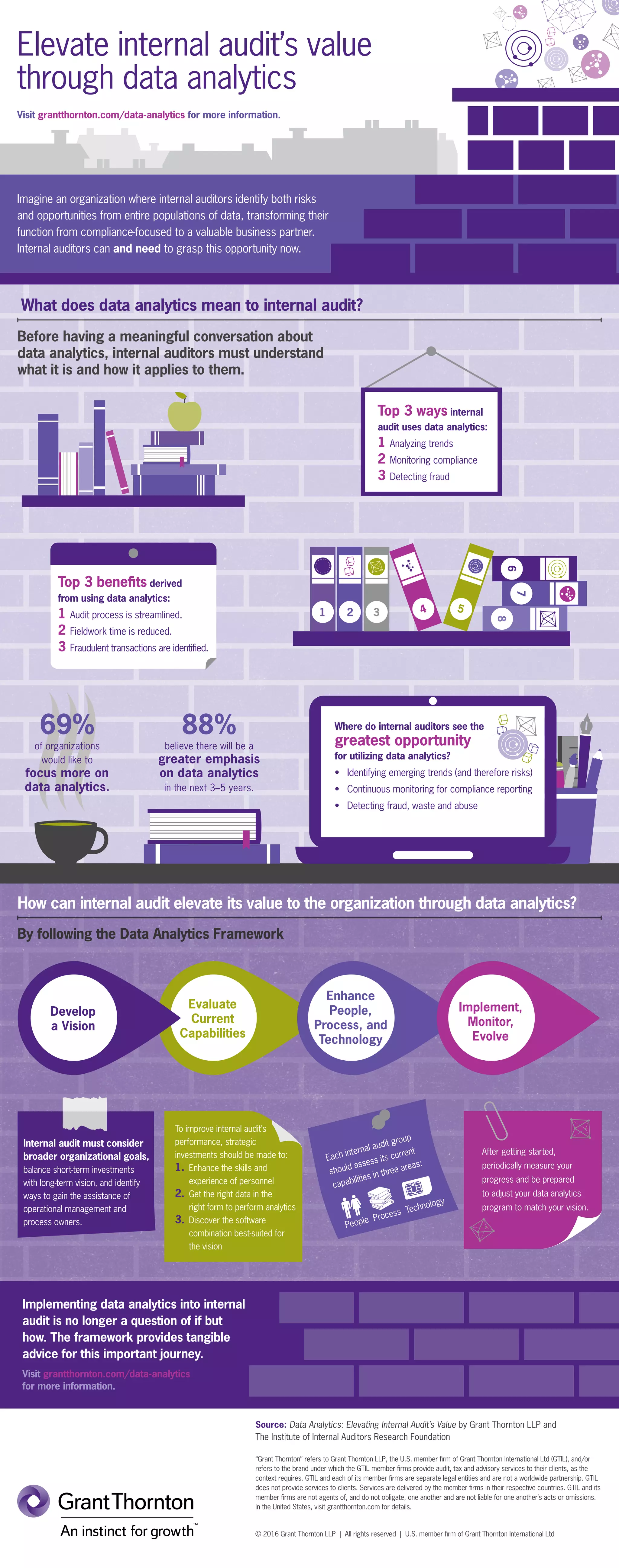
Imagine an organization where internal auditors identify both risks
and opportunities from entire populations of data, transforming their
function from compliance-focused to a valuable business partner.
Internal auditors can and need to grasp this opportunity now.
Elevate internal audit’s value
through data analytics
Visit grantthornton.com/data-analytics for more information.
88%
Before having a meaningful conversation about
data analytics, internal auditors must understand
what it is and how it applies to them.
What does data analytics mean to internal audit?
How can internal audit elevate its value to the organization through data analytics?
believe there will be a
greater emphasis
on data analytics
in the next 3–5 years.
Top 3 ways internal
audit uses data analytics:
1	 Analyzing trends
2	 Monitoring compliance
3 	Detecting fraud
Top 3 benefits derived
from using data analytics:
1	 Audit process is streamlined.
2	 Fieldwork time is reduced.
3	 Fraudulent transactions are identified.
69%
of organizations
would like to
focus more on
data analytics.
1 2 3 4 5
6
7
8
Where do internal auditors see the
greatest opportunity
for utilizing data analytics?
• Identifying emerging trends (and therefore risks)
• Continuous monitoring for compliance reporting
• Detecting fraud, waste and abuse
By following the Data Analytics Framework
Implementing data analytics into internal
audit is no longer a question of if but
how. The framework provides tangible
advice for this important journey.
Visit grantthornton.com/data-analytics
for more information.
Internal audit must consider
broader organizational goals,
balance short-term investments
with long-term vision, and identify
ways to gain the assistance of
operational management and
process owners.
To improve internal audit’s
performance, strategic
investments should be made to:
1.	 Enhance the skills and
	 experience of personnel
2.	 Get the right data in the
	 right form to perform analytics
3.	 Discover the software
	 combination best-suited for 	
	 the vision
Source: Data Analytics: Elevating Internal Audit’s Value by Grant Thornton LLP and
The Institute of Internal Auditors Research Foundation
“Grant Thornton” refers to Grant Thornton LLP, the U.S. member firm of Grant Thornton International Ltd (GTIL), and/or
refers to the brand under which the GTIL member firms provide audit, tax and advisory services to their clients, as the
context requires. GTIL and each of its member firms are separate legal entities and are not a worldwide partnership. GTIL
does not provide services to clients. Services are delivered by the member firms in their respective countries. GTIL and its
member firms are not agents of, and do not obligate, one another and are not liable for one another’s acts or omissions.
In the United States, visit grantthornton.com for details.
© 2016 Grant Thornton LLP  |  All rights reserved  |  U.S. member firm of Grant Thornton International Ltd
Each internal audit group
should assess its current
capabilities in three areas:
People Process Technology
Develop
a Vision
Evaluate
Current
Capabilities
Enhance
People,
Process, and
Technology
Implement,
Monitor,
Evolve
After getting started,
periodically measure your
progress and be prepared
to adjust your data analytics
program to match your vision.

The Future of Internal Audit through data analytics

  • 1.
    Imagine an organizationwhere internal auditors identify both risks and opportunities from entire populations of data, transforming their function from compliance-focused to a valuable business partner. Internal auditors can and need to grasp this opportunity now. Elevate internal audit’s value through data analytics Visit grantthornton.com/data-analytics for more information. 88% Before having a meaningful conversation about data analytics, internal auditors must understand what it is and how it applies to them. What does data analytics mean to internal audit? How can internal audit elevate its value to the organization through data analytics? believe there will be a greater emphasis on data analytics in the next 3–5 years. Top 3 ways internal audit uses data analytics: 1 Analyzing trends 2 Monitoring compliance 3 Detecting fraud Top 3 benefits derived from using data analytics: 1 Audit process is streamlined. 2 Fieldwork time is reduced. 3 Fraudulent transactions are identified. 69% of organizations would like to focus more on data analytics. 1 2 3 4 5 6 7 8 Where do internal auditors see the greatest opportunity for utilizing data analytics? • Identifying emerging trends (and therefore risks) • Continuous monitoring for compliance reporting • Detecting fraud, waste and abuse By following the Data Analytics Framework Implementing data analytics into internal audit is no longer a question of if but how. The framework provides tangible advice for this important journey. Visit grantthornton.com/data-analytics for more information. Internal audit must consider broader organizational goals, balance short-term investments with long-term vision, and identify ways to gain the assistance of operational management and process owners. To improve internal audit’s performance, strategic investments should be made to: 1. Enhance the skills and experience of personnel 2. Get the right data in the right form to perform analytics 3. Discover the software combination best-suited for the vision Source: Data Analytics: Elevating Internal Audit’s Value by Grant Thornton LLP and The Institute of Internal Auditors Research Foundation “Grant Thornton” refers to Grant Thornton LLP, the U.S. member firm of Grant Thornton International Ltd (GTIL), and/or refers to the brand under which the GTIL member firms provide audit, tax and advisory services to their clients, as the context requires. GTIL and each of its member firms are separate legal entities and are not a worldwide partnership. GTIL does not provide services to clients. Services are delivered by the member firms in their respective countries. GTIL and its member firms are not agents of, and do not obligate, one another and are not liable for one another’s acts or omissions. In the United States, visit grantthornton.com for details. © 2016 Grant Thornton LLP  |  All rights reserved  |  U.S. member firm of Grant Thornton International Ltd Each internal audit group should assess its current capabilities in three areas: People Process Technology Develop a Vision Evaluate Current Capabilities Enhance People, Process, and Technology Implement, Monitor, Evolve After getting started, periodically measure your progress and be prepared to adjust your data analytics program to match your vision.