BEYOND THE BADGE
Architecting Engagement Through Game Design Thinking

Dustin DiTommaso | @DU5TB1N
INTRODUCTION: WHY GAME DESIGN THINKING?

HYPE CYCLE: 2010/11 Saw a surge in ‘gami ed’ systems
& surrounding media frenzy.

DEBATE: Lack of consensus on usable game-based
vocabulary, including de ning ‘game’ & ‘gami cation.’

EVOLUTION: The de nition and practice of ‘gami cation’
is changing & differentiating.

SUSTAINABILITY: Survival of the ttest. With Evolution
comes continued Presence.

GAMES ARE A MEANS TO AN END
At the the Heart of It, we are designing
Experiences
INTRODUCTION: WHY GAME DESIGN THINKING?

HYPE CYCLE: 2010/11 Saw a surge in ‘gami ed’ systems
& surrounding media frenzy.

DEBATE: Lack of consensus on usable game-based
vocabulary, including de ning ‘game’ & ‘gami cation.’

EVOLUTION: The de nition and practice of ‘gami cation’
is changing & differentiating.

SUSTAINABILITY: Survival of the ttest. With evolution
comes continued presence.

GAMES ARE A MEANS TO AN END
At the the Heart of it, we are designing
Experiences
INTRODUCTION: WHY GAME DESIGN THINKING?

HYPE CYCLE: 2010/11 Saw a surge in ‘gami ed’ systems
& surrounding media frenzy.

DEBATE: Lack of consensus on usable game-based
vocabulary, including de ning ‘game’ & ‘gami cation.’

EVOLUTION: The de nition and practice of ‘gami cation’
is changing & differentiating.

SUSTAINABILITY: Survival of the ttest. With Evolution
comes continued Presence.

GAMES ARE A MEANS TO AN END
At the the Heart of It, we are designing
Experiences
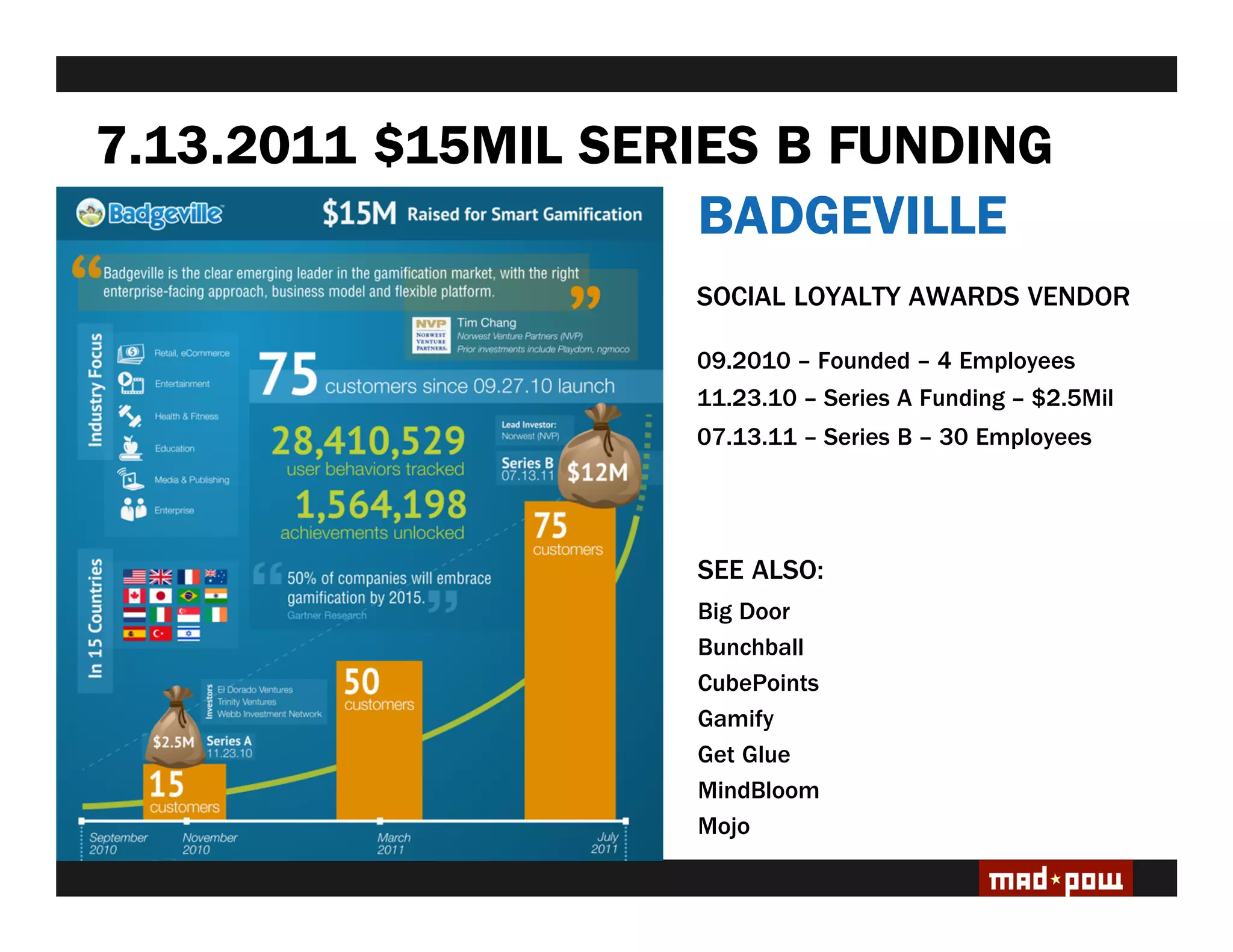
7.13.2011 $15MIL SERIES B FUNDING
                     BADGEVILLE
                     SOCIAL LOYALTY AWARDS VENDOR

                     09.2010 – Founded – 4 Employees
                     11.23.10 – Series A Funding – $2.5Mil
            A set.
                     07.13.11 – Series B – 30 Employees


                     SEE ALSO:
                     Big Door
                     Bunchball
                     CubePoints
                     Gamify
                     Get Glue
                     MindBloom
                     Mojo
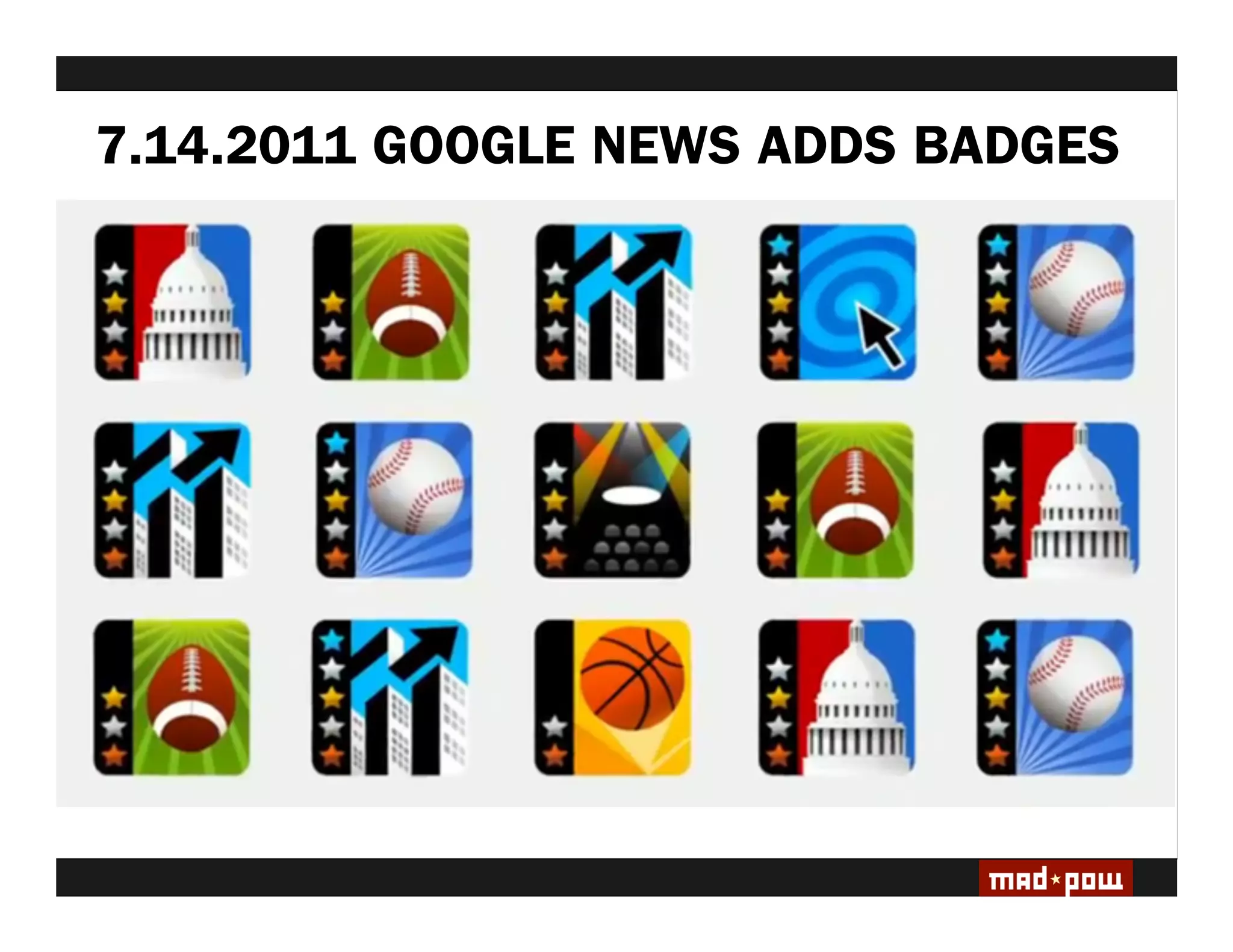
7.14.2011 GOOGLE NEWS ADDS BADGES
HYPE CYCLE: 2010/11 Saw a surge in ‘gami ed’ systems
& surrounding media frenzy.

DEBATE: Lack of consensus on usable game-based
vocabulary, including de ning ‘game’ & ‘gami cation.’

EVOLUTION: The de nition and practice of ‘gami cation’
is changing & differentiating.

SUSTAINABILITY: Survival of the ttest. With Evolution
comes continued Presence.

GAMES ARE A MEANS TO AN END
At the the Heart of It, we are designing
Experiences
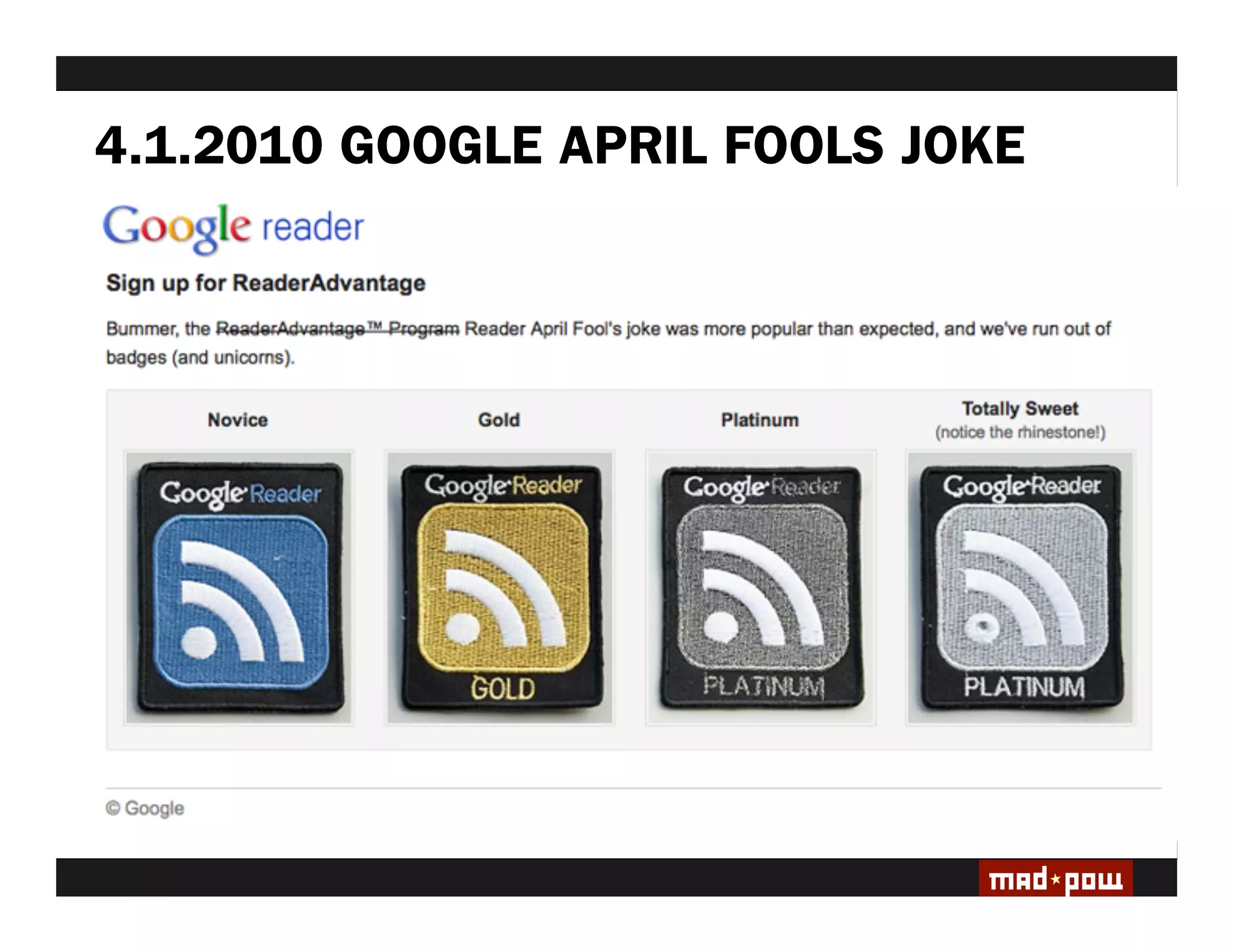
4.1.2010 GOOGLE APRIL FOOLS JOKE
HYPE CYCLE: 2010/11 Saw a surge in ‘gami ed’ systems
& surrounding media frenzy.

DEBATE: Lack of consensus on usable game-based
vocabulary, including de ning ‘game’ & ‘gami cation.’

EVOLUTION: The de nition and practice of ‘gami cation’
is changing & differentiating.

SUSTAINABILITY: Survival of the ttest. With Evolution
comes continued Presence.

GAMES ARE A MEANS TO AN END
At the the Heart of It, we are designing
Experiences
FOURSQUARE
         CURRENTLY, 10 MILLION USERS

         03.2009 – Launched!
A set.   09.2009 – 100,000 Users
         08.2010 – 1,000,000 Users


         BUT !!!

         Daily Check-ins/User dropped from 0.5 to 0.34
         when growing from 2 to 8 million accounts
         (foursquare 2011)

         21% report checking in for the Mayorship
         challenge and achievements

         54% say they check in ONLY when discounts or
         coupons are involved
TOO MUCH FOCUS ON SHALLOW, EXTRINSIC
REWARDS – POINTS & BADGES –
DOES NOT LEAD TO PLAYER SATISFACTION
OR SUSTAINED ENGAGEMENT.
TOO MUCH FOCUS ON SHALLOW, EXTRINSIC
REWARDS – POINTS & BADGES –
DOES NOT LEAD TO PLAYER SATISFACTION
OR SUSTAINED ENGAGEMENT.
WHAT IS A GAME?
WHAT IS A GAME?
A Structured, Voluntary Experience with
Rules and Goals that is Engaging and Fun.
FUN!!??!!??   O RLY??!!??
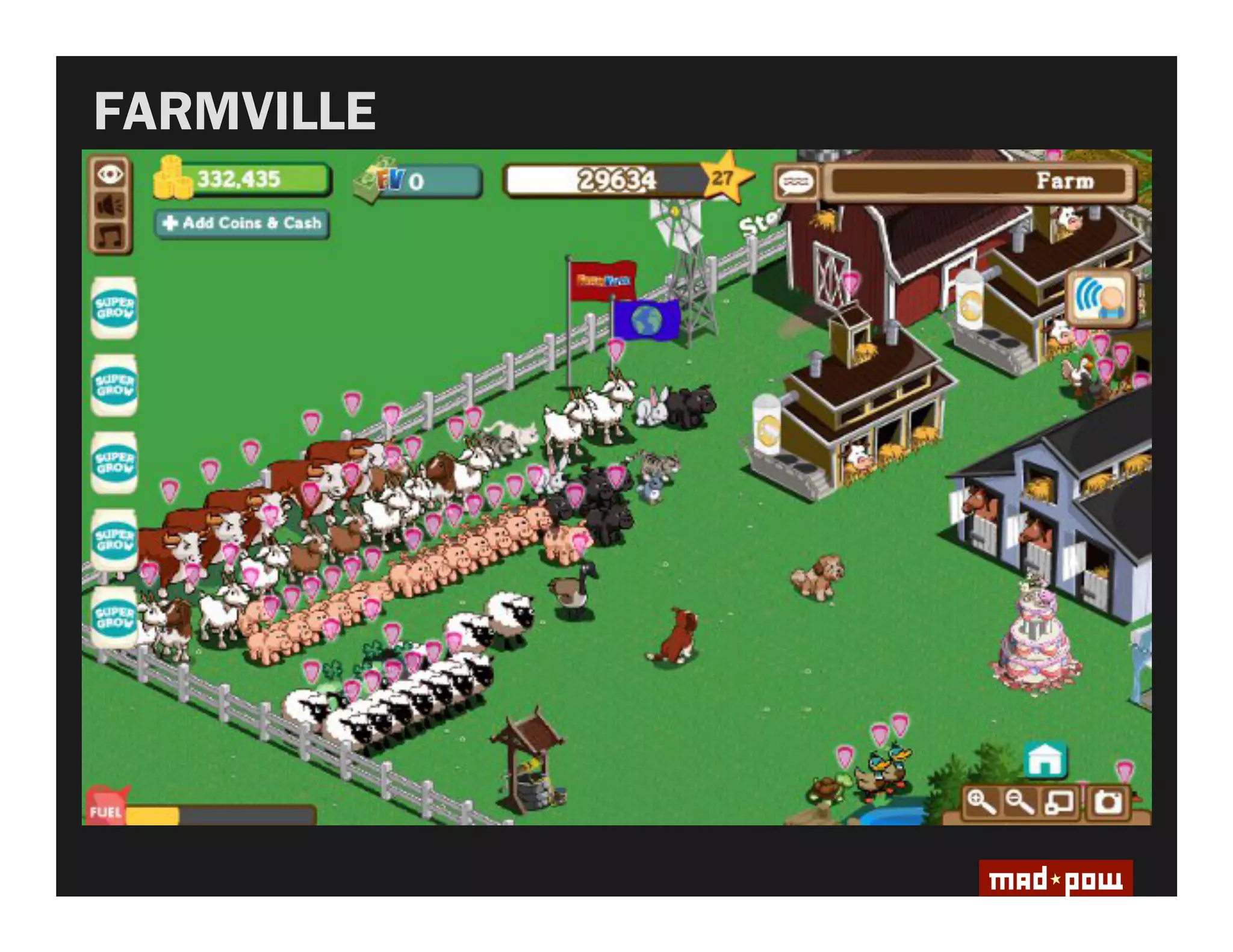
FARMVILLE
THE PROBLEM WITH FUN

  IT’S TOO DILUTED OF A CONCEPT

  It doesn’t distinguish the unique psychological
  experience of gameplay that leads to SUSTAINTED
  ENGAGEMENT.


   SEE:

   RAPH KOSTER – A THEORY OF FUN IN GAMES
   NICOLE LAZZARO – FOUR KEYS TO FUN
   MARC LEBLANC – EIGHT KINDS OF FUN
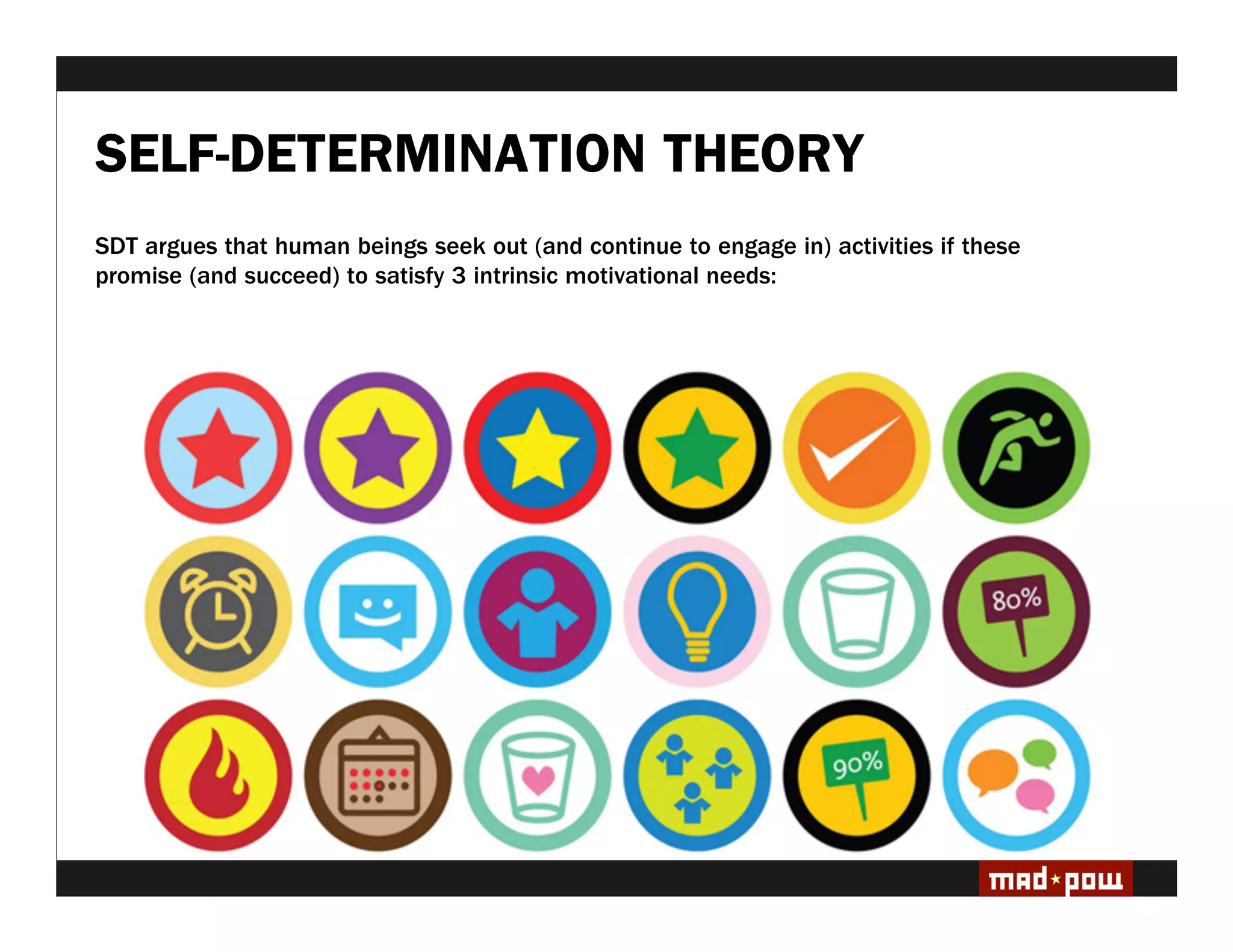
SELF-DETERMINATION THEORY
SDT argues that human beings seek out (and continue to engage in) activities if these
promise (and succeed) to satisfy 3 intrinsic motivational needs:
SELF-DETERMINATION THEORY
SDT argues that human beings seek out (and continue to engage in) activities if these
promise (and succeed) to satisfy 3 intrinsic motivational needs:


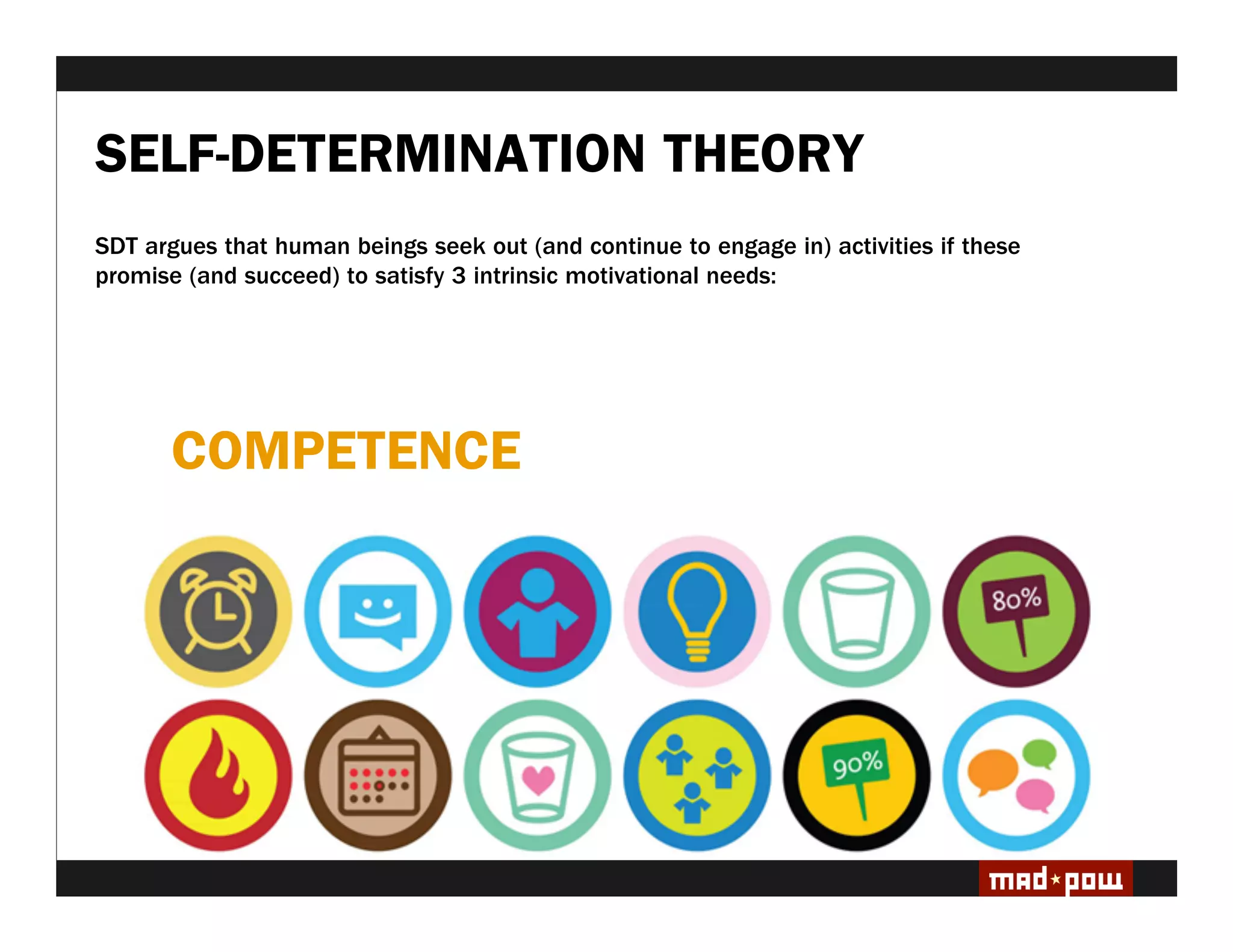
       COMPETENCE
SELF-DETERMINATION THEORY
SDT argues that human beings seek out (and continue to engage in) activities if these
promise (and succeed) to satisfy 3 intrinsic motivational needs:


       COMPETENCE

       AUTONOMY
SELF-DETERMINATION THEORY
SDT argues that human beings seek out (and continue to engage in) activities if these
promise (and succeed) to satisfy 3 intrinsic motivational needs:


       COMPETENCE

       AUTONOMY


       RELATEDNESS
COMPETENCE
THE PATH TO MASTERY:
+ The “Path To Mastery” is an Experience over Time
+ Nested, short-term achievable goals that lead to and support success of the overarching
  long-term goal.
+ Wherever a player is on their quest there should be a next goal just around the corner.
+ Design Appropriate Challenges and Rewards for All Players along Player Experience Lifecycle.
  N00B – Enthusiast – Master

MAKE PROGRESS VISIBLE:
+ Provide Real-Time Granular, Sustained and Cumulative Feedback on Overall Performance
+ Utilize Reward Mechanics to Light a Blazed Path of Accomplishment.
+ NOT About Shiny Digital Trophies, or Badges
+ Ensure that Rewards are Meaningful to Player Competence, during immediate play and
  long-term engagement.
COMPETENCE
EXPERIENCE OF CHALLENGE
+ Build Player Skill Through Challenges That Cause Them To Reach Just A Bit Out of Their Level
+ Optimal Challenges Stretch Player Ability But Don’t Overwhelm
+ Allow Players to Fail, if they can Learn and Grow from it (Gami cation does NOT do this)
+ Still, a High Success to Fail Ratio Works Best


EXPRESSION OF MASTERY
+ After Hard-Earned Rewards, Allow Players to Enjoy and Express their Dominance
+ Ease-Off Dif culty for a Short Term
+ Provide Social Outlets for Bragging & Peacocking
+ Big “Juicy Feedback” for a Job Well Done.
AUTONOMY
THE GAME BELONGS TO THE USER
+ Choice, Control and Mastery lead players to Deep Engagement and Loyalty
+ Provide the Right Information for Players to Best Make Use of their Autonomy
+ Operant Conditioning Tactics such as Time-Based or Loss Aversion Mechanics are a Turn-Off to
  those who recognize them and simply Predatory to those who don’t


OPPORTUNITIES FOR ACTION!
+ Goal is to Maximize Opportunities for Action
+ Provide a Variety of Ways to Play (Competitive, Cooperative, Solo)
+ Provide a Variety of Available Actions (Challenge, Social, Side-Quests, Secrets, Unlocks, etc.)
+ Allow Multiple Paths through Nested Goals that still lead to Overarching Goal
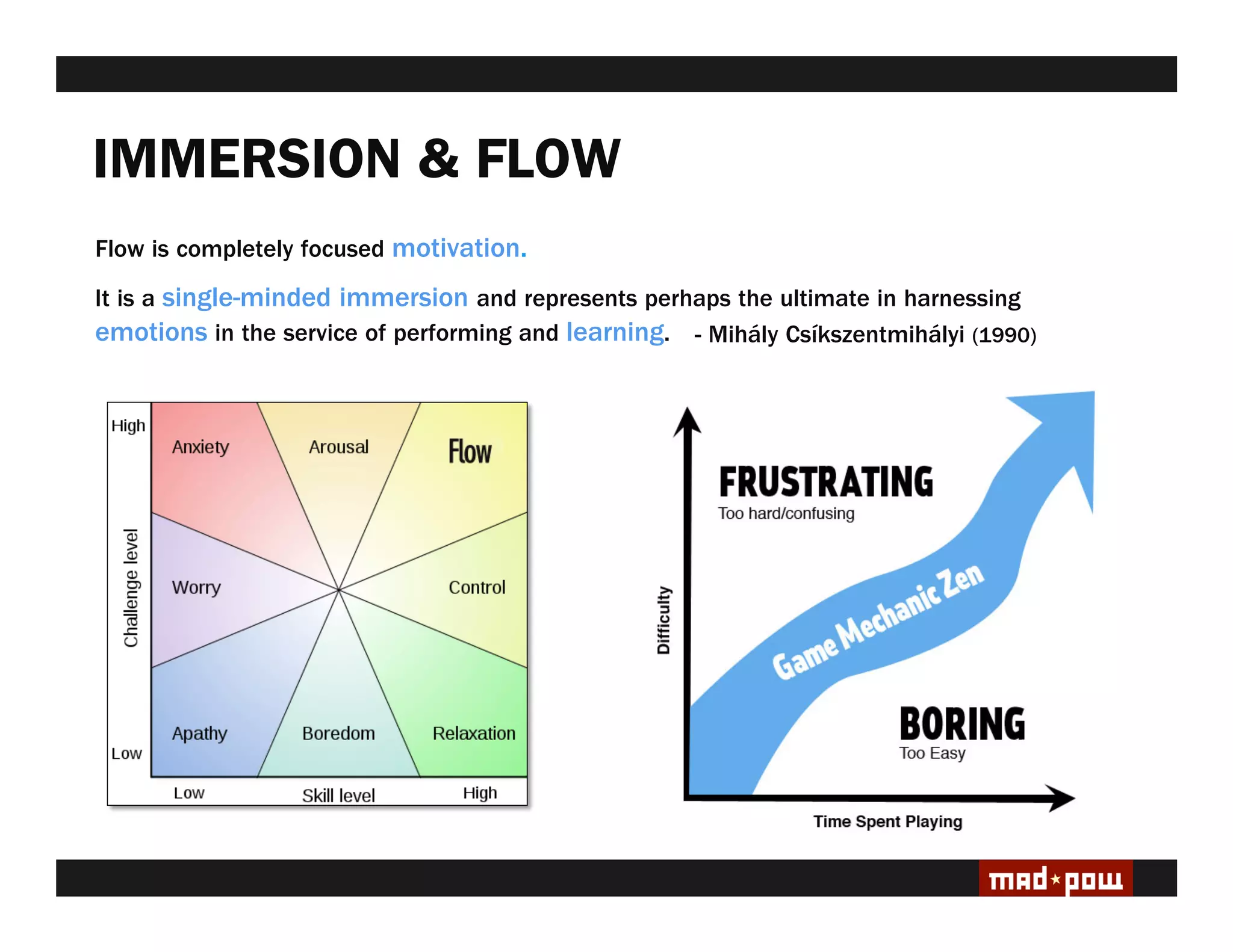
IMMERSION & FLOW
Flow is completely focused motivation..
It is a single-minded immersion and represents perhaps the ultimate in harnessing
emotions in the service of performing and learning. - Mihály Csíkszentmihályi (1990)
RELATEDNESS
THE SPARK OF CONNECTION
+ We are intrinsically motivated to seek meaningful connections with others
+ Data shows that in multiplayer situations, allowing players to connect with others and build
  relationships energizes, motivates and sustains ongoing engagement.
+ Focus on mechanics that allow players to both give and receive support of their goals
+ Provide for Communities of interest beyond one-on-one connections


BEYOND OTHER PLAYERS
+ Tap into content that people are passionate about (Health, Wealth, Career, Arts, ProSocial)
+ Allow users to inject their own short & long term goals into the system (Think Mint Goals)
+ Support your players with Informational Feedback that they care about
RELATEDNESS
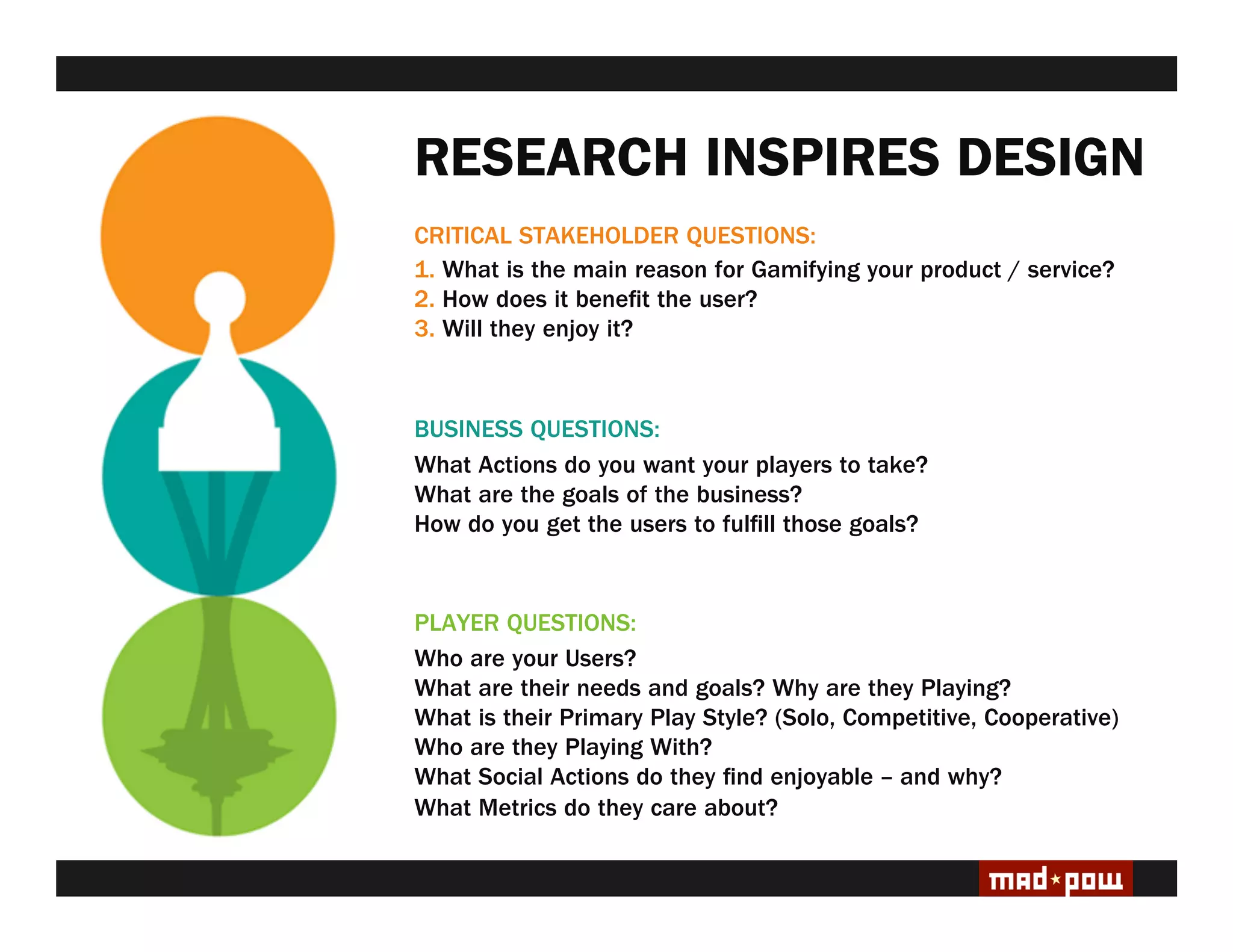
RESEARCH INSPIRES DESIGN
CRITICAL STAKEHOLDER QUESTIONS:
1. What is the main reason for Gamifying your product / service?
2. How does it bene t the user?
3. Will they enjoy it?


BUSINESS QUESTIONS:
What Actions do you want your players to take?
What are the goals of the business?
How do you get the users to ful ll those goals?


PLAYER QUESTIONS:
Who are your Users?
What are their needs and goals? Why are they Playing?
What is their Primary Play Style? (Solo, Competitive, Cooperative)
Who are they Playing With?
What Social Actions do they nd enjoyable – and why?
What Metrics do they care about?
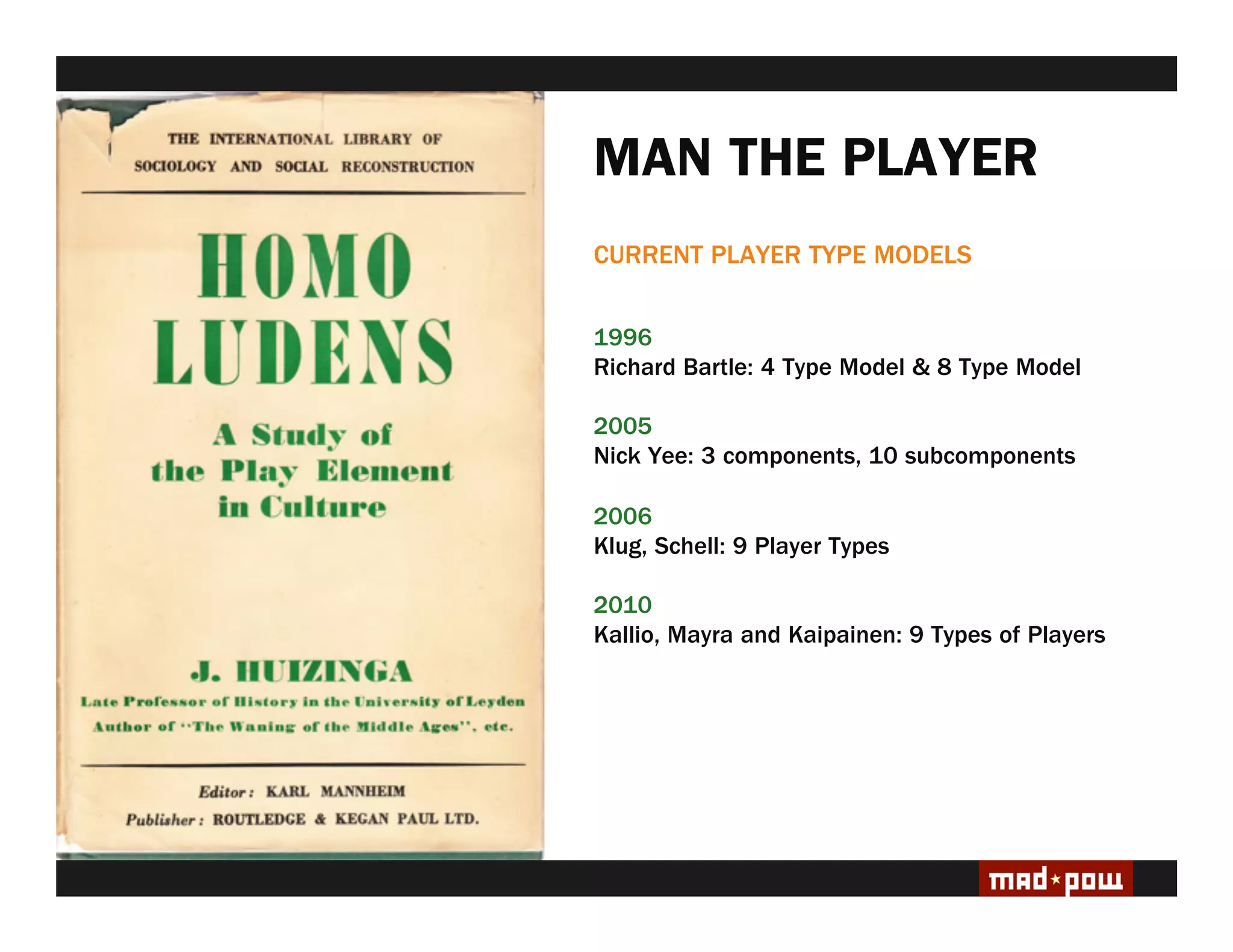
MAN THE PLAYER
CURRENT PLAYER TYPE MODELS


1996
Richard Bartle: 4 Type Model & 8 Type Model

2005
Nick Yee: 3 components, 10 subcomponents

2006
Klug, Schell: 9 Player Types

2010
Kallio, Mayra and Kaipainen: 9 Types of Players
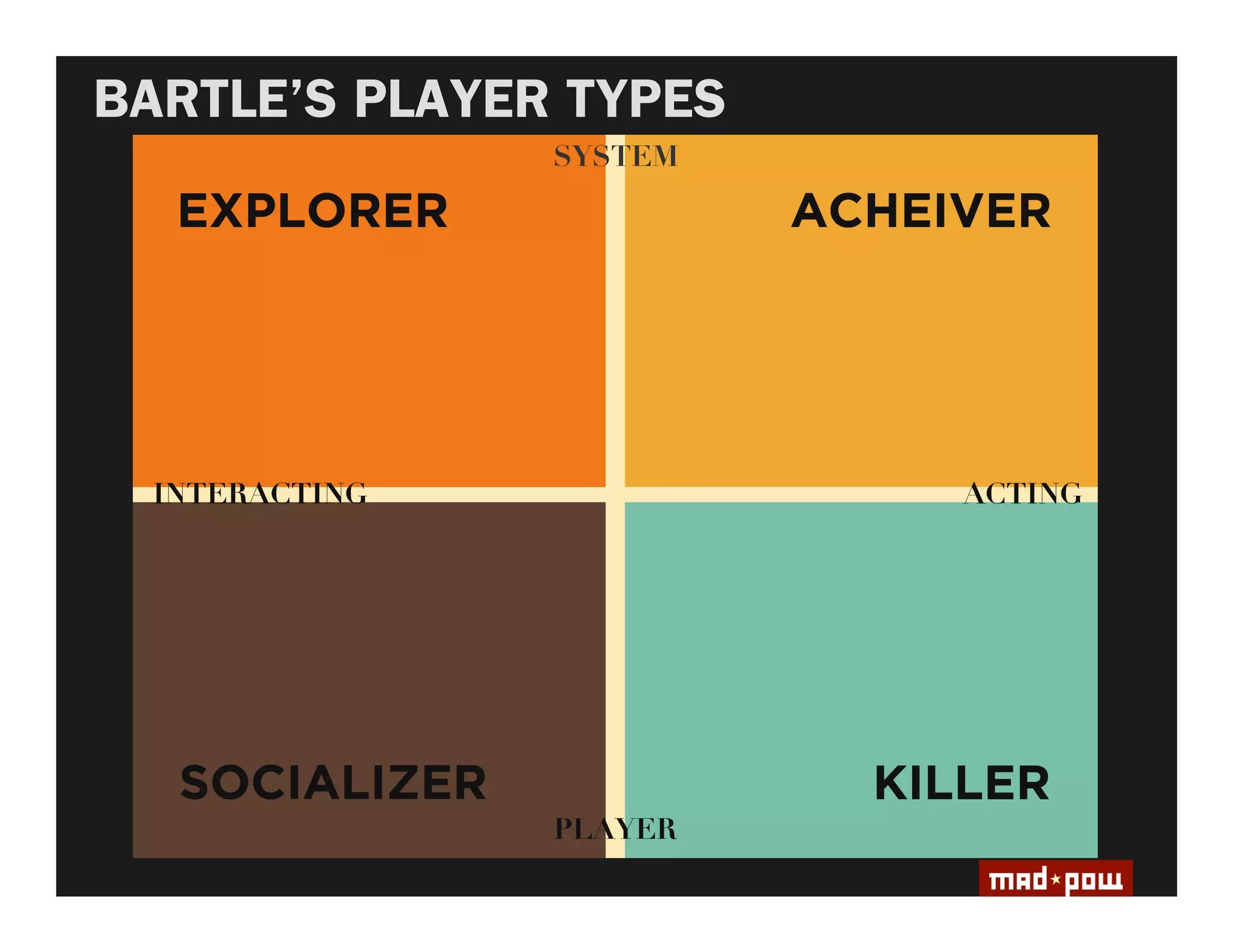
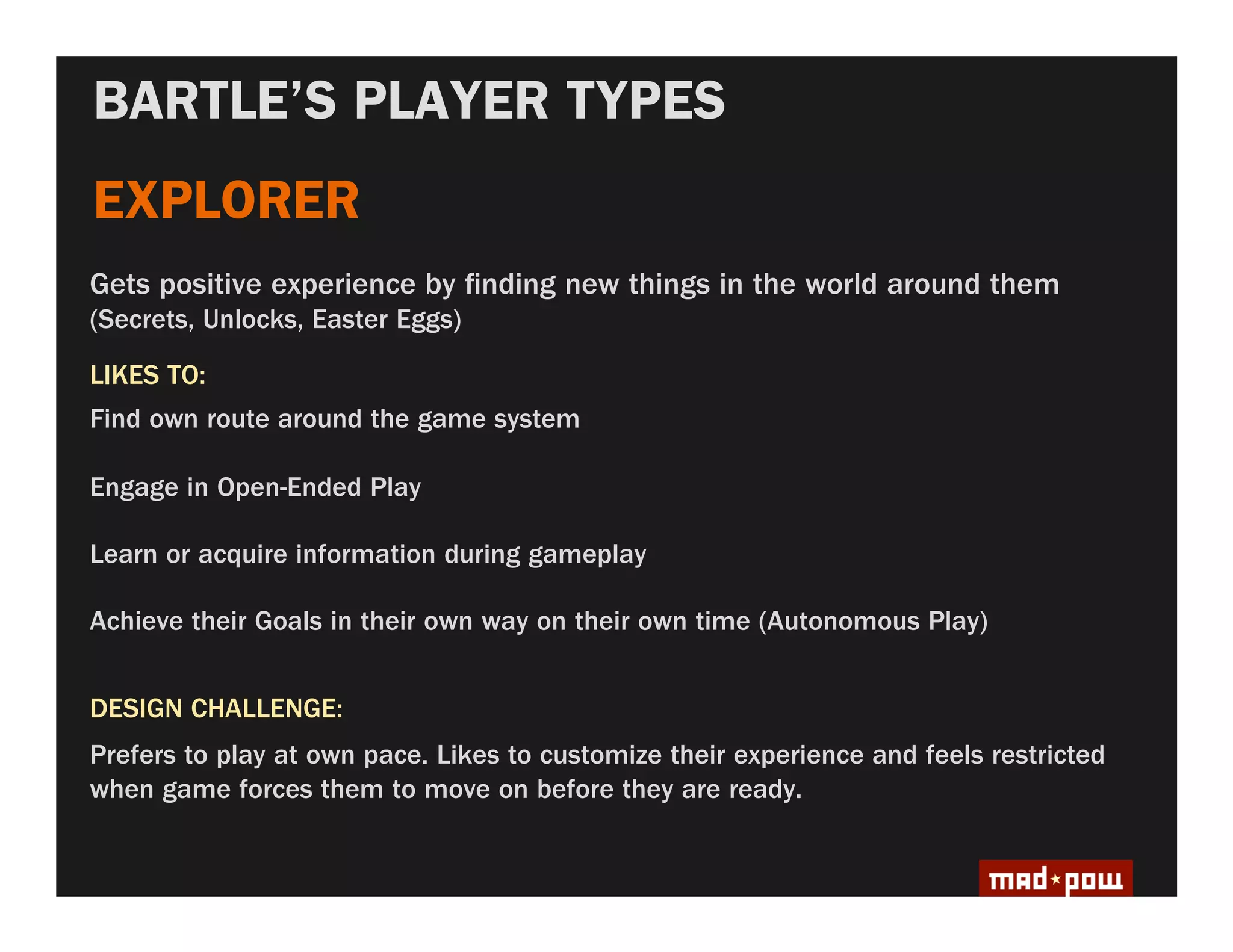
BARTLE’S PLAYER TYPES
EXPLORER
Gets positive experience by nding new things in the world around them
(Secrets, Unlocks, Easter Eggs)
LIKES TO:
Find own route around the game system

Engage in Open-Ended Play

Learn or acquire information during gameplay

Achieve their Goals in their own way on their own time (Autonomous Play)


DESIGN CHALLENGE:
Prefers to play at own pace. Likes to customize their experience and feels restricted
when game forces them to move on before they are ready.
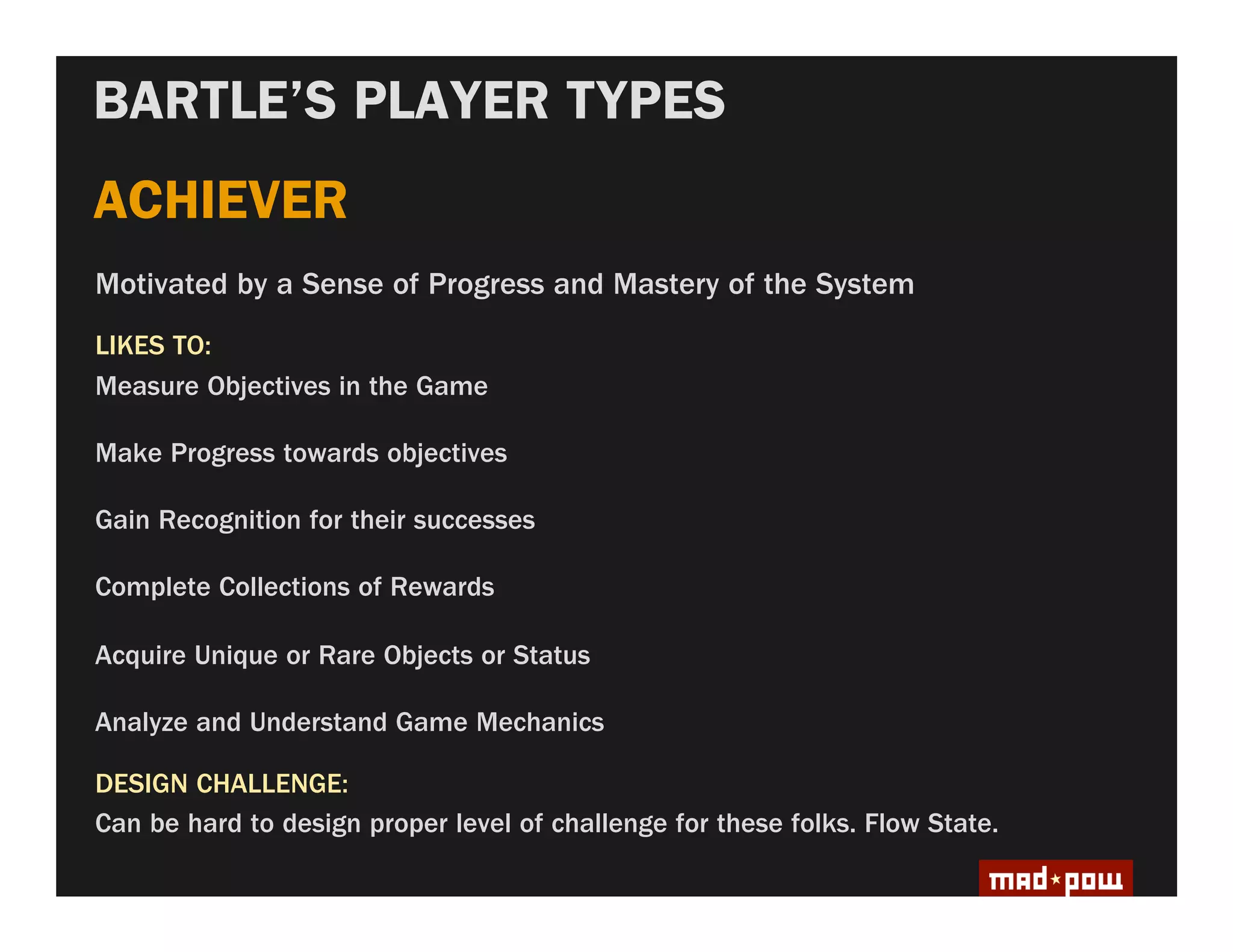
BARTLE’S PLAYER TYPES
ACHIEVER
Motivated by a Sense of Progress and Mastery of the System
LIKES TO:
Measure Objectives in the Game

Make Progress towards objectives

Gain Recognition for their successes

Complete Collections of Rewards

Acquire Unique or Rare Objects or Status

Analyze and Understand Game Mechanics

DESIGN CHALLENGE:
Can be hard to design proper level of challenge for these folks. Flow State.
BARTLE’S PLAYER TYPES
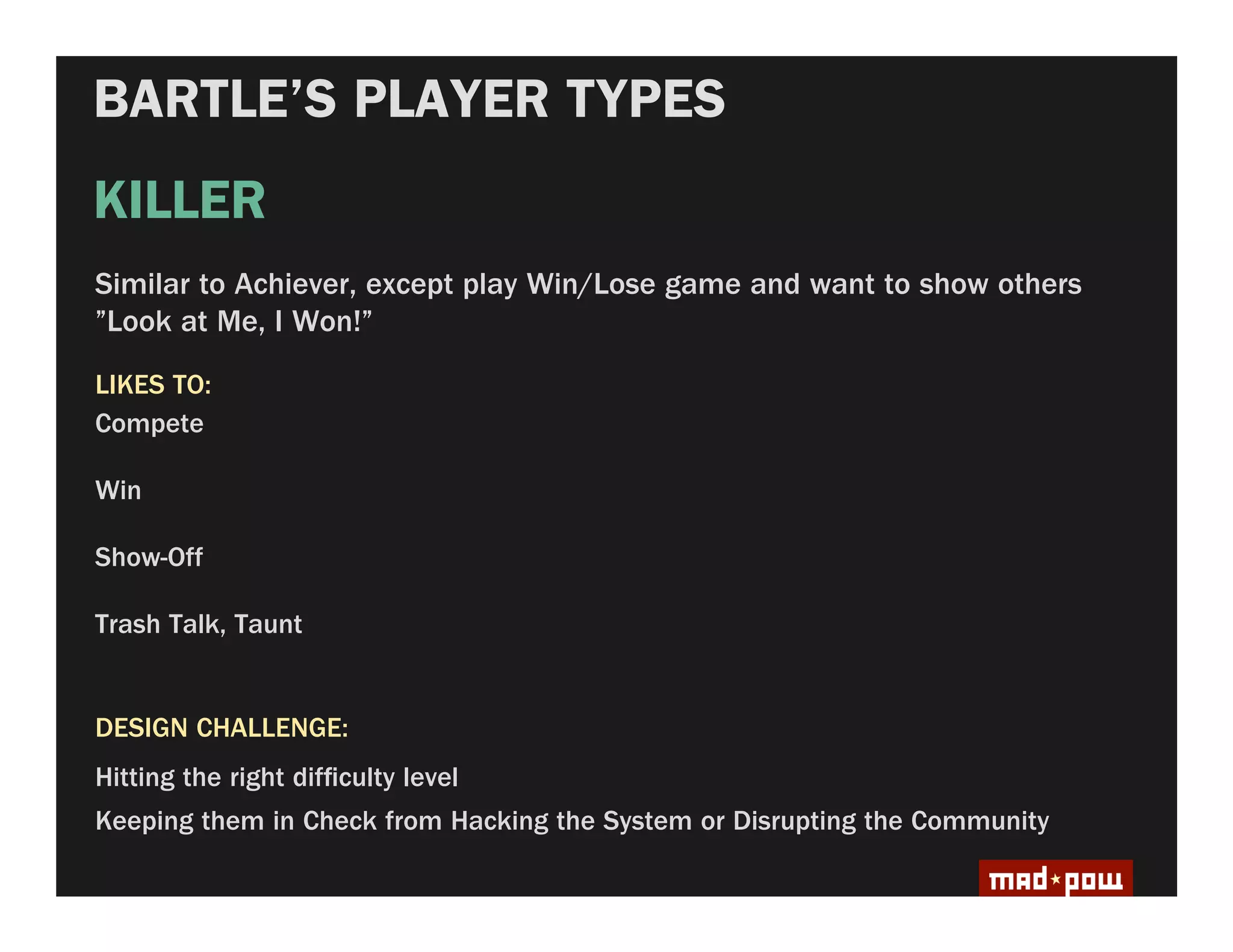
KILLER
Similar to Achiever, except play Win/Lose game and want to show others
”Look at Me, I Won!”

LIKES TO:
Compete

Win

Show-Off

Trash Talk, Taunt


DESIGN CHALLENGE:
Hitting the right dif culty level
Keeping them in Check from Hacking the System or Disrupting the Community
BARTLE’S PLAYER TYPES
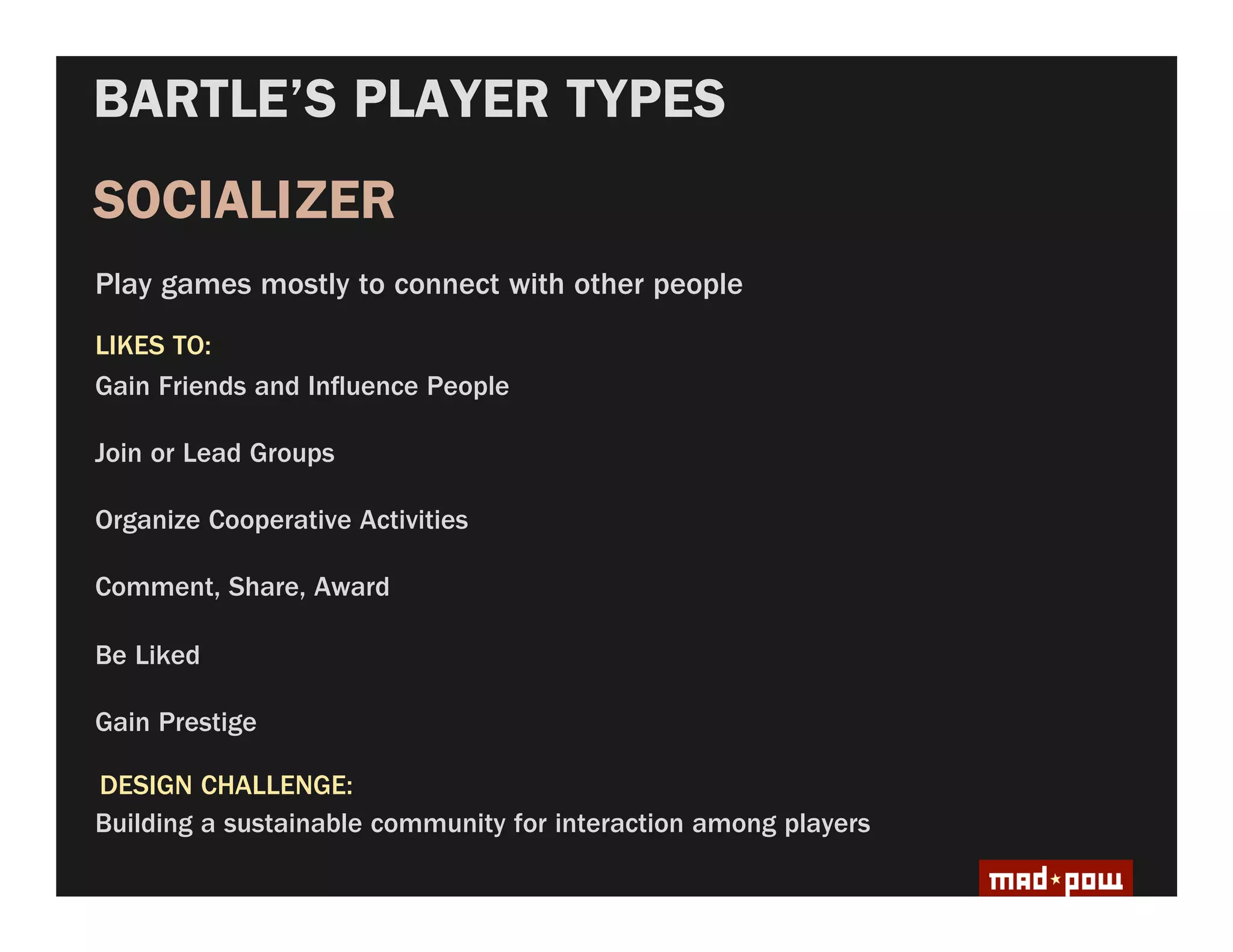
SOCIALIZER
Play games mostly to connect with other people
LIKES TO:
Gain Friends and In uence People

Join or Lead Groups

Organize Cooperative Activities

Comment, Share, Award

Be Liked

Gain Prestige

DESIGN CHALLENGE:
Building a sustainable community for interaction among players
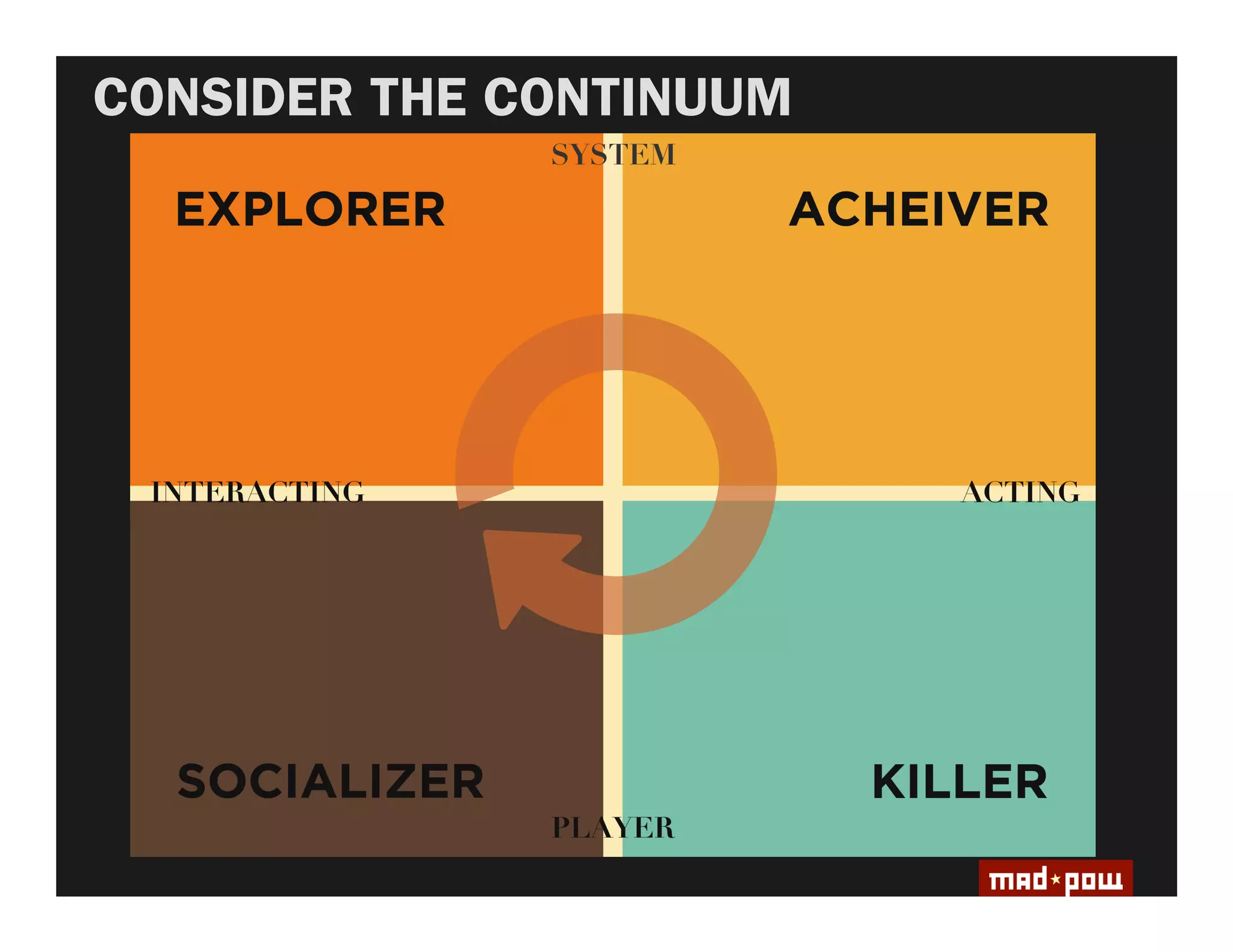
CONSIDER THE CONTINUUM
BONUS TIPS FOR ENGAGEMENT
ENGAGEMENT IS A JOURNEY
Design the Experience Over Time
Create Journey Maps (Timelines of player actions, reactions & emotions)
What does that Journey Towards Mastery look like?

ONBOARDING
Focus on N00B and First Time Experience
The First 60 seconds are crucial to show First-Time Users how it works
Get In, Get Busy, Tell People, Come Back
Guide the Player Experience - N00B Can’t Lose, Give them endorphin releasing
actions to perform.

GIVE THEN GET
Provide Value immediately when users arrive.
Give them the opportunity to engage, personalize and express preferences before
asking them to register.
BONUS TIPS FOR ENGAGEMENT
PICK THE RIGHT REWARDS AND FEEDBACK
Know your audience intimately and create enough Juicy Feedback for all levels of
the Journey (N00B, Regular, Master)
Light the Path of the Journey with Progress Mechanics
Achievable short term goals that work towards overarching long term goals

SOCIAL HOOKS
If you’ve created the RIGHT Rewards/Achievements then your Players will WANT to
share their Status with others.

DESIGN ETHICALLY
Addiction is not the same as Engagement
There is certainly ‘Click-Whir’ Behavioral Psych at work behind many mechanics.
Use them Responsibly.
REFERENCES: A PATH TO MASTERY

       GAME DESIGN THINKER

Nic Kelman, “Yes, but is it a game?” from Games : Required essay from a not so
required book.

Raph Koster, A Theory of Fun for Game Design : Fun arises from Learning & Mastery

James Paul Gee, What Video Games Have to Teach Us about Learning & Literacy :
Pairs nicely with Koster’s book

Mihály Csikszentmihályi, Flow – The Psychology of Optimal Experience : Many
implications for creating engagement architectures

Johan Huizinga, Homo Ludens, A Study of the Play Element in Culture : “It is ancient
wisdom, but also a little cheap, to call all human activity ‘play’.”

Ryan, Deci, The Handbook of Self-Determination Research : Perhaps the most well
researched psychological theory of intrinsic motivation
REFERENCES: A PATH TO MASTERY
       GAME MAKER
Hunicke, Leblanc, Zubek, MDA a Formal Process of Game Design : Origin of the
Mechanics, Dynamics, Aesthetics framework

Jesse Schell, The Art of Game Design – A Book of Lenses : Tactical and practical

Bateman, Boon, 21st Century Game Design : Pragmatic approach to Game Design

Jane McGonigal, Reality is Broken : Serious Games will Save the World

Zicherman, Linder, Game-Based Marketing : Enthusiastic, Behaviorist Argument for
Gami cation Pro teering.


         BONUS PLAY

Bartle Player Type Quiz : http://www.game-on-book.com/bartle
Jesse Schell, Visions of the Gamepocalypse [VIDEO] : http://bit.ly/jT6LvD
Portsmouth | Boston | Louisville
We deliver research-inspired design   Dustin DiTommaso
aimed at improving the experiences    Experience Design Director
people have with technology,          Email: dustin@madpow.net
organizations, and each other.        Twitter: @DU5TB1N

Beyond The Badge: Architecting Engagement Through Game Design Thinking

  • 1.
    BEYOND THE BADGE ArchitectingEngagement Through Game Design Thinking Dustin DiTommaso | @DU5TB1N
  • 2.
    INTRODUCTION: WHY GAMEDESIGN THINKING? HYPE CYCLE: 2010/11 Saw a surge in ‘gami ed’ systems & surrounding media frenzy. DEBATE: Lack of consensus on usable game-based vocabulary, including de ning ‘game’ & ‘gami cation.’ EVOLUTION: The de nition and practice of ‘gami cation’ is changing & differentiating. SUSTAINABILITY: Survival of the ttest. With Evolution comes continued Presence. GAMES ARE A MEANS TO AN END At the the Heart of It, we are designing Experiences
  • 3.
    INTRODUCTION: WHY GAMEDESIGN THINKING? HYPE CYCLE: 2010/11 Saw a surge in ‘gami ed’ systems & surrounding media frenzy. DEBATE: Lack of consensus on usable game-based vocabulary, including de ning ‘game’ & ‘gami cation.’ EVOLUTION: The de nition and practice of ‘gami cation’ is changing & differentiating. SUSTAINABILITY: Survival of the ttest. With evolution comes continued presence. GAMES ARE A MEANS TO AN END At the the Heart of it, we are designing Experiences
  • 4.
    INTRODUCTION: WHY GAMEDESIGN THINKING? HYPE CYCLE: 2010/11 Saw a surge in ‘gami ed’ systems & surrounding media frenzy. DEBATE: Lack of consensus on usable game-based vocabulary, including de ning ‘game’ & ‘gami cation.’ EVOLUTION: The de nition and practice of ‘gami cation’ is changing & differentiating. SUSTAINABILITY: Survival of the ttest. With Evolution comes continued Presence. GAMES ARE A MEANS TO AN END At the the Heart of It, we are designing Experiences
  • 5.
    7.13.2011 $15MIL SERIESB FUNDING BADGEVILLE SOCIAL LOYALTY AWARDS VENDOR 09.2010 – Founded – 4 Employees 11.23.10 – Series A Funding – $2.5Mil A set. 07.13.11 – Series B – 30 Employees SEE ALSO: Big Door Bunchball CubePoints Gamify Get Glue MindBloom Mojo
  • 6.
    7.14.2011 GOOGLE NEWSADDS BADGES HYPE CYCLE: 2010/11 Saw a surge in ‘gami ed’ systems & surrounding media frenzy. DEBATE: Lack of consensus on usable game-based vocabulary, including de ning ‘game’ & ‘gami cation.’ EVOLUTION: The de nition and practice of ‘gami cation’ is changing & differentiating. SUSTAINABILITY: Survival of the ttest. With Evolution comes continued Presence. GAMES ARE A MEANS TO AN END At the the Heart of It, we are designing Experiences
  • 7.
    4.1.2010 GOOGLE APRILFOOLS JOKE HYPE CYCLE: 2010/11 Saw a surge in ‘gami ed’ systems & surrounding media frenzy. DEBATE: Lack of consensus on usable game-based vocabulary, including de ning ‘game’ & ‘gami cation.’ EVOLUTION: The de nition and practice of ‘gami cation’ is changing & differentiating. SUSTAINABILITY: Survival of the ttest. With Evolution comes continued Presence. GAMES ARE A MEANS TO AN END At the the Heart of It, we are designing Experiences
  • 8.
    FOURSQUARE CURRENTLY, 10 MILLION USERS 03.2009 – Launched! A set. 09.2009 – 100,000 Users 08.2010 – 1,000,000 Users BUT !!! Daily Check-ins/User dropped from 0.5 to 0.34 when growing from 2 to 8 million accounts (foursquare 2011) 21% report checking in for the Mayorship challenge and achievements 54% say they check in ONLY when discounts or coupons are involved
  • 10.
    TOO MUCH FOCUSON SHALLOW, EXTRINSIC REWARDS – POINTS & BADGES – DOES NOT LEAD TO PLAYER SATISFACTION OR SUSTAINED ENGAGEMENT.
  • 11.
    TOO MUCH FOCUSON SHALLOW, EXTRINSIC REWARDS – POINTS & BADGES – DOES NOT LEAD TO PLAYER SATISFACTION OR SUSTAINED ENGAGEMENT.
  • 12.
    WHAT IS AGAME?
  • 13.
    WHAT IS AGAME? A Structured, Voluntary Experience with Rules and Goals that is Engaging and Fun.
  • 14.
    FUN!!??!!?? O RLY??!!??
  • 15.
  • 16.
    THE PROBLEM WITHFUN IT’S TOO DILUTED OF A CONCEPT It doesn’t distinguish the unique psychological experience of gameplay that leads to SUSTAINTED ENGAGEMENT. SEE: RAPH KOSTER – A THEORY OF FUN IN GAMES NICOLE LAZZARO – FOUR KEYS TO FUN MARC LEBLANC – EIGHT KINDS OF FUN
  • 17.
    SELF-DETERMINATION THEORY SDT arguesthat human beings seek out (and continue to engage in) activities if these promise (and succeed) to satisfy 3 intrinsic motivational needs:
  • 18.
    SELF-DETERMINATION THEORY SDT arguesthat human beings seek out (and continue to engage in) activities if these promise (and succeed) to satisfy 3 intrinsic motivational needs: COMPETENCE
  • 19.
    SELF-DETERMINATION THEORY SDT arguesthat human beings seek out (and continue to engage in) activities if these promise (and succeed) to satisfy 3 intrinsic motivational needs: COMPETENCE AUTONOMY
  • 20.
    SELF-DETERMINATION THEORY SDT arguesthat human beings seek out (and continue to engage in) activities if these promise (and succeed) to satisfy 3 intrinsic motivational needs: COMPETENCE AUTONOMY RELATEDNESS
  • 21.
    COMPETENCE THE PATH TOMASTERY: + The “Path To Mastery” is an Experience over Time + Nested, short-term achievable goals that lead to and support success of the overarching long-term goal. + Wherever a player is on their quest there should be a next goal just around the corner. + Design Appropriate Challenges and Rewards for All Players along Player Experience Lifecycle. N00B – Enthusiast – Master MAKE PROGRESS VISIBLE: + Provide Real-Time Granular, Sustained and Cumulative Feedback on Overall Performance + Utilize Reward Mechanics to Light a Blazed Path of Accomplishment. + NOT About Shiny Digital Trophies, or Badges + Ensure that Rewards are Meaningful to Player Competence, during immediate play and long-term engagement.
  • 22.
    COMPETENCE EXPERIENCE OF CHALLENGE +Build Player Skill Through Challenges That Cause Them To Reach Just A Bit Out of Their Level + Optimal Challenges Stretch Player Ability But Don’t Overwhelm + Allow Players to Fail, if they can Learn and Grow from it (Gami cation does NOT do this) + Still, a High Success to Fail Ratio Works Best EXPRESSION OF MASTERY + After Hard-Earned Rewards, Allow Players to Enjoy and Express their Dominance + Ease-Off Dif culty for a Short Term + Provide Social Outlets for Bragging & Peacocking + Big “Juicy Feedback” for a Job Well Done.
  • 23.
    AUTONOMY THE GAME BELONGSTO THE USER + Choice, Control and Mastery lead players to Deep Engagement and Loyalty + Provide the Right Information for Players to Best Make Use of their Autonomy + Operant Conditioning Tactics such as Time-Based or Loss Aversion Mechanics are a Turn-Off to those who recognize them and simply Predatory to those who don’t OPPORTUNITIES FOR ACTION! + Goal is to Maximize Opportunities for Action + Provide a Variety of Ways to Play (Competitive, Cooperative, Solo) + Provide a Variety of Available Actions (Challenge, Social, Side-Quests, Secrets, Unlocks, etc.) + Allow Multiple Paths through Nested Goals that still lead to Overarching Goal
  • 24.
    IMMERSION & FLOW Flowis completely focused motivation.. It is a single-minded immersion and represents perhaps the ultimate in harnessing emotions in the service of performing and learning. - Mihály Csíkszentmihályi (1990)
  • 25.
    RELATEDNESS THE SPARK OFCONNECTION + We are intrinsically motivated to seek meaningful connections with others + Data shows that in multiplayer situations, allowing players to connect with others and build relationships energizes, motivates and sustains ongoing engagement. + Focus on mechanics that allow players to both give and receive support of their goals + Provide for Communities of interest beyond one-on-one connections BEYOND OTHER PLAYERS + Tap into content that people are passionate about (Health, Wealth, Career, Arts, ProSocial) + Allow users to inject their own short & long term goals into the system (Think Mint Goals) + Support your players with Informational Feedback that they care about
  • 26.
  • 27.
    RESEARCH INSPIRES DESIGN CRITICALSTAKEHOLDER QUESTIONS: 1. What is the main reason for Gamifying your product / service? 2. How does it bene t the user? 3. Will they enjoy it? BUSINESS QUESTIONS: What Actions do you want your players to take? What are the goals of the business? How do you get the users to ful ll those goals? PLAYER QUESTIONS: Who are your Users? What are their needs and goals? Why are they Playing? What is their Primary Play Style? (Solo, Competitive, Cooperative) Who are they Playing With? What Social Actions do they nd enjoyable – and why? What Metrics do they care about?
  • 28.
    MAN THE PLAYER CURRENTPLAYER TYPE MODELS 1996 Richard Bartle: 4 Type Model & 8 Type Model 2005 Nick Yee: 3 components, 10 subcomponents 2006 Klug, Schell: 9 Player Types 2010 Kallio, Mayra and Kaipainen: 9 Types of Players
  • 29.
  • 30.
    BARTLE’S PLAYER TYPES EXPLORER Getspositive experience by nding new things in the world around them (Secrets, Unlocks, Easter Eggs) LIKES TO: Find own route around the game system Engage in Open-Ended Play Learn or acquire information during gameplay Achieve their Goals in their own way on their own time (Autonomous Play) DESIGN CHALLENGE: Prefers to play at own pace. Likes to customize their experience and feels restricted when game forces them to move on before they are ready.
  • 31.
    BARTLE’S PLAYER TYPES ACHIEVER Motivatedby a Sense of Progress and Mastery of the System LIKES TO: Measure Objectives in the Game Make Progress towards objectives Gain Recognition for their successes Complete Collections of Rewards Acquire Unique or Rare Objects or Status Analyze and Understand Game Mechanics DESIGN CHALLENGE: Can be hard to design proper level of challenge for these folks. Flow State.
  • 32.
    BARTLE’S PLAYER TYPES KILLER Similarto Achiever, except play Win/Lose game and want to show others ”Look at Me, I Won!” LIKES TO: Compete Win Show-Off Trash Talk, Taunt DESIGN CHALLENGE: Hitting the right dif culty level Keeping them in Check from Hacking the System or Disrupting the Community
  • 33.
    BARTLE’S PLAYER TYPES SOCIALIZER Playgames mostly to connect with other people LIKES TO: Gain Friends and In uence People Join or Lead Groups Organize Cooperative Activities Comment, Share, Award Be Liked Gain Prestige DESIGN CHALLENGE: Building a sustainable community for interaction among players
  • 34.
  • 36.
    BONUS TIPS FORENGAGEMENT ENGAGEMENT IS A JOURNEY Design the Experience Over Time Create Journey Maps (Timelines of player actions, reactions & emotions) What does that Journey Towards Mastery look like? ONBOARDING Focus on N00B and First Time Experience The First 60 seconds are crucial to show First-Time Users how it works Get In, Get Busy, Tell People, Come Back Guide the Player Experience - N00B Can’t Lose, Give them endorphin releasing actions to perform. GIVE THEN GET Provide Value immediately when users arrive. Give them the opportunity to engage, personalize and express preferences before asking them to register.
  • 37.
    BONUS TIPS FORENGAGEMENT PICK THE RIGHT REWARDS AND FEEDBACK Know your audience intimately and create enough Juicy Feedback for all levels of the Journey (N00B, Regular, Master) Light the Path of the Journey with Progress Mechanics Achievable short term goals that work towards overarching long term goals SOCIAL HOOKS If you’ve created the RIGHT Rewards/Achievements then your Players will WANT to share their Status with others. DESIGN ETHICALLY Addiction is not the same as Engagement There is certainly ‘Click-Whir’ Behavioral Psych at work behind many mechanics. Use them Responsibly.
  • 38.
    REFERENCES: A PATHTO MASTERY GAME DESIGN THINKER Nic Kelman, “Yes, but is it a game?” from Games : Required essay from a not so required book. Raph Koster, A Theory of Fun for Game Design : Fun arises from Learning & Mastery James Paul Gee, What Video Games Have to Teach Us about Learning & Literacy : Pairs nicely with Koster’s book Mihály Csikszentmihályi, Flow – The Psychology of Optimal Experience : Many implications for creating engagement architectures Johan Huizinga, Homo Ludens, A Study of the Play Element in Culture : “It is ancient wisdom, but also a little cheap, to call all human activity ‘play’.” Ryan, Deci, The Handbook of Self-Determination Research : Perhaps the most well researched psychological theory of intrinsic motivation
  • 39.
    REFERENCES: A PATHTO MASTERY GAME MAKER Hunicke, Leblanc, Zubek, MDA a Formal Process of Game Design : Origin of the Mechanics, Dynamics, Aesthetics framework Jesse Schell, The Art of Game Design – A Book of Lenses : Tactical and practical Bateman, Boon, 21st Century Game Design : Pragmatic approach to Game Design Jane McGonigal, Reality is Broken : Serious Games will Save the World Zicherman, Linder, Game-Based Marketing : Enthusiastic, Behaviorist Argument for Gami cation Pro teering. BONUS PLAY Bartle Player Type Quiz : http://www.game-on-book.com/bartle Jesse Schell, Visions of the Gamepocalypse [VIDEO] : http://bit.ly/jT6LvD
  • 40.
    Portsmouth | Boston| Louisville We deliver research-inspired design Dustin DiTommaso aimed at improving the experiences Experience Design Director people have with technology, Email: dustin@madpow.net organizations, and each other. Twitter: @DU5TB1N