PANTEION UNIVERSITY
Department of communication
     media and culture

   Marketing and public relations lab


   Social Media and Entrepreneurship
Gamification
According to Herodotus: the first game - dice (Kingdom of
 Lydia)

Facing Famine: Extreme circumstances, extreme solutions

 One day they eat, the other they played dice,
 forgetting the famine! (Βlissful productivity)

Result? Survival from the famine for 18 years !

 The first ever game to influence a civilization!
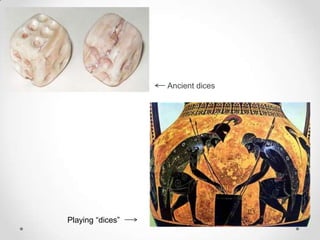
Ancient dices


Playing “dices”
How games entered our
           lives?
     The decade of games is starting now
                 because:
 - Cultural and technological shifts have led us to a
perfect convergence of reach, relevance and
demand.

 -Traditional forms of entertainment (movies,
television... remember books?) are in a rapid
decline. The demand for entertainment shifted to
a more interactive, pervasive form of
entertainment. It's shifting to games.
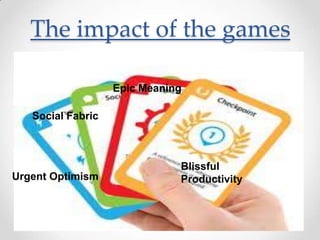
The impact of the games

                   Epic Meaning

   Social Fabric


                              Blissful
Urgent Optimism               Productivity
Through games …
                  Greater insistence
                  on a problem,
                  accepting failure                 Discovering our
                  and having the                    real capacity
                  opportunity to try                epic winning.
                  again.

                                                      Positive
                                                      feedback

Motives to achieve
something
important, having
inspiration for
cooperation.                       -Inspiration for
                                   cooperation evolving in
     Displaying the best           a more collaborative and
     version of ourselves.         compassionate nature
How games affect our lives?
Ιnteractive involvement of the players-Identification
with a character in the game.
Developing solving skills, analytical and estimation skills
and quick decision-making
 Abilities of resource - management(time, armor,
people) and testing.
 Ability to recognize the types of situations and react
to them with determination.
 Channelize one's emotions in a positive way.
 Team spirit, leadership and social skills.
“When you strip away
the genre differences
and the technological
complexities,
all games share four
defining traits: a goal,
rules, a feedback
system, and voluntary
participation.”
Jane McGonigal:


   “We have to
   start doing the real
   world more like a game.”
Game Mechanics

Game Mechanics are       Game mechanics are
constructs or tactics    essentially a
commonly used in         collection of tools that
games to encourage       measure and report
game play. These are     statistics. Those
things like badges,      statistics represent
points, leader boards,   progress.
levels, challenges,
achievements.
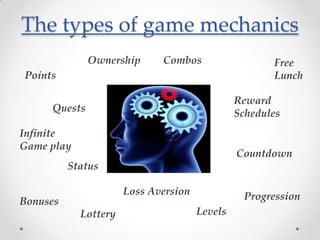
The types of game mechanics
              Ownership      Combos                   Free
Points                                                Lunch

                                               Reward
     Quests                                    Schedules
Infinite
Game play
                                               Countdown
          Status

                      Loss Aversion             Progression
Bonuses
            Lottery                   Levels
Game Dynamics

…are strategies commonly used in
game design based on psychological
motivations. Game dynamics are fast
becoming a critical currency of
motivation. Their power lies not in
connecting us to our friends, but in
directly influencing our individual
behaviour.
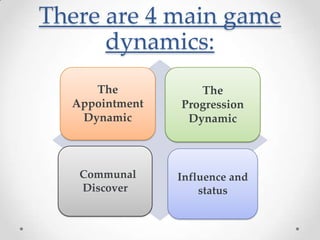
There are 4 main game
      dynamics:
     The           The
  Appointment   Progression
   Dynamic       Dynamic


   Communal     Influence and
   Discover         status
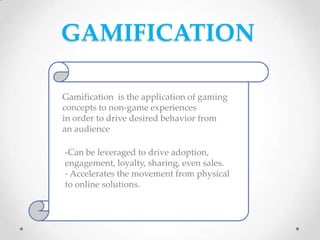
GAMIFICATION

Gamification is the application of gaming
concepts to non-game experiences
in order to drive desired behavior from
an audience

-Can be leveraged to drive adoption,
engagement, loyalty, sharing, even sales.
- Accelerates the movement from physical
to online solutions.
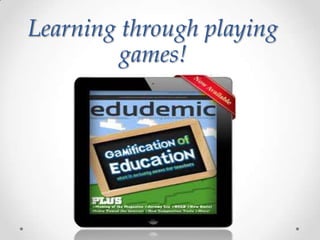
Learning through playing
         games!
The cycle of lecture, test and repeat
is not the best way to engage kids.
In fact, it might be the best way to
            alienate them.
“ There are many lessons
 from the world of video
games that we can apply
  to education and see
    immediate results.”
- Games can create a risk-free environment for
   learning and discovery. In most games, failure is a
   given.

- This is a very effective way for teens to learn.

- Importantly, there is no shame around this type of
   failure. It’s simply part of the process of learning
   (and, eventually, winning).

- Kids who are not frustrated by failure are less likely to
   give up on learning.
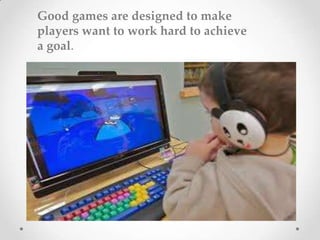
Good games are designed to make
players want to work hard to achieve
a goal.
- Games have many other properties that make
 them a perfect vehicle to address our education
 problems.

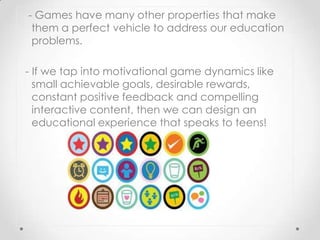
- If we tap into motivational game dynamics like
  small achievable goals, desirable rewards,
  constant positive feedback and compelling
  interactive content, then we can design an
  educational experience that speaks to teens!
Turning theory into reality!
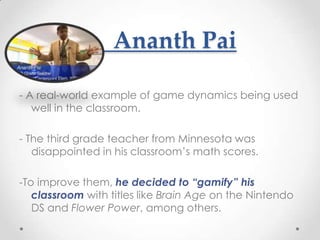
Ananth Pai

- A real-world example of game dynamics being used
   well in the classroom.

- The third grade teacher from Minnesota was
   disappointed in his classroom’s math scores.

-To improve them, he decided to “gamify” his
   classroom with titles like Brain Age on the Nintendo
   DS and Flower Power, among others.
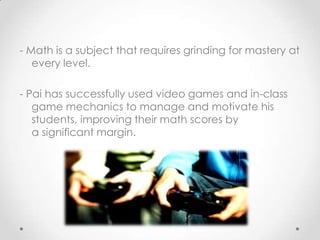
- Math is a subject that requires grinding for mastery at
   every level.

- Pai has successfully used video games and in-class
   game mechanics to manage and motivate his
   students, improving their math scores by
   a significant margin.
“Until we have School
 Ville or World of 21st Century
      Skillcraft, let’s replace
lectures and testing with play
  and discovery and begin
fostering a passion for lifelong
       learning in all of our
             students!”

               Ananth Pai
Salman
Khan,
creator
of Khan
Academy
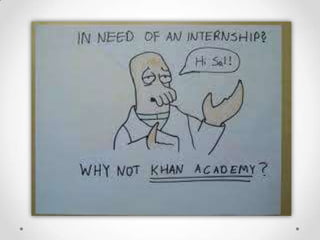
The Khan Academy
- The Khan Academy is a not-for-profit organization on
   a mission.

- Their goal is changing education for the better by
   providing a free world-class education to anyone
   anywhere.

- All of the site's materials and resources are available
   to anyone completely free of charge.
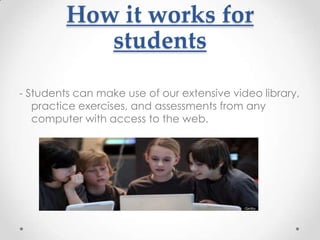
How it works for
            students

- Students can make use of our extensive video library,
   practice exercises, and assessments from any
   computer with access to the web.
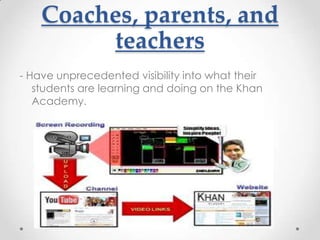
Coaches, parents, and
         teachers
- Have unprecedented visibility into what their
   students are learning and doing on the Khan
   Academy.
A global classroom
- By entering you're joining millions of Khan Academy
   students from all over the world who learn at their
   own pace every single day.

- You also have the ability read some of the
   inspirational stories shared by their global
   community and you can share yours as well.
The “game” of Khan
          Academy
- Learning is fun & students should want to learn.
- Most students steadily lose their natural enthusiasm &
   curiosity, as they grow older.

- The education system has a very poorly designed
   motivation and incentive system.

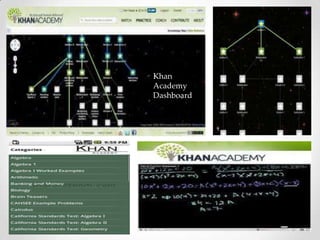
• The platform behind the Khan Academy was based
  in the concept of badges and other game
  mechanics.
Khan
Academy
Dashboard
Main Characteristics
- Most games are fairly non-judgmental.

- You feel good when you progress, regardless of how
   old you are or how long it took you.

- Most games give you a sense of immediate success
  and progress.

- Most games encourage you to push your own
   personal boundaries.
What if…
- Instead of threatening to fail a 9th grader who
   struggles with fractions we made him feel proud to
   actually learn fractions?

- Instead of waiting for the end of the year to get your
   grade you accumulated a sense of progress with
   every action you did every single day?

- Students were always encouraged to improve
   themselves incrementally?
Let’s not forget…
- Students should feel good about what
   they accomplish every single day.

- They should be encouraged to overcome
   their personal challenges.

- When learning once again becomes a personalized
   path full of individual triumphs, students will reclaim
   their natural enthusiasm and passion for learning.
Ιζμπιστσιούκ Ντορίνα   @DorinaIzbisciuc
Μαυρουδή Ελευθερία     @eliaki_m
Ξυπόλιτος Νίκος        @nikosxypolitos
Στολάκη Ντιάνα Μαρία   @mariastol
Τσέλιος Νίκος          @nikostselios
Διδάσκοντες
Γιαννακέας Γιώργος
Δοξαράς Ιωάννης
Νεκτάριος Συλιγαρδάκης
Λήδα Τσενέ- συντονίστρια
Μπέτυ Τσαγκαρέστου υπεύθυνη εργαστηρίου
Gamification:the new key to success.How gamification is applied in education.

Gamification:the new key to success.How gamification is applied in education.

  • 1.
  • 2.
    Department of communication media and culture Marketing and public relations lab Social Media and Entrepreneurship
  • 4.
  • 5.
    According to Herodotus:the first game - dice (Kingdom of Lydia) Facing Famine: Extreme circumstances, extreme solutions  One day they eat, the other they played dice, forgetting the famine! (Βlissful productivity) Result? Survival from the famine for 18 years !  The first ever game to influence a civilization!
  • 6.
  • 7.
    How games enteredour lives? The decade of games is starting now because: - Cultural and technological shifts have led us to a perfect convergence of reach, relevance and demand. -Traditional forms of entertainment (movies, television... remember books?) are in a rapid decline. The demand for entertainment shifted to a more interactive, pervasive form of entertainment. It's shifting to games.
  • 9.
    The impact ofthe games Epic Meaning Social Fabric Blissful Urgent Optimism Productivity
  • 10.
    Through games … Greater insistence on a problem, accepting failure Discovering our and having the real capacity opportunity to try epic winning. again. Positive feedback Motives to achieve something important, having inspiration for cooperation. -Inspiration for cooperation evolving in Displaying the best a more collaborative and version of ourselves. compassionate nature
  • 11.
    How games affectour lives? Ιnteractive involvement of the players-Identification with a character in the game. Developing solving skills, analytical and estimation skills and quick decision-making  Abilities of resource - management(time, armor, people) and testing.  Ability to recognize the types of situations and react to them with determination.  Channelize one's emotions in a positive way.  Team spirit, leadership and social skills.
  • 12.
    “When you stripaway the genre differences and the technological complexities, all games share four defining traits: a goal, rules, a feedback system, and voluntary participation.”
  • 13.
    Jane McGonigal: “We have to start doing the real world more like a game.”
  • 15.
    Game Mechanics Game Mechanicsare Game mechanics are constructs or tactics essentially a commonly used in collection of tools that games to encourage measure and report game play. These are statistics. Those things like badges, statistics represent points, leader boards, progress. levels, challenges, achievements.
  • 16.
    The types ofgame mechanics Ownership Combos Free Points Lunch Reward Quests Schedules Infinite Game play Countdown Status Loss Aversion Progression Bonuses Lottery Levels
  • 17.
    Game Dynamics …are strategiescommonly used in game design based on psychological motivations. Game dynamics are fast becoming a critical currency of motivation. Their power lies not in connecting us to our friends, but in directly influencing our individual behaviour.
  • 18.
    There are 4main game dynamics: The The Appointment Progression Dynamic Dynamic Communal Influence and Discover status
  • 20.
    GAMIFICATION Gamification is theapplication of gaming concepts to non-game experiences in order to drive desired behavior from an audience -Can be leveraged to drive adoption, engagement, loyalty, sharing, even sales. - Accelerates the movement from physical to online solutions.
  • 23.
  • 24.
    The cycle oflecture, test and repeat is not the best way to engage kids. In fact, it might be the best way to alienate them.
  • 25.
    “ There aremany lessons from the world of video games that we can apply to education and see immediate results.”
  • 27.
    - Games cancreate a risk-free environment for learning and discovery. In most games, failure is a given. - This is a very effective way for teens to learn. - Importantly, there is no shame around this type of failure. It’s simply part of the process of learning (and, eventually, winning). - Kids who are not frustrated by failure are less likely to give up on learning.
  • 28.
    Good games aredesigned to make players want to work hard to achieve a goal.
  • 29.
    - Games havemany other properties that make them a perfect vehicle to address our education problems. - If we tap into motivational game dynamics like small achievable goals, desirable rewards, constant positive feedback and compelling interactive content, then we can design an educational experience that speaks to teens!
  • 30.
  • 31.
    Ananth Pai - Areal-world example of game dynamics being used well in the classroom. - The third grade teacher from Minnesota was disappointed in his classroom’s math scores. -To improve them, he decided to “gamify” his classroom with titles like Brain Age on the Nintendo DS and Flower Power, among others.
  • 32.
    - Math isa subject that requires grinding for mastery at every level. - Pai has successfully used video games and in-class game mechanics to manage and motivate his students, improving their math scores by a significant margin.
  • 33.
    “Until we haveSchool Ville or World of 21st Century Skillcraft, let’s replace lectures and testing with play and discovery and begin fostering a passion for lifelong learning in all of our students!” Ananth Pai
  • 34.
  • 35.
    The Khan Academy -The Khan Academy is a not-for-profit organization on a mission. - Their goal is changing education for the better by providing a free world-class education to anyone anywhere. - All of the site's materials and resources are available to anyone completely free of charge.
  • 37.
    How it worksfor students - Students can make use of our extensive video library, practice exercises, and assessments from any computer with access to the web.
  • 38.
    Coaches, parents, and teachers - Have unprecedented visibility into what their students are learning and doing on the Khan Academy.
  • 39.
    A global classroom -By entering you're joining millions of Khan Academy students from all over the world who learn at their own pace every single day. - You also have the ability read some of the inspirational stories shared by their global community and you can share yours as well.
  • 41.
    The “game” ofKhan Academy - Learning is fun & students should want to learn. - Most students steadily lose their natural enthusiasm & curiosity, as they grow older. - The education system has a very poorly designed motivation and incentive system. • The platform behind the Khan Academy was based in the concept of badges and other game mechanics.
  • 42.
  • 43.
    Main Characteristics - Mostgames are fairly non-judgmental. - You feel good when you progress, regardless of how old you are or how long it took you. - Most games give you a sense of immediate success and progress. - Most games encourage you to push your own personal boundaries.
  • 44.
    What if… - Insteadof threatening to fail a 9th grader who struggles with fractions we made him feel proud to actually learn fractions? - Instead of waiting for the end of the year to get your grade you accumulated a sense of progress with every action you did every single day? - Students were always encouraged to improve themselves incrementally?
  • 46.
    Let’s not forget… -Students should feel good about what they accomplish every single day. - They should be encouraged to overcome their personal challenges. - When learning once again becomes a personalized path full of individual triumphs, students will reclaim their natural enthusiasm and passion for learning.
  • 47.
    Ιζμπιστσιούκ Ντορίνα @DorinaIzbisciuc Μαυρουδή Ελευθερία @eliaki_m Ξυπόλιτος Νίκος @nikosxypolitos Στολάκη Ντιάνα Μαρία @mariastol Τσέλιος Νίκος @nikostselios
  • 48.
    Διδάσκοντες Γιαννακέας Γιώργος Δοξαράς Ιωάννης ΝεκτάριοςΣυλιγαρδάκης Λήδα Τσενέ- συντονίστρια Μπέτυ Τσαγκαρέστου υπεύθυνη εργαστηρίου