Amy Jo Kim, Ph.D.  © 2011 All Rights Reserved Smart Gamification How to Build  Sustainable Social Systems
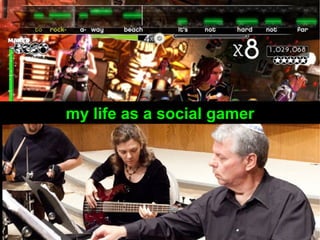
my life as a social gamer
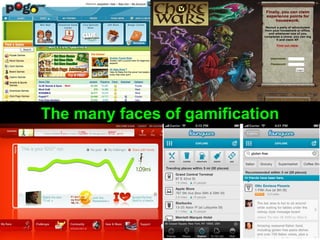
The many faces of gamification
What’s the larger trend?
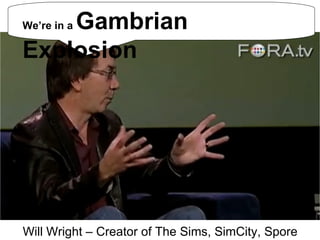
Will Wright – Creator of The Sims, SimCity, Spore We’re in a  Gambrian Explosion
everyone’s a gamer Games are everywhere
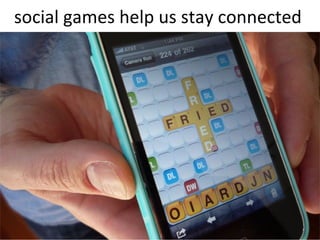
social games help us stay connected
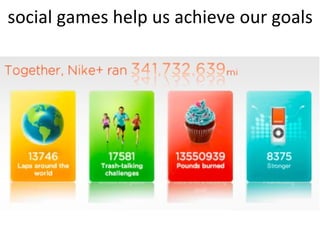
social games help us achieve our goals
How can we navigate this  fast-changing terrain?
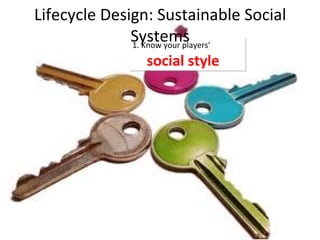
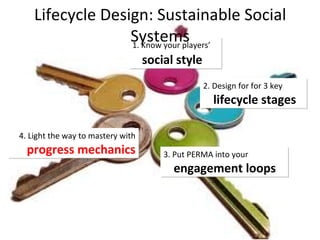
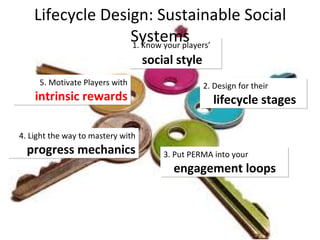
1. Know your players’  social style Lifecycle Design: Sustainable Social Systems
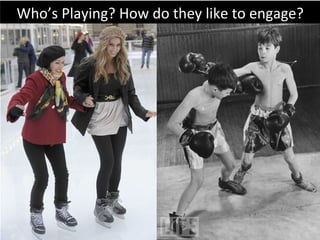
Who’s Playing? How do they like to engage?
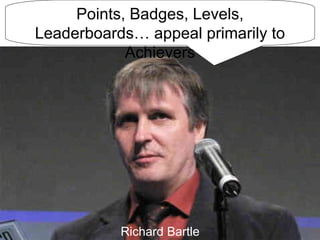
Jane McGonigal Richard Bartle Points, Badges, Levels, Leaderboards… appeal primarily to Achievers
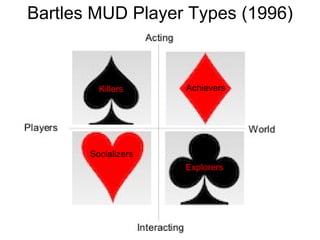
Killers Achievers Socializers Explorers Bartles MUD Player Types (1996)
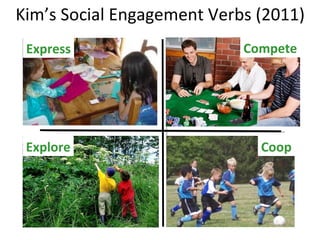
Compete Coop Explore Express Kim’s Social Engagement Verbs (2011)
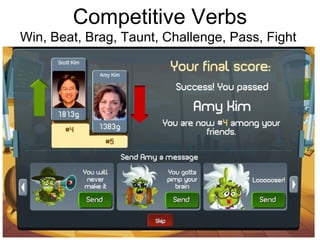
Competitive Verbs Win, Beat, Brag, Taunt, Challenge, Pass, Fight
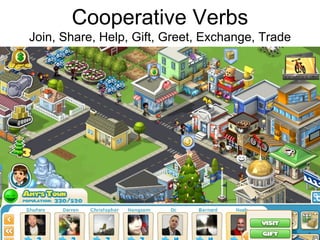
Cooperative Verbs Join, Share, Help, Gift, Greet, Exchange, Trade
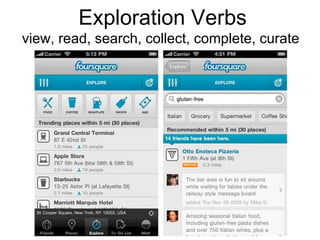
Exploration Verbs view, read, search, collect, complete, curate
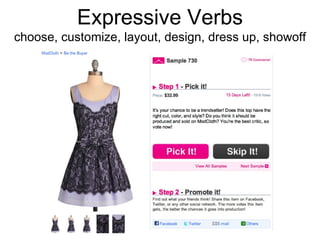
Expressive Verbs choose, customize, layout, design, dress up, showoff
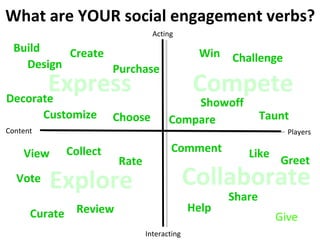
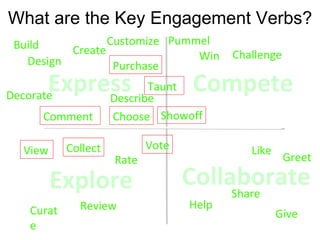
Content Players Interacting Acting What are YOUR social engagement verbs? Explore Express Compete Collaborate Give Help Comment Like Share Greet Collect Rate View Review Vote Curate Win Challenge Showoff Compare Taunt Create Design Customize Choose Purchase Decorate Build
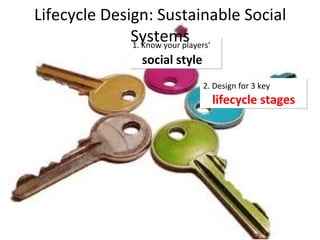
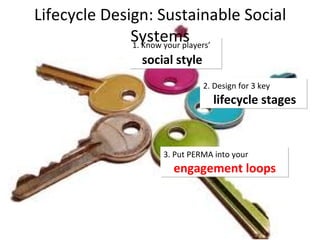
2. Design for 3 key lifecycle stages 1. Know your players’  social style Lifecycle Design: Sustainable Social Systems
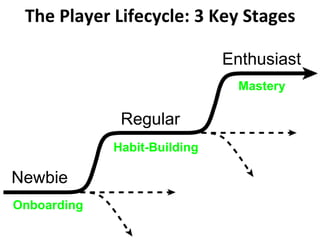
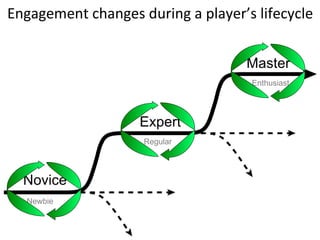
The Player Lifecycle: 3 Key Stages Onboarding Habit-Building Mastery Newbie Regular Enthusiast
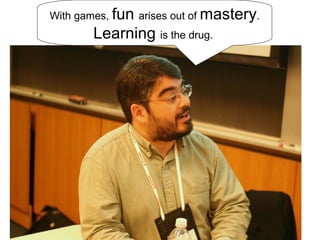
Jane McGonigal With games,  fun  arises out of  mastery .  Learning  is the drug.
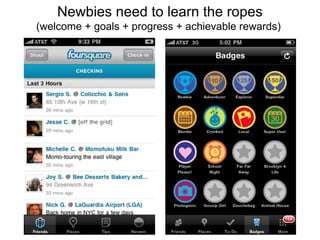
Regulars need fresh content/activities/challenges Newbies need to learn the ropes (welcome + goals + progress + achievable rewards)
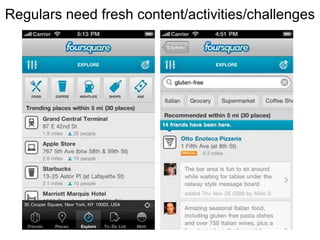
Regulars need fresh content/activities/challenges
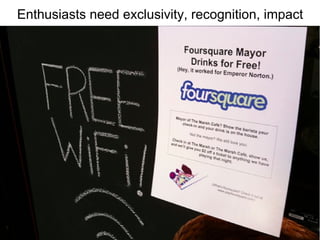
Enthusiasts need exclusivity, recognition, impact
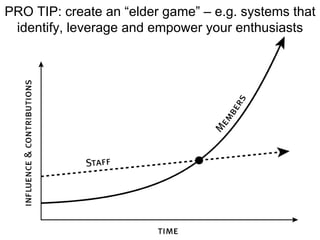
PRO TIP: create an “elder game” – e.g. systems that identify, leverage and empower your enthusiasts
2. Design for 3 key lifecycle stages 1. Know your players’  social style Lifecycle Design: Sustainable Social Systems 3. Put PERMA into your engagement loops
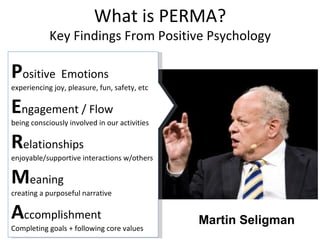
P ositive  Emotions experiencing joy, pleasure, fun, safety, etc E ngagement / Flow being consciously involved in our activities R elationships enjoyable/supportive interactions w/others M eaning creating a purposeful narrative A ccomplishment Completing goals + following core values Martin Seligman What is PERMA? Key Findings From Positive Psychology
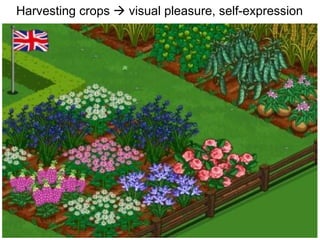
Harvesting crops    visual pleasure, self-expression
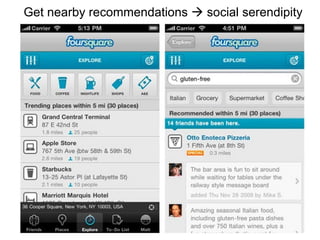
Get nearby recommendations    social serendipity
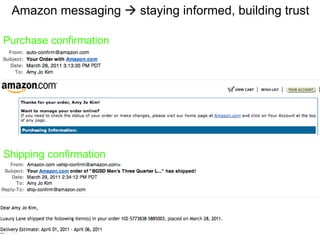
Amazon messaging    staying informed, building trust Shipping confirmation Purchase confirmation
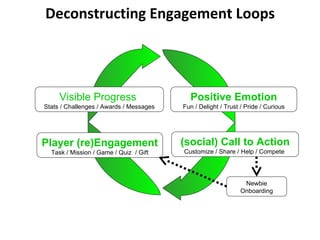
Deconstructing Engagement Loops Positive Emotion Fun / Delight / Trust / Pride / Curious Newbie Onboarding (social) Call to Action Customize / Share / Help / Compete  Player (re)Engagement Task / Mission / Game / Quiz  / Gift Visible Progress  Stats / Challenges / Awards / Messages
Newbie Enthusiast Regular Novice Expert Master Engagement changes during a player’s lifecycle
4. Light the way to mastery with progress mechanics 3. Put PERMA into your engagement loops 2. Design for for 3 key lifecycle stages 1. Know your players’  social style Lifecycle Design: Sustainable Social Systems
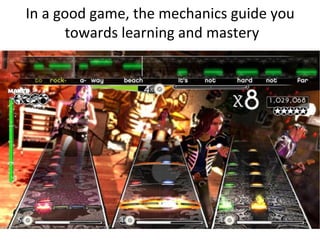
In a good game, the mechanics guide you towards learning and mastery
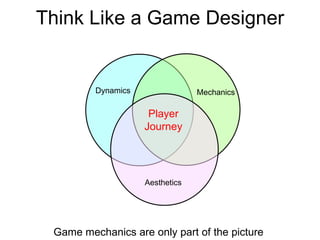
Dynamics Mechanics Aesthetics Player Journey Think Like a Game Designer Game mechanics are only part of the picture
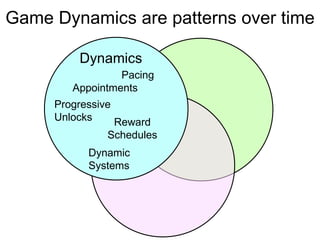
Progressive Unlocks Appointments Dynamics Game Dynamics are patterns over time Dynamic Systems Reward Schedules Pacing
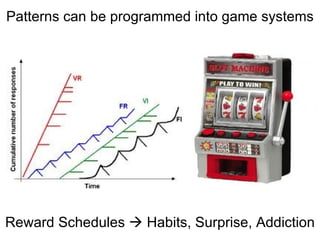
Patterns can be programmed into game systems Reward Schedules    Habits, Surprise, Addiction
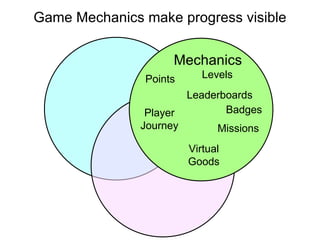
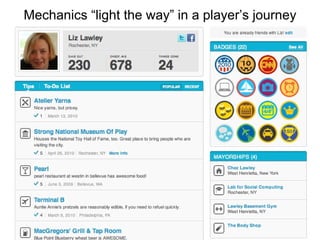
Game Mechanics make progress visible Levels Player Journey Points Leaderboards Badges Missions Mechanics Virtual Goods
Mechanics “light the way” in a player’s journey
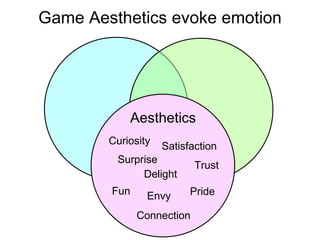
Fun Delight Envy Pride Aesthetics Game Aesthetics evoke emotion Surprise Satisfaction Trust Connection Curiosity
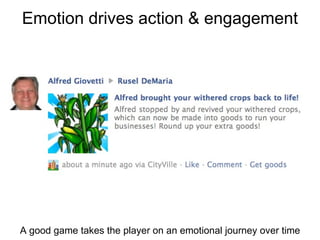
Emotion drives action & engagement A good game takes the player on an emotional journey over time
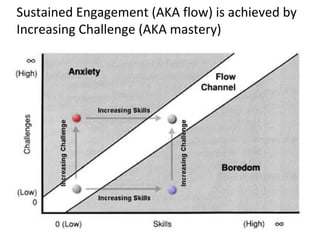
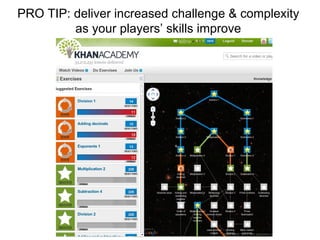
Sustained Engagement (AKA flow) is achieved by  Increasing Challenge (AKA mastery)
PRO TIP: deliver increased challenge & complexity  as your players’ skills improve
4. Light the way to mastery with progress mechanics 2. Design for their lifecycle stages 1. Know your players’  social style 5. Motivate Players with  intrinsic rewards Lifecycle Design: Sustainable Social Systems 3. Put PERMA into your engagement loops
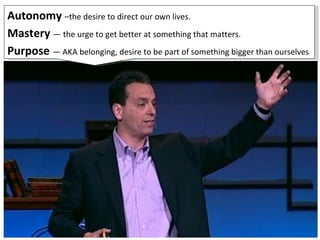
Autonomy  –the desire to direct our own lives.  Mastery  — the urge to get better at something that matters. Purpose  — AKA belonging, desire to be part of something bigger than ourselves
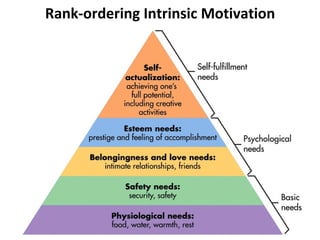
Rank-ordering Intrinsic Motivation
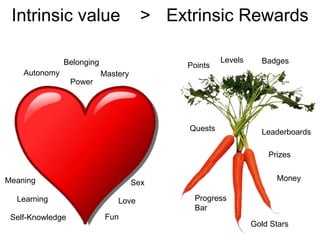
Autonomy Belonging Fun Self-Knowledge Mastery Power Love Prizes Points Levels  Leaderboards Badges Learning Quests Intrinsic value  >  Extrinsic Rewards Sex Meaning Gold Stars Progress Bar Money
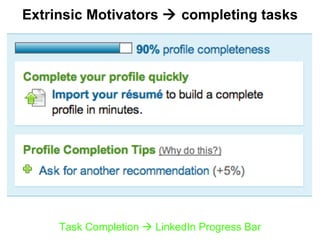
Extrinsic Motivators    completing tasks Task Completion    LinkedIn Progress Bar
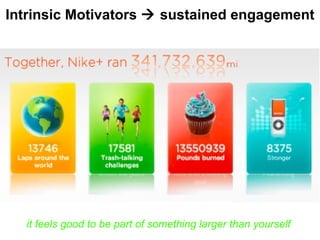
Intrinsic Motivators    sustained engagement it feels good to be part of something larger than yourself
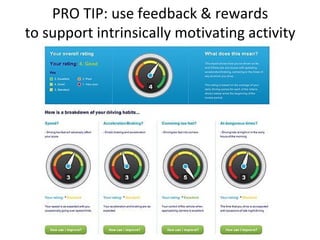
PRO TIP: use feedback & rewards to support intrinsically motivating activity
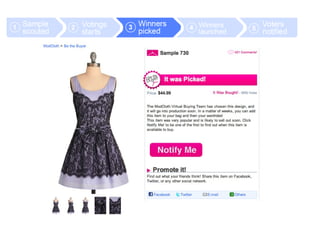
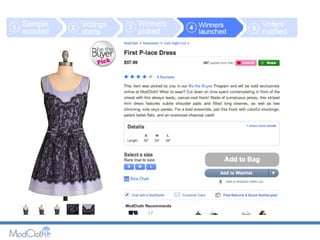
CASE STUDY: modcloth
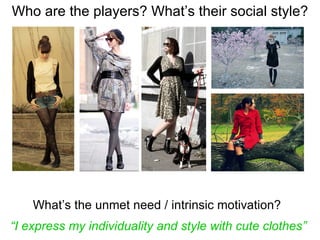
What’s their intrinsic motivation?  What’s the unmet need / intrinsic motivation?  “ I express my individuality and style with cute clothes”  Who are the players? What’s their social style?
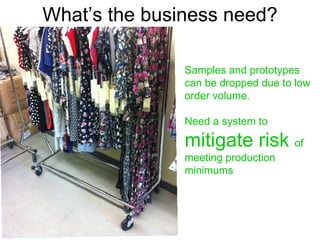
Samples and prototypes can be dropped due to low order volume. Need a system to  mitigate risk  of meeting production minimums What’s the business need?
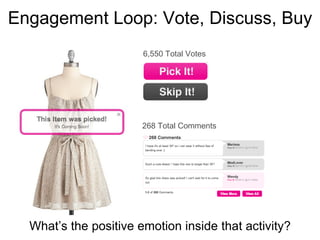
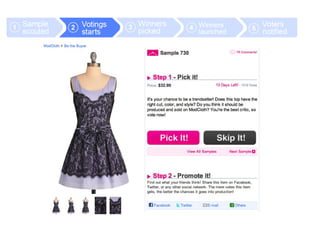
6,550 Total Votes 268 Total Comments Engagement Loop: Vote, Discuss, Buy What’s the positive emotion inside that activity?
 
 
Give Help Comment Like Share Greet Collect Rate View Review Vote Curate Win Challenge Showoff Taunt Create Design Customize Choose Purchase Decorate Build Describe Pummel What are the Key Engagement Verbs? Explore Express Compete Collaborate
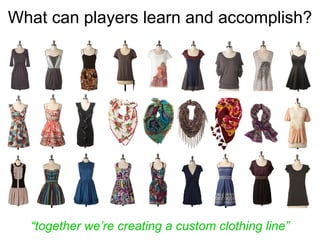
What can players learn and accomplish? “ together we’re creating a custom clothing line”
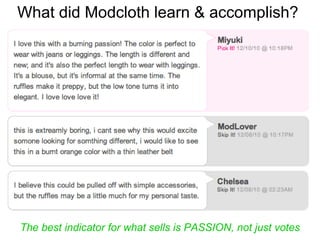
What did Modcloth learn & accomplish?  The best indicator for what sells is PASSION, not just votes
Thank You @amyjokim  on Twitter http://about.me/amyjokim http://www.shufflebrain.com

Smart Gamification

  • 1.
    Amy Jo Kim,Ph.D. © 2011 All Rights Reserved Smart Gamification How to Build Sustainable Social Systems
  • 2.
    my life asa social gamer
  • 3.
    The many facesof gamification
  • 4.
  • 5.
    Will Wright –Creator of The Sims, SimCity, Spore We’re in a Gambrian Explosion
  • 6.
    everyone’s a gamerGames are everywhere
  • 7.
    social games helpus stay connected
  • 8.
    social games helpus achieve our goals
  • 9.
    How can wenavigate this fast-changing terrain?
  • 10.
    1. Know yourplayers’ social style Lifecycle Design: Sustainable Social Systems
  • 11.
    Who’s Playing? Howdo they like to engage?
  • 12.
    Jane McGonigal RichardBartle Points, Badges, Levels, Leaderboards… appeal primarily to Achievers
  • 13.
    Killers Achievers SocializersExplorers Bartles MUD Player Types (1996)
  • 14.
    Compete Coop ExploreExpress Kim’s Social Engagement Verbs (2011)
  • 15.
    Competitive Verbs Win,Beat, Brag, Taunt, Challenge, Pass, Fight
  • 16.
    Cooperative Verbs Join,Share, Help, Gift, Greet, Exchange, Trade
  • 17.
    Exploration Verbs view,read, search, collect, complete, curate
  • 18.
    Expressive Verbs choose,customize, layout, design, dress up, showoff
  • 19.
    Content Players InteractingActing What are YOUR social engagement verbs? Explore Express Compete Collaborate Give Help Comment Like Share Greet Collect Rate View Review Vote Curate Win Challenge Showoff Compare Taunt Create Design Customize Choose Purchase Decorate Build
  • 20.
    2. Design for3 key lifecycle stages 1. Know your players’ social style Lifecycle Design: Sustainable Social Systems
  • 21.
    The Player Lifecycle:3 Key Stages Onboarding Habit-Building Mastery Newbie Regular Enthusiast
  • 22.
    Jane McGonigal Withgames, fun arises out of mastery . Learning is the drug.
  • 23.
    Regulars need freshcontent/activities/challenges Newbies need to learn the ropes (welcome + goals + progress + achievable rewards)
  • 24.
    Regulars need freshcontent/activities/challenges
  • 25.
    Enthusiasts need exclusivity,recognition, impact
  • 26.
    PRO TIP: createan “elder game” – e.g. systems that identify, leverage and empower your enthusiasts
  • 27.
    2. Design for3 key lifecycle stages 1. Know your players’ social style Lifecycle Design: Sustainable Social Systems 3. Put PERMA into your engagement loops
  • 28.
    P ositive Emotions experiencing joy, pleasure, fun, safety, etc E ngagement / Flow being consciously involved in our activities R elationships enjoyable/supportive interactions w/others M eaning creating a purposeful narrative A ccomplishment Completing goals + following core values Martin Seligman What is PERMA? Key Findings From Positive Psychology
  • 29.
    Harvesting crops  visual pleasure, self-expression
  • 30.
    Get nearby recommendations  social serendipity
  • 31.
    Amazon messaging  staying informed, building trust Shipping confirmation Purchase confirmation
  • 32.
    Deconstructing Engagement LoopsPositive Emotion Fun / Delight / Trust / Pride / Curious Newbie Onboarding (social) Call to Action Customize / Share / Help / Compete Player (re)Engagement Task / Mission / Game / Quiz / Gift Visible Progress Stats / Challenges / Awards / Messages
  • 33.
    Newbie Enthusiast RegularNovice Expert Master Engagement changes during a player’s lifecycle
  • 34.
    4. Light theway to mastery with progress mechanics 3. Put PERMA into your engagement loops 2. Design for for 3 key lifecycle stages 1. Know your players’ social style Lifecycle Design: Sustainable Social Systems
  • 35.
    In a goodgame, the mechanics guide you towards learning and mastery
  • 36.
    Dynamics Mechanics AestheticsPlayer Journey Think Like a Game Designer Game mechanics are only part of the picture
  • 37.
    Progressive Unlocks AppointmentsDynamics Game Dynamics are patterns over time Dynamic Systems Reward Schedules Pacing
  • 38.
    Patterns can beprogrammed into game systems Reward Schedules  Habits, Surprise, Addiction
  • 39.
    Game Mechanics makeprogress visible Levels Player Journey Points Leaderboards Badges Missions Mechanics Virtual Goods
  • 40.
    Mechanics “light theway” in a player’s journey
  • 41.
    Fun Delight EnvyPride Aesthetics Game Aesthetics evoke emotion Surprise Satisfaction Trust Connection Curiosity
  • 42.
    Emotion drives action& engagement A good game takes the player on an emotional journey over time
  • 43.
    Sustained Engagement (AKAflow) is achieved by Increasing Challenge (AKA mastery)
  • 44.
    PRO TIP: deliverincreased challenge & complexity as your players’ skills improve
  • 45.
    4. Light theway to mastery with progress mechanics 2. Design for their lifecycle stages 1. Know your players’ social style 5. Motivate Players with intrinsic rewards Lifecycle Design: Sustainable Social Systems 3. Put PERMA into your engagement loops
  • 46.
    Autonomy –thedesire to direct our own lives. Mastery — the urge to get better at something that matters. Purpose — AKA belonging, desire to be part of something bigger than ourselves
  • 47.
  • 48.
    Autonomy Belonging FunSelf-Knowledge Mastery Power Love Prizes Points Levels Leaderboards Badges Learning Quests Intrinsic value > Extrinsic Rewards Sex Meaning Gold Stars Progress Bar Money
  • 49.
    Extrinsic Motivators  completing tasks Task Completion  LinkedIn Progress Bar
  • 50.
    Intrinsic Motivators  sustained engagement it feels good to be part of something larger than yourself
  • 51.
    PRO TIP: usefeedback & rewards to support intrinsically motivating activity
  • 52.
  • 53.
    What’s their intrinsicmotivation? What’s the unmet need / intrinsic motivation? “ I express my individuality and style with cute clothes” Who are the players? What’s their social style?
  • 54.
    Samples and prototypescan be dropped due to low order volume. Need a system to mitigate risk of meeting production minimums What’s the business need?
  • 55.
    6,550 Total Votes268 Total Comments Engagement Loop: Vote, Discuss, Buy What’s the positive emotion inside that activity?
  • 56.
  • 57.
  • 59.
    Give Help CommentLike Share Greet Collect Rate View Review Vote Curate Win Challenge Showoff Taunt Create Design Customize Choose Purchase Decorate Build Describe Pummel What are the Key Engagement Verbs? Explore Express Compete Collaborate
  • 60.
    What can playerslearn and accomplish? “ together we’re creating a custom clothing line”
  • 61.
    What did Modclothlearn & accomplish? The best indicator for what sells is PASSION, not just votes
  • 62.
    Thank You @amyjokim on Twitter http://about.me/amyjokim http://www.shufflebrain.com

Editor's Notes

  • #26 Back when I studied Psychology, the most memorable and useful thing I learned was the “one-armed bandit” schedule of reinforcement. Which you can see here, in red. The essence is this: if you give random, sizeable rewards for user actions (e.g. how a slot machine works), you will get an addictive behavior pattern - in mice, in pigeons, or in humans.
  • #27 Back when I studied Psychology, the most memorable and useful thing I learned was the “one-armed bandit” schedule of reinforcement. Which you can see here, in red. The essence is this: if you give random, sizeable rewards for user actions (e.g. how a slot machine works), you will get an addictive behavior pattern - in mice, in pigeons, or in humans.
  • #56 An example of the type of participation we see: 11% of our audience has participated in BTB without ever really being directed there
  • #58 After the voting period closes, We pick the winners based on an algorithm that takes into account how historical voting patterns typically correlate with future sales unexpected: total number of votes more indicative of future sales than the ration of + to -