 Called “one long
argument” for
evolution
 Hundreds of
thousands of
observations
 Detailed, testable
theory
 No mechanism for HOW
variation is passed from
parent to offspring
 Modern synthesis:
combination of Mendel’s
and Darwin’s ideas
 Comparing fossils
presents a pattern of
gradual change
 Darwin found gaps in
the fossil record
 Scenario 1: Leaves
towards the bottom of trees
are disappearing. Some
giraffes can reach leaves
higher up, while others’
necks are not long
enough?
 Which giraffes will thrive?
Which giraffes will die out?
 What will future
generations look like?
 Scenario 2: A certain species of rabbits in a dense forest
come in brown and white fur colors. Hawks, soaring
overhead, often eat the rabbits.
 Which rabbits will be easier to spot?
 Which color trait will more likely be passed on to future
generations?
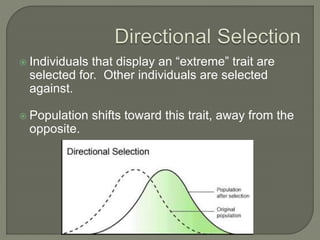
 Individuals that display an “extreme” trait are
selected for. Other individuals are selected
against.
 Population shifts toward this trait, away from the
opposite.
 Scenario 3: Lizards
range in size from tiny
to very large. Small
lizards generally run
very slowly while
large lizards are
usually the easiest for
predators to see.
 What size lizard
stands the best
chance of survival?
 Scenario 4: Human
babies of very low
birth weight are often
more prone to
disease. Babies of
very large weights are
difficult for mothers to
safely deliver.
 What size babies
stand the best chance
of survival?
 Individuals that display an average trait are selected for.
Individuals that display extreme traits are selected
against.
 Population shifts towards the average trait, and those
with extreme forms die off.
 Scenario 5: Limpets are marine animals that attach to
rocks. Their color varies from pure white to dark brown.
White-shelled that are on rocks covered with goose
barnacles (also white) are at an advantage. On bare,
dark-colored rocks, brown limpets are at an advantage.
 What “advantage” is being referred to above?
 If you were a dark limpet,
where would you live?
A white limpet?
 What color would have the
hardest time surviving?
 Individuals that display either extreme are
selected for. “Average” individuals are selected
against.
 Population shifts towards away from the average
trait, towards BOTH extremes.
 Design three example situations (1 paragraph
each) representing the three types of selection
we covered. Include the following:
1. Description of the animals involved and their traits
2. How is nature selecting for/against certain animals
3. Which trait will be come more common/less common
and why?
4. Name the type of selection.
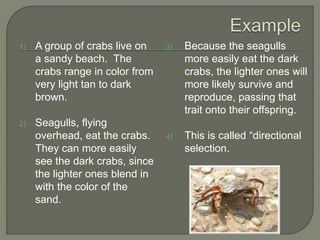
1) A group of crabs live on
a sandy beach. The
crabs range in color from
very light tan to dark
brown.
2) Seagulls, flying
overhead, eat the crabs.
They can more easily
see the dark crabs, since
the lighter ones blend in
with the color of the
sand.
3) Because the seagulls
more easily eat the dark
crabs, the lighter ones will
more likely survive and
reproduce, passing that
trait onto their offspring.
4) This is called “directional
selection.
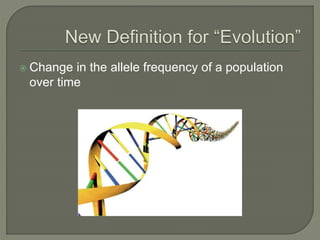
 Change in the allele frequency of a population
over time
 Does chance
play a role?
 Is evolution
predictable?
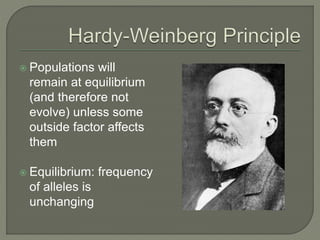
 Populations will
remain at equilibrium
(and therefore not
evolve) unless some
outside factor affects
them
 Equilibrium: frequency
of alleles is
unchanging
1. Natural Selection
2. Sexual Selection
(mate choice)
3. Mutations
4. Gene flow (migration)
5. Genetic Drift and
population bottlenecks
 Movement of
individuals
(and alleles)
from one
population to
another
 What are
some
barriers?
 Change in allele frequency
caused by chance events
 More common in small
populations
 Can be beneficial, harmful, or
neutral
 Examples:
• Founder Effect
• Population Bottleneck
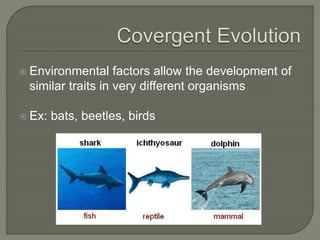
 Environmental factors allow the development of
similar traits in very different organisms
 Ex: bats, beetles, birds
 Descendants of a
single ancestor
diversify into species
that fit into different
parts of the
environment.
 Adaptive Radiation-
when a new
population is in a new
environment it will
undergo divergent
evolution until the
environment is full.
 Species that live near
one another evolve to
benefit one another
 Ex. Yucca moth and
Yucca plant
 Adaptive Radiation –
one species,
subjected to different
environmental
pressures, can evolve
into multiple species
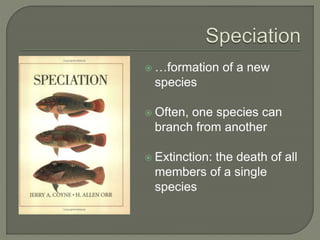
 …formation of a new
species
 Often, one species can
branch from another
 Extinction: the death of all
members of a single
species
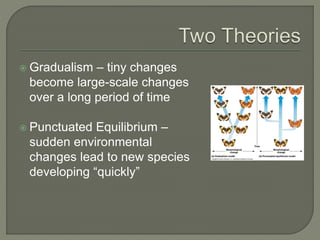
 Gradualism – tiny changes
become large-scale changes
over a long period of time
 Punctuated Equilibrium –
sudden environmental
changes lead to new species
developing “quickly”
Morphological Concept: uses similarities
(physical and physiological) between
organisms
Biological Concept: group of organisms
that can breed and have fertile offspring
Geographic Isolation (Allopatric speciation)
Reproductive Isolation (Sympatric
speciation)

Evolution Part 2

  • 2.
     Called “onelong argument” for evolution  Hundreds of thousands of observations  Detailed, testable theory
  • 3.
     No mechanismfor HOW variation is passed from parent to offspring  Modern synthesis: combination of Mendel’s and Darwin’s ideas
  • 4.
     Comparing fossils presentsa pattern of gradual change  Darwin found gaps in the fossil record
  • 7.
     Scenario 1:Leaves towards the bottom of trees are disappearing. Some giraffes can reach leaves higher up, while others’ necks are not long enough?  Which giraffes will thrive? Which giraffes will die out?  What will future generations look like?
  • 8.
     Scenario 2:A certain species of rabbits in a dense forest come in brown and white fur colors. Hawks, soaring overhead, often eat the rabbits.  Which rabbits will be easier to spot?  Which color trait will more likely be passed on to future generations?
  • 9.
     Individuals thatdisplay an “extreme” trait are selected for. Other individuals are selected against.  Population shifts toward this trait, away from the opposite.
  • 10.
     Scenario 3:Lizards range in size from tiny to very large. Small lizards generally run very slowly while large lizards are usually the easiest for predators to see.  What size lizard stands the best chance of survival?
  • 11.
     Scenario 4:Human babies of very low birth weight are often more prone to disease. Babies of very large weights are difficult for mothers to safely deliver.  What size babies stand the best chance of survival?
  • 12.
     Individuals thatdisplay an average trait are selected for. Individuals that display extreme traits are selected against.  Population shifts towards the average trait, and those with extreme forms die off.
  • 13.
     Scenario 5:Limpets are marine animals that attach to rocks. Their color varies from pure white to dark brown. White-shelled that are on rocks covered with goose barnacles (also white) are at an advantage. On bare, dark-colored rocks, brown limpets are at an advantage.  What “advantage” is being referred to above?  If you were a dark limpet, where would you live? A white limpet?  What color would have the hardest time surviving?
  • 14.
     Individuals thatdisplay either extreme are selected for. “Average” individuals are selected against.  Population shifts towards away from the average trait, towards BOTH extremes.
  • 15.
     Design threeexample situations (1 paragraph each) representing the three types of selection we covered. Include the following: 1. Description of the animals involved and their traits 2. How is nature selecting for/against certain animals 3. Which trait will be come more common/less common and why? 4. Name the type of selection.
  • 16.
    1) A groupof crabs live on a sandy beach. The crabs range in color from very light tan to dark brown. 2) Seagulls, flying overhead, eat the crabs. They can more easily see the dark crabs, since the lighter ones blend in with the color of the sand. 3) Because the seagulls more easily eat the dark crabs, the lighter ones will more likely survive and reproduce, passing that trait onto their offspring. 4) This is called “directional selection.
  • 18.
     Change inthe allele frequency of a population over time
  • 19.
     Does chance playa role?  Is evolution predictable?
  • 20.
     Populations will remainat equilibrium (and therefore not evolve) unless some outside factor affects them  Equilibrium: frequency of alleles is unchanging
  • 21.
    1. Natural Selection 2.Sexual Selection (mate choice) 3. Mutations 4. Gene flow (migration) 5. Genetic Drift and population bottlenecks
  • 22.
     Movement of individuals (andalleles) from one population to another  What are some barriers?
  • 23.
     Change inallele frequency caused by chance events  More common in small populations  Can be beneficial, harmful, or neutral  Examples: • Founder Effect • Population Bottleneck
  • 25.
     Environmental factorsallow the development of similar traits in very different organisms  Ex: bats, beetles, birds
  • 26.
     Descendants ofa single ancestor diversify into species that fit into different parts of the environment.  Adaptive Radiation- when a new population is in a new environment it will undergo divergent evolution until the environment is full.
  • 27.
     Species thatlive near one another evolve to benefit one another  Ex. Yucca moth and Yucca plant
  • 28.
     Adaptive Radiation– one species, subjected to different environmental pressures, can evolve into multiple species
  • 29.
     …formation ofa new species  Often, one species can branch from another  Extinction: the death of all members of a single species
  • 30.
     Gradualism –tiny changes become large-scale changes over a long period of time  Punctuated Equilibrium – sudden environmental changes lead to new species developing “quickly”
  • 32.
    Morphological Concept: usessimilarities (physical and physiological) between organisms Biological Concept: group of organisms that can breed and have fertile offspring
  • 33.
    Geographic Isolation (Allopatricspeciation) Reproductive Isolation (Sympatric speciation)