TECHNOLOGICAL
      DEVELOPMENTS IN BANKING
               SECTOR


SUDHAKARA
SUNIL KUMAR.V
SUHAS..M
SURESH.A
SURESH.S
SWATHI
INTRODUCTION


E-BANKING


CORE   BANKING

MOBILE   BANKING

AUTOMATED TELLER
MACHINE(ATM’S)
   The technological development of modern banking
    can be traced, in some ways, back to 1960, when
    Charles Sanford joined Bankers Trust. He rose up the
    ranks to become chairman and chief executive in the
    late 1980s. During his tenure, which lasted until
    1996, the bank pioneered a number of practices that
    would later become common in the industry,
    including the development of new ways of banking
    practices including check encoders, check scanners,
    currency counters, currency discriminators, check
    strippers.
   After post 80's,banking sector witnessed many other
    technological developments such as use of
    computers, ATM's and cellphone and cloud
    computing.
C  o m b in a t io n o f
 the tw o te rms
  1. E l e c t r o n i c
 t e c h n o lo g y a n d
  2 . B a n k in g
P r o c e s s b y w h i c h

 a c us to me r
To    p r o v id e s e r v ic e s
  in u s e r s o w n
  e n v ir o n m e n t f o r
  c o n v e n ie n c e a n d
  a c c e s s ib ilit y .
 T o r e d u c e r is k o f
  h a n d lin g c a s h .
 T o p r o v id e a s y s t e m
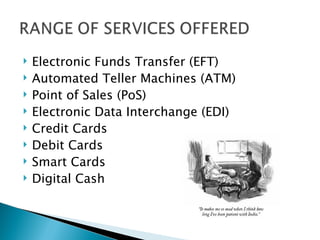
   Electronic Funds Transfer (EFT)
   Automated Teller Machines (ATM)
   Point of Sales (PoS)
   Electronic Data Interchange (EDI)
   Credit Cards
   Debit Cards
   Smart Cards
   Digital Cash
B E N E F IT S            B  E N E F IT
 TO B A N K
                            S TO
1. U n l i m i t e d
 N e tw o rk .              C U S TO M
2 .L e s s e r              ERS
 c ha nc e of              1. A n y
 fra u d a nd
 m is a p p r o p r i       w he re
 a t io n .                 B a n k in g .
3 .B e tte r               2 .A ny
 p r o f it a b ilit y .
4 .B e tte r
                            t im e
Connectivity problems.
C  y b e r c r im e .
C o m p u t e r L i t e r a c y
is E s s e n t ia l.
H i g h c o s t o f
t e c h n o lo g y .
P e r s o n a l c o n t a c t
n o t p o s s ib le .
Finland was the first country in
 the world to have taken in E-
 banking. In India, it was ICICI
 Bank which E-banking as early as
 1997 under the brand name
 ‘Infinity’
   ICICI ‘s profit to equity holders registered a
    growth of 21% percent in 2001.
   Citibank claims that its project Suvidha, which
    started off in Bangalore in early in 1998, has
    encouraged customers to interact with
    electronically, using telephones, the Internet,
    and ATMs.
   The Vice President of Global Trust Bank, P.C.
    Narayan says,
       “An electronic transaction costs as much
    as 65% less than a physical one. ATMs have
    definitely emerged as the new business
    model for the banks and the way banking has
    been conducted. I think it is one of the
    remarkable things that has happened to
    Indian Banking Industry”.
   A Reserve Bank of India (RBI) committee has
    come out with the road map for electronic
    banking and has sought legislation on EFT
    systems to facilitate multiple payment
    systems for banks and financial institutions.
   The RBI has been gearing up to upgrading
    itself as a regulator and supervisor of the
    technologically dominated financial system
   Several initiatives taken by the Government of
    India as well as the RBI have facilitated the
    development of E-banking in India. The
    Govt. of India enacted the IT Act, 2000 with
    effect from Oct.17,2000, which provides
    recognition to electronic transactions and
    other means of electronic commerce.
   “The potential of “E-banking is huge. With
    the increase in connectivity, the number of
    users will explode”, says K.V. Kamat, the CEO
    of ICICI Bank.
   The strategy for banks is to provide value-
    added services to products to customers
    utilizing the Internet extensively.
 Web  based banking service or E-Banking, the
  latest generation of banking transactions, has
  opened up new window of opportunity to the
  banks and existing financial institutions.
Since its evolution in 90th decade, it is having
  unprecedented growth.
Core banking is a general term used to describe
the services provided by a group of networked bank
branches. Bank customers may access their funds
and other simple transactions from any of the
member branch offices. CORE stands for "centralized
online real-time environment".
Core Banking Solution (CBS) is networking of
branches, which enables Customers to operate their
accounts, and avail banking services from any branch
of the Bank on CBS network, regardless of where he
maintains his account. The customer is no more the
customer of a Branch. He becomes the Bank’s
Customer. Thus CBS is a step towards enhancing
customer convenience through Anywhere and
Anytime Banking.
   Finacle core banking solution offers an unlimited
    palette of features for banks to design and
    deploy products for varying market segments.
    The product bundling capabilities of the solution
    offer a wide range of possibilities for banks to
    create products with innovative features. The
    facilities provided for differential pricing, channel
    rules and customization through Finacle Studio –
    the scripting engine, empower banks to
    continuously innovate and extend their suite of
    products, across segments.

    Finacle core banking solution supports
    business event automation and process
    orchestration, thus eliminating manual tasks
    and reducing process time. The elimination of
    error and data redundancies also results in
    increased branch productivity. Straight
    Through Processing (STP) abilities enhance
    reduction in turnaround and processing time,
    increasing output and enabling speedy
    completion of tasks.

    The CIF and CRM capabilities in Finacle offer
    a unified view of the customer across the
    entire solution and across multiple back-end
    applications, enabling the bank to view the
    customer from a completely informed angle.
    This empowers banks to effectively manage
    customer relationships and aggressively
    explore cross-sell opportunities.

    The Service Oriented Architecture (SOA)
    enables the IT team at the bank to effect
    changes without touching the base code,
    ensuring lesser vendor dependency and
    faster adaptability to changing business
    conditions.
   Substantial reduction of operation costs
   Easier introduction of new products
   Faster customer service
   Integration of all products and services, leading
    to improved risk management
   Mitigation of Operational Risk
   Real-time transaction processing
   Scaling up of operations
   Availability of e-trade options to bank customers
   Efficient and easy transactions which can be
    conducted 24/7
1).Excessive reliance on technology
2). Any failure in computer systems can cause
entire network to go down.
3). If Data is not protected properly and if
proper care is not taken , hackers can gain
access to the sensitive data.
•Mobile Banking refers to provision and availment of
banking- and financial services with the help of mobile
telecommunication devices.

•Mobile  banking (also known as M-Banking, mbanking)
is a term used for performing balance checks, account
transactions, payments, credit applications and other
banking transactions through a mobile device such as
a mobile phone
   SMS (Short messaging service)

   GPRS (General Packet Radio Service)

   USSD (Unstructured Supplementary Service Data)
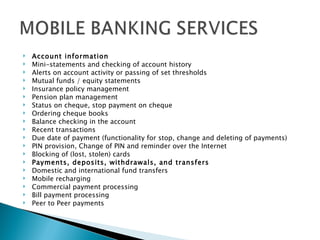
   Account information
   Mini-statements and checking of account history
   Alerts on account activity or passing of set thresholds
   Mutual funds / equity statements
   Insurance policy management
   Pension plan management
   Status on cheque, stop payment on cheque
   Ordering cheque books
   Balance checking in the account
   Recent transactions
   Due date of payment (functionality for stop, change and deleting of payments)
   PIN provision, Change of PIN and reminder over the Internet
   Blocking of (lost, stolen) cards
   Payments, deposits, withdrawals, and transfers
   Domestic and international fund transfers
   Mobile recharging
   Commercial payment processing
   Bill payment processing
   Peer to Peer payments 
Customer Benefits
•  Usually Secure, Convenient and easy method of
  payment
• Anywhere anytime payment

Banks
• Additional channel for customer payments
• Use of existing Infrastructure
• Value added service to customers
   Risk of Illegal access by hackers.

   Transaction needs signal strength. It might
    not work in remote geographical regions

   M-Banking Is not as flexible, as done through
    computer means

    Device used by the customer may not be
    compatible to the M-banking Application
   It is a computerized telecommunication
    device that provides of a financial
    institution with access to financial
    transaction in a public space without the
    need for a cashier , human clerk or bank
    teller.
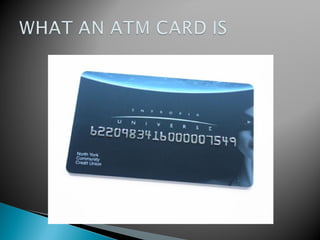
   It is a card issued by a bank , credit
    union or building society that can be
    used at an ATM for deposits ,
    withdrawals , account information or
    other kind of transactions , often
    through interbank networks.
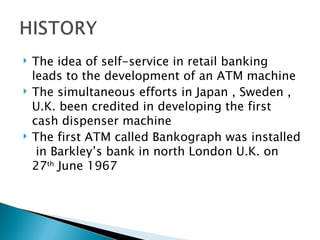
   The idea of self-service in retail banking
    leads to the development of an ATM machine
   The simultaneous efforts in Japan , Sweden ,
    U.K. been credited in developing the first
    cash dispenser machine
   The first ATM called Bankograph was installed
     in Barkley’s bank in north London U.K. on
    27th June 1967
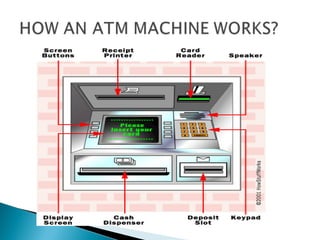
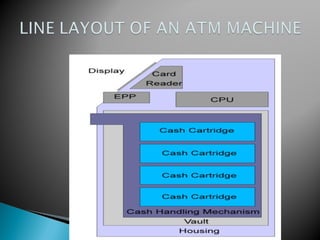
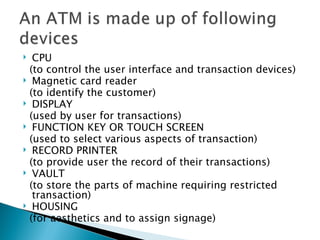
  CPU
  (to control the user interface and transaction devices)
 Magnetic card reader
  (to identify the customer)
 DISPLAY
  (used by user for transactions)
 FUNCTION KEY OR TOUCH SCREEN
  (used to select various aspects of transaction)
 RECORD PRINTER
  (to provide user the record of their transactions)
 VAULT
  (to store the parts of machine requiring restricted
   transaction)
 HOUSING
  (for aesthetics and to assign signage)
   Today ATMs are been used globally
   The number of ATMs using currently are
    about 1.8 million
   Globally they are divided into seven regions
   ATMS are fastly using in CANADA , USA ,
    EUROPE, JAPAN
   But yet to reach high number in the near east
    or africa
1)U have access to the cash in your bank account
  whenever u needed
2)For instance, u are in stores that doesn’t take checks
  and credit cards but it has an atm you can withdraw
  the money for your purpose.
3)You can travel anywhere without cash
4)If you have ever faced a need of money,then you can
  probably access on atm machine
5) these saves time
6) they operate 24hours
7) these use pin for security thus they are safe
8) Checking recent or past bank statements
9) Checking how much money is remaining in the
       account.
1)they are not safe since they are located outside the bank
     hall
2)if one forgets the pin number he or she will not be able to
     withdraw money from their accounts
3) if one makes mistakes three times in entering the pin
     number the card will be swallowed down the machine
     and it takes time to retrieve it
4) If the bank card is stolen and the number ascertained, an
     unauthorized person can easily access the account.
5) Machine may not recognize your Credit card
6) May be no ATM’s near by
7) If someone watches or hacks an ATM machine your details
         May be taken
8) If problem with credit card you can not withdraw your
          money 
Tech developments in banking sector

Tech developments in banking sector

  • 1.
    TECHNOLOGICAL DEVELOPMENTS IN BANKING SECTOR SUDHAKARA SUNIL KUMAR.V SUHAS..M SURESH.A SURESH.S SWATHI
  • 2.
    INTRODUCTION E-BANKING CORE BANKING MOBILE BANKING AUTOMATED TELLER MACHINE(ATM’S)
  • 3.
    The technological development of modern banking can be traced, in some ways, back to 1960, when Charles Sanford joined Bankers Trust. He rose up the ranks to become chairman and chief executive in the late 1980s. During his tenure, which lasted until 1996, the bank pioneered a number of practices that would later become common in the industry, including the development of new ways of banking practices including check encoders, check scanners, currency counters, currency discriminators, check strippers.  After post 80's,banking sector witnessed many other technological developments such as use of computers, ATM's and cellphone and cloud computing.
  • 5.
    C om b in a t io n o f the tw o te rms 1. E l e c t r o n i c t e c h n o lo g y a n d 2 . B a n k in g P r o c e s s b y w h i c h a c us to me r
  • 6.
    To p r o v id e s e r v ic e s in u s e r s o w n e n v ir o n m e n t f o r c o n v e n ie n c e a n d a c c e s s ib ilit y .  T o r e d u c e r is k o f h a n d lin g c a s h .  T o p r o v id e a s y s t e m
  • 7.
    Electronic Funds Transfer (EFT)  Automated Teller Machines (ATM)  Point of Sales (PoS)  Electronic Data Interchange (EDI)  Credit Cards  Debit Cards  Smart Cards  Digital Cash
  • 9.
    B E NE F IT S B E N E F IT TO B A N K S TO 1. U n l i m i t e d N e tw o rk . C U S TO M 2 .L e s s e r ERS c ha nc e of 1. A n y fra u d a nd m is a p p r o p r i w he re a t io n . B a n k in g . 3 .B e tte r 2 .A ny p r o f it a b ilit y . 4 .B e tte r t im e
  • 10.
    Connectivity problems. C y b e r c r im e . C o m p u t e r L i t e r a c y is E s s e n t ia l. H i g h c o s t o f t e c h n o lo g y . P e r s o n a l c o n t a c t n o t p o s s ib le .
  • 11.
    Finland was thefirst country in the world to have taken in E- banking. In India, it was ICICI Bank which E-banking as early as 1997 under the brand name ‘Infinity’
  • 12.
    ICICI ‘s profit to equity holders registered a growth of 21% percent in 2001.  Citibank claims that its project Suvidha, which started off in Bangalore in early in 1998, has encouraged customers to interact with electronically, using telephones, the Internet, and ATMs.
  • 13.
    The Vice President of Global Trust Bank, P.C. Narayan says, “An electronic transaction costs as much as 65% less than a physical one. ATMs have definitely emerged as the new business model for the banks and the way banking has been conducted. I think it is one of the remarkable things that has happened to Indian Banking Industry”.
  • 14.
    A Reserve Bank of India (RBI) committee has come out with the road map for electronic banking and has sought legislation on EFT systems to facilitate multiple payment systems for banks and financial institutions.  The RBI has been gearing up to upgrading itself as a regulator and supervisor of the technologically dominated financial system
  • 15.
    Several initiatives taken by the Government of India as well as the RBI have facilitated the development of E-banking in India. The Govt. of India enacted the IT Act, 2000 with effect from Oct.17,2000, which provides recognition to electronic transactions and other means of electronic commerce.
  • 16.
    “The potential of “E-banking is huge. With the increase in connectivity, the number of users will explode”, says K.V. Kamat, the CEO of ICICI Bank.  The strategy for banks is to provide value- added services to products to customers utilizing the Internet extensively.
  • 17.
     Web based banking service or E-Banking, the latest generation of banking transactions, has opened up new window of opportunity to the banks and existing financial institutions. Since its evolution in 90th decade, it is having unprecedented growth.
  • 18.
    Core banking isa general term used to describe the services provided by a group of networked bank branches. Bank customers may access their funds and other simple transactions from any of the member branch offices. CORE stands for "centralized online real-time environment". Core Banking Solution (CBS) is networking of branches, which enables Customers to operate their accounts, and avail banking services from any branch of the Bank on CBS network, regardless of where he maintains his account. The customer is no more the customer of a Branch. He becomes the Bank’s Customer. Thus CBS is a step towards enhancing customer convenience through Anywhere and Anytime Banking.
  • 19.
    Finacle core banking solution offers an unlimited palette of features for banks to design and deploy products for varying market segments. The product bundling capabilities of the solution offer a wide range of possibilities for banks to create products with innovative features. The facilities provided for differential pricing, channel rules and customization through Finacle Studio – the scripting engine, empower banks to continuously innovate and extend their suite of products, across segments.
  • 20.
    Finacle core banking solution supports business event automation and process orchestration, thus eliminating manual tasks and reducing process time. The elimination of error and data redundancies also results in increased branch productivity. Straight Through Processing (STP) abilities enhance reduction in turnaround and processing time, increasing output and enabling speedy completion of tasks.
  • 21.
    The CIF and CRM capabilities in Finacle offer a unified view of the customer across the entire solution and across multiple back-end applications, enabling the bank to view the customer from a completely informed angle. This empowers banks to effectively manage customer relationships and aggressively explore cross-sell opportunities.
  • 23.
    The Service Oriented Architecture (SOA) enables the IT team at the bank to effect changes without touching the base code, ensuring lesser vendor dependency and faster adaptability to changing business conditions.
  • 24.
    Substantial reduction of operation costs  Easier introduction of new products  Faster customer service  Integration of all products and services, leading to improved risk management  Mitigation of Operational Risk  Real-time transaction processing  Scaling up of operations  Availability of e-trade options to bank customers  Efficient and easy transactions which can be conducted 24/7
  • 25.
    1).Excessive reliance ontechnology 2). Any failure in computer systems can cause entire network to go down. 3). If Data is not protected properly and if proper care is not taken , hackers can gain access to the sensitive data.
  • 26.
    •Mobile Banking refersto provision and availment of banking- and financial services with the help of mobile telecommunication devices. •Mobile banking (also known as M-Banking, mbanking) is a term used for performing balance checks, account transactions, payments, credit applications and other banking transactions through a mobile device such as a mobile phone
  • 27.
    SMS (Short messaging service)  GPRS (General Packet Radio Service)  USSD (Unstructured Supplementary Service Data)
  • 29.
    Account information  Mini-statements and checking of account history  Alerts on account activity or passing of set thresholds  Mutual funds / equity statements  Insurance policy management  Pension plan management  Status on cheque, stop payment on cheque  Ordering cheque books  Balance checking in the account  Recent transactions  Due date of payment (functionality for stop, change and deleting of payments)  PIN provision, Change of PIN and reminder over the Internet  Blocking of (lost, stolen) cards  Payments, deposits, withdrawals, and transfers  Domestic and international fund transfers  Mobile recharging  Commercial payment processing  Bill payment processing  Peer to Peer payments 
  • 30.
    Customer Benefits • Usually Secure, Convenient and easy method of payment • Anywhere anytime payment Banks • Additional channel for customer payments • Use of existing Infrastructure • Value added service to customers
  • 31.
    Risk of Illegal access by hackers.  Transaction needs signal strength. It might not work in remote geographical regions  M-Banking Is not as flexible, as done through computer means  Device used by the customer may not be compatible to the M-banking Application
  • 33.
    It is a computerized telecommunication device that provides of a financial institution with access to financial transaction in a public space without the need for a cashier , human clerk or bank teller.
  • 35.
    It is a card issued by a bank , credit union or building society that can be used at an ATM for deposits , withdrawals , account information or other kind of transactions , often through interbank networks.
  • 36.
    The idea of self-service in retail banking leads to the development of an ATM machine  The simultaneous efforts in Japan , Sweden , U.K. been credited in developing the first cash dispenser machine  The first ATM called Bankograph was installed in Barkley’s bank in north London U.K. on 27th June 1967
  • 38.
     CPU (to control the user interface and transaction devices)  Magnetic card reader (to identify the customer)  DISPLAY (used by user for transactions)  FUNCTION KEY OR TOUCH SCREEN (used to select various aspects of transaction)  RECORD PRINTER (to provide user the record of their transactions)  VAULT (to store the parts of machine requiring restricted transaction)  HOUSING (for aesthetics and to assign signage)
  • 40.
    Today ATMs are been used globally  The number of ATMs using currently are about 1.8 million  Globally they are divided into seven regions  ATMS are fastly using in CANADA , USA , EUROPE, JAPAN  But yet to reach high number in the near east or africa
  • 41.
    1)U have accessto the cash in your bank account whenever u needed 2)For instance, u are in stores that doesn’t take checks and credit cards but it has an atm you can withdraw the money for your purpose. 3)You can travel anywhere without cash 4)If you have ever faced a need of money,then you can probably access on atm machine 5) these saves time 6) they operate 24hours 7) these use pin for security thus they are safe 8) Checking recent or past bank statements 9) Checking how much money is remaining in the      account.
  • 42.
    1)they are notsafe since they are located outside the bank hall 2)if one forgets the pin number he or she will not be able to withdraw money from their accounts 3) if one makes mistakes three times in entering the pin number the card will be swallowed down the machine and it takes time to retrieve it 4) If the bank card is stolen and the number ascertained, an unauthorized person can easily access the account. 5) Machine may not recognize your Credit card 6) May be no ATM’s near by 7) If someone watches or hacks an ATM machine your details     May be taken 8) If problem with credit card you can not withdraw your      money