SEMINAR ON:
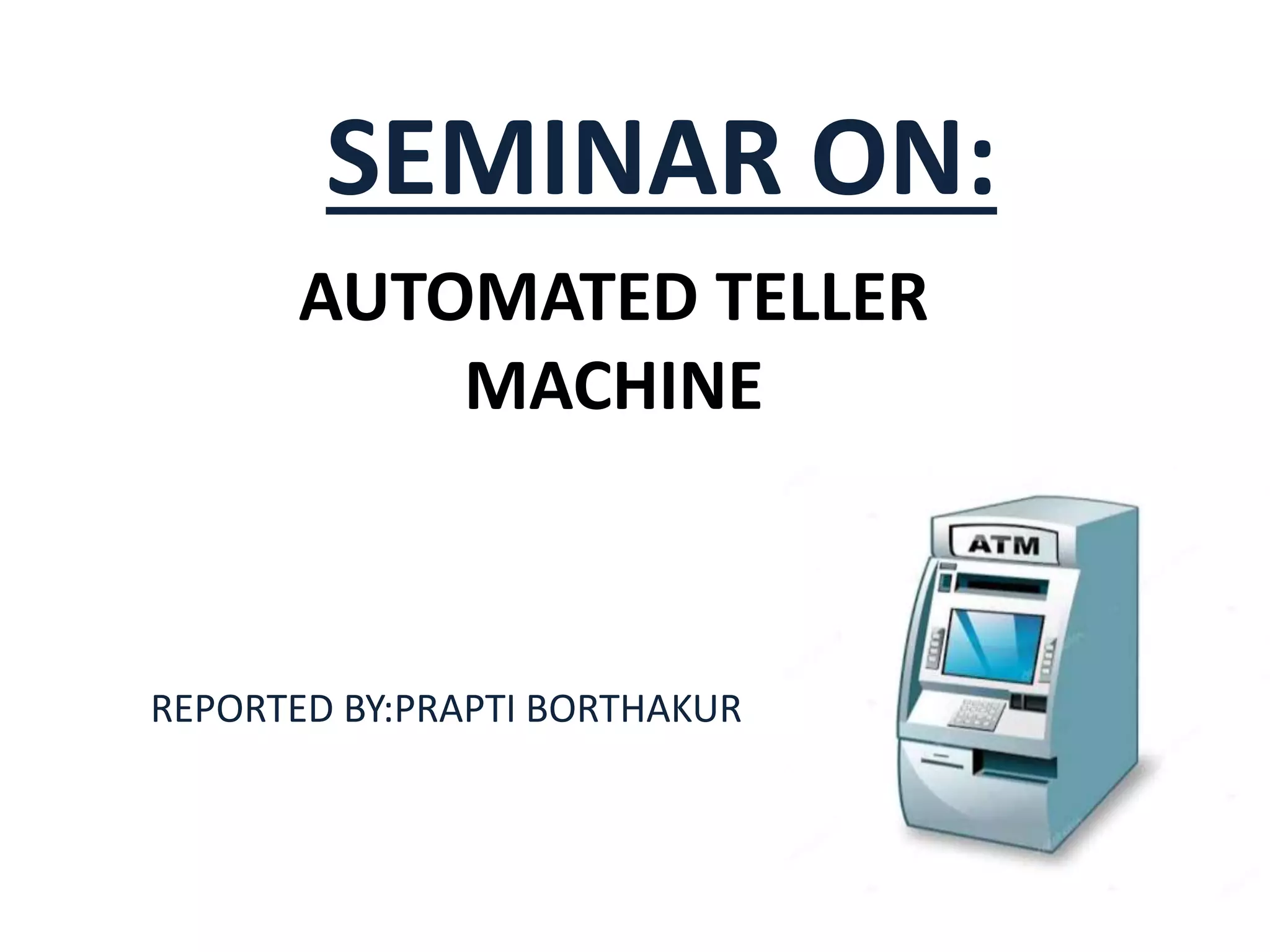
AUTOMATED TELLER
MACHINE
REPORTED BY:PRAPTI BORTHAKUR
CONTENTS
•Introduction
•History
•Types of ATM
•Parts of ATM
•ATM Networking
•ATM security
•Security issues of ATM
•Advantage of ATM
•Disadvantage of ATM
•Conclusion
INTRODUCTION
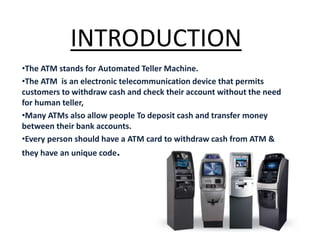
•The ATM stands for Automated Teller Machine.
•The ATM is an electronic telecommunication device that permits
customers to withdraw cash and check their account without the need
for human teller,
•Many ATMs also allow people To deposit cash and transfer money
between their bank accounts.
•Every person should have a ATM card to withdraw cash from ATM &
they have an unique code.
HISTORY
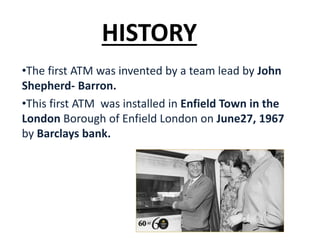
•The first ATM was invented by a team lead by John
Shepherd- Barron.
•This first ATM was installed in Enfield Town in the
London Borough of Enfield London on June27, 1967
by Barclays bank.
TYPES OF ATM
•Leased line ATM machine.
•Dial up ATM machine.
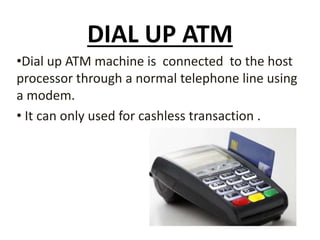
DIAL UP ATM
•Dial up ATM machine is connected to the host
processor through a normal telephone line using
a modem.
• It can only used for cashless transaction .
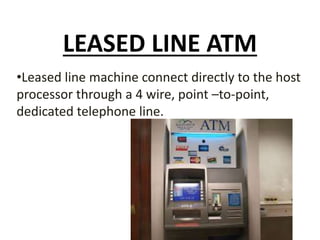
LEASED LINE ATM
•Leased line machine connect directly to the host
processor through a 4 wire, point –to-point,
dedicated telephone line.
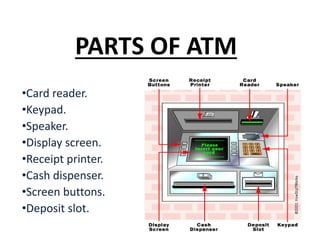
PARTS OF ATM
•Card reader.
•Keypad.
•Speaker.
•Display screen.
•Receipt printer.
•Cash dispenser.
•Screen buttons.
•Deposit slot.
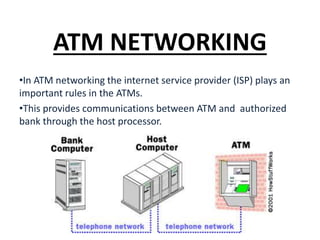
ATM NETWORKING
•In ATM networking the internet service provider (ISP) plays an
important rules in the ATMs.
•This provides communications between ATM and authorized
bank through the host processor.
ATM SECURITY
•The reader inside the ATM first checks the card is real or
fake.
•The ATM is secured with PIN number which is kept secret. It
is encrypted by the strong software.
•The customer have to enter the PIN within a time limit.
•ATM contain secure crypto-processors, generally within an
IBM PC compatible host computer in a secure enclosure.
•Another trend in ATM security is the fortified cash dispenser
is replaced by paper tape printer.
•Most of the ATMs are under CCTV surveillance.
•ATMs have alarm systems. They have also automatic sparking
system, think of it like a lighter spark, every couple of
seconds. That prevents filling them with gas to detonate.
SECURITY ISSUES OF ATM
•ATM contains large amount of cash, they are
attractive targets for criminals.
•A more sophisticated theft involves covertly
monitoring the device and its users. Thieves can
install small cameras in different places of ATM,
sometime hidden by plastic panels that look like
normal part of ATM.
•By installing fake card slots, or even extra
attachments called “skimmers” on top of the
existing card slot, attackers can read the
information on card’s magnetic strips.
ADVANTAGES
•The ATM provides 24hrs service.
•The ATM provides privacy in banking
communications.
•The ATMs reduces the work load of
bank’s staffs.
•The ATMs are convenient to banks
customers.
•The ATM is very beneficial for travelers.
DISADVANTAGES
•Some time ATM may be off line.
•We may forgot our PIN number.
•Risk of robbery when we leave the ATM.
•ATM can break down or run out of cash.
•Fees to use ATMs of other banks can
become expensive.
CONCLUSION
•Based on the studies made on ATM we hear by
conclude that ATM is the easiest way of depositing
and withdrawing money.
•Transaction is possible at any time that’s why in
India some people called ATM as “all time money”.
•Hence it can be concluded that ATM is safe , fast ,
reliable , convenient, excisable and any time money
machine

AUTOMATED TELLER MACHINE

  • 1.
  • 2.
    CONTENTS •Introduction •History •Types of ATM •Partsof ATM •ATM Networking •ATM security •Security issues of ATM •Advantage of ATM •Disadvantage of ATM •Conclusion
  • 3.
    INTRODUCTION •The ATM standsfor Automated Teller Machine. •The ATM is an electronic telecommunication device that permits customers to withdraw cash and check their account without the need for human teller, •Many ATMs also allow people To deposit cash and transfer money between their bank accounts. •Every person should have a ATM card to withdraw cash from ATM & they have an unique code.
  • 4.
    HISTORY •The first ATMwas invented by a team lead by John Shepherd- Barron. •This first ATM was installed in Enfield Town in the London Borough of Enfield London on June27, 1967 by Barclays bank.
  • 5.
    TYPES OF ATM •Leasedline ATM machine. •Dial up ATM machine.
  • 6.
    DIAL UP ATM •Dialup ATM machine is connected to the host processor through a normal telephone line using a modem. • It can only used for cashless transaction .
  • 7.
    LEASED LINE ATM •Leasedline machine connect directly to the host processor through a 4 wire, point –to-point, dedicated telephone line.
  • 8.
    PARTS OF ATM •Cardreader. •Keypad. •Speaker. •Display screen. •Receipt printer. •Cash dispenser. •Screen buttons. •Deposit slot.
  • 9.
    ATM NETWORKING •In ATMnetworking the internet service provider (ISP) plays an important rules in the ATMs. •This provides communications between ATM and authorized bank through the host processor.
  • 10.
    ATM SECURITY •The readerinside the ATM first checks the card is real or fake. •The ATM is secured with PIN number which is kept secret. It is encrypted by the strong software. •The customer have to enter the PIN within a time limit. •ATM contain secure crypto-processors, generally within an IBM PC compatible host computer in a secure enclosure. •Another trend in ATM security is the fortified cash dispenser is replaced by paper tape printer. •Most of the ATMs are under CCTV surveillance. •ATMs have alarm systems. They have also automatic sparking system, think of it like a lighter spark, every couple of seconds. That prevents filling them with gas to detonate.
  • 11.
    SECURITY ISSUES OFATM •ATM contains large amount of cash, they are attractive targets for criminals. •A more sophisticated theft involves covertly monitoring the device and its users. Thieves can install small cameras in different places of ATM, sometime hidden by plastic panels that look like normal part of ATM. •By installing fake card slots, or even extra attachments called “skimmers” on top of the existing card slot, attackers can read the information on card’s magnetic strips.
  • 12.
    ADVANTAGES •The ATM provides24hrs service. •The ATM provides privacy in banking communications. •The ATMs reduces the work load of bank’s staffs. •The ATMs are convenient to banks customers. •The ATM is very beneficial for travelers.
  • 13.
    DISADVANTAGES •Some time ATMmay be off line. •We may forgot our PIN number. •Risk of robbery when we leave the ATM. •ATM can break down or run out of cash. •Fees to use ATMs of other banks can become expensive.
  • 14.
    CONCLUSION •Based on thestudies made on ATM we hear by conclude that ATM is the easiest way of depositing and withdrawing money. •Transaction is possible at any time that’s why in India some people called ATM as “all time money”. •Hence it can be concluded that ATM is safe , fast , reliable , convenient, excisable and any time money machine