RESIDENTIAL CONSTRUCTION
WINDOWS & DOORS
WINDOW TERMINOLOGY
Windows are factory assembled as
complete units, often with the exterior
casing in place.
The basic parts are the glazing, the
sash, and the frame.
Glazing refers to the clear glass or
plastic portions of a window. (the glass
within each section may also be called
a pane or light)
The sash is the part that holds the
glazing and the frame is the fixed part
of the assembly that receives the sash.
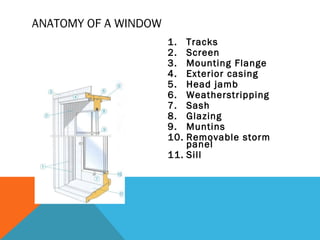
ANATOMY OF A WINDOW
1.
2.
3.
4.
5.
6.
7.
8.
9.
10.

Tracks
Screen
Mounting Flange
Exterior casing
Head jamb
Weatherstripping
Sash
Glazing
Muntins
Removable storm
panel
11. Sill
TYPES OF WINDOWS

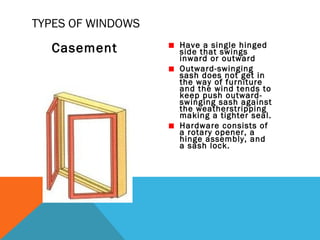
Casement

Have a single hinged
side that swings
inward or outward
Outward-swinging
sash does not get in
the way of furniture
and the wind tends to
keep push outwardswinging sash against
the weatherstripping
making a tighter seal.
Hardware consists of
a rotary opener, a
hinge assembly, and
a sash lock.
TYPES OF WINDOWS
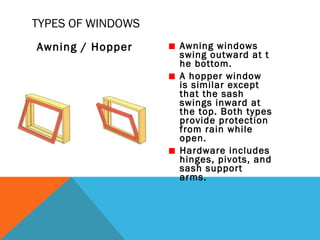
Awning / Hopper

Awning windows
swing outward at t
he bottom.
A hopper window
is similar except
that the sash
swings inward at
the top. Both types
provide protection
from rain while
open.
Hardware includes
hinges, pivots, and
sash support
arms.
TYPES OF WINDOWS

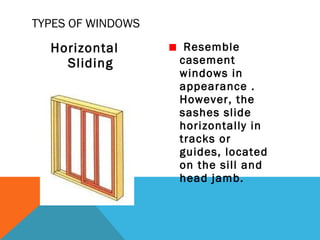
Horizontal
Sliding

Resemble
casement
windows in
appearance .
However, the
sashes slide
horizontally in
tracks or
guides, located
on the sill and
head jamb.
TYPES OF WINDOWS
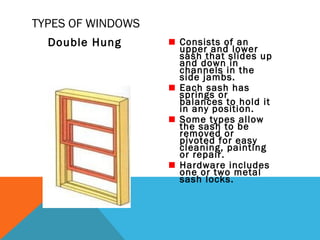
Double Hung

Consists of an
upper and lower
sash that slides up
and down in
channels in the
side jambs.
Each sash has
springs or
balances to hold it
in any position.
Some types allow
the sash to be
removed or
pivoted for easy
cleaning, painting
or repair.
Hardware includes
one or two metal
sash locks.
FRAME & SASH MATERIALS
Any of the basic types of windows can have sashes and frames
made of wood, metal, vinyl, fiberglass, or wood composites.
Hybrid windows are a combination or two or more materials
WOOD

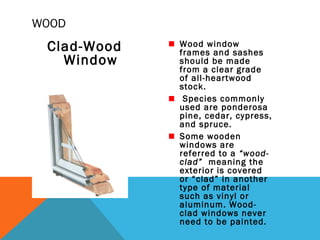
Clad-Wood
Window

Wood window
frames and sashes
should be made
from a clear grade
of all-heartwood
stock.
Species commonly
used are ponderosa
pine, cedar, cypress,
and spruce.
Some wooden
windows are
referred to a “woodclad” meaning the
exterior is covered
or “clad” in another
type of material
such as vinyl or
aluminum. Woodclad windows never
need to be painted.
METAL
Made from steel or aluminum these windows
are lighter and less costly than windows
made from other materials.
Require less maintenance than wooden
windows. Available with baked on or
anodized finishes.
Are very common in some parts of the
country and less common in other parts,
especially areas where winters are cold as
metal windows experience greater heat loss.
Also moist interior air has a tendency to
condense on metal windows.
The most efficient metal windows have two
piece frames separated by a thermal break.
Normally installed via a nailing flange.
VINYL, FIBERGLASS, & COMPOSITES
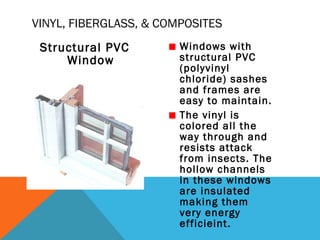
Structural PVC
Window

Windows with
structural PVC
(polyvinyl
chloride) sashes
and frames are
easy to maintain.
The vinyl is
colored all the
way through and
resists attack
from insects. The
hollow channels
in these windows
are insulated
making them
very energy
efficieint.
VINYL, FIBERGLASS, & COMPOSITES
Window frames can also be made of
fiberglass, which is a polyester-based
material reinforced with very thin glass
strands.
Like vinyl, they come in hollow and
insulated types. Fiberglass is stiffer
and stronger than vinyl.
Composite windows are made from a
mixture of polymers (plastics) and
wood under pressure. They have
properties of solid wood but are more
decay resistant.
ENERGY EFFICIENCY
Energy efficiency of a window depends on more than one
component. For example a window with energy efficient glazing
would still experience energy losses if it had faulty weatherstripping.
Accurate ratings of windows compare glazing, weatherstripping,
materials, and construction.
STANDARDS & CERTIFICATION
The Canadian General Standards Board or
CGSB sets the minimum durability on edge
seals on insulated glass units.
CSA in conjunction with the Canadian
Window & Door Manufacturers Association
came up with a window performance rating
known as CSA-A440. This rating considers a
windows air tightness, water tightness, wind
load resistance, condensation resistance,
forced entry resistance, ease of operation,
hardware, insect screens, weatherstripping
and finishes.
The National Building Code of Canada states
that all windows meet the CSA –A440
standard. This standard in updated yearly.
STANDARDS & CERTIFICATION

All windows sold in Canada also have an
ER Rating. This is a comparative
performance rating based on three factors;
 Solar heat gains
 Heat loss through frames, spacers, and glass
 Air leakage
STANDARDS & CERTIFICATION
Finally windows sold in Canada will
have a IGMAC Logo on them. This
stands for the Insulating Glass
Manufacturers of Canada and it
applies to the sealed unit only. It can
be found etched into the glass or the
spacer between the panes of glass.
IGMAC certified products will carry the
logo and the manufacturers name.
GLAZING
In all provinces in Canada we now use
insulating glass windows in home
construction (sometimes called doubleglazed windows). They are made with
two or more sheets of glass separated
by an air space.
The edges are sealed to trap air
between the sheets, which provides
the insulation. Different types of
glazing are available.
TYPES OF GLAZING
Low-e glazing; also called Low-Emissivity,
means that the glass radiates less heat to
the outdoors than regular glass. In some
types a special coating is applied to one
glass surface facing the air space. This can
reduce energy flow by as much as 50%.
Heat-absorbing glazing ; contains special
tints that enable it to absorb large amounts
of solar energy.
Gas-filled glazing; air between the glazing is
replaced by a heavier gas such as argon or
krypton. The heavier gas increases energy
efficiency.
WEATHERSTRIPPING
The main purpose of weatherstripping around a window is to prevent
air from leaking between the sash and the frame.
It can be made from various flexible materials such as foam and
fibrous pile. Over time it will loose its effectiveness and must be
replaced… it must never be painted or stained.
RESIDENTIAL CONSTRUCTION
WINDOWS & DOORS

* Source: (1) Carpentry & Building Construction / Feirer & Feirer (2) Sill to Sash: A Professionals Guide to Windows & Doors

Windows presentation

  • 1.
  • 2.
    WINDOW TERMINOLOGY Windows arefactory assembled as complete units, often with the exterior casing in place. The basic parts are the glazing, the sash, and the frame. Glazing refers to the clear glass or plastic portions of a window. (the glass within each section may also be called a pane or light) The sash is the part that holds the glazing and the frame is the fixed part of the assembly that receives the sash.
  • 3.
    ANATOMY OF AWINDOW 1. 2. 3. 4. 5. 6. 7. 8. 9. 10. Tracks Screen Mounting Flange Exterior casing Head jamb Weatherstripping Sash Glazing Muntins Removable storm panel 11. Sill
  • 4.
    TYPES OF WINDOWS Casement Havea single hinged side that swings inward or outward Outward-swinging sash does not get in the way of furniture and the wind tends to keep push outwardswinging sash against the weatherstripping making a tighter seal. Hardware consists of a rotary opener, a hinge assembly, and a sash lock.
  • 5.
    TYPES OF WINDOWS Awning/ Hopper Awning windows swing outward at t he bottom. A hopper window is similar except that the sash swings inward at the top. Both types provide protection from rain while open. Hardware includes hinges, pivots, and sash support arms.
  • 6.
    TYPES OF WINDOWS Horizontal Sliding Resemble casement windowsin appearance . However, the sashes slide horizontally in tracks or guides, located on the sill and head jamb.
  • 7.
    TYPES OF WINDOWS DoubleHung Consists of an upper and lower sash that slides up and down in channels in the side jambs. Each sash has springs or balances to hold it in any position. Some types allow the sash to be removed or pivoted for easy cleaning, painting or repair. Hardware includes one or two metal sash locks.
  • 8.
    FRAME & SASHMATERIALS Any of the basic types of windows can have sashes and frames made of wood, metal, vinyl, fiberglass, or wood composites. Hybrid windows are a combination or two or more materials
  • 9.
    WOOD Clad-Wood Window Wood window frames andsashes should be made from a clear grade of all-heartwood stock. Species commonly used are ponderosa pine, cedar, cypress, and spruce. Some wooden windows are referred to a “woodclad” meaning the exterior is covered or “clad” in another type of material such as vinyl or aluminum. Woodclad windows never need to be painted.
  • 10.
    METAL Made from steelor aluminum these windows are lighter and less costly than windows made from other materials. Require less maintenance than wooden windows. Available with baked on or anodized finishes. Are very common in some parts of the country and less common in other parts, especially areas where winters are cold as metal windows experience greater heat loss. Also moist interior air has a tendency to condense on metal windows. The most efficient metal windows have two piece frames separated by a thermal break. Normally installed via a nailing flange.
  • 11.
    VINYL, FIBERGLASS, &COMPOSITES Structural PVC Window Windows with structural PVC (polyvinyl chloride) sashes and frames are easy to maintain. The vinyl is colored all the way through and resists attack from insects. The hollow channels in these windows are insulated making them very energy efficieint.
  • 12.
    VINYL, FIBERGLASS, &COMPOSITES Window frames can also be made of fiberglass, which is a polyester-based material reinforced with very thin glass strands. Like vinyl, they come in hollow and insulated types. Fiberglass is stiffer and stronger than vinyl. Composite windows are made from a mixture of polymers (plastics) and wood under pressure. They have properties of solid wood but are more decay resistant.
  • 13.
    ENERGY EFFICIENCY Energy efficiencyof a window depends on more than one component. For example a window with energy efficient glazing would still experience energy losses if it had faulty weatherstripping. Accurate ratings of windows compare glazing, weatherstripping, materials, and construction.
  • 14.
    STANDARDS & CERTIFICATION TheCanadian General Standards Board or CGSB sets the minimum durability on edge seals on insulated glass units. CSA in conjunction with the Canadian Window & Door Manufacturers Association came up with a window performance rating known as CSA-A440. This rating considers a windows air tightness, water tightness, wind load resistance, condensation resistance, forced entry resistance, ease of operation, hardware, insect screens, weatherstripping and finishes. The National Building Code of Canada states that all windows meet the CSA –A440 standard. This standard in updated yearly.
  • 15.
    STANDARDS & CERTIFICATION Allwindows sold in Canada also have an ER Rating. This is a comparative performance rating based on three factors;  Solar heat gains  Heat loss through frames, spacers, and glass  Air leakage
  • 16.
    STANDARDS & CERTIFICATION Finallywindows sold in Canada will have a IGMAC Logo on them. This stands for the Insulating Glass Manufacturers of Canada and it applies to the sealed unit only. It can be found etched into the glass or the spacer between the panes of glass. IGMAC certified products will carry the logo and the manufacturers name.
  • 17.
    GLAZING In all provincesin Canada we now use insulating glass windows in home construction (sometimes called doubleglazed windows). They are made with two or more sheets of glass separated by an air space. The edges are sealed to trap air between the sheets, which provides the insulation. Different types of glazing are available.
  • 18.
    TYPES OF GLAZING Low-eglazing; also called Low-Emissivity, means that the glass radiates less heat to the outdoors than regular glass. In some types a special coating is applied to one glass surface facing the air space. This can reduce energy flow by as much as 50%. Heat-absorbing glazing ; contains special tints that enable it to absorb large amounts of solar energy. Gas-filled glazing; air between the glazing is replaced by a heavier gas such as argon or krypton. The heavier gas increases energy efficiency.
  • 19.
    WEATHERSTRIPPING The main purposeof weatherstripping around a window is to prevent air from leaking between the sash and the frame. It can be made from various flexible materials such as foam and fibrous pile. Over time it will loose its effectiveness and must be replaced… it must never be painted or stained.
  • 20.
    RESIDENTIAL CONSTRUCTION WINDOWS &DOORS * Source: (1) Carpentry & Building Construction / Feirer & Feirer (2) Sill to Sash: A Professionals Guide to Windows & Doors