PILE FOUNDATION
Introduction and a brief about types , classification of pile foundation also about
drilling and joining details.
AMITY SCHOOL OF ARCHITECTURE AND PLANNING
Submitted by: Nikhar Mehra
B.arch
Semester-7
Contents
Foundations ..................................................................................................................................................2
Pile Foundation.........................................................................................................................................2
THEY CONSIST OF TWO COMPONENTS: ...................................................................................................3
PILE CLASSIFICATIONS...............................................................................................................................3
 Piles may be classified by their basic design function (end-bearing, friction or a combination)
or by their method of construction (displacement (driven) or replacement (bored)..........................3
 End-bearing piles develop most of their friction at the toe of the pile, bearing on a hard layer.3
 The pile transmits load direct to firm strata, and also receives lateral restraint from subsoil. 3
TYPES OF PILES AND THEIR STRUCTURAL CHARACTERISTICS...................................................................3
ON THE BASIS OF LOAD TRANSFER :...........................................................................................3
1. End bearing piles ........................................................................................................................3
2. Friction Piles ...............................................................................................................................3
ON THE BASIS OF INSTALLATION.........................................................................................................4
1. Displacement Piles.....................................................................................................................4
2. Replacemet Piles........................................................................................................................4
ON THE BASIS OF MATERIALS...................................................................................................................4
STEEL PILES............................................................................................................................................5
CONCRETE PILES....................................................................................................................................5
TIMBER PILES ........................................................................................................................................6
..............................................................................................................................................................6
COMPOSITE PILES .................................................................................................................................6
DRILLING METHODS FOR DEEP FOUNDATIONS........................................................................................8
KELLY DRILLING .....................................................................................................................................8
CLUSTER DRILLING ................................................................................................................................9
DOUBLE ROTARY DRILLING...................................................................................................................9
DOWN-THE-HOLE DRILLING................................................................................................................10
CONTINUOUS FLIGHT AUGER DRILLING .............................................................................................10
............................................................................................................................................................10
DRILLING WITH BORED PILE GRAB......................................................................................................10
REVERSE CIRCULATION AIR INJECTION DRILLING...............................................................................11
Foundationsprovide support for structures by transferring the load to the rock or
layers of soil that have sufficient bearing capacity and suitable settlement characteristics.
There are a very wide range of foundations types available which are suitable for different
applications.
Foundations are classified mainly as Shallow foundations and Deep foundations.
Pile Foundation
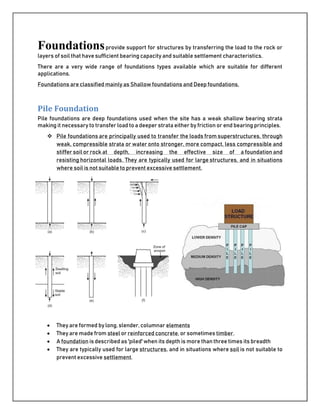
Pile foundations are deep foundations used when the site has a weak shallow bearing strata
making it necessary to transfer load to a deeper strata either by friction or end bearing principles.
 Pile foundations are principally used to transfer the loads from superstructures, through
weak, compressible strata or water onto stronger, more compact, less compressible and
stiffer soil or rock at depth, increasing the effective size of a foundation and
resisting horizontal loads. They are typically used for large structures, and in situations
where soil is not suitable to prevent excessive settlement.
 They are formed by long, slender, columnar elements
 They are made from steel or reinforced concrete, or sometimes timber.
 A foundation is described as 'piled' when its depth is more than three times its breadth
 They are typically used for large structures, and in situations where soil is not suitable to
prevent excessive settlement.
THEY CONSIST OF TWO COMPONENTS:
Pile cap and single or group of piles.
PILE CLASSIFICATIONS
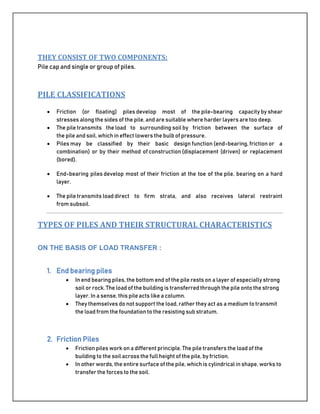
 Friction (or floating) piles develop most of the pile-bearing capacity by shear
stresses along the sides of the pile, and are suitable where harder layers are too deep.
 The pile transmits the load to surrounding soil by friction between the surface of
the pile and soil, which in effect lowers the bulb of pressure.
 Piles may be classified by their basic design function (end-bearing, friction or a
combination) or by their method of construction (displacement (driven) or replacement
(bored).
 End-bearing piles develop most of their friction at the toe of the pile, bearing on a hard
layer.
 The pile transmits load direct to firm strata, and also receives lateral restraint
from subsoil.
TYPES OF PILES AND THEIR STRUCTURAL CHARACTERISTICS
ON THE BASIS OF LOAD TRANSFER :
1. End bearing piles
 In end bearing piles, the bottom end of the pile rests on a layer of especially strong
soil or rock. The load of the building is transferred through the pile onto the strong
layer. In a sense, this pileacts like a column.
 They themselves do not support the load, rather they act as a medium to transmit
the load from the foundation to the resisting sub stratum.
2. Friction Piles
 Friction piles work on a different principle. The pile transfers the load of the
building to the soil across the full height of the pile, by friction.
 In other words, the entire surface of the pile, which is cylindrical in shape, works to
transfer the forces to the soil.
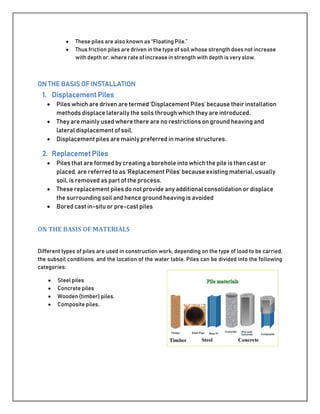
 These piles are also known as “Floating Pile.”
 Thus friction piles are driven in the type of soil whose strength does not increase
with depth or, where rate of increase in strength with depth is very slow.
ON THE BASIS OF INSTALLATION
1. Displacement Piles
 Piles which are driven are termed ‘Displacement Piles’ because their installation
methods displace laterally the soils through which they are introduced.
 They are mainly used where there are no restrictions on ground heaving and
lateral displacement of soil.
 Displacement piles are mainly preferred in marine structures.
2. Replacemet Piles
 Piles that are formed by creating a borehole into which the pile is then cast or
placed, are referred to as ‘Replacement Piles’ because existing material, usually
soil, is removed as part of the process.
 These replacement piles do not provide any additional consolidation or displace
the surrounding soil and hence ground heaving is avoided
 Bored cast in-situ or pre-cast piles
ON THE BASIS OF MATERIALS
Different types of piles are used in construction work, depending on the type of load to be carried,
the subsoil conditions, and the location of the water table. Piles can be divided into the following
categories:
 Steel piles
 Concrete piles
 Wooden (timber) piles,
 Composite piles.
STEEL PILES
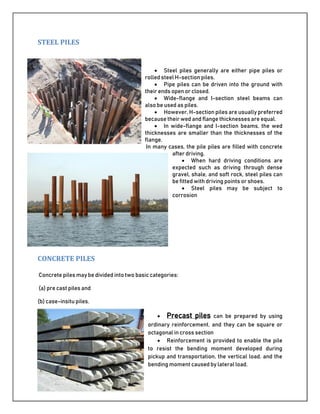
 Steel piles generally are either pipe piles or
rolled steel H-section piles.
 Pipe piles can be driven into the ground with
their ends open or closed.
 Wide-flange and I-section steel beams can
also be used as piles.
 However, H-section piles are usually preferred
because their wed and flange thicknesses are equal.
 In wide-flange and I-section beams, the wed
thicknesses are smaller than the thicknesses of the
flange.
In many cases, the pile piles are filled with concrete
after driving.
 When hard driving conditions are
expected such as driving through dense
gravel, shale, and soft rock, steel piles can
be fitted with driving points or shoes.
 Steel piles may be subject to
corrosion
CONCRETE PILES
Concrete piles may be divided into two basic categories:
(a) pre cast piles and
(b) case-insitu piles.
 Precast piles can be prepared by using
ordinary reinforcement, and they can be square or
octagonal in cross section
 Reinforcement is provided to enable the pile
to resist the bending moment developed during
pickup and transportation, the vertical load, and the
bending moment caused by lateral load.
 The piles are cast to desired lengths and cured before being transported to the work sites.
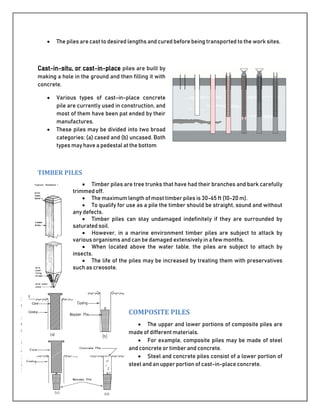
Cast-in-situ, or cast-in-place piles are built by
making a hole in the ground and then filling it with
concrete.
 Various types of cast-in-place concrete
pile are currently used in construction, and
most of them have been pat ended by their
manufactures.
 These piles may be divided into two broad
categories: (a) cased and (b) uncased. Both
types may have a pedestal at the bottom
TIMBER PILES
 Timber piles are tree trunks that have had their branches and bark carefully
trimmed off.
 The maximum length of most timber piles is 30-65 ft (10-20 m).
 To qualify for use as a pile the timber should be straight, sound and without
any defects.
 Timber piles can stay undamaged indefinitely if they are surrounded by
saturated soil.
 However, in a marine environment timber piles are subject to attack by
various organisms and can be damaged extensively in a few months.
 When located above the water table, the piles are subject to attach by
insects.
 The life of the piles may be increased by treating them with preservatives
such as creosote.
COMPOSITE PILES
 The upper and lower portions of composite piles are
made of different materials.
 For example, composite piles may be made of steel
and concrete or timber and concrete.
 Steel and concrete piles consist of a lower portion of
steel and an upper portion of cast-in-place concrete.
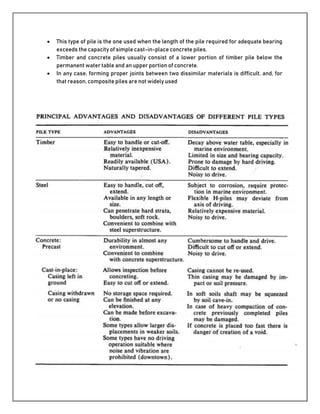
 This type of pile is the one used when the length of the pile required for adequate bearing
exceeds the capacity of simple cast-in-place concrete piles.
 Timber and concrete piles usually consist of a lower portion of timber pile below the
permanent water table and an upper portion of concrete.
 In any case, forming proper joints between two dissimilar materials is difficult, and, for
that reason, composite piles are not widely used
DRILLING METHODS FOR DEEP FOUNDATIONS
The most common drilling methods in deep foundation are
1. Kelly drilling,
2. Continuous flight
3. Auger drilling,
4. Full displacement drilling,
5. Double rotary drilling,
6. Drilling with hammer grab,
7. Reverse circulation air injection drilling
8. Down-the-hole drilling.
In the drilled cavity a multitude of products can be created, e.g. by filling with fresh concrete a so-
called cast-in-place pile is produced.
Precast concrete and steel elements serving as load-bearing or lining elements can also be
inserted.
KELLY DRILLING
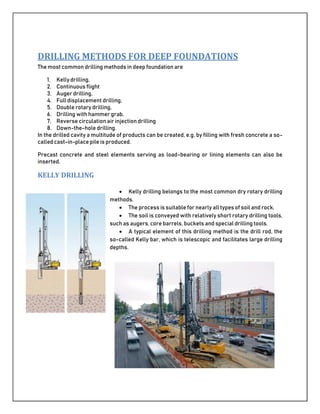
 Kelly drilling belongs to the most common dry rotary drilling
methods.
 The process is suitable for nearly all types of soil and rock.
 The soil is conveyed with relatively short rotary drilling tools,
such as augers, core barrels, buckets and special drilling tools.
 A typical element of this drilling method is the drill rod, the
so-called Kelly bar, which is telescopic and facilitates large drilling
depths.
CLUSTER DRILLING
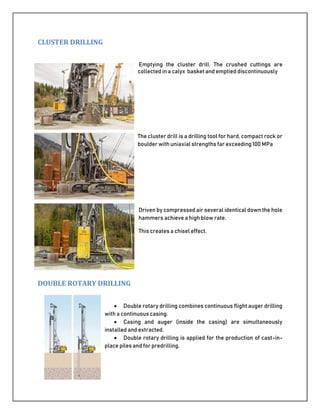
Emptying the cluster drill. The crushed cuttings are
collected in a calyx basket and emptied discontinuously
The cluster drill is a drilling tool for hard, compact rock or
boulder with uniaxial strengths far exceeding 100 MPa
Driven by compressed air several identical down the hole
hammers achieve a high blow rate.
This creates a chisel effect.
DOUBLE ROTARY DRILLING
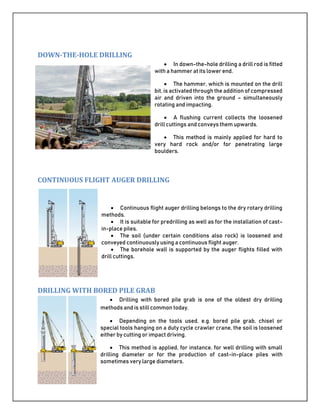
 Double rotary drilling combines continuous flight auger drilling
with a continuous casing.
 Casing and auger (inside the casing) are simultaneously
installed and extracted.
 Double rotary drilling is applied for the production of cast-in-
place piles and for predrilling.
DOWN-THE-HOLE DRILLING
 In down-the-hole drilling a drill rod is fitted
with a hammer at its lower end.
 The hammer, which is mounted on the drill
bit, is activated through the addition of compressed
air and driven into the ground – simultaneously
rotating and impacting.
 A flushing current collects the loosened
drill cuttings and conveys them upwards.
 This method is mainly applied for hard to
very hard rock and/or for penetrating large
boulders.
CONTINUOUS FLIGHT AUGER DRILLING
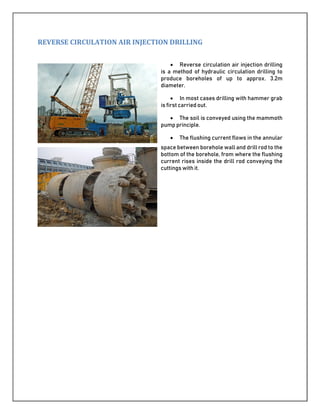
 Continuous flight auger drilling belongs to the dry rotary drilling
methods.
 It is suitable for predrilling as well as for the installation of cast-
in-place piles.
 The soil (under certain conditions also rock) is loosened and
conveyed continuously using a continuous flight auger.
 The borehole wall is supported by the auger flights filled with
drill cuttings.
DRILLING WITH BORED PILE GRAB
 Drilling with bored pile grab is one of the oldest dry drilling
methods and is still common today.
 Depending on the tools used, e.g. bored pile grab, chisel or
special tools hanging on a duty cycle crawler crane, the soil is loosened
either by cutting or impact driving.
 This method is applied, for instance, for well drilling with small
drilling diameter or for the production of cast-in-place piles with
sometimes very large diameters.
REVERSE CIRCULATION AIR INJECTION DRILLING
 Reverse circulation air injection drilling
is a method of hydraulic circulation drilling to
produce boreholes of up to approx. 3.2m
diameter.
 In most cases drilling with hammer grab
is first carried out.
 The soil is conveyed using the mammoth
pump principle.
 The flushing current flows in the annular
space between borehole wall and drill rod to the
bottom of the borehole, from where the flushing
current rises inside the drill rod conveying the
cuttings with it.

Foundations pile

  • 1.
    PILE FOUNDATION Introduction anda brief about types , classification of pile foundation also about drilling and joining details. AMITY SCHOOL OF ARCHITECTURE AND PLANNING Submitted by: Nikhar Mehra B.arch Semester-7
  • 2.
    Contents Foundations ..................................................................................................................................................2 Pile Foundation.........................................................................................................................................2 THEYCONSIST OF TWO COMPONENTS: ...................................................................................................3 PILE CLASSIFICATIONS...............................................................................................................................3  Piles may be classified by their basic design function (end-bearing, friction or a combination) or by their method of construction (displacement (driven) or replacement (bored)..........................3  End-bearing piles develop most of their friction at the toe of the pile, bearing on a hard layer.3  The pile transmits load direct to firm strata, and also receives lateral restraint from subsoil. 3 TYPES OF PILES AND THEIR STRUCTURAL CHARACTERISTICS...................................................................3 ON THE BASIS OF LOAD TRANSFER :...........................................................................................3 1. End bearing piles ........................................................................................................................3 2. Friction Piles ...............................................................................................................................3 ON THE BASIS OF INSTALLATION.........................................................................................................4 1. Displacement Piles.....................................................................................................................4 2. Replacemet Piles........................................................................................................................4 ON THE BASIS OF MATERIALS...................................................................................................................4 STEEL PILES............................................................................................................................................5 CONCRETE PILES....................................................................................................................................5 TIMBER PILES ........................................................................................................................................6 ..............................................................................................................................................................6 COMPOSITE PILES .................................................................................................................................6 DRILLING METHODS FOR DEEP FOUNDATIONS........................................................................................8 KELLY DRILLING .....................................................................................................................................8 CLUSTER DRILLING ................................................................................................................................9 DOUBLE ROTARY DRILLING...................................................................................................................9 DOWN-THE-HOLE DRILLING................................................................................................................10 CONTINUOUS FLIGHT AUGER DRILLING .............................................................................................10 ............................................................................................................................................................10 DRILLING WITH BORED PILE GRAB......................................................................................................10 REVERSE CIRCULATION AIR INJECTION DRILLING...............................................................................11
  • 3.
    Foundationsprovide support forstructures by transferring the load to the rock or layers of soil that have sufficient bearing capacity and suitable settlement characteristics. There are a very wide range of foundations types available which are suitable for different applications. Foundations are classified mainly as Shallow foundations and Deep foundations. Pile Foundation Pile foundations are deep foundations used when the site has a weak shallow bearing strata making it necessary to transfer load to a deeper strata either by friction or end bearing principles.  Pile foundations are principally used to transfer the loads from superstructures, through weak, compressible strata or water onto stronger, more compact, less compressible and stiffer soil or rock at depth, increasing the effective size of a foundation and resisting horizontal loads. They are typically used for large structures, and in situations where soil is not suitable to prevent excessive settlement.  They are formed by long, slender, columnar elements  They are made from steel or reinforced concrete, or sometimes timber.  A foundation is described as 'piled' when its depth is more than three times its breadth  They are typically used for large structures, and in situations where soil is not suitable to prevent excessive settlement.
  • 4.
    THEY CONSIST OFTWO COMPONENTS: Pile cap and single or group of piles. PILE CLASSIFICATIONS  Friction (or floating) piles develop most of the pile-bearing capacity by shear stresses along the sides of the pile, and are suitable where harder layers are too deep.  The pile transmits the load to surrounding soil by friction between the surface of the pile and soil, which in effect lowers the bulb of pressure.  Piles may be classified by their basic design function (end-bearing, friction or a combination) or by their method of construction (displacement (driven) or replacement (bored).  End-bearing piles develop most of their friction at the toe of the pile, bearing on a hard layer.  The pile transmits load direct to firm strata, and also receives lateral restraint from subsoil. TYPES OF PILES AND THEIR STRUCTURAL CHARACTERISTICS ON THE BASIS OF LOAD TRANSFER : 1. End bearing piles  In end bearing piles, the bottom end of the pile rests on a layer of especially strong soil or rock. The load of the building is transferred through the pile onto the strong layer. In a sense, this pileacts like a column.  They themselves do not support the load, rather they act as a medium to transmit the load from the foundation to the resisting sub stratum. 2. Friction Piles  Friction piles work on a different principle. The pile transfers the load of the building to the soil across the full height of the pile, by friction.  In other words, the entire surface of the pile, which is cylindrical in shape, works to transfer the forces to the soil.
  • 5.
     These pilesare also known as “Floating Pile.”  Thus friction piles are driven in the type of soil whose strength does not increase with depth or, where rate of increase in strength with depth is very slow. ON THE BASIS OF INSTALLATION 1. Displacement Piles  Piles which are driven are termed ‘Displacement Piles’ because their installation methods displace laterally the soils through which they are introduced.  They are mainly used where there are no restrictions on ground heaving and lateral displacement of soil.  Displacement piles are mainly preferred in marine structures. 2. Replacemet Piles  Piles that are formed by creating a borehole into which the pile is then cast or placed, are referred to as ‘Replacement Piles’ because existing material, usually soil, is removed as part of the process.  These replacement piles do not provide any additional consolidation or displace the surrounding soil and hence ground heaving is avoided  Bored cast in-situ or pre-cast piles ON THE BASIS OF MATERIALS Different types of piles are used in construction work, depending on the type of load to be carried, the subsoil conditions, and the location of the water table. Piles can be divided into the following categories:  Steel piles  Concrete piles  Wooden (timber) piles,  Composite piles.
  • 6.
    STEEL PILES  Steelpiles generally are either pipe piles or rolled steel H-section piles.  Pipe piles can be driven into the ground with their ends open or closed.  Wide-flange and I-section steel beams can also be used as piles.  However, H-section piles are usually preferred because their wed and flange thicknesses are equal.  In wide-flange and I-section beams, the wed thicknesses are smaller than the thicknesses of the flange. In many cases, the pile piles are filled with concrete after driving.  When hard driving conditions are expected such as driving through dense gravel, shale, and soft rock, steel piles can be fitted with driving points or shoes.  Steel piles may be subject to corrosion CONCRETE PILES Concrete piles may be divided into two basic categories: (a) pre cast piles and (b) case-insitu piles.  Precast piles can be prepared by using ordinary reinforcement, and they can be square or octagonal in cross section  Reinforcement is provided to enable the pile to resist the bending moment developed during pickup and transportation, the vertical load, and the bending moment caused by lateral load.
  • 7.
     The pilesare cast to desired lengths and cured before being transported to the work sites. Cast-in-situ, or cast-in-place piles are built by making a hole in the ground and then filling it with concrete.  Various types of cast-in-place concrete pile are currently used in construction, and most of them have been pat ended by their manufactures.  These piles may be divided into two broad categories: (a) cased and (b) uncased. Both types may have a pedestal at the bottom TIMBER PILES  Timber piles are tree trunks that have had their branches and bark carefully trimmed off.  The maximum length of most timber piles is 30-65 ft (10-20 m).  To qualify for use as a pile the timber should be straight, sound and without any defects.  Timber piles can stay undamaged indefinitely if they are surrounded by saturated soil.  However, in a marine environment timber piles are subject to attack by various organisms and can be damaged extensively in a few months.  When located above the water table, the piles are subject to attach by insects.  The life of the piles may be increased by treating them with preservatives such as creosote. COMPOSITE PILES  The upper and lower portions of composite piles are made of different materials.  For example, composite piles may be made of steel and concrete or timber and concrete.  Steel and concrete piles consist of a lower portion of steel and an upper portion of cast-in-place concrete.
  • 8.
     This typeof pile is the one used when the length of the pile required for adequate bearing exceeds the capacity of simple cast-in-place concrete piles.  Timber and concrete piles usually consist of a lower portion of timber pile below the permanent water table and an upper portion of concrete.  In any case, forming proper joints between two dissimilar materials is difficult, and, for that reason, composite piles are not widely used
  • 9.
    DRILLING METHODS FORDEEP FOUNDATIONS The most common drilling methods in deep foundation are 1. Kelly drilling, 2. Continuous flight 3. Auger drilling, 4. Full displacement drilling, 5. Double rotary drilling, 6. Drilling with hammer grab, 7. Reverse circulation air injection drilling 8. Down-the-hole drilling. In the drilled cavity a multitude of products can be created, e.g. by filling with fresh concrete a so- called cast-in-place pile is produced. Precast concrete and steel elements serving as load-bearing or lining elements can also be inserted. KELLY DRILLING  Kelly drilling belongs to the most common dry rotary drilling methods.  The process is suitable for nearly all types of soil and rock.  The soil is conveyed with relatively short rotary drilling tools, such as augers, core barrels, buckets and special drilling tools.  A typical element of this drilling method is the drill rod, the so-called Kelly bar, which is telescopic and facilitates large drilling depths.
  • 10.
    CLUSTER DRILLING Emptying thecluster drill. The crushed cuttings are collected in a calyx basket and emptied discontinuously The cluster drill is a drilling tool for hard, compact rock or boulder with uniaxial strengths far exceeding 100 MPa Driven by compressed air several identical down the hole hammers achieve a high blow rate. This creates a chisel effect. DOUBLE ROTARY DRILLING  Double rotary drilling combines continuous flight auger drilling with a continuous casing.  Casing and auger (inside the casing) are simultaneously installed and extracted.  Double rotary drilling is applied for the production of cast-in- place piles and for predrilling.
  • 11.
    DOWN-THE-HOLE DRILLING  Indown-the-hole drilling a drill rod is fitted with a hammer at its lower end.  The hammer, which is mounted on the drill bit, is activated through the addition of compressed air and driven into the ground – simultaneously rotating and impacting.  A flushing current collects the loosened drill cuttings and conveys them upwards.  This method is mainly applied for hard to very hard rock and/or for penetrating large boulders. CONTINUOUS FLIGHT AUGER DRILLING  Continuous flight auger drilling belongs to the dry rotary drilling methods.  It is suitable for predrilling as well as for the installation of cast- in-place piles.  The soil (under certain conditions also rock) is loosened and conveyed continuously using a continuous flight auger.  The borehole wall is supported by the auger flights filled with drill cuttings. DRILLING WITH BORED PILE GRAB  Drilling with bored pile grab is one of the oldest dry drilling methods and is still common today.  Depending on the tools used, e.g. bored pile grab, chisel or special tools hanging on a duty cycle crawler crane, the soil is loosened either by cutting or impact driving.  This method is applied, for instance, for well drilling with small drilling diameter or for the production of cast-in-place piles with sometimes very large diameters.
  • 12.
    REVERSE CIRCULATION AIRINJECTION DRILLING  Reverse circulation air injection drilling is a method of hydraulic circulation drilling to produce boreholes of up to approx. 3.2m diameter.  In most cases drilling with hammer grab is first carried out.  The soil is conveyed using the mammoth pump principle.  The flushing current flows in the annular space between borehole wall and drill rod to the bottom of the borehole, from where the flushing current rises inside the drill rod conveying the cuttings with it.