FLOORING
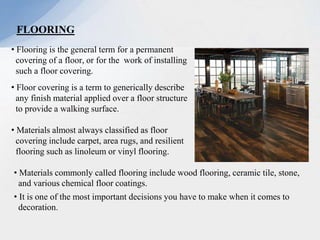
• Flooring is the general term for a permanent
covering of a floor, or for the work of installing
such a floor covering.
• Floor covering is a term to generically describe
any finish material applied over a floor structure
to provide a walking surface.
• Materials almost always classified as floor
covering include carpet, area rugs, and resilient
flooring such as linoleum or vinyl flooring.
• Materials commonly called flooring include wood flooring, ceramic tile, stone,
and various chemical floor coatings.
FLOORING
• It is one of the most important decisions you have to make when it comes to
decoration.
• The first carpets were actually created thousands of years ago. 5000 B.C.
which last untill discovery of the Persian rug in the 17th century, they are
still one of the oldest flooring options still used today.
• Tile/ ceramic / marble floors were first around 4000 B.C. and get popular
during 12th century, when monks began using tiles to create patterns on
cathedral floors.
• In more recent years, several more flooring options have surfaced,
including engineered wood in 1960 and laminated in 1970.But newest
notable option is the arrival of bamboo floors in 1990.
HISTORY
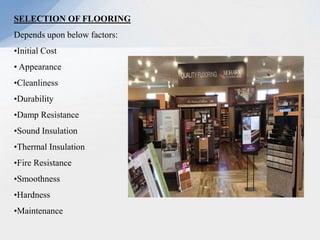
SELECTION OF FLOORING
Depends upon below factors:
•Initial Cost
• Appearance
•Cleanliness
•Durability
•Damp Resistance
•Sound Insulation
•Thermal Insulation
•Fire Resistance
•Smoothness
•Hardness
•Maintenance
TYPES OF FLOORING
1. Resilient Flooring
2. Wood flooring
3. Carpet & Rugs
4. Ceramic Tiles
5. Seamless chemical flooring
6. Marble flooring
7. Terrazzo flooring
8. Brick Flooring
9. Glass Flooring
10. Stone Flooring
11. Rubber flooring
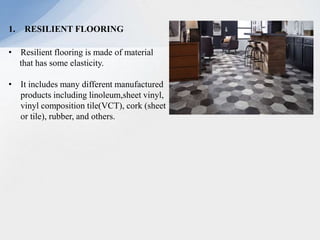
1. RESILIENT FLOORING
• Resilient flooring is made of material
that has some elasticity.
• It includes many different manufactured
products including linoleum,sheet vinyl,
vinyl composition tile(VCT), cork (sheet
or tile), rubber, and others.
Advantages
• Easy to install
• Maintenance cost is low
• Water resistance
• Attractive in apperance
Disadvantage
• Environmental impact
• Wears overtime
• Difficulty in repair
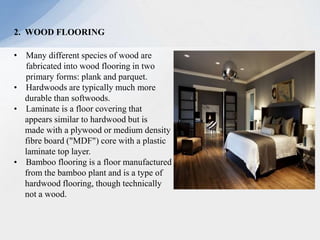
2. WOOD FLOORING
• Many different species of wood are
fabricated into wood flooring in two
primary forms: plank and parquet.
• Hardwoods are typically much more
durable than softwoods.
• Laminate is a floor covering that
appears similar to hardwood but is
made with a plywood or medium density
fibre board ("MDF") core with a plastic
laminate top layer.
• Bamboo flooring is a floor manufactured
from the bamboo plant and is a type of
hardwood flooring, though technically
not a wood.
Advantages
•It provides warmth.
•It can last more than 100 years with regular maintenance.
•It is very resistant to daily living wear and tear.
•It is easy to clean.
Disadvantages
•It is expensive.
•It creates noise.
•It can be vulnerable to humidity and moisture.
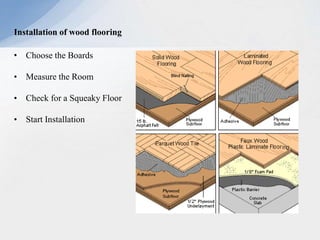
Installation of wood flooring
• Choose the Boards
• Measure the Room
• Check for a Squeaky Floor
• Start Installation
3. SOFT COVERING
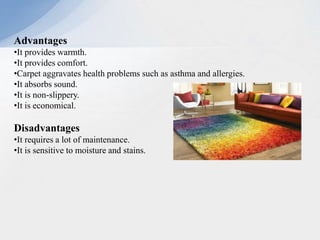
• Carpet is a floor covering woven from
natural or man-made fibre.
• Fitted carpet is attached to the floor
structure, extends wall-to- wall, and
cannot be moved from place to place.
• Rugs are smaller than the room in which
they are located and are generally placed
over the wood flooring.
• They may be attached to the flooring
below by adhesive or other methods.
Advantages
•It provides warmth.
•It provides comfort.
•Carpet aggravates health problems such as asthma and allergies.
•It absorbs sound.
•It is non-slippery.
•It is economical.
Disadvantages
•It requires a lot of maintenance.
•It is sensitive to moisture and stains.
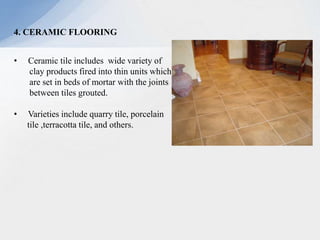
4. CERAMIC FLOORING
• Ceramic tile includes wide variety of
clay products fired into thin units which
are set in beds of mortar with the joints
between tiles grouted.
• Varieties include quarry tile, porcelain
tile ,terracotta tile, and others.
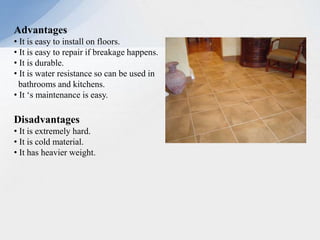
Advantages
• It is easy to install on floors.
• It is easy to repair if breakage happens.
• It is durable.
• It is water resistance so can be used in
bathrooms and kitchens.
• It ‘s maintenance is easy.
Disadvantages
• It is extremely hard.
• It is cold material.
• It has heavier weight.
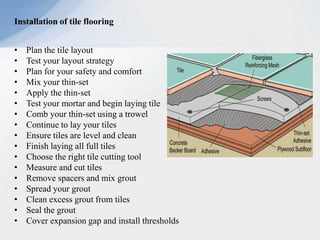
Installation of tile flooring
• Plan the tile layout
• Test your layout strategy
• Plan for your safety and comfort
• Mix your thin-set
• Apply the thin-set
• Test your mortar and begin laying tile
• Comb your thin-set using a trowel
• Continue to lay your tiles
• Ensure tiles are level and clean
• Finish laying all full tiles
• Choose the right tile cutting tool
• Measure and cut tiles
• Remove spacers and mix grout
• Spread your grout
• Clean excess grout from tiles
• Seal the grout
• Cover expansion gap and install thresholds
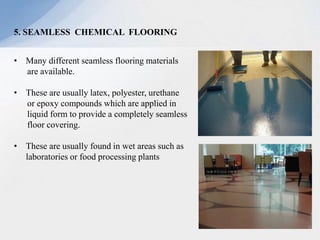
5. SEAMLESS CHEMICAL FLOORING
• Many different seamless flooring materials
are available.
• These are usually latex, polyester, urethane
or epoxy compounds which are applied in
liquid form to provide a completely seamless
floor covering.
• These are usually found in wet areas such as
laboratories or food processing plants
Advantages
• It can be used everywhere, from kitchens to locker rooms to corridors and
classrooms.
• Hygienic topcoats specially developed to be self proactive against the growth
of mold, bacteria, yeast, fungi, and other micro-organisms.
• It is easy to install.
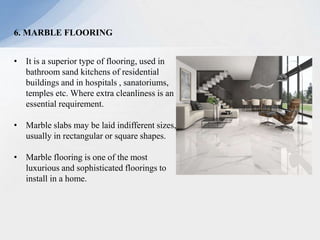
6. MARBLE FLOORING
• It is a superior type of flooring, used in
bathroom sand kitchens of residential
buildings and in hospitals , sanatoriums,
temples etc. Where extra cleanliness is an
essential requirement.
• Marble slabs may be laid indifferent sizes,
usually in rectangular or square shapes.
• Marble flooring is one of the most
luxurious and sophisticated floorings to
install in a home.
Advantages
•Marble creates a very magnificent aesthetic impact on the interiors.
•It is very durable.
•It is scratch resistant.
Disadvantages
• It requires proper care and maintenance.
• Italian marble is usually very soft and prone to cracks.
• It is highly porous and prone to staining.
• It is not appropriate for kitchen as it absorbs stains.
• It is very heavy and lot of labour is required in lifting the stone.
• It becomes very cold in winters.
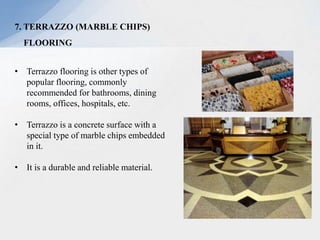
7. TERRAZZO (MARBLE CHIPS)
FLOORING
• Terrazzo flooring is other types of
popular flooring, commonly
recommended for bathrooms, dining
rooms, offices, hospitals, etc.
• Terrazzo is a concrete surface with a
special type of marble chips embedded
in it.
• It is a durable and reliable material.
Advantages
• It is durable.
• It is very easy to maintain.
• It is very dense.
• It doesn’t harm the environment.
Disadvantages
• It makes the surface very slippery when it’s wet.
• It is very expensive.
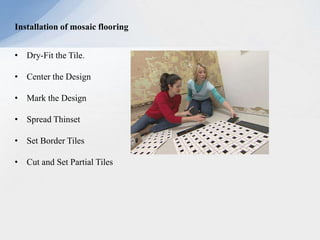
Installation of mosaic flooring
• Dry-Fit the Tile.
• Center the Design
• Mark the Design
• Spread Thinset
• Set Border Tiles
• Cut and Set Partial Tiles
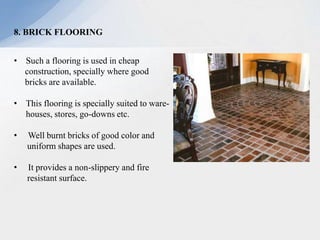
8. BRICK FLOORING
• Such a flooring is used in cheap
construction, specially where good
bricks are available.
• This flooring is specially suited to ware-
houses, stores, go-downs etc.
• Well burnt bricks of good color and
uniform shapes are used.
• It provides a non-slippery and fire
resistant surface.
Advantages
• It is extremely durable.
• It is fire resistant.
• It can be counted as sustained material.
Disadvantages
• As it is very dense and heavy, can be impractical for installation in some
areas without proper support.
• It is extremely hard.
• If not cleaned properly, can promote mold growth.
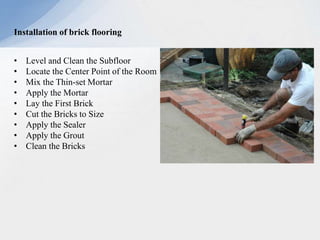
Installation of brick flooring
• Level and Clean the Subfloor
• Locate the Center Point of the Room
• Mix the Thin-set Mortar
• Apply the Mortar
• Lay the First Brick
• Cut the Bricks to Size
• Apply the Sealer
• Apply the Grout
• Clean the Bricks
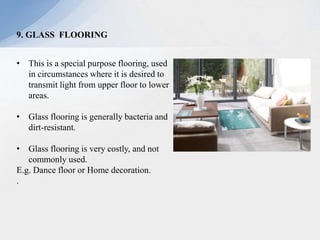
9. GLASS FLOORING
• This is a special purpose flooring, used
in circumstances where it is desired to
transmit light from upper floor to lower
areas.
• Glass flooring is generally bacteria and
dirt-resistant.
• Glass flooring is very costly, and not
commonly used.
E.g. Dance floor or Home decoration.
.
Advantages
• It is aesthetically pleasing.
• We can get tailor made shapes and sizes of glass.
• It is great insulation material.
• It is also waterproof.
• It is easy to clean.
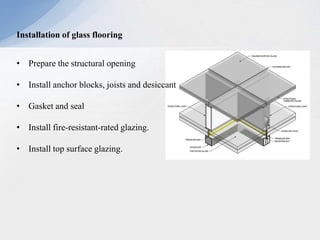
Installation of glass flooring
• Prepare the structural opening
• Install anchor blocks, joists and desiccant
• Gasket and seal
• Install fire-resistant-rated glazing.
• Install top surface glazing.
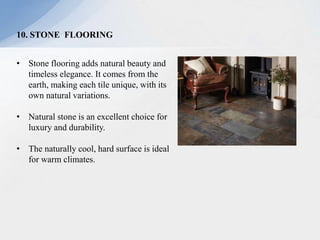
10. STONE FLOORING
• Stone flooring adds natural beauty and
timeless elegance. It comes from the
earth, making each tile unique, with its
own natural variations.
• Natural stone is an excellent choice for
luxury and durability.
• The naturally cool, hard surface is ideal
for warm climates.
Advantages
•It also has a very pleasing and natural aesthetic impact.
•It is eco-friendly material.
•It is extremely durable.
Disadvantages
•It requires maintains and regular washing and cleaning every alternate day.
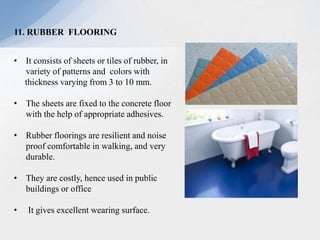
11. RUBBER FLOORING
• It consists of sheets or tiles of rubber, in
variety of patterns and colors with
thickness varying from 3 to 10 mm.
• The sheets are fixed to the concrete floor
with the help of appropriate adhesives.
• Rubber floorings are resilient and noise
proof comfortable in walking, and very
durable.
• They are costly, hence used in public
buildings or office
• It gives excellent wearing surface.
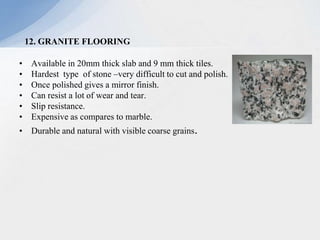
• Available in 20mm thick slab and 9 mm thick tiles.
• Hardest type of stone –very difficult to cut and polish.
• Once polished gives a mirror finish.
• Can resist a lot of wear and tear.
• Slip resistance.
• Expensive as compares to marble.
• Durable and natural with visible coarse grains.
12. GRANITE FLOORING
PRECAUTION DURING FLOOR CONSTRUCTION
1.The base and sub-base of the floor at the ground should be prepared with great
care, strictly following the construction specification and procedure.
2.The required shape for the floor should be given in the base course itself.
3.Metallic or other strips, as may be required to lay the flooring, should be laid
straight.
4.Curing of floors including that for base concrete should be carried out properly
such that required strength is obtained.
5.Tiles for flooring should laid on the mortar bed in a manner that no gap is left
between the mortar and the tile at any place.
6.Tiles should be tapped properly in the mortar bed to ensure a proper level.
7.Wooden or bamboo floor finishing should be stuck to the base with the help of a
prescribed adhesive.
PSYCHOLOGY
Warm shades of brown, whether in a rich carpet or polished wooden floor will
suggest a genuine, neutral and comfortable place-men are most likely to respond to
brown tones favorably, so this is ideal for masculine themed areas. To add drama to
richly colored rug which will break up the area and add stimulation for the eye.
• Grey floors are relaxing or restful. Using grey flooring in a dining room can
be balanced with yellow or pink accents which lift the color and also increase
appetite. A grey floor is the perfect foil for furniture.
• Black floors are currently very popular, but they must be balanced with careful
lighting choices as a black floor can ‘flatten’ a room, making it appear shadow
and wide.
•White or very light floor can open up a small room and light parquet or laminate
floors or white washed wooden flooring naturally create a simple, rustic and relaxed
ambience, commonly associated with seaside locations and holiday homes. As a
result, this type of floor choice will work harmoniously with blues and greens-
the shades we associate with the sea.
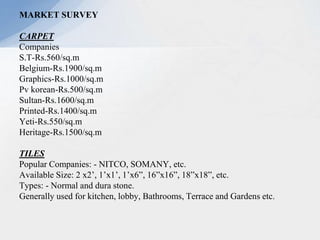
MARKET SURVEY
CARPET
Companies
S.T-Rs.560/sq.m
Belgium-Rs.1900/sq.m
Graphics-Rs.1000/sq.m
Pv korean-Rs.500/sq.m
Sultan-Rs.1600/sq.m
Printed-Rs.1400/sq.m
Yeti-Rs.550/sq.m
Heritage-Rs.1500/sq.m
TILES
Popular Companies: - NITCO, SOMANY, etc.
Available Size: 2 x2’, 1’x1’, 1’x6”, 16”x16”, 18”x18”, etc.
Types: - Normal and dura stone.
Generally used for kitchen, lobby, Bathrooms, Terrace and Gardens etc.
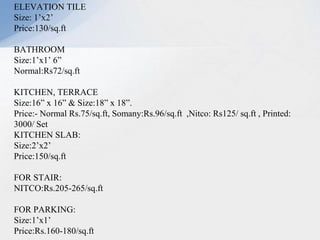
ELEVATION TILE
Size: 1’x2’
Price:130/sq.ft
BATHROOM
Size:1’x1’ 6”
Normal:Rs72/sq.ft
KITCHEN, TERRACE
Size:16” x 16” & Size:18” x 18”.
Price:- Normal Rs.75/sq.ft, Somany:Rs.96/sq.ft ,Nitco: Rs125/ sq.ft , Printed:
3000/ Set
KITCHEN SLAB:
Size:2’x2’
Price:150/sq.ft
FOR STAIR:
NITCO:Rs.205-265/sq.ft
FOR PARKING:
Size:1’x1’
Price:Rs.160-180/sq.ft
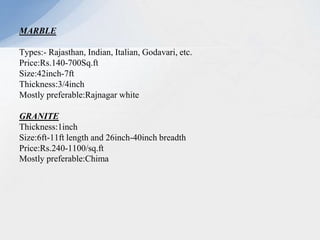
MARBLE
Types:- Rajasthan, Indian, Italian, Godavari, etc.
Price:Rs.140-700Sq.ft
Size:42inch-7ft
Thickness:3/4inch
Mostly preferable:Rajnagar white
GRANITE
Thickness:1inch
Size:6ft-11ft length and 26inch-40inch breadth
Price:Rs.240-1100/sq.ft
Mostly preferable:Chima
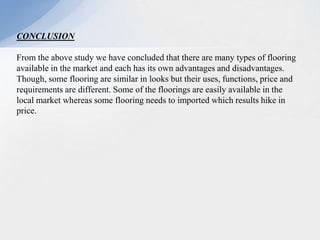
CONCLUSION
From the above study we have concluded that there are many types of flooring
available in the market and each has its own advantages and disadvantages.
Though, some flooring are similar in looks but their uses, functions, price and
requirements are different. Some of the floorings are easily available in the
local market whereas some flooring needs to imported which results hike in
price.
• http://www.academia.edu/9411189/Flooring_System_Details_of_Construction.
• http://homeguides.sfgate.com/flooring-apartment-62884.html
•https://www.lowes.com/projects/build-and-remodel/install-floor-tile/project
REFERENCES :

Flooring

  • 1.
  • 2.
    • Flooring isthe general term for a permanent covering of a floor, or for the work of installing such a floor covering. • Floor covering is a term to generically describe any finish material applied over a floor structure to provide a walking surface. • Materials almost always classified as floor covering include carpet, area rugs, and resilient flooring such as linoleum or vinyl flooring. • Materials commonly called flooring include wood flooring, ceramic tile, stone, and various chemical floor coatings. FLOORING • It is one of the most important decisions you have to make when it comes to decoration.
  • 3.
    • The firstcarpets were actually created thousands of years ago. 5000 B.C. which last untill discovery of the Persian rug in the 17th century, they are still one of the oldest flooring options still used today. • Tile/ ceramic / marble floors were first around 4000 B.C. and get popular during 12th century, when monks began using tiles to create patterns on cathedral floors. • In more recent years, several more flooring options have surfaced, including engineered wood in 1960 and laminated in 1970.But newest notable option is the arrival of bamboo floors in 1990. HISTORY
  • 4.
    SELECTION OF FLOORING Dependsupon below factors: •Initial Cost • Appearance •Cleanliness •Durability •Damp Resistance •Sound Insulation •Thermal Insulation •Fire Resistance •Smoothness •Hardness •Maintenance
  • 5.
    TYPES OF FLOORING 1.Resilient Flooring 2. Wood flooring 3. Carpet & Rugs 4. Ceramic Tiles 5. Seamless chemical flooring 6. Marble flooring 7. Terrazzo flooring 8. Brick Flooring 9. Glass Flooring 10. Stone Flooring 11. Rubber flooring
  • 6.
    1. RESILIENT FLOORING •Resilient flooring is made of material that has some elasticity. • It includes many different manufactured products including linoleum,sheet vinyl, vinyl composition tile(VCT), cork (sheet or tile), rubber, and others.
  • 7.
    Advantages • Easy toinstall • Maintenance cost is low • Water resistance • Attractive in apperance Disadvantage • Environmental impact • Wears overtime • Difficulty in repair
  • 8.
    2. WOOD FLOORING •Many different species of wood are fabricated into wood flooring in two primary forms: plank and parquet. • Hardwoods are typically much more durable than softwoods. • Laminate is a floor covering that appears similar to hardwood but is made with a plywood or medium density fibre board ("MDF") core with a plastic laminate top layer. • Bamboo flooring is a floor manufactured from the bamboo plant and is a type of hardwood flooring, though technically not a wood.
  • 9.
    Advantages •It provides warmth. •Itcan last more than 100 years with regular maintenance. •It is very resistant to daily living wear and tear. •It is easy to clean. Disadvantages •It is expensive. •It creates noise. •It can be vulnerable to humidity and moisture.
  • 10.
    Installation of woodflooring • Choose the Boards • Measure the Room • Check for a Squeaky Floor • Start Installation
  • 11.
    3. SOFT COVERING •Carpet is a floor covering woven from natural or man-made fibre. • Fitted carpet is attached to the floor structure, extends wall-to- wall, and cannot be moved from place to place. • Rugs are smaller than the room in which they are located and are generally placed over the wood flooring. • They may be attached to the flooring below by adhesive or other methods.
  • 12.
    Advantages •It provides warmth. •Itprovides comfort. •Carpet aggravates health problems such as asthma and allergies. •It absorbs sound. •It is non-slippery. •It is economical. Disadvantages •It requires a lot of maintenance. •It is sensitive to moisture and stains.
  • 13.
    4. CERAMIC FLOORING •Ceramic tile includes wide variety of clay products fired into thin units which are set in beds of mortar with the joints between tiles grouted. • Varieties include quarry tile, porcelain tile ,terracotta tile, and others.
  • 14.
    Advantages • It iseasy to install on floors. • It is easy to repair if breakage happens. • It is durable. • It is water resistance so can be used in bathrooms and kitchens. • It ‘s maintenance is easy. Disadvantages • It is extremely hard. • It is cold material. • It has heavier weight.
  • 15.
    Installation of tileflooring • Plan the tile layout • Test your layout strategy • Plan for your safety and comfort • Mix your thin-set • Apply the thin-set • Test your mortar and begin laying tile • Comb your thin-set using a trowel • Continue to lay your tiles • Ensure tiles are level and clean • Finish laying all full tiles • Choose the right tile cutting tool • Measure and cut tiles • Remove spacers and mix grout • Spread your grout • Clean excess grout from tiles • Seal the grout • Cover expansion gap and install thresholds
  • 16.
    5. SEAMLESS CHEMICALFLOORING • Many different seamless flooring materials are available. • These are usually latex, polyester, urethane or epoxy compounds which are applied in liquid form to provide a completely seamless floor covering. • These are usually found in wet areas such as laboratories or food processing plants
  • 17.
    Advantages • It canbe used everywhere, from kitchens to locker rooms to corridors and classrooms. • Hygienic topcoats specially developed to be self proactive against the growth of mold, bacteria, yeast, fungi, and other micro-organisms. • It is easy to install.
  • 18.
    6. MARBLE FLOORING •It is a superior type of flooring, used in bathroom sand kitchens of residential buildings and in hospitals , sanatoriums, temples etc. Where extra cleanliness is an essential requirement. • Marble slabs may be laid indifferent sizes, usually in rectangular or square shapes. • Marble flooring is one of the most luxurious and sophisticated floorings to install in a home.
  • 19.
    Advantages •Marble creates avery magnificent aesthetic impact on the interiors. •It is very durable. •It is scratch resistant. Disadvantages • It requires proper care and maintenance. • Italian marble is usually very soft and prone to cracks. • It is highly porous and prone to staining. • It is not appropriate for kitchen as it absorbs stains. • It is very heavy and lot of labour is required in lifting the stone. • It becomes very cold in winters.
  • 20.
    7. TERRAZZO (MARBLECHIPS) FLOORING • Terrazzo flooring is other types of popular flooring, commonly recommended for bathrooms, dining rooms, offices, hospitals, etc. • Terrazzo is a concrete surface with a special type of marble chips embedded in it. • It is a durable and reliable material.
  • 21.
    Advantages • It isdurable. • It is very easy to maintain. • It is very dense. • It doesn’t harm the environment. Disadvantages • It makes the surface very slippery when it’s wet. • It is very expensive.
  • 22.
    Installation of mosaicflooring • Dry-Fit the Tile. • Center the Design • Mark the Design • Spread Thinset • Set Border Tiles • Cut and Set Partial Tiles
  • 23.
    8. BRICK FLOORING •Such a flooring is used in cheap construction, specially where good bricks are available. • This flooring is specially suited to ware- houses, stores, go-downs etc. • Well burnt bricks of good color and uniform shapes are used. • It provides a non-slippery and fire resistant surface.
  • 24.
    Advantages • It isextremely durable. • It is fire resistant. • It can be counted as sustained material. Disadvantages • As it is very dense and heavy, can be impractical for installation in some areas without proper support. • It is extremely hard. • If not cleaned properly, can promote mold growth.
  • 25.
    Installation of brickflooring • Level and Clean the Subfloor • Locate the Center Point of the Room • Mix the Thin-set Mortar • Apply the Mortar • Lay the First Brick • Cut the Bricks to Size • Apply the Sealer • Apply the Grout • Clean the Bricks
  • 26.
    9. GLASS FLOORING •This is a special purpose flooring, used in circumstances where it is desired to transmit light from upper floor to lower areas. • Glass flooring is generally bacteria and dirt-resistant. • Glass flooring is very costly, and not commonly used. E.g. Dance floor or Home decoration. .
  • 27.
    Advantages • It isaesthetically pleasing. • We can get tailor made shapes and sizes of glass. • It is great insulation material. • It is also waterproof. • It is easy to clean.
  • 28.
    Installation of glassflooring • Prepare the structural opening • Install anchor blocks, joists and desiccant • Gasket and seal • Install fire-resistant-rated glazing. • Install top surface glazing.
  • 29.
    10. STONE FLOORING •Stone flooring adds natural beauty and timeless elegance. It comes from the earth, making each tile unique, with its own natural variations. • Natural stone is an excellent choice for luxury and durability. • The naturally cool, hard surface is ideal for warm climates.
  • 30.
    Advantages •It also hasa very pleasing and natural aesthetic impact. •It is eco-friendly material. •It is extremely durable. Disadvantages •It requires maintains and regular washing and cleaning every alternate day.
  • 31.
    11. RUBBER FLOORING •It consists of sheets or tiles of rubber, in variety of patterns and colors with thickness varying from 3 to 10 mm. • The sheets are fixed to the concrete floor with the help of appropriate adhesives. • Rubber floorings are resilient and noise proof comfortable in walking, and very durable. • They are costly, hence used in public buildings or office • It gives excellent wearing surface.
  • 32.
    • Available in20mm thick slab and 9 mm thick tiles. • Hardest type of stone –very difficult to cut and polish. • Once polished gives a mirror finish. • Can resist a lot of wear and tear. • Slip resistance. • Expensive as compares to marble. • Durable and natural with visible coarse grains. 12. GRANITE FLOORING
  • 33.
    PRECAUTION DURING FLOORCONSTRUCTION 1.The base and sub-base of the floor at the ground should be prepared with great care, strictly following the construction specification and procedure. 2.The required shape for the floor should be given in the base course itself. 3.Metallic or other strips, as may be required to lay the flooring, should be laid straight. 4.Curing of floors including that for base concrete should be carried out properly such that required strength is obtained. 5.Tiles for flooring should laid on the mortar bed in a manner that no gap is left between the mortar and the tile at any place. 6.Tiles should be tapped properly in the mortar bed to ensure a proper level. 7.Wooden or bamboo floor finishing should be stuck to the base with the help of a prescribed adhesive.
  • 34.
    PSYCHOLOGY Warm shades ofbrown, whether in a rich carpet or polished wooden floor will suggest a genuine, neutral and comfortable place-men are most likely to respond to brown tones favorably, so this is ideal for masculine themed areas. To add drama to richly colored rug which will break up the area and add stimulation for the eye. • Grey floors are relaxing or restful. Using grey flooring in a dining room can be balanced with yellow or pink accents which lift the color and also increase appetite. A grey floor is the perfect foil for furniture. • Black floors are currently very popular, but they must be balanced with careful lighting choices as a black floor can ‘flatten’ a room, making it appear shadow and wide. •White or very light floor can open up a small room and light parquet or laminate floors or white washed wooden flooring naturally create a simple, rustic and relaxed ambience, commonly associated with seaside locations and holiday homes. As a result, this type of floor choice will work harmoniously with blues and greens- the shades we associate with the sea.
  • 35.
    MARKET SURVEY CARPET Companies S.T-Rs.560/sq.m Belgium-Rs.1900/sq.m Graphics-Rs.1000/sq.m Pv korean-Rs.500/sq.m Sultan-Rs.1600/sq.m Printed-Rs.1400/sq.m Yeti-Rs.550/sq.m Heritage-Rs.1500/sq.m TILES PopularCompanies: - NITCO, SOMANY, etc. Available Size: 2 x2’, 1’x1’, 1’x6”, 16”x16”, 18”x18”, etc. Types: - Normal and dura stone. Generally used for kitchen, lobby, Bathrooms, Terrace and Gardens etc.
  • 36.
    ELEVATION TILE Size: 1’x2’ Price:130/sq.ft BATHROOM Size:1’x1’6” Normal:Rs72/sq.ft KITCHEN, TERRACE Size:16” x 16” & Size:18” x 18”. Price:- Normal Rs.75/sq.ft, Somany:Rs.96/sq.ft ,Nitco: Rs125/ sq.ft , Printed: 3000/ Set KITCHEN SLAB: Size:2’x2’ Price:150/sq.ft FOR STAIR: NITCO:Rs.205-265/sq.ft FOR PARKING: Size:1’x1’ Price:Rs.160-180/sq.ft
  • 37.
    MARBLE Types:- Rajasthan, Indian,Italian, Godavari, etc. Price:Rs.140-700Sq.ft Size:42inch-7ft Thickness:3/4inch Mostly preferable:Rajnagar white GRANITE Thickness:1inch Size:6ft-11ft length and 26inch-40inch breadth Price:Rs.240-1100/sq.ft Mostly preferable:Chima
  • 38.
    CONCLUSION From the abovestudy we have concluded that there are many types of flooring available in the market and each has its own advantages and disadvantages. Though, some flooring are similar in looks but their uses, functions, price and requirements are different. Some of the floorings are easily available in the local market whereas some flooring needs to imported which results hike in price.
  • 39.