Timber window
Vpicoa,indapur
1st year b.arch. Ass pro. Ar. Abhay Aitwade
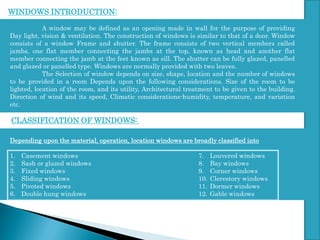
WINDOWS INTRODUCTION:
A window may be defined as an opening made in wall for the purpose of providing
Day light, vision & ventilation. The construction of windows is similar to that of a door. Window
consists of a window Frame and shutter. The frame consists of two vertical members called
jambs, one flat member connecting the jambs at the top, known as head and another flat
member connecting the jamb at the feet known as sill. The shutter can be fully glazed, panelled
and glazed or panelled type. Windows are normally provided with two leaves.
The Selection of window depends on size, shape, location and the number of windows
to be provided in a room Depends upon the following considerations. Size of the room to be
lighted, location of the room, and its utility, Architectural treatment to be given to the building.
Direction of wind and its speed, Climatic considerations-humidity, temperature, and variation
etc.
Depending upon the material, operation, location windows are broadly classified into
1. Casement windows
2. Sash or glazed windows
3. Fixed windows
4. Sliding windows
5. Pivoted windows
6. Double hung windows
CLASSIFICATION OF WINDOWS:
7. Louvered windows
8. Bay windows
9. Corner windows
10. Clerestory windows
11. Dormer windows
12. Gable windows
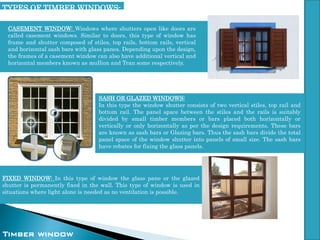
FIXED WINDOW: In this type of window the glass pane or the glazed
shutter is permanently fixed in the wall. This type of window is used in
situations where light alone is needed as no ventilation is possible.
Timber window
TYPES OF TIMBER WINDOWS-
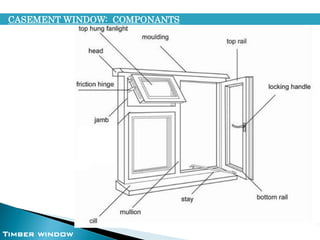
CASEMENT WINDOW: Windows where shutters open like doors are
called casement windows. Similar to doors, this type of window has
frame and shutter composed of stiles, top rails, bottom rails, vertical
and horizontal sash bars with glass panes. Depending upon the design,
the frames of a casement window can also have additional vertical and
horizontal members known as mullion and Tran some respectively.
SASH OR GLAZED WINDOWS:
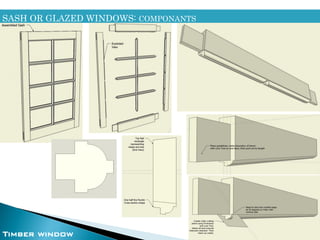
In this type the window shutter consists of two vertical stiles, top rail and
bottom rail. The panel space between the stiles and the rails is suitably
divided by small timber members or bars placed both horizontally or
vertically or only horizontally as per the design requirements. These bars
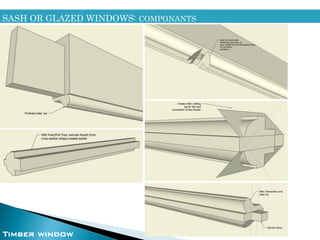
are known as sash bars or Glazing bars. Thus the sash bars divide the total
panel space of the window shutter into panels of small size. The sash bars
have rebates for fixing the glass panels.
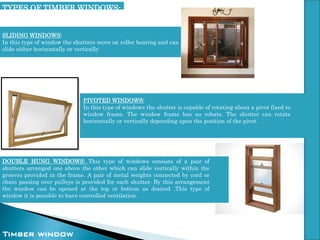
SLIDING WINDOWS:
In this type of window the shutters move on roller bearing and can
slide either horizontally or vertically
Timber window
TYPES OF TIMBER WINDOWS-
DOUBLE HUNG WINDOWS: This type of windows consists of a pair of
shutters arranged one above the other which can slide vertically within the
grooves provided in the frame. A pair of metal weights connected by cord or
chain passing over pulleys is provided for each shutter. By this arrangement
the window can be opened at the top or bottom as desired .This type of
window it is possible to have controlled ventilation.
PIVOTED WINDOWS:
In this type of windows the shutter is capable of rotating about a pivot fixed to
window frame. The window frame has no rebate. The shutter can rotate
horizontally or vertically depending upon the position of the pivot.
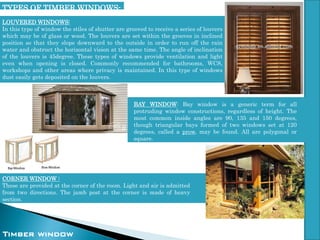
BAY WINDOW: Bay window is a generic term for all
protruding window constructions, regardless of height. The
most common inside angles are 90, 135 and 150 degrees,
though triangular bays formed of two windows set at 120
degrees, called a prow, may be found. All are polygonal or
square.
LOUVERED WINDOWS:
In this type of window the stiles of shutter are grooved to receive a series of louvers
which may be of glass or wood. The louvers are set within the grooves in inclined
position so that they slope downward to the outside in order to run off the rain
water and obstruct the horizontal vision at the same time. The angle of inclination
of the louvers is 45degree. These types of windows provide ventilation and light
even when opening is closed. Commonly recommended for bathrooms, WCS,
workshops and other areas where privacy is maintained. In this type of windows
dust easily gets deposited on the louvers.
Timber window
CORNER WINDOW :
These are provided at the corner of the room. Light and air is admitted
from two directions. The jamb post at the corner is made of heavy
section.
TYPES OF TIMBER WINDOWS-
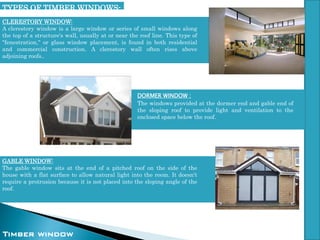
DORMER WINDOW :
The windows provided at the dormer end and gable end of
the sloping roof to provide light and ventilation to the
enclosed space below the roof.
Timber window
CLERESTORY WINDOW:
A clerestory window is a large window or series of small windows along
the top of a structure's wall, usually at or near the roof line. This type of
"fenestration," or glass window placement, is found in both residential
and commercial construction. A clerestory wall often rises above
adjoining roofs..
GABLE WINDOW:
The gable window sits at the end of a pitched roof on the side of the
house with a flat surface to allow natural light into the room. It doesn't
require a protrusion because it is not placed into the sloping angle of the
roof.
TYPES OF TIMBER WINDOWS-
Timber window
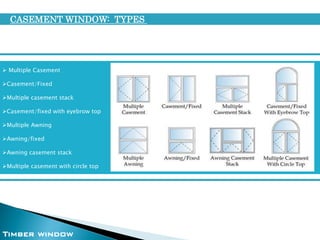
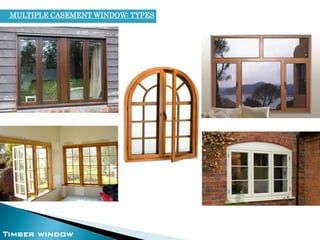
CASEMENT WINDOW: TYPES
 Multiple Casement
Casement/Fixed
Multiple casement stack
Casement/fixed with eyebrow top
Multiple Awning
Awning/fixed
Awning casement stack
Multiple casement with circle top
CASEMENT WINDOW: COMPONANTS
Timber window
MULTIPLE CASEMENT WINDOW: TYPES
Timber window
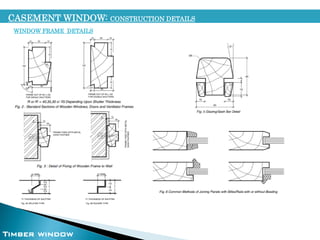
CASEMENT WINDOW: CONSTRUCTION DETAILS
WINDOW FRAME DETAILS
Timber window
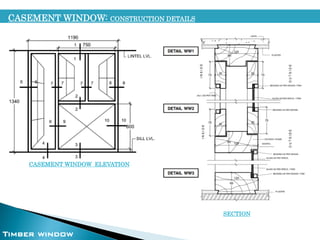
CASEMENT WINDOW ELEVATION
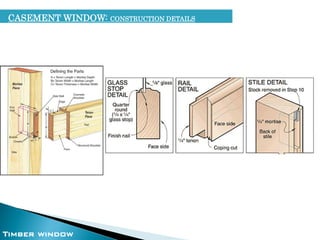
CASEMENT WINDOW: CONSTRUCTION DETAILS
SECTION
Timber window
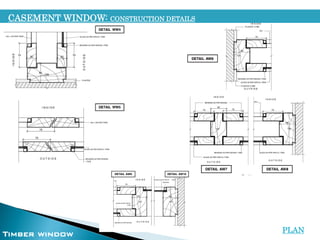
CASEMENT WINDOW: CONSTRUCTION DETAILS
Timber window PLAN
CASEMENT WINDOW: CONSTRUCTION DETAILS
Timber window
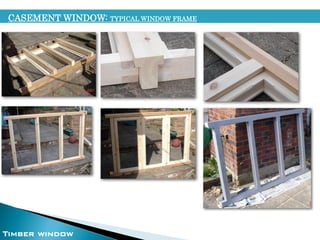
CASEMENT WINDOW: TYPICAL WINDOW FRAME
Timber window
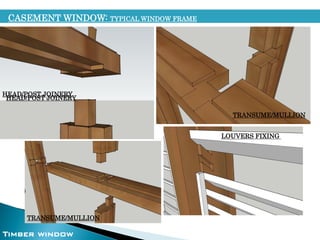
CASEMENT WINDOW: TYPICAL WINDOW FRAME
HEAD/POST JOINERY
TRANSUME/MULLION
HEAD/POST JOINERY
TRANSUME/MULLION
LOUVERS FIXING
Timber window
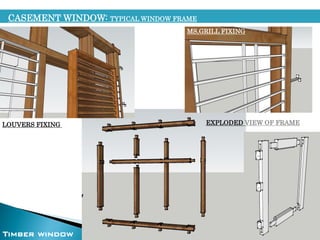
CASEMENT WINDOW: TYPICAL WINDOW FRAME
LOUVERS FIXING
MS,GRILL FIXING
EXPLODED VIEW OF FRAME
Timber window
SASH OR GLAZED WINDOWS: COMPONANTS
Timber window
SASH OR GLAZED WINDOWS: COMPONANTS
Timber window
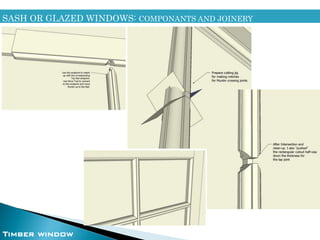
SASH OR GLAZED WINDOWS: COMPONANTS AND JOINERY
Timber window
Thank you…

Timber window

  • 1.
    Timber window Vpicoa,indapur 1st yearb.arch. Ass pro. Ar. Abhay Aitwade
  • 2.
    WINDOWS INTRODUCTION: A windowmay be defined as an opening made in wall for the purpose of providing Day light, vision & ventilation. The construction of windows is similar to that of a door. Window consists of a window Frame and shutter. The frame consists of two vertical members called jambs, one flat member connecting the jambs at the top, known as head and another flat member connecting the jamb at the feet known as sill. The shutter can be fully glazed, panelled and glazed or panelled type. Windows are normally provided with two leaves. The Selection of window depends on size, shape, location and the number of windows to be provided in a room Depends upon the following considerations. Size of the room to be lighted, location of the room, and its utility, Architectural treatment to be given to the building. Direction of wind and its speed, Climatic considerations-humidity, temperature, and variation etc. Depending upon the material, operation, location windows are broadly classified into 1. Casement windows 2. Sash or glazed windows 3. Fixed windows 4. Sliding windows 5. Pivoted windows 6. Double hung windows CLASSIFICATION OF WINDOWS: 7. Louvered windows 8. Bay windows 9. Corner windows 10. Clerestory windows 11. Dormer windows 12. Gable windows
  • 3.
    FIXED WINDOW: Inthis type of window the glass pane or the glazed shutter is permanently fixed in the wall. This type of window is used in situations where light alone is needed as no ventilation is possible. Timber window TYPES OF TIMBER WINDOWS- CASEMENT WINDOW: Windows where shutters open like doors are called casement windows. Similar to doors, this type of window has frame and shutter composed of stiles, top rails, bottom rails, vertical and horizontal sash bars with glass panes. Depending upon the design, the frames of a casement window can also have additional vertical and horizontal members known as mullion and Tran some respectively. SASH OR GLAZED WINDOWS: In this type the window shutter consists of two vertical stiles, top rail and bottom rail. The panel space between the stiles and the rails is suitably divided by small timber members or bars placed both horizontally or vertically or only horizontally as per the design requirements. These bars are known as sash bars or Glazing bars. Thus the sash bars divide the total panel space of the window shutter into panels of small size. The sash bars have rebates for fixing the glass panels.
  • 4.
    SLIDING WINDOWS: In thistype of window the shutters move on roller bearing and can slide either horizontally or vertically Timber window TYPES OF TIMBER WINDOWS- DOUBLE HUNG WINDOWS: This type of windows consists of a pair of shutters arranged one above the other which can slide vertically within the grooves provided in the frame. A pair of metal weights connected by cord or chain passing over pulleys is provided for each shutter. By this arrangement the window can be opened at the top or bottom as desired .This type of window it is possible to have controlled ventilation. PIVOTED WINDOWS: In this type of windows the shutter is capable of rotating about a pivot fixed to window frame. The window frame has no rebate. The shutter can rotate horizontally or vertically depending upon the position of the pivot.
  • 5.
    BAY WINDOW: Baywindow is a generic term for all protruding window constructions, regardless of height. The most common inside angles are 90, 135 and 150 degrees, though triangular bays formed of two windows set at 120 degrees, called a prow, may be found. All are polygonal or square. LOUVERED WINDOWS: In this type of window the stiles of shutter are grooved to receive a series of louvers which may be of glass or wood. The louvers are set within the grooves in inclined position so that they slope downward to the outside in order to run off the rain water and obstruct the horizontal vision at the same time. The angle of inclination of the louvers is 45degree. These types of windows provide ventilation and light even when opening is closed. Commonly recommended for bathrooms, WCS, workshops and other areas where privacy is maintained. In this type of windows dust easily gets deposited on the louvers. Timber window CORNER WINDOW : These are provided at the corner of the room. Light and air is admitted from two directions. The jamb post at the corner is made of heavy section. TYPES OF TIMBER WINDOWS-
  • 6.
    DORMER WINDOW : Thewindows provided at the dormer end and gable end of the sloping roof to provide light and ventilation to the enclosed space below the roof. Timber window CLERESTORY WINDOW: A clerestory window is a large window or series of small windows along the top of a structure's wall, usually at or near the roof line. This type of "fenestration," or glass window placement, is found in both residential and commercial construction. A clerestory wall often rises above adjoining roofs.. GABLE WINDOW: The gable window sits at the end of a pitched roof on the side of the house with a flat surface to allow natural light into the room. It doesn't require a protrusion because it is not placed into the sloping angle of the roof. TYPES OF TIMBER WINDOWS-
  • 7.
    Timber window CASEMENT WINDOW:TYPES  Multiple Casement Casement/Fixed Multiple casement stack Casement/fixed with eyebrow top Multiple Awning Awning/fixed Awning casement stack Multiple casement with circle top
  • 8.
  • 9.
    MULTIPLE CASEMENT WINDOW:TYPES Timber window
  • 10.
    CASEMENT WINDOW: CONSTRUCTIONDETAILS WINDOW FRAME DETAILS Timber window
  • 11.
    CASEMENT WINDOW ELEVATION CASEMENTWINDOW: CONSTRUCTION DETAILS SECTION Timber window
  • 12.
    CASEMENT WINDOW: CONSTRUCTIONDETAILS Timber window PLAN
  • 13.
    CASEMENT WINDOW: CONSTRUCTIONDETAILS Timber window
  • 14.
    CASEMENT WINDOW: TYPICALWINDOW FRAME Timber window
  • 15.
    CASEMENT WINDOW: TYPICALWINDOW FRAME HEAD/POST JOINERY TRANSUME/MULLION HEAD/POST JOINERY TRANSUME/MULLION LOUVERS FIXING Timber window
  • 16.
    CASEMENT WINDOW: TYPICALWINDOW FRAME LOUVERS FIXING MS,GRILL FIXING EXPLODED VIEW OF FRAME Timber window
  • 17.
    SASH OR GLAZEDWINDOWS: COMPONANTS Timber window
  • 18.
    SASH OR GLAZEDWINDOWS: COMPONANTS Timber window
  • 19.
    SASH OR GLAZEDWINDOWS: COMPONANTS AND JOINERY Timber window
  • 20.