


WINDOW
 A window is a transparent or translucent
opening in a wall or door that allows the
passage of light and, if not closed or sealed, air
and sound.
 Windows are held in place by frames, which
prevent them from collapsing in. Many glazed
windows may be opened, to allow ventilation,
or closed, to exclude inclement weather.
Double-hung sash window
This sash window is the traditional style of
window in the United Kingdom, and many
other places that were formerly colonized
by the UK, with two parts (sashes) that
overlap slightly and slide up and down
inside the frame.
Single-hung sash window
One sash is movable (usually the
bottom one) and the other fixed. This is
the earlier form of sliding sash
window, and is also cheaper.
Horizontal sliding sash window
Has two or more sashes that overlap slightly
but slide horizontally within the frame. In the
UK, these are sometimes called Yorkshire sash
windows, presumably because of their
traditional use in that county.
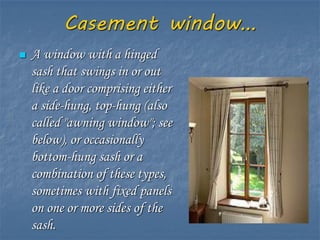
Casement window…
 A window with a hinged
sash that swings in or out
like a door comprising either
a side-hung, top-hung (also
called "awning window"; see
below), or occasionally
bottom-hung sash or a
combination of these types,
sometimes with fixed panels
on one or more sides of the
sash.
Awning window…
An awning window is a
casement window that is
hung horizontally, hinged
on top, so that it swings
outward like an awning.
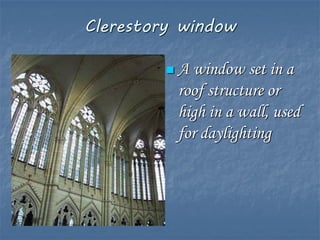
Clerestory window
 A window set in a
roof structure or
high in a wall, used
for daylighting
Hopper window
 A hopper window is a bottom hung
casement window that opens similar to a
draw bridge typically opening to the
outside.
Tilt and slide window…
 A window (more usually a door-sized
window) where the sash tilts inwards at
the top and then slides horizontally behind
the fixed pane.
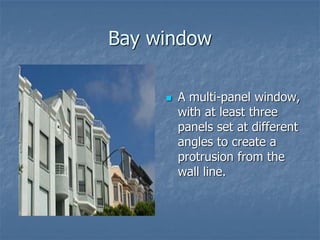
Bay window
 A multi-panel window,
with at least three
panels set at different
angles to create a
protrusion from the
wall line.
Tilt and turn window
 A window which can either tilt inwards at
the top, or can open inwards hinged at
the side.
Transom window
 A window above a door; in an exterior
door the transom window is often fixed, in
an interior door it can open either by
hinges at top or bottom, or rotate on
hinges. It provided ventilation before
forced air heating and cooling
Jalousie window
 Also known as a louvered window, the
jalousie window consists of parallel slats of
glass or acrylic that open and close like a
Venetian blind, usually using a crank or a
lever. They are used extensively in tropical
architecture
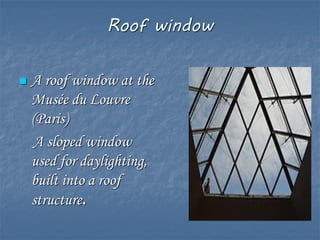
Roof window
 A roof window at the
Musée du Louvre
(Paris)
A sloped window
used for daylighting,
built into a roof
structure.
Roof lantern
 A roof lantern is a multi-paned glass
structure, resembling a small building,
built on a roof for day or moon light.
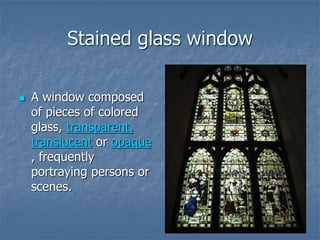
Stained glass window
 A window composed
of pieces of colored
glass, transparent,
translucent or opaque
, frequently
portraying persons or
scenes.
Glazing and filling
 Low-emissivity coated panes reduce heat transfer by radiation, which, depending
on which surface is coated, helps prevent heat loss (in cold climates) or heat
gains (in warm climates).
 High thermal resistance can be obtained by evacuating or filling the insulated
glazing units with gases such as argon or krypton, which reduces conductive heat
transfer due to their low thermal conductivity. Performance of such units
depends on good window seals and meticulous frame construction to prevent
entry of air and loss of efficiency.
 Modern double-pane and triple-pane windows often include one or more low-e
coatings to reduce the window's U-factor (its insulation value, specifically its
rate of heat loss). In general, soft-coat low-e coatings tend to result in a lower
solar heat gain coefficient (SHGC) than hard-coat low-e coatings.
 Modern windows are usually glazed with one large sheet of glass per sash, while
windows in the past were glazed with multiple panes separated by "glazing bars",
or "muntins", due to the unavailability of large sheets of glass. Today, glazing
bars tend to be decorative, separating windows into small panes of glass even
though larger panes of glass are available, generally in a pattern dictated by the
architectural style at use. Glazing bars are typically wooden, but occasionally
lead glazing bars soldered in place are used for more intricate glazing patterns.
Window coverings
 A window covering is a shading or screening device that
can be used for multiple purposes. For example, some
window coverings are used to control solar heat gain
and glare. Typically, there are external shading devices
and internal shading devices.[8] Low-e window film is a
low-cost alternative to window replacement to transform
existing poorly-insulating windows into energy-efficient
windows.
 For high-rise buildings, smart glass can be used as an
alternative.

Types of windows

  • 1.
  • 2.
     A windowis a transparent or translucent opening in a wall or door that allows the passage of light and, if not closed or sealed, air and sound.  Windows are held in place by frames, which prevent them from collapsing in. Many glazed windows may be opened, to allow ventilation, or closed, to exclude inclement weather.
  • 3.
    Double-hung sash window Thissash window is the traditional style of window in the United Kingdom, and many other places that were formerly colonized by the UK, with two parts (sashes) that overlap slightly and slide up and down inside the frame.
  • 4.
    Single-hung sash window Onesash is movable (usually the bottom one) and the other fixed. This is the earlier form of sliding sash window, and is also cheaper.
  • 5.
    Horizontal sliding sashwindow Has two or more sashes that overlap slightly but slide horizontally within the frame. In the UK, these are sometimes called Yorkshire sash windows, presumably because of their traditional use in that county.
  • 6.
    Casement window…  Awindow with a hinged sash that swings in or out like a door comprising either a side-hung, top-hung (also called "awning window"; see below), or occasionally bottom-hung sash or a combination of these types, sometimes with fixed panels on one or more sides of the sash.
  • 7.
    Awning window… An awningwindow is a casement window that is hung horizontally, hinged on top, so that it swings outward like an awning.
  • 8.
    Clerestory window  Awindow set in a roof structure or high in a wall, used for daylighting
  • 9.
    Hopper window  Ahopper window is a bottom hung casement window that opens similar to a draw bridge typically opening to the outside.
  • 10.
    Tilt and slidewindow…  A window (more usually a door-sized window) where the sash tilts inwards at the top and then slides horizontally behind the fixed pane.
  • 11.
    Bay window  Amulti-panel window, with at least three panels set at different angles to create a protrusion from the wall line.
  • 12.
    Tilt and turnwindow  A window which can either tilt inwards at the top, or can open inwards hinged at the side.
  • 13.
    Transom window  Awindow above a door; in an exterior door the transom window is often fixed, in an interior door it can open either by hinges at top or bottom, or rotate on hinges. It provided ventilation before forced air heating and cooling
  • 14.
    Jalousie window  Alsoknown as a louvered window, the jalousie window consists of parallel slats of glass or acrylic that open and close like a Venetian blind, usually using a crank or a lever. They are used extensively in tropical architecture
  • 15.
    Roof window  Aroof window at the Musée du Louvre (Paris) A sloped window used for daylighting, built into a roof structure.
  • 16.
    Roof lantern  Aroof lantern is a multi-paned glass structure, resembling a small building, built on a roof for day or moon light.
  • 17.
    Stained glass window A window composed of pieces of colored glass, transparent, translucent or opaque , frequently portraying persons or scenes.
  • 18.
    Glazing and filling Low-emissivity coated panes reduce heat transfer by radiation, which, depending on which surface is coated, helps prevent heat loss (in cold climates) or heat gains (in warm climates).  High thermal resistance can be obtained by evacuating or filling the insulated glazing units with gases such as argon or krypton, which reduces conductive heat transfer due to their low thermal conductivity. Performance of such units depends on good window seals and meticulous frame construction to prevent entry of air and loss of efficiency.  Modern double-pane and triple-pane windows often include one or more low-e coatings to reduce the window's U-factor (its insulation value, specifically its rate of heat loss). In general, soft-coat low-e coatings tend to result in a lower solar heat gain coefficient (SHGC) than hard-coat low-e coatings.  Modern windows are usually glazed with one large sheet of glass per sash, while windows in the past were glazed with multiple panes separated by "glazing bars", or "muntins", due to the unavailability of large sheets of glass. Today, glazing bars tend to be decorative, separating windows into small panes of glass even though larger panes of glass are available, generally in a pattern dictated by the architectural style at use. Glazing bars are typically wooden, but occasionally lead glazing bars soldered in place are used for more intricate glazing patterns.
  • 19.
    Window coverings  Awindow covering is a shading or screening device that can be used for multiple purposes. For example, some window coverings are used to control solar heat gain and glare. Typically, there are external shading devices and internal shading devices.[8] Low-e window film is a low-cost alternative to window replacement to transform existing poorly-insulating windows into energy-efficient windows.  For high-rise buildings, smart glass can be used as an alternative.