Necrotising Fasciitis
Dr Anang Pangeni
068.09.
 Recognized and reported for centuries
 Hippocrates in the 5th century BC
 Joseph Jones in 1871 : ‘hospital gangrene’
 Meleny , 1924 , Beijing outbreak “hemolytic streptococcal
gangrene”
 Wilson , 1952, coined the term
 infection, necrosis of the fascia and subcutaneous tissue with
relative sparing of the underlying muscle
 A rapidly progressive tissue infection characterized
by extensive necrosis of the subcutaneous fat and
fascia with secondary involvement of skin and
rarely muscles
 Necrotizing fasciitis is a severe, insidiously
advancing, soft-tissue infection characterized by
widespread fascial necrosis
 High mortality
 Reported incidence 6 to 76%
 Studies* :Delay in diagnosis and consequent delayed
debridement is often the cause
 A common admission in our facility.
McHenry CR, Piotrowski JJ, Petrinic D, Malangoni MA. Determinants of mortality in necrotizing soft tissue infections. Ann Surg 1995; 221:558–563.
Wong CH, Chang HC, Pasupathy S, et al. Necrotizing fasciitis: clinical presentation, microbiology and determinants of mortality. J Bone Joint Surg
Am 2003; 85A:1454–1460.
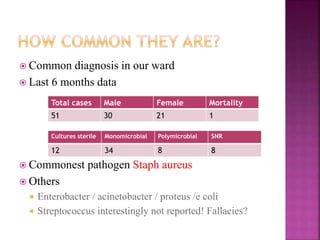
 Common diagnosis in our ward
 Last 6 months data
 Commonest pathogen Staph aureus
 Others
 Enterobacter / acinetobacter / proteus /e coli
 Streptococcus interestingly not reported! Fallacies?
Total cases Male Female Mortality
51 30 21 1
Cultures sterile Monomicrobial Polymicrobial SNR
12 34 8 8
 Not fully understood, and in many cases no identifiable
cause can be found.
 True risk factors for NSTI have not been identified
 Agreed : pre-existing conditions that render them
susceptible to infection
 injection drug use
 chronic debilitating comorbidities (e.g.,diabetes mellitus,
immune suppression,and obesity)
 Cases without a recognized precipitating factor are more
likely to be caused by group A streptococcal infection,
and community-acquired MRS infection*
*Miller LG, Perdreau-Remington F, Rieg G, et al. Necrotizing fasciitis caused by community-associated methicillin-resistant Staphylococcus
aureus in Los Angeles. N Engl J Med 2005; 352:1445–53.
 Diabetes
 Chronic disease
 Drugs—for example, steroids
 Malnutrition
 Immunosuppression
 Age > 60
 Intravenous drug misuse
 Peripheral vascular disease
 Renal failure
 Underlying malignancy
 Obesity
 Blunt or penetrating trauma
 Soft tissue infections
 Surgery
 Intravenous drug use
 Childbirth
 Burns
 Muscle injuries
 Minor trauma
 Insect bite,
 Pustule
 Minor operations,
 Anorectal abscess,
 Instrumentation,
 Septic abortion,
 Genitourinary infection
 Gram positive aerobic
bacteria
 Group A ß haemolytic
streptoccoci
 Group B streptococci
 Enterococci
 Coagulase negative
staphylococci
 Staphylococcus aureus
 Bacillus species
 Gram negative aerobic
bacteria
 Escherichia coli
 Pseudomonas aeruginosa
 Proteus species
 Serratia species
 Anaerobic bacteria
 Bacteroides species
 Clostridium species
 Peptostreptococcus species
 Fungi
 Zygomycetes
 Aspergillus
 Candida
 Other
 Vibrio species
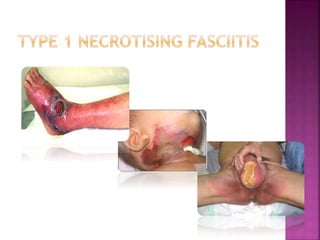
 Type 1
 Polymicrobial (aerobic and anaerobic bacteria)
 Occur most commonly after surgery or in
individuals with diabetes and peripheral vascular
disease.
 Primarily includes 3 categories (locations) of
infection
 Diabetes Mellitus- infections of the feet
 Cervical necrotizing fasciitis- infection of the neck
 Fournier’s Gangrene- infection of the perineum
 Type 2
 A monomicrobial infection caused primarily by group
A streptococcus (GAS), although it is occasionally
caused by community-associated methicillin-resistant
Staphylococcus aureus (MRSA)
 Type 3 (not usually described)
 Clostridial gas gangrene / Vibrio spp infection
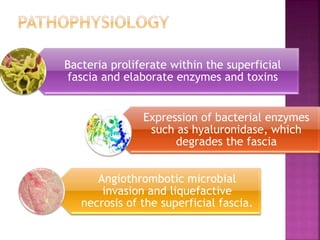
Bacteria proliferate within the superficial
fascia and elaborate enzymes and toxins
Expression of bacterial enzymes
such as hyaluronidase, which
degrades the fascia
Angiothrombotic microbial
invasion and liquefactive
necrosis of the superficial fascia.
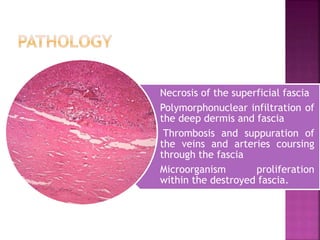
Necrosis of the superficial fascia
Polymorphonuclear infiltration of
the deep dermis and fascia
Thrombosis and suppuration of
the veins and arteries coursing
through the fascia
Microorganism proliferation
within the destroyed fascia.
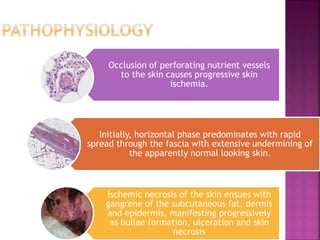
Occlusion of perforating nutrient vessels
to the skin causes progressive skin
ischemia.
Initially, horizontal phase predominates with rapid
spread through the fascia with extensive undermining of
the apparently normal looking skin.
Ischemic necrosis of the skin ensues with
gangrene of the subcutaneous fat, dermis
and epidermis, manifesting progressively
as bullae formation, ulceration and skin
necrosis
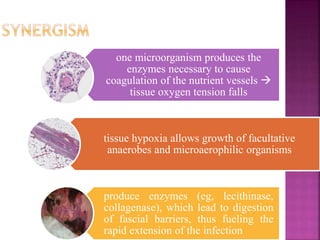
one microorganism produces the
enzymes necessary to cause
coagulation of the nutrient vessels 
tissue oxygen tension falls
tissue hypoxia allows growth of facultative
anaerobes and microaerophilic organisms
produce enzymes (eg, lecithinase,
collagenase), which lead to digestion
of fascial barriers, thus fueling the
rapid extension of the infection
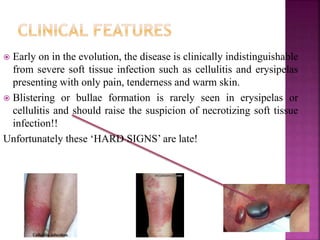
 Early on in the evolution, the disease is clinically indistinguishable
from severe soft tissue infection such as cellulitis and erysipelas
presenting with only pain, tenderness and warm skin.
 Blistering or bullae formation is rarely seen in erysipelas or
cellulitis and should raise the suspicion of necrotizing soft tissue
infection!!
Unfortunately these ‘HARD SIGNS’ are late!
 Although the following features can occur with
cellulitis, they may instead suggest necrotizing
fasciitis:
 Rapid progression
 Poor therapeutic response
 Blistering necrosis
 Cyanosis
 Extreme local tenderness
 High temperature
 Tachycardia
 Hypotension
 Altered level of consciousness
 Early findings
 Pain
 Cellulitis
 Pyrexia
 Tachycardia
 Swelling
 Induration
 Skin anaesthesia
 Late findings
 Severe pain
 Skin discoloration (purple or
black)
 Blistering
 Haemorrhagic bullae
 Crepitus
 Discharge of “dishwater”
fluid
 Severe sepsis or SIRS
 Multiorgan failure
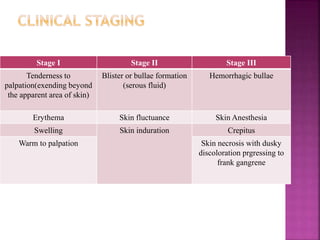
Stage I Stage II Stage III
Tenderness to
palpation(exending beyond
the apparent area of skin)
Blister or bullae formation
(serous fluid)
Hemorrhagic bullae
Erythema Skin fluctuance Skin Anesthesia
Swelling Skin induration Crepitus
Warm to palpation Skin necrosis with dusky
discoloration prgressing to
frank gangrene
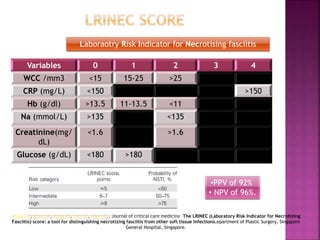
Wong CH, Khin LW, Heng KS, Tan KC, Low CO., Journal of critical care medicine The LRINEC (Laboratory Risk Indicator for Necrotizing
Fasciitis) score: a tool for distinguishing necrotizing fasciitis from other soft tissue infections.epartment of Plastic Surgery, Singapore
General Hospital, Singapore.
Variables 0 1 2 3 4
WCC /mm3 <15 15-25 >25
CRP (mg/L) <150 >150
Hb (g/dl) >13.5 11-13.5 <11
Na (mmol/L) >135 <135
Creatinine(mg/
dL)
<1.6 >1.6
Glucose (g/dL) <180 >180
•PPV of 92%
• NPV of 96%.
Laboraotry Risk Indicator for Necrotising fasciitis
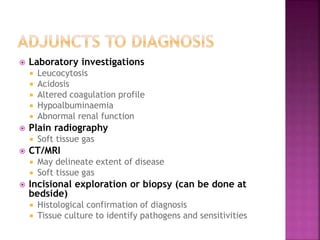
 Laboratory investigations
 Leucocytosis
 Acidosis
 Altered coagulation profile
 Hypoalbuminaemia
 Abnormal renal function
 Plain radiography
 Soft tissue gas
 CT/MRI
 May delineate extent of disease
 Soft tissue gas
 Incisional exploration or biopsy (can be done at
bedside)
 Histological confirmation of diagnosis
 Tissue culture to identify pathogens and sensitivities
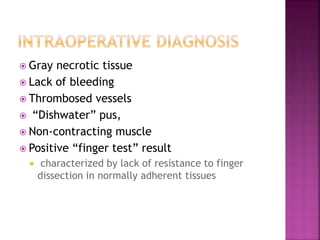
 Gray necrotic tissue
 Lack of bleeding
 Thrombosed vessels
 “Dishwater” pus,
 Non-contracting muscle
 Positive “finger test” result
 characterized by lack of resistance to finger
dissection in normally adherent tissues
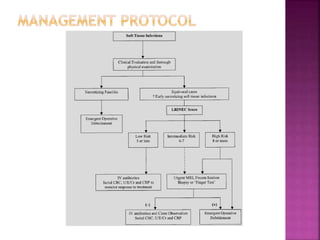
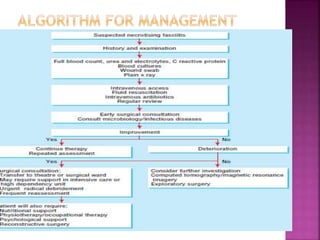
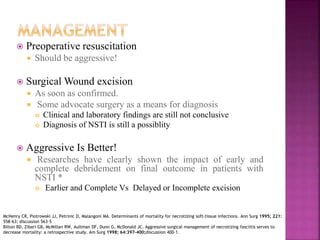
 Preoperative resuscitation
 Should be aggressive!
 Surgical Wound excision
 As soon as confirmed.
 Some advocate surgery as a means for diagnosis
 Clinical and laboratory findings are still not conclusive
 Diagnosis of NSTI is still a possiblity
 Aggressive Is Better!
 Researches have clearly shown the impact of early and
complete debridement on final outcome in patients with
NSTI *
 Earlier and Complete Vs Delayed or Incomplete excision
McHenry CR, Piotrowski JJ, Petrinic D, Malangoni MA. Determinants of mortality for necrotizing soft-tissue infections. Ann Surg 1995; 221:
558–63; discussion 563–5
Bilton BD, Zibari GB, McMillan RW, Aultman DF, Dunn G, McDonald JC. Aggressive surgical management of necrotizing fasciitis serves to
decrease mortality: a retrospective study. Am Surg 1998; 64:397–400;discussion 400–1.
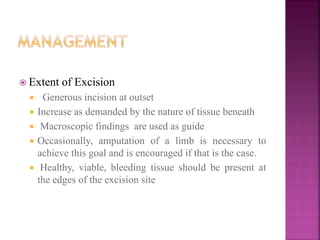
 Extent of Excision
 Generous incision at outset
 Increase as demanded by the nature of tissue beneath
 Macroscopic findings are used as guide
 Occasionally, amputation of a limb is necessary to
achieve this goal and is encouraged if that is the case.
 Healthy, viable, bleeding tissue should be present at
the edges of the excision site
 We have not seen these!
 Advocated by different groups that argue for a
decreased number of debridements and decreased
mortality*
 increases the normal oxygen saturation in the
infected wounds by 1000-fold leading to
 Bacteriocidal effect,
 Improves neutrophil function,
 Enhanced wound healing
 Results are contradictory!
 Where available
 Should not jeopardize the standard therapy — adequate
and timely debridements
*Riseman JA, Zamboni WA, Curtis A, Graham DR, Konrad HR,Ross DS. Hyperbaric oxygen therapy for necrotizing
fasciitis reduces mortality and the need for debridements. Surgery 1990; 108:847–50.
Jallali N, Withey S, Butler PE. Hyperbaric oxygen as adjuvant therapy in the management of necrotizing fasciitis. Am J
Surg 2005; 189:462–6.
 Defined as infections of any of the layers within
the soft tissue compartment (dermis,subcutaneous
tissue, superficial fascia, deep fascia, or muscle)
that are associated with necrotizing changes.
 Different terms are used to define and classify
STIs, leading to confusion when referring to
infections that have common pathophysiological
and clinical characteristics and, most importantly,
share a common management strategy
 Necrotising fasciitis is potentially fatal condition and
can affect any part of the body .
 The aetiology is not fully understood but most patients
who develop necrotising fasciitis have pre-existing
conditions that render them susceptible to infection
 Diagnosis is often delayed because of the paucity of
symptoms and the unfamiliarity of the condition
among clinicians
 Laboratory findings and other diagnostic tests may be
useful adjuncts, but the diagnosis is still primarily a
clinical one and a high index of suspicion is required
 Management should consist of immediate
resuscitation, early surgical debridement, and
administration of broad spectrum intravenous
antibiotics.
 ‘Necrotising soft tissue infection’ can be used as a
standard term to designate these infections, so as to
help in correct data interpretation.

When bacteria go bad

  • 1.
  • 2.
     Recognized andreported for centuries  Hippocrates in the 5th century BC  Joseph Jones in 1871 : ‘hospital gangrene’  Meleny , 1924 , Beijing outbreak “hemolytic streptococcal gangrene”  Wilson , 1952, coined the term  infection, necrosis of the fascia and subcutaneous tissue with relative sparing of the underlying muscle
  • 3.
     A rapidlyprogressive tissue infection characterized by extensive necrosis of the subcutaneous fat and fascia with secondary involvement of skin and rarely muscles  Necrotizing fasciitis is a severe, insidiously advancing, soft-tissue infection characterized by widespread fascial necrosis
  • 4.
     High mortality Reported incidence 6 to 76%  Studies* :Delay in diagnosis and consequent delayed debridement is often the cause  A common admission in our facility. McHenry CR, Piotrowski JJ, Petrinic D, Malangoni MA. Determinants of mortality in necrotizing soft tissue infections. Ann Surg 1995; 221:558–563. Wong CH, Chang HC, Pasupathy S, et al. Necrotizing fasciitis: clinical presentation, microbiology and determinants of mortality. J Bone Joint Surg Am 2003; 85A:1454–1460.
  • 5.
     Common diagnosisin our ward  Last 6 months data  Commonest pathogen Staph aureus  Others  Enterobacter / acinetobacter / proteus /e coli  Streptococcus interestingly not reported! Fallacies? Total cases Male Female Mortality 51 30 21 1 Cultures sterile Monomicrobial Polymicrobial SNR 12 34 8 8
  • 6.
     Not fullyunderstood, and in many cases no identifiable cause can be found.  True risk factors for NSTI have not been identified  Agreed : pre-existing conditions that render them susceptible to infection  injection drug use  chronic debilitating comorbidities (e.g.,diabetes mellitus, immune suppression,and obesity)
  • 7.
     Cases withouta recognized precipitating factor are more likely to be caused by group A streptococcal infection, and community-acquired MRS infection* *Miller LG, Perdreau-Remington F, Rieg G, et al. Necrotizing fasciitis caused by community-associated methicillin-resistant Staphylococcus aureus in Los Angeles. N Engl J Med 2005; 352:1445–53.
  • 8.
     Diabetes  Chronicdisease  Drugs—for example, steroids  Malnutrition  Immunosuppression  Age > 60  Intravenous drug misuse  Peripheral vascular disease  Renal failure  Underlying malignancy  Obesity
  • 9.
     Blunt orpenetrating trauma  Soft tissue infections  Surgery  Intravenous drug use  Childbirth  Burns  Muscle injuries  Minor trauma  Insect bite,  Pustule  Minor operations,  Anorectal abscess,  Instrumentation,  Septic abortion,  Genitourinary infection
  • 10.
     Gram positiveaerobic bacteria  Group A ß haemolytic streptoccoci  Group B streptococci  Enterococci  Coagulase negative staphylococci  Staphylococcus aureus  Bacillus species  Gram negative aerobic bacteria  Escherichia coli  Pseudomonas aeruginosa  Proteus species  Serratia species  Anaerobic bacteria  Bacteroides species  Clostridium species  Peptostreptococcus species  Fungi  Zygomycetes  Aspergillus  Candida  Other  Vibrio species
  • 11.
     Type 1 Polymicrobial (aerobic and anaerobic bacteria)  Occur most commonly after surgery or in individuals with diabetes and peripheral vascular disease.  Primarily includes 3 categories (locations) of infection  Diabetes Mellitus- infections of the feet  Cervical necrotizing fasciitis- infection of the neck  Fournier’s Gangrene- infection of the perineum
  • 13.
     Type 2 A monomicrobial infection caused primarily by group A streptococcus (GAS), although it is occasionally caused by community-associated methicillin-resistant Staphylococcus aureus (MRSA)  Type 3 (not usually described)  Clostridial gas gangrene / Vibrio spp infection
  • 14.
    Bacteria proliferate withinthe superficial fascia and elaborate enzymes and toxins Expression of bacterial enzymes such as hyaluronidase, which degrades the fascia Angiothrombotic microbial invasion and liquefactive necrosis of the superficial fascia.
  • 15.
    Necrosis of thesuperficial fascia Polymorphonuclear infiltration of the deep dermis and fascia Thrombosis and suppuration of the veins and arteries coursing through the fascia Microorganism proliferation within the destroyed fascia.
  • 16.
    Occlusion of perforatingnutrient vessels to the skin causes progressive skin ischemia. Initially, horizontal phase predominates with rapid spread through the fascia with extensive undermining of the apparently normal looking skin. Ischemic necrosis of the skin ensues with gangrene of the subcutaneous fat, dermis and epidermis, manifesting progressively as bullae formation, ulceration and skin necrosis
  • 17.
    one microorganism producesthe enzymes necessary to cause coagulation of the nutrient vessels  tissue oxygen tension falls tissue hypoxia allows growth of facultative anaerobes and microaerophilic organisms produce enzymes (eg, lecithinase, collagenase), which lead to digestion of fascial barriers, thus fueling the rapid extension of the infection
  • 18.
     Early onin the evolution, the disease is clinically indistinguishable from severe soft tissue infection such as cellulitis and erysipelas presenting with only pain, tenderness and warm skin.  Blistering or bullae formation is rarely seen in erysipelas or cellulitis and should raise the suspicion of necrotizing soft tissue infection!! Unfortunately these ‘HARD SIGNS’ are late!
  • 19.
     Although thefollowing features can occur with cellulitis, they may instead suggest necrotizing fasciitis:  Rapid progression  Poor therapeutic response  Blistering necrosis  Cyanosis  Extreme local tenderness  High temperature  Tachycardia  Hypotension  Altered level of consciousness
  • 20.
     Early findings Pain  Cellulitis  Pyrexia  Tachycardia  Swelling  Induration  Skin anaesthesia  Late findings  Severe pain  Skin discoloration (purple or black)  Blistering  Haemorrhagic bullae  Crepitus  Discharge of “dishwater” fluid  Severe sepsis or SIRS  Multiorgan failure
  • 21.
    Stage I StageII Stage III Tenderness to palpation(exending beyond the apparent area of skin) Blister or bullae formation (serous fluid) Hemorrhagic bullae Erythema Skin fluctuance Skin Anesthesia Swelling Skin induration Crepitus Warm to palpation Skin necrosis with dusky discoloration prgressing to frank gangrene
  • 22.
    Wong CH, KhinLW, Heng KS, Tan KC, Low CO., Journal of critical care medicine The LRINEC (Laboratory Risk Indicator for Necrotizing Fasciitis) score: a tool for distinguishing necrotizing fasciitis from other soft tissue infections.epartment of Plastic Surgery, Singapore General Hospital, Singapore. Variables 0 1 2 3 4 WCC /mm3 <15 15-25 >25 CRP (mg/L) <150 >150 Hb (g/dl) >13.5 11-13.5 <11 Na (mmol/L) >135 <135 Creatinine(mg/ dL) <1.6 >1.6 Glucose (g/dL) <180 >180 •PPV of 92% • NPV of 96%. Laboraotry Risk Indicator for Necrotising fasciitis
  • 23.
     Laboratory investigations Leucocytosis  Acidosis  Altered coagulation profile  Hypoalbuminaemia  Abnormal renal function  Plain radiography  Soft tissue gas  CT/MRI  May delineate extent of disease  Soft tissue gas  Incisional exploration or biopsy (can be done at bedside)  Histological confirmation of diagnosis  Tissue culture to identify pathogens and sensitivities
  • 24.
     Gray necrotictissue  Lack of bleeding  Thrombosed vessels  “Dishwater” pus,  Non-contracting muscle  Positive “finger test” result  characterized by lack of resistance to finger dissection in normally adherent tissues
  • 27.
     Preoperative resuscitation Should be aggressive!  Surgical Wound excision  As soon as confirmed.  Some advocate surgery as a means for diagnosis  Clinical and laboratory findings are still not conclusive  Diagnosis of NSTI is still a possiblity  Aggressive Is Better!  Researches have clearly shown the impact of early and complete debridement on final outcome in patients with NSTI *  Earlier and Complete Vs Delayed or Incomplete excision McHenry CR, Piotrowski JJ, Petrinic D, Malangoni MA. Determinants of mortality for necrotizing soft-tissue infections. Ann Surg 1995; 221: 558–63; discussion 563–5 Bilton BD, Zibari GB, McMillan RW, Aultman DF, Dunn G, McDonald JC. Aggressive surgical management of necrotizing fasciitis serves to decrease mortality: a retrospective study. Am Surg 1998; 64:397–400;discussion 400–1.
  • 28.
     Extent ofExcision  Generous incision at outset  Increase as demanded by the nature of tissue beneath  Macroscopic findings are used as guide  Occasionally, amputation of a limb is necessary to achieve this goal and is encouraged if that is the case.  Healthy, viable, bleeding tissue should be present at the edges of the excision site
  • 29.
     We havenot seen these!  Advocated by different groups that argue for a decreased number of debridements and decreased mortality*  increases the normal oxygen saturation in the infected wounds by 1000-fold leading to  Bacteriocidal effect,  Improves neutrophil function,  Enhanced wound healing  Results are contradictory!  Where available  Should not jeopardize the standard therapy — adequate and timely debridements *Riseman JA, Zamboni WA, Curtis A, Graham DR, Konrad HR,Ross DS. Hyperbaric oxygen therapy for necrotizing fasciitis reduces mortality and the need for debridements. Surgery 1990; 108:847–50. Jallali N, Withey S, Butler PE. Hyperbaric oxygen as adjuvant therapy in the management of necrotizing fasciitis. Am J Surg 2005; 189:462–6.
  • 30.
     Defined asinfections of any of the layers within the soft tissue compartment (dermis,subcutaneous tissue, superficial fascia, deep fascia, or muscle) that are associated with necrotizing changes.  Different terms are used to define and classify STIs, leading to confusion when referring to infections that have common pathophysiological and clinical characteristics and, most importantly, share a common management strategy
  • 31.
     Necrotising fasciitisis potentially fatal condition and can affect any part of the body .  The aetiology is not fully understood but most patients who develop necrotising fasciitis have pre-existing conditions that render them susceptible to infection  Diagnosis is often delayed because of the paucity of symptoms and the unfamiliarity of the condition among clinicians
  • 32.
     Laboratory findingsand other diagnostic tests may be useful adjuncts, but the diagnosis is still primarily a clinical one and a high index of suspicion is required  Management should consist of immediate resuscitation, early surgical debridement, and administration of broad spectrum intravenous antibiotics.  ‘Necrotising soft tissue infection’ can be used as a standard term to designate these infections, so as to help in correct data interpretation.

Editor's Notes

  • #3 Necrotizing fasciitis has been recognized for centuries dating back to Hippocratus in the 5th century BC1. Necrotizing fasciitis was first described in 1871 by Confederate Army Surgeon Joseph Jones during the American civil war as ‘hospital gangrene’ and then by Meleny as ‘haemolytic streptococcal gangrene’4. In 1883,Fournier5 described a fulminating genital gangrene affecting healthy men, and named the process ‘idiopathic gangrene of the scrotum’2. In 1952, Wilson6 used the term necrotizing fasciitis to describe the same disease in other parts of the body.
  • #7 The first and most important tool for early diagnosis of NSTI is to have a high index of suspicion. Unfortunately, true risk factors for NSTI have not been identified. However, some conditions appear to be more commonly associated with NSTI and are worth considering when dealing with any kind of soft-tissue infection. These include injection drug use and chronic debilitating comorbidities (e.g., diabetes mellitus, immune suppression, and obesity) [8–10]. Patients that have any of these characteristics and present with soft-tissue infection should be evaluated to confirm or rule out NSTI. Other than injection drug use, the precipitating factor of NSTI does not appear helpful for establishing the likelihood of NSTI versus nonnecrotizing soft-tissue infection
  • #8 The first and most important tool for early diagnosis of NSTI is to have a high index of suspicion. Unfortunately, true risk factors for NSTI have not been identified. However, some conditions appear to be more commonly associated with NSTI and are worth considering when dealing with any kind of soft-tissue infection. These include injection drug use and chronic debilitating comorbidities (e.g., diabetes mellitus, immune suppression, and obesity) [8–10]. Patients that have any of these characteristics and present with soft-tissue infection should be evaluated to confirm or rule out NSTI. Other than injection drug use, the precipitating factor of NSTI does not appear helpful for establishing the likelihood of NSTI versus nonnecrotizing soft-tissue infection
  • #11 No specific combination of bacterial species is either diagnostic of NSTI or found in all cases. A wide spectrum of organisms are commonly recovered (table 3). In a relatively recent series, approximately two-thirds of cases were polymicrobial, and onethird were monomicrobial, with the great majority of monomicrobial cases being a result of gram-positive cocci.
  • #17 As this process progresses, occlusion of perforating nutrient vessels to the skin causes progressive skin ischemia. Initially a horizontal phase predominates with rapid spread through the fascia with extensive undermining of the apparently normal looking skin. As the condition evolves, ischemic necrosis of the skin ensues with gangrene of the subcutaneous fat, dermis and epidermis, manifesting progressively as bullae formation, ulceration and skin necrosis
  • #18 As this process progresses, occlusion of perforating nutrient vessels to the skin causes progressive skin ischemia. Initially a horizontal phase predominates with rapid spread through the fascia with extensive undermining of the apparently normal looking skin. As the condition evolves, ischemic necrosis of the skin ensues with gangrene of the subcutaneous fat, dermis and epidermis, manifesting progressively as bullae formation, ulceration and skin necrosis