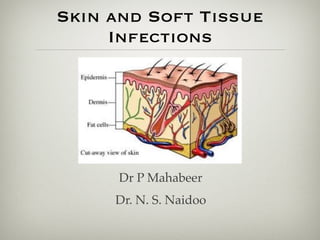
Skin and Soft Tissue
Infections
Dr P Mahabeer
Dr. N. S. Naidoo
• What is the difference bet uncomplicated
and complicated ssti. Give 2 examples of
each and the bacterial causes.
• Write short notes on impetigo, bullous
impetigo, erysipelas, cellulitis.
The Skin
• Skin :
– organ system with
multiple functions,
incl. protection of
tissues from external
microbial invasion
• Surface =
keratinised
stratified epithelium
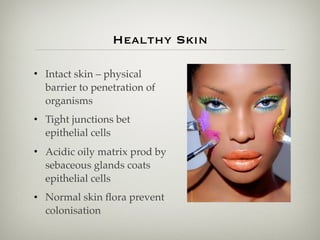
Healthy Skin
• Intact skin – physical
barrier to penetration of
organisms
• Tight junctions bet
epithelial cells
• Acidic oily matrix prod by
sebaceous glands coats
epithelial cells
• Normal skin flora prevent
colonisation
How does infection occur?
• Minor trauma that destroys the integrity
and allows organisms access
• Surface penetrated by ducts of
pilosebaceous glands, sweat gland and hair
follicles provide route of entry for microbes
, esp. if ducts are obstructed


Modes of infection

– Circulating microbe
– Circulating toxin
– Direct introduction of microbe into
epithelium
Pathogenesis
• To cause infxn – organisms must penetrate barrier
• Due to trauma
• Symptoms incude
– Pain
– Warmth
– Skin discolouration
– Swelling
– vesicles
Categories
– localised or spreading
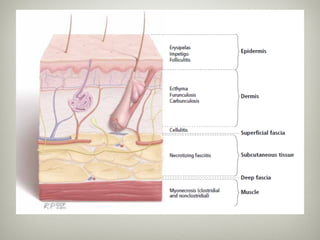
– Uncomplicated – infxn of superficial layer
– Complicated – infxn extending to deeper
layers
• Respond to drainage and antibiotics
• These include:
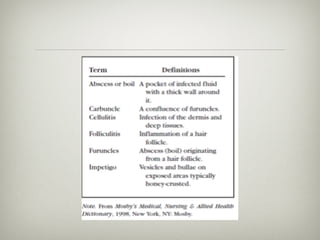
• Minor abscess
• Impetigo
• Cellulitis
• Erysipelas
• Folliculitis
• Furuncles or boils
• carbuncles
Uncomplicated
SSTI
complicated SSTI
– Involve deeper structures
– Significant surgical intervention
– Infxns in pts at risk eg Diabetes; poor blood supply
– These include
• Gas gangrene
• Necrotising cellulitis ( dermal and subcut tx)
• Necrotising fascitis ( include fascia)
• Pyomyositis and myonecrosis ( muscle)
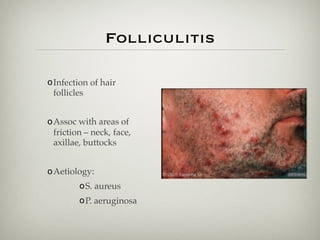
Folliculitis
oInfection of hair
follicles
oAssoc with areas of
friction – neck, face,
axillae, buttocks
oAetiology:
oS. aureus
oP. aeruginosa
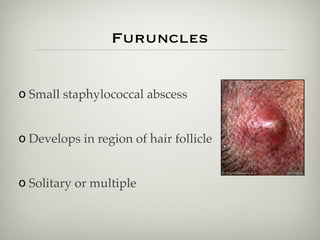
o Small staphylococcal abscess
o Develops in region of hair follicle
o Solitary or multiple
Furuncles
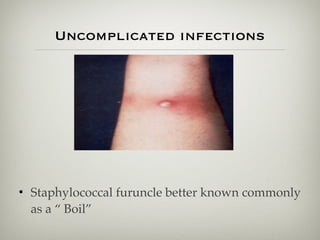
Uncomplicated infections
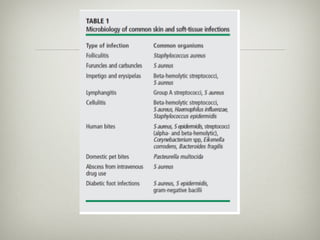
• Staphylococcal furuncle better known commonly
as a “ Boil”
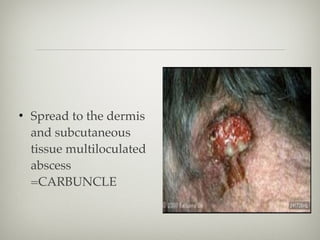
• Spread to the dermis
and subcutaneous
tissue multiloculated
abscess
=CARBUNCLE
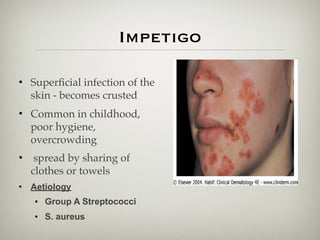
Impetigo
• Superficial infection of the
skin - becomes crusted
• Common in childhood,
poor hygiene,
overcrowding
• spread by sharing of
clothes or towels
• Aetiology
• Group A Streptococci
• S. aureus
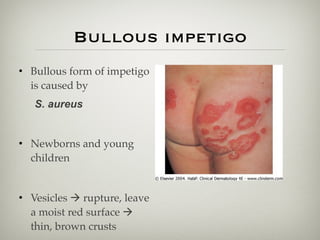
Bullous impetigo
• Bullous form of impetigo
is caused by
S. aureus
• Newborns and young
children
• Vesicles ! rupture, leave
a moist red surface !
thin, brown crusts
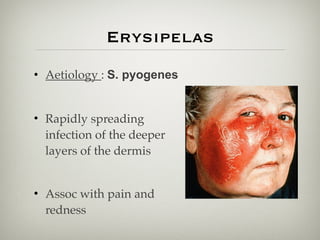
Erysipelas
• Aetiology : S. pyogenes
• Rapidly spreading
infection of the deeper
layers of the dermis
• Assoc with pain and
redness
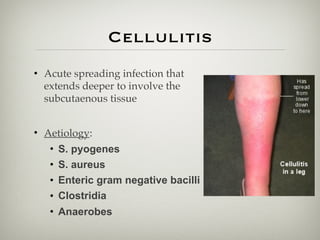
Cellulitis
• Acute spreading infection that
extends deeper to involve the
subcutaenous tissue
• Aetiology:
• S. pyogenes
• S. aureus
• Enteric gram negative bacilli
• Clostridia
• Anaerobes
Treatment of SSTI
• Adequate drainage of infected fluid
• Remove dead/necrotic tissue
• Remove foreign devices
• Appropriate antibiotc treatment
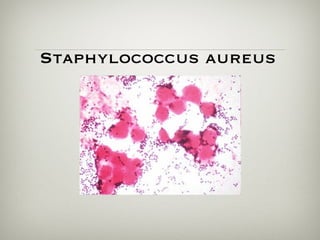
Staphylococcus aureus
• Many children and adults become transiently
colonized by S. aureus.
• carried in the :
– Nasopharynx
– skin
– Clothing
– perineal area.
• intrapersonal transfer by aerosol and by direct
contact.
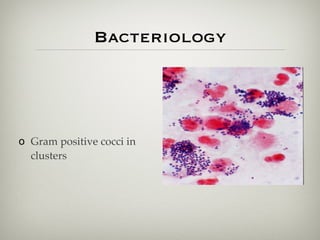
Bacteriology
o Gram positive cocci in
clusters
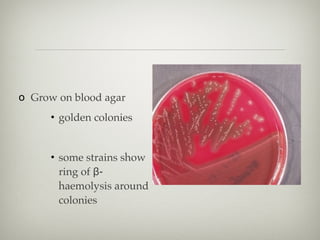
o Grow on blood agar
• golden colonies
• some strains show
ring of β-
haemolysis around
colonies
Pathogenesis
• Colonisation by Staph aureus mediated by:
– surface proteins – bind to host tissue
– Fibrin
– Collagen
– fibronectin
• Trauma , foreign matter – provide access
for org to enter
Virulence factors:
• Capsule
– Exopolysaccharide
– Prevents ingestion by PMN
– Promotes adherence to host cell and prosthetic devices
– Classified into 8 types based on immunotyping.
• Capsular types 5 and 8 resp for up to 75% of clin infections
• Vaccine ags 5 & 8 : pts with hemodialysis
Surface adhesins
• Adherence to host proteins
• Microbial surface components –
• acronym : MSCRAMM
• Imp ones are
• Clumping factor A and B
• Fibronectin-binding prts
• Prt A
• Protein A:
– Bound to cell wall peptidoglycan
– Binds Fc region of IgG
– Interferes with opsonisation, ingestion by PMN
• Cell wall constituents:
– Teichoic acid – imp for adherence to mucosal surfaces
– Peptidoglycan – rigidity & resilience
– Inhibit chemotaxis
• Teichoic acids rep 50% of wt of cell wall
• They are site of attach of prts and
enzymes
• LTA : plasma memb-bound counterparts
of teichoic acid – implicated in
inflammation – triggers cytokine release
• Enzymes:
– Catalase – inactivates H peroxide & free radicals prod after ingestion by PMN
– Coagulase – coat bact with fibrin →resistant to opson & phagocytosis
– Fibrinolysis – break down fibrin clots → spread in tissues
– Hyaluronidase – hydrolyses intracellular matrix of mucopolysacc in tissue →
spread
– Lipases – spread in subcut tissue
• Haemolysins:
– Alpha – lyses PMN , neurotoxin
– Beta – sphinogomyelinase – lyse varity of cells
• Panton Valentine Leucocidin (PVL):
– Found in 2% of strains
– Cause severe skin infections and severe haemorrhagic
pneumonia in young adults and children
– Encoded on a mobile phage
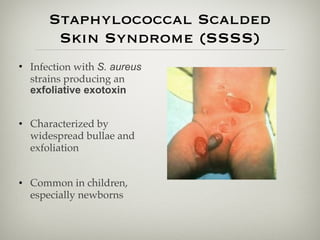
Staphylococcal scalded
skin syndrome
• SSSS (Ritter’s dx)
• Skin and mucosal colonisation with a toxigenic S aureus that prod an
exfoliative toxin (A or B)
• Toxin genes on plasmid or phage
• Toxin acts on desmoglein 1 ( transmemb desosomal glycoprotein invlv
in interkeratinocyte adhesion ) in the stratum granulosum
Staphylococcal Scalded
Skin Syndrome (SSSS)
• Infection with S. aureus
strains producing an
exfoliative exotoxin
• Characterized by
widespread bullae and
exfoliation
• Common in children,
especially newborns
• Superantigens
• Tsst-1
• Staph enterotoxin
• Are prts that do not activate the imm sys via
normal Ag presenting
• Attach to Vβ domain of large quan of T lymphs
• Activates 20%of total poolof T cells
• Normal Ag pres – 1/10000
• Massive cytokine release - shock
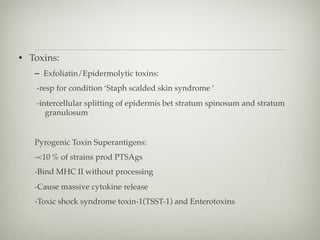
• Toxins:
– Exfoliatin/Epidermolytic toxins:
-resp for condition ‘Staph scalded skin syndrome ‘
-intercellular splitting of epidermis bet stratum spinosum and stratum
granulosum
Pyrogenic Toxin Superantigens:
-<10 % of strains prod PTSAgs
-Bind MHC II without processing
-Cause massive cytokine release
-Toxic shock syndrome toxin-1(TSST-1) and Enterotoxins
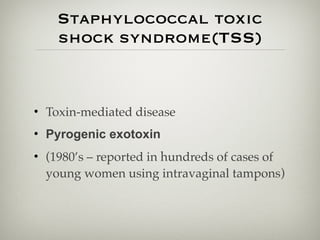
Staphylococcal toxic
shock syndrome(TSS)
• Toxin-mediated disease
• Pyrogenic exotoxin
• (1980’s – reported in hundreds of cases of
young women using intravaginal tampons)
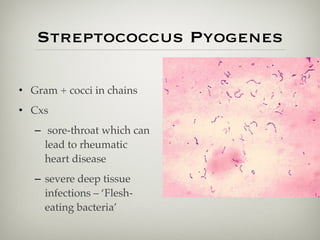
Streptococcus Pyogenes
• Gram + cocci in chains
• Cxs
– sore-throat which can
lead to rheumatic
heart disease
– severe deep tissue
infections – ‘Flesh-
eating bacteria’
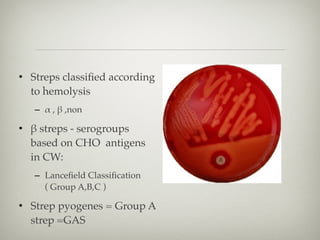
• Streps classified according
to hemolysis
– α , β ,non
• β streps - serogroups
based on CHO antigens
in CW:
– Lancefield Classification
( Group A,B,C )
• Strep pyogenes = Group A
strep =GAS


Virulence factors:

• M protein –
– > 80 serotypes
– Maj virulence factor – anchored in cell memb
– Anti-phagocytic
– Lack of M-prt = non-pathogenic
• Protein F – bind to fibronectin
• LTA( lipoteichoic acid) – similar to Prt F
• Adherence to nasopharynx
– M protein
– Protein F
– LTA
• Adherence to skin
– M protein – keratinocytes
– Protein F – Langerhans cells


Hemolysins:


–Streptolysin O:
• cytotoxin lysing WBC, Plts and tissue cells
• toxin inserts directly into the cell memb
forming pores
• antigenic and antibodies ags it used for
serological test ( ASOT)
–Streptolysin S:
– non-antigenic.
– toxic to WBC
• Pyrogenic exotoxins
– Erythrogenic toxin!scarlet fever(10%
GAS)
– Similar to pyrogenic toxins in St aureus
• Other virulence factors contribute to
spread:
– Stretokinase – lyes fibrin clot
– Hyaluronidase
– Hyaluronic capsule - inhib phagocytosis
– DNAse
– C5a peptidase
• 2 immunologic complications of GAS
infection:
– Acute rheumatic fever
• Antibodies to M protein bind to heart tissue- cross-
react
– Acute glomerulonephritis
• Deposition of immune complexes in glomerulus –
complement activation & inflammation
Wound infections
• Secondary to surgery, trauma or physiologic
• Contributing factors :
– Contaminating dose
– Virulence of org
– Physical condition of wound
– Physiological state of wound
• poor oxygenation
• poor blood supply
• Sources of infection
– Patient’s normal flora
– From infected people/carriers that may
reach the wound eg hands, fomites, air
– From environment eg soil, clothing
Organisms
• Staph aureus
• Group A streptococcus/ Streptococcus pyogenes
• Pseudomonas aeruginosa
• Clostridium perfringens
• Other gram negative bacilli
– Acinetobacter spp
– Klebsiella pneumoniae
– Enterobacter spp
Pseudomonas aeruginosa
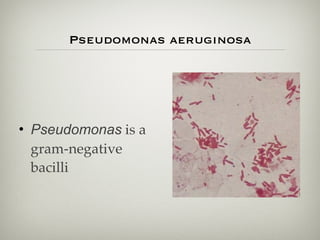
• Pseudomonas is a
gram-negative
bacilli
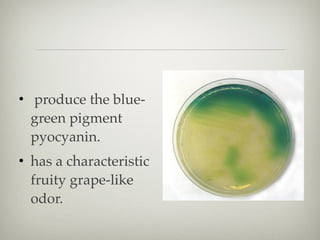
• produce the blue-
green pigment
pyocyanin.
• has a characteristic
fruity grape-like
odor.
• Epidemiology
• Found in soil, water
• Has been isolated from stool
• Hospitalised pts – higher colonisation rate
• Most impt cause of opportunistic infection
• Burns
• Cystic fibrosis
• Immunosuppression
• Adhesins

pili (N-methyl-phenylalanine pili)

polysaccharide capsule (glycocalyx)

alginate slime (biofilm)


• Invasins

elastase

hemolysins (phospholipase and lecithinase)

cytotoxin (leukocidin)

pyocyanin diffusible pigment


• Toxins:

Exoenzyme S

Exotoxin A

• Lipopolysaccharide


Antiphagocytic surface properties

capsules, slime layers

LPS

Biofilm construction

Complicated SSTI
• Gas gangrene is a severe condition
resulting from bacteria invading healthy
muscle from adjacent traumatized muscle
or soft tissue.
• The infection originates in a wound
contaminated with bacteria of the genus
CLOSTRIDIUM.
• Clostridial myonecrosis is a destructive infectious
process of muscle associated with infections of the
skin and soft tissues.
• Caused by the anaerobic, gas-forming bacilli of
the Clostridium genus.
• Often occurs after
• abdominal operations on the GIT ,
• penetrating trauma, such as gunshot wounds
• frostbite,
can expose muscle, fascia, and subcutaneous tissues to
these organisms.
Clostridium spp.
• Large, spore forming GPB
• Spores resistant to heat, dessication and
disinfectant
• Medically impt:
• C. perfringens
• C. tetani
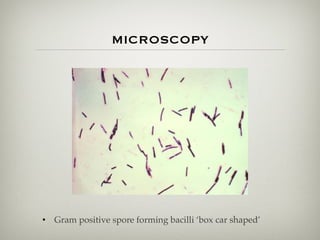
MICROSCOPY
• Gram positive spore forming bacilli ‘box car shaped’


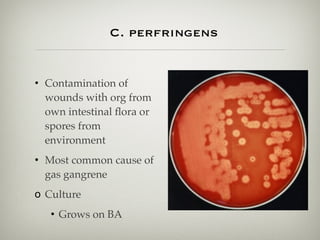
C. perfringens

• Contamination of
wounds with org from
own intestinal flora or
spores from
environment
• Most common cause of
gas gangrene
o Culture
• Grows on BA
Clostridium perfringens
• This organism produces collagenases and
proteases that cause widespread tissue
destruction
• Multiple exotoxins
– Most important is α-toxin-phospolipase
that hydrolyses lecithin &
sphingomyelin! disrupt cell
membranes of various host cells


C. tetani

• Contamination of wounds
• Can lead to tetanus in the unimmunised pt
• Effect by neurotoxin – tetanospasmin
• Blocks release of inhibitory
neurotransmitters
• Clinical:
• Severe muscle spasm – trismus (lockjaw)
Necrotising fascitis
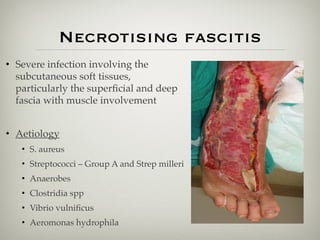
• Severe infection involving the
subcutaneous soft tissues,
particularly the superficial and deep
fascia with muscle involvement
• Aetiology
• S. aureus
• Streptococci – Group A and Strep milleri
• Anaerobes
• Clostridia spp
• Vibrio vulnificus
• Aeromonas hydrophila
Infection of other skin
layers
• Infection of keratinised layers
• Fungal infections:
– Candida spp
– Dermatophytes
• Candida
• Moist areas
• Can be assoc with defects in cellular immunity
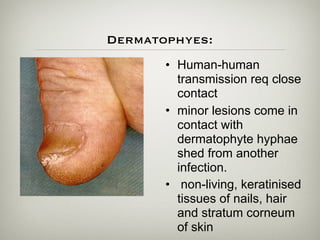
Dermatophyes:
• Human-human
transmission req close
contact
• minor lesions come in
contact with
dermatophyte hyphae
shed from another
infection.
• non-living, keratinised
tissues of nails, hair
and stratum corneum
of skin
• Low infectivity & virulence
• Not painful or life-threatening
• Families, locker rooms
• Aetiology -3 genera
• Microsporum
• Trichyophyton
• Epidermophyton
• Each “disease” often given its own name, eg.
Tinea capitis (scalp), tinea pedis (athletes foot)
• Most common – ringworm
• Treatment : topical antifungals (eg azoles)
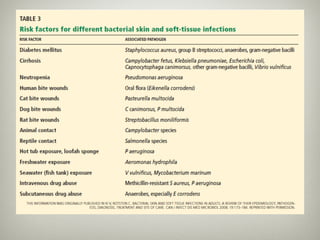
Human bites
• can result in serious soft tissue infection.
• infections include
– Streptococcus spp
– S. aureus
– Eikenella corrodens
– Fusobacterium nucleatum
– Prevotella melaninogenica
Dog bites
• Infections related to dog bites are often
polymicrobial, predominantly involving
Pasteurella and Bacteroides spp.
• A history of travel is important in the
assessment of SSTIs:
– Vibrio spp. infection in those exposed to
sea water
• Rashes in travellers may be associated with
a range of infections
– Tick bite fever

Skin and Soft Tissue Infections

  • 1.
    Skin and SoftTissue Infections Dr P Mahabeer Dr. N. S. Naidoo
  • 2.
    • What isthe difference bet uncomplicated and complicated ssti. Give 2 examples of each and the bacterial causes. • Write short notes on impetigo, bullous impetigo, erysipelas, cellulitis.
  • 3.
    The Skin • Skin: – organ system with multiple functions, incl. protection of tissues from external microbial invasion • Surface = keratinised stratified epithelium
  • 4.
    Healthy Skin • Intactskin – physical barrier to penetration of organisms • Tight junctions bet epithelial cells • Acidic oily matrix prod by sebaceous glands coats epithelial cells • Normal skin flora prevent colonisation
  • 5.
    How does infectionoccur? • Minor trauma that destroys the integrity and allows organisms access • Surface penetrated by ducts of pilosebaceous glands, sweat gland and hair follicles provide route of entry for microbes , esp. if ducts are obstructed
  • 6.
    
 Modes of infection
 –Circulating microbe – Circulating toxin – Direct introduction of microbe into epithelium
  • 7.
    Pathogenesis • To causeinfxn – organisms must penetrate barrier • Due to trauma • Symptoms incude – Pain – Warmth – Skin discolouration – Swelling – vesicles
  • 8.
    Categories – localised orspreading – Uncomplicated – infxn of superficial layer – Complicated – infxn extending to deeper layers
  • 10.
    • Respond todrainage and antibiotics • These include: • Minor abscess • Impetigo • Cellulitis • Erysipelas • Folliculitis • Furuncles or boils • carbuncles Uncomplicated SSTI
  • 11.
    complicated SSTI – Involvedeeper structures – Significant surgical intervention – Infxns in pts at risk eg Diabetes; poor blood supply – These include • Gas gangrene • Necrotising cellulitis ( dermal and subcut tx) • Necrotising fascitis ( include fascia) • Pyomyositis and myonecrosis ( muscle)
  • 13.
    Folliculitis oInfection of hair follicles oAssocwith areas of friction – neck, face, axillae, buttocks oAetiology: oS. aureus oP. aeruginosa
  • 14.
    o Small staphylococcalabscess o Develops in region of hair follicle o Solitary or multiple Furuncles
  • 15.
    Uncomplicated infections • Staphylococcalfuruncle better known commonly as a “ Boil”
  • 16.
    • Spread tothe dermis and subcutaneous tissue multiloculated abscess =CARBUNCLE
  • 17.
    Impetigo • Superficial infectionof the skin - becomes crusted • Common in childhood, poor hygiene, overcrowding • spread by sharing of clothes or towels • Aetiology • Group A Streptococci • S. aureus
  • 18.
    Bullous impetigo • Bullousform of impetigo is caused by S. aureus • Newborns and young children • Vesicles ! rupture, leave a moist red surface ! thin, brown crusts
  • 19.
    Erysipelas • Aetiology :S. pyogenes • Rapidly spreading infection of the deeper layers of the dermis • Assoc with pain and redness
  • 20.
    Cellulitis • Acute spreadinginfection that extends deeper to involve the subcutaenous tissue • Aetiology: • S. pyogenes • S. aureus • Enteric gram negative bacilli • Clostridia • Anaerobes
  • 21.
    Treatment of SSTI •Adequate drainage of infected fluid • Remove dead/necrotic tissue • Remove foreign devices • Appropriate antibiotc treatment
  • 23.
  • 24.
    Staphylococcus aureus • Manychildren and adults become transiently colonized by S. aureus. • carried in the : – Nasopharynx – skin – Clothing – perineal area. • intrapersonal transfer by aerosol and by direct contact.
  • 25.
  • 26.
    o Grow onblood agar • golden colonies • some strains show ring of β- haemolysis around colonies
  • 27.
    Pathogenesis • Colonisation byStaph aureus mediated by: – surface proteins – bind to host tissue – Fibrin – Collagen – fibronectin • Trauma , foreign matter – provide access for org to enter
  • 28.
    Virulence factors: • Capsule –Exopolysaccharide – Prevents ingestion by PMN – Promotes adherence to host cell and prosthetic devices – Classified into 8 types based on immunotyping. • Capsular types 5 and 8 resp for up to 75% of clin infections • Vaccine ags 5 & 8 : pts with hemodialysis
  • 29.
    Surface adhesins • Adherenceto host proteins • Microbial surface components – • acronym : MSCRAMM • Imp ones are • Clumping factor A and B • Fibronectin-binding prts • Prt A
  • 30.
    • Protein A: –Bound to cell wall peptidoglycan – Binds Fc region of IgG – Interferes with opsonisation, ingestion by PMN • Cell wall constituents: – Teichoic acid – imp for adherence to mucosal surfaces – Peptidoglycan – rigidity & resilience – Inhibit chemotaxis
  • 31.
    • Teichoic acidsrep 50% of wt of cell wall • They are site of attach of prts and enzymes • LTA : plasma memb-bound counterparts of teichoic acid – implicated in inflammation – triggers cytokine release
  • 32.
    • Enzymes: – Catalase– inactivates H peroxide & free radicals prod after ingestion by PMN – Coagulase – coat bact with fibrin →resistant to opson & phagocytosis – Fibrinolysis – break down fibrin clots → spread in tissues – Hyaluronidase – hydrolyses intracellular matrix of mucopolysacc in tissue → spread – Lipases – spread in subcut tissue
  • 33.
    • Haemolysins: – Alpha– lyses PMN , neurotoxin – Beta – sphinogomyelinase – lyse varity of cells • Panton Valentine Leucocidin (PVL): – Found in 2% of strains – Cause severe skin infections and severe haemorrhagic pneumonia in young adults and children – Encoded on a mobile phage
  • 34.
    Staphylococcal scalded skin syndrome •SSSS (Ritter’s dx) • Skin and mucosal colonisation with a toxigenic S aureus that prod an exfoliative toxin (A or B) • Toxin genes on plasmid or phage • Toxin acts on desmoglein 1 ( transmemb desosomal glycoprotein invlv in interkeratinocyte adhesion ) in the stratum granulosum
  • 35.
    Staphylococcal Scalded Skin Syndrome(SSSS) • Infection with S. aureus strains producing an exfoliative exotoxin • Characterized by widespread bullae and exfoliation • Common in children, especially newborns
  • 36.
    • Superantigens • Tsst-1 •Staph enterotoxin • Are prts that do not activate the imm sys via normal Ag presenting • Attach to Vβ domain of large quan of T lymphs • Activates 20%of total poolof T cells • Normal Ag pres – 1/10000 • Massive cytokine release - shock
  • 37.
    • Toxins: – Exfoliatin/Epidermolytictoxins: -resp for condition ‘Staph scalded skin syndrome ‘ -intercellular splitting of epidermis bet stratum spinosum and stratum granulosum Pyrogenic Toxin Superantigens: -<10 % of strains prod PTSAgs -Bind MHC II without processing -Cause massive cytokine release -Toxic shock syndrome toxin-1(TSST-1) and Enterotoxins
  • 38.
    Staphylococcal toxic shock syndrome(TSS) •Toxin-mediated disease • Pyrogenic exotoxin • (1980’s – reported in hundreds of cases of young women using intravaginal tampons)
  • 39.
    Streptococcus Pyogenes • Gram+ cocci in chains • Cxs – sore-throat which can lead to rheumatic heart disease – severe deep tissue infections – ‘Flesh- eating bacteria’
  • 40.
    • Streps classifiedaccording to hemolysis – α , β ,non • β streps - serogroups based on CHO antigens in CW: – Lancefield Classification ( Group A,B,C ) • Strep pyogenes = Group A strep =GAS
  • 41.
    
 Virulence factors:
 • Mprotein – – > 80 serotypes – Maj virulence factor – anchored in cell memb – Anti-phagocytic – Lack of M-prt = non-pathogenic • Protein F – bind to fibronectin • LTA( lipoteichoic acid) – similar to Prt F
  • 42.
    • Adherence tonasopharynx – M protein – Protein F – LTA • Adherence to skin – M protein – keratinocytes – Protein F – Langerhans cells
  • 43.
    
 
 Hemolysins:
 
 –Streptolysin O: • cytotoxinlysing WBC, Plts and tissue cells • toxin inserts directly into the cell memb forming pores • antigenic and antibodies ags it used for serological test ( ASOT) –Streptolysin S: – non-antigenic. – toxic to WBC
  • 44.
    • Pyrogenic exotoxins –Erythrogenic toxin!scarlet fever(10% GAS) – Similar to pyrogenic toxins in St aureus
  • 45.
    • Other virulencefactors contribute to spread: – Stretokinase – lyes fibrin clot – Hyaluronidase – Hyaluronic capsule - inhib phagocytosis – DNAse – C5a peptidase
  • 46.
    • 2 immunologiccomplications of GAS infection: – Acute rheumatic fever • Antibodies to M protein bind to heart tissue- cross- react – Acute glomerulonephritis • Deposition of immune complexes in glomerulus – complement activation & inflammation
  • 47.
    Wound infections • Secondaryto surgery, trauma or physiologic • Contributing factors : – Contaminating dose – Virulence of org – Physical condition of wound – Physiological state of wound • poor oxygenation • poor blood supply
  • 48.
    • Sources ofinfection – Patient’s normal flora – From infected people/carriers that may reach the wound eg hands, fomites, air – From environment eg soil, clothing
  • 49.
    Organisms • Staph aureus •Group A streptococcus/ Streptococcus pyogenes • Pseudomonas aeruginosa • Clostridium perfringens • Other gram negative bacilli – Acinetobacter spp – Klebsiella pneumoniae – Enterobacter spp
  • 50.
    Pseudomonas aeruginosa • Pseudomonasis a gram-negative bacilli
  • 51.
    • produce theblue- green pigment pyocyanin. • has a characteristic fruity grape-like odor.
  • 52.
    • Epidemiology • Foundin soil, water • Has been isolated from stool • Hospitalised pts – higher colonisation rate • Most impt cause of opportunistic infection • Burns • Cystic fibrosis • Immunosuppression
  • 53.
    • Adhesins
 pili (N-methyl-phenylalaninepili)
 polysaccharide capsule (glycocalyx)
 alginate slime (biofilm)
 
 • Invasins
 elastase
 hemolysins (phospholipase and lecithinase)
 cytotoxin (leukocidin)
 pyocyanin diffusible pigment


  • 54.
    • Toxins:
 Exoenzyme S
 ExotoxinA
 • Lipopolysaccharide
 
 Antiphagocytic surface properties
 capsules, slime layers
 LPS
 Biofilm construction

  • 55.
    Complicated SSTI • Gasgangrene is a severe condition resulting from bacteria invading healthy muscle from adjacent traumatized muscle or soft tissue. • The infection originates in a wound contaminated with bacteria of the genus CLOSTRIDIUM.
  • 56.
    • Clostridial myonecrosisis a destructive infectious process of muscle associated with infections of the skin and soft tissues. • Caused by the anaerobic, gas-forming bacilli of the Clostridium genus. • Often occurs after • abdominal operations on the GIT , • penetrating trauma, such as gunshot wounds • frostbite, can expose muscle, fascia, and subcutaneous tissues to these organisms.
  • 57.
    Clostridium spp. • Large,spore forming GPB • Spores resistant to heat, dessication and disinfectant • Medically impt: • C. perfringens • C. tetani
  • 58.
    MICROSCOPY • Gram positivespore forming bacilli ‘box car shaped’
  • 59.
    
 C. perfringens
 • Contaminationof wounds with org from own intestinal flora or spores from environment • Most common cause of gas gangrene o Culture • Grows on BA
  • 60.
    Clostridium perfringens • Thisorganism produces collagenases and proteases that cause widespread tissue destruction • Multiple exotoxins – Most important is α-toxin-phospolipase that hydrolyses lecithin & sphingomyelin! disrupt cell membranes of various host cells
  • 61.
    
 C. tetani
 • Contaminationof wounds • Can lead to tetanus in the unimmunised pt • Effect by neurotoxin – tetanospasmin • Blocks release of inhibitory neurotransmitters • Clinical: • Severe muscle spasm – trismus (lockjaw)
  • 62.
    Necrotising fascitis • Severeinfection involving the subcutaneous soft tissues, particularly the superficial and deep fascia with muscle involvement • Aetiology • S. aureus • Streptococci – Group A and Strep milleri • Anaerobes • Clostridia spp • Vibrio vulnificus • Aeromonas hydrophila
  • 63.
    Infection of otherskin layers • Infection of keratinised layers • Fungal infections: – Candida spp – Dermatophytes • Candida • Moist areas • Can be assoc with defects in cellular immunity
  • 64.
    Dermatophyes: • Human-human transmission reqclose contact • minor lesions come in contact with dermatophyte hyphae shed from another infection. • non-living, keratinised tissues of nails, hair and stratum corneum of skin
  • 65.
    • Low infectivity& virulence • Not painful or life-threatening • Families, locker rooms • Aetiology -3 genera • Microsporum • Trichyophyton • Epidermophyton
  • 66.
    • Each “disease”often given its own name, eg. Tinea capitis (scalp), tinea pedis (athletes foot) • Most common – ringworm • Treatment : topical antifungals (eg azoles)
  • 67.
    Human bites • canresult in serious soft tissue infection. • infections include – Streptococcus spp – S. aureus – Eikenella corrodens – Fusobacterium nucleatum – Prevotella melaninogenica
  • 68.
    Dog bites • Infectionsrelated to dog bites are often polymicrobial, predominantly involving Pasteurella and Bacteroides spp.
  • 70.
    • A historyof travel is important in the assessment of SSTIs: – Vibrio spp. infection in those exposed to sea water • Rashes in travellers may be associated with a range of infections – Tick bite fever