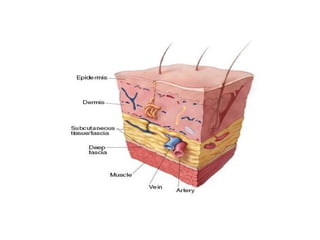
SOFT TISSUE INFECTIONS
Prepared by:
HAMISI MKINDI,MD4,SFUCHAS
hermyc@live.com
Skin and soft tissue infections
(SSTIs)
• Include infections of skin, subcutaneous
tissue, fascia, and muscle, encompass a wide
spectrum of clinical presentations, ranging
from simple cellulitis to rapidly progressive
necrotizing fasciitis.
• Diagnosing the exact extent of the disease is
critical for successful management of a
patient of soft tissue infection.
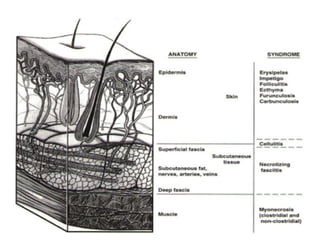
TYPES
The various types of SSTIs, listed according to clinical
presentation and anatomic location, include the
following:
•Impetigo
•Folliculitis
•Furuncles
•Carbuncles
•Erysipelas
•Cellulitis
•Necrotizing fasciitis
•Pyomyositis
Impetigo
• Impetigo is an acute, highly contagious gram-
positive bacterial infection of the superficial
layers of the epidermis.
• Skin lesions such as cuts, abrasions, and
chickenpox can also become secondarily infected
(impetiginized) with the same pathogens that
produce classic impetigo.
• Impetigo occurs most commonly in children,
especially those who live in hot, humid climates
Impetigo-Pathophysiology
• Intact skin is usually resistant to colonization.
• Requires fibronectin Colonization
• Colonization Infection
Impetigo-Presentation
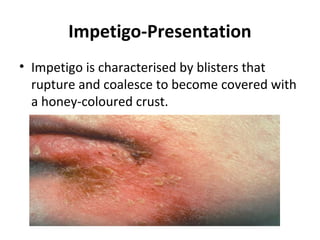
• Impetigo is characterised by blisters that
rupture and coalesce to become covered with
a honey-coloured crust.
Impetigo-Treatment
• Treatment is directed at washing the affected
areas and applying topical antistaphylococcal
treatments, and broad-spectrum oral
antibiotics if streptococcal infection is
implicated.
• Mupirocin ointment (Bactroban).
• Oral Cephalexin
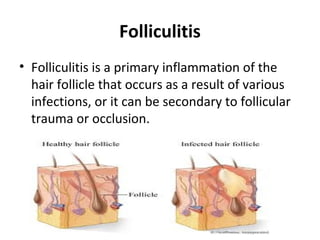
Folliculitis
• Folliculitis is a primary inflammation of the
hair follicle that occurs as a result of various
infections, or it can be secondary to follicular
trauma or occlusion.
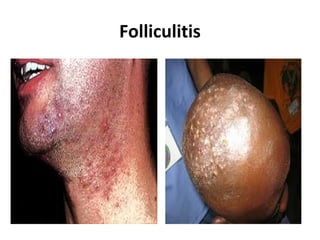
Folliculitis
Folliculitis-Management
• Antibacterial soap.
• Antibiotics for staphilococcus aureus-
Preferably dicloxacillin or a cephalosporin.
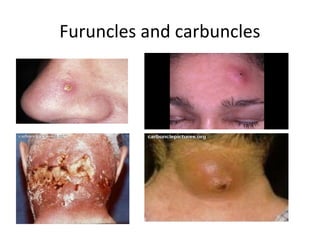
Furuncles and Carbunlces
• Furuncles and carbuncles are subcutaneous
abscesses caused by S. aureus.
• The lesions are red, tender nodules that may
have a surrounding cellulitis. They often drain
spontaneously.
• If fluctuant, these lesions should be incised
and drained in conjunction with antibiotics,
especially if systemic symptoms or cellulitis is
present.
Furuncles and carbuncles
Cellulitis
• Is an inflammation of the dermal and
subcutaneous tissues due to non suppurative
bacterial invasion.
• Misnomer as lesion is one of the connective
tissues and interstitial tissue and not of the
cells.
• The common causative organisms are GAS
and staphylococcus.
Cellulitis-Pathophysiology
• Cellulitis usually follows a breach in the skin.
• In some cases, there is no obvious portal of
entry and the breach may be due to
microscopic changes in the skin or invasive
qualities of certain bacteria.
• There is a widespread swelling and redness at
the area of inflammation but without definite
localization.
• Risk factors:
Trauma, skin break, insect bite,animal bite
dental infections, diabetes and obesity.
Cellulitis-Clinical features
There is varying degree of fever and toxaemia.
The affected part is very much swollen and
tender and hot.
Cellulitis-O/E
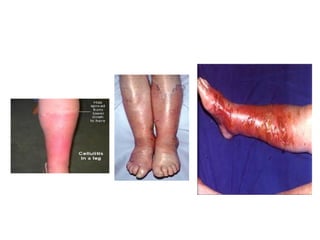
• The affected part is warm,swollen and tender.
• There is pitting oedema and brawny
induration.
• Regional lymph nodes will be enlarged and
tender with acute lymphadenitis.
• Calf tendersness test R/O dvt
Cellulitits-Diagnosis
• Most often clinical.
• Blood culture.
• Ultrasound
Cellulitis-Treatment
Consist of:
•Rest and elevation of the part to reduce
oedema.
•Appropriate antibiotic preferably broad
spectrum should be administered.
•Pain relief
•Failure of inflammatory swelling to subside
after 48-72 hours suggest that an abscess has
developed hence I & D UGA.
Erysipela
• Is an acute infection of the upper dermis and
superficial lymphatics, usually caused by
streptococcus bacteria.
• Erysipelas is more superficial than cellulitis,
and is typically more raised and demarcated.
Erysipela-Pathophysiology
• Bacterial inoculation into an area of skin
trauma is the initial event in developing
erysipelas.
• The infection rapidly invades and spreads
through the lymphatic vessels. This can
produce overlying skin "streaking" and
regional lymph node swelling and tenderness.
Erysipelas-Clinical features
• The area affected is erythematous and
oedematous.
• The patient may be febrile and have a
leucocytosis.
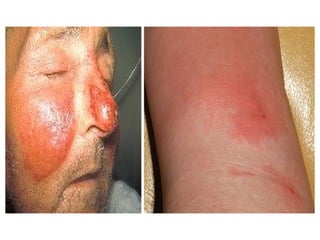
Erysipelas or Cellulitis???
• Erysipela:
Typical rosy rash dissapears on pressure and
feels stiff.
Raised rash of erysipelas has a sharply defined
margin which is better felt than inspected.
Erysipelas-Treatment
• Prompt administration of broad-spectrum
antibiotics.
Necrotizing fascitis
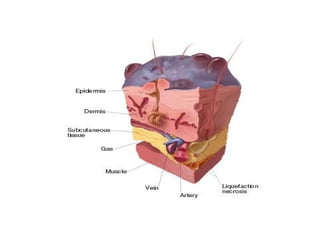
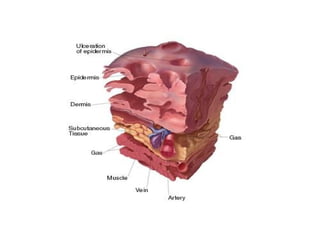
• A severe and extensive necrosis of the
superficial fascia and subcutaneous fat
with destruction of those tissues.
• Gram + and – bacteria involved
Pathophysiology
• Organisms spread from sub Q tissues along
superficial and deep planes, facilitated by
bacterial enzymes and toxins.
• Infection causes vascular occlusion, ischemia,
necrosis.
• Superficial nerves damaged, producing
anesthesia.
• Septicemia ensues
Pathophysiology
• M1 and M3 surface proteins increase
adherence of the bacteria to the tissues,
protect from phagocytosis.
• Streptococcal pyrogenic exotoxins release
cytokines and produce hypotension.
Nec.Fasc-Symptoms
• pain or soreness of a muscle.
• The skin may be warm with red or purplish
areas of swelling that spread rapidly.
• There may be ulcers, blisters or black spots on
the skin.
• Fever, chills, fatigue (tiredness) or vomiting
may follow the initial wound or soreness
Diagnosis of Nec. Fas.
• History and Physical examination of the
patient !!!!! This is a simple diagnostic test that
works every time.
• Microbiology: group A Streptococcus
pyogenes , Coliforms, Staphylococcus Aureus,
Bacteroides species, and rarely Clostridium
septicum
Six Clinical Criteria of Nec. Fas.
1) Necrosis of the superficial fascia with undermining
of the surrounding tissues
2) Systemic toxic reaction with altered mental status
3) Absence of muscle involvement
4) No Clostridia species isolated
5) No arterial inflow occlusion
6) Pathological exam of debrided tissue shows
intense leukocytic infiltration, focal fascial and
surrounding tissue necrosis and thrombosis of
microvasculature
ref: Fisher’s criteria
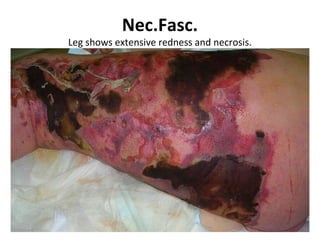
Nec.Fasc.
Leg shows extensive redness and necrosis.
Diagnosis-LRINEC
• The Laboratory Risk Indicator for Necrotizing
Fasciitis (LRINEC) score.
• It uses six serologic measures: C-reactive
protein, total white blood cell count,
hemoglobin, sodium, creatinine and glucose.
• A score greater than or eqaul to 6 indicates
that necrotizing fasciitis should be seriously
considered.
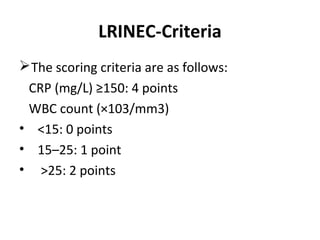
LRINEC-Criteria
The scoring criteria are as follows:
CRP (mg/L) ≥150: 4 points
WBC count (×103/mm3)
• <15: 0 points
• 15–25: 1 point
• >25: 2 points
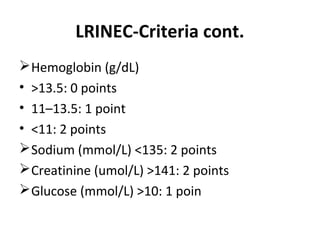
LRINEC-Criteria cont.
Hemoglobin (g/dL)
• >13.5: 0 points
• 11–13.5: 1 point
• <11: 2 points
Sodium (mmol/L) <135: 2 points
Creatinine (umol/L) >141: 2 points
Glucose (mmol/L) >10: 1 poin
Radiology
• Standard x-rays of little use.
• CT more sensitive.
• MRI and CT can delineate and determine
extent of surgical resection.
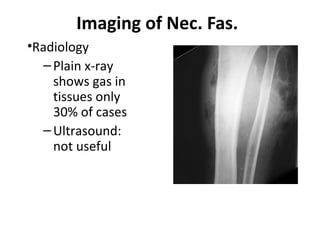
Imaging of Nec. Fas.
•Radiology
–Plain x-ray
shows gas in
tissues only
30% of cases
–Ultrasound:
not useful
Nec.Fasc-Treatment
• Regardless of the etiology, the primary
therapy is emergent surgical debridement and
treatment with antibiotics that are active
against streptococci, clostridium species, and
mixed aerobes and anaerobes.
• Clindamycin and pen G IV or Ceftriaxone 2gm
q12h IV .
Pyomyositis
• Pyomyositis, also known as tropical
pyomyositis or myositis tropicans, is a
bacterial infection of the skeletal muscles which
results in a pus-filled abscess
• Deep infection of muscle usually caused by S. aureus
and occasionally by group A streptococci or enteric
bacilli.
• Patients present with fever and tender swelling of
the muscle;Following exercise or muscle injury, the
skin is usually minimally involved.
Pyomyostis-Diagnosis
• Most often infects the large muscle groups.
• The diagnosis can be readily made, if
suspected, by needle aspiration and x-rays.
• Within 1-2 days of injury, the involved
extremity becomes painful and swollen. Gas
present in tissue may be obvious by physical
exam, x-ray or CT.
Pyomyositis-Treatment
• Surgical debridement and appropriate
antibiotics are curative (nafcillin-oxacillin or
vanco 1 gm q12h IV)
Clostridial Myonecrosis
• Principally C. perfringens but C. novyi and C.
septicum also seen.
• Predisposing event
–Deep trauma with gross contamination
–Surgical wound
–Hematogenous spread from colonic lesion
• Incubation Period 2-3 days; then explosive
spread.
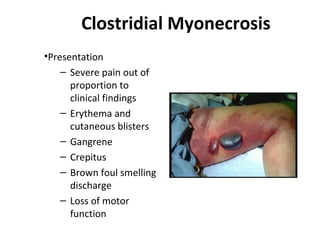
Clostridial Myonecrosis
•Presentation
– Severe pain out of
proportion to
clinical findings
– Erythema and
cutaneous blisters
– Gangrene
– Crepitus
– Brown foul smelling
discharge
– Loss of motor
function
Pathophysiology
• Clostridia spores Tissues
Contamination, severe and open wounds
Germinate and grow rapidly
If normal tissue ox-red potential lowered eg.cell injury
• Lesion involve co-infection
• Alpha toxin and other exotoxins secreted.
• Enzymes break down ground substance
facilitating spread.
Pathophysiology-continued
• Fermentation of tissue carbohydrates.
• ‘’GAS GANGRENE’’
Treatment
• Debridement and excision, with amputation
necessary in many cases.
• Antibiotics alone are not effective because
they do not penetrate ischaemic muscles
sufficiently to be effective.
Treatment-cont
• Penicillin is given as an adjuvant treatment to
surgery.
• In addition to surgery and
antibiotics, hypercarbic oxygen
therapy (HBOT) is used and acts to inhibit the
growth of and kill the anaerobic C.
perfringens.
References
• WWW.emedecine.medscape/Skin soft tissue
infections.
• Bailey & Love’s short practice of surgery
• Ovadia D, Ezra E, Ben-Sira L et al. (2007).
"Primary pyomyositis in children: a
retrospective analysis of 11 cases".
• Lippincot illustrated review of microbiology
• Consise textbook of surgery by S DAS

Soft tissue infections surgery

  • 1.
    SOFT TISSUE INFECTIONS Preparedby: HAMISI MKINDI,MD4,SFUCHAS hermyc@live.com
  • 2.
    Skin and softtissue infections (SSTIs) • Include infections of skin, subcutaneous tissue, fascia, and muscle, encompass a wide spectrum of clinical presentations, ranging from simple cellulitis to rapidly progressive necrotizing fasciitis. • Diagnosing the exact extent of the disease is critical for successful management of a patient of soft tissue infection.
  • 3.
    TYPES The various typesof SSTIs, listed according to clinical presentation and anatomic location, include the following: •Impetigo •Folliculitis •Furuncles •Carbuncles •Erysipelas •Cellulitis •Necrotizing fasciitis •Pyomyositis
  • 5.
    Impetigo • Impetigo isan acute, highly contagious gram- positive bacterial infection of the superficial layers of the epidermis. • Skin lesions such as cuts, abrasions, and chickenpox can also become secondarily infected (impetiginized) with the same pathogens that produce classic impetigo. • Impetigo occurs most commonly in children, especially those who live in hot, humid climates
  • 6.
    Impetigo-Pathophysiology • Intact skinis usually resistant to colonization. • Requires fibronectin Colonization • Colonization Infection
  • 7.
    Impetigo-Presentation • Impetigo ischaracterised by blisters that rupture and coalesce to become covered with a honey-coloured crust.
  • 8.
    Impetigo-Treatment • Treatment isdirected at washing the affected areas and applying topical antistaphylococcal treatments, and broad-spectrum oral antibiotics if streptococcal infection is implicated. • Mupirocin ointment (Bactroban). • Oral Cephalexin
  • 9.
    Folliculitis • Folliculitis isa primary inflammation of the hair follicle that occurs as a result of various infections, or it can be secondary to follicular trauma or occlusion.
  • 10.
  • 11.
    Folliculitis-Management • Antibacterial soap. •Antibiotics for staphilococcus aureus- Preferably dicloxacillin or a cephalosporin.
  • 12.
    Furuncles and Carbunlces •Furuncles and carbuncles are subcutaneous abscesses caused by S. aureus. • The lesions are red, tender nodules that may have a surrounding cellulitis. They often drain spontaneously. • If fluctuant, these lesions should be incised and drained in conjunction with antibiotics, especially if systemic symptoms or cellulitis is present.
  • 13.
  • 14.
    Cellulitis • Is aninflammation of the dermal and subcutaneous tissues due to non suppurative bacterial invasion. • Misnomer as lesion is one of the connective tissues and interstitial tissue and not of the cells. • The common causative organisms are GAS and staphylococcus.
  • 15.
    Cellulitis-Pathophysiology • Cellulitis usuallyfollows a breach in the skin. • In some cases, there is no obvious portal of entry and the breach may be due to microscopic changes in the skin or invasive qualities of certain bacteria. • There is a widespread swelling and redness at the area of inflammation but without definite localization.
  • 16.
    • Risk factors: Trauma,skin break, insect bite,animal bite dental infections, diabetes and obesity.
  • 17.
    Cellulitis-Clinical features There isvarying degree of fever and toxaemia. The affected part is very much swollen and tender and hot.
  • 18.
    Cellulitis-O/E • The affectedpart is warm,swollen and tender. • There is pitting oedema and brawny induration. • Regional lymph nodes will be enlarged and tender with acute lymphadenitis. • Calf tendersness test R/O dvt
  • 20.
    Cellulitits-Diagnosis • Most oftenclinical. • Blood culture. • Ultrasound
  • 21.
    Cellulitis-Treatment Consist of: •Rest andelevation of the part to reduce oedema. •Appropriate antibiotic preferably broad spectrum should be administered. •Pain relief •Failure of inflammatory swelling to subside after 48-72 hours suggest that an abscess has developed hence I & D UGA.
  • 22.
    Erysipela • Is anacute infection of the upper dermis and superficial lymphatics, usually caused by streptococcus bacteria. • Erysipelas is more superficial than cellulitis, and is typically more raised and demarcated.
  • 23.
    Erysipela-Pathophysiology • Bacterial inoculationinto an area of skin trauma is the initial event in developing erysipelas. • The infection rapidly invades and spreads through the lymphatic vessels. This can produce overlying skin "streaking" and regional lymph node swelling and tenderness.
  • 24.
    Erysipelas-Clinical features • Thearea affected is erythematous and oedematous. • The patient may be febrile and have a leucocytosis.
  • 26.
    Erysipelas or Cellulitis??? •Erysipela: Typical rosy rash dissapears on pressure and feels stiff. Raised rash of erysipelas has a sharply defined margin which is better felt than inspected.
  • 27.
    Erysipelas-Treatment • Prompt administrationof broad-spectrum antibiotics.
  • 28.
    Necrotizing fascitis • Asevere and extensive necrosis of the superficial fascia and subcutaneous fat with destruction of those tissues. • Gram + and – bacteria involved
  • 29.
    Pathophysiology • Organisms spreadfrom sub Q tissues along superficial and deep planes, facilitated by bacterial enzymes and toxins. • Infection causes vascular occlusion, ischemia, necrosis. • Superficial nerves damaged, producing anesthesia. • Septicemia ensues
  • 33.
    Pathophysiology • M1 andM3 surface proteins increase adherence of the bacteria to the tissues, protect from phagocytosis. • Streptococcal pyrogenic exotoxins release cytokines and produce hypotension.
  • 34.
    Nec.Fasc-Symptoms • pain orsoreness of a muscle. • The skin may be warm with red or purplish areas of swelling that spread rapidly. • There may be ulcers, blisters or black spots on the skin. • Fever, chills, fatigue (tiredness) or vomiting may follow the initial wound or soreness
  • 35.
    Diagnosis of Nec.Fas. • History and Physical examination of the patient !!!!! This is a simple diagnostic test that works every time. • Microbiology: group A Streptococcus pyogenes , Coliforms, Staphylococcus Aureus, Bacteroides species, and rarely Clostridium septicum
  • 36.
    Six Clinical Criteriaof Nec. Fas. 1) Necrosis of the superficial fascia with undermining of the surrounding tissues 2) Systemic toxic reaction with altered mental status 3) Absence of muscle involvement 4) No Clostridia species isolated 5) No arterial inflow occlusion 6) Pathological exam of debrided tissue shows intense leukocytic infiltration, focal fascial and surrounding tissue necrosis and thrombosis of microvasculature ref: Fisher’s criteria
  • 37.
    Nec.Fasc. Leg shows extensiveredness and necrosis.
  • 38.
    Diagnosis-LRINEC • The LaboratoryRisk Indicator for Necrotizing Fasciitis (LRINEC) score. • It uses six serologic measures: C-reactive protein, total white blood cell count, hemoglobin, sodium, creatinine and glucose. • A score greater than or eqaul to 6 indicates that necrotizing fasciitis should be seriously considered.
  • 39.
    LRINEC-Criteria The scoring criteriaare as follows: CRP (mg/L) ≥150: 4 points WBC count (×103/mm3) • <15: 0 points • 15–25: 1 point • >25: 2 points
  • 40.
    LRINEC-Criteria cont. Hemoglobin (g/dL) •>13.5: 0 points • 11–13.5: 1 point • <11: 2 points Sodium (mmol/L) <135: 2 points Creatinine (umol/L) >141: 2 points Glucose (mmol/L) >10: 1 poin
  • 41.
    Radiology • Standard x-raysof little use. • CT more sensitive. • MRI and CT can delineate and determine extent of surgical resection.
  • 42.
    Imaging of Nec.Fas. •Radiology –Plain x-ray shows gas in tissues only 30% of cases –Ultrasound: not useful
  • 43.
    Nec.Fasc-Treatment • Regardless ofthe etiology, the primary therapy is emergent surgical debridement and treatment with antibiotics that are active against streptococci, clostridium species, and mixed aerobes and anaerobes. • Clindamycin and pen G IV or Ceftriaxone 2gm q12h IV .
  • 44.
    Pyomyositis • Pyomyositis, alsoknown as tropical pyomyositis or myositis tropicans, is a bacterial infection of the skeletal muscles which results in a pus-filled abscess • Deep infection of muscle usually caused by S. aureus and occasionally by group A streptococci or enteric bacilli. • Patients present with fever and tender swelling of the muscle;Following exercise or muscle injury, the skin is usually minimally involved.
  • 45.
    Pyomyostis-Diagnosis • Most ofteninfects the large muscle groups. • The diagnosis can be readily made, if suspected, by needle aspiration and x-rays. • Within 1-2 days of injury, the involved extremity becomes painful and swollen. Gas present in tissue may be obvious by physical exam, x-ray or CT.
  • 46.
    Pyomyositis-Treatment • Surgical debridementand appropriate antibiotics are curative (nafcillin-oxacillin or vanco 1 gm q12h IV)
  • 47.
    Clostridial Myonecrosis • PrincipallyC. perfringens but C. novyi and C. septicum also seen. • Predisposing event –Deep trauma with gross contamination –Surgical wound –Hematogenous spread from colonic lesion • Incubation Period 2-3 days; then explosive spread.
  • 48.
    Clostridial Myonecrosis •Presentation – Severepain out of proportion to clinical findings – Erythema and cutaneous blisters – Gangrene – Crepitus – Brown foul smelling discharge – Loss of motor function
  • 49.
    Pathophysiology • Clostridia sporesTissues Contamination, severe and open wounds Germinate and grow rapidly If normal tissue ox-red potential lowered eg.cell injury • Lesion involve co-infection • Alpha toxin and other exotoxins secreted. • Enzymes break down ground substance facilitating spread.
  • 50.
    Pathophysiology-continued • Fermentation oftissue carbohydrates. • ‘’GAS GANGRENE’’
  • 51.
    Treatment • Debridement andexcision, with amputation necessary in many cases. • Antibiotics alone are not effective because they do not penetrate ischaemic muscles sufficiently to be effective.
  • 52.
    Treatment-cont • Penicillin isgiven as an adjuvant treatment to surgery. • In addition to surgery and antibiotics, hypercarbic oxygen therapy (HBOT) is used and acts to inhibit the growth of and kill the anaerobic C. perfringens.
  • 53.
    References • WWW.emedecine.medscape/Skin softtissue infections. • Bailey & Love’s short practice of surgery • Ovadia D, Ezra E, Ben-Sira L et al. (2007). "Primary pyomyositis in children: a retrospective analysis of 11 cases". • Lippincot illustrated review of microbiology • Consise textbook of surgery by S DAS