Hand infections
Dr Vivek Singh
23/4/2017
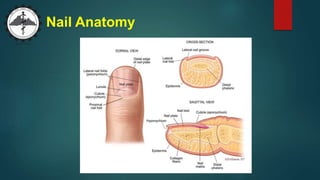
Nail Anatomy
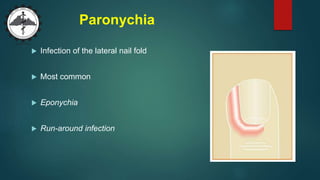
Paronychia
 Infection of the lateral nail fold
 Most common
 Eponychia
 Run-around infection
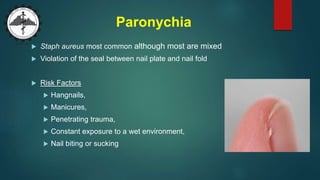
Paronychia
 Staph aureus most common although most are mixed
 Violation of the seal between nail plate and nail fold
 Risk Factors
 Hangnails,
 Manicures,
 Penetrating trauma,
 Constant exposure to a wet environment,
 Nail biting or sucking
Swelling,
erythema &
tenderness
with
progressio
n to
abscess
formation.
Spontaneous
decompression
can occur,
(subungual
abscess).
Deeper
infections
can involve
the nailbed,
pulp space,
and bone
Paronychia-Clinical presentation
Paronychia
 Laboratory evaluation if not responding to
initial treatment
 Radiographs if long-standing infection, foreign
body or osteomyelitis
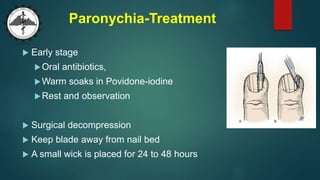
Paronychia-Treatment
 Early stage
Oral antibiotics,
Warm soaks in Povidone-iodine
Rest and observation
 Surgical decompression
 Keep blade away from nail bed
 A small wick is placed for 24 to 48 hours
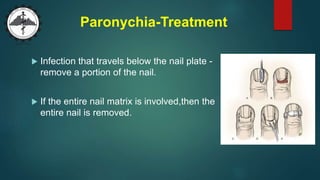
Paronychia-Treatment
 Infection that travels below the nail plate -
remove a portion of the nail.
 If the entire nail matrix is involved,then the
entire nail is removed.
Chronic Paronychia
 Indurated, painful eponychium
 Frequent water immersion-predisposing
 Intermittent acute infections
 Diabetes and psoriasis predisposing
 Gram-positive,negative, Candida,mycobacterial
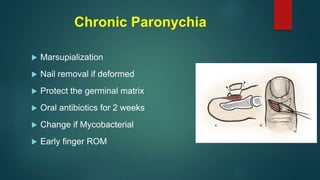
Chronic Paronychia
 Marsupialization
 Nail removal if deformed
 Protect the germinal matrix
 Oral antibiotics for 2 weeks
 Change if Mycobacterial
 Early finger ROM
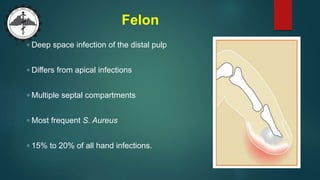
Felon
◦ Deep space infection of the distal pulp
◦ Differs from apical infections
◦ Multiple septal compartments
◦ Most frequent S. Aureus
◦ 15% to 20% of all hand infections.
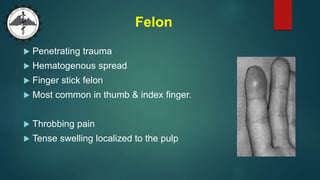
Felon
 Penetrating trauma
 Hematogenous spread
 Finger stick felon
 Most common in thumb & index finger.

 Throbbing pain
 Tense swelling localized to the pulp
Felon
 Extend toward the phalanx --> osteomyelitis
 Toward the skin --> draining sinus
 Obliterate vessels ---> skin slough or necrosis
 Suppurative flexor tenosynovitis
 Septic arthritis of the DIPJ
Felon-Treatment
 Aim-Preserving the function of distal phalanx.
 Don’t wait for fluctuation if tension is severe
 If recognized early (mild cellulitis): soaks & antibiotics
 Abscess(48 hrs): surgical drainage
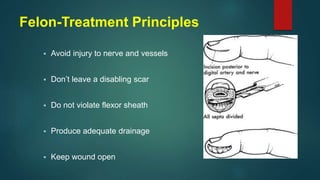
Felon-Treatment Principles
 Avoid injury to nerve and vessels
 Don’t leave a disabling scar
 Do not violate flexor sheath
 Produce adequate drainage
 Keep wound open
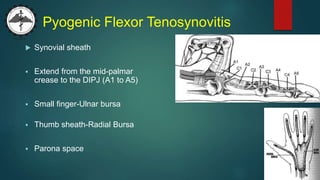
Pyogenic Flexor Tenosynovitis
 Synovial sheath
 Extend from the mid-palmar
crease to the DIPJ (A1 to A5)
 Small finger-Ulnar bursa
 Thumb sheath-Radial Bursa
 Parona space
Pyogenic Flexor Tenosynovitis
 Penetrating trauma
 Felons can rupture
 Purulence destroys the gliding mechanism
 Tendon necrosis possible
 Usual causative agent: Staph. Aureus
 Pasteurella multocida -animal bites.
 Immunocompromised -Mixed gram –and+
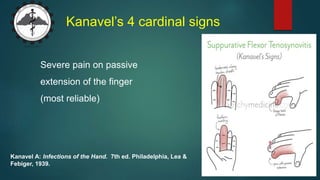
Kanavel’s 4 cardinal signs
Severe pain on passive
extension of the finger
(most reliable)
Kanavel A: Infections of the Hand. 7th ed. Philadelphia, Lea &
Febiger, 1939.
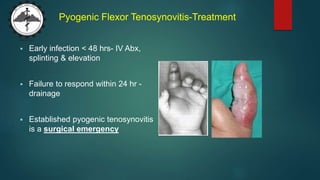
Pyogenic Flexor Tenosynovitis-Treatment
 Early infection < 48 hrs- IV Abx,
splinting & elevation
 Failure to respond within 24 hr -
drainage
 Established pyogenic tenosynovitis
is a surgical emergency
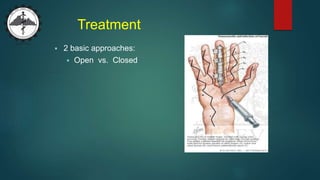
Treatment
 2 basic approaches:
 Open vs. Closed
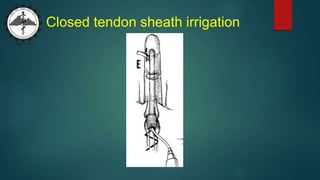
Closed tendon sheath irrigation
Deep Space Infections
 Hand-three potential palmar spaces.
 Forearm has one potential space.
 Hand-three superficial spaces
Deep Space Infections
 Swelling particularly on the dorsal side.
 Distinguish from local dorsal abscess
 X-Ray for retained foreign body, OM, or fracture.
 Aspiration, ultrasound, or MRI may be useful .
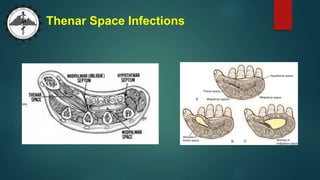
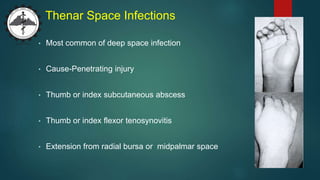
Thenar Space Infections
• Most common of deep space infection
• Cause-Penetrating injury
• Thumb or index subcutaneous abscess
• Thumb or index flexor tenosynovitis
• Extension from radial bursa or midpalmar space
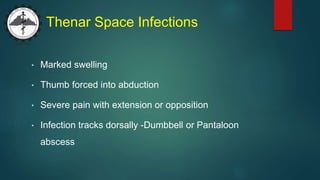
Thenar Space Infections
• Marked swelling
• Thumb forced into abduction
• Severe pain with extension or opposition
• Infection tracks dorsally -Dumbbell or Pantaloon
abscess
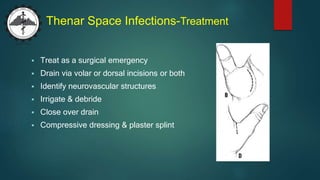
Thenar Space Infections-Treatment
 Treat as a surgical emergency
 Drain via volar or dorsal incisions or both
 Identify neurovascular structures
 Irrigate & debride
 Close over drain
 Compressive dressing & plaster splint
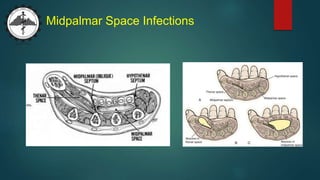
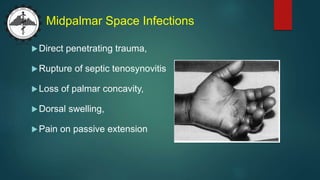
Midpalmar Space Infections
Direct penetrating trauma,
Rupture of septic tenosynovitis
Loss of palmar concavity,
Dorsal swelling,
Pain on passive extension
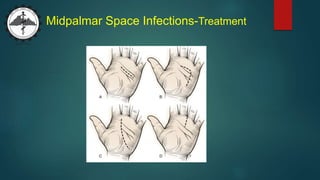
Midpalmar Space Infections-Treatment
Deep Subfascial Space Infections
1. Dorsal subcutaneous space
2. Dorsal subaponeurotic space
3. Interdigital web space-collar-button abscess
Deep Subfascial Space Infections
 Dorsal Subcutaneous and Dorsal Subaponeurotic Space Abscess
 Penetrating injuries
 Dorsal aspect of the hand swollen,warm and tender.
 Finger extension difficult and painful.
 Differentiating from cellulitis or other hand infections difficult
Deep Subfascial Space Infections
 Web Space Abscess (Collar-Button Abscess)
 Hourglass shape
 Cause-fissure in the skin between the fingers
 Pain and swelling localized to the web space
 Swelling either palmar or dorsal aspect
 Finger abduction
Deep Subfascial Space Infections-
Treatment
 Dorsal Subcutaneous and Subaponeurotic Space Abscess
 One or two dorsal longitudinal incisions
 Determine whether infection is superficial or deep
 Subaponeurotic space opened by incising along margin of the
extensor tendon
Deep Subfascial Space Infections
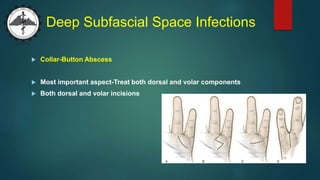
 Collar-Button Abscess
 Most important aspect-Treat both dorsal and volar components
 Both dorsal and volar incisions
Deep space infections-Aftertreatment
 Keep wounds open
 Gauze wick for 48-72 hrs
 After 72 hrs soaks in Povidone-iodine
 IV Antibiotics 10 days
 Oral antibiotics 4 weeks
 Early active motion
Summary
 Careful history & examination
 Anatomical area involved
 Extent of spread
 Empiric antibiotics till culture report
 Prompt and adequate surgical treatment
 Immobilization in position of function
 Rehabilitation
Thank you

Hand infections

  • 1.
    Hand infections Dr VivekSingh 23/4/2017
  • 2.
  • 3.
    Paronychia  Infection ofthe lateral nail fold  Most common  Eponychia  Run-around infection
  • 4.
    Paronychia  Staph aureusmost common although most are mixed  Violation of the seal between nail plate and nail fold  Risk Factors  Hangnails,  Manicures,  Penetrating trauma,  Constant exposure to a wet environment,  Nail biting or sucking
  • 5.
    Swelling, erythema & tenderness with progressio n to abscess formation. Spontaneous decompression canoccur, (subungual abscess). Deeper infections can involve the nailbed, pulp space, and bone Paronychia-Clinical presentation
  • 6.
    Paronychia  Laboratory evaluationif not responding to initial treatment  Radiographs if long-standing infection, foreign body or osteomyelitis
  • 7.
    Paronychia-Treatment  Early stage Oralantibiotics, Warm soaks in Povidone-iodine Rest and observation  Surgical decompression  Keep blade away from nail bed  A small wick is placed for 24 to 48 hours
  • 8.
    Paronychia-Treatment  Infection thattravels below the nail plate - remove a portion of the nail.  If the entire nail matrix is involved,then the entire nail is removed.
  • 9.
    Chronic Paronychia  Indurated,painful eponychium  Frequent water immersion-predisposing  Intermittent acute infections  Diabetes and psoriasis predisposing  Gram-positive,negative, Candida,mycobacterial
  • 10.
    Chronic Paronychia  Marsupialization Nail removal if deformed  Protect the germinal matrix  Oral antibiotics for 2 weeks  Change if Mycobacterial  Early finger ROM
  • 11.
    Felon ◦ Deep spaceinfection of the distal pulp ◦ Differs from apical infections ◦ Multiple septal compartments ◦ Most frequent S. Aureus ◦ 15% to 20% of all hand infections.
  • 12.
    Felon  Penetrating trauma Hematogenous spread  Finger stick felon  Most common in thumb & index finger.  Throbbing pain  Tense swelling localized to the pulp
  • 13.
    Felon  Extend towardthe phalanx --> osteomyelitis  Toward the skin --> draining sinus  Obliterate vessels ---> skin slough or necrosis  Suppurative flexor tenosynovitis  Septic arthritis of the DIPJ
  • 14.
    Felon-Treatment  Aim-Preserving thefunction of distal phalanx.  Don’t wait for fluctuation if tension is severe  If recognized early (mild cellulitis): soaks & antibiotics  Abscess(48 hrs): surgical drainage
  • 15.
    Felon-Treatment Principles  Avoidinjury to nerve and vessels  Don’t leave a disabling scar  Do not violate flexor sheath  Produce adequate drainage  Keep wound open
  • 16.
    Pyogenic Flexor Tenosynovitis Synovial sheath  Extend from the mid-palmar crease to the DIPJ (A1 to A5)  Small finger-Ulnar bursa  Thumb sheath-Radial Bursa  Parona space
  • 17.
    Pyogenic Flexor Tenosynovitis Penetrating trauma  Felons can rupture  Purulence destroys the gliding mechanism  Tendon necrosis possible  Usual causative agent: Staph. Aureus  Pasteurella multocida -animal bites.  Immunocompromised -Mixed gram –and+
  • 18.
    Kanavel’s 4 cardinalsigns Severe pain on passive extension of the finger (most reliable) Kanavel A: Infections of the Hand. 7th ed. Philadelphia, Lea & Febiger, 1939.
  • 19.
    Pyogenic Flexor Tenosynovitis-Treatment Early infection < 48 hrs- IV Abx, splinting & elevation  Failure to respond within 24 hr - drainage  Established pyogenic tenosynovitis is a surgical emergency
  • 20.
    Treatment  2 basicapproaches:  Open vs. Closed
  • 21.
  • 22.
    Deep Space Infections Hand-three potential palmar spaces.  Forearm has one potential space.  Hand-three superficial spaces
  • 23.
    Deep Space Infections Swelling particularly on the dorsal side.  Distinguish from local dorsal abscess  X-Ray for retained foreign body, OM, or fracture.  Aspiration, ultrasound, or MRI may be useful .
  • 24.
  • 25.
    Thenar Space Infections •Most common of deep space infection • Cause-Penetrating injury • Thumb or index subcutaneous abscess • Thumb or index flexor tenosynovitis • Extension from radial bursa or midpalmar space
  • 26.
    Thenar Space Infections •Marked swelling • Thumb forced into abduction • Severe pain with extension or opposition • Infection tracks dorsally -Dumbbell or Pantaloon abscess
  • 27.
    Thenar Space Infections-Treatment Treat as a surgical emergency  Drain via volar or dorsal incisions or both  Identify neurovascular structures  Irrigate & debride  Close over drain  Compressive dressing & plaster splint
  • 28.
  • 29.
    Midpalmar Space Infections Directpenetrating trauma, Rupture of septic tenosynovitis Loss of palmar concavity, Dorsal swelling, Pain on passive extension
  • 30.
  • 31.
    Deep Subfascial SpaceInfections 1. Dorsal subcutaneous space 2. Dorsal subaponeurotic space 3. Interdigital web space-collar-button abscess
  • 32.
    Deep Subfascial SpaceInfections  Dorsal Subcutaneous and Dorsal Subaponeurotic Space Abscess  Penetrating injuries  Dorsal aspect of the hand swollen,warm and tender.  Finger extension difficult and painful.  Differentiating from cellulitis or other hand infections difficult
  • 33.
    Deep Subfascial SpaceInfections  Web Space Abscess (Collar-Button Abscess)  Hourglass shape  Cause-fissure in the skin between the fingers  Pain and swelling localized to the web space  Swelling either palmar or dorsal aspect  Finger abduction
  • 34.
    Deep Subfascial SpaceInfections- Treatment  Dorsal Subcutaneous and Subaponeurotic Space Abscess  One or two dorsal longitudinal incisions  Determine whether infection is superficial or deep  Subaponeurotic space opened by incising along margin of the extensor tendon
  • 35.
    Deep Subfascial SpaceInfections  Collar-Button Abscess  Most important aspect-Treat both dorsal and volar components  Both dorsal and volar incisions
  • 36.
    Deep space infections-Aftertreatment Keep wounds open  Gauze wick for 48-72 hrs  After 72 hrs soaks in Povidone-iodine  IV Antibiotics 10 days  Oral antibiotics 4 weeks  Early active motion
  • 37.
    Summary  Careful history& examination  Anatomical area involved  Extent of spread  Empiric antibiotics till culture report  Prompt and adequate surgical treatment  Immobilization in position of function  Rehabilitation
  • 38.