


Dr. Mohamed A. El Rouby
Assistant Professor of Plastic Surgery
Gangrene
 The word "gangrene" comes from the
Greek "ganggraina" denoting "an
eating sore that ends in mortification".
MEDICAL DEFFINITION:
Gangrene: The death of body tissue
due to the loss of blood supply to that
tissue, sometimes permitting bacteria
to invade it and accelerate its decay.
NNNNNNNNN Gangrene is a complication of
necrosis “ N cell death N ”
characterized by the decay of body
tissues, which become black and
appearing “rotten”.
 It is caused by infection or ischemia,
such as a thrombosis.
TYPES OF GANGRENE
 DRY GANGRENE
 WET GANGRENE
 GAS GANGRENE
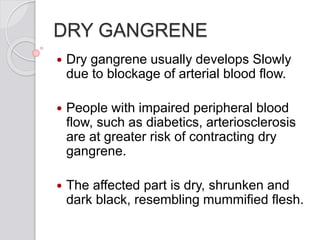
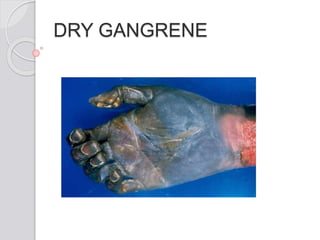
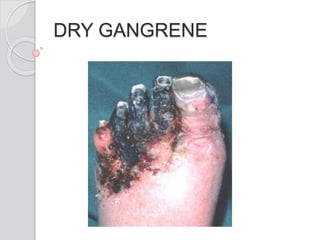
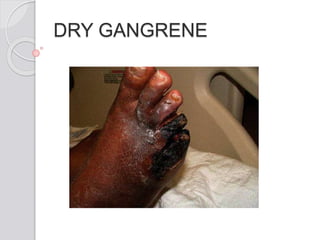
DRY GANGRENE
 Dry gangrene usually develops Slowly
due to blockage of arterial blood flow.
 People with impaired peripheral blood
flow, such as diabetics, arteriosclerosis
are at greater risk of contracting dry
gangrene.
 The affected part is dry, shrunken and
dark black, resembling mummified flesh.
DRY GANGRENE
DRY GANGRENE
DRY GANGRENE
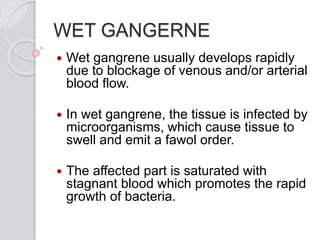
WET GANGERNE
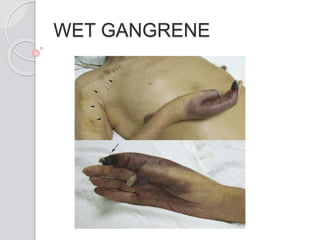
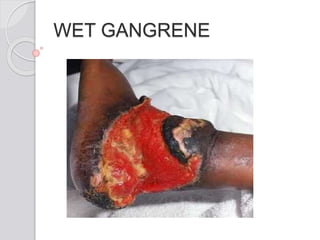
 Wet gangrene usually develops rapidly
due to blockage of venous and/or arterial
blood flow.
 In wet gangrene, the tissue is infected by
microorganisms, which cause tissue to
swell and emit a fawol order.
 The affected part is saturated with
stagnant blood which promotes the rapid
growth of bacteria.
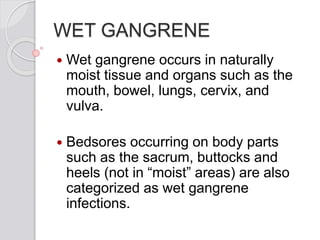
WET GANGRENE
 Wet gangrene occurs in naturally
moist tissue and organs such as the
mouth, bowel, lungs, cervix, and
vulva.
 Bedsores occurring on body parts
such as the sacrum, buttocks and
heels (not in “moist” areas) are also
categorized as wet gangrene
infections.
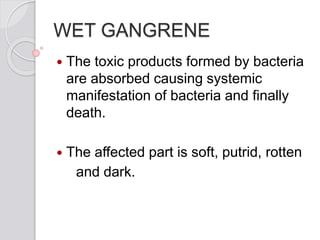
WET GANGRENE
 The toxic products formed by bacteria
are absorbed causing systemic
manifestation of bacteria and finally
death.
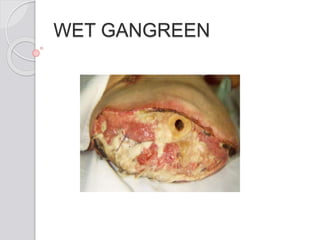
 The affected part is soft, putrid, rotten
and dark.
WET GANGREEN
WET GANGRENE
WET GANGRENE
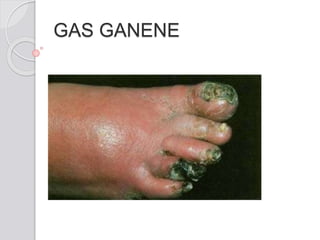
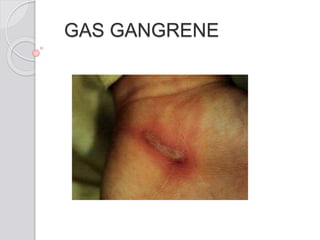
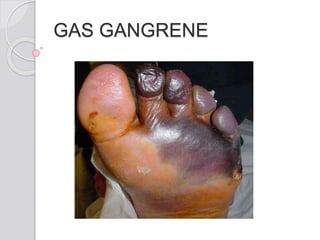
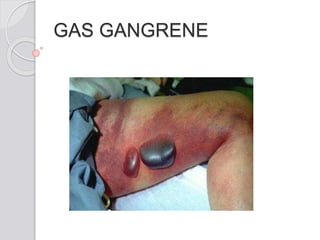
GAS GANGRENE
 Gas gangrene is an anaerobic bacterial
infection that produces gas within deep
tissues.
 Infection spreads rapidly as the gases
produced by bacteria expand and effect
healthy tissue.
 Gas gangrene is caused by a
environmental bacteria. (mostly found in
soil).
GAS GANGRENE
 Gas gangrene can cause necrosis,
gas production, and sepsis.
 Progression to toxemia and shock is
often very rapid.
 Because of its ability to quickly spread
to surrounding tissues, gas gangrene
should be treated as a medical
emergency.
GAS GANENE
GAS GANGRENE
GAS GANGRENE
GAS GANGRENE
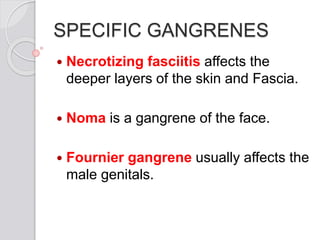
SPECIFIC GANGRENES
 Necrotizing fasciitis affects the
deeper layers of the skin and Fascia.
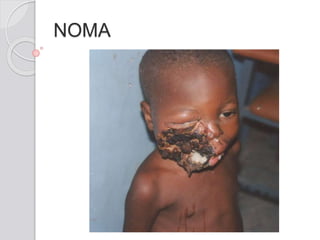
 Noma is a gangrene of the face.
 Fournier gangrene usually affects the
male genitals.
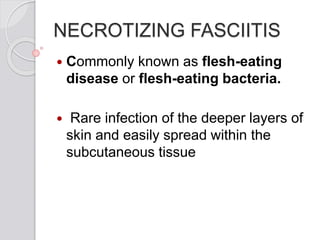
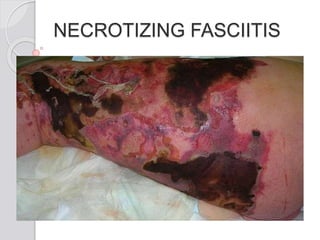
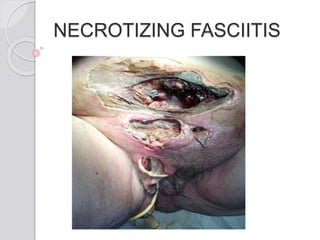
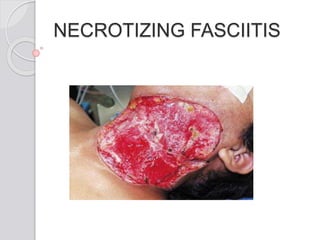
NECROTIZING FASCIITIS
 Commonly known as flesh-eating
disease or flesh-eating bacteria.
 Rare infection of the deeper layers of
skin and easily spread within the
subcutaneous tissue
NECROTIZING FASCIITIS
What is Necrotizing Fasciitis?
 Other names:
◦ β-hemolytic streptococcal gangrene
◦ Meleney ulcer
◦ acute dermal gangrene
◦ hospital gangrene
◦ necrotizing cellulitis.
 3 types of NF (causative organism):
◦ Type I : a polymicrobial flora.
◦ Type II Group A β-Streptococcus bacteria
(most common case)
◦ Type III : marine vibrio gram-negative rods.
How does one contract NF?
 exposed to an individual with an opening in
their skin.
◦ direct contact with someone carrying the
bacteria
◦ the bacterium being carried by the person itself.
 The entrance can be as minor as a paper
cut or a pin prick.
 Can happen to anyone!!!!!!?
Cofactors that Increase risks
 Immuno-suppression
 Severe illnesses: heart, lung, or liver
disease, Burns
 Diabetes
 Obesity
 Alcoholism
Pathogenesis:
 Bacterial infection and release of exotoxins
 Inflammatory response by immune system
 Cytokines inhibit function of phagocytic cells
◦ Anaerobes thrive speeding up necrotic process
 Endothelial cells will be damaged;
 Poor blood supply inhibit:
◦ Inflammatory response process
◦ Ability to transfer antibiotics to the affected fascial
layer
 Vasoconstriction and thrombosis  edema  hypoxia 
necrosis of the fascia, skin, soft tissue, and muscles
involving the subcutaneous nerves.
Clinical Picture: early symptoms and
signs of NF?
 Clinically indistinguishable
from other possible soft tissue
infections.
 General: Flu like symptoms
that include fever, chills,
nausea, weakness, dizziness,
aches and a heat rate of more
than 100 beats per minute.
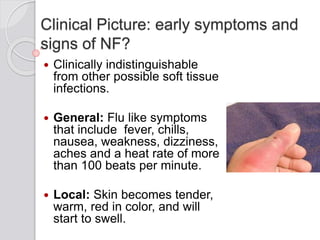
 Local: Skin becomes tender,
warm, red in color, and will
start to swell.
Advanced symptoms…
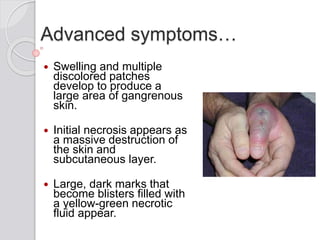
 Swelling and multiple
discolored patches
develop to produce a
large area of gangrenous
skin.
 Initial necrosis appears as
a massive destruction of
the skin and
subcutaneous layer.
 Large, dark marks that
become blisters filled with
a yellow-green necrotic
fluid appear.
Critical symptoms…
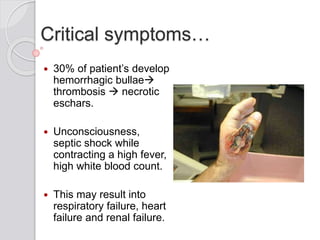
 30% of patient’s develop
hemorrhagic bullae
thrombosis  necrotic
eschars.
 Unconsciousness,
septic shock while
contracting a high fever,
high white blood count.
 This may result into
respiratory failure, heart
failure and renal failure.
Investigations
 Some of these tests include:
1. CBC
2. creatinine, glucose, albumin, and
calcium levels (inflammatory response
syndrome)
3. X-ray
4. CT, and MRI scanning
5. The most importantly culture and
sensitivity tests and tissue biopsy.
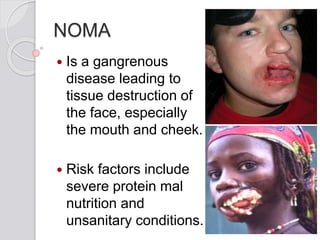
NOMA
 Is a gangrenous
disease leading to
tissue destruction of
the face, especially
the mouth and cheek.
 Risk factors include
severe protein mal
nutrition and
unsanitary conditions.
NOMA
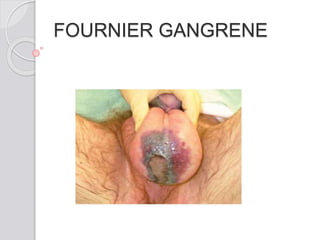
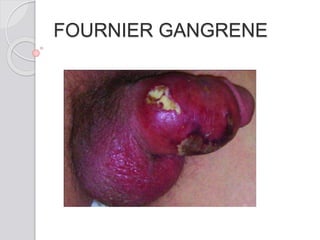
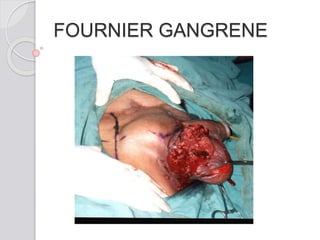
FOURNIER GANGRENE
 A type of necrotizing infection usually
affecting the male genitals.
 In the majority of cases it is a mixed
infection caused by both aerobic and
anaerobic bacteria
FOURNIER GANGRENE
FOURNIER GANGRENE
FOURNIER GANGRENE
Management:
 Medical Emergency:
◦ Clinical Diagnosis
◦ Investigations.
◦ Treatment: The best treatment for
gangrene is revascularization!!!?
 The method of treatment is generally
determined depending on location of
affected tissue and extent of tissue
loss.
Management:
 Medical treatment.
 Surgical Debridement .. Amputation.
◦ Coverage of the defect.
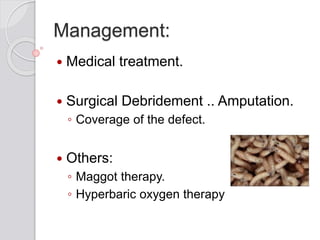
 Others:
◦ Maggot therapy.
◦ Hyperbaric oxygen therapy
Necrotizing fasciitis

Necrotizing fasciitis

  • 2.
    Dr. Mohamed A.El Rouby Assistant Professor of Plastic Surgery
  • 3.
    Gangrene  The word"gangrene" comes from the Greek "ganggraina" denoting "an eating sore that ends in mortification".
  • 4.
    MEDICAL DEFFINITION: Gangrene: Thedeath of body tissue due to the loss of blood supply to that tissue, sometimes permitting bacteria to invade it and accelerate its decay.
  • 5.
    NNNNNNNNN Gangrene isa complication of necrosis “ N cell death N ” characterized by the decay of body tissues, which become black and appearing “rotten”.  It is caused by infection or ischemia, such as a thrombosis.
  • 6.
    TYPES OF GANGRENE DRY GANGRENE  WET GANGRENE  GAS GANGRENE
  • 7.
    DRY GANGRENE  Drygangrene usually develops Slowly due to blockage of arterial blood flow.  People with impaired peripheral blood flow, such as diabetics, arteriosclerosis are at greater risk of contracting dry gangrene.  The affected part is dry, shrunken and dark black, resembling mummified flesh.
  • 8.
  • 9.
  • 10.
  • 11.
    WET GANGERNE  Wetgangrene usually develops rapidly due to blockage of venous and/or arterial blood flow.  In wet gangrene, the tissue is infected by microorganisms, which cause tissue to swell and emit a fawol order.  The affected part is saturated with stagnant blood which promotes the rapid growth of bacteria.
  • 12.
    WET GANGRENE  Wetgangrene occurs in naturally moist tissue and organs such as the mouth, bowel, lungs, cervix, and vulva.  Bedsores occurring on body parts such as the sacrum, buttocks and heels (not in “moist” areas) are also categorized as wet gangrene infections.
  • 13.
    WET GANGRENE  Thetoxic products formed by bacteria are absorbed causing systemic manifestation of bacteria and finally death.  The affected part is soft, putrid, rotten and dark.
  • 14.
  • 15.
  • 16.
  • 17.
    GAS GANGRENE  Gasgangrene is an anaerobic bacterial infection that produces gas within deep tissues.  Infection spreads rapidly as the gases produced by bacteria expand and effect healthy tissue.  Gas gangrene is caused by a environmental bacteria. (mostly found in soil).
  • 18.
    GAS GANGRENE  Gasgangrene can cause necrosis, gas production, and sepsis.  Progression to toxemia and shock is often very rapid.  Because of its ability to quickly spread to surrounding tissues, gas gangrene should be treated as a medical emergency.
  • 19.
  • 20.
  • 21.
  • 22.
  • 23.
    SPECIFIC GANGRENES  Necrotizingfasciitis affects the deeper layers of the skin and Fascia.  Noma is a gangrene of the face.  Fournier gangrene usually affects the male genitals.
  • 24.
    NECROTIZING FASCIITIS  Commonlyknown as flesh-eating disease or flesh-eating bacteria.  Rare infection of the deeper layers of skin and easily spread within the subcutaneous tissue
  • 25.
  • 26.
  • 27.
  • 28.
    What is NecrotizingFasciitis?  Other names: ◦ β-hemolytic streptococcal gangrene ◦ Meleney ulcer ◦ acute dermal gangrene ◦ hospital gangrene ◦ necrotizing cellulitis.  3 types of NF (causative organism): ◦ Type I : a polymicrobial flora. ◦ Type II Group A β-Streptococcus bacteria (most common case) ◦ Type III : marine vibrio gram-negative rods.
  • 29.
    How does onecontract NF?  exposed to an individual with an opening in their skin. ◦ direct contact with someone carrying the bacteria ◦ the bacterium being carried by the person itself.  The entrance can be as minor as a paper cut or a pin prick.  Can happen to anyone!!!!!!?
  • 30.
    Cofactors that Increaserisks  Immuno-suppression  Severe illnesses: heart, lung, or liver disease, Burns  Diabetes  Obesity  Alcoholism
  • 31.
    Pathogenesis:  Bacterial infectionand release of exotoxins  Inflammatory response by immune system  Cytokines inhibit function of phagocytic cells ◦ Anaerobes thrive speeding up necrotic process  Endothelial cells will be damaged;  Poor blood supply inhibit: ◦ Inflammatory response process ◦ Ability to transfer antibiotics to the affected fascial layer  Vasoconstriction and thrombosis  edema  hypoxia  necrosis of the fascia, skin, soft tissue, and muscles involving the subcutaneous nerves.
  • 32.
    Clinical Picture: earlysymptoms and signs of NF?  Clinically indistinguishable from other possible soft tissue infections.  General: Flu like symptoms that include fever, chills, nausea, weakness, dizziness, aches and a heat rate of more than 100 beats per minute.  Local: Skin becomes tender, warm, red in color, and will start to swell.
  • 33.
    Advanced symptoms…  Swellingand multiple discolored patches develop to produce a large area of gangrenous skin.  Initial necrosis appears as a massive destruction of the skin and subcutaneous layer.  Large, dark marks that become blisters filled with a yellow-green necrotic fluid appear.
  • 34.
    Critical symptoms…  30%of patient’s develop hemorrhagic bullae thrombosis  necrotic eschars.  Unconsciousness, septic shock while contracting a high fever, high white blood count.  This may result into respiratory failure, heart failure and renal failure.
  • 35.
    Investigations  Some ofthese tests include: 1. CBC 2. creatinine, glucose, albumin, and calcium levels (inflammatory response syndrome) 3. X-ray 4. CT, and MRI scanning 5. The most importantly culture and sensitivity tests and tissue biopsy.
  • 36.
    NOMA  Is agangrenous disease leading to tissue destruction of the face, especially the mouth and cheek.  Risk factors include severe protein mal nutrition and unsanitary conditions.
  • 37.
  • 38.
    FOURNIER GANGRENE  Atype of necrotizing infection usually affecting the male genitals.  In the majority of cases it is a mixed infection caused by both aerobic and anaerobic bacteria
  • 39.
  • 40.
  • 41.
  • 42.
    Management:  Medical Emergency: ◦Clinical Diagnosis ◦ Investigations. ◦ Treatment: The best treatment for gangrene is revascularization!!!?  The method of treatment is generally determined depending on location of affected tissue and extent of tissue loss.
  • 43.
    Management:  Medical treatment. Surgical Debridement .. Amputation. ◦ Coverage of the defect.  Others: ◦ Maggot therapy. ◦ Hyperbaric oxygen therapy