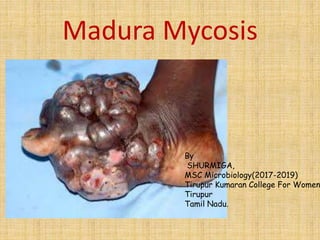
Madura Mycosis
By
SHURMIGA,
MSC Microbiology(2017-2019)
Tirupur Kumaran College For Women
Tirupur
Tamil Nadu.
Definition
• Madura foot or mycetoma (tumour-like)
• Chronic granulomatous disease characterised
by localised infection of subcutaneous tissues
and sometimes bone characterised by
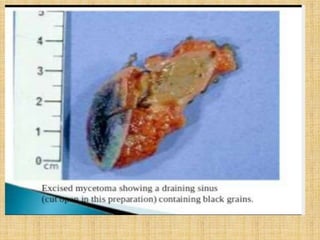
discharging sinuses filled with organisms like
actinomycetes or fungi.
History
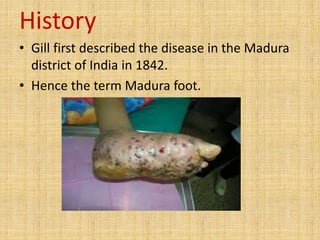
• Gill first described the disease in the Madura
district of India in 1842.
• Hence the term Madura foot.
Pathophysiology
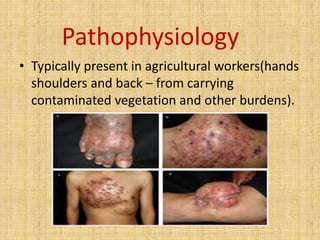
• Typically present in agricultural workers(hands
shoulders and back – from carrying
contaminated vegetation and other burdens).
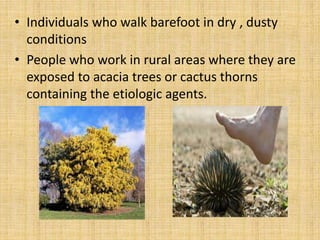
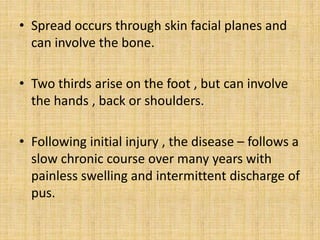
• Individuals who walk barefoot in dry , dusty
conditions
• People who work in rural areas where they are
exposed to acacia trees or cactus thorns
containing the etiologic agents.
• Spread occurs through skin facial planes and
can involve the bone.
• Two thirds arise on the foot , but can involve
the hands , back or shoulders.
• Following initial injury , the disease – follows a
slow chronic course over many years with
painless swelling and intermittent discharge of
pus.
• There may be a deep itching sensation
• Pain may occur due to secondary bacterial
infection or bone invasion
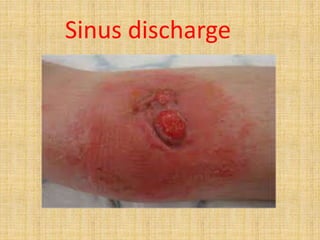
• After some years, massive swelling of the area
occurs , with induration , skin rupture and
sinus trace formation. As the infection
spreads, old sinuses close and new ones open
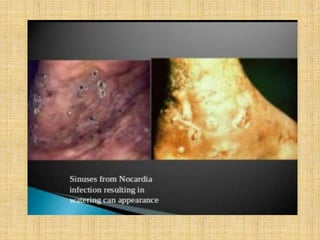
Sinus discharge
Causes
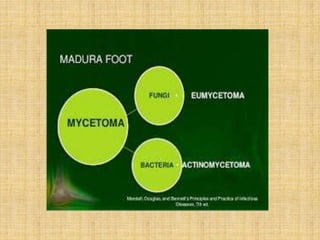
• Due to fungi – eumycetoma (40%) or
• Actinomycetes – (actinomycetoma) 60%
• Actinomycetoma may be due to
Actinomadura madurae
Actinomadura pelletieri
Streptomyces somaliensis
Nocardia species
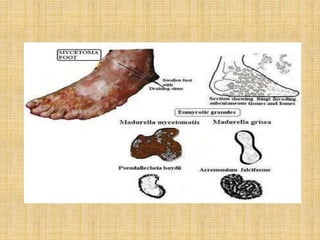
• Eumycetoma is often due to
 Madurella mycetomi ,
 Pseudallescheria boydi (Scedosporium
apiospermum) ,
 Cladophialophora
Clinical features
• Slow spreading skin infection
• Local swelling
• Small hard painless nodules
• Ulceration
• Pus discharge
• Scarred skin & discoloration
• Itching
• Pain and burning sensation
Lab studies
• Direct microscopy
• Blood – leukocytosis & neutrophilia
• Culture of exudates
• Skin biopsy
• Serology
• DNA sequencing has been used for
identification in difficult cases.
Microscopy
• Serosanguinous fluid containing the granules
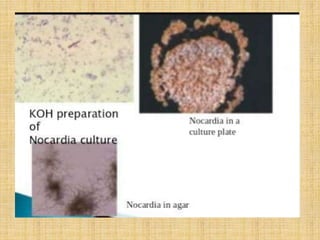
examined using – 10% KOH and Parker ink or
calcofluor white mounts
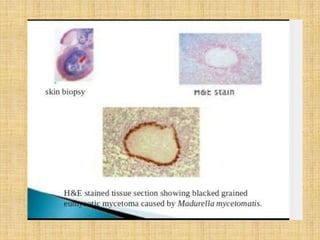
• Tissue sections stained using
H&E(Hematoxylin and Eosin stain) ,
PAS(Periodic Acid Shiffs Stain) and Grocott’s
methenamine silver(GMS).
• Actinomycotic grains contains very fine
filaments.
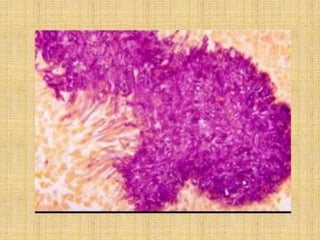
• Fungal grains contain short hyphae (branched
filaments) that are often swollen
Culture
• Sabouraud’s dextrose agar or mycobiotic agar
to isolate fungi
• Blood agar to isolate bacteria
• Agar plates are cultured at 25-30 degree
celcius and 37 degree celcius for up to six
weeks . Fungi grow more quickly than
actinomycetes.
Serology
• (1) Immunodiffusion tests eumycotic
mycetoma infections.
• (2) Counterimmunoelectrophoresis
• (3) Enzyme-linked immunosorbent assay
(ELISA)
• (4) Western blot.
Imaging
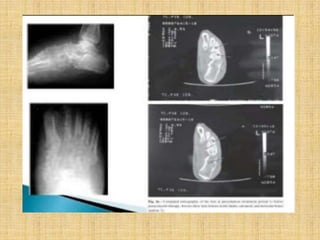
• Plain x-rays assess for evidence of bone
involvement
• CT scan may be more sensitive in the early
stages
• MRI scans better assessment of the degree of
bone and soft tissue involvement; and may be
useful in evaluating the differential diagnosis
of the swelling .
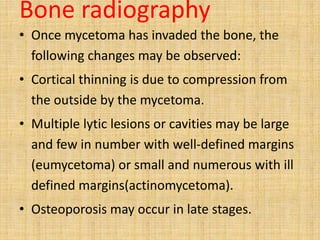
Bone radiography
• Once mycetoma has invaded the bone, the
following changes may be observed:
• Cortical thinning is due to compression from
the outside by the mycetoma.
• Multiple lytic lesions or cavities may be large
and few in number with well-defined margins
(eumycetoma) or small and numerous with ill
defined margins(actinomycetoma).
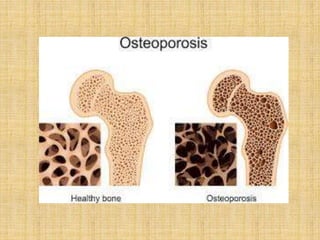
• Osteoporosis may occur in late stages.
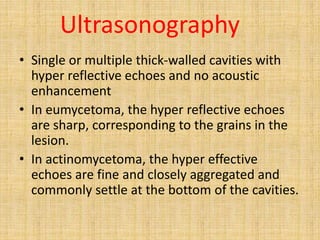
Ultrasonography
• Single or multiple thick-walled cavities with
hyper reflective echoes and no acoustic
enhancement
• In eumycetoma, the hyper reflective echoes
are sharp, corresponding to the grains in the
lesion.
• In actinomycetoma, the hyper effective
echoes are fine and closely aggregated and
commonly settle at the bottom of the cavities.
Treatment
Due to the slow ,relatively pain –free
progression of the disease, mycetoma is often
at an advanced stage when diagnosed.
• Antifungals
• Antibiotics
• Treatment of any secondary infections
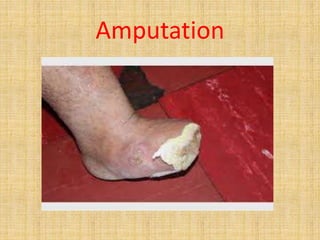
• Amputation-in severe cases
Amputation
Medical
• Actinomycetomas usually respond better to
medical treatment than eumycetomas
• Therapy is suggested for 1-2 years (or greater)
for complete eradication
• The current treatment of actinomycetoma is
trimethoprim-sulfamethoxazole 7.5-40mg/kg
daily in 3 oral doses for several months or
years.
Eumycetoma
• Ketoconazole 400mg daily
• Itraconazole 300mg daily
• Amphotericin B 50 mg daily
• Terbinafine
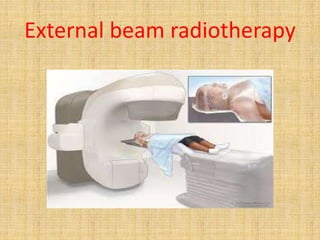
• External beam radiotherapy in doses ranging
from 3.5-14 Gy has been considered
successful treatment in a few selected cases.
External beam radiotherapy
Surgical
• Excision of the affected tissues
• Localized mycetoma lesions that can be
excised completely without residual disability.
• Disease process more extensive than
suggested by superficial lesion- so apparently
healthy tissue removed to avoid recurrence
• Surgical reduction of large lesions can improve
the patient’s response to medical treatment.
• Scalp lesion- rapidly fatal so attended without
delay
• Extensive surgery may have to be followed by
skin grafting/plastic surgery
• To cover large open area /improve functions
• Extensive bone involvement often warrents
surgical amputation.
Complications
• Secondary bacterial infection
• Immonucompromised patients may can develop
invasive infection
• This can cause increased pain and disability as
well as osteomyelitis, septicaemia, which my be
fatal if untreated.
• Lymphatic obstruction and fibrosis may cause
lymph oedema
• In advanced cases, deformities or ankylosis may
occur
• Chronic neglected infection may necessitate
amputation.
• Complications may result from toxicity due to
prolonged antimicrobial of antifungal therapy.
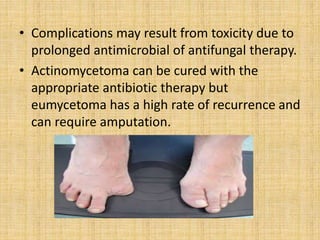
• Actinomycetoma can be cured with the
appropriate antibiotic therapy but
eumycetoma has a high rate of recurrence and
can require amputation.
Epidemology
• Endemic in the tropics and subtropics
• More common in men than in women
• The male-to-female ratio is 3:1
• Particularly those aged 20 to 50
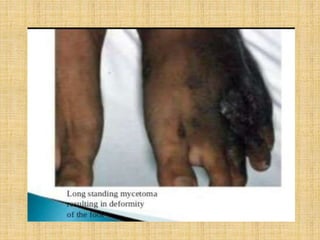
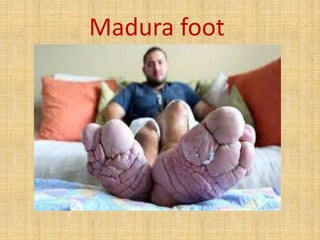
Madura foot
THE END
THANK
YOU

Madura foot ppt

  • 1.
    Madura Mycosis By SHURMIGA, MSC Microbiology(2017-2019) TirupurKumaran College For Women Tirupur Tamil Nadu.
  • 2.
    Definition • Madura footor mycetoma (tumour-like) • Chronic granulomatous disease characterised by localised infection of subcutaneous tissues and sometimes bone characterised by discharging sinuses filled with organisms like actinomycetes or fungi.
  • 3.
    History • Gill firstdescribed the disease in the Madura district of India in 1842. • Hence the term Madura foot.
  • 4.
    Pathophysiology • Typically presentin agricultural workers(hands shoulders and back – from carrying contaminated vegetation and other burdens).
  • 5.
    • Individuals whowalk barefoot in dry , dusty conditions • People who work in rural areas where they are exposed to acacia trees or cactus thorns containing the etiologic agents.
  • 6.
    • Spread occursthrough skin facial planes and can involve the bone. • Two thirds arise on the foot , but can involve the hands , back or shoulders. • Following initial injury , the disease – follows a slow chronic course over many years with painless swelling and intermittent discharge of pus.
  • 7.
    • There maybe a deep itching sensation • Pain may occur due to secondary bacterial infection or bone invasion • After some years, massive swelling of the area occurs , with induration , skin rupture and sinus trace formation. As the infection spreads, old sinuses close and new ones open
  • 8.
  • 10.
    Causes • Due tofungi – eumycetoma (40%) or • Actinomycetes – (actinomycetoma) 60% • Actinomycetoma may be due to Actinomadura madurae Actinomadura pelletieri Streptomyces somaliensis Nocardia species
  • 11.
    • Eumycetoma isoften due to  Madurella mycetomi ,  Pseudallescheria boydi (Scedosporium apiospermum) ,  Cladophialophora
  • 14.
    Clinical features • Slowspreading skin infection • Local swelling • Small hard painless nodules • Ulceration • Pus discharge • Scarred skin & discoloration • Itching • Pain and burning sensation
  • 17.
    Lab studies • Directmicroscopy • Blood – leukocytosis & neutrophilia • Culture of exudates • Skin biopsy • Serology • DNA sequencing has been used for identification in difficult cases.
  • 18.
    Microscopy • Serosanguinous fluidcontaining the granules examined using – 10% KOH and Parker ink or calcofluor white mounts • Tissue sections stained using H&E(Hematoxylin and Eosin stain) , PAS(Periodic Acid Shiffs Stain) and Grocott’s methenamine silver(GMS). • Actinomycotic grains contains very fine filaments. • Fungal grains contain short hyphae (branched filaments) that are often swollen
  • 22.
    Culture • Sabouraud’s dextroseagar or mycobiotic agar to isolate fungi • Blood agar to isolate bacteria • Agar plates are cultured at 25-30 degree celcius and 37 degree celcius for up to six weeks . Fungi grow more quickly than actinomycetes.
  • 24.
    Serology • (1) Immunodiffusiontests eumycotic mycetoma infections. • (2) Counterimmunoelectrophoresis • (3) Enzyme-linked immunosorbent assay (ELISA) • (4) Western blot.
  • 25.
    Imaging • Plain x-raysassess for evidence of bone involvement • CT scan may be more sensitive in the early stages • MRI scans better assessment of the degree of bone and soft tissue involvement; and may be useful in evaluating the differential diagnosis of the swelling .
  • 26.
    Bone radiography • Oncemycetoma has invaded the bone, the following changes may be observed: • Cortical thinning is due to compression from the outside by the mycetoma. • Multiple lytic lesions or cavities may be large and few in number with well-defined margins (eumycetoma) or small and numerous with ill defined margins(actinomycetoma). • Osteoporosis may occur in late stages.
  • 28.
    Ultrasonography • Single ormultiple thick-walled cavities with hyper reflective echoes and no acoustic enhancement • In eumycetoma, the hyper reflective echoes are sharp, corresponding to the grains in the lesion. • In actinomycetoma, the hyper effective echoes are fine and closely aggregated and commonly settle at the bottom of the cavities.
  • 30.
    Treatment Due to theslow ,relatively pain –free progression of the disease, mycetoma is often at an advanced stage when diagnosed. • Antifungals • Antibiotics • Treatment of any secondary infections • Amputation-in severe cases
  • 31.
  • 32.
    Medical • Actinomycetomas usuallyrespond better to medical treatment than eumycetomas • Therapy is suggested for 1-2 years (or greater) for complete eradication • The current treatment of actinomycetoma is trimethoprim-sulfamethoxazole 7.5-40mg/kg daily in 3 oral doses for several months or years.
  • 33.
    Eumycetoma • Ketoconazole 400mgdaily • Itraconazole 300mg daily • Amphotericin B 50 mg daily • Terbinafine • External beam radiotherapy in doses ranging from 3.5-14 Gy has been considered successful treatment in a few selected cases.
  • 34.
  • 35.
    Surgical • Excision ofthe affected tissues • Localized mycetoma lesions that can be excised completely without residual disability. • Disease process more extensive than suggested by superficial lesion- so apparently healthy tissue removed to avoid recurrence • Surgical reduction of large lesions can improve the patient’s response to medical treatment.
  • 36.
    • Scalp lesion-rapidly fatal so attended without delay • Extensive surgery may have to be followed by skin grafting/plastic surgery • To cover large open area /improve functions • Extensive bone involvement often warrents surgical amputation.
  • 37.
    Complications • Secondary bacterialinfection • Immonucompromised patients may can develop invasive infection • This can cause increased pain and disability as well as osteomyelitis, septicaemia, which my be fatal if untreated. • Lymphatic obstruction and fibrosis may cause lymph oedema • In advanced cases, deformities or ankylosis may occur • Chronic neglected infection may necessitate amputation.
  • 38.
    • Complications mayresult from toxicity due to prolonged antimicrobial of antifungal therapy. • Actinomycetoma can be cured with the appropriate antibiotic therapy but eumycetoma has a high rate of recurrence and can require amputation.
  • 39.
    Epidemology • Endemic inthe tropics and subtropics • More common in men than in women • The male-to-female ratio is 3:1 • Particularly those aged 20 to 50
  • 40.
  • 41.