NECROTIZING
FASCIITIS
AKHIL JOSEPH
Pharm.D 5th Year
• Definition
• Risk factors
• Etiology
• Pathophysiology
• Epidemiology
• Clinical Features
• Investigations
• Management
• Why it is Dangerous ?
• Difficult to diagnose
• Extremely toxic
• Spread rapidly
• May lead to limb amputation
What is Necrotizing Fasciitis?
• Life-threatening, progressive, rapidly
spreading, inflammatory infection located in
the deep fascia.
• Infection rapidly destroy the skin and soft
tissue beneath it
• Also known as: “flesh-eating” bacteria.
• Other names: β-hemolytic streptococcal
gangrene, Meleney ulcer, acute dermal
gangrene, hospital gangrene, and necrotizing
cellulitis.
• 3 types of NF.
• Type I : A polymicrobial flora and common
• Type II : Group A β-Streptococcus bacteria (most common case) /
monobacterial and fulminant.
• Type III : Marine vibrio gram-negative rods and fulminant.
• Type IV : Fungal (candida or Mucor and Rhizopus species )
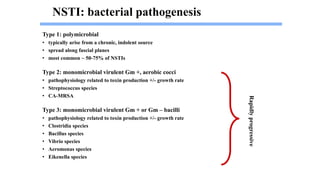
NSTI: bacterial pathogenesis
Type 1: polymicrobial
• typically arise from a chronic, indolent source
• spread along fascial planes
• most common ~ 50-75% of NSTIs
Type 2: monomicrobial virulent Gm +, aerobic cocci
• pathophysiology related to toxin production +/- growth rate
• Streptococcus species
• CA-MRSA
Type 3: monomicrobial virulent Gm + or Gm – bacilli
• pathophysiology related to toxin production +/- growth rate
• Clostridia species
• Bacillus species
• Vibrio species
• Aeromonas species
• Eikenella species
Rapidlyprogressive
How does one contract NF?
• exposed to an individual with an opening in their skin.
• direct contact with someone carrying the bacteria
• the bacterium being carried by the person itself.
• sight of entrance can be as minor as a paper cut or a pin prick.
• enter through weakened skin, as a contusion, a bruise, a blister, or even an
abrasion.
• Can happen to anyone!!!!!!
Epidemiology
• The overall morbidity & mortality is 70 – 80%.
• Fournier’s gangrene (NF of external genitalia) has a reported mortality
as high as 75%.
• Gender ratio: Male : Female = 3:1
• Age: pediatric cases are rare but reported from countries where poor
hygiene in.
Risk Factors
• Immuno-suppression illnesses
e.g.: DM, Cancer, alcoholism, vascular insufficiency, organ transplant,
HIV or neutropenia.
• Trauma or foreign bodies in surgical wound.
• Idiopathic as scrotal or penile necrotizing fasciitis.
• Alcoholism
• Severe illnesses: heart, lung, or liver disease
• Obesity
What’s going on inside your body?
• Bacteria eat away at tissue between skin and muscle
• Increase in sensitivity or anesthetic feel to the skin itself
• Inflammatory response by immune system
• Bacterial toxins released
• Cytokines impede function of phagocytic cells
• Anaerobes thrive speeding up necrotic process
• Endothelial cells become damaged;
• Increased permeability of the lining of vessels in the body
• Poor blood supply inhibit:
• Inflammatory response process
• Ability for the immune system to properly work
• Ability to transfer antibiotics to the affected fascial layer
• Vasoconstriction and thrombosis  edema  hypoxia  necrosis of the fascia, skin, soft tissue, and
muscles.
• Additional necrosis involving the subcutaneous nerves.
What are the early symptoms and signs of
NF?
• Flu like symptoms that include fever, chills,
nausea, weakness, dizziness, aches and a
heat rate of more than 100 beats per minute.
• Skin becomes tender, warm, red in color,
and will start to swell.
• Patients may experience pain greater than
expected from the appearance of the wound.
• Subcutaneous tissue may also have a hard
feel on palpation that goes past the visibly
infected area.
• Clinically indistinguishable from other
possible soft tissue infections with only the
presentation of pain, tenderness, and warm
skin.
Advanced symptoms…
• The advanced symptoms appear as the disease
progresses
• The area of the body experiencing pain begins
to swell excessively.
• Multiple discolored patches develop to
produce a large area of gangrenous skin.
• Initial necrosis appears as a massive
destruction of the skin and subcutaneous layer.
• The normal skin and subcutaneous tissue are
loosened.
• Large, dark marks that become blisters filled
with a yellow-green necrotic fluid appear.
• Fournier's gangrene begin with pain and
itching of the scrotal skin.
Critical symptoms…
• The critical symptoms form in the last stages of NF.
• 30% of patient’s develop hemorrhagic bullae which may
cause them to become anemic.
• Vasculature of the skin becomes inflamed and thrombosed.
Resulting in necrotic eschars that look like deep thermal
burns.
• Without treatment, secondary involvement of deeper muscle
layers may occur.
• Patients may become numb because of nerve damage and
progressing gangrene in the infected area.
• Unconsciousness will occur as the body becomes too weak
to fight off the infection along with a severe decrease in the
patient’s blood pressure.
• As toxins are being released, the body’s organ may go into
septic shock while contracting a high fever, high white
blood count, and becoming disoriented. This may result into
respiratory failure, heart failure and renal failure.
Exams and Laboratory Testing
• In order to get a definitive diagnosis of NF, physicians look for
abnormalities in the test results that are characteristics of the disease.
• Some of these tests include:
1. Blood samples
2. Testing for elevated or lowered creatinine, glucose, CPK, bicarbonate,
albumin, and calcium levels.
3. X-ray gas in the subcutaneous fascia planes.?? D.D. of subcutaneous gas
in a radiograph.
4. C.T. scan : demonstrating necrosis with asymmetric fascial thickening &
gas in the tissues.
5. MRI scanning
6. And most importantly antibiotic culture and sensitivity tests.
Surgical diagnosis
• Finger test: A 2-cm long incision under local anesthesia is made in the
affected area, lack of fascial resistance, active bleeding and foul
smelling fluid will constitute a positive finger test; which will be
diagnostic of necrotizing fasciitis.
• Biopsy/Frozen section biopsy: Diagnosis of NF early reduces the
mortality. But it needs dedication and willingness of a pathologist
familiar with the interpretation of NF. Gold standard for detecting and
diagnosing necrotizing fasciitis is biopsy either tissues taken during or
after the debridement.
Treating NF
• Early diagnosis and treatment is vital
• Emergency debridement
• IV antibiotic treatment
• Hyperbaric oxygen therapy is recommended for anaerobic organisms
• Morphine drip and a patient-controlled analgesia pump to control pain
• Soft tissue reconstruction
• Monitor nutrition
• If sepsis has set in, vasoconstricting medications should be given.
• Education and counseling.
• Bold early surgical debridement, appropriate early antibiotics and brave medical
organ supportive intensive care is essential for better outcome of NF patients.
• Early and aggressive debridement of all necrotic tissues until the tissue start to
bleed is the pillar of NF management and may need more than one debridement;
hence repeated wound examination is mandatory, and these patients’ needs on
average two or more setting of debridement.
• Delayed or incomplete debridement will increase the morbidity and mortality,
toxemia, dehydration and biochemical disorders.
• In NF surgical debridement of necrotic tissue within 24 hours of presentation to the
hospital has significantly better outcome than the delayed debridement done (6%
verses 25%)
• Repeated aggressive debridement decrease mortality in the NF patients. NF patients
wound care has to be taken meticulously. These wounds should be washed and
dressed with the occlusive, adsorptive dressing with bandage two to three times in a
day. It is recommended to use antibiotic dressing (1% povidone iodine or silver
sulfadiazine).
• Antibiotics therapy should be started as soon as blood samples were
taken for microbiological work-up. Common type of NF is
polymicrobial; initial antibiotic regimen should include agents effective
against gram positive cocci, gram negative bacilli and anaerobes.
• Initial antibiotic therapy will have two antimicrobial agents. One of
these should be clindamycin.
• Clindamycin has few added advantage in these patients, the efficacy of
clindamycin is independent of inoculum size or bacterial growth, it is a
potent suppressor of the bacterial toxins, its sub-inhibitory concentration
also facilitates phagocytosis, it reduces the synthesis of penicillin
binding proteins, have a longer post antibiotic and immuno-modulating
effect (as it inhibits the synthesis of tumoor necrosis factor)
• If streptococci are the identified major pathogens, the D.O.C is
Penicillin-G with clindamycin as an alternative.
• To ensure adequate treatment, we have to cover aerobic & anaerobic
bacteria.
• The anaerobic coverage can be provided by Metronidazole or 3rd
generation cephalosporin's.
• Gentamicin combined with clindamycin or chloramphenicol has been
reported as a standard coverage.
• Ampicillin may be added to the basic regimen to treat enterococci if
suspected by gram stain.
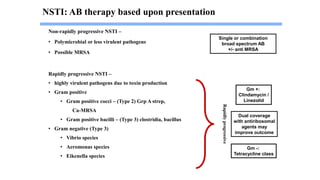
NSTI: AB therapy based upon presentation
Non-rapidly progressive NSTI –
• Polymicrobial or less virulent pathogens
• Possible MRSA
Rapidly progressive NSTI –
• highly virulent pathogens due to toxin production
• Gram positive
• Gram positive cocci – (Type 2) Grp A strep,
Ca-MRSA
• Gram positive bacilli – (Type 3) clostridia, bacillus
• Gram negative (Type 3)
• Vibrio species
• Aeromonas species
• Eikenella species
Rapidlyprogressive
Dual coverage
with antiribosomal
agents may
improve outcome
Gm +:
Clindamycin /
Linezolid
Gm -:
Tetracycline class
Single or combination
broad spectrum AB
+/- anti MRSA
• Intravenous immunoglobulins (IVIG) are useful in patients with NF
with toxic shock syndrome. As they neutralizes the super antigens; β
hemolytic streptococcal activity on cytokine release and reduces the
plasma tumour necrosis factor and interleukin 6 levels. IVIG use in
toxic shock syndrome yielded 67% survival when compared to the
control group 34% in a study conducted by Kaul et al.
• Adequate nutrition support is important for the better outcome of NF
patients. Early enteral feeding will have obvious benefits, and in acute
phase of NF it is recommended to supplement twice of basic caloric
requirement.
HBOT
• Hyperbaric oxygen therapy (HBOT) is a medical treatment which enhances the body’s
natural healing process by inhalation of 100% oxygen in a total body chamber where the
atmospheric pressure is increased and controlled.
• Use of hyperbaric oxygen therapy (HBOT) in NF patients remains a controversial issue. It
is advised that HBOT should be given in the post-debridement period. It should be taken
care that transfer of NF to a hospital equipped with the HBOT should not delay the
emergency debridement surgery.
• There are no large, randomized controlled study trails in support of beneficial effects of
HBOT in NF patients. HBOT increases the oxygen saturation in the infected tissues by
1000 folds; has a bacteriostatic effect, improves polymorphonuclear function, stops
spread of the disease processes and enhances the wound healing. The standard HBOT is 2
to 2.5 atm for 90 to 120 minutes twice daily.
Fasciotomy.
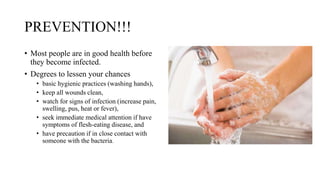
PREVENTION!!!
• Most people are in good health before
they become infected.
• Degrees to lessen your chances
• basic hygienic practices (washing hands),
• keep all wounds clean,
• watch for signs of infection (increase pain,
swelling, pus, heat or fever),
• seek immediate medical attention if have
symptoms of flesh-eating disease, and
• have precaution if in close contact with
someone with the bacteria.
THANK YOU…

Necrotizing fascitis

  • 1.
  • 2.
    • Definition • Riskfactors • Etiology • Pathophysiology • Epidemiology • Clinical Features • Investigations • Management
  • 3.
    • Why itis Dangerous ? • Difficult to diagnose • Extremely toxic • Spread rapidly • May lead to limb amputation
  • 4.
    What is NecrotizingFasciitis? • Life-threatening, progressive, rapidly spreading, inflammatory infection located in the deep fascia. • Infection rapidly destroy the skin and soft tissue beneath it • Also known as: “flesh-eating” bacteria. • Other names: β-hemolytic streptococcal gangrene, Meleney ulcer, acute dermal gangrene, hospital gangrene, and necrotizing cellulitis.
  • 5.
    • 3 typesof NF. • Type I : A polymicrobial flora and common • Type II : Group A β-Streptococcus bacteria (most common case) / monobacterial and fulminant. • Type III : Marine vibrio gram-negative rods and fulminant. • Type IV : Fungal (candida or Mucor and Rhizopus species )
  • 7.
    NSTI: bacterial pathogenesis Type1: polymicrobial • typically arise from a chronic, indolent source • spread along fascial planes • most common ~ 50-75% of NSTIs Type 2: monomicrobial virulent Gm +, aerobic cocci • pathophysiology related to toxin production +/- growth rate • Streptococcus species • CA-MRSA Type 3: monomicrobial virulent Gm + or Gm – bacilli • pathophysiology related to toxin production +/- growth rate • Clostridia species • Bacillus species • Vibrio species • Aeromonas species • Eikenella species Rapidlyprogressive
  • 8.
    How does onecontract NF? • exposed to an individual with an opening in their skin. • direct contact with someone carrying the bacteria • the bacterium being carried by the person itself. • sight of entrance can be as minor as a paper cut or a pin prick. • enter through weakened skin, as a contusion, a bruise, a blister, or even an abrasion. • Can happen to anyone!!!!!!
  • 9.
    Epidemiology • The overallmorbidity & mortality is 70 – 80%. • Fournier’s gangrene (NF of external genitalia) has a reported mortality as high as 75%. • Gender ratio: Male : Female = 3:1 • Age: pediatric cases are rare but reported from countries where poor hygiene in.
  • 10.
    Risk Factors • Immuno-suppressionillnesses e.g.: DM, Cancer, alcoholism, vascular insufficiency, organ transplant, HIV or neutropenia. • Trauma or foreign bodies in surgical wound. • Idiopathic as scrotal or penile necrotizing fasciitis. • Alcoholism • Severe illnesses: heart, lung, or liver disease • Obesity
  • 11.
    What’s going oninside your body? • Bacteria eat away at tissue between skin and muscle • Increase in sensitivity or anesthetic feel to the skin itself • Inflammatory response by immune system • Bacterial toxins released • Cytokines impede function of phagocytic cells • Anaerobes thrive speeding up necrotic process • Endothelial cells become damaged; • Increased permeability of the lining of vessels in the body • Poor blood supply inhibit: • Inflammatory response process • Ability for the immune system to properly work • Ability to transfer antibiotics to the affected fascial layer • Vasoconstriction and thrombosis  edema  hypoxia  necrosis of the fascia, skin, soft tissue, and muscles. • Additional necrosis involving the subcutaneous nerves.
  • 13.
    What are theearly symptoms and signs of NF? • Flu like symptoms that include fever, chills, nausea, weakness, dizziness, aches and a heat rate of more than 100 beats per minute. • Skin becomes tender, warm, red in color, and will start to swell. • Patients may experience pain greater than expected from the appearance of the wound. • Subcutaneous tissue may also have a hard feel on palpation that goes past the visibly infected area. • Clinically indistinguishable from other possible soft tissue infections with only the presentation of pain, tenderness, and warm skin.
  • 14.
    Advanced symptoms… • Theadvanced symptoms appear as the disease progresses • The area of the body experiencing pain begins to swell excessively. • Multiple discolored patches develop to produce a large area of gangrenous skin. • Initial necrosis appears as a massive destruction of the skin and subcutaneous layer. • The normal skin and subcutaneous tissue are loosened. • Large, dark marks that become blisters filled with a yellow-green necrotic fluid appear. • Fournier's gangrene begin with pain and itching of the scrotal skin.
  • 15.
    Critical symptoms… • Thecritical symptoms form in the last stages of NF. • 30% of patient’s develop hemorrhagic bullae which may cause them to become anemic. • Vasculature of the skin becomes inflamed and thrombosed. Resulting in necrotic eschars that look like deep thermal burns. • Without treatment, secondary involvement of deeper muscle layers may occur. • Patients may become numb because of nerve damage and progressing gangrene in the infected area. • Unconsciousness will occur as the body becomes too weak to fight off the infection along with a severe decrease in the patient’s blood pressure. • As toxins are being released, the body’s organ may go into septic shock while contracting a high fever, high white blood count, and becoming disoriented. This may result into respiratory failure, heart failure and renal failure.
  • 17.
    Exams and LaboratoryTesting • In order to get a definitive diagnosis of NF, physicians look for abnormalities in the test results that are characteristics of the disease. • Some of these tests include: 1. Blood samples 2. Testing for elevated or lowered creatinine, glucose, CPK, bicarbonate, albumin, and calcium levels. 3. X-ray gas in the subcutaneous fascia planes.?? D.D. of subcutaneous gas in a radiograph. 4. C.T. scan : demonstrating necrosis with asymmetric fascial thickening & gas in the tissues. 5. MRI scanning 6. And most importantly antibiotic culture and sensitivity tests.
  • 18.
    Surgical diagnosis • Fingertest: A 2-cm long incision under local anesthesia is made in the affected area, lack of fascial resistance, active bleeding and foul smelling fluid will constitute a positive finger test; which will be diagnostic of necrotizing fasciitis. • Biopsy/Frozen section biopsy: Diagnosis of NF early reduces the mortality. But it needs dedication and willingness of a pathologist familiar with the interpretation of NF. Gold standard for detecting and diagnosing necrotizing fasciitis is biopsy either tissues taken during or after the debridement.
  • 19.
    Treating NF • Earlydiagnosis and treatment is vital • Emergency debridement • IV antibiotic treatment • Hyperbaric oxygen therapy is recommended for anaerobic organisms • Morphine drip and a patient-controlled analgesia pump to control pain • Soft tissue reconstruction • Monitor nutrition • If sepsis has set in, vasoconstricting medications should be given. • Education and counseling.
  • 20.
    • Bold earlysurgical debridement, appropriate early antibiotics and brave medical organ supportive intensive care is essential for better outcome of NF patients. • Early and aggressive debridement of all necrotic tissues until the tissue start to bleed is the pillar of NF management and may need more than one debridement; hence repeated wound examination is mandatory, and these patients’ needs on average two or more setting of debridement. • Delayed or incomplete debridement will increase the morbidity and mortality, toxemia, dehydration and biochemical disorders. • In NF surgical debridement of necrotic tissue within 24 hours of presentation to the hospital has significantly better outcome than the delayed debridement done (6% verses 25%) • Repeated aggressive debridement decrease mortality in the NF patients. NF patients wound care has to be taken meticulously. These wounds should be washed and dressed with the occlusive, adsorptive dressing with bandage two to three times in a day. It is recommended to use antibiotic dressing (1% povidone iodine or silver sulfadiazine).
  • 21.
    • Antibiotics therapyshould be started as soon as blood samples were taken for microbiological work-up. Common type of NF is polymicrobial; initial antibiotic regimen should include agents effective against gram positive cocci, gram negative bacilli and anaerobes. • Initial antibiotic therapy will have two antimicrobial agents. One of these should be clindamycin. • Clindamycin has few added advantage in these patients, the efficacy of clindamycin is independent of inoculum size or bacterial growth, it is a potent suppressor of the bacterial toxins, its sub-inhibitory concentration also facilitates phagocytosis, it reduces the synthesis of penicillin binding proteins, have a longer post antibiotic and immuno-modulating effect (as it inhibits the synthesis of tumoor necrosis factor)
  • 22.
    • If streptococciare the identified major pathogens, the D.O.C is Penicillin-G with clindamycin as an alternative. • To ensure adequate treatment, we have to cover aerobic & anaerobic bacteria. • The anaerobic coverage can be provided by Metronidazole or 3rd generation cephalosporin's. • Gentamicin combined with clindamycin or chloramphenicol has been reported as a standard coverage. • Ampicillin may be added to the basic regimen to treat enterococci if suspected by gram stain.
  • 24.
    NSTI: AB therapybased upon presentation Non-rapidly progressive NSTI – • Polymicrobial or less virulent pathogens • Possible MRSA Rapidly progressive NSTI – • highly virulent pathogens due to toxin production • Gram positive • Gram positive cocci – (Type 2) Grp A strep, Ca-MRSA • Gram positive bacilli – (Type 3) clostridia, bacillus • Gram negative (Type 3) • Vibrio species • Aeromonas species • Eikenella species Rapidlyprogressive Dual coverage with antiribosomal agents may improve outcome Gm +: Clindamycin / Linezolid Gm -: Tetracycline class Single or combination broad spectrum AB +/- anti MRSA
  • 25.
    • Intravenous immunoglobulins(IVIG) are useful in patients with NF with toxic shock syndrome. As they neutralizes the super antigens; β hemolytic streptococcal activity on cytokine release and reduces the plasma tumour necrosis factor and interleukin 6 levels. IVIG use in toxic shock syndrome yielded 67% survival when compared to the control group 34% in a study conducted by Kaul et al. • Adequate nutrition support is important for the better outcome of NF patients. Early enteral feeding will have obvious benefits, and in acute phase of NF it is recommended to supplement twice of basic caloric requirement.
  • 26.
    HBOT • Hyperbaric oxygentherapy (HBOT) is a medical treatment which enhances the body’s natural healing process by inhalation of 100% oxygen in a total body chamber where the atmospheric pressure is increased and controlled. • Use of hyperbaric oxygen therapy (HBOT) in NF patients remains a controversial issue. It is advised that HBOT should be given in the post-debridement period. It should be taken care that transfer of NF to a hospital equipped with the HBOT should not delay the emergency debridement surgery. • There are no large, randomized controlled study trails in support of beneficial effects of HBOT in NF patients. HBOT increases the oxygen saturation in the infected tissues by 1000 folds; has a bacteriostatic effect, improves polymorphonuclear function, stops spread of the disease processes and enhances the wound healing. The standard HBOT is 2 to 2.5 atm for 90 to 120 minutes twice daily.
  • 28.
  • 29.
    PREVENTION!!! • Most peopleare in good health before they become infected. • Degrees to lessen your chances • basic hygienic practices (washing hands), • keep all wounds clean, • watch for signs of infection (increase pain, swelling, pus, heat or fever), • seek immediate medical attention if have symptoms of flesh-eating disease, and • have precaution if in close contact with someone with the bacteria.
  • 32.