Necrotizing Fasciitis BY Hosam Mohammad Hamza, Msc GENERAL SURGEON & ENDOSCOPIST MINIA FACULTY OF MEDICINE MINIA- EGYPT
Outline Definition  Causes. Pathophysiology. Clinical features. Diagnosis D.D. Complications. Treatment
Definition   A  progressive  life-threatening soft-tissue infection (with liquifactive necrosis of subcutaneous fat and fascia) ± skin . Cheng NC, Su YM, Kuo YS, Tai HC, Tang YB. Factors affecting the mortality of necrotizing fasciitis involving the upper extremities.  Surg Today . 2008;38(12):1108-13. Early reports date back to the 5th century B.C. , when Hippocrates described a complication of erysipelas. The term “ necrotizing fasciitis” was first used on 1952
Causes Surgery may induce local tissue injury and bacterial invasion (e.g. intraperitoneal or perianal abscesses) Trauma. IM injections.  Local  hypoxia  with systemic illnes s  ( immunosuppression or DM     compromise of the fascial blood supply )  Schwartz’s principles of surgery, 9 th  ed. A  possible relationship between the use of   NSAIDs  ( as ibuprofen )  and development of necrotizing fasciitis during varicella infections  has been shown. Zerr DM, Alexander ER, Duchin JS, et al .  A case - control study of necrotizing fasciitis during primary varicella .   Pediatrics .  Apr 1999;103 ( 4 Pt 1 ): 783-90 .
Idiopathic necrotizing fasciitis No obvious portal of entry. typically involves genetalia ( Fourniere Gangrene ) or lower extremities. caused by single organism (e.g. Strep. pyogenes) May be due to unrecognized breaks in skin or hematogenous spread
  Pathophysiology 1ry site of pathology is  the superficial fascia. Surgery / Trauma     tissue hypoxia    PMNL dysfunction    good  environment  for f acultative aerob es   more ↓  oxidation      proliferat ion of  anaerobic bacteria   angiothrombotic microbial invasion     liquefactive necrosis Microbiology: -  G roup A h a emolytic streptococci . - Staph. Aureus. - O ther s : Bacteroides, Clostridium, and ( Vibrio vulnificus  often in chronic liver D .) - Fungi (Rare and less aggressive forms) SCH A erobic metabolism   C o 2   + H 2 O .  Ana erobic metabol .    H,  N ,  H 2 S.
Type I Polymicrobial  ( aerobic and anaerobi c) C ommon with DM and PVD, after surgical procedures Type II -  Monomicrobial (primarily by GAS, occasionally caused by community-associated MRSA).
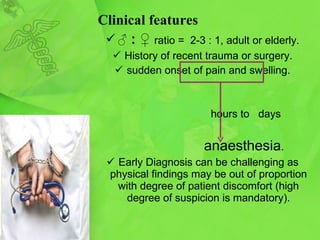
Clinical features ♂   : ♀  ratio =  2-3 : 1, adult or elderly. History of recent trauma or surgery. sudden onset of pain and swelling . hours to  days anaesthesia . Early Diagnosis can be challenging as  p hysical findings may be  out of proportion with  degree of patient discomfort   (high degree of suspicion is mandatory).
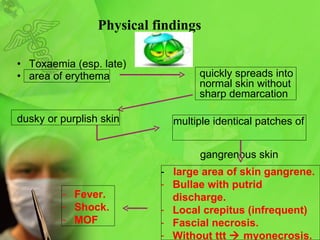
Physical findings Toxaemia (esp. late) area of erythema quickly spreads into normal skin without sharp demarcation dusky or purplish skin m ultiple identical patches  of  gangrenous  skin -  large area of  skin  gangren e. Bullae with putrid discharge. Local crepitus (infrequent) Fascial necrosis . Without ttt    myonecrosis.   Fever. Shock. MOF
Important distinguishing features:  (SABISTON’S TEXTBOOK OF SURGERY) wooden hard  feel of subcutaneous Tissue. while yeilding in cellulitis and erysipelas. If an open wound     probing  allows easy dissection of superficial fascial planes beyound wound margins with little pain.
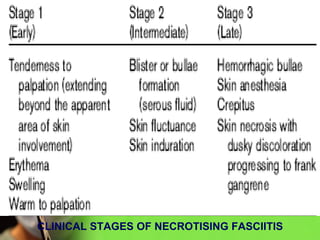
CLINICAL STAGES OF NECROTISING FASCIITIS
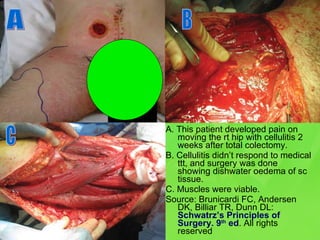
A. This patient developed pain on moving the rt hip with cellulitis 2 weeks after total colectomy. B. Cellulitis didn’t respond to medical ttt, and surgery was done showing dishwater oedema of sc tissue. C. Muscles were viable. Source: Brunicardi FC, Andersen DK, Billiar TR, Dunn DL:  Schwatrz’s Principles of Surgery. 9 th  ed . All rights reserved A B C
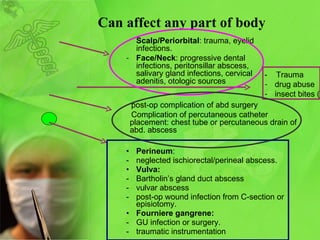
Can affect any part of body Perineum :  neglected ischiorectal/perineal abscess. Vulva: Bartholin’s gland duct abscess vulvar abscess post-op wound infection from C-section or episiotomy. Fourniere gangrene:  GU infection or surgery.  traumatic instrumentation Scalp/Periorbital : trauma, eyelid infections. Face/Neck : progressive dental infections, peritonsillar abscess, salivary gland infections, cervical adenitis, otologic sources -  Trauma drug abuse insect bites (rare). post-op complication of abd surgery Complication of percutaneous catheter placement: chest tube or percutaneous drain of abd. abscess
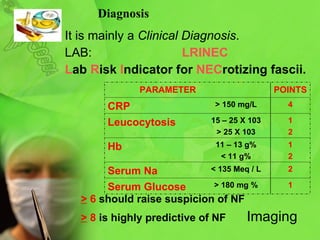
Diagnosis It is mainly a  Clinical Diagnosis . LAB:  LRINEC L ab  R isk  I ndicator for  NEC rotizing fascii. >  6  should raise suspicion of NF >  8  is highly predictive of NF   Imaging  1 > 180 mg % Serum Glucose 2 < 135 Meq / L Serum Na 1 2 11 – 13 g% < 11 g% Hb 1 2 15 – 25 X 103 > 25 X 103 Leucocytosis 4 > 150 mg/L CRP POINTS PARAMETER
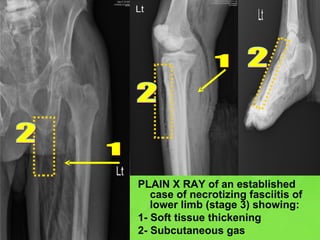
PLAIN X RAY of an established case of necrotizing fasciitis of lower limb (stage 3) showing: 1- Soft tissue thickening 2- Subcutaneous gas 1 1 2 2 2
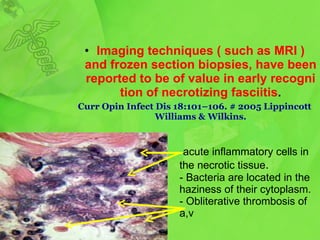
acute inflammatory cells in the necrotic tissue . - Bacteria are located in the haziness of their cytoplasm. - Obliterative thrombosis of a,v Imaging   techniques  (  such as  MRI )  and   frozen section biopsies, have been reported to be of value in   early recognition of necrotizing fasciitis . Curr Opin Infect Dis 18:101–106. # 2005 Lippincott Williams & Wilkins.
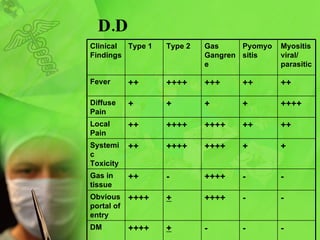
D.D - - - + ++++ DM - - ++++ + ++++ Obvious portal of entry - - ++++ - ++ Gas in tissue + + ++++ ++++ ++ Systemic Toxicity ++ ++ ++++ ++++ ++ Local Pain ++++ + + + + Diffuse Pain ++ ++ +++ ++++ ++ Fever Myositis viral/ parasitic Pyomyositis Gas Gangrene Type 2 Type 1 Clinical Findings
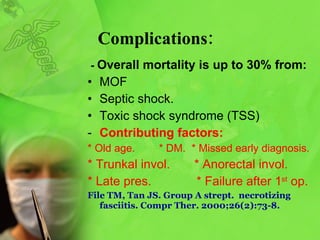
Complications: -  Overall mortality is up to 30% from: MOF  Septic shock.   Toxic shock syndrome (TSS) Contributing factors: * Old age.  * DM.  * Missed early diagnosis. * Trunkal invol.  * Anorectal invol. * Late pres.  * Failure after 1 st  op. File TM, Tan JS .  Group A strept.  necrotizing fasciitis .   Compr Ther.  2000;26 ( 2 ): 73-8.
Treatment D elay in diagnosis and treatment of   necrotizing fasciitis increase s  mortality   McHenry CR, Piotrowski JJ, Petrinic D,   Malangoni MA. Determinants of   mortality in necrotizing soft tissue infections. Ann Surg 1995; 221:558–563. Aggressive ttt is needed even for suspected cases to reduce mortality .
ABC. A ntibiotics   as soon as possible  ( aerobic and anaerobic bacteria ) Surgery: Aggressive  resuscitation followed by aggressive  debridement of all necrotic tissue . may need to be repeated  ( careful daily postop inspection ).  fasciotomies in extremities . Amputation for myonecrosis in limbs Postop use of unprocessed honey Stimulates epithelialization. Debrides Deodourizes  wound Dehydrates Akram Rajiput, Waseem Abul Samad, Mortality in necrotizing fasciitis. J Ayub Med Coll Abbottabad 2008; 20(2)
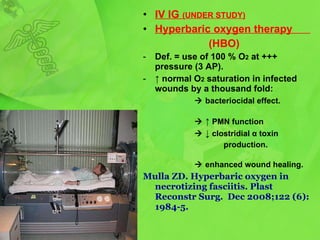
IV IG  (UNDER STUDY) Hyperbaric oxygen therapy  ( HBO ) Def. = use of 100 % O 2  at +++ pressure (3 AP). ↑   normal O 2  saturation in infected wounds by a thousand fold:     bacteriocidal effect.     ↑   PMN function    ↓   clostridial  α  toxin  production.      enhanced wound healing . Mulla ZD. Hyperbaric oxygen in necrotizing fasciitis.  Plast Reconstr Surg .    Dec 2008;122   (6):1984-5.
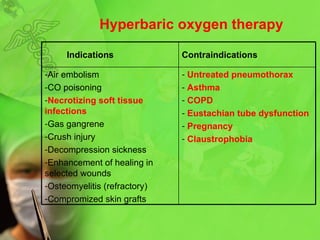
Hyperbaric oxygen therapy  Untreated pneumothorax Asthma COPD Eustachian tube dysfunction Pregnancy Claustrophobia Air embolism  CO poisoning Necrotizing soft tissue infections  Gas gangrene  Crush injury Decompression sickness  Enhancement of healing in selected wounds  Osteomyelitis (refractory)  Compromized skin grafts  Contraindications   Indications
HBO cannot replace surgery .  The best outcome is obtained using a combined approach of antibiotics, surgery, and HBO, when readily available .
 

Necrotizing Fasciitis

  • 1.
    Necrotizing Fasciitis BYHosam Mohammad Hamza, Msc GENERAL SURGEON & ENDOSCOPIST MINIA FACULTY OF MEDICINE MINIA- EGYPT
  • 2.
    Outline Definition Causes. Pathophysiology. Clinical features. Diagnosis D.D. Complications. Treatment
  • 3.
    Definition A progressive life-threatening soft-tissue infection (with liquifactive necrosis of subcutaneous fat and fascia) ± skin . Cheng NC, Su YM, Kuo YS, Tai HC, Tang YB. Factors affecting the mortality of necrotizing fasciitis involving the upper extremities.  Surg Today . 2008;38(12):1108-13. Early reports date back to the 5th century B.C. , when Hippocrates described a complication of erysipelas. The term “ necrotizing fasciitis” was first used on 1952
  • 4.
    Causes Surgery mayinduce local tissue injury and bacterial invasion (e.g. intraperitoneal or perianal abscesses) Trauma. IM injections. Local hypoxia with systemic illnes s ( immunosuppression or DM  compromise of the fascial blood supply ) Schwartz’s principles of surgery, 9 th ed. A possible relationship between the use of NSAIDs ( as ibuprofen ) and development of necrotizing fasciitis during varicella infections has been shown. Zerr DM, Alexander ER, Duchin JS, et al .  A case - control study of necrotizing fasciitis during primary varicella .   Pediatrics .  Apr 1999;103 ( 4 Pt 1 ): 783-90 .
  • 5.
    Idiopathic necrotizing fasciitisNo obvious portal of entry. typically involves genetalia ( Fourniere Gangrene ) or lower extremities. caused by single organism (e.g. Strep. pyogenes) May be due to unrecognized breaks in skin or hematogenous spread
  • 6.
    Pathophysiology1ry site of pathology is the superficial fascia. Surgery / Trauma  tissue hypoxia  PMNL dysfunction  good environment for f acultative aerob es  more ↓ oxidation  proliferat ion of anaerobic bacteria  angiothrombotic microbial invasion  liquefactive necrosis Microbiology: - G roup A h a emolytic streptococci . - Staph. Aureus. - O ther s : Bacteroides, Clostridium, and ( Vibrio vulnificus often in chronic liver D .) - Fungi (Rare and less aggressive forms) SCH A erobic metabolism  C o 2 + H 2 O . Ana erobic metabol .  H, N , H 2 S.
  • 7.
    Type I Polymicrobial ( aerobic and anaerobi c) C ommon with DM and PVD, after surgical procedures Type II - Monomicrobial (primarily by GAS, occasionally caused by community-associated MRSA).
  • 8.
    Clinical features ♂ : ♀ ratio = 2-3 : 1, adult or elderly. History of recent trauma or surgery. sudden onset of pain and swelling . hours to days anaesthesia . Early Diagnosis can be challenging as p hysical findings may be out of proportion with degree of patient discomfort (high degree of suspicion is mandatory).
  • 9.
    Physical findings Toxaemia(esp. late) area of erythema quickly spreads into normal skin without sharp demarcation dusky or purplish skin m ultiple identical patches of gangrenous skin - large area of skin gangren e. Bullae with putrid discharge. Local crepitus (infrequent) Fascial necrosis . Without ttt  myonecrosis. Fever. Shock. MOF
  • 10.
    Important distinguishing features: (SABISTON’S TEXTBOOK OF SURGERY) wooden hard feel of subcutaneous Tissue. while yeilding in cellulitis and erysipelas. If an open wound  probing allows easy dissection of superficial fascial planes beyound wound margins with little pain.
  • 11.
    CLINICAL STAGES OFNECROTISING FASCIITIS
  • 12.
    A. This patientdeveloped pain on moving the rt hip with cellulitis 2 weeks after total colectomy. B. Cellulitis didn’t respond to medical ttt, and surgery was done showing dishwater oedema of sc tissue. C. Muscles were viable. Source: Brunicardi FC, Andersen DK, Billiar TR, Dunn DL: Schwatrz’s Principles of Surgery. 9 th ed . All rights reserved A B C
  • 13.
    Can affect anypart of body Perineum : neglected ischiorectal/perineal abscess. Vulva: Bartholin’s gland duct abscess vulvar abscess post-op wound infection from C-section or episiotomy. Fourniere gangrene: GU infection or surgery. traumatic instrumentation Scalp/Periorbital : trauma, eyelid infections. Face/Neck : progressive dental infections, peritonsillar abscess, salivary gland infections, cervical adenitis, otologic sources - Trauma drug abuse insect bites (rare). post-op complication of abd surgery Complication of percutaneous catheter placement: chest tube or percutaneous drain of abd. abscess
  • 14.
    Diagnosis It ismainly a Clinical Diagnosis . LAB: LRINEC L ab R isk I ndicator for NEC rotizing fascii. > 6 should raise suspicion of NF > 8 is highly predictive of NF Imaging 1 > 180 mg % Serum Glucose 2 < 135 Meq / L Serum Na 1 2 11 – 13 g% < 11 g% Hb 1 2 15 – 25 X 103 > 25 X 103 Leucocytosis 4 > 150 mg/L CRP POINTS PARAMETER
  • 15.
    PLAIN X RAYof an established case of necrotizing fasciitis of lower limb (stage 3) showing: 1- Soft tissue thickening 2- Subcutaneous gas 1 1 2 2 2
  • 16.
    acute inflammatory cellsin the necrotic tissue . - Bacteria are located in the haziness of their cytoplasm. - Obliterative thrombosis of a,v Imaging techniques ( such as MRI ) and frozen section biopsies, have been reported to be of value in early recognition of necrotizing fasciitis . Curr Opin Infect Dis 18:101–106. # 2005 Lippincott Williams & Wilkins.
  • 17.
    D.D - -- + ++++ DM - - ++++ + ++++ Obvious portal of entry - - ++++ - ++ Gas in tissue + + ++++ ++++ ++ Systemic Toxicity ++ ++ ++++ ++++ ++ Local Pain ++++ + + + + Diffuse Pain ++ ++ +++ ++++ ++ Fever Myositis viral/ parasitic Pyomyositis Gas Gangrene Type 2 Type 1 Clinical Findings
  • 18.
    Complications: - Overall mortality is up to 30% from: MOF Septic shock. Toxic shock syndrome (TSS) Contributing factors: * Old age. * DM. * Missed early diagnosis. * Trunkal invol. * Anorectal invol. * Late pres. * Failure after 1 st op. File TM, Tan JS .  Group A strept. necrotizing fasciitis .   Compr Ther.  2000;26 ( 2 ): 73-8.
  • 19.
    Treatment D elayin diagnosis and treatment of necrotizing fasciitis increase s mortality McHenry CR, Piotrowski JJ, Petrinic D, Malangoni MA. Determinants of mortality in necrotizing soft tissue infections. Ann Surg 1995; 221:558–563. Aggressive ttt is needed even for suspected cases to reduce mortality .
  • 20.
    ABC. A ntibiotics as soon as possible ( aerobic and anaerobic bacteria ) Surgery: Aggressive resuscitation followed by aggressive debridement of all necrotic tissue . may need to be repeated ( careful daily postop inspection ). fasciotomies in extremities . Amputation for myonecrosis in limbs Postop use of unprocessed honey Stimulates epithelialization. Debrides Deodourizes wound Dehydrates Akram Rajiput, Waseem Abul Samad, Mortality in necrotizing fasciitis. J Ayub Med Coll Abbottabad 2008; 20(2)
  • 21.
    IV IG (UNDER STUDY) Hyperbaric oxygen therapy ( HBO ) Def. = use of 100 % O 2 at +++ pressure (3 AP). ↑ normal O 2 saturation in infected wounds by a thousand fold:  bacteriocidal effect.  ↑ PMN function  ↓ clostridial α toxin production.  enhanced wound healing . Mulla ZD. Hyperbaric oxygen in necrotizing fasciitis.  Plast Reconstr Surg .  Dec 2008;122 (6):1984-5.
  • 22.
    Hyperbaric oxygen therapy Untreated pneumothorax Asthma COPD Eustachian tube dysfunction Pregnancy Claustrophobia Air embolism CO poisoning Necrotizing soft tissue infections Gas gangrene Crush injury Decompression sickness Enhancement of healing in selected wounds Osteomyelitis (refractory) Compromized skin grafts Contraindications Indications
  • 23.
    HBO cannot replacesurgery . The best outcome is obtained using a combined approach of antibiotics, surgery, and HBO, when readily available .
  • 24.